Category: Blog

  • Is Your Will Up to Date for the New Year? How to Change Your Will in VA

    Is Your Will Up to Date for the New Year? How to Change Your Will in VA

    As one year ends and a new one begins, it’s natural to think about fresh starts and future goals. Many people make New Year’s resolutions to exercise more, spend less, or finally tackle that cluttered garage. But have you ever thought about whether your will reflects your current wishes and circumstances?

    Life changes quickly—marriages, divorces, new additions to the family, or shifts in your financial situation can all leave your current will out of sync with your intentions. An outdated will can create unnecessary confusion and stress for your loved ones. That’s why the start of a new year is the perfect time to review your will and make any changes to align with your current wishes.

    In this blog, an estate planning attorney from PJI Law, PLC explains when to change your will, how to change your will, and common mistakes to avoid. 

    When Should You Change Your Will?  

    Major life changes often signal the need to update your last will and testament (“will”). Keeping your will current ensures that your estate is distributed according to your wishes and can prevent potential disputes among your heirs. Common triggers for updating your will include:

    • Marriage, Divorce, or Remarriage: Entering into or ending a marriage significantly alters your personal and financial circumstances. After getting married, you may want to include your spouse as a beneficiary or appoint them as an executor. In the event of a divorce or remarriage, it’s important to revise your will to reflect these changes, which might involve removing a former spouse or adding new family members such as stepchildren.
    • Birth or Adoption of Children or Grandchildren: Welcoming a new child or grandchild into your family is a joyful event that also necessitates updating your will. Adding them as beneficiaries ensures they are provided for in your estate plan. You may also wish to appoint a guardian for minor children to care for them if something happens to you.
    • Death of Beneficiaries or Executors: If someone named in your will—whether a beneficiary, executor, or guardian—passes away, you’ll need to update your will accordingly. This ensures your assets are distributed as you intend and that capable individuals are in place to manage your estate.
    • Significant Financial Changes: Major shifts in your financial situation, such as acquiring or selling substantial assets, receiving an inheritance, or starting a new business, can affect how you want your estate distributed. Updating your will allows you to account for these changes and manage any potential tax implications.
    • Changes in Relationships: Relationships evolve over time. If you’ve become estranged from or reconciled with someone named in your will, you may want to adjust your estate plan to reflect your current feelings and intentions.
    • Relocation to a New State: Moving to a different state can impact your estate plan because estate laws vary by state. If you’ve relocated to Virginia from elsewhere, it’s important to review your will to ensure it complies with Virginia’s legal requirements and addresses any state-specific considerations.
    • Desire to Add or Change Charitable Contributions: If you wish to add, remove, or modify charitable donations in your will, updating your estate plan ensures your philanthropic goals are accurately reflected.

    Even if no major changes occur, reviewing your will every three to five years helps confirm it aligns with your current circumstances and wishes. Regular updates provide peace of mind that your estate plan accurately reflects your intentions and can prevent unintended consequences down the road.

    Options for Changing Your Will

    Codicil

    A codicil functions as an amendment to your existing will. This legal document must meet the same requirements as the original will, including witness signatures. Codicils work well for minor changes, such as updating an executor or adding a beneficiary. However, if you need to make multiple changes, drafting a new will is often more efficient.

    Create a New Will

    For substantial changes, writing a new will often proves more effective than using multiple codicils. Your new will should explicitly state that it revokes all previous wills and codicils to prevent any confusion or conflicts. The new document needs to meet all Virginia legal requirements and should comprehensively address your current circumstances.

    Steps to Create a New Will

    The process begins with a thorough inventory of your assets and property. This includes both tangible and intangible assets, such as real estate, vehicles, bank accounts, investments, and digital assets.

    • Determine Beneficiaries: Decide who should receive your assets and in what proportions. Include alternate beneficiaries in case your primary choices are unable to inherit.
    • Choose an Executor: Select someone trustworthy and capable of handling estate administration. Consider naming a backup executor as well.
    • Draft the Will: Work with an attorney to ensure the will complies with Virginia law. This includes having two witnesses present for the signing.
    • Store the Will Safely: Place the will in a secure location, such as a fireproof safe or safety deposit box, and inform your executor where to find it.

    Common Mistakes to Avoid

    • Failing to Revoke Old Wills: Without a clear revocation clause, old wills may cause confusion.
    • Not Updating Beneficiary Designations: Ensure life insurance policies and retirement accounts align with your will. These designations typically override your will’s provisions.
    • Ignoring Digital Assets: Include instructions for managing cryptocurrency, online accounts, and digital photos.
    • Overlooking Tax Implications: While Virginia doesn’t impose an estate tax, federal taxes may apply to larger estates.

    Should You DIY or Consult with an Attorney?  

    Creating or updating a will might seem like a task you can handle on your own with a DIY template or online service. However, even small errors—such as improper witnessing or vague language—can lead to significant issues that delay estate administration or invite disputes.

    Working with an estate planning attorney offers a personalized approach that makes your will legally sound and tailored to your situation. Whether your estate is straightforward or complex, professional guidance can help you make informed decisions and avoid pitfalls. While it may involve an initial investment, consulting with an attorney helps protect your wishes and safeguard your loved ones.

    Is It Time to Change or Create a New Will?  

    As life changes, your will should keep pace. Whether you need to make updates to reflect recent events or start fresh with a new will, PJI Law can help you determine the best path forward. Our estate planning attorneys will review your current will and overall estate plan, providing personalized guidance to make certain that your wishes are clearly documented and legally enforceable.  

    Updating or creating a will is about more than just following Virginia law—it’s about protecting your loved ones and making thoughtful decisions for the future. If you’ve been searching online for “last will and testament attorneys” or “attorney for wills near me,” contact PJI Law instead. Call us at (703) 865-6100 or use our confidential online form to schedule your consultation. Together, we’ll create an estate plan that gives you peace of mind for the new year and beyond. 

    At PJI Law, you’ll receive personalized service and attention!

    Copyright © 2024. PJI Law, PLC. All rights reserved.

    The information in this blog post (“post”) is provided for general informational purposes only and may not reflect the current law in your jurisdiction. No information in this post should be construed as legal advice from the individual author or the law firm, nor is it intended to be a substitute for legal counsel on any subject matter. No reader of this post should act or refrain from acting based on any information included in or accessible through this post without seeking the appropriate legal or other professional advice on the particular facts and circumstances at issue from a lawyer licensed in the recipient’s state, country, or other appropriate licensing jurisdiction.

    PJI Law, PLC
    3900 Jermantown Rd, 2nd Floor
    Fairfax, Virginia 22030
    (703) 865-6100
    https://pjibe.webteam.ai/

  • What Is a SOW (Statement of Work) in Virginia?

    What Is a SOW (Statement of Work) in Virginia?

    What is a SOW? A Statement of Work (SOW) is a foundational document used to define the terms, responsibilities, and deliverables of a specific project. In Virginia, SOWs are critical for ensuring alignment between parties, mitigating risks, and maintaining compliance with legal and contractual obligations. Whether you’re working on a government project, managing a private sector initiative, or negotiating supplier contracts, an effective SOW provides the framework for a successful collaboration.

    In this blog, a legal contract lawyer from PJI Law, PLC explains what a SOW is, key considerations before drafting one, essential components, and practical drafting tips to help you avoid common pitfalls.

    What is a SOW and why is it important

    What is a Statement of Work?

    A SOW is a detailed agreement that outlines the specifics of a project or task, such as the scope of work, deliverables, timelines, and payment terms. Typically, it complements a master agreement, which governs the broader legal relationship between parties. SOWs may cover projects that are defined:

    • At the inception of the master agreement, or
    • During the agreement’s term, as new projects arise.

    Why SOWs Are Important

    SOWs eliminate uncertainty by providing clarity on:

    • Total work effort required: Prevents misunderstandings about the scale of the project.
    • Impact of changes: Clearly defines how alterations to scope affect timelines, costs, and deliverables.
    • Avoiding disputes: Reduces the risk of disagreements that could lead to financial losses or litigation.

    Issues to Consider Before Drafting a SOW

    Drafting a SOW requires forethought and planning to avoid unintended consequences. Below are key factors to address:

    Choosing the Right SOW Format

    The SOW format should align with the type of contract:

    • Fixed-Price Contracts: Require highly detailed SOWs to ensure all tasks and costs are accounted for.
    • Time-and-Materials Contracts: Allow for more flexibility and may require less precision.
    • Cost Reimbursement Contracts: Focus on project parameters rather than technical details.

    Avoiding Pre-Execution Pitfalls

    Avoiding Pre-Execution Pitfalls

    Before finalizing a SOW, take these steps to protect your interests:

    • Verify Authority: Confirm that the other party’s representatives have the authority to negotiate.
    • Use Non-Disclosure Agreements: Secure Non-Disclosure Agreements if sensitive information is shared during negotiations.
    • Avoid Verbal Commitments: Ensure that all agreements are documented in writing and marked as “non-binding” until the final SOW is signed.

    Defining Contracting Parties

    Clearly identify the parties involved in the project:

    • Specify which entity (buyer or supplier) is responsible for key deliverables.
    • Include any third parties, such as subcontractors, in the agreement, or ensure they are covered under a participation or delegation agreement.

    Key Components of a SOW in Virginia

    To draft an effective SOW, you need to include several critical components. These elements serve as the foundation for your contract and project success.

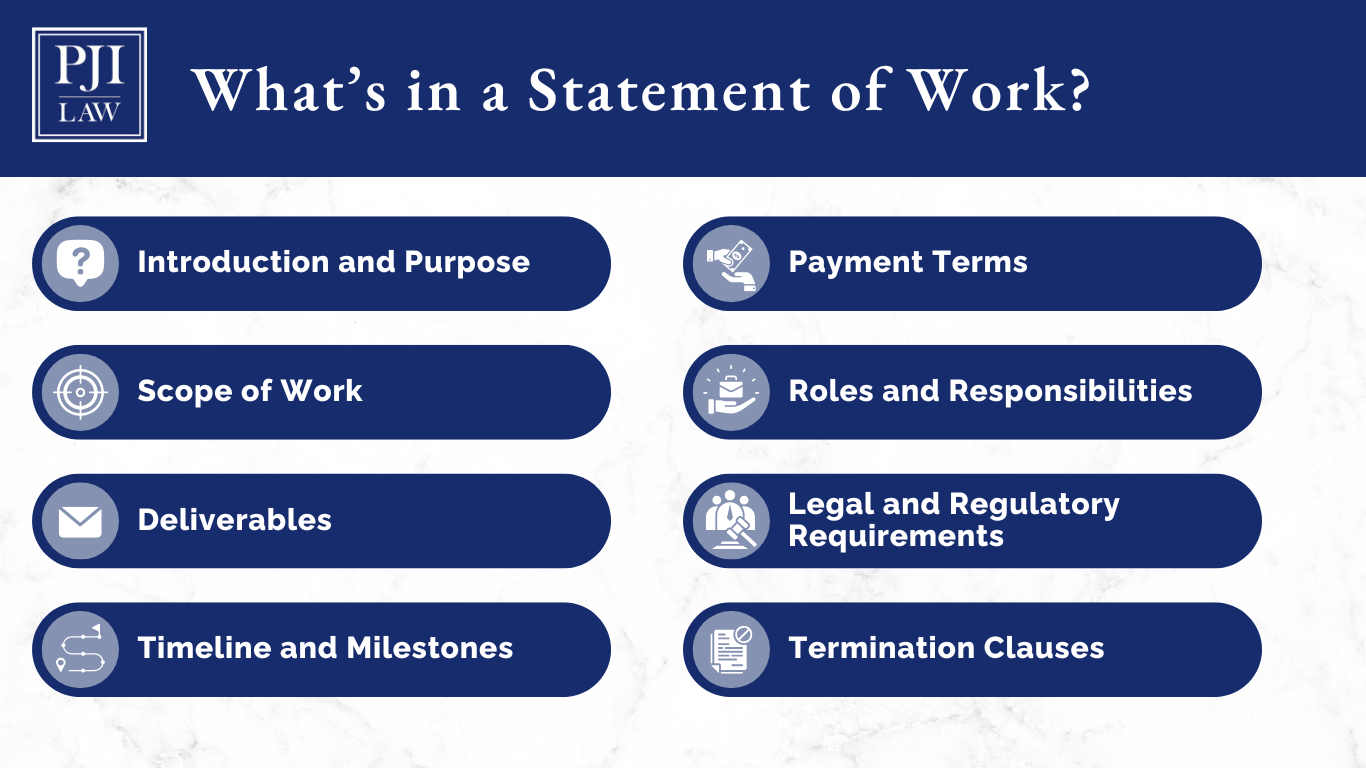
    1. Introduction and Purpose

    The Introduction and Purpose section defines the project’s intent and goals, ensuring all parties are aligned from the start. It answers two key questions:

    • What is the project intended to achieve?
    • Why is it necessary?

    Example:

    For a SOW providing IT services to a Virginia municipality:

    • Objective: “Upgrade the municipality’s cybersecurity systems to protect sensitive data and comply with state mandates.”
    • Rationale: “This project addresses increasing cybersecurity threats and supports compliance with Virginia’s public sector requirements.”

    A concise purpose statement establishes the project’s relevance and lays the foundation for the rest of the SOW.

    2. Scope of Work

    The Scope of Work section establishes the boundaries of the project. It clarifies what tasks and services are included—and equally important, what is excluded. A well-defined scope prevents misunderstandings and reduces the risk of “scope creep,” where additional work is added without renegotiating the agreement.

    Key Details to Include:

    • Tasks to Be Completed: List specific activities the supplier or contractor will perform.
      Example: “Perform a full cybersecurity audit, install firewall systems, and provide staff training.”
    • Services to Be Provided: Outline the deliverables or services the project entails.
      Example: “Continuous network monitoring during the contract period.”
    • Exclusions (if applicable): Specify what is not part of the agreement to avoid disputes later.
      Example: “This project does not include the procurement of hardware or software licenses.”

    A precise Scope of Work sets clear expectations for all parties and ensures that the project stays within agreed-upon parameters.

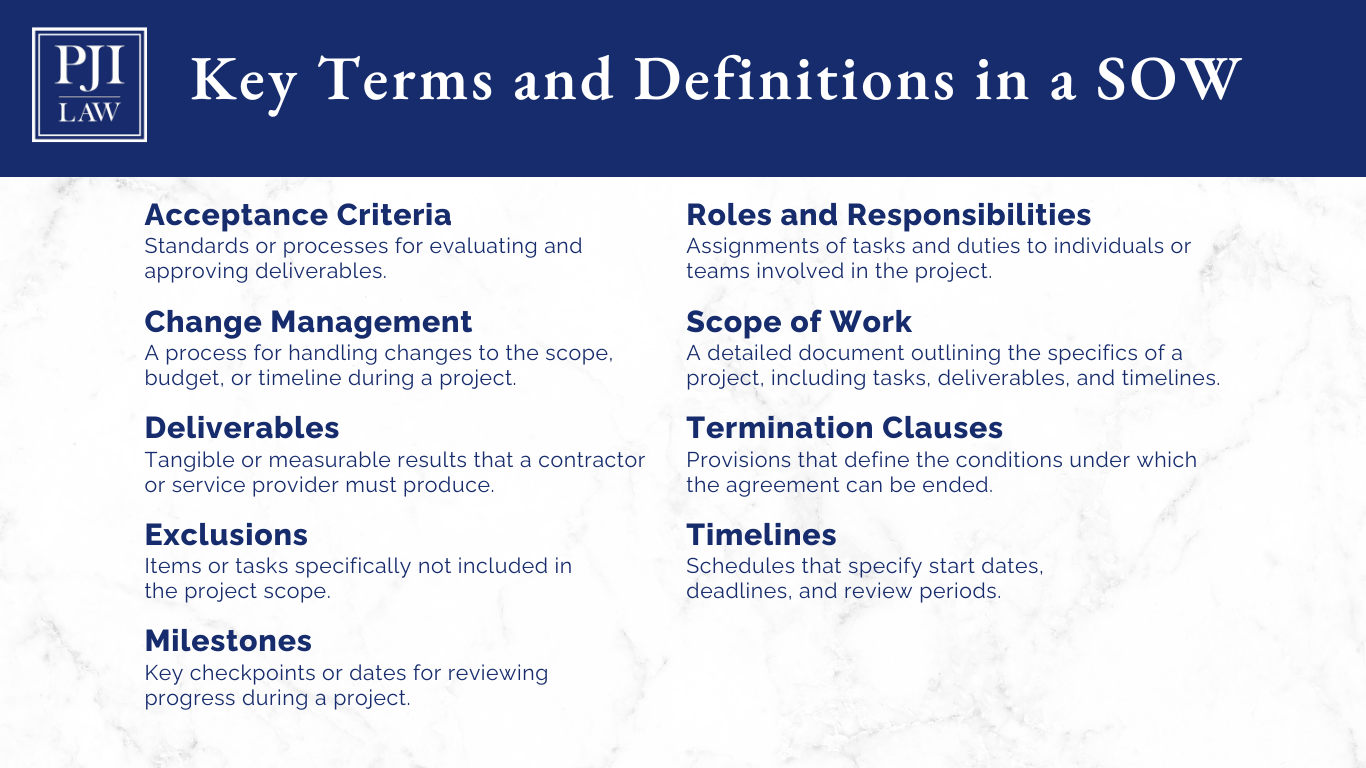
    Key Terms and Definitions in a SOW

    3. Deliverables

    Deliverables

    Deliverables are the tangible or measurable outcomes that the contractor or service provider is required to produce. These define the end results of the project, ensuring both parties understand what constitutes success.

    Key Elements to Include:

    • Description of Each Deliverable: Clearly outline what will be produced.
      Example: “Completed architectural drawings that meet zoning requirements.”
    • Deadlines: Specify the due dates for each deliverable.
      Example: “Final site survey to be submitted by March 1, 2026.”
    • Acceptance Criteria: Define the standards or processes for evaluating each deliverable.
      Example: “Drawings must receive approval from the Virginia State Planning Commission.”

    By clearly specifying deliverables, along with deadlines and acceptance criteria, you eliminate ambiguity and create a framework for accountability.

    4. Timelines and Milestones

    Timelines establish when tasks and deliverables should be completed. For larger projects, breaking the timeline into milestones can make progress easier to track. A milestone might include phases such as “Design Approval” or “Initial Testing,” with specific deadlines attached.

    Virginia businesses often use this section to highlight key deadlines tied to state or local regulations, particularly for government projects.

    5. Payment Terms

    The payment section outlines how and when payments will be made. Include:

    • Payment schedules
    • Milestone-based payments (if applicable)
    • Penalties for late payments or missed deadlines

    For projects in Virginia, this section should comply with any state-specific payment regulations, such as those outlined in the Virginia Prompt Payment Act.

    Seeking a legal contract lawyer for SOW

    6. Roles and Responsibilities

    Roles and Responsibilities

    The Roles and Responsibilities section establishes accountability by defining who is responsible for specific aspects of the project. Clear assignments ensure smooth collaboration and prevent confusion during execution.

    Key Elements to Include:

    • Primary Points of Contact: Identify the main contacts for each party, responsible for communication and decision-making.
      Example: “The project manager for [Company Name] will serve as the primary contact for progress updates and approvals.”
    • Responsibilities: Outline the duties assigned to each team or individual.
      Example:Client Responsibilities: Provide timely feedback on deliverables and grant necessary site access.
      Contractor Responsibilities: Submit progress reports, complete tasks on schedule, and adhere to project specifications.
    • Escalation Processes: Detail steps for resolving disputes or delays.
      Example: “In case of unresolved issues, disputes will be escalated to senior management within five business days.”

    Clearly defined roles and responsibilities foster efficient collaboration, minimize misunderstandings, and provide a clear path for addressing challenges.

    7. Legal and Regulatory Requirements

    Virginia has distinct legal and regulatory requirements that must be addressed in any project, especially for government or public-sector work. Including these ensures that the project complies with state laws and avoids potential penalties or disputes.

    Key Considerations:

      • Compliance with the Virginia Public Procurement Act: Required for contracts involving public funds, this act sets standards for procurement fairness and accountability.
        Example: “All procurement activities must adhere to the Virginia Public Procurement Act (Va. Code § 2.2-4300 et seq.).”
      • Licensing Requirements for Contractors: Verify and document that all contractors hold the appropriate licenses for the work being performed.
        Example: “General contractors must maintain an active Class A license as required by the Virginia Department of Professional and Occupational Regulation (DPOR).”
      • Environmental or Safety Standards: Ensure compliance with state-specific regulations, such as:
        • Virginia Building Code: Relevant for construction projects.
        • OSHA Standards: Critical for ensuring workplace safety.

    By referencing applicable state laws and regulations, this section protects both parties and ensures a legally sound project framework.

    8. Termination Clauses

    Termination Clauses

    While the goal of any project is successful completion, termination clauses provide a safety net by defining the conditions under which the agreement can be ended. Including these clauses ensures that all parties understand their rights and obligations in the event of unforeseen issues.

    Common Grounds for Termination:

    • Failure to Meet Deliverables: If critical milestones or deliverables are not met within the agreed timeline.
      Example: “The agreement may be terminated if the contractor fails to deliver the approved designs within 60 days of the agreed deadline.”
    • Breach of Contract Terms: When one party fails to fulfill essential obligations outlined in the SOW.
      Example: “A material breach of any term of this agreement allows the non-breaching party to terminate the contract after providing written notice.”
    • Mutual Agreement to Discontinue: If both parties decide to end the project due to changing circumstances or priorities.
      Example: “Termination by mutual consent must be documented in writing and signed by both parties.”

    By outlining clear conditions for termination, this section protects both parties from prolonged disputes and provides a structured exit strategy if the project cannot proceed as planned.

    What's in a Statement of Work

    Best Practices for Drafting a SOW in Virginia

    Creating an effective SOW requires more than just filling out a form. Following best practices ensures that your document is clear, comprehensive, and legally sound, reducing the risk of disputes and delays.

    Be Specific

    Avoid ambiguous terms like “reasonable” or “as needed,” which can lead to differing interpretations. Instead, use precise and measurable language.

    Example: Replace “complete the project quickly” with “deliver the final report within 10 business days.”

    Use Plain Language

    Clear, concise language helps all parties understand their obligations without needing a legal background.

    Example: Instead of writing, “The supplier shall endeavor to perform to the best of its abilities,” use “The supplier will complete the installation as outlined in Section 3.”

    Consult State Laws

    Virginia has unique legal requirements, especially for public contracts. For instance:

    • Virginia Public Procurement Act: Establishes rules for procurement processes in government projects.
    • Virginia Building Code: Applicable for construction-related SOWs.

    Consult a contract lawyer or reference specific statutes when drafting SOWs that may be subject to state laws.

    Involve Stakeholders Early

    Engage all key stakeholders, including contractors, clients, and legal teams, during the drafting process. Early input ensures the SOW reflects the needs and expectations of all parties.

    Review and Revise

    A SOW should not be finalized without a thorough review. Check for consistency, completeness, and alignment with the master agreement. Ensure all stakeholders sign off on the SOW after revisions to confirm mutual understanding.

    Plan for Changes

    Include provisions for managing changes to scope, budget, or timelines. This avoids disputes when adjustments are necessary.

    Example: Add a “Change Management” section detailing how additional tasks or modifications will be approved.

    By adhering to these best practices, you can create a well-structured SOW that fosters collaboration and ensures project success, whether you’re working on private contracts or public-sector initiatives in Virginia.

    Common Mistakes and How to Avoid Them

    Common Mistakes and How To Avoid Them

    Even with careful preparation, some common mistakes can undermine the effectiveness of a SOW. Here’s what to watch out for and how to avoid these pitfalls:

    Overlooking Local Regulations

    Virginia’s legal framework includes specific requirements for contracts, particularly in government or public-sector projects. Neglecting these can render a SOW unenforceable or non-compliant. To avoid this, reference applicable laws, such as the Virginia Public Procurement Act, and consult an attorney if the project involves complex regulatory obligations.

    Failing to Define Scope Clearly

    Unclear scope descriptions can lead to disagreements about what the project includes or excludes. For example, vague language like “perform required maintenance” can create confusion. Instead, be specific by detailing the tasks, deliverables, and exclusions in a way that all parties can easily understand.

    Not Specifying Acceptance Criteria

    Without clear acceptance criteria, disagreements can arise about whether deliverables meet the agreed-upon standards. For instance, phrases like “provide a quality report” leave room for interpretation. Clearly define what “quality” means by specifying measurable criteria, such as format, content, and deadlines.

    Ignoring Termination Provisions

    A SOW without termination clauses leaves you without a clear exit strategy if the project encounters significant issues. Include conditions for termination, such as failure to meet deadlines or breach of contract, and specify notice periods to ensure all parties know the process for ending the agreement if necessary.

    Using Vague Language

    Vague terms like “as needed” or “reasonable efforts” often lead to differing expectations between parties. Use specific, actionable language instead, such as “complete Task Y within 10 business days of receiving approval for Task X,” to minimize misunderstandings.

    By addressing these common issues, you can draft a SOW that is clear, enforceable, and designed to support the success of your project.

    In closing, a Statement of Work is a vital document that sets the stage for project success. Whether you’re a contractor, business owner, or government agency in Virginia, a well-crafted SOW helps define expectations, allocate responsibilities, and minimize the risk of disputes. By tailoring your SOW to meet Virginia’s legal and regulatory requirements, you create a solid foundation for achieving your project goals.


    Seeking contract attorneys to protect your interests with a properly drafted SOW

    Protect Your Interests with a Professionally Drafted SOW

    A well-prepared Statement of Work is key to defining expectations, avoiding disputes, and protecting your interests. At PJI Law, our contract attorneys help clients create and review SOWs that are clear, thorough, and tailored to their needs, balancing strong protections with language that fosters collaborative business relationships.

    Whether you need to draft a SOW from the ground up or refine one prepared by another party, we’ll focus on addressing the specifics—like scope, deliverables, and legal requirements—so your project starts on the right path.

    Take the next step in protecting your rights and strengthening your business agreements. Contact PJI Law at (703) 865-6100 or fill out our confidential online form to schedule a consultation. Let us help you create a strong foundation for success.

    At PJI Law, you’ll receive white glove service and personalized attention!

    Copyright © 2024. PJI Law, PLC. All rights reserved.

    The information in this blog post (“post”) is provided for general informational purposes only and may not reflect the current law in your jurisdiction. No information in this post should be construed as legal advice from the individual author or the law firm, nor is it intended to be a substitute for legal counsel on any subject matter. No reader of this post should act or refrain from acting based on any information included in or accessible through this post without seeking the appropriate legal or other professional advice on the particular facts and circumstances at issue from a lawyer licensed in the recipient’s state, country, or other appropriate licensing jurisdiction.

    PJI Law, PLC
    3900 Jermantown Rd, 2nd Floor
    Fairfax, Virginia 22030
    (703) 865-6100
    https://pjibe.webteam.ai/

  • An Estate Planning Checklist for the New Year from Richmond Estate Planning Lawyers

    An Estate Planning Checklist for the New Year from Richmond Estate Planning Lawyers

    As we welcome the New Year, it’s a time for fresh beginnings and important resolutions. One resolution that should top your list is starting your Virginia estate planning, or updating your existing estate plan.

    Why is estate planning critical in Richmond, VA?

    As our estate planning lawyers know, it gives you control of your affairs while you’re alive and after you pass away. While no one likes to think about the possibility of becoming incapacitated or the inevitability of death, with a comprehensive estate plan, you can rest assured knowing your family members or other trusted individuals will uphold your choices for medical care and the management of your estate.

    Additionally, establishing an estate plan enables you to minimize estate and gift taxes, avoid inheritance disputes, and prevent loved ones from having to undergo the public probate process.

    Regardless of the size of your estate, at PJI Law in Richmond, VA, we create estate plans customized to the needs and desires of each client. Our estate planning attorneys recognize that securing the future of your family and protecting your legacy are paramount. We understand the nuances of Richmond estate planning and remain committed to helping you achieve peace of mind.

    Read our estate planning checklist below, then contact us at (804) 653-3450 for personalized service and attention.

    Is-your-estate-planning-checklist-complete_

    State-Planning-Check-List

    List Your Assets and Liabilities

    Whether you have an existing estate plan or are embarking on the process for the first time, begin by taking an inventory of your assets — physical, financial, or digital — and your liabilities to gain a full understanding of everything that comprises your estate. Assets may include:

    • Real property
    • Cars
    • Jewelry
    • Collectables
    • Personal items
    • Savings accounts
    • Life insurance
    • Retirement accounts
    • Businesses
    • Bonds
    • Stocks

    Liabilities may include:

    • Credit cards
    • Mortgages
    • Lines of credit
    • Auto loans
    • Other outstanding debts

    Assess Your Current Estate Plan

    If you already have an estate plan, now is the perfect time to review and update it. Changes in life circumstances such as second marriages, divorces, births, or asset acquisitions may necessitate revisions. Our estate planning attorneys in Richmond can help you align your plan with your current wishes and goals.

    Whether revising your estate planning documents or beginning the process, estate plans can include various documents, depending on the needs and circumstances of individuals and families. Consider incorporating the following elements for an effective estate plan.

    Establish a Will

    Drafting a will is a foundational step in estate planning. Wills, which take effect upon death, enable individuals to specify beneficiaries for their property and appoint guardians for minor children.

    To be legally valid, wills in Virginia must meet the following requirements:

    1. Age and Capacity: The person making the will (the testator) must be at least 18 years old and of sound mind, meaning they understand the nature of making a will and the effects of their decisions.
    2. Written Document: Wills must be in writing. Oral wills are not recognized in Virginia.
    3. Signature: The will must be signed by the testator. If the testator is unable to sign, another person can sign on their behalf, but this must be done in the testator’s presence and at their direction.
    4. Personal Representative: In your will, you can designate a personal representative to handle your estate administration after you pass away. Probate lawyers recommend choosing a trustworthy individual to fulfill this critical duty.
    5. Witnesses: The will must be signed in the presence of at least two competent witnesses. These witnesses must also sign the will in the presence of the testator and each other.
    6. Intent: The testator must have the intent for the document to serve as their last will and testament.
    7. Voluntariness: The will must be made voluntarily, without any undue influence, coercion, or duress.

    As with all estate planning documents, review and update your will periodically. An estate planning lawyer in Richmond can keep your will compliant with Virginia laws and reflective of your current wishes.

    Keep in mind that a will must go through probate, a public process that can be lengthy and costly, and require the assistance of a probate attorney. If you wish to avoid probate, consider including trusts in your estate planning.

    Seeking-an-estate-planning-law-firm-in-Richmond-Virginia_

    Set Up a Trust

    Richmond, VA trusts bypass the probate process and facilitate a smoother transition of assets to your loved ones. Because you can tailor Virginia trusts to your specific needs, they offer flexibility and security.

    The elements of a trust include:

    1. Grantor: The person who creates the trust
    2. Trustee: The individual or entity responsible for managing the trust assets and trust administration
    3. Beneficiary/Beneficiaries: The person or persons who will receive the trust assets and benefits
    4. Funding: Transferring assets into the trust to be managed by the trustee
    5. Terms and Conditions: Instructions for how and when trust assets are distributed to beneficiaries

    What is a Living Trust vs. a Testamentary Trust?

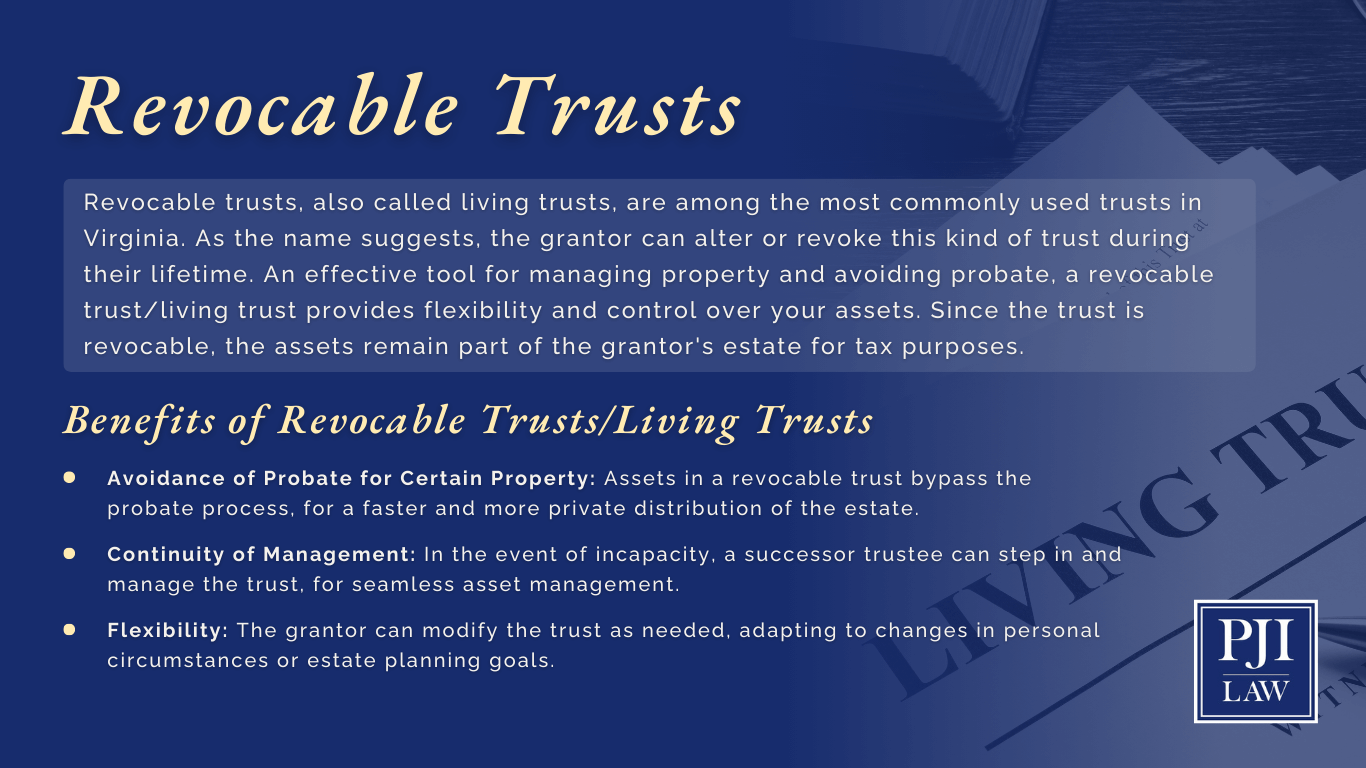
    A living trust, also known as an inter-vivos trust, goes into effect during the grantor’s lifetime. You can make changes to or revoke a living trust at any time. A testamentary trust is created within a will and goes into effect upon death. It cannot be modified or revoked after the testator passes away.

    What is the Difference Between a Revocable Living Trust and an Irrevocable Trust?

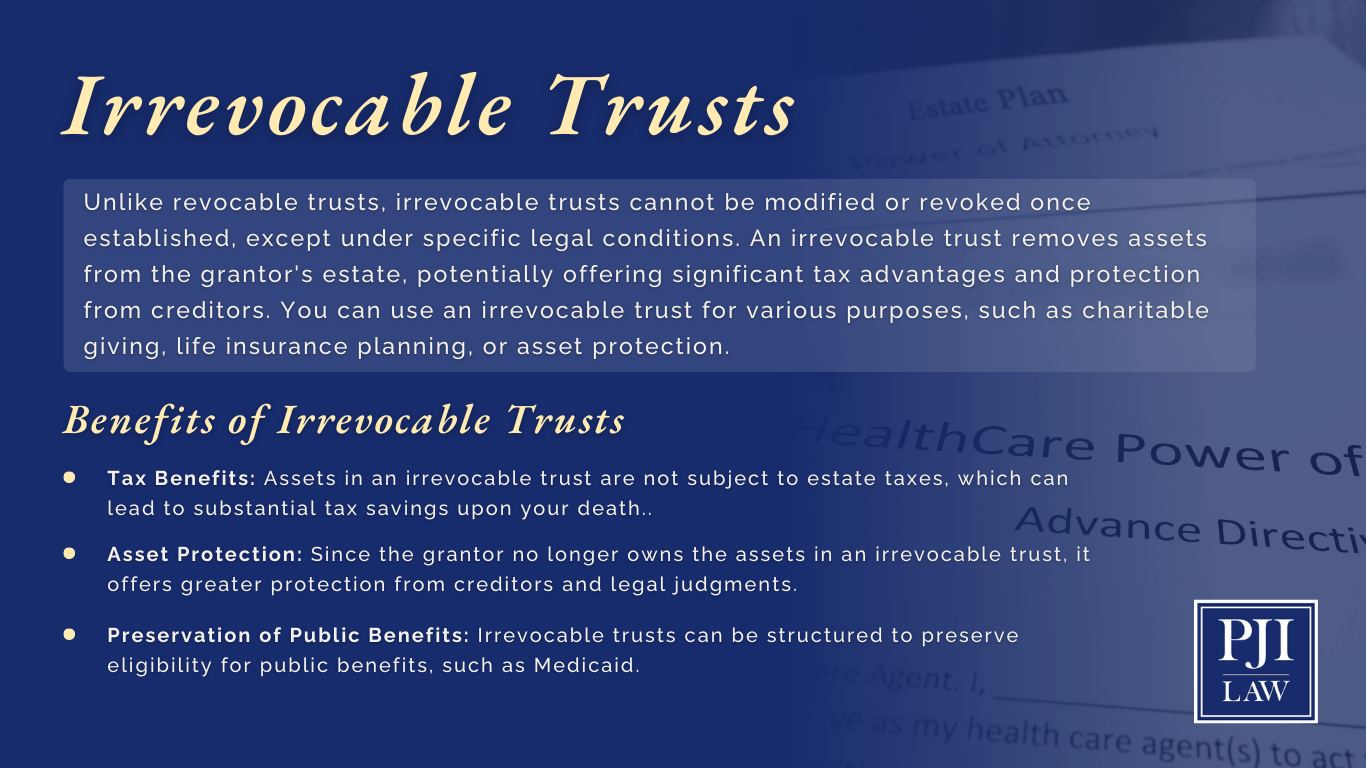
    The grantor can change or terminate a revocable trust at any time, while they cannot modify an irrevocable trust. While irrevocable trusts offer greater asset protection and some tax benefits, they require careful consideration and planning. Working with a knowledgeable attorney in the Richmond area can help you determine the best type of trust for you, based on your unique circumstances and goals.

    Create Advance Medical Directives

    Advance medical directives express your healthcare wishes in case you become incapacitated and unable to communicate them yourself. In Virginia, advance medical directives may include:

    • Durable Powers of Attorney/Medical Powers of Attorney: These documents allow individuals to appoint someone to make medical decisions on their behalf if they are unable to do so.
    • Living Wills: Living wills state an individual’s preferences for end-of-life care. A living will specifies the types of life-sustaining treatments you do or do not want.
    • Do Not Resuscitate Order (DNR): DNRs instruct medical professionals not to attempt life-saving measures, such as CPR, defibrillation, medication, or artificial breathing, if your heart or breathing stops.

    These documents uphold your preferences for medical care, empowering someone you trust to make decisions on your behalf if necessary. Consulting a Virginia attorney to properly prepare and execute these documents according to state law is a wise choice.

    Appoint Powers of Attorney

    With powers of attorney you can designate someone you trust, known as an agent, to manage your financial or legal affairs should you become incapacitated. This person can make decisions regarding your finances, property, and investments, handling your matters according to your wishes.

    Our attorneys can help you implement the right powers of attorney for your needs. Your options include:

    • Durable power of attorney
    • General power of attorney
    • Limited power of attorney
    • Springing power of attorney

    Your designated agent must abide by a set of guidelines when deciding on your behalf. This individual must perform their duties competently and diligently, with your best interests in mind.

    Furthermore, your agent must avoid conflicts of interest, keep records and provide them when requested. Lastly, they must preserve the estate plan as long as it is in your best interests. Our attorneys in Richmond can discuss these responsibilities and guidelines with you in greater detail during a consultation.

    Designate Beneficiaries

    Another essential element of estate planning is designating beneficiaries for your assets. Beneficiaries are the individuals or entities that will receive your assets after you pass away.

    As part of your estate plan, you can designate beneficiaries for various accounts and policies, such as:

    1. Life insurance
    2. Retirement accounts (401(k), IRA, TSP)
    3. Bank accounts
    4. Investment accounts
    5. Real estate
    6. Business interests

    Choosing specific beneficiaries allows your assets to pass to the intended recipients without going through probate or being subject to creditor claims or tax implications. Regularly review and update your beneficiary designations to reflect any changes in your circumstances or wishes.

    Looking-for-an-estate-planning-attorney-in-Richmond-Virginia_

    Review Transfer-on-Death Designations

    In addition to beneficiary designations, you have the option to designate transfer-on-death (TOD) beneficiaries for real estate. Similar to beneficiary designations, with a Virginia TOD you can transfer ownership of your real estate property to a designated beneficiary upon your death.

    The deed is recorded with the county clerk’s office and becomes effective only after your passing. Until then, you retain full control and ownership of the property, and you can revoke or modify the deed at any time. Our attorneys advise our clients to regularly review and update TOD designations because they are legally binding and cannot be changed after your passing.

    Create Clear Instructions for Your Personal Representative

    As we noted above, your personal representative handles your estate administration. As part of your estate planning efforts, we recommend creating a document informing them about where to locate your assets and all necessary documents, including logins and passwords of your digital assets.

    Business Planning

    If you own a business, a succession plan is vital for its continuity. Business succession planning ensures that your business can thrive even after you step down, whether due to retirement, incapacity, or passing. It involves designating successors and outlining the transition process clearly.

    An attorney from our law firm can help you:

    • Choose an exit strategy
    • Create a plan to ensure a seamless transition
    • Select a successor
    • Connect with the right financial and insurance advisors
    • Limit taxes

    Start the New Year with Confidence in Richmond, VA with PJI Law

    Embarking on the New Year by estate planning can give you and your loved ones peace of mind. At PJI Law, our trust and estate counsel offer clients personalized service and attention. Our practice areas include wills, trusts, advance medical directives, powers of attorney, business succession planning, deed preparation, transfer-on-death deeds, probate law, trust administration, and estate plan maintenance.

    Don’t wait until it’s too late contact our Richmond office today at (804) 653-3450 or complete our online form to schedule a consultation. Find out how we may be able to help you create a comprehensive estate plan that secures your legacy and protects your family members and all loved ones.

    Copyright © 2024. PJI Law, PLC. All rights reserved.

    The information in this blog post (“post”) is provided for general informational purposes only and may not reflect the current law in your jurisdiction. No information in this post should be construed as legal advice from the individual author or the law firm, nor is it intended to be a substitute for legal counsel on any subject matter. No reader of this post should act or refrain from acting based on any information included in or accessible through this post without seeking the appropriate legal or other professional advice on the particular facts and circumstances at issue from a lawyer licensed in the recipient’s state, country, or other appropriate licensing jurisdiction.

    PJI Law, PLC
    4108 E Parham Rd,
    Richmond, VA 23228
    (804) 653-3450
    https://pjibe.webteam.ai/

  • What Is a Limited Power of Attorney in Virginia?

    What Is a Limited Power of Attorney in Virginia?

    Have you ever wondered what would happen if you became temporarily unable to handle specific financial or legal matters? Life can sometimes throw unexpected challenges our way. Perhaps you’re planning an extended trip abroad and need someone to manage your property transactions in your absence.

    Or maybe you’re facing a scheduled surgery and want to make sure your business or investments are taken care of while you recover. Even if you’re simply looking to prepare for life’s uncertainties, having a limited power of attorney in Virginia might be the solution you’re looking for. This document allows you to appoint someone to manage specific tasks on your behalf, ensuring your affairs stay in order, even when you can’t handle them yourself.

    What is a limited power of attorney? Continue reading to learn more about how it works and why it could be essential for your peace of mind.

    What is a Limited Power of Attorney?

    A limited power of attorney in Virginia is a legal document that allows you to appoint someone (called an “agent” or “attorney-in-fact”) to act on your behalf for specific tasks or transactions. Unlike a general power of attorney, which grants broad authority, a limited power of attorney restricts your agent’s powers to particular matters you specify in the document. This specificity gives you greater control over what actions your agent can take, making it a popular choice for those who want careful oversight of their affairs without a broad delegation of power.

    When to Consider a Limited Power of Attorney

    You might find a limited power of attorney useful in various situations, such as:

    • Selling or purchasing property while you’re out of state
    • Managing specific investments during your temporary incapacity
    • Handling tax matters when you’re unavailable
    • Overseeing a business transaction during your absence
    • Dealing with insurance claims while you’re recovering from illness
    • Managing rental properties during extended travel
    • Handling specific legal proceedings
    • Operating a business account for designated purposes

    Having a limited power of attorney in these cases can ensure your affairs stay on track, even if you’re temporarily unavailable.

    Key Requirements for Virginia Limited Power of Attorney

    To create a valid limited power of attorney, the following requirements must be met:

    • You must be at least 18 years old
    • You must have the mental capacity to understand the document at the time of signing
    • Sign the document in front of a notary (Virginia does not require witnesses for a limited power of attorney, though having witnesses can add a layer of authenticity)
    • Clearly specify the powers you’re granting in detail, especially for high-risk actions

    Virginia law requires that certain powers, like those related to real estate transactions or making gifts, be explicitly stated in the document to be legally binding. The document should be clear, specific, and written in a way that financial institutions and courts can easily understand. Consulting a lawyer for power of attorney can also help ensure all requirements are met according to Virginia’s Uniform Power of Attorney Act.

    Powers You Can Grant

    Your limited power of attorney can authorize your agent to handle specific tasks such as:

    • Real estate transactions, including sales, purchases, and lease agreements
    • Banking operations, like deposits, withdrawals, and check writing
    • Investment decisions for specific accounts or assets
    • Contract negotiations and signings
    • Tax document preparation and filing
    • Insurance matters, including filing claims and changing policies
    • Vehicle registration and sales
    • Stock and bond transactions
    • Safe deposit box access
    • Social Security, Medicare, or other government benefits management

    Clearly defining these powers ensures your agent knows exactly what they are authorized to do, reducing the risk of misunderstandings or unauthorized actions.

    Limitations and Restrictions

    Understanding what a limited power of attorney cannot do is just as important as knowing what it can do. Your agent cannot:

    • Make decisions beyond the scope specified in the document
    • Transfer their powers to another person
    • Act after the limited power of attorney expires
    • Make medical decisions (unless specifically authorized)
    • Change or create your will
    • Vote on your behalf
    • Make gifts of your property unless explicitly authorized
    • Change beneficiary designations on life insurance or retirement accounts
    • Access your personal email or social media accounts without specific authorization

    Knowing these restrictions helps ensure that your limited power of attorney is used solely for the purposes you intended.

    Choosing Your Agent

    When selecting an agent for your limited power of attorney, consider someone who:

    • Is trustworthy and reliable
    • Understands what is required to fulfill their specified financial or legal duty
    • Is willing to seek professional guidance if something unexpected arises
    • Lives close enough to handle the tasks
    • Has the time to fulfill the responsibilities
    • Will follow your wishes and act in your best interest
    • Can maintain accurate records of all transactions
    • Will communicate regularly about actions taken
    • Has no conflicts of interest with the assigned tasks

    Choosing an agent with these qualities can help you feel confident that your affairs are in good hands.

    How to Revoke a Limited Power of Attorney

    You can revoke your limited power of attorney at any time as long as you’re mentally competent. To do so:

    • Create a written revocation document
    • Sign it in front of a notary
    • Provide copies to your agent and any institutions that received the original limited power of attorney
    • Keep records of when and how you notified all parties
    • File the revocation with the county clerk if the original was recorded
    • Send the revocation via certified mail to ensure proof of receipt

    Taking these steps ensures that your revocation is documented and legally recognized, ending your agent’s authority.

    Protecting Yourself

    To safeguard your interests when creating a limited power of attorney:

    • Be specific about the powers you’re granting
    • Include an expiration date or a durability clause if you want it to remain effective in case of incapacitation
    • Maintain copies of all documents
    • Inform relevant financial institutions
    • Consider requiring your agent to provide regular updates
    • Include backup agents in case your primary agent becomes unavailable
    • Review and update the document periodically
    • Keep a log of all institutions that have received copies
    • Consider requiring two agents to act jointly for significant transactions

    These precautions can help you create a limited power of attorney that serves your needs while providing additional protections for your interests.

    A limited power of attorney can provide peace of mind knowing specific matters will be handled according to your wishes when you can’t manage them yourself. By understanding the requirements, carefully selecting your agent, and clearly defining the granted powers, you can create an effective limited power of attorney that serves your needs while protecting your interests.

    Virginia’s Uniform Power of Attorney Act includes specific provisions. Consulting estate planning attorneys can help you align your limited power of attorney with state laws and protect your interests so that your limited power of attorney meets all Virginia requirements and addresses your unique situation.

    Protect Your Interests with a Limited Power of Attorney

    When unexpected situations arise, you’ll want the confidence of knowing your specific financial and legal matters are in capable hands. PJI Law can help you establish a limited power of attorney that meets your unique needs while protecting your interests under Virginia law.

    Your life doesn’t pause when you’re unavailable or temporarily unable to handle important transactions. By working with PJI Law’s estate planning attorneys, you can create a carefully crafted limited power of attorney that gives you control over exactly what powers you grant and to whom.

    Take the first step toward securing your peace of mind. Contact PJI Law today to create a limited power of attorney that fits your specific situation. Our attorneys will guide you through each decision, ensuring your document provides the protection you need while maintaining the control you want.

    If you’ve been searching online for a “power of attorney near me,” call us at (703) 865-6100 or connect through our confidential online form to schedule your consultation. Let’s work together to put proper legal safeguards in place for your financial and legal matters.

    At PJI Law, you’ll receive personalized service and attention!

    Copyright © 2024. PJI Law, PLC. All rights reserved.

    The information in this blog post (“post”) is provided for general informational purposes only and may not reflect the current law in your jurisdiction. No information in this post should be construed as legal advice from the individual author or the law firm, nor is it intended to be a substitute for legal counsel on any subject matter. No reader of this post should act or refrain from acting based on any information included in or accessible through this post without seeking the appropriate legal or other professional advice on the particular facts and circumstances at issue from a lawyer licensed in the recipient’s state, country, or other appropriate licensing jurisdiction.

    PJI Law, PLC
    3900 Jermantown Rd, 2nd Floor
    Fairfax, Virginia 22030
    (703) 865-6100
    https://pjibe.webteam.ai/

  • How to Avoid Pitfalls When Making a Personal Loan to a Friend in Virginia

    How to Avoid Pitfalls When Making a Personal Loan to a Friend in Virginia

    The phone rings, and you see it’s one of your closest friends calling. After a few minutes of catching up, they gently bring up an unexpected financial situation. “I wouldn’t ask if it weren’t important,” they say, “but I was wondering if you might be able to help me out with a loan. I’ll make repaying you my priority.”

    You pause, feeling the weight of the decision. You know your friend wouldn’t ask if it weren’t serious, and as much as you want to help, lending money to friends can feel risky. You don’t want to jeopardize your friendship, but you also need to ensure your finances are protected.

    Lending money to friends feels straightforward in the moment, but it often involves more than expected. A clear, structured loan agreement can safeguard your finances and friendship alike. In this blog, we’ll cover the key steps to take when making a personal loan to a friend in Virginia, what your options are if your friend stops paying, and when you might need the help of a collection attorney. From crafting a simple agreement to understanding interest limits, you’ll learn how to lend responsibly while safeguarding your finances and peace of mind.

    Virginia’s Contract and Interest Rate Laws for Loans

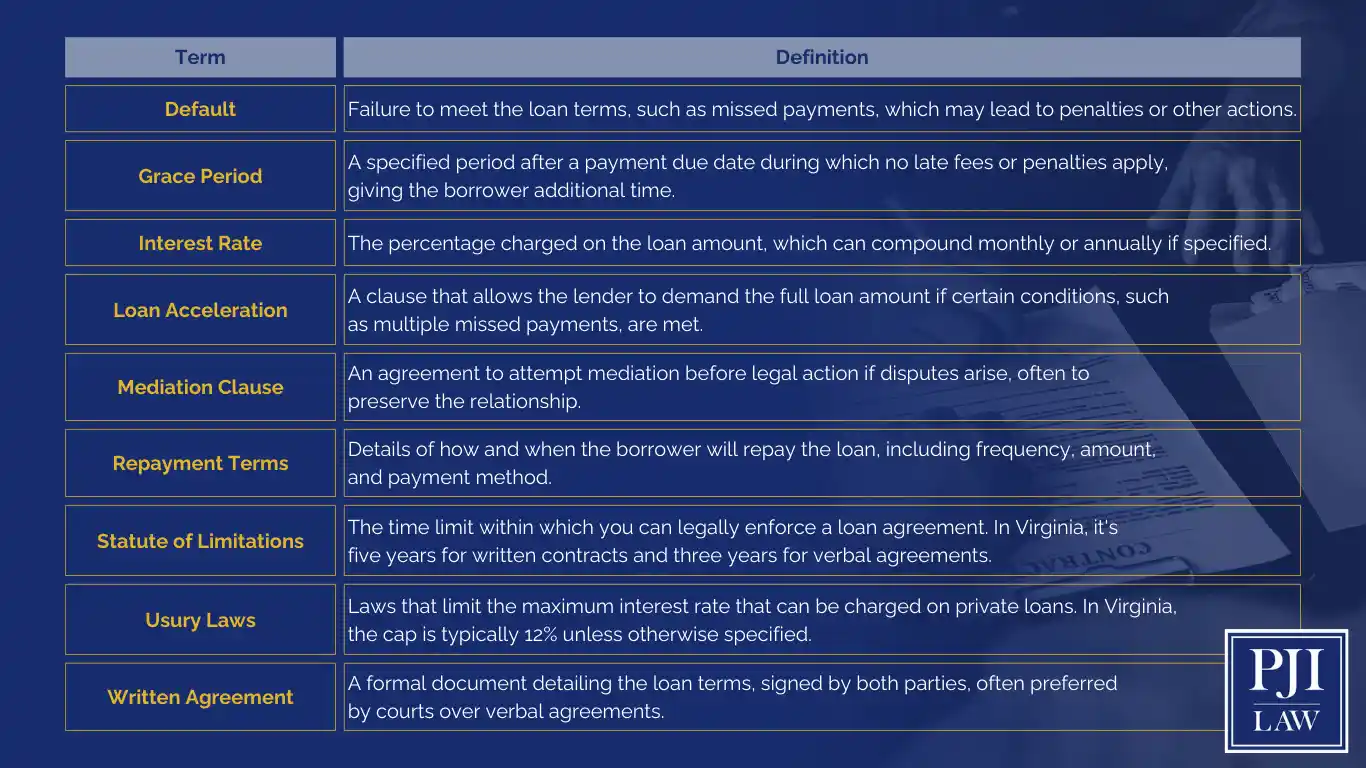
    Before you reach for your wallet, it’s essential to understand that in Virginia, personal loans between friends are legally binding contracts. The state’s statute of limitations for written contracts is five years, while verbal agreements have a three-year limit. To enforce your loan agreement, you need to act within these timeframes before the statute of limitations expires. You can view the full statute here.

    Additionally, Virginia’s usury laws cap interest rates at 12% annually for most private loans, unless a different rate is set in writing. If your loan amount exceeds a threshold (usually $5,000), a higher rate may apply—you can confirm this threshold and other specifics of Virginia’s usury laws here. Written contracts aren’t just for big business deals—they provide clarity for both sides in personal loans as well, making it easier to resolve any misunderstandings that may arise. While charging interest to a friend might feel uncomfortable, establishing clear terms helps both parties treat the loan seriously.

    need-help-with-a-loan-agreement-for-making-a-loan-to-a-friend

    Consider Alternative Options

    Before committing to a personal loan, explore alternative borrowing options that might be easier on your friendship and your finances:

    • Local Credit Unions: Credit unions often offer personal loans at lower rates than traditional banks. Many credit unions in Virginia provide flexible loan terms that can be more affordable and structured than a private loan.
    • Peer-to-Peer Lending Platforms: Platforms like LendingClub or Prosper facilitate loans between individuals but provide structure, interest rates, and payment schedules. This can keep the loan more formal without involving friends or family directly.
    • Non-Profit Credit Counseling Services in Virginia: Many non-profit organizations offer financial counseling and small loan options, especially for individuals in financial hardship. Services like these can be a safer alternative than relying on friends or family for funds.
    • Emergency Assistance Programs: Some community organizations in Virginia provide emergency funds or loans for specific needs, like medical bills or utilities, at low or no interest. This can be a helpful resource, especially if the loan is for a temporary hardship.
    • Payment Plans with Creditors: If the funds are needed for an existing debt, see if the creditor offers a payment plan or reduced payment options. Many creditors offer flexibility on repayment terms, which can remove the need for a personal loan entirely.

    Know When to Say No

    know-when-to-say-no

    Sometimes, the best way to protect your finances and your friendship is to decline a loan request. Consider saying no if any of these apply:

    • Financial Limitations: If you can’t afford to lose the money or would be financially strained by lending it, it’s likely best to decline.
    • History of Financial Issues: If the friend has a pattern of financial instability or unpaid debts, the risk may outweigh the benefit.
    • Feeling Pressured or Rushed: If you feel uncomfortable or pressured into the loan, take a step back. Financial decisions should never be rushed.
    • Unwise Loan Purpose: If the loan is for something unnecessary or seems risky (e.g., gambling or a risky investment), it may be best to say no.
    • Potential Impact on Your Own Stability: If lending would affect your financial security, prioritize protecting your own stability.

    Document Everything in Writing

    document-everything-in-writing

    If you decide to go ahead with the loan, you might think a handshake or verbal promise is enough between friends, but Virginia courts strongly favor written agreements. Having a written contract not only clarifies expectations but also protects both parties if issues arise. Here’s what to include for legal enforceability:

    • Exact Loan Amount: Specify the precise amount of money being borrowed. This should match any cash, check, or digital transfer provided.
    • Interest Rate (if applicable): If charging interest, include the rate and whether it compounds monthly or annually. If interest isn’t being charged, note that the loan is interest-free.
    • Parties’ Full Legal Names and Addresses: Record both parties’ full names and current addresses as they appear on identification.
    • Date of Agreement: Include the date the agreement is signed, as this helps establish the timeline if legal action is needed.
    • Signatures and Notary (if possible): Both parties should sign. For extra formality, consider notarizing the document to strengthen its enforceability in court.


    do-you-need-a-collection-attorney-after-making-a-loan-to-a-friend

    Consider using a loan agreement template tailored to Virginia law, but review it carefully and consult a legal professional if needed to ensure all necessary elements are included.
    PJI-Law-SuperBlog-Images-5

    Establish Clear Repayment Terms

    Vague repayment plans often lead to misunderstandings that can strain even the strongest friendships. Outline each repayment term in detail to avoid complications:

    • Total Loan Amount: Specify the amount your friend will repay, including any interest. This ensures both parties are clear on the final repayment amount.
    • Payment Frequency and Due Dates: Decide how often payments will be made (e.g., weekly or monthly) and specify due dates. A consistent schedule helps both parties avoid missed payments.
    • Payment Amount and Method: Define the amount for each payment and the payment method (e.g., bank transfer, check, or cash). Consistency will help keep the loan organized.
    • Grace Periods and Consequences for Missed Payments: Decide whether to offer a grace period and outline any penalties or actions for missed payments. Specify if late fees apply or if multiple missed payments allow additional actions like loan acceleration.
    • Acceptance of Partial Payments: State if partial payments are acceptable, and if so, how they’ll be applied to the principal and interest. This keeps everyone clear on loan progress.

    By outlining these terms thoroughly, you create a structured repayment plan that supports a smoother repayment process and protects both parties.

    Safeguard Your Tax Position

    The IRS pays attention to personal loans, even between friends. Loans without clear terms or interest rates may appear as gifts to the IRS, triggering gift taxes or other tax obligations. To avoid tax complications and keep your financial records clean:

    • Document this as a loan, not a gift.
    • Charge at least the minimum interest rate required by the IRS (the applicable federal rate for your loan term, which you can find here.
    • Keep detailed records of all payments received.
    • Report interest income on your tax returns.
    • Understand that forgiving the loan has tax implications, and consult an accountant if necessary.

    Plan for Worst-Case Scenarios

    plan-for-worst-case-scenarios
    Nobody likes to think about things going wrong, but anticipating potential issues can save both your finances and your friendship if problems arise. Including these provisions in your loan agreement helps prevent misunderstandings and sets expectations:

    • Early Repayment Options: Specify whether early repayment is allowed and if there are any incentives for paying off the loan sooner. For example, you could decide to waive a portion of interest if the loan is repaid early. This provides flexibility for your friend if their financial situation improves.
    • Defining Default and Its Consequences: Outline exactly what constitutes a default. This could include missed payments, partial payments, or a specified number of late payments. Clearly define the consequences, such as late fees, interest increases, or other penalties, so there is no ambiguity if payments become inconsistent.
    • Relocation Terms: Decide what happens if either you or your friend moves out of Virginia during the loan period. Moving can complicate legal recourse, especially if it becomes necessary to pursue repayment. You may want to specify that the terms of the loan remain governed by Virginia law, even if one of you relocates.
    • Mediation Before Legal Action: To avoid escalating tensions, include a clause that requires mediation before pursuing legal action if a serious dispute arises. Mediation can be a less costly, less adversarial way to resolve issues and can help preserve your relationship while seeking a fair solution.
    • Loan Acceleration Terms: State if and when the loan will be “accelerated” due to missed payments. Loan acceleration means that if a certain number of payments are missed, the entire balance becomes due immediately. This gives you a clear path for handling cases of serious non-payment.
    • Provision for Potential Modifications: Include a clause allowing for possible modifications to the loan terms if unforeseen financial hardships arise. This clause can specify that any adjustments to the payment schedule or amounts must be agreed upon in writing by both parties, adding a layer of flexibility without undermining the agreement.

    By planning for these scenarios, you’re protecting both parties and minimizing potential disruptions. Setting these terms upfront helps ensure a smoother process if challenges occur, providing peace of mind and structure for both you and your friend.

    Keep Communications Professional

    Once the loan is made, it’s important to treat the arrangement professionally to avoid misunderstandings or strains on your relationship. While maintaining formality in personal loans can feel awkward at first, it reduces misunderstandings and keeps everyone on the same page. Taking these steps can help maintain clear communication and accountability:

    • Separate Loan-Related Communication: Keep loan-related discussions separate from your usual interactions. Use email or written notes instead of casual texts, which helps set a more professional tone and keeps a clear record.
    • Document Every Payment: Record each payment as it’s made and keep a log of payment dates, amounts, and methods (e.g., cash, check, bank transfer). This documentation can be valuable if you ever need to reference specific payment details.
    • Provide Regular Loan Statements: Create monthly or quarterly loan statements summarizing payments made, the remaining balance, and any upcoming due dates. This way, both of you are always aware of the loan’s status.
    • Send Professional Payment Reminders: If a payment is due soon, send a polite reminder that is professional and friendly. This can be as simple as an email or text message that keeps the tone respectful and business-like.
    • Maintain a Loan Tracking Spreadsheet: Track the loan balance, payments received, and due dates in a spreadsheet. This keeps everything organized and makes it easy to see the loan’s progress.

    Protect Your Friendship

    Money can strain even the best relationships, so take steps to keep your friendship intact and minimize the emotional impact of the loan:

    • Keep Loan Discussions Private: Avoid bringing up the loan at social events or in group settings. Discuss it one-on-one, away from mutual friends, so it doesn’t become a public or uncomfortable topic.
    • Maintain Clear Boundaries: Refrain from casually discussing the loan when spending time together socially. Let your social time stay focused on enjoying each other’s company.
    • Respect Privacy: Avoid sharing details of the loan with mutual friends or family. This keeps the arrangement private and minimizes any external pressure on the borrower.
    • Continue Friendship Activities: As much as possible, maintain your usual friendship routines. This helps keep the loan from becoming a defining aspect of your relationship.
    • Address Issues Calmly and Privately: If problems arise, approach them privately and respectfully. A calm, constructive conversation can help resolve issues without damaging the relationship.

    When to Seek Legal Assistance

    when-to-seek-legal-assistance

    If significant problems arise with the loan, consider consulting a Virginia collections attorney who handles contract disputes or small claims cases to guide you through your options:

    • Multiple Missed Payments: If your friend has missed several payments and stopped communicating, a legal consultation may help you decide on next steps.
    • Disputes Over Loan Existence: If your friend denies the loan’s existence or refuses to acknowledge the terms, legal support can help you enforce your agreement.
    • Approaching the Statute of Limitations: If you’re nearing Virginia’s statute of limitations (five years for written agreements, three years for verbal), consult an attorney to ensure your rights remain protected.
    • Relocation or Bankruptcy: If your friend moves out of Virginia or files for bankruptcy, your legal options may change. Legal advice can clarify how these circumstances impact the loan.
    • Exhausted Informal Resolution Attempts: If all other attempts at resolving the matter have failed, pursuing the issue in Virginia’s small claims court may be a cost-effective option. The court handles cases up to $5,000, which may be suitable for many personal loans.

    Remember, making a personal loan to a friend in Virginia requires careful consideration and planning. Helping a friend in tough times is admirable, but by protecting yourself legally and financially, you’re ensuring both your friendship and finances are preserved.

    Get Back What You’re Owed: Recover Your Loan to a Friend with PJI Law’s Trusted Support

    When you extended a personal loan to a trusted friend, you took every step to cover your bases. But now, with the loan in default, you’re left in a difficult position of needing to recover what you’re owed. At PJI Law, we understand that deciding to take collection action against a friend isn’t easy and that personal loan disputes can feel both financially stressful and emotionally complicated.

    With our white-glove service and personalized approach, PJI Law’s trusted collection attorneys are here to help. We’ll carefully review your loan agreement, assess your options, and work toward a resolution that brings you the results you need. Throughout the process, you’ll receive focused, attentive support, ensuring you feel informed and confident every step of the way.

    Reaching out for help is a big step, and we’re ready to provide the guidance you need. If you’ve been searching online for a “debt collection attorney near me,” call us instead at (703) 865-6100 or complete our confidential online form to schedule a confidential consultation with PJI Law. Let us handle the complexities so you can move forward with peace of mind.

    At PJI Law, you’ll receive white glove service and personalized attention!

    Copyright © 2024. PJI Law, PLC. All rights reserved.

    The information in this blog post (“post”) is provided for general informational purposes only and may not reflect the current law in your jurisdiction. No information in this post should be construed as legal advice from the individual author or the law firm, nor is it intended to be a substitute for legal counsel on any subject matter. No reader of this post should act or refrain from acting based on any information included in or accessible through this post without seeking the appropriate legal or other professional advice on the particular facts and circumstances at issue from a lawyer licensed in the recipient’s state, country, or other appropriate licensing jurisdiction.

    PJI Law, PLC
    3900 Jermantown Rd, 2nd Floor
    Fairfax, Virginia 22030
    (703) 865-6100
    https://pjibe.webteam.ai/

  • What is a Conservatorship in Richmond, Virginia?

    What is a Conservatorship in Richmond, Virginia?

    As the warm afternoon sun filtered through the curtains, Emma sat at her grandmother’s kitchen table, surrounded by piles of paperwork. Her grandmother, once a vibrant and independent spirit, was now struggling with daily tasks due to the onset of dementia. Emma had always admired her grandmother’s resilience, but she now faced a challenging decision: how to manage her grandmother’s finances and healthcare needs effectively.

    As the family gathered to discuss the future, the conversation inevitably turned to the concept of conservatorship—a legal mechanism that could provide the guidance and protection her grandmother desperately needed.

    Emma wondered, “What is a conservatorship in Richmond, Virginia?”

    People often consider the terms guardianship and conservatorship interchangeable; however, as an experienced Virginia attorney can attest, each legal document serves a unique purpose.

    A conservatorship is a court-appointed arrangement that allows a responsible individual to manage the financial affairs of someone who cannot do so themselves due to a loss of mental capacity or physical limitations. This legal structure can be vital for the incapacitated person and their family to care for their loved one and protect their assets.

    Guardianship is a court-appointed relationship where a trusted person makes decisions for an incapacitated individual’s personal affairs, such as support, care, health, safety, habilitation, education, and residence. The court specifies the guardian’s powers, which can include limited or temporary responsibilities. Guardianship seeks to support the well-being of the incapacitated person while encouraging their participation in decisions and maintaining as much independence as possible.

    Understanding the nuances of conservatorships can be daunting, but for individuals seeking to manage the financial affairs of a beloved family member whose medical condition has led to incapacity, it can help them secure the best interests of the person. 

    Do you have questions about conservatorship?

    The conservatorship lawyers at PJI Law guide families in and around Richmond in making informed decisions about conservatorships. If you’re concerned about an incapacitated individual in your life, our compassionate team is ready to listen to your concerns and help you navigate the complexities of the conservatorship process. Contact us today at (804) 653-3450 to schedule a consultation. With personalized service and attention, we will provide peace of mind and security for you and your loved one.

    Richmond, Virginia elder attorney answers the question, "What is a conservatorship?" Call (804) 653-3450 to schedule a consultation.

    Defining a Conservatorship and Explaining the Difference Between Guardianship and Conservatorship in Virginia

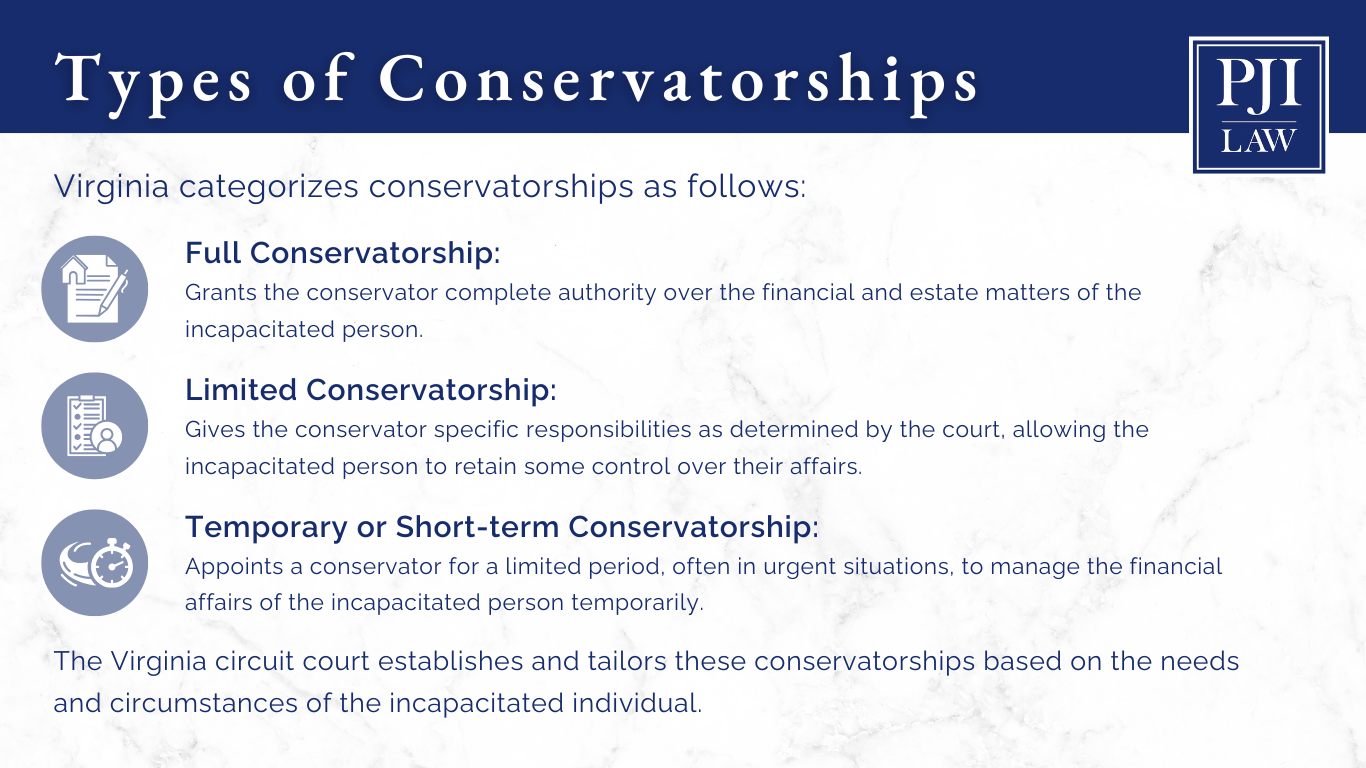
    A conservatorship is a legal arrangement in which a circuit court appoints an individual or entity to manage the financial affairs of someone who cannot make financial decisions or manage their finances themselves, due to factors like mental incapacity and poor health. If an individual is concerned about an incapacitated person in their life and wants to become their conservator, they must begin by filing a petition. Afterward, the Virginia circuit court will appoint a guardian ad litem to the case, whose job is to investigate the statements made by the individual seeking a conservatorship in their petition. 

    Next, the Virginia circuit court will require the petitioner to provide supporting evidence explaining why the incapacitated person needs a conservator and demonstrating that the individual is incapacitated.

    From there, the prospective conservator must attend a hearing where a judge will listen to the evidence and make a determination. In such cases, the skilled representation of a knowledgeable and experienced attorney for guardians and conservators will help you make your case and respond to legal questions.

    When an incapacitated person does not have an estate plan with advance medical directives like a power of attorney, a loved one may seek a guardianship. As a guardian for an incapacitated adult, an individual assumes responsibility for maintaining their living arrangements,  consenting to medical care, including mental and physical health services, and making palliative care decisions.

    To summarize, in Virginia, guardianship and conservatorship serve distinct purposes. When granted a guardianship, an individual has authority over an incapacitated person’s personal affairs, including medical care. On the other hand, a conservator’s role is limited to the financial matters of the incapacitated person. In most cases, the same person fulfills the guardianship and conservatorship obligations for an incapacitated adult.

    Richmond, Virginia elder attorney answers the question, "What is a conservatorship?" Call (804) 653-3450 to schedule a consultation.

    An Elder Attorney Explains the Guardianship and Conservatorship Process in Virginia

    Prospective guardians and conservators must follow the same process.

    Filing a Petition

    An individual seeking to become a guardian or conservator must begin by filing a petition with the circuit court. In this petition, the proposed guardian or conservator must provide evidence that the incapacitated adult is unable to handle their affairs. In the case of a guardianship, a lack of advance directives concerning medical care and the incapacitated adult’s inability to make medical decisions are the reasons for wanting to establish guardianship. On the other hand, the incapacitated adult’s inability to handle their finances would compel a loved one to pursue conservatorship proceedings. 

    Court Evaluation

    Whether an individual requires a guardianship or a conservatorship is a matter of the court’s discretion. First, an appointed guardian ad litem will evaluate the information in the petition, then the judge will receive the evidence and the guardian ad litem’s findings. From there, the potential guardian or conservator will attend a hearing. Keep in mind, the incapacitated adult can also attend these hearings with their lawyer. If you want to increase your chances of a judge granting you a guardianship or conservatorship for an incapacitated adult you love, hire a seasoned attorney to help you present your case.

    Role of Medical Evidence

    A judge does not want to limit someone’s freedom unless it’s absolutely necessary. Thus, they rely on expert testimony and medical records to determine whether an adult is incapacitated. Moreover, the court can also call for a written report by a physician or psychologist about any findings that affect the case’s outcome.

    Remember, bad decision-making does not always equate to a person being unable to handle their finances or health care decisions. If the individual can adequately process information, it’s doubtful that the court will rule the person is incapacitated, regardless of the quality of their decisions. 

    Preparing for Your Hearing: What a Prospective Guardian and Conservator Needs to Know

    When seeking a court order for a guardianship or a conservatorship, being fully prepared for your hearing is vital.

    1. Gather Documents: Be ready to present all relevant documents, including financial statements, and medical records at the hearing.
    2. Familiarize Yourself with Medical Evidence: Medical evidence will significantly impact the outcome of your case, so gather and review all necessary reports or expert testimony and be ready to explain them to the judge.

    Richmond, Virginia elder attorney answers the question, "What is a conservatorship?" Call (804) 653-3450 to schedule a consultation.

    Criteria for a Conservator in Virginia

    A Virginia judge considers several criteria when deciding to grant a conservatorship.

    1. Limitations of the Respondent: The specific limitations that affect the individual’s ability to manage their affairs.
    2. Self-Reliance and Independence: The potential for the respondent’s maximum self-reliance and independence.
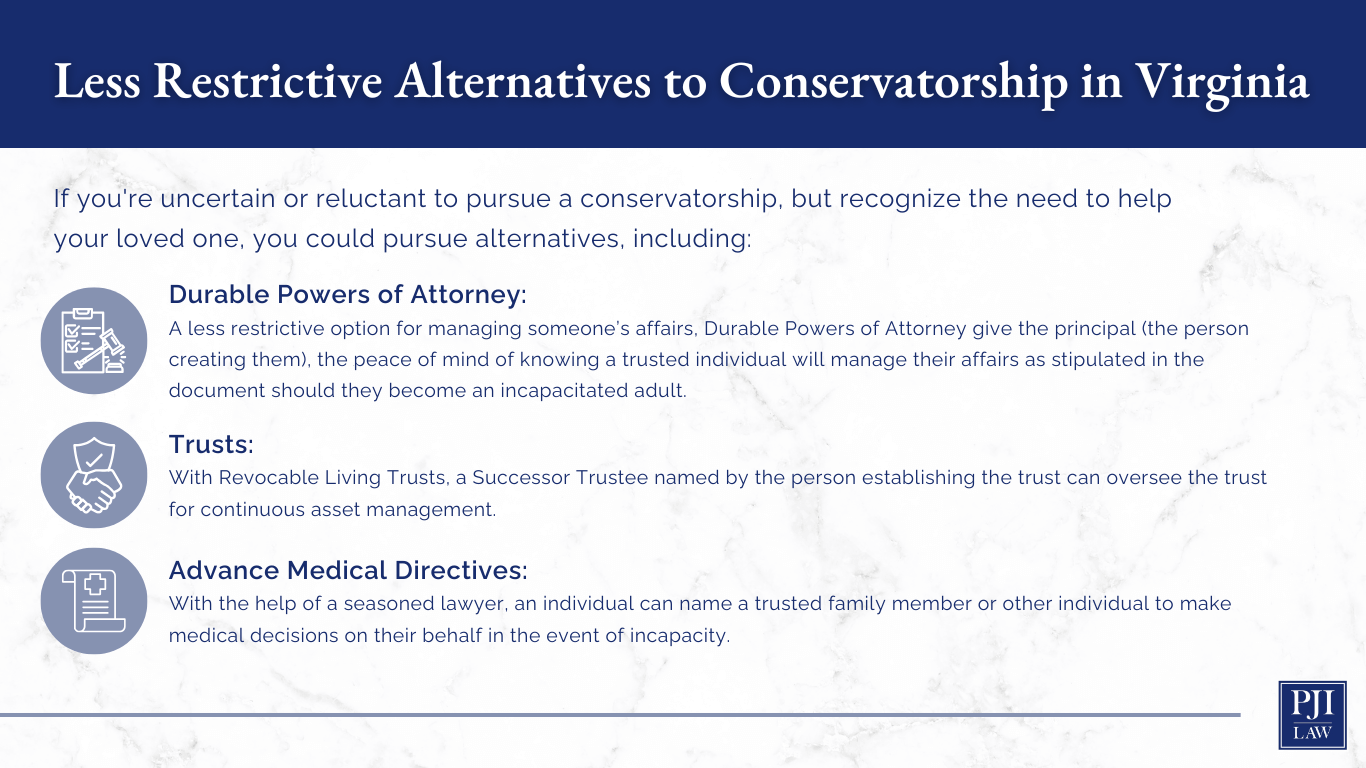
    3. Less Restrictive Alternatives: Availability of less restrictive options, such as advance directives or a durable power of attorney.
    4. Protection from Harm: The necessity to protect the individual from neglect, exploitation, or abuse.
    5. Actions Required by the Conservator: The specific actions that need to be taken by the conservator.
    6. Suitability of the Proposed Conservator: The appropriateness of the person proposed to be the conservator.

    The court requires clear and convincing evidence of the individual’s incapacity and the need for a conservator to manage their affairs.

    What Rights Do Incapacitated Adults Have?

    Even when a judge grants a conservatorship or a guardianship based on compelling evidence such as increasing age or physical or mental limitation, incapacitated adults retain several important rights:

    1. Right to be Informed: An incapacitated adult has the right to be informed about the proceedings and any decisions being made on their behalf.
    2. Right to Participate in Decisions: The incapacitated individual should be encouraged to participate in decisions affecting their life to the extent possible, and their expressed desires and personal values should be considered.
    3. Right to Legal Representation: An incapacitated adult has the right to legal representation and can request the appointment of a lawyer if they do not already have one during conservatorship proceedings.
    4. Right to Due Process: Regardless of their age or other factors, the incapacitated individual retains a right to due process, including the right to attend hearings, present evidence, and cross-examine witnesses during the conservatorship process.
    5. Right to Appeal: They have the right to appeal the court’s decision to appoint a conservator if they disagree with it.

    These rights seek to ensure that the individual retains as much autonomy and involvement in their personal affairs as possible, even with a guardian or a conservator.

    How to Choose a Conservator in Richmond, Virginia

    Criteria to Consider

    Trustworthiness – In this role, integrity and reliability are paramount. Look for someone with a strong ethical foundation and a history of responsible behavior.

    Financial Knowledge and Experience – Effective asset management requires financial acumen. Consider candidates with a background in finance, accounting, or related fields. Professional certifications or relevant work experience can be strong indicators of capability.

    Experience with Role Responsibilities – Prior experience in a similar role can be beneficial. A candidate who understands the complexities of managing another person’s affairs and navigating legal requirements will be better equipped to handle the responsibilities.

    Surety Bonds for a Conservatorship

    In some cases, a surety bond — essentially an insurance policy to protect the individual, could be required before the conservatorship takes effect. If you fail to uphold your duties or misuse the property or money, the court can intervene. The judge will have the surety company repay the money lost to the estate. Then you will have to pay the surety company.

    If you must obtain a surety bond, the court will provide the amount. Your Richmond elder attorney can guide you through the process.

    Richmond, Virginia elder attorney answers the question, "What is a conservatorship?" Call (804) 653-3450 to schedule a consultation.

    Trust the Conservatorship Lawyers at PJI Law in Richmond, Virginia

    Have you been typing “conservatorship lawyers” or “conservatorship attorneys near me?” into your search bar? 

    Whether you’re secure in your decision or seeking to explore your options for a loved one, we’re ready to help.

    PJI Law understands that every client’s situation is unique. Our team of experienced conservatorship lawyers is dedicated to helping you make the right decisions for you and the incapacitated adult in your life.

    Schedule a consultation today at (804) 653-3450 or complete our online form. With personalized service and attention, we will explain your options, suggest the right approach, and guide you through the process. 

    Copyright © 2024. PJI Law, PLC. All rights reserved.

    The information in this blog post (“post”) is provided for general informational purposes only and may not reflect the current law in your jurisdiction. No information in this post should be construed as legal advice from the individual author or the law firm, nor is it intended to be a substitute for legal counsel on any subject matter. No reader of this post should act or refrain from acting based on any information included in or accessible through this post without seeking the appropriate legal or other professional advice on the particular facts and circumstances at issue from a lawyer licensed in the recipient’s state, country, or other appropriate licensing jurisdiction.

    PJI Law, PLC
    4108 E Parham Rd, 
    Richmond, VA 23228
    (804) 653-3450
    https://pjibe.webteam.ai/

  • The Disadvantages of Dying with No Will in Virginia

    The Disadvantages of Dying with No Will in Virginia

    Whether you’ve spent years building a life, raising a family, and accumulating assets, or you’re just starting your adult journey, have you thought about what would happen if you unexpectedly died due to a natural disaster, accident, or illness? Maybe you think you’re too young to worry about a will or that you don’t have enough to justify one. The truth is, now is the perfect time to start planning for the future, no matter your age or financial status.

    A will isn’t just about distributing your possessions – it’s about protecting your loved ones, expressing your wishes for medical care, naming guardians for your children, and even managing your digital legacy. While it might feel like a topic you’d rather avoid, understanding the consequences of dying intestate (without a will) in Virginia is crucial to safeguarding your family, your values, and your legacy.

    Without a will, these important decisions are left up to the state’s intestacy laws, which might not align with your personal wishes or your family’s needs. So, what happens if you die with no will in Virginia? An estate planning attorney from PJI Law, PLC answers this question and shares what else you need to know.

    What Happens When You Die Without a Will in Virginia?

    When you die without a will in Virginia, you don’t get to decide how your assets are distributed. Instead, the state’s intestacy laws take over, determining who inherits your property based on a predetermined formula. Depending on your situation, this process might not align with your wishes or your family’s needs.

    Your Family May Face Unnecessary Stress and Conflict

    Unintended Beneficiaries

    Without a will, you can’t control who receives your assets. In some cases, Virginia’s intestacy laws might distribute your property to relatives you barely know or didn’t get along with, potentially causing tension within your family.

    Increased Family Disputes

    The absence of clear instructions can lead to disagreements among your loved ones about who should receive what. These disputes can strain relationships and even lead to costly legal battles, depleting the assets you intended to leave behind.

    Your Estate May Incur Higher Costs and Delays

    Lengthy Probate Process

    Dying without a will often results in a more complex and time-consuming probate process. The court must appoint an administrator (can be a family member or even a creditor) to manage your estate, which can take weeks or even months. However, the probate length can vary depending on the complexity of your estate.

    Increased Administrative Expenses

    The extended probate process typically leads to higher legal and administrative fees, reducing the overall value of your estate. These additional costs can include bond requirements for the administrator, which are typically waived if a will names an executor. These additional costs could have been minimized or avoided with a properly drafted will.

    Your Children’s Future May Be Uncertain

    Guardianship Issues

    If you have minor children, dying without a will means you haven’t legally designated a guardian for them. The court will decide who raises your children, potentially choosing someone you wouldn’t have selected yourself. The court will choose based on the best interest of your child, but this decision may not reflect your personal preferences. Contesting a guardianship decision can also lead to family conflict.

    Inheritance Complications

    Without a will, Virginia law determines how your assets are split among your spouse and children. This distribution might not provide adequate support for your children’s specific needs or future education.

    Your Business Interests May Be at Risk

    Lack of Succession Planning

    If you own a business, dying without a will can leave your company in limbo. There’s no clear plan for who will take over or how the business will be managed, potentially jeopardizing its future and the livelihoods of your employees. A comprehensive estate plan, including a will and potentially a trust, can help ensure a smoother transition and protect your business.

    Unintended Partners

    Your business interests might be divided among family members who have no experience or interest in running the company, potentially leading to disputes or forced sales.

    Your Charitable Intentions May Go Unfulfilled

    Missed Opportunities for Giving

    If you’ve always wanted to leave a portion of your estate to a favorite charity or cause, dying without a will means this wish won’t be carried out. Virginia’s intestacy laws don’t make provisions for charitable giving.

    Loss of Tax Benefits

    Charitable bequests in a will can provide tax benefits for your estate. While Virginia does not have an estate tax, your estate could still be subject to federal estate taxes. Without a will, you miss out on these potential advantages, possibly leaving your heirs to deal with the consequences of a larger tax burden.

    Your Digital Assets May Be Lost or Mishandled

    Inaccessible Accounts

    In today’s digital age, many of us have valuable or sentimental assets stored online. These can include everything from social media accounts to cryptocurrency or cloud-stored photos. Without instructions in a will, your family might struggle to access or manage your digital accounts, potentially losing important information or memories.

    Privacy Concerns

    Without clear directions, your digital legacy could be mishandled, potentially exposing private information or leaving your online presence in a state you wouldn’t have wanted. Having a plan in place for your digital assets can help prevent this.

    You Miss the Chance to Leave a Personal Legacy

    No Final Messages

    A will provides an opportunity to leave personal messages or explanations to your loved ones. Without one, you miss the chance to provide closure or express your final thoughts and wishes.

    Loss of Family Heirlooms

    Without specific instructions, family heirlooms or items of sentimental value might not reach the intended recipients, potentially losing their significance or causing family discord.

    The Importance of Creating a Will

    Now that you understand the disadvantages of dying without a will in Virginia, it’s clear that creating one is a crucial step in protecting your assets and loved ones. A well-crafted will gives you the power to make important decisions that align with your values and wishes, providing peace of mind for you and your family.

    With a will, you gain control over vital aspects of your legacy. You can designate who will care for your minor children, ensuring they’re raised by someone you trust. Your property and possessions will be distributed according to your wishes, not state law. If you own a business, you can outline your succession plan, protecting your life’s work. You can even leave a lasting impact by designating gifts to causes you care about. In our increasingly digital world, a will also allows you to provide instructions for handling your online accounts and assets.

    While Virginia’s Small Estate Act can simplify probate for limited assets in certain situations, having a will can make the process smoother for estates of any size. Remember, estate planning is not just for the wealthy or the elderly. No matter your age or financial status, having a will is a fundamental part of responsible adult life. It’s about taking control of your legacy and showing your love for your family through careful planning. By taking the time to create a will, you’re not just putting your affairs in order – you’re providing clarity and direction for your loved ones during a difficult time, ensuring that your life’s work and values continue to have an impact, even after you’re gone.

    Take Control of Your Legacy Today

    Don’t let the state decide what happens to your assets, your children, or your digital presence. At PJI Law, we understand the complexities of Virginia estate planning. As your local attorneys for wills, we can guide you through the process of creating a comprehensive will that truly reflects your wishes and protects what matters most to you.

    Whether you’re just starting out in life or you’ve accumulated significant assets over the years, now is the time to secure your legacy. Our experienced legal team will work closely with you to craft a will that addresses all aspects of your estate, from asset distribution to guardianship arrangements and even your digital footprint.

    Don’t leave your family’s future to chance. Take the first step towards peace of mind by contacting PJI Law today. Our knowledgeable Virginia wills attorneys are ready to help you create a will that safeguards your legacy and your loved ones’ well-being.

    Call us at (703) 865-6100 or reach out through our confidential online form to schedule a consultation. Let’s work together to ensure your wishes are respected and your family is protected, no matter what the future holds.

    At PJI Law, you’ll receive personalized service and attention!

    Copyright © 2024. PJI Law, PLC. All rights reserved.

    The information in this blog post (“post”) is provided for general informational purposes only and may not reflect the current law in your jurisdiction. No information in this post should be construed as legal advice from the individual author or the law firm, nor is it intended to be a substitute for legal counsel on any subject matter. No reader of this post should act or refrain from acting based on any information included in or accessible through this post without seeking the appropriate legal or other professional advice on the particular facts and circumstances at issue from a lawyer licensed in the recipient’s state, country, or other appropriate licensing jurisdiction.

    PJI Law, PLC
    3900 Jermantown Rd, 2nd Floor
    Fairfax, Virginia 22030
    (703) 865-6100
    https://pjibe.webteam.ai/

  • What Are the Elements of Breach of Contract in Virginia? 

    What Are the Elements of Breach of Contract in Virginia? 

    Have you been working with a client for months on a major project, and everything seemed to be going well—until now? Suddenly, payments are delayed, or perhaps the work you’ve been providing isn’t being accepted as agreed. You’ve reached out to discuss the issue, but the other party either refuses to cooperate or accuses you of breaching the contract. Now, you’re faced with tough decisions. Should you try to resolve the situation on your own, or is it time to involve a contract lawyer?

    Contract disputes can quickly become complicated, and when payments stall or work is rejected, it’s essential to know your rights and the key elements of breach of contract. Whether you’re accusing someone of breaching the contract or defending yourself against such claims, understanding these elements can help you protect your rights and navigate the next steps. In this blog, we’ll break down the core elements of a breach of contract in Virginia and guide you through what you need to prove in these situations.

    What Is a Contract?

    What is a Contract

    Before we discuss the elements of a breach of contract, it’s important to understand what makes a contract valid in the first place. A valid contract lays the foundation for determining whether a breach has occurred. Let’s start by exploring what defines a legally binding contract in Virginia.

    A contract is an agreement between two or more parties, whether individuals or businesses, that creates legally enforceable obligations. In Virginia, as in most states, a contract is formed when certain key elements are present:

    • Offer: One party makes a clear proposal to do something, such as providing goods, services, or payment.
    • Acceptance: The other party agrees to the terms of the offer without making any significant changes.
    • Consideration: Both parties exchange something of value. This is often money, but it can also be goods, services, or even a promise to do or not do something. Each party must be giving and receiving something of value, creating mutual obligations that both sides are expected to fulfill.
    • Mutual Assent: Both parties must understand and agree to the terms of the contract. This is often referred to as a “meeting of the minds.” This understanding includes both parties’ obligations to perform their part of the agreement.
    • Capacity: Each party must have the legal ability to enter into the agreement, meaning they are of legal age and of sound mind.
    • Legality: The subject matter of the contract must be legal. A contract to perform illegal activities is not enforceable.

    Contracts can be written, oral, or even implied through actions, but some agreements—such as those involving real estate or contracts that cannot be performed within a year—must be in writing to be enforceable under the Statute of Frauds.

    In essence, a contract is a legally binding promise. Both parties are expected to meet their obligations, and when one party fails to uphold their end of the agreement, the other party may have the right to take legal action or seek damages for any losses.

    What-are-the-elements-of-breach-of-contract-do-you-have-a-case

    What is a Breach of Contract?

    A breach of contract occurs when one party fails to fulfill their obligations as outlined in a valid contract. This can happen in several ways, such as not performing the agreed-upon duties, performing them improperly, or signaling that they will not perform them at all. When a breach occurs, the non-breaching party may have the right to seek legal remedies, such as damages, to recover losses caused by the breach.

    Material vs. Non-Material Breaches

    Not all breaches are equal. Virginia law distinguishes between material and non-material breaches. A material breach is one that’s serious enough to defeat the purpose of the contract, giving you the right to cancel the contract and seek damages.

    A non-material breach, on the other hand, is minor and usually doesn’t let you cancel the contract, though it may still allow you to claim damages.

    A breach is considered material if:

    • The contract explicitly states it as such
    • The breach affects an essential part of the agreement
    • The breach causes significant harm or takes away a major benefit you expected under the contract

    Sometimes, even small breaches can add up if they happen repeatedly, resulting in a material breach.

    Elements of Breach of Contract in Virginia

    To claim a breach of contract, you need to prove three core elements:

    • Existence of a valid contract
       
    • Breach of the contract by the other party
        
    • Damages resulting from the breach

    Let’s break these down in more detail, along with a potential fourth element that’s sometimes emphasized.

    Do-you-need-a-contract-lawyer

    Element 1: Existence of a Valid Contract

    To claim a breach, you first need to show that a valid contract exists. That means proving all the necessary parts of the contract (offer, acceptance, consideration, mutual assent, capacity, and legality) are in place.

    In Virginia, contracts can be written, oral, or even implied by actions. However, some types of contracts—like those for the sale of land, agreements that take more than a year to perform, or promises to pay someone else’s debt—need to be in writing to be enforceable. 

    Element 2: Breach of the Contract by the Other Party

    Breach-of-the-contract-by-the-other-party

    Next, you need to show that the other party didn’t meet their end of the agreement. This is where the breach happens. A breach can take several forms:

    • Non-performance: The other party doesn’t do what they promised.
    • Defective performance: The other party does the job, but not correctly or fully.
    • Anticipatory breach: The other party tells you (either through words or actions) that they won’t perform their part of the contract.

    Element 3: Damages Resulting from the Breach

    Finally, you need to show that you suffered damages because of the breach. Damages are usually in the form of money, and the goal is to put you in the same position you would have been in if the contract had been fulfilled.

    There are different types of damages you can claim:

    • Compensatory damages: These cover the direct losses you suffered.
    • Consequential damages: These cover any indirect losses that were a foreseeable result of the breach.
    • Liquidated damages: These are specific amounts listed in the contract to cover potential breaches.
    • Specific performance: In some cases, instead of money, the court may order the breaching party to do what they promised (this usually happens in contracts involving unique items, like real estate).

    It’s important to provide solid proof of your damages. You can’t claim speculative or uncertain losses.

    The Fourth Element: Your Own Performance or Willingness to Perform

    While Virginia law generally requires the three core elements above, some legal interpretations also include a fourth element: showing that you either performed your part of the contract or were ready and willing to do so. This element is often considered part of proving the breach, but in some cases, it’s listed separately.

    For example, if you’re a contractor and you didn’t finish the work on a project, you can’t claim a breach because your client didn’t pay you. On the other hand, if you finished the job or were prepared to finish, but the client refused to pay, then you’ve met this requirement.

    Virginia law also recognizes substantial performance, meaning your performance doesn’t have to be perfect. If you’ve completed most of your obligations with only minor issues, you may still have the right to claim a breach.

    Common Defenses to Breach of Contract Claims

    Whether you’re the one accused of breaching a contract or you’re claiming that the other party breached the contract, it’s important to understand the common defenses that can apply in these situations. Knowing these defenses can help you anticipate the other side’s arguments and protect your interests:

    Statute of Limitations

    Statute-of-Limitations
    In Virginia, there is a time limit for filing a breach of contract lawsuit—five years for written contracts and three years for oral contracts. If too much time has passed since the breach, the defendant can argue that the lawsuit is “time-barred” under the statute of limitations. On the other hand, if you’re the party claiming the breach, you must act within this time frame to avoid losing your right to sue.

    Statute of Frauds

    Certain contracts, like those involving real estate or agreements that take more than a year to complete, must be in writing to be enforceable. If the contract doesn’t meet these requirements, the party accused of the breach may argue that the contract is unenforceable under the Statute of Frauds. If you’re the party claiming the breach, make sure your contract complies with this requirement.

    Lack of Capacity

    A contract may be voidable if one of the parties lacked the legal capacity to enter into it. If the accused party was a minor, mentally incompetent, or otherwise unable to understand the terms, they may use this as a defense. On the flip side, if you’re accusing someone of breaching the contract, you’ll need to show that both parties had the capacity to make the agreement.

    Duress or Undue Influence

    If the party accused of breaching the contract was forced or improperly influenced into entering the agreement, they may argue that the contract is void. If you’re the one claiming breach, you’ll need to show that the agreement was entered into freely and without pressure.

    Mutual Mistake

    If both parties were mistaken about an essential fact that significantly affects the agreement, the contract may be voidable. The accused party can use this as a defense if the mistake was mutual. If you’re claiming a breach, you’ll need to prove that there was no misunderstanding about the key terms of the agreement.

    Impossibility or Impracticability

    Sometimes unforeseen events make it impossible or extremely difficult to fulfill the contract. If you’re accused of breaching the contract, you may argue that performance became impossible due to circumstances beyond your control. If you’re claiming a breach, you’ll need to show that performance was still possible and that the other party simply failed to meet their obligations.

    Fraud or Misrepresentation

    If one party entered into the contract based on fraudulent statements or false information, the contract may be voidable. The accused party may argue that they were misled into the agreement, while the party claiming the breach will need to show that no fraud or misrepresentation occurred.

    Waiver

    If the party accusing the breach knowingly accepted the other party’s performance, even though it didn’t fully meet the contract’s terms, and failed to object within a reasonable time, they may have waived their right to claim a breach. If you’re the party claiming a breach, you’ll need to show that you did not accept defective performance without protest.

    Cure of Breach

    In some cases, the party accused of breaching the contract may be able to “cure” the breach by fixing the problem before the deadline or within a reasonable time. If you’re claiming a breach, you’ll need to prove that the breaching party either did not cure the issue or did not attempt to fix it in time.
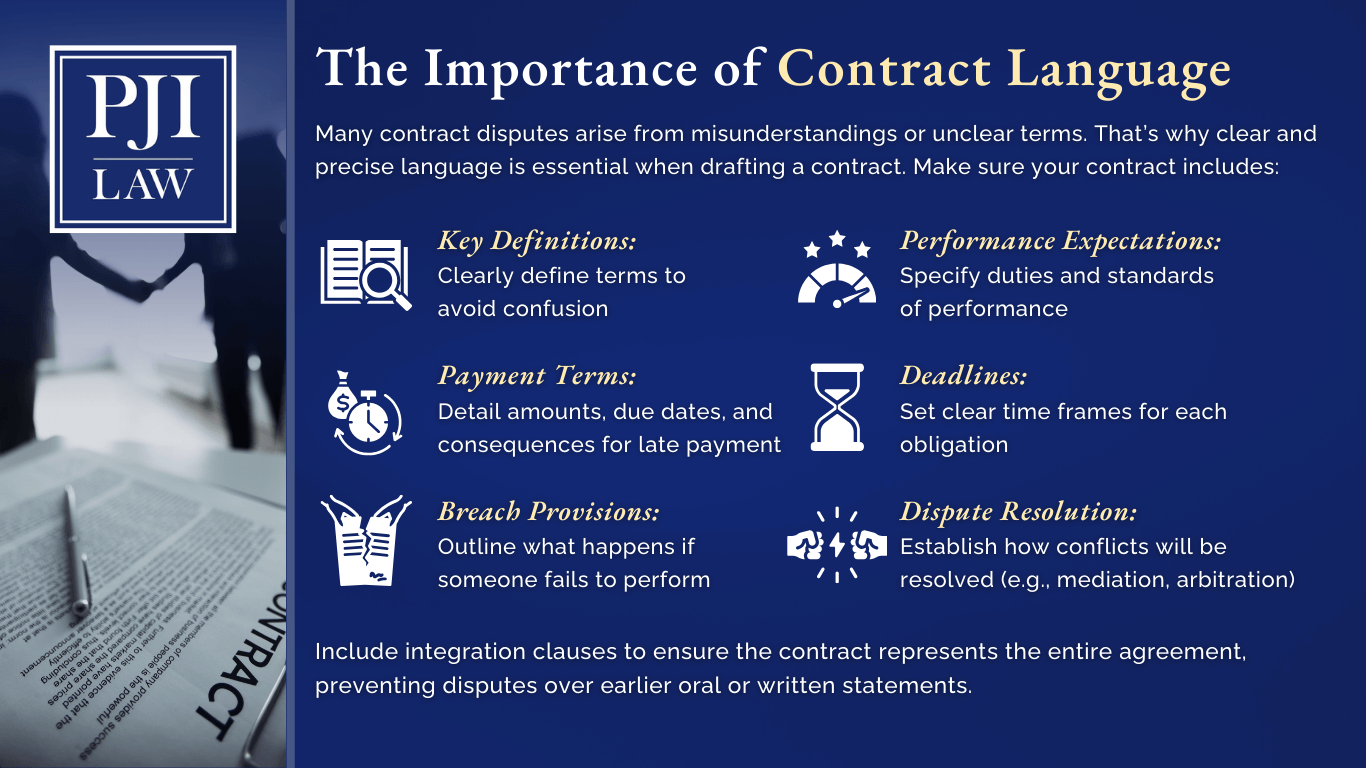
    The-Importance-of-Contract-Language

    Practical Steps When Facing a Breach of Contract

    When a breach of contract situation arises, it’s critical to take the right steps as early as possible, whether you’re the one claiming a breach or facing accusations. Both parties must be proactive in protecting their rights and addressing the issue to prevent further legal complications.

    1. Review the Contract Thoroughly

    If you’re claiming a breach or defending against one, your first step is to carefully review the contract. Make sure you fully understand your rights and obligations, as well as any conditions or clauses that apply. Look for any terms related to a breach, performance standards, dispute resolution, or specific remedies. Understanding what the contract says will help guide your next steps.

    • For the party claiming a breach: Check the terms the other party allegedly violated and ensure the contract clearly outlines what they were supposed to do.
    • For the accused party: Make sure to identify any clauses that might excuse performance, like force majeure, or any provisions that allow you to cure a breach.

    2. Document Everything

    Detailed documentation is crucial for both sides. Keep records of every communication and all actions related to the contract. This includes emails, texts, letters, invoices, work logs, and even verbal agreements that were later confirmed in writing. These records will provide a timeline of events, which can be invaluable if you need to prove your case.

    • For the party claiming a breach: Document all instances where the other party failed to perform or didn’t meet the contract terms.
    • For the accused party: Keep records showing your attempts to perform or any issues you encountered that might justify delays or non-performance.

    3. Communicate with the Other Party

    Often, disputes arise from misunderstandings or miscommunications. Reach out to the other party and try to discuss the issue calmly. Many times, the breach can be resolved through a conversation, potentially avoiding the time and cost of legal action. Be clear about the problem and listen to the other party’s perspective.

    • For the party claiming a breach: Explain the issue and give the other party a chance to remedy it before escalating the situation.
    • For the accused party: Listen carefully to the concerns and see if there’s a way to fix the problem or come to a compromise.

    4. Send a Demand Letter

    If communication doesn’t resolve the issue, your next step should be a formal demand letter. This letter outlines the specific breach, what you expect as a remedy (such as payment, services, or contract termination), and a timeframe for resolving the issue.

    • For the party claiming a breach: Clearly state the breach and what you need to be made whole, such as monetary compensation or specific performance.
    • For the accused party: If you receive a demand letter, respond promptly and see if you can negotiate a solution before the matter escalates.

    5. Explore Dispute Resolution Options

    Explore-Dispute-Resolution-Options

    Before heading straight to court, consider other avenues like mediation or arbitration. These methods can be less adversarial and may offer faster, more cost-effective solutions. Mediation involves a neutral third party helping both sides come to an agreement, while arbitration can result in a binding decision without the need for a full court trial.

    • For the party claiming a breach: Propose alternative dispute resolution if you think it will help resolve the issue quicker and with less expense.
    • For the accused party: Agree to explore these options if you prefer to avoid the stress and cost of court proceedings.

    6. Act Quickly

    Time is critical when dealing with a breach of contract. **Don’t wait too long to take action**, whether you are pursuing a claim or defending against one. Delays could weaken your position, as evidence may be lost, or the statute of limitations may expire.

    • For the party claiming a breach: Start the process early to ensure you’re within the statute of limitations, and that you can still recover damages or enforce the contract.
    • For the accused party: Respond to claims immediately so you can present your defenses before the situation worsens.

    By following these steps, both parties can better protect themselves in a breach of contract situation. Staying organized, communicating effectively, and considering all legal options can lead to faster and less costly resolutions.

    When to Seek Legal Help

    When-to-Seek-Legal-Help

    There comes a point in many contract disputes where legal guidance becomes essential. If informal efforts to resolve the breach fail or if the contract’s terms are complex, seeking professional legal help is often the best course of action. A Fairfax breach of contract lawyer can help you understand your rights, evaluate the strength of your case, and develop a strategy tailored to your situation.

    You should consider legal help If:

    • Negotiations stall: If you’ve tried to resolve the issue directly with the other party but haven’t reached a solution, it may be time to involve a lawyer.
    • The stakes are high: When significant money, property, or business interests are involved, you’ll want professional legal advice to ensure you’re protected.
    • The other party hires a lawyer: If the other side brings in legal representation, it’s usually wise to do the same to ensure a fair outcome.
    • The contract is complicated: Some contracts involve complex legal terms or clauses that are difficult to interpret. An attorney can clarify these terms and help you navigate the legal landscape.
    • Litigation is likely: If you anticipate the dispute going to court, consulting with a lawyer early on can give you a better chance of success.

    An attorney will not only help you assess your legal options but also work to protect your interests, whether that means negotiating a fair settlement or representing you in court. If you’re uncertain about your next steps, don’t hesitate to reach out for legal guidance before the situation escalates further.

    Understanding the elements of breach of contract in Virginia can help you protect your rights. Contracts play a vital role in both personal and business relationships, and knowing how to handle disputes when they arise is key to avoiding bigger problems.

    While many contract disputes can be resolved through negotiation or alternative dispute resolution, legal action may be necessary if these options fail. Acting quickly and with the right knowledge can help you secure the best outcome.

    Looking-for-Fairfax-breach-of-contract-lawyers

    Resolve Your Contract Dispute with PJI Law

    If you’re facing a contract dispute—whether you believe the other party has breached the agreement or you’re defending yourself against a breach claim—PJI Law is here to help. Our experienced Fairfax breach of contract lawyers understand the complexities of contract law in Virginia and can guide you through the entire process.

    We’ll work closely with you to review your contract, identify potential risks, and develop a legal strategy tailored to your situation. Whether it’s negotiating a resolution or pursuing legal action, we’ll be by your side to protect your rights and interests every step of the way.

    Don’t wait until a contract dispute escalates. If you’ve been searching online for a “contract dispute attorney near me,” contact PJI Law instead. You can call us at (703) 865-6100 or complete our confidential online form to schedule your consultation.

    By taking proactive steps to address your contract concerns, you’re investing in the protection of your rights and the success of your business relationships.

    At PJI Law, you’ll receive white glove service and personalized attention!

    Copyright © 2024. PJI Law, PLC. All rights reserved.

    The information in this blog post (“post”) is provided for general informational purposes only and may not reflect the current law in your jurisdiction. No information in this post should be construed as legal advice from the individual author or the law firm, nor is it intended to be a substitute for legal counsel on any subject matter. No reader of this post should act or refrain from acting based on any information included in or accessible through this post without seeking the appropriate legal or other professional advice on the particular facts and circumstances at issue from a lawyer licensed in the recipient’s state, country, or other appropriate licensing jurisdiction.

    PJI Law, PLC
    3900 Jermantown Rd, 2nd Floor
    Fairfax, Virginia 22030
    (703) 865-6100
    https://pjibe.webteam.ai/

  • Richmond Estate Planning Attorneys Explain the Types of Trusts in Virginia

    Richmond Estate Planning Attorneys Explain the Types of Trusts in Virginia

    Richmond natives John and Mary Thompson spent their lives working hard, with dreams of leaving a lasting legacy for their children and grandchildren. They took pride in their small business, modest home, a vacation property in Virginia Beach, a few cherished family heirlooms, and a nest egg that they hoped would support their family for generations. Confident that their assets would naturally transfer to their loved ones, the Thompsons never imagined that after their death, their children would have to deal with the complexities of the probate process and estate taxes in the absence of a proper estate plan.

    Unknown to John and Mary, Virginia offers many types of trusts that could have safeguarded their intentions. Among their three children, their youngest son, David, who has Down syndrome, would have greatly benefited from a special needs trust, which would have secured his lifelong care and financial security without jeopardizing his eligibility for government assistance.

    As John and Mary faced the inevitable challenges of aging, they began to realize that their well-intentioned legacy might not unfold as planned. Hoping it wasn’t too late, they started the estate planning process with a focus on trusts and how they might serve their unique circumstances.

    As the local trust attorneys at PJI Law in Richmond know, trusts are a vital aspect of estate planning. Contrary to a popular myth, anyone who wishes to secure their legacy and provide for their loved ones can benefit from a trust, regardless of the amount of money they have in the bank or their annual salary.

    When established with the help of an experienced estate attorney, trusts can help you manage and protect assets, avoid probate, and minimize taxes. This blog explores the various trust options in Virginia and how certain types can work for you, depending on your specific concerns.

    Have you been searching online for a “trust attorney near me?”

    Contact us at (804) 653-3450 to schedule a consultation. With personalized service and attention, we will listen to your goals, gather the details, and recommend the right trusts for you as part of a comprehensive estate plan.

    Understanding Trusts in Virginia

    A trust is a legal arrangement established by an individual known as the grantor (settlor), that designates an individual, known as the trustee, to hold and manage money and property for any person or persons — the beneficiary or beneficiaries named by the grantor. Once the grantor transfers ownership of an asset into the trust, it belongs to the trust itself, not to the trustee. The grantor can tailor the trust to address their specific goals.

    Revocable Trusts

    Revocable trusts, also called living trusts, are among the most commonly used trusts in Virginia. As the name suggests, the grantor can alter or revoke this kind of trust during their lifetime. An effective tool for managing property and avoiding probate, a revocable trust/living trust provides flexibility and control over your assets. Since the trust is revocable, the assets remain part of the grantor’s estate for tax purposes.

    Benefits of Revocable Trusts/Living Trusts

    • Avoidance of Probate for Certain Property: Assets in a revocable trust bypass the probate process, for a faster and more private distribution of the estate.
    • Continuity of Management: In the event of incapacity, a successor trustee can step in and manage the trust, for seamless asset management.
    • Flexibility: The grantor can modify the trust as needed, adapting to changes in personal circumstances or estate planning goals.

    Richmond, Virginia estate planning attorneys explain the types of trusts available. Call (804) 653-3450 to schedule a consultation.

    Irrevocable Trusts

    Unlike revocable trusts, irrevocable trusts cannot be modified or revoked once established, except under specific legal conditions. An irrevocable trust removes assets from the grantor’s estate, potentially offering significant tax advantages and protection from creditors. You can use an irrevocable trust for various purposes, such as charitable giving, life insurance planning, or asset protection.

    For example, many Virginians choose irrevocable life insurance trusts (ILIT) to set aside funds for estate taxes. An ILIT removes the life insurance policy from the insured person’s estate, reducing potential taxes. The policy’s death benefit is not considered part of the estate and is not subject to estate tax, potentially saving thousands of dollars.

    Benefits of Irrevocable Trusts

    • Tax Benefits: Assets in an irrevocable trust are not subject to estate taxes, which can lead to substantial tax savings upon your death.
    • Asset Protection: Since the grantor no longer owns the assets in an irrevocable trust, it offers greater protection from creditors and legal judgments.
    • Preservation of Public Benefits: Irrevocable trusts can be structured to preserve eligibility for public benefits, such as Medicaid.

    Richmond, Virginia estate planning attorneys explain the types of trusts available. Call (804) 653-3450 to schedule a consultation.

    Testamentary Trusts

    Created through wills, testamentary trusts take effect after the grantor’s death. This trust helps individuals who wish to provide for a minor child or children or allow beneficiaries to receive assets under certain conditions, such as reaching a specific age.

    Benefits of Testamentary Trusts

    • Control Over Inheritance: The grantor can dictate how and when beneficiaries receive their inheritance.
    • Protection for Minors: Assets can be managed by a trustee until the beneficiary reaches maturity.

    Drawbacks of Testamentary Trusts

    • Do Not Avoid Probate: These types of trusts are overseen by the probate court and local commissioner of accounts. The trustee of a testamentary trust is required to file an Inventory and annual Accountings until the trust is fully distributed.
    • Privacy Concerns: As part of probate, both the contents of the testamentary trust and the decedent’s assets become a matter of public record.

    Special Needs Trusts

    A special needs trust provides for individuals with disabilities without jeopardizing their eligibility for government benefits. When you designate a special needs child or individual as the beneficiary, this trust enables them to maintain their quality of life while still qualifying for public assistance.

    Benefits of Special Needs Trusts

    • Preservation of Benefits: Trust assets do not count towards eligibility for Supplemental Security Income (SSI) or Medicaid.
    • Quality of Life Enhancements: Funds can be used for medical care, education, and other personal needs not covered by public benefits.

    Charitable Trusts

    Charitable trusts allow individuals to support charitable organizations while enjoying tax benefits. There are two primary types of charitable trusts: charitable remainder trusts and charitable lead trusts.

    Charitable Remainder Trust

    A charitable remainder trust (CRT) lets you achieve your personal and philanthropic goals. You simply transfer assets into the trust, providing a steady income to yourself or other beneficiaries for a designated period – or even for their entire lifetime. Once that period ends, the trust distributes the remaining assets to your chosen charitable organization.

    Charitable Lead Trust

    A charitable lead trust (CLT) first gives a portion of the trust income to a charity for a specified amount of time. After that period ends, the trust pays the remaining funds to you or your heirs.

    Benefits of Charitable Trusts

    • Tax Deductions: Donors may receive income tax deductions for contributions to the trust.
    • Support for Causes: These trusts enable donors to support causes they care about while potentially reducing estate taxes.

    Richmond, Virginia estate planning attorneys explain the types of trusts available. Call (804) 653-3450 to schedule a consultation.

    Spendthrift Trusts

    Spendthrift trusts protect beneficiaries from creditors and their own potentially imprudent spending habits. The trustee controls the distribution of trust funds so that the assets serve the beneficiary’s best interest.

    Benefits of Spendthrift Trusts

    • Creditor Protection: Beneficiaries cannot sell or pledge their interest in the trust to creditors.
    • Financial Management: Trustees can manage funds prudently, preventing misuse by the beneficiary.

    Qualified Personal Residence Trusts (QPRTs)

    QPRTs are specialized irrevocable trusts that allow individuals to transfer their residences to beneficiaries at a reduced gift tax value. The grantor retains the right to live in the home for a specified period, after which the property passes to the beneficiaries.

    Benefits of QPRTs

    • Gift Tax Reduction: The value of the gift is reduced, potentially minimizing gift taxes.
    • Estate Tax Savings: By removing the home from the estate, QPRTs can lead to estate tax savings.

    Qualified Terminable Interest Property Trusts (QTIP)

    These trusts provide income for a surviving spouse and ensure that the remaining assets go to each beneficiary designated by the grantor after the spouse passes away.

    Benefits of QTIPs

    • Surviving Spouse Protection: The surviving spouse receives income from the trust for life, giving them financial security.
    • Control over Asset Distribution: The grantor can specify how and when assets will pass to other beneficiaries after the surviving spouse’s death.

    Pet Trusts

    With a pet trust, you can care for your cherished pets after you pass away by designating a trustworthy individual or individuals to take responsibility for them.

    Benefits of Pet Trusts

    • Peace of Mind: Knowing that your pets will be cared for after your passing can bring peace of mind.
    • Pet’s Best Interest: You can specify how you want your pet to be taken care of and prioritize their best interests.
    • Avoid Family Disputes: Pet trusts can prevent potential disagreements among family members about who should take responsibility for the pet.

    Richmond, Virginia estate planning attorneys explain the types of trusts available. Call (804) 653-3450 to schedule a consultation.

    Generation-Skipping Trusts

    A generation-skipping trust (GST) is a strategic estate planning tool designed to minimize estate taxes across multiple generations. These trusts transfer assets to the grantor’s grandchildren and bypass their children to reduce any inheritance complications and preserve long-term wealth. The primary benefit of a GST is the ability to leverage its federal tax exemption. Each individual can allocate a certain amount, indexed for inflation, to a GST without incurring the federal generation-skipping transfer tax. This exemption allows substantial amounts of wealth to be passed down without being eroded by taxes at each generational transfer.

    Benefits of Generation-Skipping Trusts

    • Wealth Preservation: By skipping a generation, these trusts protect assets from estate taxes twice.
    • Avoidance of Probate: Trust assets pass directly to the grandchildren, avoiding the costly and time-consuming probate process.

    Which Type of Trust is Best for Me – Living Trusts or Irrevocable Trusts?

    Experienced Richmond estate planning lawyers know that choosing the right type of trust depends on your individual goals and circumstances. When you consult a knowledgeable lawyer, they will guide you through the process and help you make informed decisions. At PJI Law, we have extensive experience in creating customized trusts that meet our clients’ unique needs.

    Contact PJI Law, Your Estate Planning Lawyers in Richmond, for Help Creating a Trust

    Whether you’re considering a living trust or an irrevocable trust, work with an experienced estate planning attorney. Because trusts are complex legal documents, consulting a Richmond attorney with profound knowledge of state and federal laws will help you structure your trust properly so that it serves its intended purpose. An attorney can also help you navigate any potential tax implications.

    PJI Law understands that every client’s situation is unique. Our team of experienced estate planning lawyers is dedicated to creating trusts and other legal tools tailored for you. Whether you want to protect your money, property, and other assets, provide for loved ones, or support charitable causes, we will take the time to listen and design a trust that meets your specific needs and goals.

    Schedule a consultation today at (804) 653-3450 or complete our online form. With personalized service and attention, we will help you preserve your future and legacy.

    Copyright © 2024. PJI Law, PLC. All rights reserved.

    The information in this blog post (“post”) is provided for general informational purposes only and may not reflect the current law in your jurisdiction. No information in this post should be construed as legal advice from the individual author or the law firm, nor is it intended to be a substitute for legal counsel on any subject matter. No reader of this post should act or refrain from acting based on any information included in or accessible through this post without seeking the appropriate legal or other professional advice on the particular facts and circumstances at issue from a lawyer licensed in the recipient’s state, country, or other appropriate licensing jurisdiction.

    PJI Law, PLC
    4108 E Parham Rd,
    Richmond, VA 23228
    (804) 653-3450
    https://pjibe.webteam.ai/

  • What Is an Independent Contractor Agreement in Virginia?

    What Is an Independent Contractor Agreement in Virginia?

    As the business landscape continues to evolve, many companies in Virginia are increasingly turning to independent contractors to supplement their workforce on an as-needed basis. This flexible model offers numerous advantages, from cost savings to enhanced agility. However, formalizing these working relationships through an independent contractor agreement is crucial for protecting both parties and ensuring a successful partnership.

    An independent contractor agreement is a legally binding document that outlines the terms, responsibilities, and expectations of the contractor-client relationship. Whether you’re a small business owner, a freelancer, or an enterprise-level organization, understanding the purpose and key components of these agreements is essential in today’s ever-evolving business world.

    In this comprehensive guide, we’ll explore the defining characteristics of independent contractor agreements, discuss the essential elements of a well-crafted agreement, and highlight the legal requirements and potential pitfalls to avoid. By the end, you’ll have a clear roadmap for leveraging this useful tool to support your business goals and empower your workforce.

    Fairfax, VA attorney explains an independent contractor agreement, and who needs one in Virginia. Call (703) 865-6100 to schedule a consultation.

    What Exactly Is an Independent Contractor Agreement?

    An independent contractor agreement is a legal contract that defines the working relationship between a company (the “hiring party”) and an individual or business (the “independent contractor”). Unlike an employment agreement, which governs the terms of a traditional employer-employee dynamic, an independent contractor agreement outlines the specific services the contractor will provide, the compensation they will receive, and the parameters under which they will operate.

    In simple terms, an independent contractor agreement is a way to formally document an arrangement where an individual or business is hired to perform a defined scope of work, rather than being an employee of the company. This type of agreement provides clarity for both parties and helps ensure a mutually beneficial relationship.

    If you’re considering engaging an independent contractor or have been asked to sign such an agreement, it’s highly recommended to consult an independent contractor attorney in Virginia. They can review the contract terms, ensure compliance with state laws, and help you understand your rights and obligations as either the hiring party or the independent contractor.

    Fairfax, VA attorney explains an independent contractor agreement, and who needs one in Virginia. Call (703) 865-6100 to schedule a consultation.

    Key Differences Between Employees and Independent Contractors

    While both employees and independent contractors provide services to a company, there are several critical distinctions between these two working relationships:

    Control and Supervision:

    • Employees work under the direct control and supervision of their employer.
    • Independent contractors have a greater degree of autonomy in how they perform their work.

    Taxes and Benefits:

    • Employers are responsible for withholding taxes and providing benefits for employees.
    • Independent contractors are self-employed and must handle their own tax obligations and benefits.

    Work Schedule:

    • Employees generally have a set work schedule and hours.
    • Independent contractors have more flexibility in determining their own schedule and work hours.

    Termination:

    • Employees can generally only be terminated for cause or through proper procedures.
    • Independent contractor agreements can be terminated more easily, as specified in the contract.

    Ensuring you properly classify the nature of your working relationships is essential. Misclassifying an employee as an independent contractor can have serious legal and financial consequences. Consulting a legal contract lawyer in Virginia can help you navigate these nuances and structure the appropriate agreements.

    Determining if Your Relationship Qualifies as an Independent Contractor Arrangement

    Distinguishing between an employee and an independent contractor relationship is not always straightforward. There are a number of factors that courts and government agencies use to evaluate the true nature of a working arrangement. Some of the key considerations include:

    Control and Independence:

    • The degree of control the hiring party has over the worker’s performance and schedule
    • The worker’s ability to exercise independent judgment and discretion

    Financial Relationship:

    • Who provides the necessary tools, equipment, and supplies
    • How the worker is compensated (e.g., by the project, hourly, or salaried)

    Permanence of the Relationship:

    • Whether the work is temporary or ongoing
    • If the worker has other clients or is exclusively working for the hiring party

    If you’re unsure whether your situation qualifies as an independent contractor arrangement, it’s highly recommended to consult a contract lawyer. They can review the specific details of your working relationship and provide guidance on the appropriate classification and contractual terms.

    Navigating the Legal Requirements for Independent Contractors in Virginia

    In addition to the general considerations around employee classification, companies engaging independent contractors in Virginia must also be mindful of the specific legal requirements governing these working relationships. From business licensing to tax obligations, there are a number of compliance factors to keep in mind.

    For example, Virginia requires independent contractors to obtain a business license and register for state and federal tax IDs. There are also regulations around worker’s compensation coverage and unemployment insurance that may apply, depending on the nature of the contract. Failure to properly adhere to these legal obligations can expose the hiring company to penalties and liabilities.

    A legal contract lawyer well-versed in Virginia’s independent contractor laws can help you navigate these complexities. They can ensure the agreement is structured to comply with all relevant statutes and regulations, protecting both the company and the contractor. This level of legal experience is invaluable in establishing a robust, compliant independent contractor relationship.

    Protecting Your Business Interests with a Well-Crafted Agreement

    Engaging an independent contractor without a formal, written agreement in place can leave your business vulnerable. From undefined scopes of work to unclear ownership of intellectual property, operating without a proper contract opens the door to potential disputes and legal complications down the line.

    A well-crafted independent contractor agreement is essential for safeguarding your company’s interests. By outlining the specific terms, responsibilities, and parameters of the working relationship, you can ensure both parties have a clear understanding of their obligations and protect critical business assets.

    Investing the time upfront to develop a comprehensive agreement is a small price to pay compared to the headaches and costs that can arise from a poorly structured or nonexistent contract. Don’t leave your business exposed.

    Fairfax, VA attorney explains an independent contractor agreement, and who needs one in Virginia. Call (703) 865-6100 to schedule a consultation.

    Essential Elements to Include in a Virginia Independent Contractor Agreement

    When drafting an independent contractor agreement in Virginia, there are several key elements that should be included to ensure a comprehensive and legally sound document:

    • Scope of Work: Clearly define the specific services the contractor will provide, including any deliverables, milestones, and deadlines.
    • Compensation: Outline the payment terms, such as hourly rate, project-based fees, or commission structure, as well as any expense reimbursement policies.
    • Term and Termination: Specify the duration of the agreement and the conditions under which it can be terminated by either party.
    • Intellectual Property: Ensure proper assignment of ownership for any intellectual property, such as copyrights or patents, developed during the engagement.
    • Confidentiality: Include non-disclosure and non-compete clauses to protect your company’s sensitive information and competitive advantage.
    • Insurance and Liability: If necessary, determine the required insurance coverage and allocate liability for the contractor’s actions.
    • Miscellaneous Provisions: Address other important legal considerations, like dispute resolution, governing law, and independent contractor status.

    Working closely with an independent contractor attorney in Virginia can help ensure your agreement addresses all the necessary elements and aligns with state-specific regulations, and give you the peace of mind that your business interests are properly safeguarded.

    Common Mistakes to Avoid When Drafting Independent Contractor Contracts

    Entering into an independent contractor relationship without a properly structured agreement can expose your business to a variety of legal and financial risks. To ensure your independent contractor contracts are bulletproof, it’s important to be aware of the common pitfalls to avoid:

    Failing to Clearly Define the Scope of Work

    A vague or overly broad scope of work can lead to misunderstandings and disputes over the contractor’s deliverables and responsibilities. Be sure to spell out the specific services, project milestones, and expected outcomes in clear, unambiguous language.

    Neglecting to Address Intellectual Property Rights

    Independent contractors may create valuable intellectual property, such as designs, software code, or proprietary information, during the course of their work. Failing to properly assign ownership rights can result in costly legal battles down the line.

    Omitting Confidentiality and Non-Compete Clauses

    Protecting your company’s confidential information and guarding against unfair competition are critical considerations. Comprehensive non-disclosure and non-compete provisions should be included to safeguard your business interests.

    Improper Classification of the Worker’s Status

    Misclassifying an employee as an independent contractor can carry significant legal and financial penalties. Ensure your agreement accurately reflects the nature of the working relationship based on factors like control, autonomy, and financial arrangements.

    Neglecting to Address Liability and Insurance

    Depending on the industry in which they operate, some independent contractors must carry their own liability insurance to protect against potential claims or lawsuits arising from their work. Your contract should clearly outline these requirements and delineate the allocation of risk.

    Relying on a One-Size-Fits-All Template

    Every independent contractor engagement is unique, with its own set of nuances and requirements. Attempting to use a generic contract template without tailoring it to your specific situation is a recipe for trouble.

    To avoid these pitfalls and draft truly robust independent contractor agreements, it’s highly recommended to work with an experienced contract lawyer.

    Fairfax, VA attorney explains an independent contractor agreement, and who needs one in Virginia. Call (703) 865-6100 to schedule a consultation.

    When Is It Time to Seek Legal Assistance for Your Independent Contractor Needs?

    Navigating the complexities of independent contractor agreements can be challenging, even for seasoned business owners. If you’re unsure about any aspect of the contracting process or have concerns about protecting your company’s interests, it’s always better to err on the side of caution and consult a legal professional. An experienced independent contractor attorney can provide invaluable guidance to ensure your independent contractor relationships are properly structured and compliant with Virginia laws and regulations.

    PJI Law: Your Virginia Independent Contractor Attorney

    Navigating the complexities of an independent contractor agreement can be a daunting task, but you don’t have to go it alone. At PJI Law, our experienced contract lawyer is here to provide the guidance you need.

    As your trusted legal partner, we’ll work closely with you to carefully review any independent contractor agreement language, ensuring it aligns with your best interests and the applicable laws in your state. Our team is well-versed in the nuances of contractor relationships, and we’ll leverage that experience to identify potential pitfalls, negotiate favorable terms, and give you the peace of mind that your business interests are properly protected.

    Whether you’re a company seeking to implement a comprehensive independent contractor agreement or an individual presented with such an agreement, PJI Law can help you make informed decisions that safeguard your rights and responsibilities. We understand the complexities involved in these contractual relationships, and can provide you with the necessary guidance to ensure a fair and mutually beneficial arrangement.

    Call us at (703) 865-6100 or complete our online form to schedule your consultation. 

    Copyright © 2024. PJI Law, PLC. All rights reserved.

    The information in this blog post (“post”) is provided for general informational purposes only and may not reflect the current law in your jurisdiction. No information in this post should be construed as legal advice from the individual author or the law firm, nor is it intended to be a substitute for legal counsel on any subject matter. No reader of this post should act or refrain from acting based on any information included in or accessible through this post without seeking the appropriate legal or other professional advice on the particular facts and circumstances at issue from a lawyer licensed in the recipient’s state, country, or other appropriate licensing jurisdiction.

    PJI Law, PLC
    3900 Jermantown Rd, 2nd Floor
    Fairfax, Virginia 22030
    (703) 865-6100
    https://pjibe.webteam.ai/