Category: Blog

  • Can a Revocable Trust Be Changed in Northern Virginia?

    Can a Revocable Trust Be Changed in Northern Virginia?

    As life evolves, so do our needs and circumstances, making flexibility a critical aspect of estate planning. As an experienced estate planning attorney knows, a revocable trust, also known as a revocable living trust, offers adaptability, among many other benefits, for individuals seeking to care for future generations.

    Can a revocable trust be changed in Fairfax County and Northern Virginia? 

    Yes, this estate planning tool offers the flexibility our clients in Northern Virginia seek. This blog, from a knowledgeable trusts attorney, explains how these trusts work, why they’re beneficial, and how to change them when needed.

    What Is a Revocable Living Trust?

    A revocable living trust is a legal arrangement that allows the trust creator, known as the settlor or grantor, to transfer assets like money and property into the trust during their lifetime. The settlor designates a trustee to manage these assets according to the settlor’s wishes and distribute the assets based on the settlor’s instructions in the trust upon the settlor’s death.

    As we mentioned, one of the defining features of a revocable living trust is its flexibility. Unlike irrevocable trusts — which settlors cannot change or revoke once they establish them— revocable trusts give you the flexibility to make adjustments as your circumstances dictate.

    Benefits of a Revocable Trust

    An estate planning attorney may recommend a revocable trust for several reasons, depending on a client’s circumstances, wishes, and best interests:

    1. Avoid Probate: Assets in a revocable trust bypass probate court and the probate process, passing assets privately and more efficiently to your beneficiaries.
    2. Asset Management & Control: You can serve as the trustee, or choose the right individual to assume the responsibility. Either way, you have authority over the assets during your lifetime, according to the terms you include in the trust.
    3. Flexibility: The ability to modify or revoke the trust adapts to life’s changes, such as marriages, births, or financial circumstances, protecting your family’s future.
    4. Privacy: Unlike wills, which become public record during probate, trusts remain private.
    5. Peace of Mind for You & Your Family: Knowing you have placed instructions for asset management according to your wishes in a legally binding document offers significant reassurance.

    Common Reasons for Amending a Revocable Trust

    Life’s changes often necessitate adjustments to your estate plan. At our law firm in Fairfax County, clients often choose to modify their revocable trusts for the following reasons:

    • New Beneficiaries: Perhaps you’ve welcomed a new child or grandchild, and you’d like to update your trust to include them.
    • Removed Beneficiaries: Changes in relationships may mean certain individuals should no longer be beneficiaries.
    • Trustee Updates: You may want to appoint a new trustee or successor trustee if your initial choice is no longer appropriate.
    • Asset Adjustments: If you acquire or sell significant assets, you’ll want the trust to reflect these changes.
    • Estate Taxes, State Law & Law Changes: Changes in estate taxes and federal or state tax laws might necessitate updates to your trust to maximize its financial benefits.

    A revocable trust allows you to respond to these life changes and align your estate plan with your current goals.

    How to Change a Revocable Trust in Northern Virginia

    At PJI Law, our estate planning services include helping our clients modify a revocable trust. With the right legal assistance, it’s a straightforward process.

    1. Review the Trust Document

    Carefully review the terms of your existing trust as the foundation for identifying what changes you would like to make.

    2. Consult an Estate Planning Attorney

    These important decisions require collaboration with an experienced Northern Virginia estate planning attorney, due to the complexity of trust laws. To avoid future legal issues, all changes must comply with state and federal law.

    At PJI Law, we offer personalized guidance to help you determine the best course of action, whether it involves minor tweaks or more significant revisions.

    3. Draft an Amendment or Restatement

    • Amendment: If you’re making small changes to your trust, such as adjusting beneficiaries or updating the trustee, we often use an amendment, a document that outlines the specific changes without altering the rest of the trust.
    • Restatement: For more comprehensive updates, you may want to create a restatement of trust. This process involves rewriting the trust document in its entirety while retaining the original trust name and date. This approach creates clarity and eliminates confusion caused by multiple amendments over time.

    4. Sign and Notarize

    Once you and your attorney have prepared the changes, you’ll need to sign the amendment or restatement before a notary public to formalize and legally bind the updates.

    5. Notify Relevant Parties

    Depending on the changes, you may need to inform your trustees, financial institutions, and other involved parties. For example, if you’ve updated the trustee, the successor trustee will need to be aware of their new role.

    6. Revisit Funding

    If the changes involve adding or removing assets, you must properly fund the trust. Any assets not transferred to the trust may still need to go through probate, defeating one of the benefits of the trust.

    7. Store the Updated Trust Safely

    Keep your updated trust documents in a secure location, such as a fireproof safe, and inform your trustee and significant family members of their whereabouts so that they can find them in case of an emergency or death.

    The Importance of Professional Estate Planning Guidance

    While a revocable trust offers convenience and flexibility among estate planning documents, you must handle modifications correctly. Working with a skilled estate planning attorney offers many benefits:

    • Legal Compliance: Your attorney will make every change to your trust in compliance with Virginia laws and regulations.
    • Clarity: Your attorney will help you avoid ambiguity that could lead to disputes among beneficiaries.
    • Efficiency: An estate planning law firm makes the process smoother, saving you time and reducing stress.

    At PJI Law, we take pride in helping our clients preserve their legacies and protect their loved ones. Our thorough, customized approach to every detail of your trust meets your needs and passes legal scrutiny.

    Why Choose PJI Law for Your Estate Planning Needs?

    Changing a revocable trust is a significant decision requiring precision and knowledge. At PJI Law in Fairfax, VA, we deliver white-glove service designed to make this process and the overall estate planning process as seamless as possible.

    • Personalized Attention: We understand the uniqueness of every client’s situation and invest the time to understand your goals and recommend solutions tailored to your needs.
    • Experienced Guidance: Our team has extensive experience in estate planning and a commitment to helping Northern Virginia families.
    • High-Touch Service: We guarantee prompt communication and inform you every step of the way.
    • Commitment to Excellence: Our detail-oriented team executes estate planning documents flawlessly and fully aligned with your wishes.

    Whether you need to modify your existing trust or begin your estate planning from scratch, an estate planning lawyer from PJI Law will guide you through this complex process.

    Schedule an Initial Consultation at PJI Law

    A revocable trust is an indispensable estate planning tool for anyone seeking flexibility and control over their assets. If it no longer matches your current circumstances or goals, you can update it with relative ease.

    Have you been typing “trust attorneys,” “trust attorney near me,” or “estate planning attorneys” into your search bar? 

    At PJI Law, we help families across Northern Virginia protect their assets and secure their legacies. Our practice areas include Fairfax wills, power of attorney (POA) documents, irrevocable trusts, and revocable trusts. Depending on your circumstances, we may also discuss options like charitable trusts, a special needs trust, a pet trust, and other estate planning tools.

    Contact us today at (703) 865-6100 or complete our online form to schedule a free initial consultation to discuss your estate planning needs.

    At PJI Law, you’ll receive personalized service and attention! 

    Copyright © 2025. PJI Law, PLC. All rights reserved.

    The information in this blog post (“post”) is provided for general informational purposes only and may not reflect the current law in your jurisdiction. No information in this post should be construed as legal advice from the individual author or the law firm, nor is it intended to be a substitute for legal counsel on any subject matter. No reader of this post should act or refrain from acting based on any information included in or accessible through this post without seeking the appropriate legal or other professional advice on the particular facts and circumstances at issue from a lawyer licensed in the recipient’s state, country, or other appropriate licensing jurisdiction.

    PJI Law, PLC
    3900 Jermantown Rd, 2nd Floor
    Fairfax, Virginia 22030
    (703) 865-6100
    https://pjibe.webteam.ai/

  • The Differences Between a General Power of Attorney and Durable Power of Attorney in Richmond, Virginia

    The Differences Between a General Power of Attorney and Durable Power of Attorney in Richmond, Virginia

    Faced with life’s uncertainties, many people in Richmond, Virginia, wisely seek the services of a lawyer to prepare the appropriate legal documents to protect themselves and their loved ones. A power of attorney (POA), a legal arrangement that grants someone you trust the authority to act on your behalf in specific circumstances or when you cannot make your own decisions, remains one of the most critical tools for planning.

    Virginia residents can create a general power of attorney and durable power of attorney. But what does each one do?

    This blog, from a knowledgeable Richmond lawyer, explores the fundamental differences between these POAs, their uses, and when they might be suitable, based on each person’s unique circumstances and goals. We’ll also highlight the importance of consulting an experienced lawyer to tailor these documents to fulfill your goals and comply with Virginia law.

    The Differences Between a General Power of Attorney and Durable Power of Attorney in Richmond, Virginia

    What Is a Power of Attorney?

    A power of attorney is a legal document that allows an individual (the principal) to appoint someone else (the agent or attorney-in-fact) to make decisions or act on their behalf. The scope and duration of the agent’s or attorney-in-fact’s authority depends on the type of POA and the instructions it contains.

    For residents in and around Richmond, Virginia, a POA can simplify handling personal, financial, and even legal matters during times when the principal cannot handle them. However, the terms of POA documents can vary.

    General Power of Attorney

    A general power of attorney (GPOA) grants broad authority to the agent to handle various tasks on behalf of the principal, which can include managing financial matters, conducting business operations, signing agreements, or purchasing property.

    Features of a General Power of Attorney

    • Scope of Authority: The agent can perform numerous actions as outlined in the document, from paying bills and managing investments to conducting real estate transactions.
    • Timeframe: Typically, a general power of attorney remains valid only as long as the principal retains the mental capacity to make decisions. If the principal becomes incapacitated, whether due to illness, injury, or other reasons, a GPOA automatically terminates.
    • Purpose: Virginia residents often use this arrangement for short-term needs, such as when the principal is traveling or temporarily unable to handle their affairs due to circumstances like military deployment.

    Example Scenario for a General Power of Attorney

    Imagine Ben, a Richmond resident, is leaving for an extended work assignment overseas. Worried he’ll be unable to manage his financial transactions while abroad, he executes a GPOA that allows his trusted friend to oversee his banking and pay his bills. However, if Ben were to become incapacitated, it would render the document invalid, leaving his affairs unmanageable without further legal action.

    The Differences Between a General Power of Attorney and Durable Power of Attorney in Richmond, Virginia

    Durable Power of Attorney

    By contrast, a durable power of attorney (DPOA) remains effective even if the principal becomes incapacitated, making it a critical tool in estate planning and long-term personal care planning.

    Features of a Durable Power of Attorney

    • Lasting Authority: A DPOA remains in effect if the principal becomes unable to manage their own affairs due to mental or physical incapacity.
    • Broad Applications: Much like a GPOA, a DPOA can authorize the agent to undertake an array of financial, legal, and personal tasks.
    • Health Care Provisions: Durable POAs often manage medical decisions when used in conjunction with a health care POA or advance medical directive.
    • Customizable Options: With the help of an attorney, a Virginia resident can tailor the document to include specific instructions, such as which powers the agent can exercise and under what conditions.

    Example Scenario for a Durable Power of Attorney

    Consider Sarah, a retired Richmond teacher, concerned about future health issues that could make it impossible for her to manage her finances. With the help of her attorney, she sets up a DPOA granting her daughter authority to pay bills, manage investments, and even make healthcare-related decisions. If Sarah develops dementia or another incapacitating condition, the DPOA keeps her daughter’s authority to act on her behalf intact, avoiding costly legal delays.

    Understanding the Core Differences

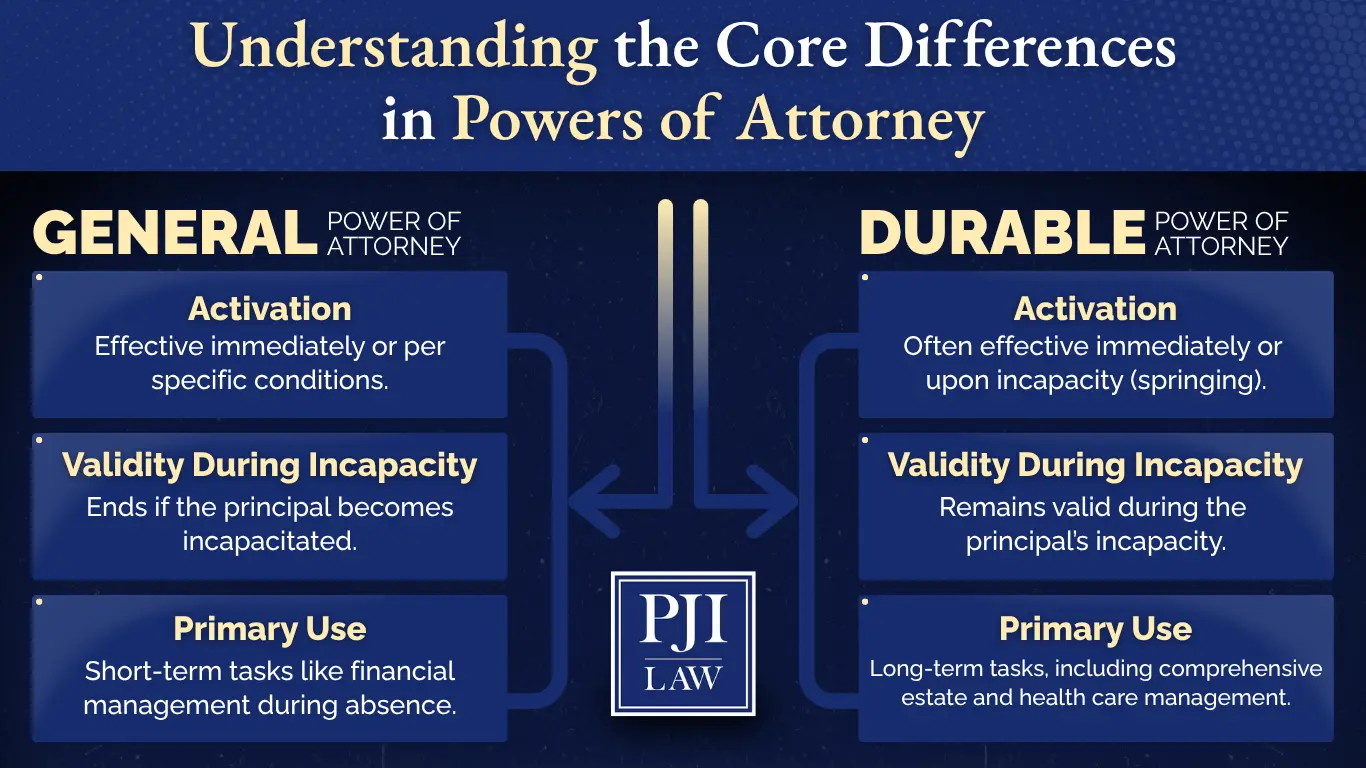
    Although the General POA and Durable POA authorize an agent to handle certain duties for the principal, their most significant difference lies in when the authority ends.

    Feature General Power of Attorney Durable Power of Attorney
    Activation Effective immediately or per specific conditions. Often effective immediately or upon incapacity (springing).
    Validity During Incapacity Ends if the principal becomes incapacitated. Remains valid during the principal’s incapacity.
    Primary Use Short-term tasks like financial management during absence. Long-term tasks including comprehensive estate and health care management.

    When Should You Use Each Type of POA?

    Deciding which POA suits you depends on your individual circumstances and goals.

    Choose a General POA When:

    • You need short-term help with financial or legal matters due to travel, military deployment, or other temporary unavailability.
    • You’re entirely confident in your ability to actively oversee the tasks being handled by your agent.
    • Incapacity concerns are not an issue, or you plan to revoke the POA before they arise.

    Create a Durable POA When:

    • You want a comprehensive, long-term solution to meet your legal, financial, and personal needs.
    • You’re planning for the possibility of incapacitation due to aging, medical issues, or unexpected accidents.
    • Your estate plan prioritizes continuity and seeks to avoid court intervention through guardianship or conservatorship.

    The Differences Between a General Power of Attorney and Durable Power of Attorney in Richmond, Virginia

    Tailoring a POA for Your Needs

    Because POA documents grant significant authority over your affairs, you want to tailor them specifically to your circumstances.

    How PJI Law Can Help

    At PJI Law, our team focuses on establishing legally sound and personalized POA documents by:

    1. Listening to Your Needs: We take the time to understand your unique goals, family dynamics, and concerns.
    2. Offering Tailored Guidance: Based on your situation, we help determine whether a General POA, Durable POA, or both are right for you.
    3. Complying with Virginia Laws: Your documents will fulfill every necessary standard, due to our in-depth knowledge of Virginia’s legal requirements.
    4. Providing Ongoing Support: Life is unpredictable, and circumstances change. We’re here to update or adjust your POA documents as your needs evolve.

    Frequently Asked Questions About Virginia POAs

    What is the main difference between a General and Durable Power of Attorney?

    The main difference is how the two documents operate if the principal becomes incapacitated. A general power of attorney ends if the principal is no longer mentally competent, while a durable power of attorney remains in effect, allowing the agent to continue managing the principal’s financial affairs or healthcare decisions.

    What does a Durable Power of Attorney typically handle?

    A durable power of attorney can include financial powers such as managing bank accounts, handling bills, or overseeing investments. When coupled with an Advanced Medical Directive, your agent can be vested with medical powers, enabling them to make healthcare decisions on behalf of the principal if they cannot communicate their wishes.

    When does a Power of Attorney document take effect?

    Virginia residents can structure a POA to take effect immediately upon signing or to become active upon a future event, such as the principal’s incapacitation. For instance, a “springing” POA takes effect only when the principal is deemed incapacitated, as specified in the document.

    Can I customize the powers granted in the POA?

    You can assign specific powers to your agent, whether for financial matters, healthcare decisions, or both. Working with an estate planning attorney aligns these powers with your wishes and complies with Virginia law.

    What is a successor agent?

    A successor agent is an individual designated in a POA document to step in if the primary agent is unable or unwilling to perform their duties to maintain continuity in your financial affairs, healthcare decisions, or other matters according to your wishes. Assigning a successor agent adds an extra layer of security and continuity, preventing disruptions if the original agent cannot serve.

    How do I get financial institutions to honor my POA?

    You should keep the original POA document in a safe place and provide certified copies to the relevant parties. Because banks or other institutions may require specific verifications, it’s wise to consult an estate planning attorney for assistance.

    What should I consider when choosing an agent for my POA?

    Choose a trustworthy individual who understands your goals and wishes. For financial powers, the agent should have strong organizational skills and financial knowledge. For medical powers, select someone capable of advocating for your healthcare preferences during stressful situations.

    Can I revoke or amend my Power of Attorney?

    Yes, as long as you are mentally competent, you can revoke or amend your POA at any time. It’s important to notify all relevant parties, including financial institutions, of the change and establish proper documentation.

    Should everyone have both types of POA?

    Not necessarily. Whether you need a general, durable, or both types of POA depends on your specific circumstances. Consulting an estate planning attorney can help you determine the right options based on your financial affairs, health concerns, and overall goals.

    Why is it important to work with an estate planning attorney for a POA?

    An estate planning attorney will create a POA that complies with Virginia law, protects your interests, and clearly outlines specific powers for your agent, reducing the risk of disputes, mismanagement, or invalidation of the document.

    The Differences Between a General Power of Attorney and Durable Power of Attorney in Richmond, Virginia

    Contact PJI Law in Richmond to Create Your Virginia Power of Attorney 

    Life is full of surprises. Preparing for a future date when you could become incapacitated or otherwise unable to handle your business, healthcare, or personal affairs protects you and your loved ones. 

    Have you been typing “estate planning lawyer near me,” “POA in Virginia,” or “Virginia power of attorney” into your search bar? 

    Whether you need a general power of attorney for short-term matters or a durable power of attorney for comprehensive and long-term security, a knowledgeable lawyer from PJI Law will explain your options, prepare the proper power of attorney form in compliance with Virginia law, and give you peace of mind.

    Contact PJI Law today at (804) 653-3450 or complete our online form to schedule a free consultation and receive personalized service and attention.

    Copyright © 2025. PJI Law, PLC. All rights reserved.

    The information in this blog post (“post”) is provided for general informational purposes only and may not reflect the current law in your jurisdiction. No information in this post should be construed as legal advice from the individual author or the law firm, nor is it intended to be a substitute for legal counsel on any subject matter. No reader of this post should act or refrain from acting based on any information included in or accessible through this post without seeking the appropriate legal or other professional advice on the particular facts and circumstances at issue from a lawyer licensed in the recipient’s state, country, or other appropriate licensing jurisdiction.

    PJI Law, PLC
    4108 E Parham Rd, 
    Richmond, VA 23228
    (804) 653-3450
    https://pjibe.webteam.ai/

  • Can You Put Retirement Accounts in a Trust in Virginia?

    Can You Put Retirement Accounts in a Trust in Virginia?

    Planning your estate is personal. It isn’t just about money or documents. It’s about the people you care about and what will happen to them after you’re gone. One of the common questions people ask is, “Can you put retirement accounts in a trust?” The answer isn’t simple, and doing it the wrong way could have serious consequences for your family.

    In this blog, you’ll learn how Virginia treats retirement accounts in estate planning, whether you can name a trust as a beneficiary, and what to watch out for when making these decisions.

    Can You Put a Retirement Account Into a Trust?

    Transferring a retirement account like an IRA or 401(k) into a trust during your lifetime is usually not recommended. Doing so would trigger a taxable event, since these accounts are tied to you as an individual and offer tax-deferred or tax-free growth. Transferring ownership to a trust is considered a distribution by the IRS. That could mean:

    • Immediate income tax liability
    • A 10% early withdrawal penalty if you’re under age 59½

    However, you can name a trust as the beneficiary of your retirement account. When you pass away, the account will transfer to the trust, not directly to a person. This allows the trust to control how and when the money is distributed.

    When Naming a Trust as Beneficiary Makes Sense

    There are several reasons you might choose to name a trust as the beneficiary of your retirement accounts:

    • You have minor children or young adult beneficiaries
    • You’re providing for someone with special needs
    • You’re in a blended family
    • You want to protect assets from creditors or poor spending habits
    • You want to avoid probate and keep the terms of the trust private

    For example, suppose you leave your IRA directly to your 19-year-old child; they could take the full amount immediately and spend it however they like. But if your trust is the beneficiary, the trustee controls the timing and purpose of the distributions.

    In the case of a special needs beneficiary, a properly drafted special needs trust can receive retirement account distributions without affecting the person’s eligibility for benefits like Medicaid or SSI. For example, suppose you name a special needs trust as the beneficiary of your $500,000 IRA, the trustee can distribute funds for your disabled child’s medical expenses without affecting their Medicaid or SSI eligibility, unlike a direct inheritance.

    can you put retirement accounts in a trust

    How the SECURE Act Changed Inherited Retirement Accounts

    Congress passed the SECURE Act in 2019, and it was supplemented by the SECURE Act 2.0 in 2022. The SECURE Act introduced the 10-year withdrawal rule for most non-spouse beneficiaries, while SECURE 2.0 raised the required minimum distribution (RMD) age to 73 (or 75 for those born after 1960), impacting trust planning. These laws changed how inherited retirement accounts work for most non-spouse beneficiaries.

    Before the SECURE Act, beneficiaries could stretch distributions over their lifetime. Now, most must withdraw the full amount within 10 years. That can lead to a hefty tax bill, especially if the distributions push the beneficiary into a higher income bracket.

    Exceptions to the 10-Year Rule

    Certain individuals still qualify for lifetime “stretch” treatment:

    • Your surviving spouse
    • Your minor child (until they reach age 21, applicable only to your own children, not grandchildren or stepchildren)
    • A disabled or chronically ill beneficiary
    • A beneficiary less than 10 years younger than you

    What About Trusts?

    To get favorable tax treatment, a trust must meet the IRS definition of a “see-through” trust:

    • It must be valid under state law
    • It must become irrevocable upon your death
    • Its beneficiaries must be identifiable
    • A copy must be given to the plan administrator by October 31 of the year following your death

    If your trust doesn’t meet these requirements, the retirement account could be taxed in as little as five years if you died before your required beginning date for RMDs (age 73), or immediately if you die after that date.

    Steps to Protect Your Retirement Accounts

      • Review retirement account beneficiary designations.
      • Consult an attorney to select the appropriate trust type.
      • Draft the trust to meet IRS “see-through” requirements.
      • Coordinate the trust with your will and other estate documents.
      • Submit trust documentation to the plan administrator by October 31 of the year following death.

    Can You Put Retirement Accounts in a Trust in Virginia?

    Choosing the Right Type of Trust for Retirement Assets

    Different types of trusts offer different benefits, and each must be carefully drafted if you want to name it as a beneficiary of a retirement account.

    Revocable Living Trust

    A revocable living trust is popular for avoiding probate and keeping your estate private. You retain control during your lifetime, and it becomes irrevocable after your death.

    Irrevocable Trust

    An irrevocable trust can protect assets from creditors and may reduce estate taxes, but it’s more complex. These trusts are subject to higher tax rates and strict distribution rules. They may also involve trustee fees and tax preparation costs, which should be weighed against their benefits.

    Conduit Trust

    A conduit trust requires the trustee to pass required distributions directly to beneficiaries. This can help the trust qualify for favorable tax treatment, but it limits your control over the timing or use of the funds. Conduit trusts ensure tax compliance but may not suit complex family needs.

    Accumulation Trust

    An accumulation trust allows the trustee to hold the retirement distributions within the trust and manage them. This provides more control and asset protection but may result in higher taxes. Accumulation trusts face compressed tax brackets (e.g., 37% at $14,450 of income in 2025), unlike individual beneficiaries. 

    Special Needs Trust

    A Special Needs Trust is used to provide for a disabled beneficiary without disrupting their access to government benefits. A retirement account can fund a special needs trust—but it must be structured properly.

    Charitable Remainder Trust (CRT)

    This is a complex tool for higher-net-worth individuals. It pays income to your chosen beneficiary for life or a set period and donates the remainder to charity. This structure can offer tax advantages and support charitable goals. CRTs typically require significant assets (e.g., $100,000+) to justify setup costs and provide a partial charitable deduction.

    Can You Put Retirement Accounts in a Trust in Virginia?

    Retirement Accounts and the Probate Process in Virginia

    When you name an individual or a trust as your retirement account beneficiary, those assets pass outside of probate under Virginia law. (See Va. Code § 64.2-100).

    That said, if your estate plan isn’t coordinated, things can still go wrong. Your IRA beneficiary form controls who inherits the account, even if your trust or will names different heirs. For example, if your trust stipulates that your children each get 50%, but your IRA beneficiary form only names one of them, the trust language doesn’t apply. The IRA will go entirely to the beneficiary named on the form.

    Common Mistakes to Avoid

    can you put retirement accounts in a trust

    Here are some of the most common and costly mistakes people make:

    • Naming the wrong type of trust as a beneficiary
    • Failing to update your beneficiary forms after a life event
    • Using a boilerplate trust that doesn’t address retirement accounts
    • Overlooking the tax hit of accelerated distributions
    • Not submitting trust documentation to the plan administrator
    • Assuming a trust is always better than leaving the account directly to a spouse

    If you name your spouse directly as the IRA beneficiary, they can roll the account into their own IRA and delay RMDs until age 73 (or 75 if born after 1960), reducing tax liability and allowing continued tax-deferred growth. That option isn’t available to a trust.

    Coordinating Your Estate Plan in Fairfax and Northern Virginia

    Whether you’re in Fairfax County or another part of Northern Virginia, you want to make sure all your estate planning documents work together. That means:

    • Reviewing your will, trust, and beneficiary forms regularly
    • Coordinating with your powers of attorney and advance directives
    • Checking whether your estate will be subject to federal estate tax
    • Talking with an attorney about family dynamics, tax planning, and long-term goals

    Virginia does not have a state estate tax. But federal rules still apply, and the exemption is $13.99 million per individual in 2025 but is scheduled to drop significantly after 2025 unless Congress acts.

    How a Trusts Attorney Can Support Your Goals

    A Virginia trusts attorney can help you:

    • Review your accounts and determine whether a trust is the right beneficiary
    • Draft trust provisions that meet IRS see-through rules and Virginia’s Uniform Trust Code (Va. Code § 64.2-700), which requires clear intent and identifiable beneficiaries
    • Coordinate your trust, will, and retirement accounts
    • Avoid triggering unnecessary taxes or legal disputes

    In Virginia, trusts must follow the Uniform Trust Code. That means they must be properly drafted and valid under state law to be effective.

     Can You Put Retirement Accounts in a Trust in Virginia?

    Not Sure How to Handle Your IRA or 401(k) in a Trust? We Can Help

    Your retirement accounts are a significant part of your legacy. Whether you’re building your first estate plan or updating it to reflect life changes, it’s worth taking a closer look at how those accounts will pass to your family.

    At PJI Law, we work with individuals and families across Fairfax and Northern Virginia to develop customized estate plans that protect what matters most. If you’re considering naming a trust as the beneficiary of your IRA or 401(k), our legal team can review your documents and help you avoid costly mistakes.

    Your online search for “attorney for trust” or “estate planning lawyers near me” brought you here. Now take the next step. Call (703) 865-6100 or fill out our confidential online form to schedule a consultation.

    From your first conversation with us, you’ll receive responsive communication, clear explanations, and solutions built around your goals. At PJI Law, we don’t offer one-size-fits-all estate planning services. We create estate plans that reflect your life, your family, and your future.

    At PJI Law, you’ll receive white glove service and personalized attention!

    Copyright © 2025. PJI Law, PLC. All rights reserved.

    The information in this blog post (“post”) is provided for general informational purposes only and may not reflect the current law in your jurisdiction. No information in this post should be construed as legal advice from the individual author or the law firm, nor is it intended to be a substitute for legal counsel on any subject matter. No reader of this post should act or refrain from acting based on any information included in or accessible through this post without seeking the appropriate legal or other professional advice on the particular facts and circumstances at issue from a lawyer licensed in the recipient’s state, country, or other appropriate licensing jurisdiction.

    PJI Law, PLC
    3900 Jermantown Rd, 2nd Floor
    Fairfax, Virginia 22030
    (703) 865-6100
    https://pjibe.webteam.ai/

  • How to Know If an Estate Is Closed in Virginia

    How to Know If an Estate Is Closed in Virginia

    As a VA probate attorney knows, managing the probate process can be a complex and emotional experience, particularly for designated personal representatives tasked with all the legal matters involved in a probate estate. 

    After the death of a loved one, the court process of probate validates the decedent’s will and appoints a personal representative. The personal representative is called an executor if specifically named in the will, or an administrator if the will does not name one. The personal representative must file any necessary tax returns, provide formal notice to heirs and creditors, pay off qualified debts, and distribute real property, personal property, and any other assets to the appropriate beneficiaries, as instructed by the decedent in their will.  

    Clients seeking the probate services of our law firm in Fairfax, VA often ask how to know if an estate is closed. 

    It’s an excellent question, given Virginia’s probate laws, the multiple responsibilities of estate administration, and the fact that the closing of an estate signifies the completion of all legal, financial, and administrative obligations.

    This guide, from a VA probate attorney, explains how to confirm an estate’s closure and how PJI Law can assist you in this process with professionalism and care.

    The Probate Process in Virginia

    As mentioned, probate is the legal process of validating a will (if one exists), settling debts, and distributing a decedent’s assets according to the will or state law. Although most estates in Virginia must go through probate, some assets, such as life insurance payouts, retirement accounts with named beneficiaries, and jointly owned property, bypass it.

    When an estate enters probate, the personal representative must fulfill several critical tasks:

    1. Validating the Will
      If the deceased left a will, the personal representative must submit it to the Circuit Court in the jurisdiction where the person resided. The court will verify whether it is valid before proceeding.
    2. Inventorying the Estate
      The personal representative must prepare a comprehensive list of the deceased’s assets, including real property, bank accounts, and personal belongings. Afterward, they must file this list with the Commissioner of Accounts.
    3. Settling Debts and Taxes
      The personal representative formally notifies creditors, pays debts, and files all necessary tax returns, including income and estate tax.
    4. Handling Disputes
      If issues such as challenges to the will, creditor disputes, or other legal claims arise, the personal representative must resolve them during probate.
    5. Distributing Assets
      Once they fulfill all obligations, the personal representative distributes the remaining assets to the beneficiaries as outlined in the decedent’s will.

    Although these steps appear to be straightforward, challenges to the validity of the will or claims from creditors can create significant delays. Consulting a knowledgeable Virginia probate attorney from PJI Law can simplify these tasks and protect the estate from unnecessary legal complications.

    How to Close an Estate in Virginia

    Once the personal representative completes the steps outlined above, it’s time to close the estate.

    1. Filing Final Accounting

    The personal representative must submit a final accounting to the Commissioner of Accounts, detailing all the financial transactions they made during probate, including income earned, debts paid, administrative expenses, and distributions to beneficiaries. As a probate lawyer knows, this stage demands clear and accurate documentation. Beneficiaries have the legal right to review this accounting and may challenge its accuracy if they believe the personal representative made errors or mismanaged the estate administration.

    2. Closing an Estate: Informal vs. Formal Distribution Processes

    Closing an estate involves distributing the remaining assets to the rightful beneficiaries, a process that may be either informal or formal depending on the complexity of the estate. It usually does not require petitioning the court. However, in specific cases where court involvement is necessary, the court issues an Order of Distribution.

    • Informal Distribution Process

    Under informal distribution, the personal representative handles the distribution of assets during the probate process.

    While informal distribution allows the Personal Representative to avoid court proceedings for most actions, waiting until the creditor claims period has passed before disbursing assets minimizes the risk of complications arising from unpaid debts. After completing asset distributions, the personal representative must submit a detailed report showing the allocation of the assets. The Commissioner of Accounts, an independent authority overseeing estate administration under Virginia law, reviews the report.

    • Formal Distribution Process

    A formal distribution involves a more structured court-supervised approach, where the personal representative proposes a distribution plan and presents it to the court for approval. The court confirms if the plan complies with the terms of the will or Virginia state laws if no will is present. After the court reviews and approves the plan, it issues an Order of Distribution.

    Signs a Virginia Estate Is Officially Closed

    If you are a personal representative or beneficiary, the following indicators confirm the official closing of an estate in Virginia.

    1. Distribution of Assets
      As mentioned, most estates will follow informal distribution, with the personal representative completing asset distributions (preferably after settling unpaid debts), then submitting a report to the Commissioner of Accounts, the independent authority that oversees Virginia estate administration. Beneficiaries should have received their designated shares of the estate as outlined in the will or according to Virginia’s intestacy laws.
    2. No Outstanding Debts or Claims
      All creditor claims, including administrative and tax obligations, should have been settled. Generally speaking, creditors cannot file claims against the estate after its closure.
    3. Release from Personal Representative Duties
      The personal representative’s job formally ends, releasing them from their responsibility for managing the estate.

    Challenges That May Arise After Closure

    While the closure of an estate offers a sense of resolution, certain situations can create complications:

    • Late Discoveries
      If the personal representative finds or becomes aware of additional assets post-closure, they may need to notify the court. Depending on the circumstances, the court may allow the existing executor to manage the new assets or reopen the probate process.
    • Beneficiary or Creditor Complaints
      Even after an estate is closed, beneficiaries and creditors have a limited timeframe, usually one year in Virginia, to raise complaints about the estate management. Executors may face allegations of mishandling assets or failing to fulfill fiduciary responsibilities.
    • Disputes Over Asset Distribution
      If beneficiaries believe the executor acted improperly, they can contest the final accounting or request further legal review.

    Working with a competent probate attorney in Northern Virginia from the beginning of the estate administration process can prevent errors and meet all legal requirements.

    Why Choose PJI Law for Your Probate Needs?

    At PJI Law, we understand that estate administration is a legal and emotional process. Executors and beneficiaries alike need a partner who provides guidance, support, and knowledge to ease the burden and facilitate a smooth outcome.

    Our Northern Virginia law firm stands out because we:

    • Prioritize Clear Communication
      You’ll never wonder about the status of your case. We keep you informed every step of the way.
    • Deliver High-Touch Service
      From greeting you by name during your first visit to going above and beyond during the entire process, we make each client feel valued and supported.
    • Offer Profound Experience
      Our Fairfax, VA team is well-versed in Virginia’s probate and estate laws. Whether it’s negotiating with creditors or handling complex tax matters, we provide knowledgeable representation tailored to your case.

    Closing an estate can be an overwhelming task, with high stakes and numerous details to manage. By trusting PJI Law, you gain peace of mind knowing we’re handling your probate needs with personalized service and attention.

    Contact PJI Law in Fairfax, VA

    A probate attorney recognizes that confirming an estate’s closure is a critical part of the probate process in Virginia. From establishing proper documentation to addressing disputes, managing this complex process effectively requires strict attention to detail and a comprehensive understanding of probate.

    If you’re an executor, beneficiary, or someone handling the rules of probate after the death of a loved one, a probate attorney from PJI Law is ready to help. Contact us today at (703) 865-6100 or complete our online form to schedule a consultation.

    At PJI Law, you’ll receive personalized service and attention!

    Copyright © 2025. PJI Law, PLC. All rights reserved.

    The information in this blog post (“post”) is provided for general informational purposes only and may not reflect the current law in your jurisdiction. No information in this post should be construed as legal advice from the individual author or the law firm, nor is it intended to be a substitute for legal counsel on any subject matter. No reader of this post should act or refrain from acting based on any information included in or accessible through this post without seeking the appropriate legal or other professional advice on the particular facts and circumstances at issue from a lawyer licensed in the recipient’s state, country, or other appropriate licensing jurisdiction.

    PJI Law, PLC
    3900 Jermantown Rd, 2nd Floor
    Fairfax, Virginia 22030
    (703) 865-6100
    https://pjibe.webteam.ai/

  • What Are the Advantages and Disadvantages of a Revocable Trust in Richmond, VA?

    What Are the Advantages and Disadvantages of a Revocable Trust in Richmond, VA?

    Estate planning is critical for anyone who wants to safeguard their assets, provide for loved ones, and establish financial security for future generations. Among estate planning documents, proficient estate planning attorneys often recommend revocable trusts to their clients as a method of reaching their financial goals. Unlike an irrevocable trust, a revocable trust (also called a revocable living trust or a living trust) offers flexibility and control.

    But what are the advantages and disadvantages of a revocable trust?

    At PJI Law, our law office focuses on personalized estate planning to fulfill your goals and protect your family’s future. This blog, from a knowledgeable lawyer, explains the basic elements of revocable trusts and their benefits and limitations to help you evaluate whether this estate planning tool suits your unique needs and circumstances.

    What Are the Advantages and Disadvantages of a Revocable Trust in Richmond, VA?

    What Is a Revocable Living Trust?

    A revocable living trust is a legal entity created to hold and manage assets during your lifetime. It takes its name from the grantor’s (the person establishing the trust) ability to modify, amend, or completely dissolve the trust during the grantor’s lifetime. Individuals who want full control over their estate plan as their needs and circumstances evolve can enjoy many benefits from a revocable living trust.

    How a revocable living trust works:

    • The grantor establishes the trust and transfers ownership of assets into it.
    • The grantor names a trustee to manage the trust’s assets. Often, the grantor serves as their trustee during their lifetime. The grantor can also specify a successor trustee to manage the trust assets if the original trustee dies or can no longer handle this fiduciary responsibility.
    • The grantor designates beneficiaries to receive the trust’s assets after the grantor’s death.
    • The trust document includes the terms and distribution schedule for the assets.

    A revocable living trust offers a straightforward and private way to manage your estate during your lifetime and after your passing.

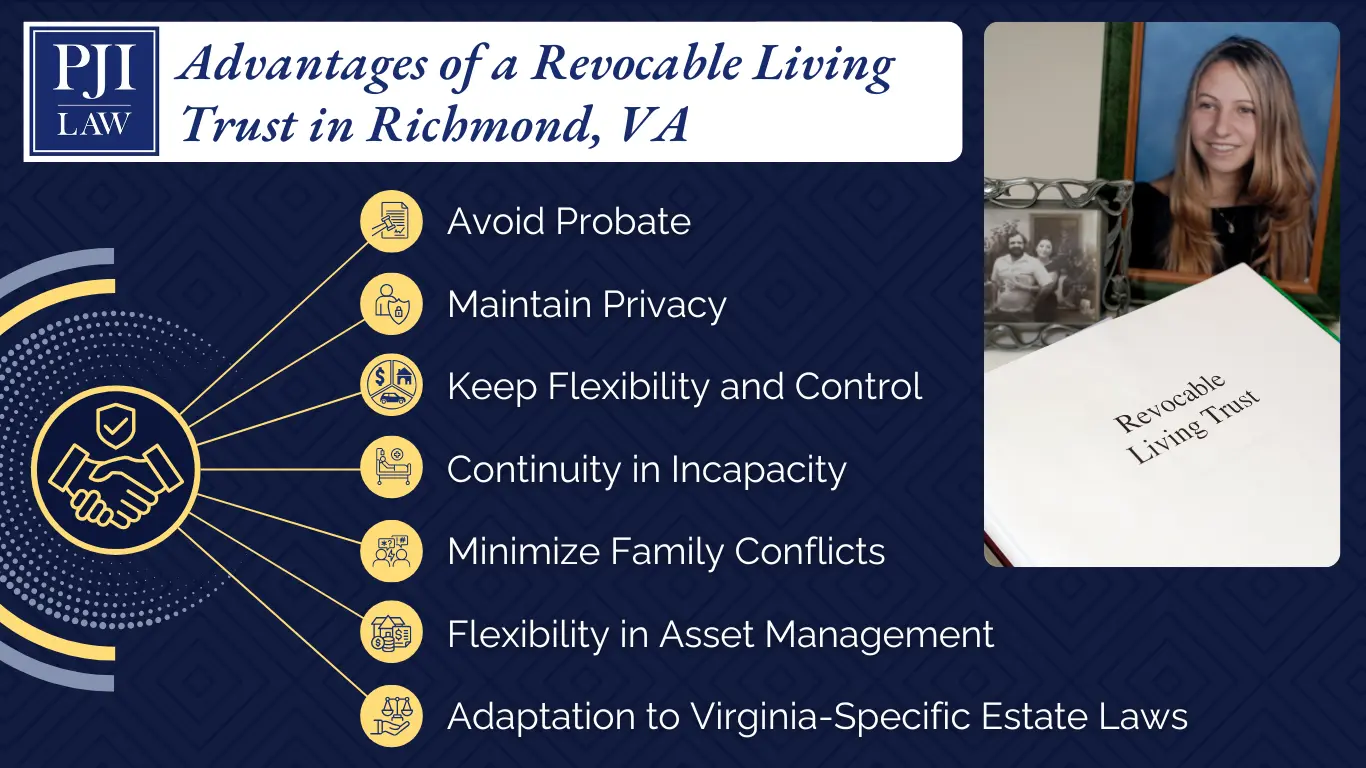
    Advantages of a Revocable Living Trust in Richmond, VA

    What Are the Advantages and Disadvantages of a Revocable Trust in Richmond, VA?

    A revocable living trust has various benefits that make it an appealing choice for many individuals and families in and around Richmond.

    1. Avoid Probate

    One of the most significant benefits of a revocable trust is its ability to avoid probate, a time-consuming, public, and costly process for your loved ones. Assets held in a revocable living trust skip the probate process and transfer directly to beneficiaries without court supervision, significantly reducing delays and expenses.

    When Richmond families can avoid probate setbacks, it saves time and allows beneficiaries to access assets efficiently during a time of grief. The function of a living trust is particularly helpful when dealing with real estate, property, business interests, or financial accounts.

    2. Maintain Privacy

    Unlike a will, which becomes a public record during the probate process, a revocable trust remains private, preventing sensitive financial details and distribution plans from being publicly disclosed. For individuals and families who value discretion, the privacy of a living trust is a highly attractive feature.

    3. Keep Flexibility and Control

    A living trust allows the grantor to retain full control over the assets. Whether you need to add new assets, remove them, or change beneficiaries, you can make adjustments as your life circumstances evolve. The flexibility a living trust offers is perfect for situations such as:

    • Changes in financial status
    • New family dynamics, like divorce and second marriages
    • Revisions to beneficiary designations
    • Adjustments for tax planning purposes

    4. Continuity in Incapacity

    Should the grantor become incapacitated, the successor trustee named in the trust can step in to manage the assets seamlessly, preventing the need for court-appointed guardianship or conservatorship, and offering peace of mind for families managing difficult medical situations.

    5. Minimize Family Conflicts

    By outlining clear terms for asset distribution and naming a trustee to oversee the process, revocable trusts can minimize misunderstandings or disputes among family members. This is especially important in cases where assets are complex or when blended families are involved.

    6. Flexibility in Asset Management

    Assets transferred into a revocable trust are managed according to your instructions and can include real estate, bank accounts, investments, and more. For example, you can transfer Richmond properties into your trust for proper management and swift transfer to beneficiaries after your death.

    7. Adaptation to Virginia-Specific Estate Laws

    Virginia’s trust laws, governed by the Virginia Uniform Trust Code, provide a user-friendly framework for creating and administering trusts. Working with an experienced law firm well-versed in VA law helps your living trust adhere to all applicable guidelines, so you gain maximum benefit without unintended pitfalls.

    What Are the Advantages and Disadvantages of a Revocable Trust in Richmond, VA?

    Disadvantages of Revocable Trusts in Richmond, VA

    While revocable trusts offer many advantages, they are not without downsides. Here are some factors to consider before deciding to create one.

    1. Higher Initial Costs

    Setting up a revocable trust generally requires more time and attorney fees compared to drafting a simple will. While the upfront expense may be substantial, the savings achieved by avoiding probate proceedings and legal fees later often outweigh the cost.

    2. Funding the Trust

    Once you create a trust, you must formally transfer assets into it. This process, known as funding the trust, can be time-consuming and requires careful attention to detail. Failing to fully fund the trust may result in certain assets still being subject to probate.

    3. No Asset Protection

    While an irrevocable trust offers protection from creditors, a revocable trust does not shelter assets in the same way. Because the grantor retains control of the assets during their lifetime, creditors can still make claims against them. If you want to safeguard assets during your lifetime, keep this in mind.

    4. Does Not Save Estate Taxes

    Revocable trusts do not provide relief from estate or inheritance taxes. If you have a substantial estate and concerns about federal estate taxes, you may need to incorporate other estate planning strategies alongside a revocable trust.

    5. Ongoing Maintenance from the Trust Maker

    A revocable trust is not a “set-it-and-forget-it” kind of tool for the trust maker. Life changes, new relationships, or shifting financial priorities require periodic updates. Additionally, you should monitor your beneficiaries over time to align the trust terms with your wishes as they evolve. Remain actively engaged with your trust so that it serves your objectives.

    Is a Revocable Trust Right for You?

    Whether or not a revocable trust is the best choice depends on your specific needs, family goals, and estate size. Individuals who will benefit most from this type of trust typically:

    • Value flexibility and control over their assets
    • Want to streamline the transfer of property after death
    • Are concerned about maintaining privacy
    • Need a plan for managing their estate in the event of incapacity

    However, individuals with smaller estates or those that do not involve complex assets may achieve their objectives with a simpler plan, such as a will, which becomes a matter of public record, or a transfer-on-death deed.

    Frequently Asked Questions About Revocable Trusts and Estate Planning

    What is a revocable trust, and how does it work?

    A revocable trust is a legal document that allows you to manage and distribute your assets during your lifetime and after your death. You, as the grantor, can modify or revoke it at any time. The trust, managed by a trustee, holds your assets, such as property or investments.

    How does a revocable trust help with estate planning?

    A revocable trust simplifies estate planning by organizing the handling and distribution of your assets. It helps avoid court involvement for probate, provides privacy, and carries out your wishes efficiently, especially if you have minor children or complex finances.

    Will I still owe estate taxes with a revocable trust?

    A revocable trust doesn’t protect your estate from taxes because the assets are still considered part of your taxable estate. However, if your estate is under the current estate tax exemption limits, there will be no estate tax imposed.

    What is a Successor Trustee?

    A successor trustee steps in to manage the trust’s assets if you become incapacitated or pass away. They must follow your wishes, pay debts, and distribute assets to beneficiaries

    How do trust assets differ from personal assets?

    Trust assets are those transferred into your trust’s name, such as bank accounts, real estate, or investments. Personal assets remain in your name and can be funded to your trust upon your death if proper beneficiary designations have been filed. To maximize the benefits of a revocable trust, you must transfer all appropriate assets properly.

    What happens if I don’t have a Durable Power of Attorney?

    Without a Durable Power of Attorney, your financial and legal decisions may require court involvement if you become incapacitated. Including this document in your estate plan allows your chosen representative to act on your behalf for important matters.

    Do revocable trusts protect assets from creditors?

    No, a revocable trust does not shield assets from creditors or lawsuits during your lifetime. For asset protection, you may need additional strategies, such as irrevocable trusts, tailored to your needs.

    Can a revocable trust benefit minor children?

    Yes, the trustee of a revocable trust manages assets intended for children until they reach a specified age. It prevents a court from appointing a guardian for financial matters and avoids direct inheritance issues.

    Why is a Pour-Over Will important in estate planning?

    A pour-over will works alongside a revocable trust to catch any assets not titled in the trust’s name at the time of your death. It transfers these assets into the trust, where they are distributed according to its terms.

    Do financial institutions recognize revocable trusts?

    Yes, most financial institutions recognize and work with revocable trusts. However, they may require specific documentation, like a copy of the trust or a trustee’s certification, before granting access to trust accounts.

    How do I create and manage a revocable trust?

    Creating and managing a revocable trust requires careful planning and legal guidance. It’s best to consult a qualified law firm that can draft the trust, assist with funding it, and guide you on succession planning to meet your goals.

    What Are the Advantages and Disadvantages of a Revocable Trust in Richmond, VA?

    PJI Law: Your Local Richmond Estate Planning Attorneys

    Estate planning becomes manageable when you have knowledgeable advisors on your side. PJI Law’s staff of legal professionals understands the intricacies of Virginia law and offers white-glove service to tailor your estate plan to your needs. We serve clients at all stages of life, from young families to older individuals. In addition to revocable living trusts, our practice areas include irrevocable trusts, special needs trusts, power of attorney documents, and estate administration.

    Have you been searching online for a “trust attorney near me,” “trust attorneys,” or “Virginia estate planning attorneys?” 

    Whether you’re exploring a revocable trust, seeking to establish a last will and testament, or considering options for asset protection, durable power of attorney, and other components of a comprehensive estate plan, contact us to discover how we can help you preserve your legacy and protect your family’s long-term financial future.

    With our personalized, high-touch approach, your estate planning will reflect your values and provide peace of mind for you and your loved ones.

    Contact us at (804) 653-3450 or complete our online form to schedule a consultation.

    Copyright © 2025. PJI Law, PLC. All rights reserved.

    The information in this blog post (“post”) is provided for general informational purposes only and may not reflect the current law in your jurisdiction. No information in this post should be construed as legal advice from the individual author or the law firm, nor is it intended to be a substitute for legal counsel on any subject matter. No reader of this post should act or refrain from acting based on any information included in or accessible through this post without seeking the appropriate legal or other professional advice on the particular facts and circumstances at issue from a lawyer licensed in the recipient’s state, country, or other appropriate licensing jurisdiction.

    PJI Law, PLC
    4108 E Parham Rd, 
    Richmond, VA 23228
    (804) 653-3450
    https://pjibe.webteam.ai/

  • What Are the Legal Consequences of Breach of Contract in Virginia?

    What Are the Legal Consequences of Breach of Contract in Virginia?

    You may have sat across from your attorney, reviewing the contract you believed would protect your business. When they pointed to a highlighted clause, it became clear: the other party had breached the agreement. Maybe they missed a key deadline. Maybe they failed to deliver what was promised. Either way, the fallout had already begun to affect your operations.

    Whether it was unpaid invoices, incomplete services, or repeated delays, the breach disrupted your business and strained relationships with clients, vendors, or partners. In Virginia, legally binding agreements are meant to protect both sides. When one party fails to meet their obligations, the law gives you options.

    Before you decide how to move forward, it helps to understand how Virginia law treats breach of contract claims, the consequences of breach of contract, and what steps you can take to protect your business.

    What Are the Legal Consequences of Breach of Contract in Virginia?

    What Makes a Contract Legally Binding in Virginia?

    Before you can enforce a contract or recover damages, the court must determine that the agreement was legally valid. In Virginia, not every promise or handshake qualifies as a contract. For an agreement to be enforceable, it must meet certain basic requirements.

    Key Elements of a Legally Binding Agreement

    A valid contract generally includes the following:

    • Offer and Acceptance: One party makes an offer, and the other party accepts it
    • Mutual Intent to be Bound: Both parties understand and agree that the contract is legally enforceable
    • Consideration: Each party provides something of value, such as payment, goods, services, or a promise
    • Clear Terms: The agreement sets out key details, including obligations, payment schedule, timelines, and other material provisions
    • Capacity and Legality: The parties must be legally allowed to enter into a contract, and the subject of the agreement must be lawful

    While informal or verbal agreements can be legally binding in Virginia, written contracts are easier to prove in court, especially if the other party denies what was agreed.

    What Is Considered a Breach of Contract in Virginia?

    A breach of contract happens when one party fails to do what they promised under a legally binding agreement. That could mean missing a payment deadline, failing to deliver goods or services, or refusing to honor important contract terms without a valid reason.

    In Virginia, contract law is based on common law, meaning it’s shaped by past court decisions, not just statutes. Unless a specific law applies (like the Statute of Frauds or the Uniform Commercial Code), most contract disputes are resolved using long-standing legal principles.

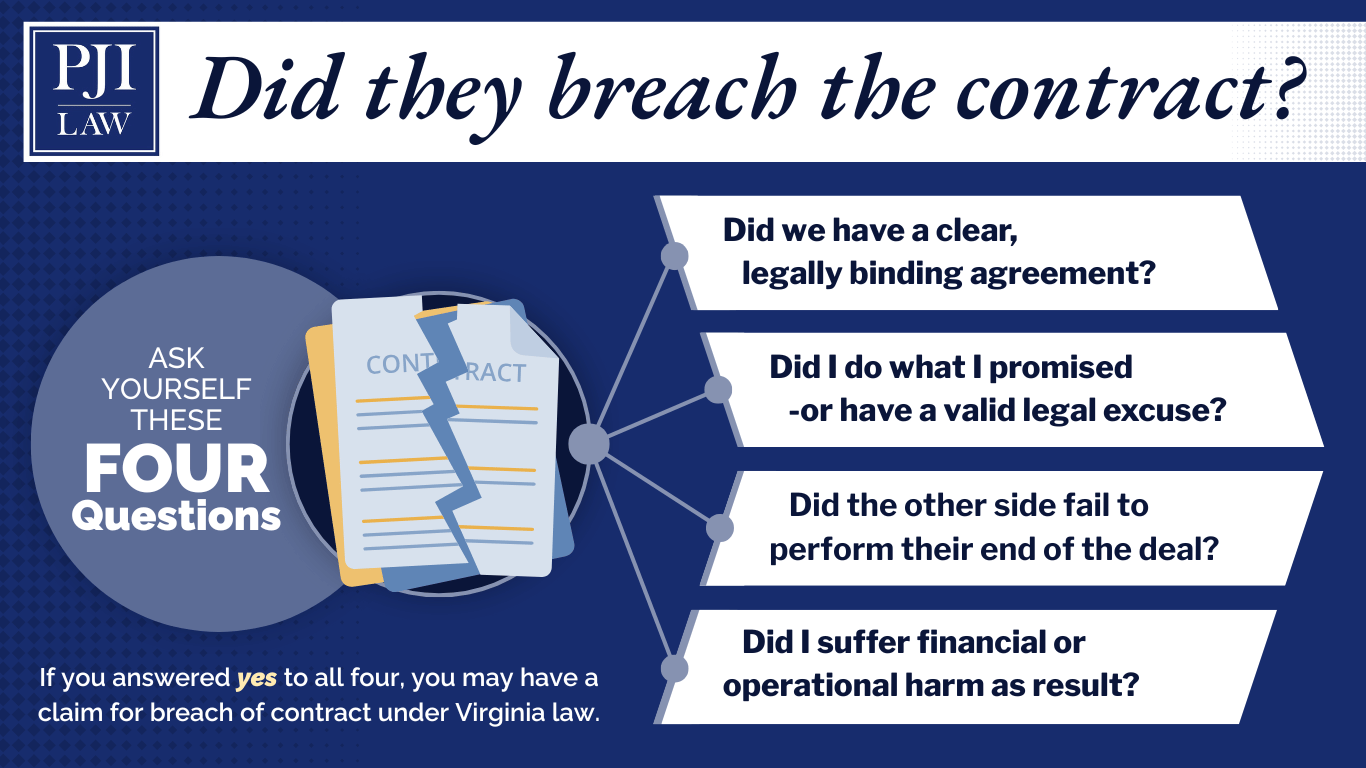
    To bring a breach of contract claim, you usually need to show that:

    • A valid contract existed
    • You met your obligations (or were legally excused from doing so)
    • The other party failed to uphold their end
    • You suffered financial loss because of it

    This standard comes from Virginia case law, including Ulloa v. QSP, Inc., 271 Va. 72 (2006), where the court explained the basic requirements for a breach of contract claim.

    What Are the Legal Consequences of Breach of Contract in Virginia?

    Different Types of Breaches and Why They Matter

    What Are the Legal Consequences of Breach of Contract in Virginia?

    Not every breach carries the same weight. In Virginia, some contract violations are more serious than others, and your case’s outcome often depends on whether the court sees the breach as material or minor. Courts treat a breach as material when it substantially defeats the purpose of the agreement or deprives you of what you were promised.

    Material Breach

    A material breach happens when one party fails to perform a key part of the contract. This usually excuses you from continuing to perform and may give you the right to end the contract or seek damages. Courts look at how much the breach undermines the agreement’s main purpose.

    Examples include:

    • A vendor fails to deliver goods essential to your operations
    • A contractor performs work so poorly that it substantially fails to meet agreed standards
    • One party discloses information protected by a non-disclosure agreement

    If the breach causes business delays, lost income, or missed opportunities, the breaching party may be held responsible for those losses. Courts may award compensatory damages or allow you to cancel the contract, depending on how serious the breach was and whether you can prove the harm.

    Minor (or Partial) Breach

    A minor breach, sometimes called a partial breach, happens when one party fails a small part of the agreement but still delivers the overall benefit. In this case, you may still need to fulfill your side of the contract, though you can often recover damages for the shortfall.

    Examples include:

    • A supplier delivers most of your order on time but falls short by a few units
    • A subcontractor uses slightly lower-quality materials, but the result still functions as agreed

    If the breach results in financial loss or extra costs, you’ll need evidence, such as invoices or communications, to support your claim. Keep in mind that a minor breach doesn’t usually justify terminating the contract.

    Anticipatory Breach

    Sometimes, it’s clear the other party has no intention of following through before their performance is even due. This is called anticipatory breach, and Virginia law allows you to take legal action as soon as that refusal becomes clear.

    For example, if a supplier emails you saying they’re not going to deliver your order, you don’t have to wait for the delivery deadline. You can seek damages or cancel the agreement right away.

    Breaches can happen in different ways, and the law doesn’t always label them the same way you would in everyday life. Here are some of the more common breach scenarios Virginia courts deal with:

    Common Examples of Contract Breaches in Virginia

    While Virginia law classifies breaches as material, minor, or anticipatory, many business owners think about breaches in terms of what actually went wrong. Here are some of the most common issues:

    • Failure to Perform: One party doesn’t follow through, whether that means delivering products, completing services, or meeting deadlines.
    • Delayed Performance: Work or payment happens too late to meet the agreement’s terms. If timing was essential to the contract, the breach may be treated more seriously.
    • Non-Payment: One side receives goods or services but doesn’t pay what was owed. This can lead to claims for damages, interest, or legal fees.
    • Impossibility: Sometimes, an unforeseen event like a supply chain collapse or a change in the law makes performance impossible. In rare cases, this may excuse a breach, but only if the event was truly unexpected, beyond the party’s control, and not caused by their own actions.

    Legal Consequences of Breach of Contract in Virginia

    When someone breaches a contract, Virginia law gives you options to recover what you’ve lost and protect your interests. The specific remedy depends on the terms of the agreement, the type of breach, and how the breach affected your business or finances. In most cases, the court’s goal is to put you in the position you would have been in if the agreement had been fulfilled as promised.

    What Are the Legal Consequences of Breach of Contract in Virginia?

    Compensatory Damages

    This is the most common remedy. If the other party caused financial harm by failing to perform, you may be able to recover damages based on your actual losses. These damages might include:

    • Lost income or profits
    • Costs for substitute goods or services
    • Additional expenses caused by the breach
    • Lost benefits you reasonably expected from the agreement

    To recover compensation, you’ll need to show that the losses were directly caused by the breach, not by unrelated events. Documentation like signed agreements, emails, and payment records can strengthen your claim.

    Virginia law also allows buyers of goods to recover damages when a seller fails to deliver. In those cases, you may be able to recoup the cost of replacing the goods elsewhere (Va. Code § 8.2-712).

    Specific Performance

    In certain cases, a court may order the breaching party to fulfill their original obligations instead of awarding money damages. This remedy is called specific performance and typically applies when:

    • The subject of the contract is unique (such as real estate or a rare item)
    • Monetary damages wouldn’t fully compensate you for the loss (Va. Code § 8.2-716)

    For example, if you had a signed agreement to buy a specific piece of land and the seller backs out, a court might require them to follow through on the deal.

    Courts are generally reluctant to apply specific performance to service contracts, especially when the work requires close supervision or ongoing performance.

    Rescission and Restitution

    In some cases, the court may cancel the contract entirely and attempt to return both parties to the positions they were in before the agreement. This is called rescission, and it’s often paired with restitution, which involves returning any money, goods, or property exchanged under the contract.

    Rescission may be appropriate when:

    • The breach is so serious that it defeats the purpose of the contract
    • The agreement was based on fraud, misrepresentation, or mistake
    • Continued performance would be unfair or impractical

    For example, if a contractor was paid upfront but never performed any work, and their failure undermines the entire deal, you may be able to ask the court to rescind the contract and recover the amount you paid.

    Rescission is an equitable remedy, which means it’s not automatic. A judge will weigh the facts and decide whether unwinding the contract is fair and appropriate under the circumstances.

    Liquidated Damages

    Some contracts include a clause that sets a fixed dollar amount to be paid if a breach occurs. This is known as a liquidated damages provision. Virginia courts will enforce these clauses if:

    • The amount reasonably reflects the expected harm
    • The harm was difficult to estimate at the time of the agreement
    • The amount isn’t excessive or meant to punish the breaching party (Va. Code § 8.2-718)

    For example, if your agreement includes a $500 per-day fee for late delivery and that amount fairly reflects the expected financial loss, a court is likely to enforce it.

    Negotiated Settlement

    Not every contract dispute ends up in court. In many cases, both parties are willing to talk through the problem and reach a resolution that avoids the stress, cost, and uncertainty of litigation. With a knowledgeable contract lawyer guiding the conversation, it’s often possible to resolve the matter through direct negotiation, mediation, or another form of alternative dispute resolution.

    Whether you’re trying to recover payment, fix a performance issue, or exit an agreement, this approach may lead to a fair outcome and help preserve important business relationships in the process.

    How Courts Review Contracts During Disputes

    However, if a breach occurs and you file a lawsuit, the court will review the agreement carefully. Judges typically ask:

    • Was there a valid contract between the parties involved?
    • Did one party fail to perform their obligations without a valid excuse?
    • Did the other side rely on the contract in good faith?
    • What was the expected benefit under the contract?
    • Can damages be reasonably calculated?

    The court may also consider whether any ambiguity exists in the language of the agreement and how both sides acted during the course of the contract. If one party breached and the other continued to perform without objection, that could affect the outcome.

    Why Contract Reviews Matter Before and After a Dispute

    Many contract disputes in Virginia could be avoided with a careful review before the agreement is signed. Others are easier to resolve when both parties understand their rights and obligations from the start. Whether you’re working with an existing client, hiring an independent contractor, or entering a new business relationship, reviewing the contract at the right time can save you from bigger problems later.

    Before Signing a New Contract

    Legal contract lawyers can assist with:

    • Spotting vague, overly broad, or one-sided provisions
    • Confirming the contract complies with Virginia law
    • Drafting clear language for payment terms, performance timelines, confidentiality clauses, and termination provisions
    • Reducing the risk of future disputes by addressing common failure points up front

    Even straightforward agreements, such as non-disclosure clauses or basic payment terms, can trigger disputes if they’re poorly written or improperly executed.

    After a Breach Occurs

    If one party hasn’t followed through, or if you’ve been accused of breaching a contract, it’s important to seek legal advice before responding. A breach of contract attorney can:

    • Review the contract and related communications
    • Assess whether a material breach has occurred
    • Evaluate the potential for liability and damages
    • Represent your position in negotiations, dispute resolution, or litigation

    Some conflicts can be resolved through direct discussion. Others may involve mediation, arbitration, or court action. How you respond early can affect the outcome if the matter escalates.

    How Long Do You Have to File a Breach of Contract Lawsuit in Virginia?

    If the other party fails to meet their obligations, you only have a limited time to take legal action. In Virginia, the deadline to file a breach of contract lawsuit depends on whether the agreement was written or oral.

    Virginia’s General Time Limits

    Under Virginia Code § 8.01-246:

    • Written contracts: You typically have five years from the date the breach occurs
    • Oral contracts: You generally have three years from the date of the breach

    These deadlines apply to most business agreements, including contracts for services, payment schedules, and NDAs.

    It’s not enough to know a breach happened. You must file your claim before the deadline passes. If you wait too long, you may lose your right to recover damages, even if the other party clearly violated the contract.

    What Can Pause the Clock?

    In limited situations, the statute of limitations may be paused or extended. This is known as “tolling.” It may apply if:

    • The other party intentionally concealed the breach
    • Both parties agreed in writing to pause the time period

    These exceptions are fact-specific and not automatic. If you believe you’re running out of time or aren’t sure when the clock started, talk to a lawyer as soon as possible. Early legal review gives you more control over your options and lowers the risk of losing your claim.

    What Are the Legal Consequences of Breach of Contract in Virginia?

    When Legal Action Makes Sense

    If a contract dispute is already affecting your business, or if you’re unsure whether the other party’s actions qualify as a breach, it may be time to involve a contract lawyer. The sooner you understand your rights and options, the more control you’ll have over how the dispute plays out.

    Dealing with a Contract Dispute in Virginia? 

    Whether you’re reviewing a new agreement, responding to a breach, or preparing to take legal action, having the right legal support can make all the difference. At PJI Law, we represent business owners, service providers, and professionals across Virginia in contract disputes involving clients, vendors, contractors, and other parties.

    We draft and review legally binding agreements, negotiate on your behalf, and represent your interests in and out of court. Our goal is to protect your business from uncertainty, limit future risk, and resolve disputes in a way that supports your long-term goals.

    Your online search for a “contract lawyer near me” or “breach of contract attorney” brought you here. We invite you to take the next step and call us at (703) 865-6100. If more convenient, you can fill out our confidential online form to schedule your consultation today.

    From the first conversation, our legal team takes the time to understand what’s at stake and work toward a resolution that supports your business. At PJI Law, you’ll receive white glove service and personalized attention!

    Copyright © 2025. PJI Law, PLC. All rights reserved.

    The information in this blog post (“post”) is provided for general informational purposes only and may not reflect the current law in your jurisdiction. No information in this post should be construed as legal advice from the individual author or the law firm, nor is it intended to be a substitute for legal counsel on any subject matter. No reader of this post should act or refrain from acting based on any information included in or accessible through this post without seeking the appropriate legal or other professional advice on the particular facts and circumstances at issue from a lawyer licensed in the recipient’s state, country, or other appropriate licensing jurisdiction.

    PJI Law, PLC
    3900 Jermantown Rd, 2nd Floor
    Fairfax, Virginia 22030
    (703) 865-6100
    https://pjibe.webteam.ai/
  • How to Approach a Family Business Succession Plan in Virginia

    How to Approach a Family Business Succession Plan in Virginia

    Starting and running a family business is a significant achievement, representing years of hard work, dedication, and sacrifice, yet maintaining the continuity of your business after your involvement ends is just as important as building it. Succession planning protects the legacy you’ve worked so hard to create. Family-owned businesses in Virginia should take strategic, proactive steps to facilitate a smooth transition.

    Do you need a family business succession plan?

    Business succession planning can feel like an overwhelming task, from determining and establishing the proper estate planning documents to complying with Virginia state law. This blog, from a business succession attorney with extensive experience, provides an in-depth look at business succession planning in Virginia.

    Why Engage in Business Succession Planning?

    Your family business is not simply your livelihood but your legacy. Without the proper safeguards, unexpected events such as incapacity or death can thrust a well-operating business into uncertainty. A business succession plan keeps the business viable under new leadership, smoothing the transition for employees, clients, and stakeholders.

    Business continuity relies on early planning. By addressing succession proactively, you can identify areas of vulnerability, train and prepare the next generation of leaders, and avoid potential disputes among family members or shareholders. Failing to plan can lead to costly probate processes, tax complications, or even the dissolution of the business entirely.

    The Basics of Succession Planning

    Encompassing much more than designating a successor, business succession planning in Virginia is a comprehensive process that includes financial, legal, and operational considerations.

    1. Establishing Goals and Priorities

    Before making any decisions, clarify your concerns and goals for the future of the business. Do you want the company to remain family-owned? Are you considering selling it? Would you prefer to transition leadership to a non-family member, such as a trusted employee?

    Your answers to these questions shape the structure, aspects, and details of the plan. Involve all relevant stakeholders in these conversations to minimize future disagreements and align the plan with everyone’s expectations.

    2. Choosing the Right Successor

    Our estate planning attorneys know that selecting a successor is one of the most sensitive components of succession planning, particularly in the context of a family business. While it may seem natural to select a relative based on inheritance, you should form your decision on the individual’s ability to lead, manage, and grow the business effectively.

    Some Virginia families opt for non-family leadership or even sell their share of the business if the expertise required does not exist within the family. Whichever path you choose, be fair and communicate clearly with everyone affected.

    3. Developing a Training and Transition Plan

    Even the most qualified successors need training, especially amid complex family dynamics. A robust succession plan includes a gradual transition where existing leaders mentor and support the new generation for a comprehensive handover of knowledge. This effort reduces the risk of operational disruptions and builds confidence among team members and stakeholders.

    4. Addressing Tax and Legal Considerations

    Virginia business owners should prioritize minimizing taxes and complying with estate laws. This step often involves creating or updating documents such as wills, trusts, buy-sell agreements, and operating agreements or corporate bylaws to align ownership transfer with both federal and state regulations.

    Transferring business ownership within a family can trigger gift or estate taxes if not handled strategically. For example, incorporating trusts or creating a structured gifting plan can help reduce tax liabilities while keeping the business within the family.

    5. Planning for Contingencies

    Unexpected events like illness or death illustrate the urgency of contingency planning. A well-thought-out succession plan addresses circumstances in which the initial successor cannot take over and provides backup plans for stability. Consider whether insurance policies, such as key person insurance, or updated shareholder agreements could protect the business during transitions.

    Fundamental Tools for Business Succession

    Business owners often use the following tools and strategies to build a solid succession plan:

    • Buy-Sell Agreements
      These agreements outline how to sell or transfer business shares in the event of an owner’s death, incapacity, or planned exit. They also establish ground rules for new ownership, protecting the interests of all stakeholders.
    • Trust Structures
      Placing a business in a trust can help avoid probate, reduce taxes, and clearly define the roles of beneficiaries. A living trust allows for a smooth transfer to the designated successor without the need for court intervention.
    • Gifting Strategies
      Some business owners choose to transfer ownership gradually by gifting portions of their business over time. This approach allows successors to gain experience under the guidance of the current management and can also reduce tax implications.
    • Life Insurance Policies
      Life insurance can provide liquidity to cover estate taxes or buyout agreements, avoiding financial stress on surviving family members.

    The Risks of Neglecting Succession Planning

    As a knowledgeable estate planning attorney can attest, without a succession plan, family businesses remain vulnerable to a myriad of challenges, including:

    • Court Intervention
      Without a clear plan, the courts may become involved, and the future of the business may not align with your wishes.
    • Family Disputes
      Disagreements about leadership or financial distribution among family members can create lasting rifts.
    • Business Decline
      A lack of training or sudden leadership transition can disrupt operations, affecting employees, clients, and profitability.
    • Higher Taxes
      Unanticipated tax liabilities can erode the value of the business, leaving beneficiaries with reduced financial benefits.

    Do I Need the Help of a Legal Professional to Put My Company’s Affairs in Order?

    Approaching a family business succession plan in Virginia requires diligence, foresight, and collaboration. As you plan for a well-deserved retirement, don’t leave the future of your company to chance. Given the complexity of succession planning, seeking the advice of proficient business succession and estate planning attorneys is a wise investment for designing a legally sound, tax-efficient plan tailored to your goals.

    Contact PJI Law for Personalized Service and Attention

    Planning your legacy is a significant matter, from preserving profits to safeguarding the relationships, reputation, and hard work that have defined your success.

    Have you been typing “succession planning lawyer,” “business succession attorney,” or “estate planning attorney near me” into your search bar? 

    At PJI Law, we recognize the uniqueness of every Virginia family and business. With white-glove service, our law firm customizes solutions that uphold your values and priorities. Through attentive conversations and clear communication, we help you make informed decisions that preserve your legacy for generations to come.

    Contact us at (703) 865-6100 or complete our online form to schedule a consultation to begin designing your business succession strategy.

    At PJI Law, you’ll receive personalized service and attention!

    Copyright © 2025. PJI Law, PLC. All rights reserved.

    The information in this blog post (“post”) is provided for general informational purposes only and may not reflect the current law in your jurisdiction. No information in this post should be construed as legal advice from the individual author or the law firm, nor is it intended to be a substitute for legal counsel on any subject matter. No reader of this post should act or refrain from acting based on any information included in or accessible through this post without seeking the appropriate legal or other professional advice on the particular facts and circumstances at issue from a lawyer licensed in the recipient’s state, country, or other appropriate licensing jurisdiction.

    PJI Law, PLC
    3900 Jermantown Rd, 2nd Floor
    Fairfax, Virginia 22030
    (703) 865-6100
    https://pjibe.webteam.ai/

  • Checklist for an Executor of a Will from a Richmond, Virginia Law Firm

    Checklist for an Executor of a Will from a Richmond, Virginia Law Firm

    Serving as the executor (also known as a personal representative) of a will is an honor that reflects the confidence and trust the deceased placed in your ability to manage their last wishes for their heirs and legacy. However, this role encompasses significant responsibility, demanding executors handle urgent financial, legal, and administrative tasks while coping with grief.

    Are you a personal representative embarking on estate administration in Richmond, Virginia?

    This checklist for an executor of a will from our Virginia law firm explains the probate process and every law governing estate administration to help you fulfill your responsibilities with clarity and confidence. 

    At PJI Law, our estate planning practice is a trusted authority in estate and probate matters for clients in Richmond, Central Virginia, and throughout the state.

    Understanding Your Role as an Executor/Personal Representative

    An executor/personal representative has fiduciary duties, meaning the person has a legal responsibility to act in the best interests of the beneficiaries and the estate. From validating the will to distributing assets, the actions of the personal representative must comply with Virginia laws and adhere to deadlines. Failure to meet your obligations can lead to legal complications or disputes.

    Below is a detailed checklist to help you manage your responsibilities as an executor in Richmond, Virginia. However, we highly recommend seeking legal counsel from a reputable probate law firm to make informed decisions, satisfy heirs, and comply with every law on probate issues and estate administration.

    Checklist for an Executor of a Will from a Richmond, Virginia Law Firm

    1. Locate and Validate the Will

    Your first duty as executor is to locate the deceased’s will and any related estate planning documents. These documents will guide the probate process, outlining the deceased’s wishes regarding asset distribution.

    Once you have the will, you must take it to the Court clerk in the Circuit Court in the county or city where the deceased resided, typically the Henrico or Richmond Circuit Courts. The Clerk of the Circuit Court will determine the validity of the document. This process, known as probate qualification, establishes the legal authority of the executor.

    Required Actions:

    • Locate the original will.
    • File the will with the Clerk of the Circuit Court.
    • Obtain a certificate of qualification, which legally grants you the authority to act as executor.

    Under some circumstances, Virginia law requires interested parties to validate the will promptly after the person’s passing. Acting quickly to begin addressing estate matters can help you meet certain deadlines.

    2. Marshal the Assets

    Marshaling assets involves identifying, securing, and documenting all the property that belonged to the deceased. This step accounts for all estate assets before distributing them to beneficiaries or creditors.

    Steps to Marshalling Assets:

    • Identify Assets: List all assets, including real estate, bank accounts, investment accounts, business interests, personal property (vehicles, jewelry, art), retirement accounts, and life insurance policies.
    • Secure Assets: Take steps to protect the estate’s property, such as notifying banks, securing real estate, and safeguarding valuables.
    • Appraise Property: Rely on public records or use a professional appraiser to determine the fair market value of certain assets, such as real estate or collectibles.
    • Compile an Inventory: Prepare a detailed inventory for all the assets and file it with the Commissioner of Accounts, as Virginia law requires.

    This process clearly shows the estate’s financial position in order to distribute assets fairly, according to the will’s terms.

    3. Notify Beneficiaries and Creditors

    Virginia law requires executors to notify all interested parties, including beneficiaries and creditors, about the probate process for transparency and compliance with legal obligations.

    Required Actions:

    • Notify Beneficiaries: Inform all named beneficiaries in the will of the estate proceedings. Provide details about their entitlements.
    • Notify Creditors: Place a notice in a local newspaper to alert creditors of the deceased’s passing to give them an opportunity to come forward and file claims against the estate within a specified time frame.

    Failure to notify beneficiaries and creditors can lead to delays and potential legal challenges, so prioritize this step.

    4. Settle Debts and Pay Taxes

    The executor must address the deceased’s outstanding debts and taxes before distributing the deceased’s assets. Debts may include mortgages, medical bills, credit card balances, and other obligations.

    Virginia does not impose an estate tax, but federal estate taxes may apply to larger estates exceeding the federal exemption limit. Executors must also file final income tax returns for the deceased and possibly an estate income tax return.

    Steps to Take:

    • Verify Debt: Review creditor concerns and claims, and pay only valid debts.
    • Settle Final Expenses: Pay for funeral costs and administrative fees.
    • File Tax Returns: Work with a tax professional to file personal and estate-related tax returns.
    • Pay Taxes: Pay all federal and state taxes from the estate.

    Virginia law mandates the resolution of these debts and taxes before distributing the estate’s assets to beneficiaries. 

    5. Distribute the Assets

    Once you settle debts and taxes, you can distribute the remaining assets to the beneficiaries listed in the will. If no will exists, Virginia intestacy laws dictate asset distribution and outline how to divide property among surviving family members.

    Important Steps:

    • Review the terms of the will to understand each beneficiary’s entitlements.
    • Distribute assets in an orderly manner and document all actions well.
    • Retain proof of distribution, such as receipts signed by beneficiaries.

    Distributions should align with the will’s instructions to avoid disputes. Work carefully to meet all legal requirements during this phase.

    6. File an Accounting with the Commissioner of Accounts

    Virginia law requires executors to submit periodic accounting to the Commissioner of Accounts. These filings detail all estate-related transactions, including income, expenses, disbursements, and distributions.

    The first accounting is typically due four months after qualification, although specific deadlines may vary depending on the estate’s complexity.

    Key Actions:

    • Maintain detailed records of all financial transactions during the probate process.
    • File periodic accountings with the Commissioner of Accounts as mandated.
    • Respond promptly to any inquiries or requests for additional information.

    Failure to file periodic accountings can result in penalties and possibly your removal as the personal representative, so be diligent in meeting these requirements.

    7. Close the Estate

    The final step is to close the estate once all responsibilities have been completed. This process involves obtaining final approval from the Commissioner of Accounts and properly notifying all parties about the estate’s closure.

    Required Steps:

    • File a final accounting with the Commissioner of Accounts.
    • Pay all taxes, debts, and administrative fees.
    • Distribute any remaining funds to beneficiaries.

    The estate is officially closed once the court approves the final accounting and validates the executor’s actions.

    Checklist for an Executor of a Will from a Richmond, Virginia Law Firm

    Frequently Asked Questions About Probate & Estate Planning

    What is an estate plan, and how does it help avoid probate?

    An estate plan is a comprehensive set of legal documents, such as wills, trusts, and power of attorney documents, designed to manage your assets during life and distribute them according to your wishes after death. Our clients avoid probate for certain assets by incorporating tools like revocable living trusts for a faster and more cost-effective property transfer to heirs and beneficiaries. Comprehensive estate planning reduces the administrative burden on an executor/personal representative and minimizes court involvement.

    What are the primary responsibilities of an executor/personal representative in estate administration?

    In Virginia, a personal representative has the fiduciary duty to manage the probate estate. Their responsibilities include validating the will, locating and securing assets, settling debts, paying taxes, addressing creditor claims, and distributing assets to beneficiaries. A personal representative must also file accountings with the Commissioner of Accounts to comply with state laws. A skilled probate attorney with extensive experience can help manage the process on your behalf, taking care of every detail and offering peace of mind.

    Checklist for an Executor of a Will from a Richmond, Virginia Law Firm

    What should I do if I suspect undue influence in a probate estate?

    Undue influence occurs when someone manipulates the deceased into altering their will or estate plan for personal gain, often creating disputes during estate administration. If you believe undue influence has impacted the validity of a will, you should consult a probate attorney immediately. An attorney can help investigate your claim, determine sufficient evidence, and guide you through potential litigation to protect the estate’s integrity.

    What steps can I take to avoid probate for my future beneficiaries?

    Several estate planning strategies are available to help you and your beneficiaries avoid probate, including setting up revocable living trusts, adding transfer-on-death (TOD) or payable-on-death (POD) designations to accounts, and establishing joint tenancy with rights of survivorship for properties. However, sometimes setting up these probate avoidance designations without guidance from a skilled estate planning attorney can cause unintended tax or distribution issues for heirs. Avoiding probate saves time and costs and offers privacy for your loved ones, but only when done correctly and with your entire estate in i. Our Richmond law firm focuses on these practice areas and can provide tailored guidance to create a plan that meets your goals.

    How can PJI Law assist with estate administration and disputes?

    PJI Law’s practice areas include estate planning, business succession planning, deed preparation, medical powers of attorney documents, estate administration, and probate to assist personal representatives and families in and around Richmond, Virginia, and throughout the state. Whether you’re managing the probate process, addressing creditor claims, resolving disputes among beneficiaries, or ready to begin your estate planning, our estate planning and probate attorneys provide compassionate, informed guidance every step of the way. We help clients develop comprehensive estate plans and guide them through sensitive estate matters and probate issues.

    Checklist for an Executor of a Will from a Richmond, Virginia Law Firm

    Contact PJI Law, Probate & Estate Planning Lawyers in Richmond, Virginia

    Regardless of the size of the estate, probate can present significant challenges for personal representatives. Disputes among beneficiaries, challenges to the will, or estates with substantial assets require informed legal counsel to prevent fiduciary litigation and accusations of financial exploitation, and fulfill all responsibilities legally.

    Have you been searching for an “estate administration lawyer,” “probate attorney near me,” or “probate lawyers in Richmond, VA?”

    A knowledgeable probate lawyer from PJI Law can guide you through the process, complying with Virginia law and minimizing the risk of legal conflicts. Our law firm provides personalized service and attention for Virginia personal representatives, guiding them through every stage of probate, from marshaling assets to filing accountings and handling disputes.

    Whether you need help preparing court filings, managing creditor concerns, or resolving disputes with heirs, our law firm is ready to protect your interests and honor your loved one’s legacy.

    Contact us at (804) 653-3450 or complete our online form to schedule a consultation to discover how we can help you handle your duties confidently and carefully.

    Copyright © 2025. PJI Law, PLC. All rights reserved.

    The information in this blog post (“post”) is provided for general informational purposes only and may not reflect the current law in your jurisdiction. No information in this post should be construed as legal advice from the individual author or the law firm, nor is it intended to be a substitute for legal counsel on any subject matter. No reader of this post should act or refrain from acting based on any information included in or accessible through this post without seeking the appropriate legal or other professional advice on the particular facts and circumstances at issue from a lawyer licensed in the recipient’s state, country, or other appropriate licensing jurisdiction.

    PJI Law, PLC
    4108 E Parham Rd,
    Richmond, VA 23228
    (804) 653-3450
    https://pjibe.webteam.ai/

  • What is a Holographic Will in Northern Virginia?

    What is a Holographic Will in Northern Virginia?

    Estate planning honors your wishes, protects your assets, and cares for your loved ones after your passing. When you work with an estates attorney to make important decisions and establish the proper estate planning documents for your unique family dynamics, circumstances, and goals, they will recommend a last will and testament. In this legal document, you can leave money, property, and other possessions to the individuals you designate. If you have minor children, you can also name guardians to care for them and raise them according to your values, should you tragically pass away before they reach adulthood.

    However, many individuals in Northern Virginia who seek our estate planning services often ask,  “What is a holographic will?”

    For these clients, creating a formal will feels overwhelming or unnecessary. This blog, from a knowledgeable Northern Virginia estate planning lawyer, explains holographic wills, the criteria they must meet to comply with state law, and what can happen when someone chooses to create a holographic will.   

    Defining a Holographic Will

    A holographic will is a last will and testament that the testator (the person creating the will) entirely writes and signs in their handwriting. Whereas a formal will requires witnesses or notaries, a testator often establishes a holographic will under urgent circumstances or when they cannot consult an estate planning lawyer for formal document preparation. Most notably, holographic wills arise under emergencies, when a person does not have access to lawyers or a legal team that can help them establish a formal will. 

    How to Create a Legally Binding Holographic Will in Fairfax County & Northern Virginia

    State law requires the following criteria:

    Age and Mental Capacity

    The testator must be at least 18 and of sound mind.

    Written Entirely by Hand

    The testator must hand write the entire holographic will. Virginia prohibits typed or pre-printed text.

    Testamentary Intent

    In the legal document, the testator must indicate their intent to establish a will to have their assets distributed after their death.

    Signature

    The Testator’s signature must be on the will, usually at the end of the document.

    Witnesses

    Virginia does not require the presence of witnesses to a holographic will at the time the testator signs it. However, after the testator’s death, at least two disinterested witnesses must testify to the accuracy of the deceased testator’s signature in court.

    Creating a Holographic Will in Fairfax County & Northern Virginia

    You should consult an estate planning lawyer when establishing a will in Fairfax County and throughout Virginia, to comply with all applicable laws. However, knowing how to create a holographic will in case of emergencies or other situations where you do not have access to a law firm is helpful. 

    Write the Entire Will in Your Handwriting

    Virginia requires a testator to entirely write a holographic will. The state forbids any typed or printed text, which could cause the court to deem the will invalid.

    Identify Each Beneficiary

    When naming beneficiaries, be specific. Use their full legal names and addresses to avoid confusion or ambiguity. Describe the relationship between you and the beneficiary, such as “my wife,” “my daughter,” or “my friend.”

    Detail Asset Distribution

    How should your assets be properly distributed? Be precise when describing each asset, including real estate properties, personal belongings, bank accounts, investments, jewelry, and other valuable items.

    Appoint an Executor/Personal Representative

    Designate a trustworthy individual as the executor or personal representative of your estate. This person assumes responsibility for paying outstanding taxes, debts, and court costs, and managing and distributing your assets according to the terms of your will. Include the executor/personal representative’s full name and address for clarity.

    Include Guardianship Provisions (if applicable)

    Do you have minor children or dependents? Identify a guardian for them in your will in the event of your death. This should be done only after obtaining the consent of the appointed individual. 

    Sign the Will

    The testator must sign the holographic will, preferably at the end of the document. Virginia does not mandate that the testator date the will, but including the date helps prevent any challenges to the will’s authenticity or the testator’s mental capacity when they signed the will.

    Although holographic wills are legal, our estate planning law firm in Fairfax County strongly advises against them. Due to concerns relating to authenticity, proper execution, and possible ambiguities, a judge is likely to deem the will invalid during probate.

    For more information, we invite you to read our blog, An Experienced Estate and Wills Attorney Answers Common Questions About Wills.

    Dying Without a Will in Virginia

    If you die without a valid will (holographic or formal), the state considers you to have died “intestate.” In such a case, Virginia’s intestacy laws dictate the distribution of the deceased’s estate during probate, relying on their surviving relatives and their relationship with the deceased. 

    For more information, we invite you to read our blog, The Disadvantages of Dying with No Will in Virginia.

    Why You Should Consult Estate Planning Attorneys

    While creating a holographic will might seem convenient, it often introduces unnecessary risk for you and your family. Estate planning is about more than just dividing property; it’s about caring for your family and other loved ones and preserving your legacy according to your wishes. At PJI Law, we offer personalized comprehensive estate planning services designed to suit your unique circumstances and family.

    We work closely with every client, taking the time to truly understand your family values and goals. Whether it’s drafting a personalized will, establishing a revocable living trust, engaging in ongoing asset protection strategies, or creating advance medical directives, we provide clarity and confidence in an often-complicated process.

    Secure Your Future & Legacy with PJI Law in Fairfax, VA

    Have you been typing “attorney for wills near me,” “will lawyer,” or “estate planning attorney” into your search bar? 

    If you’ve been considering writing a will, we encourage you to think beyond immediate fixes like holographic wills. Instead, contact the estate planning attorneys at PJI Law to establish a solid, detailed, and legally sound plan.

    In addition to wills, our practice areas include advance medical directives, irrevocable trusts, revocable living trusts, charitable trusts, power of attorney documents, and assistance with the probate process and trust administration.

    Contact PJI Law in Fairfax, Virginia at (703) 865-6100 or complete our online form to schedule a consultation.

    At PJI Law, you’ll receive personalized service and attention!

    Copyright © 2025. PJI Law, PLC. All rights reserved.

    The information in this blog post (“post”) is provided for general informational purposes only and may not reflect the current law in your jurisdiction. No information in this post should be construed as legal advice from the individual author or the law firm, nor is it intended to be a substitute for legal counsel on any subject matter. No reader of this post should act or refrain from acting based on any information included in or accessible through this post without seeking the appropriate legal or other professional advice on the particular facts and circumstances at issue from a lawyer licensed in the recipient’s state, country, or other appropriate licensing jurisdiction.

    PJI Law, PLC
    3900 Jermantown Rd, 2nd Floor
    Fairfax, Virginia 22030
    (703) 865-6100
    https://pjibe.webteam.ai/

  • How Do I Change Ownership of an LLC in Virginia?

    How Do I Change Ownership of an LLC in Virginia?

    Whether you’re stepping back from daily operations, bringing on a new member, adjusting ownership after a life event, or preparing your business for future transitions, changing the ownership of a Virginia LLC involves more than updating a name on paper. It’s a legal process that often requires internal approvals, updated agreements, and, in some cases, filings with the Virginia State Corporation Commission—especially when public records or company control is affected.

    If you’re asking yourself, how do I change ownership of an LLC?—you’re likely facing a moment of transition. Whether it’s a planned change or a response to unexpected circumstances, understanding the legal and logistical steps involved is key. In this blog, you’ll learn how LLC ownership works in Virginia and what it takes to complete a transfer properly and confidently.

    Why People Form LLCs—and What You Need to Know Before Transferring Ownership

    Before we get into the mechanics of changing ownership, it’s important to understand why so many business owners choose to form LLCs in Virginia—and how your company’s structure impacts the steps involved when ownership needs to change.

    What Makes the LLC Structure So Appealing?

    LLCs (Limited Liability Companies) are popular for a reason. They offer liability protection, tax flexibility, and operational freedom that sole proprietorships and corporations don’t always provide. Here’s what makes them a common choice for Virginia business owners:

    • Personal Asset Protection – If the company faces a lawsuit or debt, your home, car, or savings are typically not at risk.
    • Pass-Through Taxation – LLC profits and losses usually pass through to members and are reported on personal tax returns.
    • Flexible Management Structure – You can run the company yourself or appoint managers—there’s no requirement for a board of directors or shareholder meetings.
    • Simplicity and Credibility – LLCs are easier to maintain than corporations but still carry legal credibility with clients, vendors, and financial institutions.

    Whether you’re operating a small business in Fairfax, VA, or managing a growing company in Northern Virginia, this structure gives you a balance of control and protection.

    Living Will vs. Will in Richmond, Virginia: What Is the Difference?

    Documents That Shape LLC Ownership

    Changing LLC ownership in Virginia is not a one-size-fits-all process. The steps you need to take depend heavily on how your company was structured at formation and what internal documents are in place. The following items typically shape how ownership may be changed:

    • Articles of Organization – This foundational document officially forms your LLC and is filed with the Virginia State Corporation Commission (SCC). It identifies your registered agent, principal office, and whether the company is member-managed or manager-managed. Changes in ownership alone do not require filing an amendment—unless they affect publicly listed information like the registered agent, business address, or management structure.
    • Operating Agreement – While not required by law, the operating agreement governs internal operations, member rights and duties, and procedures for transferring ownership. Under Va. Code § 13.1-1023(A), members may enter into a written or oral agreement covering “the affairs of the limited liability company and the conduct of its business.” If your operating agreement outlines how membership interests may be sold, assigned, or transferred, that language will control.

      If no operating agreement exists—or if it’s silent on ownership changes—Virginia law supplies default rules. For example, Va. Code § 13.1-1038.1(A) generally requires majority consent of members to admit a new member, unless otherwise agreed. This means that even a partial interest transfer may require all current members to approve.

    • EIN (Employer Identification Number) – Your EIN does not change during a transfer, but if the LLC’s “responsible party” changes, the IRS requires an update. 
    • Buy-Sell Agreements – These agreements—either within the operating agreement or as standalone contracts—set the terms for how and when membership interests may be bought or sold. They often include provisions for pricing, valuation methods, rights of first refusal, and triggering events like retirement, death, or disability.
    • Business Licenses or Permits – Depending on your industry and local regulations, you may need to update licenses or permits if there is a change in ownership or control. This is especially relevant for businesses in regulated professions, those holding ABC licenses, or contractors subject to Department of Professional and Occupational Regulation oversight.

    Why LLC Ownership May Change

    Ownership changes are common throughout the life of an LLC. They often arise from routine business planning—but can also be triggered by more urgent circumstances. Some of the most common reasons include:

    • A member is retiring or withdrawing from the company
    • A new investor or partner is joining and acquiring an interest
    • An existing member is transferring part or all of their interest to another member or third party
    • Death, incapacity, or divorce involving a current member
    • Succession or estate planning, particularly for family-owned or closely held businesses
    • Business restructuring for tax or liability purposes

    Whether the change involves a full buyout or a partial reallocation of interests, it often requires:

    • A review of the operating agreement or buy-sell agreement
    • A written assignment or transfer of membership interest
    • Approval from other members (if required under Va. Code § 13.1-1038.1)
    • An update to the LLC’s internal records and, in some cases, its filings with the SCC

    Some ownership changes may also prompt the business to convert to a different entity type—for example, if the members decide to form a corporation or partnership to meet evolving needs. These decisions should be made carefully and documented properly to avoid conflict, tax surprises, or regulatory issues later.

    How Ownership Changes Work: LLCs With Two or More Members vs. Single-Member LLCs

    LLCs with two or more members must follow specific procedures—typically outlined in the operating agreement. For single-member LLCs, the process is more direct but still requires proper documentation and careful recordkeeping.

    If Your LLC Has Two or More Members

    If your LLC has two or more members (multi-member LLC), the operating agreement typically outlines how ownership interests can be bought, sold, or reassigned. These provisions are legally enforceable under Va. Code § 13.1-1023 and may include:

    • Limits on transferring interests to outside parties
    • Buy-sell provisions that apply during retirement, death, disability, or divorce
    • Voting or approval requirements—some decisions require unanimous consent; others only a majority
    • A valuation method for pricing the membership interest

    Most Virginia LLCs with more than one member will have an operating agreement in place since it’s strongly recommended by legal and financial professionals. However, if no agreement exists—or if it’s silent on ownership changes—Virginia law provides fallback rules. As noted earlier, this includes the requirement that a majority of current members must agree before a new member can be added—even if someone has already been assigned a share of the LLC’s profits (known as an economic interest).

    Before finalizing any ownership change, you should:

    • Review your operating agreement or, if none exists, the applicable provisions of Virginia law.
    • Obtain any required written approvals.
    • Draft and sign a contract documenting the transfer.
    • Update your company’s records to reflect who holds what percentage of ownership and what rights they have. This helps avoid confusion over decision-making authority and profit distributions.

    If You’re the Sole Member

    If you’re the only member of your Virginia LLC, changing ownership may seem simple—but it still requires careful documentation. Whether you’re selling the business, transferring some or all of your interest to a relative, or placing it in a trust for estate planning, each of these is a legal transaction that affects control, tax obligations, and your company’s internal records.

    Even without additional members, you still need to:

    • Draft a legally binding transfer agreement or assignment of membership interest.
    • Update your company’s internal records to show the new owner or beneficiary of the interest. This includes revising any existing operating agreement or creating one if none exists.
    • Amend your Articles of Organization if the change affects your registered agent, business address, or management structure
    • Update any licenses, contracts, or financial accounts tied to your ownership

    Doing this correctly protects both you and the business—especially if the LLC has contracts, liabilities, or ongoing operations. You don’t need to file ownership transfer paperwork with the Virginia SCC unless the change affects publicly filed information, such as your registered agent, business address, or how the LLC is managed.

    Living Will vs. Will in Richmond, Virginia: What Is the Difference?

    Document the Ownership Change with a Written Agreement

    Once you’ve reviewed your operating agreement and agreed on the terms of the ownership change, the next step is to put it in writing. This written agreement is what legally finalizes the change in ownership. Without a signed agreement, there’s no enforceable transfer—even if everyone involved has agreed informally.

    Your written agreement should include:

    • The names of the parties involved – including the current member(s) and the person or entity receiving the ownership interest
    • What type of change is occurring – is it a full transfer, partial interest sale, or internal reallocation of control?
    • The percentage or portion of the LLC being transferred
    • The purchase price or value of the interest (if applicable)
    • The effective date of the ownership change
    • Any continuing responsibilities or limitations related to the transfer
    • Non-disclosure or confidentiality provisions, if trade secrets or sensitive business information is involved
    • Signatures of all parties, confirming mutual intent

    Depending on how your LLC is structured and what’s being transferred, this contract might be called:

    • A Membership Interest Purchase Agreement
    • An Assignment of Membership Interest
    • A Transfer of Ownership Agreement (common for single-member LLCs)

    If your LLC has multiple members, you may also need to attach or reference the written approval required under your operating agreement or Virginia’s default rules.

    Living Will vs. Will in Richmond, Virginia: What Is the Difference?

    What to Update After the Ownership Change

    Once the ownership agreement is signed, the legal transfer has taken place—but you’re not done yet. There are still a few critical steps to keep your LLC compliant and avoid headaches down the road. You may need to update your LLC’s public records, tax status, and internal documents to reflect the change in control.

    Update the Virginia SCC

    You don’t need to file ownership transfer documents with the Virginia SCC unless the change affects public-facing company information. However, you must file an amendment to your Articles of Organization if the change affects:

    • Your registered agent or registered office
    • Your principal business address
    • Your management structure (member-managed vs. manager-managed)
    • Your company name, if this change is part of a larger restructuring

    You can file these changes through the Virginia SCC Clerk’s Information System. Failing to keep these records current could result in penalties or loss of good standing with the state.

    Notify the IRS

    If the ownership change results in a new responsible party for the LLC, you must notify the IRS using Form 8822-B. This applies in situations such as:

    • Selling the business
    • Transferring the LLC to a new individual or entity
    • Changing the LLC’s federal tax classification

    Failing to update the IRS could lead to tax filing issues, delayed correspondence, or audit complications.

    Revise the Operating Agreement

    Even if your LLC’s operating agreement doesn’t need to be filed with the state, it should be updated internally to reflect the current ownership. Updates may include:

    • Adding or removing member names
    • Adjusting ownership percentages
    • Revising voting rights or profit-sharing arrangements
    • Reflecting changes to succession or withdrawal provisions

    Keeping this document current protects the business and clarifies who holds ownership, who has decision-making authority, and how future changes should be managed.

    Review and Update Other Records

    Ownership changes often trigger other updates across your business operations. Review and revise:

    • Local and state business licenses
    • Vendor, client, or contractor agreements (some may require notice of ownership changes)
    • Leases, insurance policies, or loan agreements
    • Bank accounts, check signers, and payment systems
    • Payroll services or employee benefits records, if ownership affects employer identity

    While not every item on this list applies to every business, it’s wise to review contracts and licenses to confirm whether any terms are tied to specific owners or managing members.

    How Do I Change Ownership of an LLC in Virginia?

    Work With a Virginia Business Attorney to Finalize the Change

    Changing ownership in an LLC isn’t just a business decision—it’s a legal transaction with long-term consequences. Even if the transfer seems straightforward, it often involves contracts, tax considerations, and compliance issues that go beyond what’s visible on paper.

    A business attorney in Virginia can guide you through:

    • Reviewing your operating agreement and determining whether member approval is required
    • Drafting a customized ownership transfer agreement that reflects your goals and protects your rights
    • Ensuring compliance with state law, including Articles of Amendment filed with the SCC if needed
    • Addressing IRS requirements, such as updating the responsible party for your LLC
    • Revising or reviewing related contracts, licenses, leases, and business obligations that could be affected by the change

    This is especially important if:

    • Your LLC has multiple members
    • The company owns real estate, intellectual property, or other valuable assets
    • The change is part of a divorce, estate plan, or succession strategy
    • There are disagreements or unclear terms around valuation, authority, or control

    Some business owners attempt to handle the transfer on their own using generic templates or outdated forms. But cutting corners now can create bigger problems later—especially if tax filings are incomplete, SCC records are inaccurate, or your agreement doesn’t fully protect your interests. Whether you’re selling your ownership stake, bringing in a new partner, or restructuring for the future, legal guidance helps you make the change with confidence—and on the right terms.

    Changing ownership of an LLC in Virginia involves more than signing a contract or updating a form. It’s a coordinated process that touches nearly every part of your business—from your operating agreement and tax filings to your licenses and contracts. If you’re preparing for this kind of transition, take the legal steps that protect your business and your future.

    Changing LLC Ownership in Virginia?

    Whether you’re transferring your entire business, adding a new member, or updating your structure for the future, changing ownership in an LLC involves more than a handshake. You need clear contracts, proper filings, and an understanding of how Virginia law applies to your situation.

    At PJI Law, we work with business owners across Virginia to prepare and complete ownership changes that hold up both on paper and in practice. We assist with drafting agreements, updating operating documents, filing with the SCC, and addressing tax-related concerns tied to membership interests.

    Your online search for a “legal contract lawyer” or “lawyer for business contract” led you here–and you’re in the right place. Take the next step and call (703) 865-6100 or fill out our confidential online form to schedule your consultation today.

    At PJI Law, you’ll receive white glove service and personalized attention!

    Copyright © 2025. PJI Law, PLC. All rights reserved.

    The information in this blog post (“post”) is provided for general informational purposes only and may not reflect the current law in your jurisdiction. No information in this post should be construed as legal advice from the individual author or the law firm, nor is it intended to be a substitute for legal counsel on any subject matter. No reader of this post should act or refrain from acting based on any information included in or accessible through this post without seeking the appropriate legal or other professional advice on the particular facts and circumstances at issue from a lawyer licensed in the recipient’s state, country, or other appropriate licensing jurisdiction.

    PJI Law, PLC
    3900 Jermantown Rd, 2nd Floor
    Fairfax, Virginia 22030
    (703) 865-6100
    https://pjibe.webteam.ai/