Category: Blog

  • Living Will vs. Will in Richmond, Virginia: What Is the Difference?

    Living Will vs. Will in Richmond, Virginia: What Is the Difference?

    When planning for the future, you must understand the legal documents available to uphold your wishes and protect your loved ones. Concerning estate planning documents, clients often ask us about living will vs will. While these legal instruments sound similar, they serve entirely different purposes. This blog, from a Richmond estate planning attorney, clarifies the differences between these two estate planning documents that are part of a will-based estate plan.

    What is a Will?

    The foundation of a comprehensive estate plan, a will, or a “last will and testament,” is a legally binding document that takes effect upon your passing. It distributes your property and assets according to your wishes.

    A well-designed will can:

    • Specify the distribution of your assets among heirs.
    • Designate a personal representative to handle the probate process and asset distribution according to the terms of the will
    • Name guardians to care for minor children in your absence.
    • Support charitable causes by directing a portion of your assets to organizations you care about.

    Living Will vs. Will in Richmond, Virginia: What Is the Difference?

    A Living Trust and a Pour-Over Will

    If you have established a living trust at the recommendation of Richmond estate planning attorneys, they will advise you of the importance of a trust-based estate plan that includes a pour-over will. This type of will transfers any assets you might have accidentally left out of your living trust into the trust.

    For more detailed information on this aspect of estate planning, we invite you to read our blog, What Is a Pour-Over Will in Richmond, Virginia?

    Why is a Will So Important for Estate Planning?

    Although a will does not avoid probate like a revocable living trust, your estate may fall under intestate laws without a comprehensive will, which could lead to outcomes that don’t align with your wishes.

    When creating your will with the guidance of attorneys that do wills, you will designate a trustworthy individual to act as your personal representative. It should be someone who can manage the complexities of the probate process, comply with probate law, facilitate your estate administration effectively, and communicate well with your surviving family members and other loved ones named as beneficiaries.

    If you have minor children, your Richmond estate planning attorney will assist you in determining the right individual or individuals to assume guardianship for them if you should pass away. While this person does not have to be a family member, it should be someone committed to protecting your children and raising them according to your values.

    For more information, we invite you to read our blog, The Disadvantages of Dying With No Will in Virginia.

    What Makes a Will Legally Valid in Richmond, Virginia?

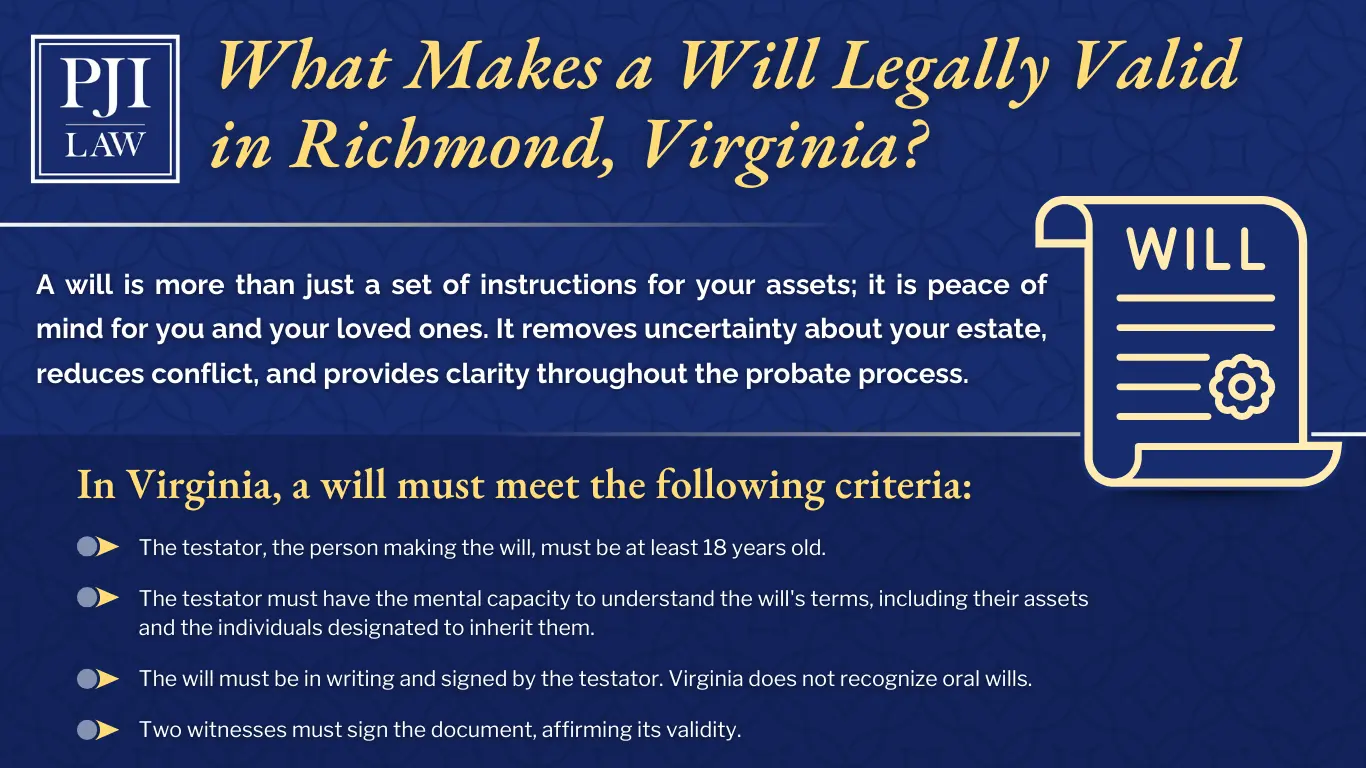
    A will is more than just a set of instructions for your assets; it is peace of mind for you and your loved ones. It removes uncertainty about your estate, reduces conflict, and provides clarity throughout the probate process during a time when your family and other loved ones grieve your death. As such, Virginia estate planning lawyers know that to fulfill all legal requirements in Virginia, a will must meet the following criteria:

    • The testator, the person making the will, must be at least 18.
    • The testator must have the mental capacity to understand the will’s terms, including their assets and those designated to inherit them.
    • The will must be in writing and signed by the testator. Virginia does not recognize oral wills.
    • Two witnesses must sign the document, affirming its validity.
    Living Will vs. Will in Richmond, Virginia: What Is the Difference?

    The Estate Administration & Probate  Process in Richmond, Virginia

    When a person passes away, their will undergoes probate. Probate is the legal procedure for transferring assets from the deceased individual to their heirs or beneficiaries. Probate involves:

    • Proving the will’s validity in court.
    • Identifying and inventorying assets.
    • Settling any outstanding debts or taxes owed by the estate.
    • Distributing remaining assets to beneficiaries according to the terms of the will.

    While this process can be lengthy and complex, a comprehensive and legally valid will can streamline probate and reduce potential conflicts among family members.

    Making Changes to Your Will

    As circumstances change throughout your life, you may need to change your will. Common reasons for updating a will may include second marriages, divorce, death, birth of children or grandchildren, and changes in assets, finances, or beneficiaries.

    Discuss these changes to your will with a knowledgeable estate planning attorney in Richmond to maintain your will’s legal validity and accuracy.

    Living Will vs. Will in Richmond, Virginia: What Is the Difference?

    What is a Living Will?

    Unlike a last will and testament, a living will is a directive that applies while you are still alive but cannot make decisions due to incapacity. It outlines your preferences for medical care, such as whether you wish to receive life support or other life-sustaining treatments in specific scenarios.

    While living wills involve planning for unexpected medical emergencies, Virginia laws provide other options, such as advance medical directives, for those preference details. At PJI Law, our estate planning services focus specifically on matters like wills, trusts, probate administration, general powers of attorney and advance medical directives.

    Advance Medical Directive/Healthcare Power of Attorney

    As you embark on estate planning for your future, our law firm recommends creating a healthcare power of attorney or advance medical directive. In this legal document, you can designate a person you trust to make medical decisions for you if you cannot communicate them to others yourself.

    This individual, known as your healthcare agent or proxy, can make decisions ranging from minor medical procedures to life-saving measures on your behalf, depending on the authority you grant them in the healthcare power of attorney or advance medical directive.

    Because your healthcare agent or proxy coordinates with your medical team to respect and implement your treatment preferences, your estate planning attorney will recommend someone trustworthy who is willing to fulfill these responsibilities if and when the time comes. Knowledgeable lawyers in Richmond will establish a legally compliant document that accurately states your desires.

    Other Available Power of Attorney (POA) Options

    Besides healthcare power of attorney, Virginia offers the following options:

    • Durable power of attorney – a durable power of attorney allows you to designate an individual or individuals to manage your finances if you become incapacitated.
    • General power of attorney – a general power of attorney grants broad authority to a person you designate.
    • Limited power of attorney – a limited power of attorney allows you to appoint someone to act on your behalf for specific tasks or transactions.
    • Springing power of attorney – a springing power of attorney only takes effect if you become incapacitated.

    For more information, we invite you to read our blog, What Type of Virginia POA Do I Need?

    Is Business Succession Planning Part of Estate Planning in Richmond, Virginia?

    If you own a business, you know it’s much more than just an enterprise; it is an integral part of your legacy and identity. For these reasons, business planning must be part of your overall estate planning.

    Whether you want your business to succeed after you pass away or plan to keep running it for the foreseeable future, creating a plan with the assistance of a skilled attorney will facilitate a seamless transition. Early planning also allows you to protect your company if you become incapacitated and unable to manage daily operations.

    Our law firm can guide you through the following aspects of business planning:

    • Choosing an exit strategy
    • Establishing a plan for a seamless transition
    • Selecting a successor
    • Connecting with the right advisors for your finances and insurance
    • Limiting taxes

    Contact PJI Law for Personalized Service & Attention to Your Estate Planning Needs, Including Wills

    At PJI Law, we understand the uniqueness of every family’s circumstances; that’s why we take a tailored approach to estate planning based on our clients’ needs and desires. We provide personalized service and attention if you need to create or update your will, establish a durable power of attorney, engage in business succession planning, or manage a probate estate.

    Have you been searching online for “will and estate planning lawyers near me?”

    With clear communication, prompt service, and a comprehensive understanding of your personal story, our Richmond law firm wants to discuss your goals, answer your questions, and protect what’s important to you.

    Contact us at (804) 653-3550 or complete our online form to schedule a consultation. 

    Copyright © 2025. PJI Law, PLC. All rights reserved.

    The information in this blog post (“post”) is provided for general informational purposes only and may not reflect the current law in your jurisdiction. No information in this post should be construed as legal advice from the individual author or the law firm, nor is it intended to be a substitute for legal counsel on any subject matter. No reader of this post should act or refrain from acting based on any information included in or accessible through this post without seeking the appropriate legal or other professional advice on the particular facts and circumstances at issue from a lawyer licensed in the recipient’s state, country, or other appropriate licensing jurisdiction.

    PJI Law, PLC
    4108 E Parham Rd, 
    Richmond, VA 23228
    (804) 653-3450
    https://pjibe.webteam.ai/

  • What Is a Warrant in Debt in Virginia?

    What Is a Warrant in Debt in Virginia?

    A knock at your door, a sheriff’s deputy or process server handing you court papers, or a notice posted at your home with a copy mailed before a default judgment—you’ve been served with a Warrant in Debt. Suddenly, you’re faced with a legal demand to pay money a creditor claims you owe. What is a Warrant in Debt? What happens next? Do you have to go to court? Can they garnish your wages or seize your assets?

    If you’re dealing with a Warrant in Debt in Virginia, whether from a credit card company, landlord, or private lender, knowing your rights and options is critical. Ignoring it won’t make it go away—it could make things worse.

    This blog breaks down what a Warrant in Debt means, what to expect in court, and how to respond effectively. If you’re a creditor trying to collect unpaid debts, we also cover how to file a claim, secure a judgment, and enforce payment legally.

    What Is a Warrant in Debt?

    A Warrant in Debt is a legal document used in Virginia’s General District Court to initiate a civil lawsuit seeking the repayment of a debt. Despite the term “warrant,” this is not a criminal matter—it’s strictly a civil claim.

    The person or entity claiming that you owe them money is called the plaintiff, and you, the person being sued, are the defendant. The plaintiff files the Warrant in Debt with the court, which then schedules a hearing known as the return date—this is your first opportunity to respond to the claim.

    Common Reasons for a Warrant in Debt

    What Is a Warrant in Debt in Virginia?

    A Warrant in Debt is typically used when a creditor is seeking repayment for an unpaid financial obligation. Some of the most common reasons a creditor may file a Warrant in Debt include:

    • Unpaid Credit Card Bills – If you fall behind on credit card payments, the credit card company or a third-party debt collector may take legal action to recover the balance owed.
    • Medical Debt – Hospitals, doctors, and other medical providers can file a Warrant in Debt if medical bills remain unpaid after repeated collection attempts.
    • Unpaid Rent or Lease Agreements – If a tenant fails to pay rent or violates the lease terms by leaving unpaid balances, the landlord can file a claim in General District Court to recover the money.
    • Car Loan Defaults – If a borrower stops making payments on a financed vehicle, the lender may seek a court judgment to collect the outstanding debt, even after repossession.
    • Personal Loans – Individuals who lend money informally or through financial institutions can file a Warrant in Debt to collect unpaid loan balances.
    • Breach of Contract Disputes – If a party fails to fulfill the financial obligations of a contract, such as payment for services or goods provided, the creditor may file a claim for the amount owed.

    If you’ve received a Warrant in Debt, act quickly to protect your rights and respond appropriately to avoid further legal and financial consequences.

    What Is a Warrant in Debt in Virginia?

    Initiating the Process as a Creditor

    If you are a creditor seeking repayment for an unpaid debt, the Warrant in Debt process allows you to pursue legal action against a debtor. To file a Warrant in Debt in Virginia, follow these steps:

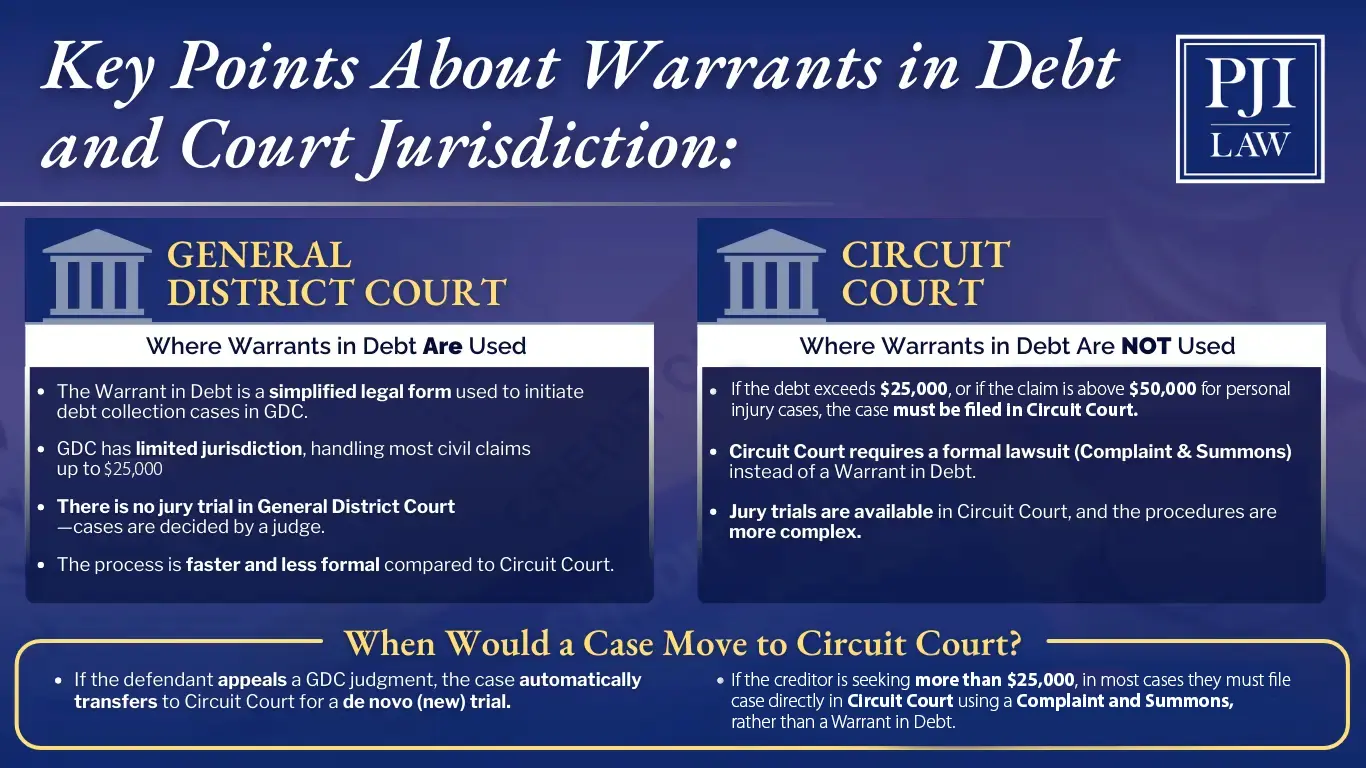
    1. File in the Correct Court – A Warrant in Debt is typically filed in General District Court for claims up to $25,000, with some exceptions such as a $50,000 limit for personal injury cases. For larger claims, the case is generally handled in Circuit Court.
    2. Complete the Warrant in Debt Form – This document must include the amount owed, any additional fees or interest, and a brief explanation of the claim.
    3. File the Form with the Court Clerk – The clerk will process the form and assign a return date, which serves as the initial hearing.
    4. Serve the Debtor Properly – The debtor must receive legal notice of the claim through a sheriff or private process server. If the debtor voluntarily accepts service, it may be sent by certified mail.
    5. Attend the Return Date – If the debtor does not appear, the court may grant a default judgment in favor of the creditor.

    Before filing a Warrant in Debt, it’s important to understand where your case belongs. The infographic below outlines key differences between the General District Court and the Circuit Court.

    Receiving a Warrant in Debt as a Debtor

    Discovering this document in your mailbox or posted at your home can be unsettling. You might question what it means for your daily life and finances and whether you have any defenses. It is important to respond and attend the hearing because ignoring a Warrant in Debt does not make it go away.

    Consequences of Ignoring a Warrant in Debt

    What Is a Warrant in Debt in Virginia?

    Failing to respond to a Warrant in Debt can result in serious financial consequences, including:

    • Default Judgment – The court automatically rules in favor of the plaintiff.
    • Wage Garnishment – Up to 25% of your disposable income may be withheld to repay the debt, subject to federal and Virginia wage garnishment laws (Virginia Code § 34-29). However, Virginia law protects lower-income individuals by limiting garnishments to only the amount exceeding 30 times the federal minimum wage per week. This means that if your weekly earnings are low, less than 25% may be garnished, or nothing at all.
    • Bank Account Levy – The creditor may freeze and withdraw money from your bank account.
    • Liens on Property – If you own real estate, the creditor may place a lien against your home.
    • Docketing a Judgment – A judgment obtained in General District Court does not automatically become a lien on a debtor’s real estate. To create a lien, the creditor must file an abstract of judgment in the Circuit Court of the county or city where the debtor resides or owns real estate to attach the judgment to real estate and potentially impact future sales or refinancing.

    Under Virginia Code § 8.01-466, creditors have legal rights to enforce judgments.

    How to Defend Yourself Against a Warrant in Debt

    If you believe the claim against you is incorrect or unfair, you have several legal defenses:

    1. The Debt Is Not Yours

    Mistakes happen, and sometimes debts are wrongly assigned or misidentified. If you were mistakenly named in the lawsuit, you can dispute it.

    2. The Amount Is Incorrect

    Even if you owe money, the amount may be inflated with unauthorized fees, penalties, or interest. Request an itemized statement.

    3. The Debt Is Too Old (Statute of Limitations)

    Virginia has a statute of limitations that restricts how long a creditor can sue for a debt:

    • Written contracts (e.g., credit cards, loans): 5 years
    • Oral agreements: 3 years
    • Promissory notes: 6 years

    If the debt is older than the statute allows, you can request dismissal.

    4. The Plaintiff Lacks Proof

    The creditor must prove you owe the debt. If they don’t have documentation, you can challenge their claim.

    5. Bankruptcy Protection

    If you’ve filed for bankruptcy, the debt may be discharged. A creditor cannot sue for discharged debts.

    What Is a Warrant in Debt in Virginia?

    Court Proceedings and Possible Outcomes

    What Is a Warrant in Debt in Virginia?

    What Happens at the Return Date?

    The return date is the first court hearing, typically set within 60 days of filing. You are not required to present a full defense at this hearing, but you must show up if you want to contest the claim.

    Options at the Return Date

    • Dispute the Claim – If you believe you don’t owe the debt or the amount is incorrect, you can argue your case.
    • Request a Trial – If you need more time to gather evidence, you can request a trial date.
    • Settle with the Plaintiff – You may negotiate a repayment plan or settlement outside of court.
    • Do Nothing – If you don’t show up, the court will likely issue a default judgment against you, allowing the creditor to collect the debt through wage garnishment, bank levies, or liens on property.

    Trial Phase

    If the debtor contests the debt, the judge might set another court date for a more in-depth hearing. At that time, each side can submit evidence and call witnesses to testify under oath. As a creditor, you would typically show proof of the transaction or contract and records indicating nonpayment. As a debtor, you might highlight any errors in the creditor’s documentation or present proof that payments were made or that the account is not yours.

    The judge then weighs the facts and decides whether money is owed and, if so, how much. This decision is called the judgment. Depending on the complexity of the case, the judge may issue the ruling immediately or take a short period to consider all the information.

    Possible Court Outcomes

    • Default Judgment: If the debtor fails to attend the hearing or does not respond, the creditor generally obtains a judgment automatically.
    • Judgment for the Creditor: If the judge rules in favor of the creditor, the debtor is responsible for the amount plus interest and possibly court costs or fees.
    • Judgment for the Debtor: If the debtor successfully proves that no money is owed or that the claim is invalid, the court may dismiss the case.
    • Settlement or Payment Agreement: Both sides can reach a settlement, either before the return date or during the proceedings, which might include a payment plan or a reduced lump-sum payment.

    Judgments, Appeals, and Enforcement

    What Is a Warrant in Debt in Virginia?
    Once a judgment is entered, it signals the court’s final decision regarding the debt. For creditors and debtors alike, this judgment triggers the next phase: collection for creditors, and payment or defense strategies for debtors.

    Post-Judgment Steps for Creditors

    • Docketing the Judgment: You might record the judgment on the public record in the appropriate Virginia county or city. This step can place a lien on any real estate the debtor owns in that jurisdiction.
    • Garnishment: You can request a garnishment against the debtor’s wages or bank account. Wage garnishment is subject to federal and Virginia state law limits, which cap how much of a debtor’s paycheck can be withheld. See § 8.01-511 of the Code of Virginia for rules on issuing a garnishment.
    • Levy and Seizure: In rare cases, a creditor can seek a court order to seize certain personal property to satisfy the judgment. The property must not be exempt under Virginia law, and procedures must be followed with precision.

    Options for Debtors After a Judgment

    • Payment Arrangements: Once the court rules in favor of the creditor, you might negotiate a schedule to repay the debt. Communicating with the creditor is often a way to avoid garnishments or liens.
    • Appeal to Circuit Court: In Virginia, you have a right to appeal a General District Court judgment to the Circuit Court within a limited time (usually 10 days from the judgment date). An appeal involves paying appeal costs and possibly posting a bond. 
    • Claim of Exemptions: If the creditor tries to garnish your wages or bank account, you may have exemptions you can claim, such as those for certain retirement benefits. These exemptions are spelled out in Virginia law, and you can assert them during the garnishment process.

    What Is a Warrant in Debt in Virginia?
    A Warrant in Debt in Virginia is a legal tool used to resolve disputes over unpaid debts. Whether you are seeking to collect or defend against a claim, knowing the process can impact the outcome. For creditors, proper documentation and following court procedures are critical to winning a case.

    For debtors, responding on time, attending court, and presenting a valid defense can affect the outcome. Consulting a civil litigation attorney can provide case-specific guidance.

    Facing a Warrant in Debt? Or Need to File One?

    Whether you’re a creditor seeking repayment or a debtor responding to a lawsuit, a Warrant in Debt can have significant financial and legal consequences. Having the right legal guidance can make all the difference in protecting your rights and interests.

    At PJI Law, we assist creditors in filing claims, securing judgments, and enforcing debt collection through proper legal channels. We also represent debtors who need to challenge improper claims, negotiate settlements, or assert legal defenses against collection actions.

    Our team provides clear guidance and strong representation at every stage, from filing paperwork to appearing in court.

    Your online search for a “debt collection attorney” or “collection attorney near me” who understands Virginia’s debt collection laws brought you here. PJI Law is ready to advocate for you. Call (703) 865-6100 or complete our confidential online form to schedule your consultation today.

    At PJI Law, you’ll receive white glove service and personalized attention!

    Copyright © 2025. PJI Law, PLC. All rights reserved.

    The information in this blog post (“post”) is provided for general informational purposes only and may not reflect the current law in your jurisdiction. No information in this post should be construed as legal advice from the individual author or the law firm, nor is it intended to be a substitute for legal counsel on any subject matter. No reader of this post should act or refrain from acting based on any information included in or accessible through this post without seeking the appropriate legal or other professional advice on the particular facts and circumstances at issue from a lawyer licensed in the recipient’s state, country, or other appropriate licensing jurisdiction.

    PJI Law, PLC
    3900 Jermantown Rd, 2nd Floor
    Fairfax, Virginia 22030
    (703) 865-6100
    https://pjibe.webteam.ai/

  • How to Avoid Probate in Virginia

    How to Avoid Probate in Virginia

    When Cara’s father passed away unexpectedly in Northern Virginia, she shouldered the heavy burden of settling his estate. Appointed as the personal representative (sometimes referred to as the executor) in his will, she felt overwhelmed by the court filings, legal processes, and the continuous mounting fees. On top of her grief, Cara spent hours gathering documents, attending court hearings, and fielding endless questions from creditors and relatives. Months turned into over a year as the probate process dragged on, delaying the distribution of her father’s assets to her family. The stress, public exposure of financial details, and escalating costs added emotional and financial strain to an already difficult time.

    As an experienced estate planning lawyer knows, stories like Cara’s are familiar. Probate can be a long, stressful, and costly process for loved ones, often delaying the distribution of assets and becoming an added burden during a time of grief.

    Are you wondering how to avoid probate in Virginia?

    When you establish the proper estate planning documents, you can help your family avoid the challenges of probate altogether. Below, our Fairfax estate planning lawyers explain how tools like trusts can help bypass the probate process in Virginia so you can fully understand your options.

    Why Avoiding Probate Matters

    Probate is a court-supervised process of validating a will and settling a deceased person’s estate. While it pays debts and taxes and distributes assets accurately, probate has its drawbacks:

    • Time-Consuming: It can be time-consuming, often taking years to complete.
    • Costly: It can also be expensive, cutting into the estate’s value due to court fees, attorney fees, and administrative costs.
    • Public: Most importantly, probate is public, which means your family’s private financial matters could become part of the public record.

    Understanding the Function of a Last Will and Testament

    Wills, which take effect upon death, remain necessary among estate planning documents. Testators (people making the wills) can outline their wishes, including designating specific heirs to receive specific assets. Parents of minor children can designate trusted guardians for them in their wills should they die before their children reach adulthood. A testator should also name an executor/personal representative in their will to carry out their wishes and handle the estate administration. 

    Wills, matters of public record, must go through probate.

    State Law Requirements for Legally Valid Wills

    Virginia requires the following criteria for wills to pass legal scrutiny:

    1. Age and Capacity: The testator must be at least 18 years old and of sound mind, meaning they understand the nature of making a will and the effects of their decisions.
    2. Written Document: Wills must be in writing. Virginia does not recognize oral wills.
    3. Signature: The testator must sign the will. If the testator cannot sign it, another individual can sign on their behalf, but they must do it in the testator’s presence and at their direction.
    4. Executor/Personal Representative: Testators can name individuals as executors or personal representatives. Because these are critical decisions, Northern Virginia estate planning lawyers guide their clients in making them.
    5. Witnesses: The will must be signed in the presence of at least two competent witnesses, who must also sign it in the presence of the testator and each other.
    6. Intent: The testator must intend for the document to serve as their last will and testament.
    7. Voluntariness: The will must be made voluntarily, without any undue influence, coercion, or duress.

    What Assets Are Exempt From Probate in VA?

    In Fairfax County and throughout Virginia, the following assets avoid probate and pass directly to the decedent’s loved ones.

    1. Jointly Owned Property

    If you jointly own property with someone else and the ownership includes the “right of survivorship,” the property does not go through probate. Instead, it automatically transfers to the surviving owner. Married couples in Virginia often hold property this way to avoid delays in transferring ownership.

    2. Beneficiary-Designated Accounts

    Accounts like life insurance policies, retirement plans (such as 401(k)s or IRAs), and payable-on-death (POD) or transfer-on-death (TOD) accounts have named beneficiaries. Upon your passing, these assets will be transferred directly to the designated beneficiary without involving the probate court.

    3. Assets in a Trust

    Assets held in a trust are not subject to probate. These can include real estate, financial accounts, or even personal belongings, as long as they are formally transferred to the trust before death.

    4. Property Owned Through Tenancy by the Entirety

    This form of ownership applies explicitly to married couples in Virginia. It offers similar benefits to joint ownership with survivorship rights, allowing the property to pass directly to the surviving spouse.

    How Trusts Help You Avoid Probate

    A trust is a legal document that allows you to place assets into a separate entity managed by a trustee—either yourself or an individual you designate to serve as a trustee. Upon your passing, the trustee distributes the assets in the trust directly to your beneficiaries according to your instructions, bypassing the probate process entirely.

    Two Types of Trusts

    1. Revocable Living Trust: This trust is popular in Northern Virginia due to its flexibility. A revocable living trust allows the grantor (the person making the trust) to change or revoke it as long as they’re alive. Once the grantor dies, the trust becomes irrevocable, and the trustee fulfills its terms without going through probate court. On the other hand, since the trust is revocable, the assets remain part of the grantor’s estate for tax purposes.
      For example, if you transfer your home or bank accounts to a revocable living trust, the trust takes ownership of those assets, not you personally, so they do not need to go through probate after your passing.
    2. Irrevocable Trust: Unlike a revocable living trust, you cannot change or terminate an irrevocable trust once you establish it, except under specific legal conditions. Many Northern Virginia residents use an irrevocable trust for several purposes, whether to leave money to a charity (by establishing charitable trusts), protect assets, or engage in life insurance planning. With the guidance of a knowledgeable attorney, you can structure this estate planning tool to preserve eligibility for public benefits like Medicaid.

    Comprehensive Estate Planning Can Include the Following Trusts Based on the Needs and Desires of Each Family and Individual

    • Pet Trust—care for your beloved pets after your death by designating a trustworthy person or persons to assume responsibility for them
    • Special Needs Trust—care for special needs individuals without compromising their eligibility for government benefits
    • Charitable Trust—A charitable trust enables you to support charitable organizations and enjoy tax benefits. The primary types of charitable trusts are charitable remainder and lead trusts.
    • Testamentary Trust—Testamentary trusts are created through wills and become effective after the grantor’s death. This trust helps individuals seeking to provide for a minor child or children. It allows beneficiaries to receive assets once they have met certain conditions, such as reaching a specific age. However, since testamentary trusts are created through wills, they do not avoid probate and are instead overseen by the probate court.
    • Spendthrift Trust—A spendthrift trust safeguards beneficiaries from creditors and their own reckless spending habits. The trustee controls the distribution of trust funds.
    • Qualified Personal Residence Trust (QPRT)—A QPRT is a specialized irrevocable trust that allows individuals to transfer their residences to beneficiaries at a reduced gift tax value. The grantor retains the right to remain in the home for a specified period. After that period is over, the property passes to the beneficiaries.
    • Qualified Terminable Interest Property Trust (QTIP)—A QTIP provides income for a surviving spouse and transfers the remaining assets to each beneficiary designated by the grantor after the spouse’s death.
    • Generation-Skipping Trust—A generation-skipping trust (GST) is a strategic estate planning tool that reduces estate taxes across multiple generations. This type of trust transfers assets to the grantor’s grandchildren and bypasses their children to minimize inheritance complexities and preserve long-term wealth. 

    Are You Ready to Begin Estate Planning? Contact PJI Law for Personalized Service and Attention

    The most effective way to smoothly transfer your assets is to work with a knowledgeable estate planning attorney. At PJI Law, our skilled lawyers and staff provide tailored estate planning services to help you avoid probate and protect your family’s legacy. Whether considering a revocable living trust, updating your beneficiary designations, or clarifying exemptions, our estate planning attorneys will listen to your goals and establish a comprehensive estate plan to achieve them.

    Have you searched online for an “estate planning attorney near me“? Look no further. Contact PJI Law today for individualized guidance. We’ll help you simplify the complexities of estate planning so you can focus on what matters most—your loved ones.

    If you’re ready to start estate planning in Northern Virginia, call PJI Law at (703) 865-6100 or use our confidential online form to schedule your consultation today.

    At PJI Law, you’ll receive personalized service and attention!

    Copyright © 2025. PJI Law, PLC. All rights reserved.

    The information in this blog post (“post”) is provided for general informational purposes only and may not reflect the current law in your jurisdiction. No information in this post should be construed as legal advice from the individual author or the law firm, nor is it intended to be a substitute for legal counsel on any subject matter. No reader of this post should act or refrain from acting based on any information included in or accessible through this post without seeking the appropriate legal or other professional advice on the particular facts and circumstances at issue from a lawyer licensed in the recipient’s state, country, or other appropriate licensing jurisdiction.

    PJI Law, PLC
    3900 Jermantown Rd, 2nd Floor
    Fairfax, Virginia 22030
    (703) 865-6100
    https://pjibe.webteam.ai/

  • Richmond Trust Attorneys Explain How to Create a Trust in Virginia

    Richmond Trust Attorneys Explain How to Create a Trust in Virginia

    In a previous blog, we explained the types of trusts in Virginia, illustrating the importance of trusts through the story of John and Mary Thompson, a Richmond couple who realized that their estate planning documents were not complete without the inclusion of a trust.

    The trust attorneys at PJI Law in Richmond understand that planning for your future and protecting the interests of your loved ones can feel overwhelming. We also recognize that each individual and family should have a plan tailored to their unique estate planning needs and goals.

    Have you been searching online for “how to create a trust?”

    This blog, from skilled estate planning attorneys in Virginia, delves into creating a trust and why it is often a viable solution for individuals who want to distribute assets smoothly and help their heirs avoid the unpredictability of probate.

    What Is a Trust?

    A trust is a legal arrangement where a person, known as the grantor, transfers their assets to a named trustee to manage for the benefit of their designated beneficiaries. While this might sound complex, a trust allows for flexibility, control, and protection of your assets while offering you and your family numerous benefits. Assets can include money and property and once the grantor transfers these assets into the trust, the trust becomes the owner of these assets. The trustee’s role is to manage the assets and distribute them to the heirs indicated in the trust according to its terms.

    Benefits of Creating a Virginia Trust

    Creating a trust and transferring assets into it offers several benefits.

    1. Bypass Probate

    As we shared in our blog, What You Need to Know About Probate in Virginia, the public probate process can be lengthy and complex. A trust allows you to bypass probate so that your loved ones receive their inheritance faster and with less hassle.

    2. Privacy

    While most people have will-based estate plans, wills become public records during the probate process, meaning anyone can access the details. Trusts, on the other hand, are private legal documents.

    3. Control and Flexibility

    Trusts allow you to set conditions for how and when to distribute your assets. For example, you can leave instructions that minor children or grandchildren only receive their inheritance when they reach a certain age.

    4. Protection from Creditors

    Assets in certain types of trusts, like irrevocable trusts, often enjoy protection from creditors, helping to secure your family’s finances for the next generation.

    5. Minimizing Family Disputes

    Clearly outlining asset management and distribution via a trust can help reduce misunderstandings and disputes among family members.

    Virginia Laws Governing Trusts

    The Virginia Uniform Trust Code (UTC) primarily governs trusts in the state. These laws provide a clear framework for creating, administrating, and enforcing trusts.

    Key Sections of the Virginia Code to Know:

    • § 64.2-700 to § 64.2-808 of the Virginia Uniform Trust Code outlines the basic requirements and duties related to trusts.
    • § 64.2-763 addresses the fiduciary duties of trustees, emphasizing their legal obligation to act in the best interest of the beneficiaries.

    To comply with these laws, consult knowledgeable Richmond estate planning lawyers.

    Types of Trusts Available in Virginia

    Virginia offers various types of trusts to meet different needs, including:

    1. Revocable Living Trusts

      • The grantor maintains control and can modify or revoke the trust during their lifetime.
      • Ideal for avoiding probate while retaining flexibility.

    2. Irrevocable Trusts

      • These trusts cannot be modified or revoked once established.
      • Offer significant tax benefits and enhanced creditor protection.

    3. Special Needs Trusts

      • Designed to provide for a beneficiary with a disability without affecting their eligibility for public benefits like Medicaid or Supplemental Security Income (SSI).

    4. Charitable Trusts

      • Intended to benefit a specific charitable organization or cause.

    5. Testamentary Trusts

      • Created through a will and only activated upon the grantor’s death.
      • These trusts do not bypass probate but are useful for passing down assets under defined conditions.

    Click here for a complete list. As experienced attorneys know, each trust has unique advantages, and the correct choice will depend on your goals and circumstances.

    Steps to Creating a Trust in Virginia

    Creating a trust requires careful planning to protect and distribute your assets as you wish.

    1. Determine Your Goals

    Before you begin, think about what you want to achieve. Are you trying to avoid probate? Minimize taxes? Protect assets for future generations? This clarity will guide the process and help with decision-making.

    2. Draft Your Trust Document

    Your trust must comply with the Virginia Uniform Trust Code.

    • Name the Grantor

    The person who creates the trust and transfers the assets.

    • Name the Trustee

    Appoint someone you trust to manage the assets and confirm that they understand their responsibilities.

    • Identify Beneficiaries

    Designate the individuals or organizations that will benefit from the trust.

    • Define Conditions

    Specify how and when to distribute assets and any restrictions based on your goals.

    • Name a Successor Trustee

    As the saying goes, death and taxes are the two things we can count on in life. You want to name a successor trustee who can handle trust administration if your original trustee passes away or can no longer fulfill their duties.

    3. Execute the Trust Agreement

    Virginia requires that the trust document be signed and notarized in most cases. This process formalizes the legal creation of your trust and ensures its enforceability.

    4. Fund the Trust

    A trust can only achieve its purpose if you fund it. Funding a trust involves transferring ownership of your assets (such as property, bank accounts, and investments) to the name of the trust or listing the trust as the beneficiary of your assets upon your death. If you want to spare your family the hassles of the probate process and facilitate a smoother estate administration, you must take the time to transfer funds into the trust.

    5. Maintain and Manage the Trust

    Once the trust is established, it requires ongoing attention. Responsibilities include updating the trust if circumstances change, managing trust assets, and ensuring timely distributions. Virginia laws require that trustees act in the best interests of the beneficiaries, maintaining transparency and avoiding self-dealing.

    Common Mistakes to Avoid When Establishing a Trust as Part of Your Estate Plan

    Creating a trust can provide immense peace of mind, but as our attorneys know, common mistakes in the process can undermine your intent.

    1. Failing to Define Beneficiaries and Conditions Clearly

    State your wishes explicitly to prevent ambiguity.

    2. Neglecting to Fund the Trust Properly

    Transfer funds into the trust. Without funding, it is just a document.

    3. Overcomplicating Trust Terms

    Keep it simple to achieve better outcomes and avoid overly restrictive conditions.

    4. Overlooking Updates

    When life events such as second marriages, death, divorce, or the arrival of a new family member occur, keep your trust up to date to align with these changes.

    Frequently Asked Questions About Virginia Trusts

    How does a pour-over will work with a trust?

    A pour-over will is a special type of will that works alongside a revocable living trust. It transfers any remaining funds that were not transferred into a trust during your lifetime or automatically upon your death, to be managed in accordance with the trust’s terms.

    Can I place retirement accounts into a trust?

    You can place certain retirement accounts into a trust, but it requires careful planning due to tax implications and legal considerations. Accounts like IRAs, 401(k)s, and other tax-advantaged accounts are typically not directly transferred into a trust during your lifetime to avoid triggering immediate taxation. Instead, you can name the trust as the beneficiary of the retirement account. This approach allows the funds to flow into the trust upon your passing, enabling you to control the distribution of assets to your beneficiaries. However, you must structure the trust properly to avoid unintended tax consequences such as accelerated distributions or higher tax rates for beneficiaries.

    For these reasons, consult a knowledgeable estate planning attorney.

    How does trust administration work?

    Trust administration involves managing and distributing the assets of a trust according to its terms and in compliance with state laws.

    1. Acceptance of Trustee Role: The trustee, named in the trust document, formally accepts their role and responsibilities.
    2. Understanding the Trust Terms: The trustee reviews the trust document to understand their duties, the beneficiaries, and the distribution instructions.
    3. Inventory of Assets: The trustee identifies and gathers all trust assets, such as real estate, bank accounts, investments, and personal property.
    4. Notification of Beneficiaries: Virginia law requires the trustee to notify beneficiaries of the trust’s existence and their rights.
    5. Management of Assets: The trustee manages the trust assets prudently, preserving and investing them appropriately, following the “prudent investor rule.”
    6. Payment of Debts and Taxes: The trustee settles any outstanding debts, expenses, and taxes the trust owes.
    7. Distribution of Assets: The trustee distributes the trust assets to the beneficiaries according to the terms of the trust.
    8. Record-Keeping and Reporting: The trustee maintains detailed records of all transactions and may need to provide beneficiaries with periodic accountings.

    What does my financial institution require from a trust?

    Each institution may have its own policies and procedures but generally requires you to provide a copy of the trust document or a certification of trust, a summary document confirming the trust’s existence without revealing all its terms. The institution will verify that the trustee has the authority to manage the account or transfer assets into the trust and retitle any accounts you transfer into the name of the trust, e.g., “Julianna Rose, Trustee of the Julianna Rose Living Trust.” If you’re naming the trust as a retirement or life insurance account beneficiary, your institution may require specific forms to update the designation.

    Contact PJI Law to Discover How Our Trust Attorneys Can Assist You

    At PJI Law, we know that establishing an estate plan is not a one-time transaction. We build lasting relationships with our clients because we want their plans to grow and adapt with them through every significant life event. Our experienced estate planning lawyers and legal staff will guide you every step of the way, from selecting the correct type of trust to structuring it properly and ensuring it serves your family’s needs in years to come.

    Whether you need a living trust, a special needs trust, or any other type of trust, our personalized services will give you and your loved ones peace of mind. Contact PJI Law at (804) 653-3450 or complete our online form to schedule a consultation for personalized service and attention.

    Copyright © 2025. PJI Law, PLC. All rights reserved.

    The information in this blog post (“post”) is provided for general informational purposes only and may not reflect the current law in your jurisdiction. No information in this post should be construed as legal advice from the individual author or the law firm, nor is it intended to be a substitute for legal counsel on any subject matter. No reader of this post should act or refrain from acting based on any information included in or accessible through this post without seeking the appropriate legal or other professional advice on the particular facts and circumstances at issue from a lawyer licensed in the recipient’s state, country, or other appropriate licensing jurisdiction.

    PJI Law, PLC
    4108 E Parham Rd,
    Richmond, VA 23228
    (804) 653-3450
    https://pjibe.webteam.ai/

  • Can I Put My Life Insurance in a Trust in Virginia?

    Can I Put My Life Insurance in a Trust in Virginia?

    Life insurance is often a key component of estate planning, offering financial security to loved ones in the event of your passing. However, simply naming a beneficiary may not provide the level of control or protection you want. A trust can help you bridge that gap. Using a trust to hold your life insurance policy can offer several advantages, such as avoiding probate, reducing estate taxes, and protecting your beneficiaries from creditors. 

    Given these benefits, you may be asking, “Can I put my life insurance in a trust in Virginia?” The answer is yes—in many cases, it can be a strategic choice. Let’s explore what this process involves and whether it’s right for you.

    Why Consider Putting Life Insurance in a Trust?

    Placing your life insurance in a trust can offer several advantages, depending on your financial goals and family situation. Here are some reasons people consider this option:

    • Avoiding Probate: In Virginia, assets held in a trust typically bypass the probate process, distributing your life insurance benefits more quickly and privately.
    • Estate Tax Planning: Although Virginia does not have a state estate tax, the federal estate tax applies to estates exceeding a certain threshold ($13.61 million in 2024 and $13.99 million in 2025). By placing your life insurance in an Irrevocable Life Insurance Trust (ILIT), you may reduce the taxable portion of your estate.
    • Controlled Distribution: A trust allows you to specify when and how your beneficiaries receive the life insurance proceeds. This can be particularly beneficial if your beneficiaries are minors or if you want to stagger distributions over time.
    • Protecting Beneficiaries: A trust can shield life insurance proceeds from creditors and ensure that funds are used according to your wishes.

    Types of Trusts for Life Insurance in Virginia

    When placing life insurance in a trust, it’s essential to choose the right type of trust for your specific needs. Here are the most common options:

    Irrevocable Life Insurance Trust (ILIT)

    An ILIT is a popular option for holding life insurance policies. Once you create an ILIT and transfer ownership of your policy to the trust, you relinquish control of the policy. While this may seem restrictive, it comes with significant benefits:

    • Estate Tax Exclusion: Since the policy is no longer part of your estate, the death benefit will not be subject to federal estate taxes.
    • Creditor Protection: The funds in an ILIT are generally protected from creditors.
    • Structured Payouts: You can dictate how and when your beneficiaries receive the proceeds.

    However, if you transfer an existing life insurance policy into an ILIT, the IRS applies a “three-year rule” under Internal Revenue Code § 2035(a). If you pass away within three years of transferring the policy, the IRS will include the policy’s proceeds in your estate for tax purposes, negating the intended estate tax benefits. To avoid this issue, many individuals choose to have the ILIT purchase a new policy instead of transferring an existing one. This strategy allows the policy to be excluded from your estate immediately.

    Despite these benefits, ILITs also have drawbacks:

    • Loss of Control: Once the policy is placed in an ILIT, you cannot change its terms or beneficiaries or revoke the trust.
    • Gift Tax Considerations: Transferring an existing life insurance policy to an ILIT may be considered a taxable gift, though this can often be mitigated through annual exclusions.
    • Complex Administration: ILITs require careful management, particularly when making premium payments, to ensure contributions qualify for gift tax exclusions and maintain the trust’s intended benefits.

    Revocable Living Trust

    A Revocable Living Trust is another option for holding a life insurance policy. Unlike an ILIT, this type of trust allows you to retain control and make changes to the trust during your lifetime. However, there are some significant differences to be aware of:

    • Flexibility: You can modify or revoke the trust as your circumstances change.
    • Probate Avoidance: Like an ILIT, a Revocable Living Trust can help your beneficiaries avoid probate.
    • Control Over Distribution: You can dictate how the proceeds are distributed, ensuring beneficiaries receive funds in a structured manner.

    Despite its advantages, a Revocable Living Trust has some limitations:

    • No Estate Tax Benefits: Since you maintain control of the policy, the death benefit will still be included in your taxable estate. However, if your estate is under the federal estate tax exemption limit at the time of your death, no estate tax will be assessed. 
    • Limited Asset Protection: Unlike an ILIT, assets in a Revocable Living Trust are not shielded from creditors during your lifetime.

    How to Transfer a Life Insurance Policy to a Trust

    If you decide to place your life insurance in a trust, you’ll need to follow a few steps to make the transfer legally effective:

    1. Create the Trust: Work with Virginia estate planning attorneys to draft the trust document. This step is critical for creating a trust that complies with Virginia law and reflects your intentions.
    2. Transfer Ownership: For ILITs, you must purchase a new policy or transfer ownership of the life insurance policy to the trust. This involves completing the necessary forms with your insurance company.
    3. Change the Beneficiary: For both ILITs and Revocable Living Trusts, the trust should be named as the beneficiary of the life insurance policy. This allows the proceeds to flow directly into the trust upon your passing.
    4. Pay Premiums: If you transfer an existing policy to an ILIT, you’ll need to make premium payments through the trust. This is often done using annual gifts to the trust, which are then used to pay the premiums.

    Potential Drawbacks to Consider

    While placing life insurance in a trust can offer significant benefits, it’s not without its challenges. Here are some potential drawbacks to be aware of:

    • Irrevocability: With an ILIT, once you transfer ownership of the policy, you cannot make changes or revoke the trust.
    • Gift Tax Implications: Transferring an existing life insurance policy to an ILIT may be considered a taxable gift. However, this can often be mitigated by using your annual gift tax exclusion ($19,000 per recipient in 2025).
    • Cost and Complexity: Creating and maintaining a trust can involve legal fees and administrative responsibilities.

    Is a Life Insurance Trust Right for You?

    The decision to place your life insurance in a trust depends on your individual circumstances, including your estate size, financial goals, and family dynamics. Here are some scenarios where a trust may be beneficial:

    • You have a large estate that may be subject to federal estate taxes.
    • You want to control how and when your beneficiaries receive life insurance proceeds.
    • You have minor children and want to provide financial protection until they reach adulthood.

    Working with Local Trust Attorneys in Virginia

    Placing life insurance in a trust involves legal and financial complexities. Consulting local trust attorneys in Virginia can clarify your options, draft the appropriate trust documents, and guide you through the process of transferring your life insurance policy.

    Putting your life insurance in a trust can be a powerful way to protect your beneficiaries, reduce estate taxes, and maintain control over your legacy. By weighing the pros and cons of ILITs and Revocable Living Trusts, you can make a decision that aligns with your estate planning goals.

    Does Your Life Insurance Support Your Loved Ones the Way You Intend?

    Planning for the future means making decisions that protect your loved ones and preserve your assets. At PJI Law, we help Virginians structure their estate plans effectively, including setting up life insurance trusts to avoid probate, minimize estate taxes, and ensure controlled distributions.

    Our trust attorneys provide personalized guidance on whether a Revocable Living Trust or an Irrevocable Life Insurance Trust (ILIT) is right for your situation. We handle the legal details so you can focus on what matters most—your family’s financial security.

    If you’re ready to explore life insurance trust options in Virginia, call PJI Law at (703) 865-6100 or use our confidential online form to schedule your consultation today.

    At PJI Law, you’ll receive personalized service and attention!

    Copyright © 2025. PJI Law, PLC. All rights reserved.

    The information in this blog post (“post”) is provided for general informational purposes only and may not reflect the current law in your jurisdiction. No information in this post should be construed as legal advice from the individual author or the law firm, nor is it intended to be a substitute for legal counsel on any subject matter. No reader of this post should act or refrain from acting based on any information included in or accessible through this post without seeking the appropriate legal or other professional advice on the particular facts and circumstances at issue from a lawyer licensed in the recipient’s state, country, or other appropriate licensing jurisdiction.

    PJI Law, PLC
    3900 Jermantown Rd, 2nd Floor
    Fairfax, Virginia 22030
    (703) 865-6100
    https://pjibe.webteam.ai/

  • What Is a Purchase Agreement Contract in Virginia?

    What Is a Purchase Agreement Contract in Virginia?

    You’ve spent months searching, and now you’ve finally found the perfect home in Virginia. After negotiating with the seller, you agree on a price and start thinking about the next steps. Before the sale is official, you’ll need to sign a purchase agreement contract—but what exactly does that mean?

    A purchase agreement contract is a legally binding document that sets the terms of a sale. These agreements exist for many types of transactions, including business deals and vehicle purchases. However, when it comes to real estate, which is the focus of this blog, this contract is a critical step in finalizing a home purchase because it helps the buyer and seller understand their rights, responsibilities, and any conditions that must be met before closing.

    If you’re preparing to buy a home, knowing what’s included in a real estate purchase agreement contract can help you make informed decisions. This blog breaks down what to expect, what key terms to look for, and how this contract shapes your home-buying process.

    Seeking a contract lawyer in Virginia

    What Is a Purchase Agreement Contract?

    A purchase agreement is a legally binding document that sets the terms of a property sale in Virginia. It outlines the rights and obligations of the buyer and seller and clearly defines all aspects of the transaction, including details such as the purchase price, property description, contingencies, and closing terms.

    Although some may refer to it as a “purchase agreement contract,” the term “contract” is implied since a signed purchase agreement is legally binding. In Virginia real estate transactions, “purchase agreement” is the more commonly used term.

    Key Elements of a Virginia Purchase Agreement

    Key Elements of a Virginia Purchase Agreement
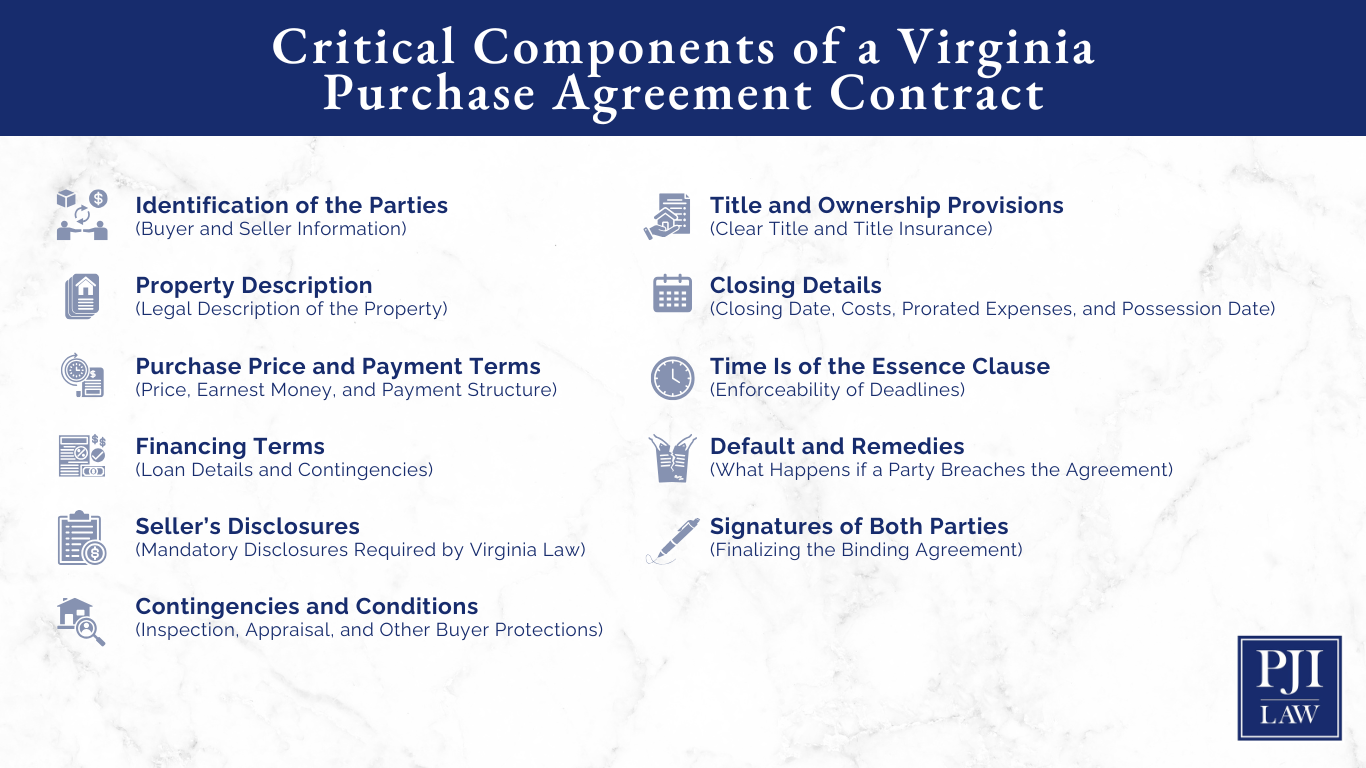
    When drafting or reviewing a purchase agreement in Virginia, several components must be considered to create a comprehensive and enforceable contract.

    Identification of Parties and Property

    The contract must clearly state the full legal names and contact information of the buyer and the seller. Accurate identification prevents potential disputes arising from misidentification. Additionally, a precise description of the property is essential.

    This description includes the property’s legal address, parcel number, and any other pertinent identifiers that distinguish it from other properties, such as the lot number, subdivision, or metes and bounds description to prevent ambiguity regarding the exact parcel being transferred. If there is any uncertainty, buyers may request a property survey to confirm the boundaries before closing.

    Seeking a contract lawyer in Virginia

    Purchase Price and Payment Terms

    The agreed-upon purchase price should be explicitly stated in the contract. Beyond the total amount, the contract should detail the structure of payments, including:

    • Earnest Money Deposit: A sum paid by the buyer to demonstrate serious intent. The contract should specify the amount, the entity holding the deposit (often an escrow agent), and conditions under which the deposit may be forfeited or returned. Virginia law requires earnest money to be held in an escrow account managed by a licensed real estate broker or settlement agent. Mismanagement of these funds could result in legal consequences for the escrow holder.
    • Financing Details: If the buyer is obtaining a mortgage, the contract should outline the financing terms, including loan type, interest rate, and the timeline for securing financing.
    • Payment Schedule: Some transactions may involve structured payments beyond the initial deposit and final closing amount. If any portion of the purchase price will be paid in installments, the contract should specify these terms.

    Property Inclusions and Exclusions

    A well-drafted purchase agreement in Virginia should clearly define what items are included in the sale. Some items, such as built-in appliances, window treatments, and light fixtures, are often assumed to be part of the home purchase. However, if the buyer or seller intends to include or exclude certain items—such as a refrigerator, washer, dryer, or outdoor fixtures—these should be explicitly listed in the contract to prevent disputes.

    Critical Components of a Virginia Purchase Agreement Contract

    Contingencies That Protect Buyers and Sellers

    Contingencies are conditions that must be met for the contract to move forward. These clauses allow either party to withdraw from the agreement without penalty under certain circumstances. Common contingencies in a Virginia purchase agreement include:

    • Financing Contingency: Protects the buyer by allowing contract cancellation if they cannot secure a mortgage within a specified timeframe.
    • Home Inspection Contingency: Allows the buyer to hire a home inspector and negotiate repairs or a price adjustment based on the findings. If the home inspection reveals significant defects, the buyer may have the right to walk away.
    • Appraisal Contingency: Seeks to value the property at or above the purchase price. If the home appraises for less than the agreed price, the buyer can renegotiate or withdraw.
    • Sale of Current Home Contingency: This contingency gives the buyer time to sell their existing home before purchasing a new one.
    • Title Contingency: Confirms that the property’s title is clear of liens or ownership disputes before the sale is finalized.
    • Insurance Contingency: Allows the buyer to cancel the contract if they cannot obtain homeowners insurance, which is often required for financing, especially in areas prone to flooding, hurricanes, or wildfires.
    • Final Walkthrough Contingency: This gives the buyer the right to complete a final walkthrough before closing to confirm that the property is in the agreed-upon condition and that any required repairs have been completed. If issues arise, the buyer may delay closing or renegotiate.
    • Well and Septic System Inspection Contingency: While Virginia law requires sellers to disclose septic system information, this contingency allows the buyer to conduct independent well and septic inspections to confirm they are in working order. If deficiencies are found, the buyer may request repairs or withdraw from the contract.

    Clearly defining contingencies with specific deadlines and conditions is crucial for a smooth transaction.

    Seller’s Disclosures in Virginia

    Sellers Disclosures in Virginia

    Unlike some states that require comprehensive seller disclosures, Virginia follows the buyer beware principle, which means the seller is generally not obligated to disclose property defects. However, Virginia law does require certain disclosures. These include:

    • Lead-Based Paint Disclosure: If the home was built before 1978, federal law requires sellers to inform buyers of any known presence of lead-based paint and provide related documentation.
    • Septic System Disclosure: If the property has a septic system, the seller must disclose its condition and provide any available inspection records. However, this does not guarantee the system is functional, which is why buyers may include a septic inspection contingency in their contract.
    • Military Air Installation Disclosure: If the property is near a military airbase, the seller must inform the buyer due to potential noise and environmental concerns.
    • Homeowners Association (HOA) Disclosure: If the property is located in an HOA community, the seller must provide information about HOA fees, rules, and any pending assessments. The buyer has the right to review these documents and may be able to withdraw from the contract within a set timeframe if they find the terms unacceptable.

    Because Virginia follows a buyer-beware approach, buyers are encouraged to conduct independent inspections to uncover potential property issues. Disclosures only provide required information—they do not replace inspections or eliminate the need for buyer contingencies

    Closing Details

    Once both parties sign the purchase agreement contract, the transaction moves toward closing—the final step where ownership officially transfers. The contract should specify:

    • Closing Date: The agreed-upon date when the transaction will be finalized. In Virginia, simply setting a closing date does not make it enforceable unless the contract includes a “time is of the essence” clause (Sims v. Nidiffer). This clause ensures that deadlines must be strictly met and that failure to close on time could be considered a breach of contract.
    • Location of Closing: Typically conducted at a title company, real estate attorney’s office, or escrow agent’s office. In Virginia, the settlement agent—who may be a title company, escrow officer, or attorney—oversees the closing process, ensuring all legal requirements are met.
    • Closing Costs: Specifies who is responsible for various costs, including title fees, escrow fees, and transfer taxes. In Virginia, these costs are negotiable, but buyers and sellers should agree on their responsibilities in the contract.
    • Title Insurance: While not required by law, title insurance is strongly recommended to protect against title defects or claims. The contract should state whether the buyer or seller is responsible for purchasing the policy.
    • Prorated Expenses: Details how property taxes, homeowners association (HOA) dues (if applicable), and utility bills will be split between the buyer and seller based on the closing date. These costs are often prorated to ensure each party pays their fair share for the time they own the property.
    • Recording Fees and Transfer Taxes: Clarifies who will pay the costs associated with recording the deed and any applicable transfer taxes. Virginia imposes deed transfer taxes, but the responsibility for payment can be negotiated in the contract.
    • Possession Date: Specifies when the buyer will take physical possession of the property. In most cases, possession transfers at closing, but in some agreements, the seller may remain in the home for a set period after closing under a separate agreement.
    • Home Warranty: If a home warranty is included as part of the sale, the contract should specify who is responsible for purchasing it and what it covers.
    • Surveys and Inspections: If the buyer requests a property survey to confirm boundary lines or additional inspections beyond the standard home inspection, the contract should specify who will pay for them and whether the results could impact the sale.

    Including these details in the purchase agreement contract can help avoid last-minute disputes and create a clear, structured path to closing day.

    Common Pitfalls to Avoid

    Common Pitfalls to Avoid

    Real estate transactions can be complex, and certain pitfalls may arise during the contract process. Here are some common mistakes and ways to prevent them in Virginia real estate contracts:

    • Ambiguous Language: Any vague or unclear terms in the contract can lead to disputes. All terms, including deadlines, responsibilities, and conditions, should be clearly defined to prevent misunderstandings.
    • Failure to Include Contingencies: Omitting important contingencies—such as financing, inspections, or appraisal clauses—can leave buyers unprotected if issues arise before closing.
    • Missed Deadlines: Real estate contracts contain strict timelines for financing approval, inspections, repairs, and closing. Failing to meet these deadlines can delay the transaction or result in contract termination.
    • Improper Identification of Parties: The contract should accurately identify all parties involved. If the buyer or seller is an LLC, trust, or other legal entity, the contract must include the full legal name of that entity to avoid enforceability issues.
    • Unclear Terms Regarding Personal Property: To avoid disputes after closing, the contract should explicitly state which items—such as appliances, light fixtures, and window treatments—convey with the home.
    • Inadequate Earnest Money Deposit: The earnest money deposit serves as a good faith payment to secure the property. In a competitive market, an insufficient deposit may make the buyer’s offer less appealing. However, buyers should also be cautious about committing too much without proper contingencies in place.
    • Overlooking Homeowners Association (HOA) Rules and Fees: If the property is located in an HOA community, buyers must review the HOA disclosure packet before proceeding. This includes rules, restrictions, financial obligations, and potential assessments that could impact the buyer’s decision.
    • Neglecting Title Insurance: While not legally required in Virginia, title insurance protects buyers from undiscovered liens, ownership disputes, and title defects that could arise after the purchase. Without it, buyers risk financial loss if an issue surfaces.
    • Failure to Address Termite and Moisture Inspections: Termite and moisture-related damage is a common issue in Virginia, particularly in older homes. The contract should specify who is responsible for inspections and any necessary treatments or repairs before closing.
    • Ignoring the “Time is of the Essence” Clause: Including this clause ensures that deadlines must be strictly followed. Without it, missed deadlines may not automatically result in a breach of contract, potentially delaying closing or causing the deal to fall apart.

    Avoiding these common mistakes helps prevent legal disputes, unexpected costs, and transaction delays, making the home-buying process in Virginia smoother for both buyers and sellers.

    Dealing with a purchase agreement

    When Can a Purchase Agreement Be Canceled?

    There are specific scenarios in which a purchase agreement can be canceled legally without penalty:

    • Failure to Meet Contingencies: If a contingency, such as financing approval or a satisfactory inspection, is not met, the buyer can withdraw without consequences.
    • Mutual Agreement: Both parties can agree to cancel the contract in writing.
    • Breach of Contract: If one party fails to meet their contractual obligations, the other party may have grounds for termination.
    • Legal Issues: Unresolved title defects, zoning violations, or undisclosed property conditions may justify contract termination.

    If a contract is canceled, the terms of earnest money refunds or forfeitures should be clearly outlined in the agreement.

    The Role of Real Estate Professionals

    The Role of Real Estate Professionals

    Although a purchase agreement is a binding legal document, buyers and sellers may not always fully understand its implications. Real estate professionals—such as agents, brokers, and attorneys—play a key role in ensuring the contract reflects both parties’ intentions and complies with Virginia laws.

    • Real Estate Agents: Agents assist in drafting, negotiating, and finalizing purchase agreements while ensuring that buyers and sellers understand the terms.
    • Attorneys: A legal contract lawyer can review the contract, explain potential risks, and handle legal complexities such as title issues or disputes.
    • Title Companies: A title company ensures the property’s title is clear of liens and facilitates the closing process.

    While not legally required, involving professionals can provide valuable guidance throughout the transaction.

    A purchase agreement contract in Virginia is the backbone of any real estate transaction, ensuring both buyers and sellers are legally protected. By understanding its key elements, legal requirements, and potential pitfalls, you can approach a property purchase with confidence. Whether you’re buying your first home or selling an investment property, a well-drafted contract helps create a clear path to a successful closing.

    Need a Contract Lawyer? Consult PJI Law in Fairfax, Virginia

    A purchase agreement contract is more than just paperwork—it defines your rights and obligations in a high-stakes transaction. Whether you’re buying or selling property, having a contract lawyer review or draft your agreement can help you avoid costly mistakes and legal disputes. At PJI Law, we review your contract for clarity, enforceability, and alignment with Virginia law. We assist with negotiations, identify potential risks, and address contingencies to protect your investment.

    Though this blog focuses on real estate purchase contracts, our legal team also assists with various business and financial agreements. Whether you’re entering a partnership agreement, drafting a promissory note, or reviewing a property lease, we provide tailored legal solutions to safeguard your interests.

    If you’re searching for a “real estate attorney near me” who can help with your contract needs, PJI Law is ready to assist. Call (703) 865-6100 or fill out our confidential online form to schedule your consultation today.

    At PJI Law, you’ll receive white glove service and personalized attention!

    Copyright © 2025. PJI Law, PLC. All rights reserved.

    The information in this blog post (“post”) is provided for general informational purposes only and may not reflect the current law in your jurisdiction. No information in this post should be construed as legal advice from the individual author or the law firm, nor is it intended to be a substitute for legal counsel on any subject matter. No reader of this post should act or refrain from acting based on any information included in or accessible through this post without seeking the appropriate legal or other professional advice on the particular facts and circumstances at issue from a lawyer licensed in the recipient’s state, country, or other appropriate licensing jurisdiction.

    PJI Law, PLC
    3900 Jermantown Rd, 2nd Floor
    Fairfax, Virginia 22030
    (703) 865-6100
    https://pjibe.webteam.ai/

  • Who Inherits if a Beneficiary Dies Before the Testator in Richmond, VA?

    Who Inherits if a Beneficiary Dies Before the Testator in Richmond, VA?

    Mary, a Richmond resident, established her estate plan five years ago, believing everything was in order. Her will outlined her wishes, with her brother, Thomas, set to inherit a significant portion of her estate. No one could have anticipated that Thomas would pass away unexpectedly before Mary in a tragic accident. When Mary died a few years later, her family faced surprising and avoidable legal issues. “Who inherits if a beneficiary dies?” they wondered.

    Thoughts about what would happen to the share of Mary’s estate she originally intended for Thomas swirled through their minds. Would it go to his children? Would the entire estate be redistributed among other heirs? Or would Virginia state law dictate a completely different outcome?

    This real-world challenge illustrates why estate planning is much more than creating a document and tucking it into a drawer. As a skilled attorney knows, it requires foresight, adaptability, and professional guidance. At PJI Law, we understand the nuances of Virginia’s estate laws and provide individual attention and personalized legal services to protect your wishes and shield your family from confusion during difficult times.

    This blog, from a wills and probate lawyer, explores how the Commonwealth of Virginia determines the outcome in cases like Mary’s — situations where a named beneficiary predeceases the testator (the person who made the will).

    Continue reading to learn more, then contact our estate planning law firm at (804) 653-3450 for personalized service and attention.

    Who inherits if a beneficiary?

    What Constitutes a Legally Valid Will in Virginia?

    As a reputable estate planning and estate administration law firm in Richmond, we cannot overemphasize the importance of establishing a legally enforceable will. It honors your final wishes and simplifies and expedites the estate administration process for your family members and other loved ones.

    Before we address the issue of beneficiaries dying before testators, let’s review the requirements that make a will a valid legal document in Virginia.

    The Code of Virginia specifies the following criteria:

    1. Age and Capacity: The testator must be at least 18 years old and of sound mind, meaning they understand the aspects and consequences of making a will.
    2. Written: A will must be written in either ink or typewritten. Virginia does not recognize oral wills.
    3. Signature: The testator must sign the document at the end of its contents. If the testator cannot sign the will, another person can sign it on their behalf. However, they must sign it in the presence of the testator and at their direction.
    4. Personal Representative/Executor: In the will, the testator can designate a personal representative, also known as an executor, to handle the estate administration and probate process upon their death. A probate lawyer can recommend the right individual for this role.
    5. Witnesses: Two disinterested and competent witnesses must attest to the testator’s signature by signing the will in their presence.
    6. Intent: The testator must intend that this legal document serve as their last will and testament.
    7. Voluntary: The testator must create the will voluntarily without undue influence, coercion, or duress.

    Benefits of creating a will

    Keep in mind that a will must undergo a public probate process as part of the deceased’s estate administration. During this time, the personal representative/executor designated in the will is responsible for paying debts and any tax obligations owed by the deceased before they can distribute assets to the primary beneficiary and other named heirs.

    For more information, we invite you to read our blog, What Does It Mean to Be an Executor of Estate in Richmond, Virginia?

    Who inherits if a beneficiary dies?

    What Happens When a Beneficiary Dies Before the Testator?

    Under state law, if a beneficiary dies before the testator, several possibilities determine what happens to the intended inheritance. These outcomes depend on critical factors, including how the will is written, whether it names alternate beneficiaries, and how the specific provisions of Virginia’s law concerning an estate apply.

    Understanding the “Lapse” Rule in Virginia

    If Mary’s will simply named Thomas as a primary beneficiary without additional instructions about what to do if Thomas predeceased her, the legal principle of “lapse” would apply. The term “lapse” simply means the gift intended for the deceased beneficiary fails, or “lapses.” When this occurs, the intended gift typically becomes part of the residuary estate, which is then distributed according to the terms of the will or, in some cases, according to Virginia’s intestacy laws.

    To learn more, we invite you to read our blog, The Disadvantages of Dying with No Will in Virginia.

    However, Virginia has a layer of protection for certain beneficiaries in the form of its anti-lapse statute.

    Virginia’s Anti-Lapse Statute

    Virginia Code § 64.2-418 states that if a deceased beneficiary was a relative of the testator — specifically, a descendant, ancestor, sibling, or descendant of a sibling — the gift will pass to the deceased beneficiary’s descendants unless a will clearly states otherwise. For example, if Mary named Thomas as her primary beneficiary and he had children, his share would automatically pass to his kids unless Mary explicitly wrote a clause dictating otherwise.

    This statute keeps family assets within the family circle unless the testator’s will expresses a desire for a different arrangement. It’s a thoughtful approach, but it also highlights the importance of updating your will to account for changes in family dynamics over time.

    Search for Estate Law Firms Near Me

    Real-World Implications

    Returning to Mary’s story, if Thomas had two children, Virginia’s anti-lapse statute could direct an equal division of Thomas’s share between his children. However, Mary’s family could still face complications if her will included ambiguous language or failed to anticipate this possibility.

    For example:

    1. No Alternate Beneficiary Named – If Mary made no mention of an alternate beneficiary, the outcome could rely entirely on the anti-lapse statute or result in the lapsed gift being distributed to other residuary beneficiaries (if any exist).
    2. Conflicting Terms in the Will – If Mary had contradicting clauses in her will or used vague terms like “all my relatives” without listing names, the case could end up in probate court, requiring judicial interpretation.
    3. Intestate Succession Risks – If the residuary estate’s beneficiary had also predeceased Mary, portions of her estate might be distributed according to Virginia’s rules for intestate succession — a result Mary likely tried to avoid.

    Consulting legal counsel in Richmond, Virginia to establish a comprehensive will and updating your will regularly as life circumstances change will help you avoid these unwanted outcomes.

    Virginia Estate Planning

    Virginia Estate Planning is an Ongoing Process, Not a Once in a Lifetime Activity

    At PJI Law, we often meet clients who created their wills ten or twenty years ago when their lives looked very different. Their families grew, relationships evolved, and loved ones passed away. Yet, their estate plans remained frozen in time. Mary’s situation could have been avoided with a quick, proactive update to her planning documents.

    Periodic reviews and revisions to your Virginia estate plan are essential for many reasons:

    • Family Changes: Births, deaths, marriages, and divorces can significantly change how you want to allocate your assets.
    • Life Stage Milestones: If your children are now adults or your grandchildren are born post-document creation, your priorities may shift.
    • State Law Updates: Virginia’s estate planning laws evolve. Staying in compliance with current law keeps your will enforceable and efficient.
    • Avoid Family Disputes: Ambiguities in a will often lead to rifts between family members. Clear, updated plans eliminate confusion and reduce tension.

    When you consult an estate planning attorney from our law firm, we will handle these updates with professionalism and care, always focused on your specific situation and what serves your best interest.

    Proactive Solutions to Avoid Lapse Issues

    To align your estate plan with your true intentions — even in unforeseen circumstances — consider implementing the following:

    Naming Contingent Beneficiaries

    Always include contingent beneficiaries in your will. If Mary’s will had stated, “If Thomas predeceases me, his share shall pass to his children equally,” her family might have avoided confusion altogether. Naming backup beneficiaries provides clarity and reduces reliance on Virginia’s intestate succession law.

    Including Residuary Clauses

    A residuary clause specifies who should inherit the remaining portions of your estate after the distribution of all specific bequests. For example, “I leave the residue of my estate to my niece, Hannah, if Thomas predeceases me” directs unallocated assets as intended.

    Drafting Testamentary Trusts

    For clients with multiple beneficiaries or minor children, establishing a testamentary trust can facilitate the smooth management of assets after their passing. Created through wills, testamentary trusts take effect after the grantor’s (the person creating the trust) death, allowing them to designate the allocation of funds, provide for minors, and avoid leaving potentially large inheritances directly to those who may be unprepared for financial responsibility.

    For example, the grantor can stipulate that their beneficiaries can only receive assets under a specific situation, such as turning 21 years of age. Testamentary trusts offer many benefits, such as giving the grantor control of when and how their heirs receive assets and enabling the grantor to name a trustee to handle trust administration and manage assets until their beneficiaries can claim their inheritance.

    However, unlike other types of trusts, a testamentary trust must undergo the public probate process where the contents of the trust and the decedent’s assets become a matter of public record. There may also be significant court costs to administer a testamentary trust.

    Leveraging Professional Legal Assistance

    Every family’s needs and financial goals are unique. That’s why PJI Law focuses on personalized, detail-oriented estate planning that upholds your desires, protects your legacy, and accounts for future uncertainties. Our estate planning and probate law firm has helped Richmond families prevent the very issues we discuss here.

    Special Considerations in Complex Situations

    Estate planning is not one-size-fits-all. Our law firm recognizes that some circumstances require advanced solutions:

    • Blended Families: Estate planning for blended families requires clarification of your inheritance intentions in situations involving stepchildren, half-siblings, or second marriages.
    • Small Business Owners: For small business owners, business succession planning must be part of their estate planning. Our attorneys help business owners design plans for who will inherit or manage their business if they become incapacitated or pass away.
    • Heirlooms and Personal Property: We assist clients in deciding who will receive sentimental items to prevent disputes among surviving family members.

    Our legal services anticipate and address these intricate scenarios with tailored advice and strategies.

    Building a Legacy with PJI Law

    The attorneys and staff at PJI Law understand that estate planning is not merely transactional — it’s relational. We pride ourselves on forming lifelong partnerships with our clients, serving as a trusted part of their family’s estate planning team. Our legal services prioritize clear and timely communication, so you never have to wonder about the progress of your estate plan or worry that your loved ones will be left with unanswered questions.

    Consider the peace of mind you’ll feel knowing your wishes are crystal clear, your family’s future is secure, and someone is there to guide your loved ones through the probate process when the time comes.

    Contact PJI Law in Richmond, Virginia to Discover How Our Attorneys and Staff Can Help with All Aspects of Estate Planning

    Have you been searching for “estate law firms near me?”

    With the guidance of our Virginia estate planning attorneys, estate planning doesn’t have to be overwhelming. Whether you’re creating your will for the first time or revisiting years-old documents, we’re here to help. By working together, we’ll establish a plan that reflects your values, protects your family, and addresses uncertainties like the possibility of a beneficiary dying before you.

    Contact PJI Law at (804) 653-3450 or complete our online form to schedule a consultation for personalized service and attention.

    Copyright © 2025. PJI Law, PLC. All rights reserved.

    The information in this blog post (“post”) is provided for general informational purposes only and may not reflect the current law in your jurisdiction. No information in this post should be construed as legal advice from the individual author or the law firm, nor is it intended to be a substitute for legal counsel on any subject matter. No reader of this post should act or refrain from acting based on any information included in or accessible through this post without seeking the appropriate legal or other professional advice on the particular facts and circumstances at issue from a lawyer licensed in the recipient’s state, country, or other appropriate licensing jurisdiction.

    PJI Law, PLC
    4108 E Parham Rd,
    Richmond, VA 23228
    (804) 653-3450
    https://pjibe.webteam.ai/

  • How Do You Evict a Tenant in Virginia?

    How Do You Evict a Tenant in Virginia?

    Evicting a tenant is rarely straightforward. The process involves dealing with legal requirements, managing interpersonal challenges, and sometimes facing unexpected hurdles. In Virginia, landlords must adhere to specific steps outlined by state law to protect their rights while ensuring fairness.

    Whether a tenant has missed rent payments, broken lease terms, or refused to vacate after the lease ended, knowing how to handle these situations can save you time, money, and stress. This leads to a common question: “How do you evict a tenant in Virginia?” This blog explains the legal steps you must follow, the potential challenges you may face, and the key tenant protections you need to understand. To start, let’s explore the reasons why you might need to evict a tenant in Virginia and how state laws define these situations.

    Wondering how to evict a tenant in Virginia

    Reasons for Eviction in Virginia

    Before initiating an eviction, it’s important to confirm that your reason for removing the tenant aligns with Virginia’s legal grounds for eviction. Common reasons include:

    • Nonpayment of rent: If a tenant fails to pay rent by the due date, you can start the eviction process.
    • Lease violations: This includes unauthorized pets, property damage, or other breaches of the lease agreement.
    • Holdover tenancy: When a tenant remains on the property after the lease has expired without your consent.
    • Illegal activity: If the tenant engages in unlawful activities on the property.

    While it’s essential to confirm your reasons for eviction align with Virginia law, it’s equally important to recognize the rights tenants are afforded during this process. These protections help ensure fairness and compliance for both parties.

    Tenant’s Rights and Protections

    Tenants have specific rights, including the right to receive proper notice and the opportunity to remedy certain breaches. Additionally, tenants are protected from retaliatory actions by landlords. Both landlords and tenants need to be aware of their rights and obligations under the Virginia Residential Landlord and Tenant Act (VRLTA) to maintain compliance with state laws.

    The VRLTA governs only residential rental agreements. Commercial leases fall under separate rules and are typically governed by the terms of the lease agreement and general contract law in Virginia.

    Once you’ve established a valid reason for eviction and understand tenant protections, the next step is to begin the formal process. This starts with serving the appropriate notice, as required by Virginia law.

    Step 1: Provide Proper Notice to the Tenant

    Provide Proper Notice to the Tenant

    Virginia law requires that you give your tenant written notice before filing for eviction. The type of notice depends on the reason for eviction:

    • Pay or Quit Notice: For nonpayment of rent, you must provide a 5-day notice that allows the tenant to either pay the overdue rent or move out.
    • Notice of Lease Violation: For breaches of the lease, you must typically provide a 21/30 notice. This gives the tenant 21 days to remedy the violation or 30 days to vacate.
    • Immediate Notice for Non-Remediable Breach: In cases of illegal activity or severe lease violations, landlords may issue an immediate notice requiring the tenant to vacate without an opportunity to remedy the breach. However, “immediate notice” does not mean instant eviction—it still requires proper service of the notice in accordance with Virginia law. For example, the notice must be delivered via hand delivery, mail, or another approved method. Failure to properly serve the notice can delay or invalidate the eviction process.

    Step 2: File an Unlawful Detainer Lawsuit

    If the tenant does not comply with the notice, your next step is to file an unlawful detainer lawsuit in the General District Court where the property is located. Here’s what you need to do:

    • Prepare the necessary documentation: Gather a copy of the lease agreement, records of unpaid rent (if applicable), and the written notice provided to the tenant.
    • File the complaint: Submit a Complaint for Unlawful Detainer form to the court clerk and pay the filing fee.
    • Serve the tenant: The court will arrange to serve the tenant with a summons and a copy of the complaint.

    Step 3: Attend the Court Hearing

    Both you and the tenant will have the opportunity to present your case in court. To improve your chances of success:

    • Be prepared: Bring all relevant documentation, including the lease, notices, and any communication with the tenant.
    • Follow court procedures: Adhere to the rules of the General District Court.

    If the court rules in your favor, it will issue a judgment for possession, allowing you to reclaim your property.

    Step 4: Obtain a Writ of Eviction

    After receiving a judgment for possession, Virginia law requires a mandatory 10-day waiting period before you can request a writ of eviction. This period allows the tenant an opportunity to appeal the judgment or vacate voluntarily. Once the 10 days have passed:

    • Request the writ: File a request with the court clerk for the writ of eviction. This must be done within 180 days of the judgment for possession; otherwise, you may need to restart the eviction process.
    • Coordinate with the sheriff: After the writ is issued, the sheriff oversees the eviction process. The sheriff must provide the tenant with at least 72 hours written notice before executing the writ. This notice allows the tenant a final opportunity to vacate the property voluntarily.
    • Execution timeline: The writ must be executed within 30 days of its issuance. If the eviction is not carried out within this timeframe, a new writ will be required.

    Note: Virginia law allows tenants to exercise an extended right of redemption, which means they can pay all outstanding amounts owed—including rent, late fees, court costs, and other charges—up to two business days before the eviction is scheduled to avoid removal.

    By adhering to these timelines and coordinating with the sheriff’s office, you can complete the final step in reclaiming your property.

    Step 5: Regain Possession of the Property

    On the scheduled eviction date, the sheriff will accompany you to the property to ensure the tenant has vacated. You may then change the locks and take control of your property.

    While these steps outline the eviction process, landlords must be prepared for potential defenses tenants may use to challenge the eviction. Understanding these defenses can help you stay ahead of disputes.

    Legal Eviction Process

    Tenant Defenses to Eviction in Virginia

    Tenants have legal rights that allow them to defend against eviction in certain situations. Be prepared for these potential defenses:

    • Improper notice: If the notice you provided doesn’t comply with Virginia law, the tenant may contest it.
    • Retaliatory eviction claims: Evictions made in retaliation for a tenant exercising legal rights, such as reporting code violations, are prohibited.
    • Habitability issues: If the tenant claims the property is uninhabitable due to unresolved maintenance problems, the court may side with them.

    Tenant defenses are just one of the many hurdles landlords may encounter. From procedural errors to court delays, being aware of these challenges can help you navigate the process more effectively.

    Common Challenges Landlords Face During the Eviction Process

    The eviction process can come with obstacles. Some common challenges include:

    • Tenant counterclaims: Tenants may raise defenses such as retaliation or habitability issues.
    • Procedural errors: Failing to follow Virginia’s strict eviction procedures can delay or invalidate the process.
    • Court delays: Scheduling hearings or obtaining a writ of eviction may take longer than expected.

    By staying organized and prepared, you can address these challenges effectively. However, in some cases, landlords may find it beneficial to consider alternatives to eviction. These options can save time, reduce costs, and preserve tenant relationships when appropriate.

    Alternatives to Eviction

    Alternatives to Eviction

    Eviction isn’t always the only option. You can explore alternatives that might save time and costs while resolving the issue with your tenant. Some options include:

    • Mediation: Work with a neutral third party to negotiate a solution that satisfies both you and your tenant.
    • Payment plans: If your tenant has financial difficulties, consider creating a temporary payment plan to help them catch up on rent.
    • Lease modifications: Adjust the lease terms to address the current situation and keep the tenant in compliance.

    If eviction becomes unavoidable, it’s important to be aware of the potential financial implications. Understanding the associated costs can help you plan and manage expenses effectively.

    Costs Associated with Eviction

    Evicting a tenant involves costs that you should consider before proceeding. These may include:

    • Court filing fees
    • Sheriff’s fees for executing the writ of eviction
    • Loss of rental income during the process
    • Legal fees, if you hire an attorney

    To minimize costs, ensure that all required documentation—such as notices, lease agreements, and payment records—is well-organized and accurate. Additionally, avoid procedural missteps, as these can lead to delays and additional expenses.

    Once the eviction process is complete, your responsibilities as a landlord don’t end. Taking the right post-eviction steps can protect your investment and prepare your property for the next tenant.

    How do you evict a tenant in Virginia

    Post-Eviction Steps for Landlords

    After regaining possession of your property, there are several important steps to take:

    • Handling Security Deposits: You must return the tenant’s security deposit within 45 days of the lease ending. If deductions are made for unpaid rent or damages, you must provide an itemized list along with any remaining balance. Failure to do so may result in legal penalties.
    • Evaluating Property Condition: Conduct a thorough inspection of the property to document its condition. Use photographs or videos as evidence, particularly if you plan to make deductions from the security deposit.
    • Repair and Cleaning: Ensure the property meets safety and habitability standards before re-renting.
    • Screening Future Tenants: Improve your tenant screening process by checking credit history, contacting references, and verifying employment. This reduces the likelihood of future disputes or evictions.

    Properly addressing these post-eviction steps not only protects your investment but also sets the stage for a more successful landlord-tenant relationship moving forward. Throughout the eviction process, landlords must also comply with fair housing laws to ensure actions remain lawful and non-discriminatory.

    Eviction and Fair Housing Laws

    Complying with fair housing laws is critical throughout the eviction process. These laws prohibit discrimination based on race, religion, sex, national origin, disability, familial status, and other protected characteristics. Even unintentional bias, such as applying policies inconsistently, can lead to legal trouble.

    To avoid potential violations:

    • Apply rules and policies consistently to all tenants.
    • Document interactions and decisions thoroughly, especially those related to lease violations and notices.
    • Refrain from using language or actions that could be perceived as discriminatory.

    For example, evicting a tenant for noise complaints while ignoring similar behavior from others could be construed as discriminatory. Understanding these legal protections helps you act fairly and lawfully, ensuring a positive reputation as a landlord.

    One of the most effective ways to prevent eviction-related issues is to start with a clear and comprehensive lease agreement. Setting expectations upfront can reduce misunderstandings and disputes.

    Importance of Clear Lease Agreements

    Importance of Clear Lease Agreements

    A clear and detailed lease agreement can help you avoid disputes that lead to eviction. Include terms that define:

    • Rent payment schedules and late fees
    • Rules for property use and maintenance
    • Consequences for violations

    A well-crafted lease protects both you and your tenant. However, even with a solid lease agreement, challenges can arise. By adopting proactive strategies, you can streamline the eviction process and minimize stress.

    Seeking a real estate dispute lawyer for help with evicting a tenant

    Tips for a Smooth Eviction Process

    While following the legal steps is critical, you can take additional measures to minimize stress and avoid complications:

    • Communicate Early: Open communication with your tenant can sometimes resolve issues before they escalate to eviction. Address concerns as soon as they arise and provide clear explanations of expectations and consequences for noncompliance. Even if eviction becomes unavoidable, a respectful dialogue may make the process less contentious.
    • Document Everything: Keep thorough and organized records of rent payments, lease violations, maintenance requests, and any communication with your tenant. These records can serve as vital evidence in court and protect you from potential counterclaims or disputes.
    • Seek Legal Guidance: If you’re dealing with complex situations, such as disputes over habitability or retaliatory eviction claims, consult real estate lawyers in Virginia who are well-versed in Virginia landlord-tenant laws. This can help you avoid procedural missteps that could delay or invalidate the eviction.
    • Be Proactive About Lease Terms: Consider including clauses in your lease agreements that clearly outline consequences for nonpayment or lease violations. Transparent and specific terms reduce ambiguity and make it easier to enforce your rights as a landlord.
    • Prepare for Court: If the matter proceeds to a hearing, bring all necessary documentation, such as the lease agreement, notices, and payment records. Practicing your statements and understanding court procedures can make your presentation more effective and persuasive.
    • Anticipate Tenant Defenses: Familiarize yourself with common tenant defenses, such as claims of improper notice or uninhabitable conditions. Address any potential issues beforehand to strengthen your position in court.

    These strategies can streamline the eviction process and reduce the likelihood of complications, ensuring a smoother path to reclaiming your property.

    Evicting a tenant in Virginia involves a series of legal steps that must be followed carefully to avoid potential legal challenges. By adhering to state laws and maintaining open communication when possible, you can manage the process with professionalism and respect. If you’re uncertain about any part of the eviction process, consulting a real estate dispute lawyer can provide clarity and protect your rights as a landlord.

    Contact PJI Law for Strategic Legal Support for Your Virginia Eviction

    Evicting a tenant can be a demanding process. You need to follow Virginia’s landlord-tenant laws carefully to avoid delays or costly mistakes. At PJI Law, our Virginia real estate lawyers will guide you through each step, from serving proper notices to representing you in court.

    We work with landlords to resolve disputes efficiently, protect property rights, and ensure a legally compliant eviction process. Whether you’re dealing with unpaid rent or lease violations, you can rely on us to simplify the process and protect your interests.

    Beyond handling evictions, we can also help you prevent future disputes by reviewing or drafting clear, legally sound lease agreements tailored to protect your rights and interests as a landlord.

    Take control of your real estate challenges today. Call PJI Law at (703) 865-6100 or fill out our confidential online form to schedule a consultation. Let us assist you in achieving a smooth and fair resolution.

    At PJI Law, you’ll receive white glove service and personalized attention!

    Copyright © 2025. PJI Law, PLC. All rights reserved.

    The information in this blog post (“post”) is provided for general informational purposes only and may not reflect the current law in your jurisdiction. No information in this post should be construed as legal advice from the individual author or the law firm, nor is it intended to be a substitute for legal counsel on any subject matter. No reader of this post should act or refrain from acting based on any information included in or accessible through this post without seeking the appropriate legal or other professional advice on the particular facts and circumstances at issue from a lawyer licensed in the recipient’s state, country, or other appropriate licensing jurisdiction.

    PJI Law, PLC
    3900 Jermantown Rd, 2nd Floor
    Fairfax, Virginia 22030
    (703) 865-6100
    https://pjibe.webteam.ai/

  • Understanding Probate Fees in Virginia

    Understanding Probate Fees in Virginia

    Taking on the responsibility of administering someone’s estate after their passing can feel overwhelming, especially when unfamiliar with the process. Probate in Virginia involves managing the deceased’s affairs, including paying debts and distributing assets to heirs or beneficiaries. 

    Along the way, you’ll encounter fees like court filing costs, executor compensation, and administrative expenses. While these costs are part of the process, knowing what to expect can help you better understand the financial aspects of probate fees in Virginia.

    What Is Probate in Virginia?

    Probate is the legal process of proving a deceased person’s will, or if there is no will, settling the estate according to Virginia law. During probate, the court ensures the deceased’s debts are paid and their assets are distributed to heirs or beneficiaries.

    In Virginia, probate occurs in the circuit court of the county or city where the deceased lived. While some estates qualify for simplified procedures, others require formal probate. Each step involves costs, which are important to anticipate.

    Filing Fees and Initial Costs

    The first expense you’ll encounter is the probate filing fee. In Virginia, fees are calculated at the time of the probate appointment and based on the value of the estate being probated.

    Additional fees may include charges for copies of documents, certificates of qualification, and other court-related services. 

    Fiduciary Compensation and Attorney Fees

    The executor or administrator of an estate is entitled to reasonable compensation for their work. In Virginia, fudiciary fees are often calculated as a percentage of the estate’s value, following a standard schedule:

    • 5% of the first $400,000
    • 4% of the next $300,000
    • 3% of the next $300,000
    • 2% of assets over $1 million

    For example, an estate valued at $600,000 would result in an executor fee of approximately $28,000. This calculation is based on guidelines provided by the Fairfax Commissioner of Accounts.

    If you choose to hire a probate lawyer, legal fees are another expense to consider. Attorneys typically charge by the hour or offer flat-rate services depending on the complexity of the estate. While this is an additional expense, their services can simplify the process, resolving the matter more efficiently and therefore may not increase the overall cost of probate.

    Appraisal and Valuation Costs

    If the estate includes real estate, valuable collections, or other unique assets, professional appraisals may be required. Appraisal costs can vary depending on the type and complexity of the assets being evaluated. 

    For instance, real estate appraisals typically depend on the property size and market conditions, while specialized items like art or jewelry may require expertise in niche markets. Although these expenses are often deductible from the estate, they can impact the overall distribution to beneficiaries.

    Taxes and Debts

    During probate, the executor is responsible for settling the deceased’s debts and taxes. Common obligations include:

    • Personal Income Taxes: Filing the final tax return for the deceased.
    • Estate Taxes: While Virginia does not impose a state estate tax, federal estate taxes may apply to larger estates exceeding the federal exemption limit.

    Additionally, the executor may need to cover property taxes, mortgage payments, and other recurring expenses from the estate until probate is complete.

    Miscellaneous Costs to Expect

    While some costs are predictable, others depend on the specific circumstances of the estate. Examples include:

    • Bond Premiums: Executors may be required to purchase a probate bond, which acts as insurance to protect the estate’s beneficiaries. The cost of the bond depends on the estate’s size.
    • Publication Fees: If required to notify creditors or unknown heirs, you may need to publish a notice in a local newspaper. This typically costs $50–$150.
    • Storage or Maintenance: Keeping assets like real estate or vehicles in good condition during probate can incur additional costs.

    How Probate Fees Impact Beneficiaries

    Probate fees reduce the total value of the estate, which directly affects the inheritance beneficiaries receive. For instance, an estate valued at $500,000 with 5% total fees will leave $25,000 less for heirs. These fees can compound when additional services, disputes, or delays occur during probate.

    Reducing Probate Fees and Avoiding Probate

    While some fees are unavoidable, you can take proactive steps to reduce costs or bypass probate entirely:

    • Establish a Revocable Living Trust: Assets placed in a trust pass outside of probate, eliminating associated fees.
    • Joint Ownership and Beneficiary Designations: Naming joint owners or beneficiaries for accounts, property, and retirement plans can bypass probate.
    • Simplified Procedures: Estates valued under $50,000 in Virginia may qualify for streamlined probate, reducing court involvement and costs.

    When to Seek Professional Advice

    Probate can become more complicated if the estate involves disputes, significant assets, or unclear instructions. While this blog provides an overview, consider reaching out to a Virginia probate attorney for tailored guidance.

    Probate fees in Virginia vary depending on the size and complexity of the estate, but they include filing fees, fiduciary compensation, appraisal costs, and other expenses. By understanding these costs, you can better prepare for the probate process and make thoughtful decisions.

    Whether you’re planning ahead or managing a loved one’s estate, being informed can save time, money, and stress during an already challenging time.

    PJI Law – Your Trusted Partner for Virginia Probate

    Probate can be a complicated process, requiring attention to legal, financial, and administrative details. At PJI Law, we provide comprehensive guidance to executors and administrators. From explaining probate fees and court filing requirements to preparing documents and resolving disputes, we’re here to simplify your responsibilities.

    Our probate lawyers also assist with identifying estate assets, addressing creditor claims, and ensuring proper distribution to heirs or beneficiaries. Whether the estate is straightforward or complex, we’ll tailor our approach to your unique situation.

    If your online search for a “probate attorney near me” or “Virginia probate attorney” led you here, you’re in the right place. Call us today at (703) 865-6100 or use our confidential online form to schedule a consultation. PJI Law is here to help you handle probate with confidence and clarity.

    At PJI Law, you’ll receive personalized service and attention!

    Copyright © 2025. PJI Law, PLC. All rights reserved.

    The information in this blog post (“post”) is provided for general informational purposes only and may not reflect the current law in your jurisdiction. No information in this post should be construed as legal advice from the individual author or the law firm, nor is it intended to be a substitute for legal counsel on any subject matter. No reader of this post should act or refrain from acting based on any information included in or accessible through this post without seeking the appropriate legal or other professional advice on the particular facts and circumstances at issue from a lawyer licensed in the recipient’s state, country, or other appropriate licensing jurisdiction.

    PJI Law, PLC
    3900 Jermantown Rd, 2nd Floor
    Fairfax, Virginia 22030
    (703) 865-6100
    https://pjibe.webteam.ai/
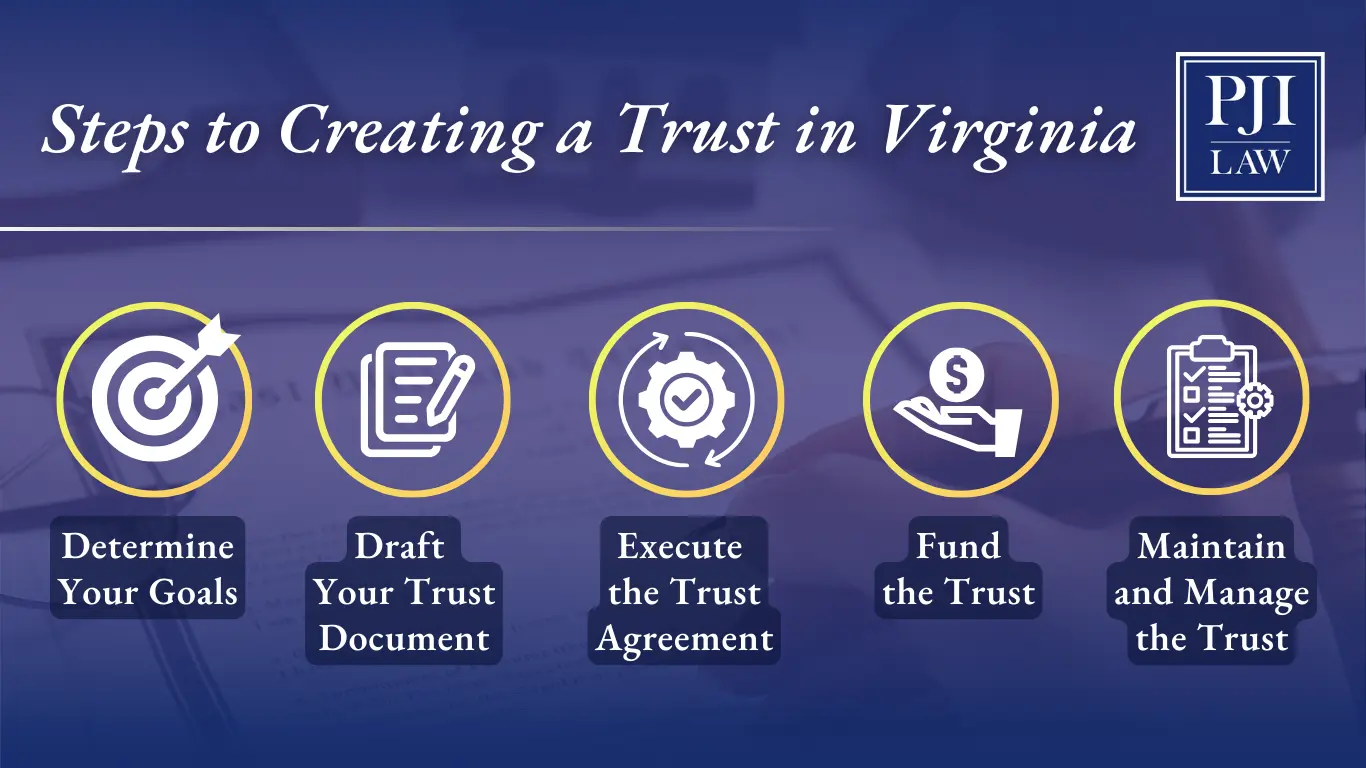
  • What Is a Pour-Over Will in Richmond, Virginia?

    What Is a Pour-Over Will in Richmond, Virginia?

    When James and Christina Peterson decided to begin estate planning, they hoped to secure their family’s future while avoiding unnecessary stress and legal hurdles. Living in Richmond, Virginia, with two young children and a growing list of assets, they knew it was time to act. With the help of an estate planning attorney, they created a revocable living trust to distribute their investments, home, and savings as they intended after their deaths.

    But as life often goes, things didn’t stay static. Over the next decade, the Petersons’ careers flourished, as did their list of possessions. James purchased a small cabin as a getaway; Christina opened a side business that grew out of her passion for floral arrangements. Caught up in the inevitable changes affecting their businesses, family, and community, they forgot to transfer these new pieces of their financial puzzle into their trust.

    When James passed unexpectedly after a car accident, Christina faced the daunting task of managing his estate while grieving her loss. Without a legal mechanism to funnel those additional assets into the trust, the distribution of James’s untransferred property could have been complicated by probate court and potentially even contested by extended family members.

    Fortunately, their estate planning attorneys in Richmond, had recommended including a pour-over will in their estate plan. Although the new assets, which had not been funded into the initial trust, had to go through probate, the pour-over will facilitated their transfer into the trust and distribution according to James’s wishes.

    The Petersons’ story demonstrates the safeguard a pour-over will can provide, especially in an estate plan paired with a trust. It assures the management of all assets, relieving loved ones of unnecessary confusion during an already difficult time.

    Are you asking, “What is a pour-over will?” This blog, from an estate planning attorney in Richmond, describes a pour-over will and why it’s so important among estate planning documents.

    This unique legal instrument works in conjunction with a trust to include every asset in your estate plan. At PJI Law, we’re here to make the estate planning process clear, manageable, and tailored to your specific goals. Continue reading to learn more, then contact us at (804) 653-3450 for personalized service and attention.


    What is a pourover will

    What Is a Pour-Over Will?

    A pour-over will is a particular type of will designed to work alongside a revocable living trust. Its primary function is to transfer any remaining assets that were not automatically transferred into a trust during your lifetime into that trust upon your death, managing them according to the terms of your trust.

    A pour-over will serves a useful purpose because, despite your best efforts, it’s easy to overlook certain assets when initially funding a trust. You might acquire new property or financial accounts after creating your trust and forget to move them into it. A pour-over will catches those items to avoid their distribution outside your intended purpose.

    How Does a Pour-Over Will Work?

    When you pass away, the pour-over will directs any unallocated assets into your trust, which streamlines the process by consolidating asset management under the governance of the trust. After the assets are redirected, the trustee — rather than probate or state intestacy laws — will manage and distribute them according to the trust’s terms.

    While estate administration requires the assets governed by the pour-over will to go through the probate process, this type of will aligns the assets with your broader estate plan, upholding your intentions.

    Benefits of a Pour-Over Will in Richmond, Virginia

    Benefits of a Pour-Over Will in Richmond Virginia
    As an estate planning attorney knows, a pour-over will offers several distinct advantages within the framework of a comprehensive estate plan:

    1. Provides a Safety Net for Your Estate Plan

    Life happens — you might forget to transfer certain assets into your revocable trust. A pour-over will serves as a backup, making sure nothing is left unmanaged or distributed contrary to your wishes.

    2. Simplifies Probate

    Even though assets covered by a pour-over will may go through probate, funneling everything into your trust simplifies the process. Once inside the trust, asset management and distribution follow pre-established instructions, avoiding additional confusion or delays.

    3. Maintains Privacy

    Trusts protect privacy, keeping your estate administration details private. Transferring unallocated assets into your trust via the pour-over will allows you to preserve the privacy that would otherwise be lost if those items were distributed through standard public probate.

    4. Keeps Consistency

    A pour-over will maintains consistency in your estate plan. All your assets, regardless of when or how they were acquired, will be handled as part of your trust instead of being subject to different rules or distributions.

    5. Reduces Stress for Loved Ones

    By consolidating your total assets into your trust, a pour-over will reduces potential confusion, disputes, and estate administration burdens for your loved ones, allowing them to focus on honoring your memory rather than untangling complicated legal matters.

    Does a Pour Over Will Avoid Probate in Virginia?

    A pour-over will does not avoid probate. While it directs any remaining assets into a trust upon your death, those assets must go through the probate process first. A pour-over will’s primary benefit is that it procures the management of all assets according to the terms of your trust, providing consistency and simplifying the overall estate management. However, the assets that are not already in the trust must undergo the initial probate step.

    Do You Need a Pour-Over Will?

    If you already have or plan to establish a revocable trust, combining it with a pour-over will in your estate planning will help you achieve a secure, complete estate plan aligned with your wishes. As a complement to your trust, a pour-over will gives you peace of mind that no asset will fall through the cracks, even if you accidentally overlook something.

    Searching for local trust attorneys in Richmond

    Frequently Asked Questions About Pour-Over Wills in Richmond, Virginia

    1. What is a pour-over will, and how does it work?

    A pour-over will is a legal document that transfers any assets not included in your living trust during your lifetime to that trust after your death. It “pours over” those assets into the trust, making it easier to manage your estate. This estate planning tool maintains control and streamlines trust administration after you pass away.

    1. Do I still need a living trust if I have a pour-over will?

    Yes, a pour-over will and a living trust are designed to complement each other. Your living trust holds most of your assets during your lifetime, while the pour-over will acts as a safety net for anything left out. Together, they give you control over the distribution of all your assets and streamline trust administration, reducing complications for the trustee, the person responsible for administering your trust, and your executor or personal representative, the person responsible for upholding the instructions in your will through probate.

    1. Should I use a pour-over will instead of a traditional will?

    Pour-over wills work in tandem with living trusts. Because trusts avoid the probate process, they simplify the transfer of assets and provide greater privacy for your family members enabling beneficiaries to access their money and inheritances more efficiently through trust administration. Therefore, if you have a trust, you also need a pour-over will. In contrast, if you do not have a trust, Richmond Estate Planning lawyers recommend a traditional will as part of a comprehensive estate plan.

    1. Who manages my estate under a pour-over will?

    The executor named in your pour-over will manages your estate. Your executor oversees the transfer of any remaining assets into your trust so that your beneficiaries receive their inheritances. An estate planning lawyer can help you carefully choose the executor who can provide these fiduciary services with integrity and efficiency so those you leave behind can avoid disputes that can lead to fiduciary litigation.

    1. What are the benefits of a pour-over will for my family members?

    A pour-over will eliminates confusion and reduces conflict among family members. By consolidating all assets into your trust, you can secure a seamless transition, minimize probate delays, and provide clarity about your wishes for the distribution of money, property, and other belongings, reducing stress during a challenging time.

    1. Can a pour-over will help me to avoid probate?

    Assets in your revocable living trust avoid probate. So while the pour-over will itself does not avoid probate, it simplifies the process by transferring any overlooked assets to your trust upon your death. Once in the trust, those assets are managed according to its terms, which avoids additional probate proceedings for your beneficiaries. Estate planning lawyers can help you structure your legal documents to minimize probate and maximize efficiency.

    1. Is a pour-over will right for me and my estate plan?

    A pour-over will is ideal if you have a trust and want a comprehensive estate plan with added control over the handling and distribution of your assets. Consulting our Richmond estate planning lawyers will help you tailor all your legal documents, including your pour-over will, to protect your family members, beneficiaries, and assets effectively.


    Have you been typing will attorney near me into your search bar

    Call the Estate Planning Lawyers at PJI Law in Richmond, Virginia to Discover How We Can Help

    At PJI Law in Richmond, we understand the complexities of estate planning, including pour-over wills and trusts. Our Richmond estate planning attorneys provide personalized service and attention, customizing your estate plan to fulfill your specific needs and goals. We’ll help you create a legally sound, comprehensive plan that protects your loved ones, simplifies the probate process, and secures your legacy.

    Whether you’re just starting your estate planning journey or need to update your current plan, leveraging our firm’s resources, our professional staff will create an estate plan that addresses your specific situation. Contact us at (804) 653-3450 or complete our online form to schedule a consultation today.

    PJI Law ~ Protecting Virginia individuals, families, and businesses with personalized, attentive, and dedicated service.

    Copyright © 2025. PJI Law, PLC. All rights reserved.

    The information in this blog post (“post”) is provided for general informational purposes only and may not reflect the current law in your jurisdiction. No information in this post should be construed as legal advice from the individual author or the law firm, nor is it intended to be a substitute for legal counsel on any subject matter. No reader of this post should act or refrain from acting based on any information included in or accessible through this post without seeking the appropriate legal or other professional advice on the particular facts and circumstances at issue from a lawyer licensed in the recipient’s state, country, or other appropriate licensing jurisdiction.

    PJI Law, PLC
    4108 E Parham Rd,
    Richmond, VA 23228
    (804) 653-3450
    https://pjibe.webteam.ai/