Tag: Estate Planning

  • Can You Put a Car in a Trust in Richmond, Virginia?

    Can You Put a Car in a Trust in Richmond, Virginia?

    If you’ve created a trust as part of your estate plan, you may have already transferred your home, bank accounts, or other property into it. But what about the vehicle sitting in your driveway? Can you put a car in a trust, and does doing so make sense in Virginia?

    Yes. Virginia allows a vehicle to be held in a trust, but placing it there requires more than simply listing the car in your estate planning documents. You must transfer the vehicle’s title through the Virginia Department of Motor Vehicles (DMV) so the title reflects the trust arrangement. Depending on the circumstances, you may also need to address an existing lien, insurance coverage, and potential tax implications.

    Putting a vehicle in a revocable living trust can help keep it out of the probate process and allow the trustee to manage or transfer it according to the trust’s terms. At PJI Law, PLC, our Richmond estate planning attorneys help clients determine how different assets and property fit into their overall estate plans.

    Before retitling your car, it helps to know what the process involves, the potential advantages and disadvantages, and whether placing the vehicle in your trust is appropriate for your circumstances.

    At a Glance

    At a Glance

    • Virginia permits vehicles to be held in trusts.
    • Putting a car in a trust requires retitling the vehicle through the DMV.
    • A revocable living trust can allow a vehicle to pass outside the probate process.
    • Certain transfers involving revocable trusts may qualify for an exemption from motor vehicle sales and use tax.
    • Liens, lender requirements, and auto insurance should be reviewed before retitling a vehicle.

    Why Would You Put a Car in a Trust?

    A revocable living trust can hold and manage property and other assets during the grantor’s lifetime and provide instructions for their management and distribution after death.

    Whether your vehicle belongs in the trust depends on your estate planning goals, but there are several potential reasons to consider transferring it.

    Keeping the Vehicle Out of Probate

    A primary reason for putting a car in a living trust is probate avoidance. If you want to avoid probate in Virginia for a particular asset, that property must be titled or otherwise structured so it can pass outside the probate estate.

    A vehicle properly transferred to a revocable living trust during your lifetime can be administered under the trust rather than becoming part of your probate estate solely because of your death.

    Providing for Management During Incapacity

    A revocable living trust can also address what happens if you become unable to manage your property or make financial decisions during your life. If the vehicle is owned through the trust, a successor trustee may be able to manage it when the requirements in the trust document for successor management are satisfied. This can be useful when the trustee needs to sell or otherwise handle trust property during the grantor’s incapacity.

    Coordinating the Vehicle With Your Estate Plan

    A trust can provide more detailed instructions than simply naming the person who should receive a vehicle. For example, trust terms can address property intended for younger beneficiaries or coordinate the vehicle with other trust assets. A direct beneficiary designation may be sufficient when you simply want one individual to receive the car after your death.

    This is why transferring property to a trust should be considered asset by asset rather than assuming every piece of property belongs in the trust. An estate planning attorney can also review how the ownership of real property, financial accounts, vehicles, and other assets coordinates with your trust and beneficiary designations.

    How Do You Put a Car in a Trust in Virginia?

     
    How Do You Put a Car in a Trust in Virginia

    Putting a car in a trust requires retitling the vehicle through the DMV. The Virginia DMV provides specific procedures for titling vehicles in living trusts.

    To transfer your vehicle to a trust, the process typically includes these steps:

    1. Complete the assignment on your current title. Fill out the applicable transfer information on your current Certificate of Title to transfer the vehicle to the trust.
    2. Apply for a new title in the trust’s name. Submit a Virginia DMV Application for Certificate of Title and Registration (Form VSA 17A) using the trust ownership information required by the DMV.
    3. Provide your trust documents. Submit the trust documentation required by the DMV showing the trustee’s name.
    4. Address any existing lien. If the vehicle has a lien, additional documentation is required. The DMV requires a Transfer of Certificate of Title with Lien (Form SUT 4) when transferring a title with an existing lien.
    5. Claim a tax exemption if applicable. Certain transfers to qualifying revocable living trusts may be exempt from Virginia’s motor vehicle sales and use tax. If applicable, a Purchaser’s Statement of Tax Exemption (Form SUT 3) may be used to document the exemption.
    6. Pay the applicable DMV fees. Title, license plate, and other fees may apply depending on the transaction.
    7. Update your auto insurance. Contact your insurance carrier so the policy accurately reflects the vehicle’s new ownership arrangement.

    Once the transfer is complete, keep the updated title information with your estate planning records and review it whenever you replace the vehicle or make significant changes to your trust or estate plan.

    Do You Pay Tax When Transferring a Car to a Trust in Virginia?

    State law imposes a motor vehicle sales and use tax on many vehicle transactions, but certain transfers involving revocable trusts may qualify for an exemption. Under Virginia Code § 58.1-2403, certain vehicle transfers to trustees of a revocable inter vivos trust, also known as a revocable living trust, may qualify for an exemption from Virginia’s motor vehicle sales and use tax when the statutory requirements are met.

    The exemption doesn’t mean that transferring any vehicle to any trust is automatically tax-free. The type of trust, identity of the parties, value and ownership of the vehicle, and nature of the transaction can affect whether the exemption applies.

    DMV guidance also requires the trust documents to establish that the trust is revocable for a qualifying transfer to receive the applicable sales and use tax exemption. An estate planning attorney can review the trust, vehicle title, and financing before the transfer to help determine whether the transaction meets the applicable requirements.

    Can You Put a Financed Car in a Trust?

    Having a loan on your vehicle doesn’t necessarily prevent a trust transfer, but it adds another party to the process because the lender has a financial interest in the vehicle. An existing lien doesn’t disappear when the car is transferred into a trust. Before retitling the vehicle, review the loan agreement and contact the lender to determine whether approval or additional documentation is required.

    DMV guidance also distinguishes between a vehicle transferred with an existing lien and a transaction involving a new lien contract when determining whether the trust transfer qualifies for the sales and use tax exemption.

    If your vehicle is financed, addressing the lender’s requirements before submitting the title transfer can help prevent problems with the process.

    Does Putting a Car in a Trust Affect Auto Insurance?

    Transferring a vehicle to a trust changes its titled ownership, so review your auto insurance before completing the transfer. Contact your insurance carrier and explain the proposed trust ownership. Ask how the trust, trustee, and drivers should be identified on the policy and whether any changes to your coverage are required. If you have an umbrella policy, review that coverage as well.

    Putting a vehicle in a trust doesn’t eliminate liability associated with owning or operating it. Because changing the titled owner may affect the insurance requirements for the vehicle, the title and insurance policy should accurately reflect the ownership arrangement.
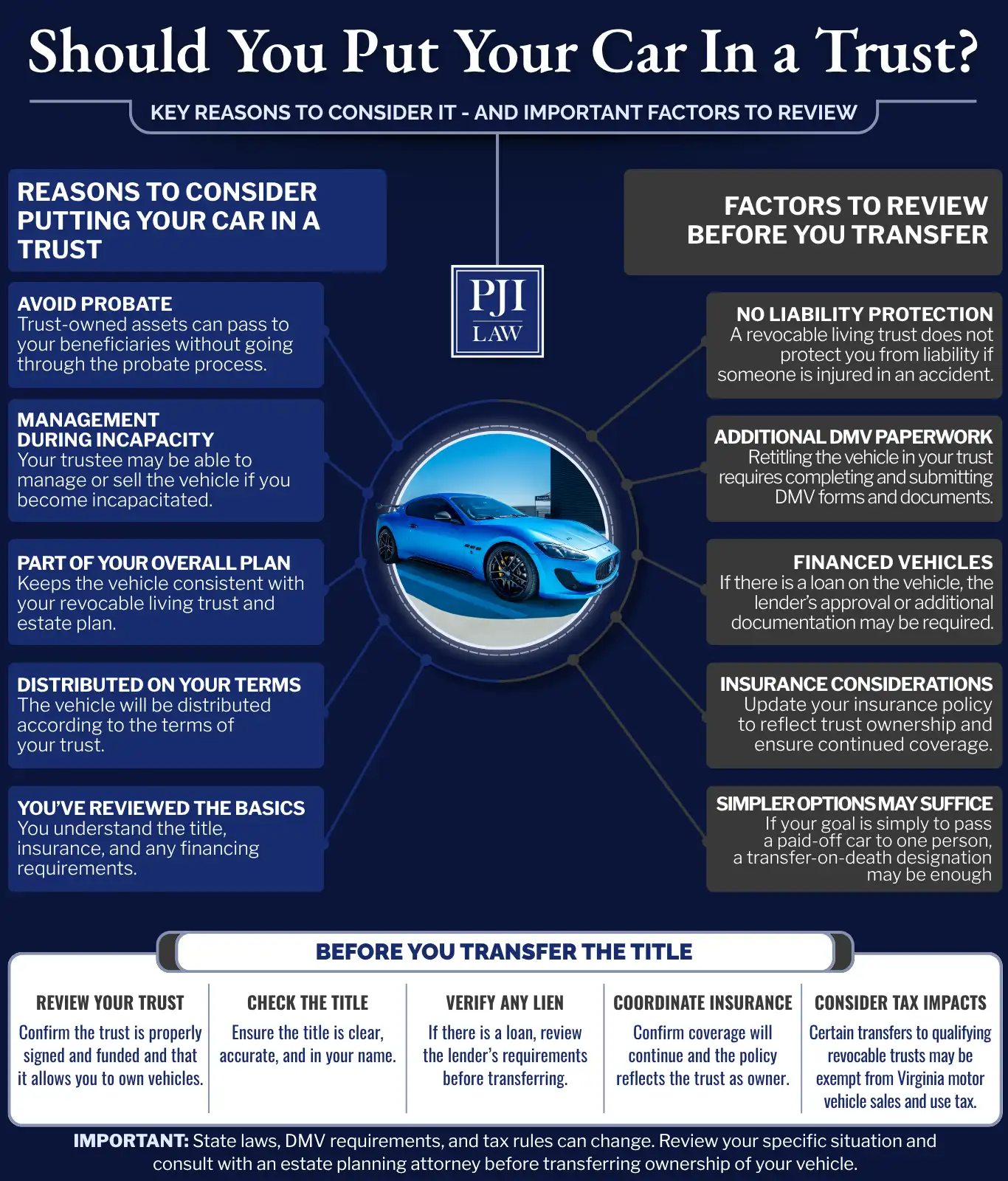
    Should You Put Your Car In a Trust_

    What Are the Downsides of Putting a Car in a Trust?

    Putting a car in a revocable living trust can help keep the vehicle out of probate and allow the trustee to manage it during incapacity, but there are tradeoffs to consider.

    One is that a revocable living trust doesn’t provide asset protection simply because the car is titled in the trust. Under Virginia Code § 64.2-747, property in a revocable trust remains subject to creditor claims against the person who created the trust during that person’s lifetime. Because owning or operating a vehicle can give rise to liability claims, adequate insurance remains particularly important.

    Other potential downsides include:

    • Additional administration: Transferring the car requires retitling it through the DMV and coordinating the ownership change with your insurer and any lender.
    • More work when you change vehicles: If you sell or trade the car, you’ll need to address the trust ownership as part of the transaction. People who replace vehicles frequently may find this added administration inconvenient.
    • The trust may be more than you need: If your only goal is to keep a paid-off vehicle out of probate and transfer it directly to one person after your death, Virginia’s Transfer on Death beneficiary designation may provide a simpler alternative, although it has its own requirements and limitations.

    Whether these drawbacks outweigh the benefits depends on the vehicle, your insurance and financing, and what you want the trust to accomplish as part of your estate plan.

    Is a Transfer on Death Title an Alternative to Putting a Car in a Trust?

    If your primary goal is keeping a vehicle out of probate, Virginia provides another option. Under Virginia Code § 46.2-633.2, an eligible vehicle owner can designate one individual to receive the vehicle after the owner’s death.

    A Transfer on Death (TOD) designation doesn’t give the beneficiary an ownership interest during your lifetime. However, it has limitations. According to the Virginia DMV, a vehicle with a lien isn’t eligible, and the beneficiary generally must apply for a new title within 120 days after the owner’s death.

    A TOD title may be worth considering when your primary goal is transferring a paid-off vehicle directly to one person. A revocable living trust may provide greater flexibility when the vehicle is part of broader planning for incapacity, multiple assets, or more detailed beneficiary instructions.

    Should You Put Your Car in Your Trust?

    Whether your car belongs in your trust depends on the vehicle, its value, and what you want your estate plan to accomplish.

    Before deciding, consider:

    • Is the vehicle owned outright or financed?
    • Who should receive the vehicle after your death?
    • Would someone need authority to manage or sell the property if you become incapacitated?
    • Does your trust contain instructions relevant to the vehicle or its beneficiaries?
    • Would a TOD designation accomplish your goal more simply?
    • What does your insurance carrier require for a trust-owned vehicle?
    • Does the proposed transfer qualify for the sales and use tax exemption?
    • How does the vehicle fit with your other property and beneficiary designations?

    A person with a paid-off vehicle and one intended beneficiary may reach a different decision than a grantor whose revocable trust contains provisions for multiple beneficiaries or continuing management of assets.

    An estate planning attorney can review the vehicle alongside your other property, financial accounts, and estate documents to determine which ownership method fits your broader plan.

    Are you trying to place your car in a trust to avoid probate and common estate planning mistakes in Richmond, Virginia_

    Frequently Asked Questions

    Can you put a car in a trust in Virginia?

    Yes. State law recognizes vehicles held in trusts, and the DMV provides procedures for titling vehicles in living trusts. You must complete the appropriate title transfer and provide the required documentation.

    Should I put my car in my living trust?

    It depends on your estate plan. Trust ownership may be useful for probate avoidance, incapacity planning, or coordinating the car with other trust property and assets. A TOD designation may be simpler when you only want one individual to receive the vehicle after your death.

    Does putting a car in a trust avoid probate in Virginia?

    A vehicle properly transferred to a revocable living trust during your lifetime can generally be administered under the trust rather than becoming part of your probate estate solely because of your death.

    How do I transfer my Virginia car title to a trust?

    You must retitle the vehicle through the DMV and provide the required title, application form, and trust documentation. Additional requirements may apply when a lender has an interest in the vehicle.

    Can I put a financed car in a trust?

    Possibly. An existing lien doesn’t automatically disappear or necessarily prevent a trust transfer. Review your loan agreement and contact the financial institution or other lender before attempting to change the vehicle’s title.

    Will putting my car in a trust affect my insurance?

    It may affect how ownership should be reflected on the policy. Contact your insurance carrier before transferring the title to determine how the trust arrangement should be documented and whether coverage changes are necessary to protect the vehicle and other property.

    Do I have to pay taxes when transferring my car to my trust in Virginia?

    Certain transfers involving qualifying revocable trusts may be exempt from motor vehicle sales and use tax when the statutory requirements are satisfied. Not every inter vivos transfer of a vehicle to a trust automatically qualifies for the exemption.

    Can I name a beneficiary on my car title in Virginia?

    Yes. State law allows eligible vehicle owners to designate one individual as a Transfer on Death beneficiary. The designated beneficiary doesn’t receive an ownership interest during your life, and a vehicle with a lien isn’t eligible for a TOD designation.

    What happens to my car if I die without putting it in a trust?

    If another ownership or beneficiary arrangement doesn’t control the transfer, a vehicle titled solely in your name may become part of your probate estate. The personal representative may then need to address the property with other estate assets through the probate process.

    Can a trustee sell a car owned by a trust?

    Yes. Virginia law gives trustees authority to sell trust property, subject to the terms of the trust and the trustee’s fiduciary duties. When selling a vehicle owned by the trust, the trustee must also address the vehicle’s title and any existing lien as part of the transaction.

    Decide Whether Your Car Belongs in Your Trust

    If you’re considering putting a car in a revocable living trust, the decision involves more than avoiding probate. How the vehicle is titled can affect insurance, financing, liability, taxes, and how the car is managed if you become incapacitated or after your death. Reviewing the vehicle as part of your broader estate plan can help you determine whether transferring it to your trust is appropriate for your circumstances.

    At PJI Law, PLC, our Richmond, Virginia, estate planning attorneys help clients create and maintain estate plans tailored to their property, family, and long-term goals. An attorney can review how your vehicles and other assets are titled, explain the available options under Virginia law, and help you coordinate those choices with the rest of your estate plan.

    Call (804) 653-3450 to schedule your complimentary consultation. You can also complete our confidential online form if that’s more convenient.

    At PJI Law, you’ll receive white-glove service and personal attention from a team that treats you like family.

    Copyright © 2026. PJI Law, PLC. All rights reserved.

    The information in this blog post (“post”) is provided for general informational purposes only and may not reflect the current law in your jurisdiction. No information in this post should be construed as legal advice from the individual author or the law firm, nor is it intended to be a substitute for legal counsel on any subject matter. No reader of this post should act or refrain from acting based on any information included in or accessible through this post without seeking the appropriate legal or other professional advice on the particular facts and circumstances at issue from a lawyer licensed in the recipient’s state, country, or other appropriate licensing jurisdiction.

    PJI Law, PLC
    4108 E Parham Road
    Richmond, VA 23228
    (804) 653-3450
    https://www.pjilaw.com/

  • Caught in the Middle: Estate Planning for the Sandwich Generation in Virginia

    Caught in the Middle: Estate Planning for the Sandwich Generation in Virginia

    If you’re raising children while helping care for your aging parents, you know what it means to have people depending on you from every direction. Between work, school activities, medical appointments, household responsibilities, and financial obligations, finding time for your own future often falls to the bottom of the list.

    Estate planning for the sandwich generation isn’t just about deciding who inherits your property. It’s about creating a coordinated plan that protects your family, gives trusted people the legal authority to manage your financial affairs if you’re unable to do so, provides for your children, and protects your loved ones from unnecessary complications during a difficult time.

    Whether you’re updating an existing estate plan or creating one for the first time, taking action now can protect the people who rely on you today and in the years ahead.

    At a Glance

    • The sandwich generation refers to adults who support both aging parents and dependent children.
    • Estate planning for the sandwich generation should address both your own needs and the needs of multiple generations.
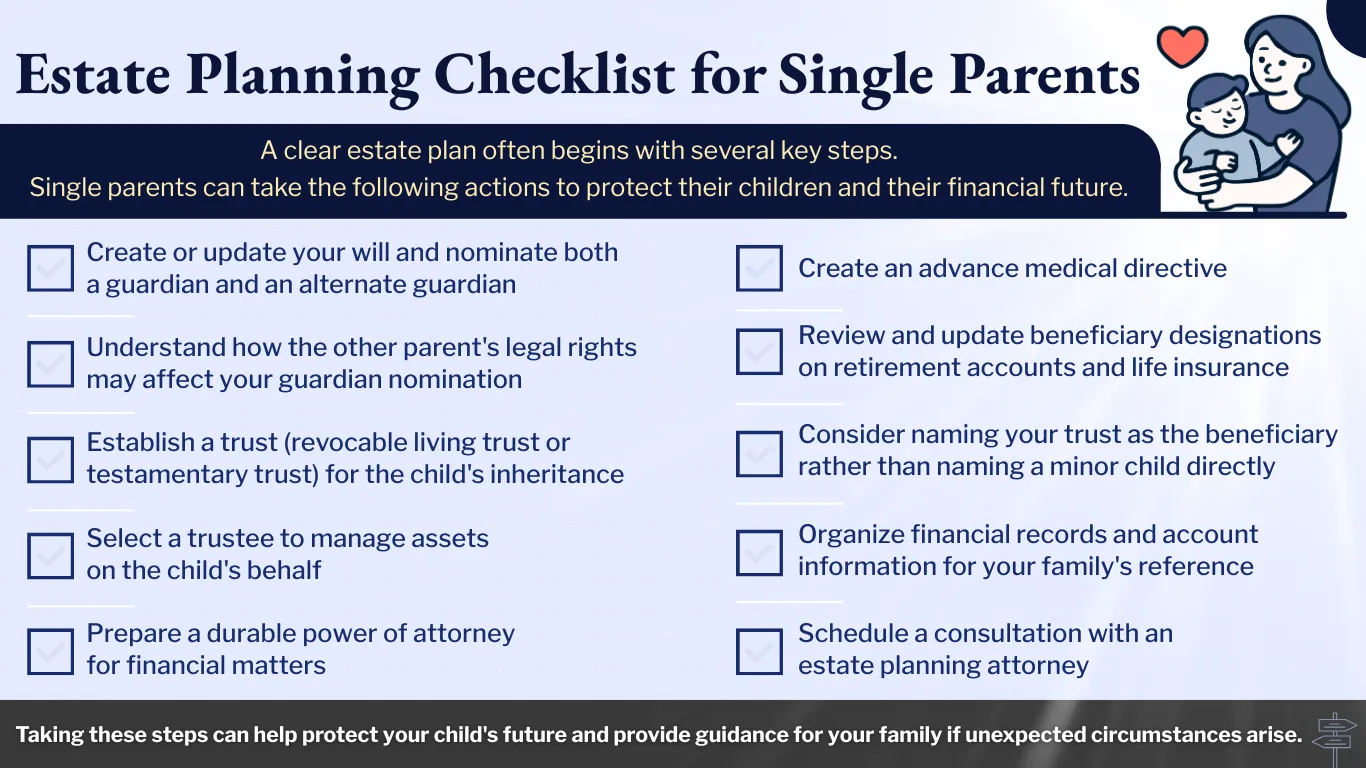
    • A comprehensive estate planning strategy often includes a will, a revocable living trust, power of attorney documents, and advance medical directives.
    • Incapacity planning is just as important as planning for death because someone may need the legal authority to manage your financial affairs if you’re incapacitated.
    • Naming guardians in your will can provide stability for minor children.
    • Reviewing your parents’ estate planning documents can identify outdated plans before an emergency occurs.
    • Working with an experienced estate planning attorney can help you develop a plan that reflects your family’s unique responsibilities under Virginia law.

    What Is the Sandwich Generation?

    The sandwich generation includes adults who are simultaneously caring for aging parents while raising or financially supporting children. It isn’t defined by age. It’s defined by life circumstances.

    If this sounds familiar, you’re in good company. Millions of Americans are balancing work, raising families, assisting parents with medical appointments, managing household finances, and trying to prepare for their own future, all at the same time. As people live longer and many adults have children later in life, more families are finding themselves in this position.

    Imagine this scenario: It’s a Tuesday afternoon. You’re leaving your daughter’s soccer practice when your mother calls, confused about a medical bill she doesn’t remember receiving. You pull into a parking lot to sort it out, knowing dinner still needs to happen and a work deadline is waiting. Tomorrow might bring a parent-teacher conference, your father’s doctor’s appointment, and another stack of bills to review. For many people, this is what life in the sandwich generation actually looks like—not one overwhelming crisis, but a steady stream of competing responsibilities.

    For many families, these responsibilities develop gradually. A parent may begin asking for assistance with paying bills, attending medical appointments, or managing bank accounts. At the same time, your own children continue to rely on you financially and emotionally. Over time, you may realize you’re coordinating care, managing schedules, and making financial decisions for multiple generations while still trying to protect your own future.

    Because you’re balancing so many responsibilities, it’s easy to postpone your own estate planning. Unfortunately, delaying these conversations can leave your family members facing uncertainty if an unexpected illness, serious injury, or other life event affects your ability to make decisions.

    Estate Planning When You’re Supporting Two Generations

    Many people think estate planning only determines what happens after death, but a well-designed plan does much more.

    If you become temporarily or permanently unable to manage your affairs because of an accident or medical condition, someone needs the legal authority to step in. Without the proper legal documents, your loved ones may need to ask a court to appoint someone to act on your behalf. That process can be time-consuming, expensive, and emotionally difficult.

    At the same time, your own children, spouse, or other family members may still depend on your income, your caregiving, or your day-to-day financial management. A thoughtful estate plan answers important questions before a crisis occurs, including:

    • Who can manage your financial affairs?
    • Who can make healthcare decisions if you’re incapacitated?
    • Who will care for your minor children?
    • How will your assets be managed if something happens to you?
    • How can your loved ones avoid unnecessary delays during the probate process?

    Planning ahead allows your family to focus on one another instead of scrambling to solve legal and financial problems during an already stressful situation.

    None of this requires you to solve everything at once. A few key documents, put in place now, can carry a lot of that weight for you later.

    Estate Planning Documents Every Sandwich Generation Family Should Consider

    Every family’s circumstances are different, but several estate planning documents form the foundation of many Virginia estate plans.

    A Last Will and Testament

    A will remains one of the most important legal documents you can create. Your will allows you to:

    • Name beneficiaries to receive your property
    • Choose an executor to administer your estate
    • Name a guardian for your minor children
    • Provide instructions that reflect your wishes

    If you have young children, naming a guardian is one of the most important decisions you’ll make. Under Virginia Code § 64.2-1701, a parent may appoint a guardian for a minor child’s person and estate directly in a will. Without a valid will, a court ultimately decides who will care for your children based on Virginia law, rather than your personal preferences.

    A Revocable Living Trust

    For many families, a revocable living trust can provide additional flexibility beyond a will alone. Unlike a will, a living trust allows you to place certain assets into the trust during your lifetime while continuing to manage them as the initial trustee. You maintain control of the trust and can modify or revoke it as your circumstances change.

    A revocable living trust may also let your loved ones avoid probate for assets properly transferred into the trust. If you later become incapacitated, your chosen successor trustee can step in to administer the trust according to your instructions without waiting for probate court involvement.

    After your death, the successor trustee continues managing and distributing trust property for your named beneficiary or beneficiaries according to the trust’s terms. For parents balancing the needs of children and aging parents, a living trust can provide continuity during periods of incapacity while simplifying the transfer of assets later.

    Financial Power of Attorney

    A financial power of attorney is one of the most valuable planning tools for the sandwich generation.

    This legal document allows you to appoint an attorney-in-fact, also called an agent, to manage your financial affairs if you’re unable to do so yourself, under the authority of the Uniform Power of Attorney Act.

    Depending on the authority you grant, your agent may be able to:

    • Pay bills
    • Access bank accounts
    • Handle real estate transactions
    • Oversee investments
    • Manage business interests
    • File taxes
    • Handle insurance matters

    Many Virginia estate plans include a durable power of attorney, sometimes called a durable financial power of attorney. Virginia Code § 64.2-1602 defines a power of attorney as durable unless the document states otherwise, meaning it remains effective even if you become incapacitated, and this document allows your loved ones to continue managing your finances without asking a court to appoint a conservator.

    Without a properly executed power of attorney, your family members may have no immediate legal authority to access your accounts or make important financial decisions on your behalf.

    Advance Medical Directives and Medical Powers of Attorney

    While a financial power of attorney protects your finances, medical planning addresses healthcare decisions.

    Virginia allows you to create an Advance Medical Directive under the Health Care Decisions Act, which lets you appoint someone you trust to make medical decisions if you’re unable to communicate your wishes. Many people refer to these appointments as medical powers of attorney because they give your chosen healthcare agent authority to act on your behalf.

    Your Advance Medical Directive can also express your preferences regarding medical treatment, life-prolonging procedures, and end-of-life care.

    Completing these documents before a medical emergency reduces uncertainty and gives your loved ones clear guidance during an emotional time.

    Don’t Overlook Your Aging Parents’ Estate Plan

    If you’re helping care for aging parents, your own estate planning is only part of the picture. Many older adults created wills or other estate planning documents years ago but haven’t updated them to reflect changes in their finances, family, or Virginia law.

    Bringing this up with your parents can feel uncomfortable. You may worry it sounds like you’re rushing them, or overstepping. Framing the conversation around peace of mind, rather than worst-case scenarios, often makes it easier for everyone involved.

    It’s worth encouraging your parents to review whether they have:

    • A current will
    • A durable power of attorney
    • An Advance Medical Directive
    • A revocable living trust, if appropriate
    • Updated beneficiary designations
    • A current list of important financial information and assets

    It’s equally important that these documents are signed while your parents still have the legal capacity to do so. Waiting too long may limit their options and could require future court proceedings to establish legal authority over their financial affairs.

    Protecting Your Children While You Care for Your Parents

    When you’re caring for two generations, it’s easy to focus on today’s responsibilities and postpone conversations about the future. However, your estate plan should continue protecting your own children, even while you’re caring for your parents.

    For parents of minor children, this often includes:

    • Naming guardians in your will
    • Creating a revocable living trust to manage inherited assets
    • Naming a successor trustee to oversee trust administration if necessary
    • Reviewing beneficiary designations on life insurance and retirement accounts
    • Coordinating your plan with your overall financial goals

    Without these documents, important decisions affecting your children could be left to a court or handled in ways that don’t reflect your wishes.

    Why Incapacity Planning Can’t Wait

    Incapacity planning is often the first thing to get pushed aside. With so much competing for your attention, it’s easy to handle the will and the property questions and leave incapacity planning for later.

    A serious illness or injury could leave you temporarily or permanently incapacitated, making it difficult to pay bills, access money, oversee a business, or make healthcare decisions.

    Most people don’t picture this happening to them. But a fall, a stroke, or a serious diagnosis can arrive without warning, and your family will need clear authority to act on your behalf right away, not weeks later after a court proceeding.

    Without the proper documents in place, your loved ones may need to petition a court for authority to act on your behalf through a guardianship or conservatorship proceeding under Virginia Code § 64.2-2000 before they can manage your finances or medical care.

    The power of attorney and Advance Medical Directive carry the most weight for incapacity specifically. Together, they let trusted individuals step in and act on your behalf without court involvement, right when your family needs that authority most.

    Common Estate Planning Mistakes the Sandwich Generation Makes

    Balancing multiple responsibilities often leads people to postpone planning altogether. Unfortunately, delays can create additional challenges for the people you’re trying to protect.

    Some of the most common mistakes include:

    • Assuming your parents’ estate planning documents are already current
    • Failing to update beneficiary designations after major life changes
    • Not creating a power of attorney
    • Overlooking incapacity planning
    • Forgetting to name guardians for minor children
    • Leaving newly acquired property outside your revocable living trust
    • Assuming verbal conversations provide legal authority
    • Waiting until a medical crisis to begin planning

    Reviewing your plan on a regular schedule and after major life events keeps it aligned with your family’s changing needs.

    Frequently Asked Questions

    What is the sandwich generation?

    The sandwich generation refers to adults who are simultaneously caring for aging parents and supporting dependent children or young adult family members. These competing responsibilities often make comprehensive estate planning even more important.

    Why is estate planning for the sandwich generation different?

    Estate planning for the sandwich generation requires a multi-generational approach. Instead of planning only for yourself, you may need to address your own financial future while protecting both your parents and your children.

    Does everyone need a revocable living trust?

    Not necessarily. A revocable living trust can spare many families the probate process, provide continuity during incapacity, and simplify the management of certain assets, but whether it’s appropriate depends on your individual circumstances and goals.

    Why is a power of attorney so important?

    A properly drafted power of attorney gives someone you trust the legal authority to manage your financial affairs if you’re unable to do so yourself. Without one, your loved ones may need to seek authority through the court.

    How often should I update my estate plan?

    You should review your estate plan after major life events such as marriage, divorce, the birth of a child, considerable changes in your finances, the death of a loved one, or changes in Virginia law. Even without major changes, reviewing your documents on a regular basis confirms they still reflect your wishes.

    Can I create a power of attorney for my aging parents?

    A power of attorney must be signed by the person granting the authority while they still have the legal capacity to understand the document. If your parent has already lost capacity, you may need to seek legal authority through the court, depending on the circumstances.

    What is the difference between a revocable living trust and an irrevocable trust?

    A revocable living trust generally allows you to manage and modify the trust during your lifetime. An irrevocable trust typically cannot be changed as easily once it’s created and may offer different planning benefits. The right choice depends on your financial goals, the type of property you own, and your overall estate planning objectives.

    Can a revocable living trust avoid probate in Virginia?

    A properly funded revocable living trust can spare the assets titled in the trust from probate. Because the trust continues after your death, your successor trustee can administer and distribute trust property according to your instructions without those assets passing through the probate process.

    Should I review my beneficiary designations as part of my estate plan?

    Beneficiary designations on life insurance policies, retirement accounts, and certain financial accounts generally control who receives those assets, regardless of what your will says. Reviewing them regularly confirms they still reflect your wishes and coordinates with the rest of your estate plan.

    When should I meet with an estate planning attorney?

    It’s a good idea to speak with an estate planning attorney whenever you experience a significant life change, such as getting married, having children, caring for aging parents, purchasing a home or business, or receiving an inheritance. Even if your circumstances haven’t changed, reviewing your estate planning documents on a regular basis keeps your plan current under Virginia law.

    Create an Estate Plan That Grows With Your Family’s Needs

    Caring for both aging parents and children often means you’re making decisions that affect several generations at once. A thoughtfully prepared estate plan protects your loved ones, provides clear legal authority if you’re ever unable to act, and reduces uncertainty during life’s most difficult moments.

    At PJI Law, PLC, our Virginia estate planning attorneys work with individuals and families to create comprehensive plans that reflect their responsibilities, priorities, and long-term goals. Whether you’re considering a revocable living trust, updating a power of attorney, planning for incapacity, or reviewing existing estate planning documents, we’ll work with you to develop a strategy tailored to your circumstances under Virginia law.

    Schedule your complimentary consultation by calling (703) 865-6100 or completing our confidential online form.

    At PJI Law, you’ll receive white-glove service and personal attention from a team that treats you like family.

    Copyright © 2026. PJI Law, PLC. All rights reserved.

    The information in this blog post (“post”) is provided for general informational purposes only and may not reflect the current law in your jurisdiction. No information in this post should be construed as legal advice from the individual author or the law firm, nor is it intended to be a substitute for legal counsel on any subject matter. No reader of this post should act or refrain from acting based on any information included in or accessible through this post without seeking the appropriate legal or other professional advice on the particular facts and circumstances at issue from a lawyer licensed in the recipient’s state, country, or other appropriate licensing jurisdiction.

    PJI Law, PLC
    3900 Jermantown Rd, 2nd Floor
    Fairfax, VA 22030
    (703) 865-6100
    https://pjibe.webteam.ai/


  • 7 Mistakes to Avoid When Gifting From an Estate in Richmond, Virginia

    7 Mistakes to Avoid When Gifting From an Estate in Richmond, Virginia

    You want to do the right thing for your family. Maybe you’re thinking about transferring your primary residence to a child, helping a family member now instead of later, or trying to minimize taxes before your estate is passed on.

    On the surface, gifting from an estate sounds simple. You give assets now, reduce your taxable estate, and avoid complications later. But what many people don’t realize is that the wrong decision can create serious tax consequences, affect Medicaid eligibility, or cost your family far more in the long run than they ever gain upfront.

    Before you gift assets, it’s important to understand where things can go wrong and why those mistakes can have consequences years down the road.

    At a Glance

    At a Glance

    • Gifting assets during your lifetime can reduce your taxable estate, but it can also eliminate valuable tax advantages tied to inherited property.
    • The stepped-up basis available after a decedent’s death can significantly reduce capital gains tax compared to gifted property.
    • Gifted property carries a carryover basis, which can increase taxable gain when sold.
    • The annual gift tax exclusion allows limited tax-free transfers, but larger gifts may require a gift tax return.
    • Adding a child to a deed as a joint owner can trigger the same tax and Medicaid issues as a direct gift, while also exposing the property to that child’s creditors.
    • Gifting can impact Medicaid eligibility and trigger penalties under the 5-year look-back rule.
    • Transferring assets too early may lead to loss of control and unintended financial consequences.
    • A gift made without coordinating your broader estate plan can create accidental inequalities among beneficiaries or undercut your existing trust documents.
    • Not all strategies that reduce estate taxes will benefit your family overall.

    Looking for an estate planning law firm in Richmond, Virginia to guide your gifting strategy_

    What Does Gifting From an Estate Actually Mean?

    The phrase “gifting from an estate” can mean a few different things, depending on who’s using it. Some people use it to describe assets distributed after death through a will or a trust. Others are referring to lifetime gifting, transferring assets out of what you own now, while you’re still alive, to reduce the size of your taxable estate or support a family member sooner.

    The risks discussed in this blog involve lifetime gifting, not assets distributed after death through a will or trust. That distinction carries weight because assets transferred during your life are treated very differently for tax purposes than inherited property received after death. What looks like a generous and practical decision today can drastically alter how capital gains tax is calculated later, leaving your loved ones with far less than you intended.

    Why Gifting Assets Can Create Unexpected Problems

    Gifting is often viewed as an easy way to simplify an estate, minimize taxes, and avoid probate. In reality, a single transfer ripples across multiple legal and financial areas.

    You are not just transferring ownership. You are also changing:

    • How cost basis is calculated
    • How future capital gains are taxed
    • Whether the asset qualifies for a stepped-up basis
    • How your future Medicaid eligibility is evaluated
    • Whether you retain any control over your own financial security

    These consequences are rarely obvious when the gift is made. Recognizing where people commonly go wrong before you commit to a transfer can save your family thousands of dollars.

    7 Mistakes to Avoid When Gifting From an Estate

     
    7 Mistakes to Avoid When Gifting From an Estate

    1. Losing the Stepped-Up Basis and Triggering a Larger Capital Gains Tax Bill

    One of the costliest mistakes is giving away highly appreciated assets during your lifetime, and it usually comes down to one overlooked detail: cost basis. When property is inherited after your death, the beneficiary typically receives a stepped-up basis equal to the fair market value of the asset at the time of death.

    This adjustment can wipe out decades of built-up capital gains tax exposure. When you gift that same asset while you’re alive instead, the recipient receives your original cost basis, known as a carryover basis, and that single difference can determine whether your family keeps more of the asset’s value or loses a portion of it to taxes. Understanding the difference between a stepped-up basis vs. carryover basis can fundamentally change your strategy.

    For example, if you purchased a Richmond home decades ago for a low price and it has risen in value, gifting it now means your child inherits your original, low purchase price as their baseline. When they sell it, they will owe capital gains tax on gifted property based on the entire growth from the day you bought it, rather than the day they received it. 

    The tax bill doesn’t simply vanish because an asset was a gift; the liability transfers to your loved ones and can lead to an unnecessarily high bill when the asset is sold. This issue frequently complicates situations involving:

    • A primary residence that has substantially appreciated over time
    • Highly valued investment real estate or family land
    • Stocks, mutual funds, or business interests held for the long term

    2. Assuming Gifting Always Reduces Estate Taxes

    While gifting shrinks the overall size of an estate, that doesn’t always translate into a net financial win for your family.

    Virginia does not impose a state-level estate or inheritance tax, meaning residents only need to plan around the federal estate tax exemption. With the federal unified lifetime exemption sitting at a generous $15 million per individual (and $30 million for married couples), per the IRS’s 2026 estate and gift tax update, the vast majority of Virginia families will never owe a federal estate tax.

    For individuals whose estates fall comfortably below that threshold, shrinking the estate yields no estate tax savings. Instead, it can strip your heirs of the massive capital gains tax savings provided by a stepped-up basis. The goal should always be minimizing your total tax exposure across all tax types.

    3. Ignoring the Gift Tax Rules

    The Internal Revenue Service (IRS) allows individuals to transfer a set amount of assets per recipient each year under the annual gift tax exclusion without filing paperwork. For 2026, this limit is $19,000 per recipient (or up to $38,000 for married couples utilizing gift splitting), as set out by the IRS.

    However, failing to account for these rules can cause compliance headaches:

    • Gifts exceeding the $19,000 limit per person require filing a Form 709 Gift Tax Return.
    • Large lifetime transfers reduce your overall $15 million lifetime estate tax exemption.
    • Failing to file required returns can lead to IRS audits and compliance penalties down the road.

    Filing a gift tax return doesn’t necessarily mean you will owe tax out-of-pocket today, but it is a strict legal tracking requirement that must be managed before making large transfers.

    4. Adding a Child to the Deed Instead of Planning the Transfer Properly

    Many parents add an adult child’s name to the deed of their home as a joint owner, thinking it’s a quick, no-cost way to skip probate. In practice, this move can create as many problems as it solves.

    It’s treated as a present gift of a partial interest in the home, which means the portion given away carries the same carryover basis issue described in Mistake 1. It exposes the home to the child’s creditors, a divorce settlement, or bankruptcy proceedings, since the child now holds a legal ownership interest the parent can’t unilaterally undo.

    It can complicate Medicaid planning, since adding a joint owner is itself a transfer that may need to be disclosed and reviewed under the look-back rule. It doesn’t always avoid probate the way people expect, particularly if the child predeceases the parent or other children are left off the deed, which can create friction among siblings later.

    A deed change is not a substitute for a coordinated estate plan. Whatever the underlying goal, probate avoidance, tax planning, or providing for a specific child, it’s worth discussing with an attorney before retitling property.

    5. Overlooking Medicaid Eligibility and the Look-Back Rule

    Gifting can directly affect Medicaid eligibility, particularly for those planning for long-term care. An important rule to understand is the 5-year (60-month) Medicaid look-back period in Virginia, set out in 12VAC30-40-300, which allows state agencies to review certain asset transfers made before an individual applies for benefits. If assets are transferred below fair market value during that time:

    • A penalty period will be imposed.
    • Eligibility for benefits will be delayed, often by months or years.
    • Access to essential medical assistance services could be cut off, leaving your family to pay out-of-pocket.

    Medicaid also considers strict asset limits, countable assets, and spend-down requirements. For married couples, coordinating asset transfers while protecting a community spouse (the spouse remaining at home) requires highly technical legal structuring. A casual gift to a child today can jeopardize your medical care tomorrow.

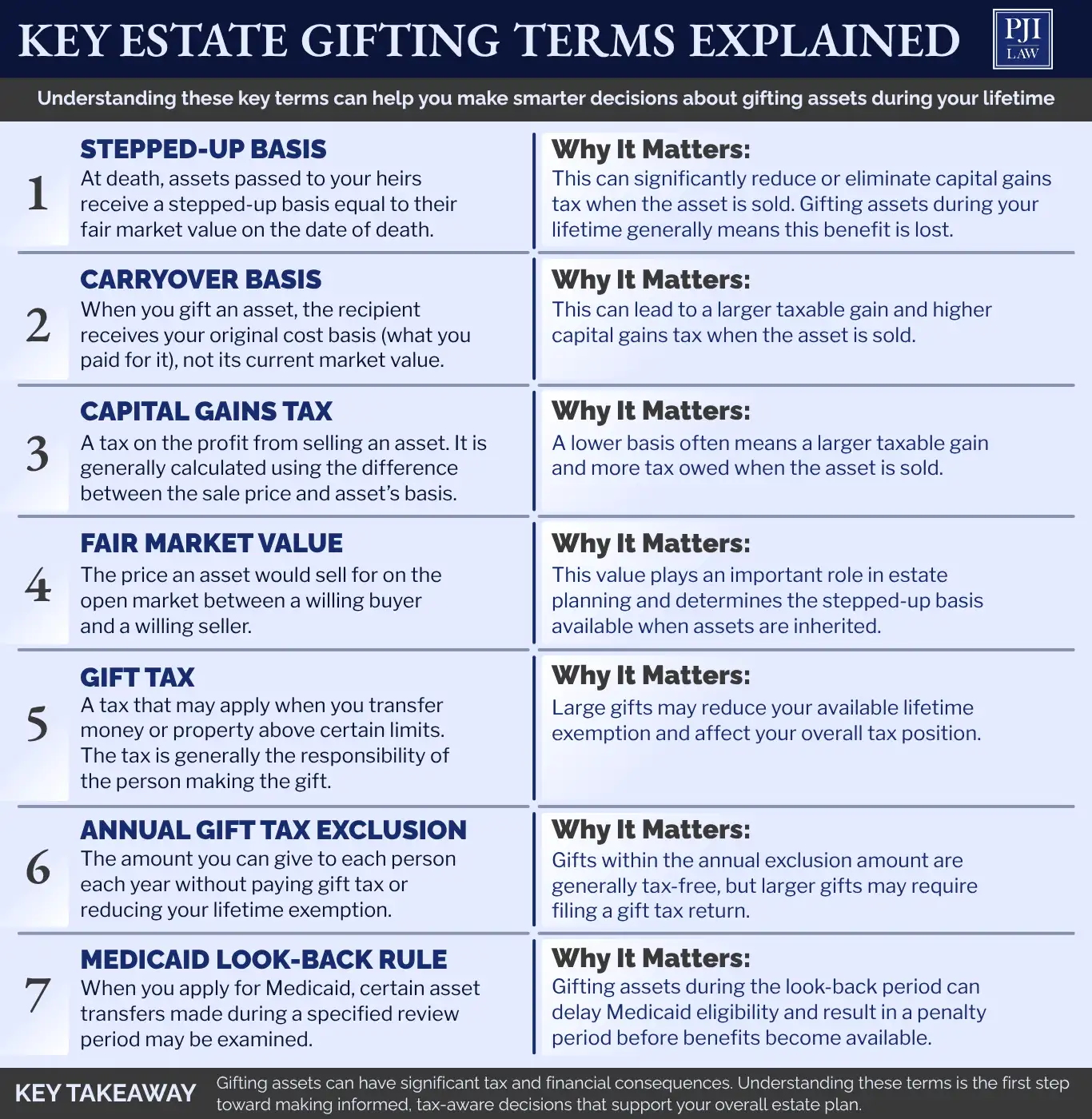
    Key Estate Gifting Terms Explained

    6. Giving Up Control Too Soon

    Once you legally transfer ownership of an asset, your authority over it terminates. This loss of control can directly threaten your lifestyle and independence, impacting:

    • Your legal right to live in or manage your primary home
    • Your access to emergency funds if your personal financial health changes
    • Your ability to stop the asset from being seized by a child’s creditors, an ex-spouse in a divorce, or bankruptcy proceedings

    For example, gifting a home to a family member may seem like a straightforward decision. However, you cannot legally force them to let you stay there, nor can you reverse the transfer if your relationship changes. In many cases, utilizing an irrevocable trust or other sophisticated planning vehicles allows you to achieve tax or protection goals without entirely abandoning financial security.

    7. Failing to Coordinate With Your Broader Estate Plan

    An isolated gifting decision can easily trigger an accidental domino effect across your entire estate strategy. Without proper coordination, an unmonitored lifetime gift can:

    • Create accidental inequalities among your children or beneficiaries
    • Short-circuit protective instructions established inside your existing trust documents
    • Disproportionately reduce a surviving spouse’s intended share of assets
    • Interfere with Medicaid planning or spend-down strategies

    Each asset transfer should function as a coordinated piece of your broader plan, rather than a quick fix for an isolated objective.

    Are you seeking an estate planning attorney to help you avoid unexpected tax consequences from gifting mistakes_

    An Example of How Gifting Can Backfire

    Consider this scenario. A parent adds her adult son to the deed of her home as a joint owner, intending to avoid probate. Two years later, she needs nursing home care and applies for Medicaid. Because the deed change counts as a gift of half the home’s value, and it happened within the 60-month look-back period under 12VAC30-40-300, the transfer has to be disclosed and factored into a penalty period.

    If the home is worth $500,000, she gave away an interest worth $250,000. Using a hypothetical average monthly private-pay nursing facility rate of $9,000 for illustration (the actual rate is set annually by DMAS and should be confirmed as of the application date), dividing $250,000 by $9,000 produces a penalty period of just under 28 months during which Medicaid will not pay for her care.

    The deed change meant to simplify things instead delays her access to benefits at the exact point she needs them, leaving her family to cover the cost of care out-of-pocket until the penalty period ends. This example uses assumed values; the actual penalty period in any specific case depends on the property’s value, the number of joint owners, and the DMAS rate in effect at the time of application.

    When Gifting Assets May Make Sense

     
    When Gifting Assets May Make Sense
    Despite the inherent risks, a proactive gifting strategy can be incredibly effective under the right conditions. It may be appropriate if:

    • Your total net worth puts you at risk of exceeding federal estate tax thresholds.
    • You want to move rapidly appreciating assets out of your name so future growth occurs within your children’s estates.
    • You want to provide immediate, targeted financial support to a family member or cover tuition costs.
    • You are making strategic charitable contributions to lower your annual income tax brackets.
    • You are working with an estate planning attorney to structure the transfer safely.

    The defining factor is whether the transfer is structured carefully alongside an estate professional who evaluates the total tax impact first.

    When It May Be Better to Wait

    For many Virginia families, holding onto assets and transferring them through a clear, legally sound inheritance structure produces a safer, more favorable tax position for their heirs. Waiting preserves your options, locks in a stepped-up basis for your heirs, protects your Medicaid eligibility window, and lets you maintain full operational control over your life savings.

    Factors that influence this decision include the specific type of asset, its current market value, its future appreciation potential, and your long-term medical care needs.

    When to Speak With an Estate Planning Attorney

    Gifting decisions touch on federal tax codes, Virginia property laws, and state Medicaid rules all at once. Before signing over a deed or writing a substantial check, consult a legal and financial professional to evaluate:

    • How the transfer affects cost basis and capital gains taxes
    • Whether it impacts Medicaid eligibility requirements and look-back periods
    • Whether alternative strategies (like trusts) could work better for your situation
    • How the decision fits into your comprehensive estate plan

    At PJI Law, PLC, our Richmond, VA estate planning attorneys work with families to evaluate gifting strategies, minimize exposure to capital gains tax, and draft comprehensive estate plans that align with your goals while taking care of your family.

    Searching online for an “estate planning attorney near me” in Richmond, Virginia_

    Frequently Asked Questions

    Is gifting better than inheritance?

    It depends. Inherited property often receives a stepped-up basis, which can reduce capital gains tax, while gifted property may lead to a larger taxable gain.

    Do I have to pay capital gains tax on gifted property?

    A person may need to pay capital gains tax when the property is sold, based on the original cost basis rather than the fair market value at the time of transfer.

    What is the annual gift tax exclusion?

    The annual gift tax exclusion allows you to transfer a certain amount each year ($19,000 per recipient) without filing a gift tax return or reducing your lifetime exemption.

    Does the recipient pay gift tax?

    Typically, the person making the gift is responsible for any gift tax, not the recipient.

    Will gifting assets affect Medicaid eligibility?

    Transfers made within the 5-year look-back period can affect Medicaid eligibility and may lead to penalties.

    What is a stepped-up basis?

    A stepped-up basis adjusts the value of inherited assets to their fair market value at the time of death, which can reduce taxable gain.

    What is a carryover basis?

    A carryover basis means the recipient receives the donor’s original cost basis, which may increase capital gains when the asset is sold.

    Can I gift my primary residence to a family member?

    A primary residence can be gifted to a family member, but doing so may create tax implications, affect control, and impact Medicaid planning.

    Do I need to file a gift tax return?

    A gift tax return may need to be filed if the gift exceeds the annual gift tax exclusion limit.

    Should I talk to a tax professional before gifting assets?

    A tax professional or financial advisor can explain the tax implications so you can avoid costly mistakes.

    Make Gifting Decisions With Your Complete Estate Plan in Mind

    Deciding when and how to gift assets is not just about reducing your estate. It’s about protecting your financial future and your family’s long-term interests. Avoiding these common mistakes can help you make more informed decisions about when and how to transfer assets as part of your overall estate plan.

    At PJI Law, PLC, our Richmond, VA estate planning attorneys sit down with you to map out your assets, your family’s needs, and the tax rules that apply to your specific situation, then build a plan around those details rather than guesswork.

    Call (804) 653-3450 to schedule a complimentary consultation. You can also complete our confidential online form if that is more convenient.

    At PJI Law, you’ll receive white-glove service and personal attention from a team that treats you like family.

    Copyright © 2026. PJI Law, PLC. All rights reserved.

    The information in this blog post (“post”) is provided for general informational purposes only and may not reflect the current law in your jurisdiction. No information in this post should be construed as legal advice from the individual author or the law firm, nor is it intended to be a substitute for legal counsel on any subject matter. No reader of this post should act or refrain from acting based on any information included in or accessible through this post without seeking the appropriate legal or other professional advice on the particular facts and circumstances at issue from a lawyer licensed in the recipient’s state, country, or other appropriate licensing jurisdiction.

    PJI Law, PLC
    4108 E Parham Road
    Richmond, VA 23228
    (804) 653-3450
    https://pjibe.webteam.ai/

  • What Should You Never Put in Your Will in Virginia?

    What Should You Never Put in Your Will in Virginia?

    You create a will to protect the people you care about. You want your assets distributed the way you intended, your family shielded from conflict, and your wishes followed without question.

    What many people don’t realize is that a will can work against those goals when it’s built on common mistakes. The wrong provisions can delay the probate process, trigger disputes among beneficiaries, or lead a Virginia court to disregard parts of your will entirely. In some cases, a single problematic clause can affect how your entire will is interpreted.

    Virginia law sets clear rules for how wills must be written and enforced. When a will conflicts with those rules, the result is often uncertainty, legal challenges, and added stress for your loved ones during an already difficult time.

    So, what should you never put in your will?

    At a Glance

     
    At a Glance

    • Assets with beneficiary designations transfer outside of probate and can’t be redirected by your will.
    • Jointly owned property passes automatically to the surviving owner regardless of what your will says.
    • Funeral instructions in a will are rarely seen in time to be followed.
    • Conditional gifts that conflict with public policy may not be enforceable under Virginia law.
    • Illegal or impossible provisions are disregarded by the court, which can alter how the estate is distributed.
    • Some assets, including real estate and business interests, are often better handled through a living trust.
    • Direct distributions to beneficiaries who rely on government benefits can affect their eligibility.
    • A well-structured estate plan coordinates your will with trusts, beneficiary designations, and other legal documents.

    Do you need the guidance of a lawyer for wills in Fairfax, Virginia_

    What Should You Never Put in Your Will?

    Some assets and instructions simply don’t belong in wills. Others can technically be included but create unnecessary complications that undermine your intentions. The following categories come up often in estate planning, and each carries real risk if handled incorrectly.

    Assets With Beneficiary Designations

    Certain assets pass outside of probate entirely, transferring directly to named beneficiaries regardless of what your will says. These typically include:

    • Life insurance policies
    • Retirement accounts
    • Payable-on-death bank accounts

    When you include these assets in your will, you create a conflict between documents. The financial institution follows the beneficiary designation, not your will. Consider this example: a person updates their will after a divorce and leaves everything to their children, but forgets to update a life insurance policy still naming a former spouse.

    After death, the insurance company pays the former spouse. The will doesn’t change that outcome. This is why beneficiary designations must be coordinated with your overall estate planning strategy.

    Jointly Owned Property

    Property held jointly with rights of survivorship passes automatically to the surviving owner. This often includes:

    • Real estate
    • Bank accounts
    • Certain business assets

    If your will attempts to distribute jointly owned property to multiple beneficiaries, the transfer still happens outside of probate. A parent might add one child to a bank account for convenience, intending to divide that money equally among all children later. After death, that account legally belongs to the one child listed as joint owner, which can lead to disputes.

    This rule extends to vehicles, as well. In Virginia, certain vehicle titles may include transfer-on-death or survivorship designations that allow the vehicle to pass outside of probate, regardless of what your will states. This issue isn’t about intent. It’s about how ownership is structured under Virginia law.

    Funeral Instructions as Binding Terms

    Funeral decisions are made within days of death. A will is often not located, reviewed, or admitted to probate until well after those decisions have already been made.

    A person may clearly state they want cremation and a private service. The family, unaware of those instructions, proceeds with a traditional burial. By the time the will is reviewed, those decisions can’t be undone. Funeral instructions should be communicated directly to loved ones and placed in separate documents where appropriate, not buried in a will that may not surface for weeks.

    Conditional Gifts That Create Legal Problems

    You can include certain conditions in a will, but not all conditions are enforceable. Provisions that attempt to control personal decisions, relationships, or beliefs can conflict with public policy. Examples include:

    • Requiring a child to marry within a specific religion to receive an inheritance
    • Conditioning a gift on cutting ties with a partner
    • Restricting distributions based on personal lifestyle choices

    When a court finds these conditions unenforceable, the result is uncertainty about how the distribution should proceed, even when your intent was clear.

    Instructions That Are Illegal or Impossible

    A will can’t direct actions that violate the law or can’t realistically be carried out. Courts will disregard provisions that attempt to:

    • Avoid estate taxes through improper means
    • Hide or misrepresent assets
    • Distribute property in a way that conflicts with legal ownership rights

    That portion of the will is simply set aside, which can alter how the entire estate is distributed. The risk isn’t just that the provision fails. It’s that the confusion it creates affects the broader administration of the estate.

    Assets Better Suited for a Revocable Living Trust

    Some assets can be placed in a will, but doing so may not be the most effective approach for asset protection and efficient distribution. Real estate, business interests, and other high-value assets often benefit from being placed in a revocable living trust instead. This can help avoid probate and allow for more efficient management.

    When these assets are left solely through a will, they must go through the full probate process in Virginia, which can involve:

    • Court oversight and required filings
    • Delays before beneficiaries receive property
    • Months-long proceedings for each property in the estate

    A living trust provides a different structure that can reduce those delays and give beneficiaries a smooth transition of ownership.

    Business Assets Without a Clear Plan

    Business assets require more than a simple transfer instruction in a will. If you own a business, your estate plan should address:

    • Who will manage the business after your passing
    • Whether ownership will transfer to one person or multiple beneficiaries
    • How decision-making authority will be handled

    Without this planning, the business can face operational challenges at a critical time. A business owner may leave equal shares to several children, assuming they’ll work together. In reality, disagreements arise over management, direction, or whether to sell. Estate planning for business interests requires coordination that goes beyond the will itself.

    Distributions That Affect Government Benefits

    If a beneficiary receives government benefits such as Supplemental Security Income, a direct inheritance can create unintended consequences. A sudden influx of assets can instantly disqualify them from the government benefits they rely on.

    A parent may leave funds directly to a child with special needs, intending to provide financial support. Instead, that inheritance can disrupt eligibility under strict Social Security Administration rules, which restrict cash assistance to individuals with limited income and resources. In these situations, a special needs trust is often the better approach. It allows assets to be used for the individual’s benefit without jeopardizing eligibility.

    Why These Mistakes Lead to Legal Challenges

     
    Why These Mistakes Lead to Legal Challenges

    When a will includes conflicting or problematic provisions, it increases the likelihood of legal challenges. Disputes often arise from:

    • The will conflicting with beneficiary designations
    • Instructions that are unclear or contradictory
    • Family members interpreting provisions differently
    • Concerns about undue influence or intent

    These disputes can bring the estate into court, where a judge must interpret the will and resolve disagreements. The probate process is already structured and formal. When disputes are layered on top, it becomes more time-consuming and more expensive, straining relationships among family members during an already difficult period.

    How the Virginia Probate Process Is Affected

    Probate is the legal process through which a will is validated and an estate is administered. The Virginia Judicial System establishes formal requirements for this process, which unfolds within the Circuit Court of the city or county where the individual resided. In Virginia, this involves:

    • Filing the will with the appropriate Circuit Court Clerk
    • Formal qualification of the executor
    • Identification and valuation of assets
    • Payment of debts and taxes
    • Distribution to beneficiaries

    When a will contains problematic provisions, the court may need to step in, leading to additional filings, delays in distribution, and increased legal costs. In some cases, the court may disregard specific provisions while enforcing the rest of the will, which can change how assets are distributed compared to what the testator intended. Issues that surface during probate often cost more to resolve than they would have cost to prevent.

    Looking for an estate planning lawyer to strategically coordinate your will with trusts for more control_

    How to Structure Your Estate Plan to Avoid These Problems

    A well-structured estate plan uses multiple tools, not just a will. The goal isn’t simply to distribute assets, but to create a plan that works under real-world conditions, avoids unnecessary probate issues, and reduces the risk of disputes.

    Use Beneficiary Designations Strategically

    Keeping designations accurate and aligned with your overall plan matters more than most people realize. To stay on top of this:

    • Review beneficiary designations on life insurance policies, retirement accounts, and payable-on-death bank accounts regularly.
    • Update designations after major life events such as marriage, divorce, or the birth of a child.
    • Confirm that the names listed match your current intentions, not outdated decisions.
    • Coordinate these designations with your will so there are no conflicts.

    If these aren’t aligned, your estate plan is working against itself.

    Consider a Revocable Living Trust for Key Assets

    A revocable living trust can be a powerful tool when your goal is to avoid probate and maintain control over how assets are managed and distributed. Key advantages include:

    • Placing real estate, high-value accounts, and significant assets outside the probate process
    • Naming a trustee to manage assets if you become incapacitated or after your passing
    • Maintaining privacy, since trust assets don’t go through the public probate process

    For larger estates or those with complex property holdings, this approach is often more efficient than relying solely on a will.

    Create a Clear Succession Plan for Business Interests

    If you own a business, your estate plan should address more than ownership transfer. A complete succession plan for business interests should:

    • Identify who will take over management responsibilities.
    • Decide whether ownership will pass to one person or multiple beneficiaries.
    • Establish a buy-sell agreement if there are business partners.
    • Coordinate your will with other legal documents governing the business.

    Without this level of planning, even a well-run business can face serious disruption after your passing.

    Use a Special Needs Trust When Appropriate

    If a beneficiary relies on government benefits, careful planning is necessary. A special needs trust:

    • Allows assets to be used for the individual’s benefit without affecting eligibility for Supplemental Security Income or other programs
    • Gives you the ability to appoint a trustee who understands how to manage distributions properly
    • Supplements rather than replaces essential benefits

    This protects the person you’re trying to support instead of inadvertently creating a financial problem for them.

    Communicate Funeral Arrangements Outside the Will

    To avoid confusion when it matters most:

    • Share funeral arrangements directly with trusted family members.
    • Put written instructions in a separate document that can be easily located.
    • Discuss your wishes in advance so there’s no uncertainty.
    • Consider designating a person responsible for carrying them out.

    This keeps your loved ones from having to guess during an already difficult time.

    Coordinate All Legal Documents Into One Plan

    Your will is only one part of your estate planning strategy. It should work together with:

    • Trusts and beneficiary designations
    • Account ownership structures
    • Other legal documents addressing debts, taxes, and executor authority

    Revisit your plan periodically to reflect changes in your life, assets, and family structure. When everything is coordinated, your estate plan functions as a complete system rather than a collection of disconnected documents.

    The Risks of DIY and Online Template Wills

     
    The Risks of DIY and Online Template Wills

    DIY wills and online templates are often marketed as simple solutions. In reality, they can create serious legal risk. These documents aren’t tailored to your situation or to Virginia law, and they often fail to account for how assets are titled, how beneficiary designations operate, or how the probate process works.

    Common issues include:

    • Missing or improper witnesses
    • Lack of a self-proving affidavit
    • Vague or conflicting provisions
    • Failure to coordinate with other legal documents

    A person may complete a template will that appears valid on its face. After death, the document could create confusion because it attempts to distribute assets that pass outside of probate, conflicts with beneficiary designations, and/or doesn’t address debts clearly.

    Family members may disagree about how to interpret the will, and the matter ends up in court. Consulting a Virginia estate planning attorney rather than relying on a template or acting as your own lawyer is one of the most effective ways to avoid this outcome.

    What Virginia Law Says About Enforceable Wills

    Virginia will requirements are straightforward on paper, but easy to get wrong without proper legal guidance. The Code of Virginia outlines requirements a will must meet to be valid. To be enforceable, a will must generally:

    • Be signed by the testator
    • Be witnessed by at least two individuals
    • Reflect the testator’s intent
    • Be created without undue influence

    A self-proving affidavit can help streamline the probate process by confirming the will’s validity without requiring witnesses to appear in court.

    Knowing what invalidates a will in Virginia is just as important as knowing how to create one. Even when a will meets execution requirements, specific provisions may still be unenforceable if they conflict with the law or public policy. Compliance isn’t just about proper execution. It’s about structure, education around your options, and alignment with legal standards that govern how Virginia courts interpret testamentary documents.

    Common Mistakes That Lead to Disputes Among Family Members

    Disputes rarely arise from one issue alone. They develop from a combination of unclear planning and unmet expectations. Common problems include:

    • Leaving unclear distribution instructions
    • Failing to address prior financial support given to one child
    • Overlooking changes in family structure
    • Not updating documents after major life events

    When these issues are present, family members may interpret the will differently, which can delay the probate process, increase costs, and affect relationships for years. The majority of these disputes are preventable. They stem not from bad intentions, but from estate plans that weren’t built to account for real-world complexity.

    What Belongs in Your Will

    How Proper Estate Planning Protects Your Wishes

    Estate planning is about more than distributing assets. It’s about creating a plan that works when it counts. A thoughtful plan can:

    • Reduce the likelihood of legal challenges
    • Help avoid probate where appropriate
    • Provide asset protection for valuable property and business interests
    • Give beneficiaries a clear path forward

    When each element is structured properly, your wishes are more likely to be carried out as intended.

    Frequently Asked Questions

    Can a will override beneficiary designations?

    No. Beneficiary designations control those assets regardless of what your will states.

    Can you include bank accounts in a will?

    You can only include bank accounts in a will if they don’t already have payable-on-death designations. If they do, the designation controls the transfer.

    What happens if part of a will is invalid?

    A court may disregard that portion and enforce the rest of the will, but this can affect the overall distribution of the estate.

    Can a will affect government benefits?

    Yes. Direct distributions can affect eligibility for Supplemental Security Income and other government benefits.

    Do you need an estate planning attorney?

    While not legally required, working with an estate planning attorney rather than acting as your own lawyer helps reduce errors, avoids common pitfalls, and produces a plan built around your specific situation and Virginia law.

    Searching online for a wills and trusts attorney in Fairfax, Virginia_

    Build a Will That Holds Up When It Counts

    A will should give your loved ones clarity, not leave them facing confusion, delay, or court involvement. Including the wrong provisions can delay probate, create disputes, and leave your family facing challenges that could have been avoided.

    At PJI Law, PLC, we work with clients across Fairfax and Northern Virginia to build estate plans that reflect their intentions and align with Virginia law. Our estate planning attorneys take the time to review your assets, beneficiary designations, business interests, and family structure so your plan works as intended.

    Whether you’re creating your first will or revisiting an existing one, our team will help you avoid the mistakes that can undermine your entire estate plan.

    Call (703) 865-6100 or contact us online to schedule your complimentary consultation today.

    At PJI Law, you’ll receive white-glove service and personal attention from a team that treats you like family.

    Copyright © 2026. PJI Law, PLC. All rights reserved.

    The information in this blog post (“post”) is provided for general informational purposes only and may not reflect the current law in your jurisdiction. No information in this post should be construed as legal advice from the individual author or the law firm, nor is it intended to be a substitute for legal counsel on any subject matter. No reader of this post should act or refrain from acting based on any information included in or accessible through this post without seeking the appropriate legal or other professional advice on the particular facts and circumstances at issue from a lawyer licensed in the recipient’s state, country, or other appropriate licensing jurisdiction.

    PJI Law, PLC
    3900 Jermantown Road, 2nd Floor
    Fairfax, VA 22030
    (703) 865-6100
    https://pjibe.webteam.ai/

  • Should You Put Your Horse in a Trust? A Practical Guide to Equine Estate Planning in Virginia

    Should You Put Your Horse in a Trust? A Practical Guide to Equine Estate Planning in Virginia

    Equine estate planning is a specialized, high-touch service for owners who expect professional, long-term care for their horses—whether those horses are elite competitors, breeding stock, or valuable stablemates. Virginia law permits trusts for the care of animals alive during the settlor’s lifetime.

    A well-crafted equine trust gives you enforceable control over funding, care standards, and succession, and it protects the animal’s welfare and your legacy in a way a simple will cannot.

    Why an Equine Trust is Different from Ordinary Pet Planning

    Horses require specialized facilities, trained caregivers, ongoing farrier and veterinary care, transport, and sometimes insurance and registration management. For owners who invest in top-tier care, estate planning should be equally bespoke.

    A will can transfer ownership and leave money, but it does not create enforceable obligations relative to how funds are spent or how care is provided. An equine trust places funds under fiduciary management and creates legal accountability for the horse’s care for as long as the trust specifies.

    How an Equine Trust Works in Virginia

    Key roles

    • Settlor: the owner who creates the trust and sets the terms.
    • Trustee: the fiduciary who manages the trust assets and disburses funds.
    • Caregiver: the person or facility responsible for daily care and stable management.
    • Enforcer: an optional appointee who can monitor compliance and bring issues to court if necessary.
    • Remainder beneficiary: who receives any remaining funds when the trust terminates.

    Virginia law allows trusts for the care of animals alive during the settlor’s lifetime and provides mechanisms for enforcement, as set out in Va. Code § 64.2-726. That legal structure is what makes an equine trust a reliable, professional solution.

    Practical Considerations for Horse Owners

    Funding and duration

    Horses can live decades and their annual upkeep varies widely. Funding should reflect realistic, location-specific costs: boarding or private stable maintenance, farrier work, routine and specialty veterinary care, feed and supplements, transport, and emergency care. For high-performance or breeding stock, include costs for training, competition travel, and insurance.

    Caregiver and facility requirements

    Name a caregiver who has access to appropriate facilities or the means to secure them. Specify facility standards, turnout routines, exercise, farrier schedules, and veterinary providers. Consider naming a professional stable manager or boarding facility as caregiver, and identify a backup caregiver with equivalent resources.

    Trustee selection

    Choose a trustee with financial competence and, ideally, familiarity with equine care or access to equine advisors. Many owners use a professional trustee or a team approach: a corporate or professional trustee for asset management and an equine-savvy individual or organization to advise on care decisions.

    Special provisions for valuable horses

    Include instructions for registration papers, transfer of ownership for sale or breeding, handling of liens or outstanding bills, and protocols for sale or retirement. Address whether the horse may be sold if funds are insufficient, and set standards for acceptable buyers or facilities.

    Multiple horses and allocation

    If you own multiple horses, specify how funds are allocated, whether one caregiver will manage all animals, and how to handle staggered survivorship. Define priorities for care and distribution of remaining funds when the last covered horse passes.

    Drafting Tips for a Boutique Equine Trust

    • Be specific about routines, providers, and facility standards.
    • Separate roles: appoint a trustee who manages money and a caregiver who manages daily care.
    • Name an enforcer to maintain compliance with your standards.
    • Include contingencies for caregiver incapacity, cost inflation, and relocation.
    • Address documentation: registration papers, health records, and transfer instructions.
    • Consider professional services: boarding contracts, equine insurance, and a professional trustee.

    These elements turn an ordinary trust into a tailored, enforceable plan that preserves both the animal’s welfare and your investment.

    Step-by-Step Setup Checklist

    1. Inventory the horse’s characteristics: competition level, breeding value, age, health, registrations.
    2. Estimate realistic funding: obtain quotes or start from your current expense records for boarding, farrier, vet, transport, and insurance.
    3. Select caregiver and backup: confirm willingness and facility access.
    4. Choose trustee and enforcer: consider a professional trustee plus an equine advisor.
    5. Draft detailed care standards: routine care, medical protocols, end-of-life decisions.
    6. Plan for contingencies: caregiver incapacity, cost increases, sale protocols.
    7. Execute the trust and integrate with your estate plan: coordinate with wills, powers of attorney, and business or breeding agreements.

    Frequently Asked Questions

    Can an animal be a legal beneficiary?

    Animals are not traditional beneficiaries under Virginia law, but the law allows a trust to be created for animals alive during the settlor’s lifetime and funded for their care.

    How much funding should I allocate to an equine trust?

    Funding depends on the horse’s needs, your standards, and your other estate planning objectives. For high-performance or breeding stock, plan for higher annual costs and include contingencies for major medical events.

    Who should I name as trustee and caregiver?

    Many owners use a professional trustee for asset management and a qualified stable manager or boarding facility as caregiver. Naming backups and an enforcer is essential.

    What happens when the horse dies?

    A properly drafted equine trust addresses this directly. When the last covered animal passes away, the trust terminates. Outstanding expenses tied to the horse’s care are paid first, and any remaining funds go to the remainder beneficiary you named in the trust instrument. A clear termination plan prevents disputes so funds are distributed as you intended.

    Who enforces an equine trust?

    The trustee manages funds and holds primary responsibility. Under Va. Code § 64.2-726, Virginia law also allows the court to appoint an enforcer, and anyone with a sincere interest in the animal’s welfare can ask the court to review the trust’s management.

    Can I include a trust protector?

    Yes. A trust protector can be named to oversee the trust and act if issues arise between the trustee and caregiver.

    What if my caregiver can’t serve?

    Your trust can name backup caregivers or give the trustee authority to appoint a qualified replacement if circumstances change.

    Does a trust cover incapacity?

    Yes. A properly drafted trust can take effect while you are still living, not just after your death.

    What happens to leftover funds after the trust ends?

    After the last covered animal passes away and outstanding expenses are paid, any remaining funds are distributed to the remainder beneficiary named in the trust.

    What happens without a plan?

    Without an estate plan that addresses your horses, decisions fall to whoever is left trying to sort things out. That can mean family members disagreeing about who should step in, no clear source of funds for ongoing care, or a valuable horse being moved to a facility that does not meet your standards. For animals with higher maintenance needs, like horses, the stakes are higher. The longer an animal’s expected lifespan and the more specialized its care, the more important it is to have a written, enforceable plan.

    My horse isn’t a high dollar show horse. Should I still consider an equine trust?

    Yes, for the reasons just described. All these factors apply as much to companion horses as competition horses. At PJI Law, our estate planning attorneys create equine trusts specifically tailored to our client’s circumstances and needs.

    I may pay the bills for the horse, but my minor child is the rider in the family.  Does this change anything?

    This gives you one more reason to consider including an equine trust as part of your estate plan. This is your opportunity to take steps to make sure that, should the unexpected occur, your child’s grief will not be compounded by losing horses and riding as a result of losing you.

    Build a Plan for the Animals Who Depend On You

    At PJI Law, PLC, our Northern Virginia estate planning attorneys work with clients who want real protection for the animals in their lives. Whether you have a horse, a dog, a cat, or multiple animals, your plan should reflect the actual cost of care, the people involved, and the instructions that carry your wishes forward.

    We structure equine trusts as part of a comprehensive estate plan, coordinate your assets, and draft clear guidance so care continues without disruption if something happens to you. Each plan is structured under Virginia law to reflect your specific circumstances and goals.

    To put a plan in place or talk through your options, schedule a consultation with PJI Law today by calling (703) 865-6100 or completing our confidential online form.

    At PJI Law, you’ll receive white-glove service and personal attention from a team that treats you like family.

    Copyright © 2026. PJI Law, PLC. All rights reserved.

    The information in this blog post (“post”) is provided for general informational purposes only and may not reflect the current law in your jurisdiction. No information in this post should be construed as legal advice from the individual author or the law firm, nor is it intended to be a substitute for legal counsel on any subject matter. No reader of this post should act or refrain from acting based on any information included in or accessible through this post without seeking the appropriate legal or other professional advice on the particular facts and circumstances at issue from a lawyer licensed in the recipient’s state, country, or other appropriate licensing jurisdiction.

    PJI Law, PLC
    3900 Jermantown Rd, 2nd Floor
    Fairfax, VA 22030
    (703) 865-6100
    https://pjibe.webteam.ai/

  • Why a Power of Attorney for a College Student is Needed Before Move-In Day in Richmond, VA

    Why a Power of Attorney for a College Student is Needed Before Move-In Day in Richmond, VA

    Most families spend months getting ready for college move-in day. You research the school, coordinate housing, handle tuition payments, and make sure your child has everything they need. What most Richmond families don’t think about until it’s too late is the legal gap that opens the moment your child turns 18.

    If you’re wondering why a power of attorney for a college student matters, the answer is this: Once your child becomes a legal adult, you lose the authority to act on their behalf. That loss is immediate under Virginia law, regardless of whether you’re paying tuition, you’re carrying them on your insurance, or they’re listed as an emergency contact.

    If your child is already in college and these documents aren’t in place, it’s not too late. Any college student over 18 can execute these documents at any time, and there’s no reason to wait until the next move-in day to get them in order.

    At a Glance

    At a Glance

    • What this is: Legal documents that authorize you to act for your child after they turn 18
    • Why it matters: Without them, you may be legally unable to make medical or financial decisions in a crisis
    • What you need: A Financial Power of Attorney, an Advance Medical Directive, and a HIPAA Authorization
    • Who is involved: Your child as the principal (the one granting authority) and you as the authorized representative
    • When to act: Before move-in day in Richmond, Virginia

    What Changes the Moment Your Child Turns 18

    Under Virginia law, your child becomes a legal adult at 18. That single change has real consequences, and most families don’t discover them until they’re facing a medical crisis or financial emergency.

    Before your child turned 18, you had the legal authority to access their medical records, speak with their doctors, manage their finances, and make decisions on their behalf. After they turn 18, that authority is gone. It doesn’t matter that you’re their parent. Hospitals, banks, and universities are bound by federal and state privacy laws that treat your child as an independent adult.

    Specifically, you may find yourself unable to:

    • Access your child’s medical records under federal privacy law
    • Speak with doctors or healthcare providers about their condition
    • Make health care decisions if your child is unconscious or incapacitated
    • Access or manage their bank account
    • Handle financial transactions on their behalf
    • View grades, financial aid details, or disciplinary records, which are protected under FERPA, the federal privacy law that governs academic records at colleges and universities

    Most parents are surprised to learn that paying tuition doesn’t give them any automatic right to see their child’s grades or speak with the financial aid office. Once your child turns 18, those records belong to them under federal law, regardless of who is footing the bill.

    This isn’t a theoretical concern. Families across Richmond face these barriers each year when something unexpected occurs. The legal system isn’t designed to make exceptions for well-meaning parents without the proper paperwork in place.

    Seeking a lawyer for Power of Attorney and Advance Medical Directives for your college student in Richmond_

    Why This Matters More Than Most Families Realize

    Why This Matters More Than Most Families Realize

    Consider what happens if your child is injured in an accident and taken to a Richmond hospital. You receive a call and drive to the emergency room. When you arrive, you ask about their condition. The hospital can’t tell you. You ask to speak with the treating physician. You’re told they can’t discuss the case without authorization. 

    You try to give direction on treatment. You’re informed you don’t have legal authority to do so. This isn’t the hospital being difficult. It’s the hospital following the law.

    Without a properly executed medical directive and federal privacy authorization, you’re legally a stranger to your child’s healthcare team. The only way to gain authority at that point may be through a court guardianship proceeding, which takes time, costs money, and creates delays at the worst possible moment.

    Families are surprised to learn how quickly this situation develops. The good news is that it’s entirely preventable. Three legal instruments, prepared before move-in day, give you the authority you need to act when it counts. Getting these authorizations in place is one of the easiest things you can do to protect your child before they leave home.

    Three Vital Legal Documents Each College Student Needs Before Move-In Day

    Many families make the mistake of thinking one document is enough. It isn’t. Each covers a different area of your child’s life, and all three need to be in place before move-in day.

    1. Financial Power of Attorney

    A financial power of attorney allows your child to appoint you as their authorized representative to handle financial matters. Under Virginia’s Uniform Power of Attorney Act (Va. Code § 64.2-1600 et seq.), this paperwork can cover a broad range of financial decisions or be limited to specific transactions.

    As the named representative under a financial power of attorney, you may be authorized to:

    • Access and manage their bank account and other funds.
    • Pay tuition, housing costs, and other college expenses.
    • Handle unexpected financial transactions.
    • Manage assets held in their name.
    • File tax returns on their behalf if needed.
    • Communicate with the university registrar, financial aid office, and billing department on your child’s behalf, although schools may still require separate FERPA authorization for access to certain academic records.
    • Sign housing contracts, enrollment forms, or other university paperwork remotely if your child is unable to do so.

    In practical terms, this means you can step in to handle the kinds of administrative tasks that come up during a college career, from resolving a billing dispute to signing a housing renewal when your child is studying abroad or dealing with a health issue. A power of attorney gives you the legal standing to make those requests. Whether a specific university portal or digital system grants you direct access will depend on that institution’s own policies, but having the paperwork in place puts you in a far stronger position to work with the school.

    A durable power of attorney is particularly important for college students because it remains in effect even if your child becomes incapacitated. Without the durable designation, a standard power of attorney terminates the moment your child loses capacity, which is exactly when you need it most.

    2. Advance Medical Directive

    Virginia law allows your child to execute an advance medical directive that names you as their healthcare representative and outlines their wishes for medical treatment. Under Va. Code § 54.1-2983, this paperwork gives you the legal authority to communicate with healthcare providers and make health care decisions if your child is unable to do so.

    As your child’s healthcare representative, you may be authorized to:

    • Speak directly with doctors and specialists.
    • Access medical records and test results.
    • Approve or decline recommended treatments.
    • Make decisions during a medical emergency when your child can’t communicate.
    • Coordinate care across multiple providers.

    Without this paperwork, healthcare providers are legally prohibited from sharing information or accepting your direction, even in a life-threatening situation. Virginia hospitals follow these rules strictly, and Richmond area medical centers are no exception.

    3. HIPAA Authorization

    The Health Insurance Portability and Accountability Act (HIPAA) restricts who can access a patient’s medical information. Even with an advance medical directive in place, a separate HIPAA authorization form is recommended to give providers clear written permission to communicate with you.

    A HIPAA authorization allows providers to:

    • Release medical records directly to you.
    • Discuss your child’s diagnosis, treatment, and progress.
    • Respond to your questions and requests for information.
    • Coordinate with your child’s insurance company on their behalf.

    Without a HIPAA authorization, providers may decline to share even basic information about your child’s condition, including whether they’re being treated at all. This paperwork works alongside the advance medical directive rather than replacing it.

    What These Documents Actually Give You

    Together, these three documents give you something no emergency contact designation or parental instinct can provide: legal authority. When something happens, you won’t be waiting for someone to make an exception. You’ll have paperwork that clearly establishes your right to act.

    With all three documents properly executed under Virginia law, you may be able to:

    • Make time-sensitive medical decisions without court involvement
    • Access and share medical records with specialists or insurance providers
    • Manage your child’s finances while they recover
    • Pay bills, handle accounts, and protect against financial disruption
    • Communicate directly with your child’s healthcare team
    • Act on your child’s behalf across a wide range of situations

    The peace of mind that comes with having these legal documents in place is real. You’re not hoping someone will work with you. You have the legal standing to step in.

    What Happens Without These Documents

    What Happens Without These Documents

    If your child turns 18 and leaves for college without these authorizations, you’re operating without a safety net. Most of the time, nothing will go wrong, and you’ll never need them. But if something does happen, the barriers you’ll face are significant.

    Without proper authorization, you may encounter:

    • Hospitals that can’t legally discuss your child’s condition or share records
    • Financial institutions that won’t grant you access to accounts
    • Doctors who can’t accept your direction on treatment decisions
    • University administrators who can’t discuss your child’s academic or financial standing
    • Court proceedings to establish guardianship or conservatorship, which can take weeks and cost thousands of dollars

    The guardianship process in Virginia requires filing a petition with the circuit court, obtaining a guardian ad litem for your child, scheduling a hearing, and waiting for a judge’s order. During that time, critical decisions may be delayed. It’s a process designed for situations where no planning was done in advance, and it’s far more burdensome than preparing the right paperwork before move-in day.

    Do you need a Financial Power of Attorney, Advance Medical Directive, & HIPAA Authorization to handle decisions for your college student in Richmond, Virginia_

    Choosing the Right Representative

    Your child gets to decide who serves as their representative. Most college students name one or both parents. Some also name a backup in case the primary representative is unavailable.

    When your child is deciding who to name, consider:

    • Availability. Can this person drop everything and respond quickly if something happens?
    • Location. Are they close enough to Richmond to act in person if needed? If both parents travel frequently or live far from Richmond, consider naming a trusted local family member or close friend as a backup representative who can respond in person quickly if needed.
    • Judgment. Will they make decisions that reflect your child’s values and wishes?
    • Communication. Can they work with medical providers, financial institutions, and other parties under pressure?

    It’s worth having an honest conversation with your child about who they trust to act on their behalf and under what circumstances. These documents reflect your child’s choices, and they should feel comfortable with whoever is named.

    Virginia Legal Requirements

    Virginia has specific requirements for these documents to be legally valid. Working with a Richmond, VA estate planning attorney helps make sure each one is properly executed and enforceable.

    For a financial power of attorney to be valid under Virginia law, it must generally be signed by your child and acknowledged before a notary public. The Virginia Uniform Power of Attorney Act governs financial powers of attorney and sets out your rights and limitations as the named representative.

    For an advance medical directive to be valid under Va. Code § 54.1-2983, your child must sign it in the presence of two witnesses, who must also sign the directive. The witnesses can’t be the person named as healthcare representative, a relative, an heir, or anyone who would benefit financially from your child’s death.

    Virginia also maintains an Advance Health Care Directive Registry where your child can file the document after signing it. Filing with the registry makes the directive accessible to healthcare providers across the state, which is particularly valuable if something happens while your child is away from home and their providers in Richmond don’t have a copy on file.

    Generic online templates may not meet these requirements. A document that doesn’t comply with Virginia law may be rejected by a hospital, bank, or other institution at exactly the moment you need it accepted.

    College Student Move-In Checklist

    Common Mistakes to Avoid

    Even parents who know these documents exist often make mistakes in how they handle them.

    • Completing only one document. Each covers a distinct area. A financial power of attorney doesn’t give you access to medical records. A HIPAA authorization doesn’t authorize you to manage your child’s bank account. And even if you have both, without an advance medical directive naming you as healthcare representative, you may not have clear legal authority to make or enforce medical decisions on your child’s behalf if they are unconscious in a Richmond emergency room. All three serve different purposes and all three are needed. 
    • Waiting until something happens. Once your child is incapacitated or in a medical crisis, it’s too late to execute these documents. Your child must have legal capacity to sign, which means the paperwork must be prepared while everything is fine. 
    • Using generic templates. Virginia has specific execution requirements. A document that doesn’t meet those requirements may be unenforceable. 
    • Not keeping paperwork accessible. These documents are only useful if you can produce them when needed. Keep originals in a secure but accessible location, provide copies to your child’s healthcare providers if appropriate, and make sure your child knows where everything is stored. 
    • Forgetting to update them. Your child’s circumstances will change over the years of college and beyond. If they move to a different state after graduation, enter a serious relationship, or their financial situation changes significantly, the documents should be reviewed and updated accordingly.

    How This Fits Into a Broader Virginia Estate Planning Strategy

    Most parents don’t think of a college student’s power of attorney as part of estate planning. But under Virginia law, these documents are part of the same framework that governs wills, trusts, and advance directives for adults of any age.

    For Richmond families, creating these documents before move-in day is often the first step in helping your child build their own estate plan. It introduces them to concepts like granting legal authority, naming trusted representatives, and putting their own wishes in writing. It also gives you the opportunity to coordinate your child’s paperwork with your own estate plan, making sure wills, trusts, beneficiary designations, and powers of attorney work together as a unified whole.

    Richmond, Virginia estate planning attorneys who work with families on college preparation can also help you review your own documents at the same time. If your own powers of attorney or advance directives haven’t been updated recently, your child’s move-in day is a natural moment to address that, as well.

    Searching online for a “Power of Attorney lawyer near me

    Frequently Asked Questions

    Q: Do I need an attorney to create these documents in Virginia?

    A: You’re not legally required to use an attorney, but Virginia’s execution requirements are specific, and a document that doesn’t meet them may be rejected when you need it most. Working with a Richmond estate planning attorney helps make sure each document is properly drafted, witnessed, notarized, and enforceable under state law.

    Q: Can I access my child’s bank account without a power of attorney?

    A: No. Financial institutions require written legal authorization. Without a valid financial power of attorney, you won’t be granted access to your child’s account regardless of your relationship to them.

    Q: What happens if my child becomes incapacitated and has no documents in place?

    A: You’d need to petition the Virginia circuit court for guardianship and conservatorship. That process involves legal filings, court hearings, and a waiting period during which you may be unable to act. It’s significantly more time-consuming and costly than preparing paperwork in advance.

    Q: Can my child revoke these documents?

    A: Yes. Your child remains in full control and can revoke or update the paperwork at any time as long as they have legal capacity to do so. Executing these documents doesn’t limit your child’s independence in any way during their day-to-day life.

    Q: Do these documents expire?

    A: They don’t expire automatically, but they should be reviewed periodically. If your child attends college out of state or moves to another state after graduation, it’s worth confirming that the Virginia documents will be recognized there. Virginia documents are often accepted in other states when properly drafted, but an attorney can build in language that strengthens out-of-state recognition and gives your child’s documents a much broader reach.

    Protect Your Child Before Move-In Day

    Between housing assignments, orientation schedules, and everything else on your list, college move-in day arrives faster than most families expect. Legal paperwork is one of the easiest things to overlook, and one of the hardest to fix once something goes wrong. Whether your child is heading to campus for the first time or is already enrolled, the time to act is now.

    At PJI Law, PLC, our Richmond, VA estate planning attorneys have years of experience working with clients and families to protect their loved ones with powers of attorney, medical directives, and HIPAA authorizations for college students heading into their next chapter. We take the time to understand your family’s situation, answer your questions, and prepare paperwork that’ll hold up when it’s needed most.

    Our clients consistently tell us that getting these documents in place before move-in day gave them real peace of mind throughout their child’s college years. We have the experience to handle that process efficiently for your family, as well.

    Call (804) 653-3450 to schedule a complimentary consultation before move-in day. You can also complete our confidential online form on our website if that’s more convenient.

    At PJI Law, you’ll receive white-glove service and personal attention from a team that treats you like family.

    Copyright © 2026. PJI Law, PLC. All rights reserved.

    The information in this blog post (“post”) is provided for general informational purposes only and may not reflect the current law in your jurisdiction. No information in this post should be construed as legal advice from the individual author or the law firm, nor is it intended to be a substitute for legal counsel on any subject matter. No reader of this post should act or refrain from acting based on any information included in or accessible through this post without seeking the appropriate legal or other professional advice on the particular facts and circumstances at issue from a lawyer licensed in the recipient’s state, country, or other appropriate licensing jurisdiction.

    PJI Law, PLC
    4108 E Parham Rd, 
    Richmond, VA 23228
    (804) 653-3450
    https://www.pjilaw.com/

  • Can You Create a Revocable Living Trust for Unmarried Couples in Virginia?

    Can You Create a Revocable Living Trust for Unmarried Couples in Virginia?

    You share a home and finances. You’ve built a life together over time. On the surface, it can feel no different from a married couple. But when you look at how Virginia law treats that relationship, the difference becomes clear.

    If something happens to you, your partner doesn’t automatically inherit your assets, access your bank accounts, or make decisions about your estate. Your family members could step in, the court could get involved, and your partner could be left trying to piece things together during one of the hardest moments of their life.

    To close that gap, many couples turn to legal tools that let them decide who receives their assets and how those assets are handled after death. One of the most common is a revocable living trust.

    So, can you create a revocable living trust for unmarried couples in Virginia? Yes, and for many couples in Virginia, it becomes one of the most effective ways to protect your partner’s access to the assets you intend to leave behind.

    At a Glance

    Virginia law does not extend automatic inheritance rights to unmarried partners the way it does to spouses. Here’s a quick look at what a revocable living trust can do for your situation:

    • Unmarried couples do not have automatic inheritance rights under Virginia law.
    • A revocable living trust allows you to control how your assets are handled.
    • Trusts provide better control over how your assets are distributed and can limit court involvement.
    • You can name your partner as a beneficiary and appoint a successor trustee.
    • Proper estate planning reduces the risk of disputes with family members.
    • A revocable living trust is usually the primary tool for partner protection, though an irrevocable trust may be worth discussing with an attorney, depending on your goals.

    Why Estate Planning Looks Different for Unmarried Couples

    When you’re not legally married, the law treats your relationship very differently from how it treats spouses.

    In Virginia, there is no recognition of common law marriage. Unlike community property states, Virginia does not treat unmarried partners as having shared ownership of community property acquired during the relationship. Your partner has no automatic claim to your property or estate under Virginia law. You can review how Virginia handles inheritance rights for unmarried individuals under Virginia’s intestacy statutes.

    That creates real risks:

    • Your partner may receive nothing if you die without a plan.
    • Your assets may pass to distant heirs instead.
    • Your loved ones could face delays and court involvement through probate proceedings.
    • Decisions about your finances or care may fall to someone else.

    That’s why estate planning for unmarried couples in Northern Virginia requires the same attention and care as any other major financial decision you make together.

    How a Revocable Living Trust Helps Protect Your Partner

    A revocable living trust gives you control over your estate while you’re alive and after your death. Instead of relying on default rules that favor legally married spouses, you decide how your assets are distributed.

    Here’s how that works:

    • You name your partner as a beneficiary.
    • You appoint a trustee to manage the trust.
    • You choose a successor trustee to step in if needed.
    • You outline exactly how your property should pass to your beneficiaries after your death.

    This structure gives you better control over how your assets are distributed, keeps your affairs private, and reduces uncertainty for the people you leave behind. It also directly affects your ability to avoid probate, which can otherwise delay access to bank accounts, personal property, and other assets held in your name, which a spouse may have legal rights to under Virginia law, unlike an unmarried partner.

    Joint Trust vs. Separate Trusts for Unmarried Couples

    One of the most common questions attorneys hear from unmarried couples is whether they can create a joint trust.

    The answer is yes, but the right structure depends on your situation.

    A joint trust may work if:

    • You share significant joint ownership of property.
    • You want a unified estate plan for your assets.
    • Your financial lives are closely connected.

    Separate trusts may be better if:

    • You have different financial goals.
    • You want to keep certain assets or property separate.
    • You have minor children from a prior relationship.
    • You want flexibility in how your estate is handled.

    Married couples and spouses often use joint trusts more easily because Virginia law treats them as a unit. For unmarried couples, the structure requires more deliberate estate planning to avoid unintended consequences, including possible gift tax implications depending on how property is contributed and titled.

    One way to reduce that risk is for each partner to contribute only their own separately owned assets to the trust, rather than commingling property. An estate planning attorney can help you evaluate which approach fits your property, your family, and your long-term goals.

    What Happens If You Do Nothing in Virginia

    If you pass away without a trust or any estate planning documents, your estate follows Virginia’s intestacy laws.

    Under those rules:

    • Your partner does not automatically inherit.
    • Your assets pass to blood relatives (including any children you have with your partner) according to a strict statutory hierarchy that does not include an unmarried partner.
    • The court oversees the process.
    • Unlike a spouse, your partner cannot claim an elective share, which is the right to a portion of your estate regardless of what a will says. Without a trust or other estate planning documents, your partner has no legal claim at all.

    This can lead to conflict, delays, and a distribution of your estate that doesn’t reflect your wishes. Without wills, a revocable living trust, or other estate planning documents, even a decades-long partnership carries no legal weight in Virginia probate court.

    How to Set Up a Revocable Living Trust in Virginia

    Creating a revocable living trust involves more than drafting a document. It requires a coordinated estate planning approach involving your assets, finances, and family situation.

    The basic steps include:

    1. Creating the Trust Document

    You outline your wishes, name your beneficiaries, and define how your assets will be handled. Virginia’s requirements for a valid trust, including the settlor’s capacity and intent to create the trust, are governed by Va. Code § 64.2-720.

    2. Choosing a Trustee and Successor Trustee

    This person manages the trust and carries out your instructions. A successor trustee steps in if you become incapacitated or pass away.

    3. Transferring Ownership of Assets

    You must transfer assets into the trust, a process sometimes called funding the trust. This includes bank accounts, property, and investment accounts. An unfunded trust does not avoid probate or control how those assets are distributed.

    4. Coordinating Beneficiary Designations

    Some assets, like retirement accounts and life insurance policies, pass through beneficiary designations, not the trust. These must be aligned with your overall estate plan to avoid gaps in coverage for your partner.

    5. Reviewing Tax and Legal Considerations

    Most revocable living trusts do not reduce estate taxes directly, though they can offer administrative advantages depending on your tax laws and overall estate planning strategy. Whether an irrevocable trust makes more sense for tax benefits in your situation is worth discussing with an attorney.

    This process works best when you work with an estate planning attorney who understands Virginia law and the needs of clients in Fairfax County and across Northern Virginia.

    Common Mistakes Unmarried Couples Make

    The gap between creating an estate plan and protecting your partner comes down to execution. Even well-structured living trusts can fall short when the details aren’t followed through.

    Common issues to watch for:

    • Failing to fund the trust after creating it
    • Relying only on wills when your property and finances require a broader plan
    • Forgetting to update beneficiary designations after major life changes
    • Assuming your partner has the same legal rights as a spouse without documentation
    • Overlooking creditor exposure, as a revocable living trust does not shield your assets from creditors while you’re alive, since you retain control over everything placed in it

    Unlike spouses, unmarried partners have no automatic fallback under Virginia law. A trust only protects what’s in it, and only if your overall estate planning strategy keeps pace with changes in your life, your property, and your family.

    Trusts vs. Wills for Unmarried Couples

    Both living trusts and wills play a role in protecting an unmarried partner, but they function differently and serve different purposes within your estate plan.

    A will:

    • Goes through probate
    • Requires court involvement
    • Becomes part of the public record
    • Can be challenged by family members or other heirs

    A trust:

    • Keeps your affairs private
    • Allows for more direct distribution of assets to beneficiaries
    • Provides stronger practical protection for a surviving partner by allowing trust assets to pass outside probate

    For unmarried couples, a trust often provides stronger protection than wills alone, particularly because Virginia law gives spouses legal rights that your partner simply does not have without proper estate planning documents in place.

    Wills remain important for property and assets not placed in the trust and for naming guardians for minor children. Most attorneys recommend using both as part of a coordinated plan.

    How Trust Planning Supports Long-Term Protection

    Your life will change. Your estate plan should keep up. A revocable living trust is flexible. You can amend it as your property, finances, and family circumstances change. That’s one of the key differences between a revocable and an irrevocable trust: a revocable living trust can be updated; an irrevocable trust generally cannot.

    Trust planning also works alongside other estate planning documents:

    • A power of attorney for financial decisions and management of property
    • Advance directives for healthcare
    • Updated beneficiary designations for retirement accounts and life insurance policies
    • Coordination with wills to cover any property or assets held outside the trust

    Together, these documents form an estate planning strategy that protects your partner the way Virginia law protects spouses by default, not because the law requires it, but because you chose it.

    Frequently Asked Questions


    Q: Can unmarried couples share a trust in Virginia?

    A: Yes. A joint trust is possible for unmarried couples, but the structure depends on your joint ownership of property, your financial goals, and your overall estate planning strategy. An estate planning attorney can walk you through whether a joint trust or separate living trusts make more sense for your situation.

    Q: Does a trust help with avoiding probate in Virginia?

    A: Yes. The most reliable way to avoid probate in Virginia with a trust is to fund it properly after signing. A fully-funded revocable living trust can reduce or eliminate the need for probate proceedings, allowing your assets and property to pass without court involvement.

    Q: What happens if my partner dies without a will or trust?

    A: Under Virginia’s intestacy laws, the estate passes to legal heirs, not to an unmarried partner. Unlike spouses, unmarried partners have no automatic inheritance rights under Virginia law.

    Q: Do unmarried couples need both a trust and a will?

    A: In most cases, yes. Wills can cover property and assets not placed in the trust and can name guardians for minor children, supporting your overall estate plan.

    Q: Are there tax benefits to a revocable trust?

    A: Most revocable living trusts do not provide direct tax benefits. However, they can support better estate administration and, depending on your circumstances, may work alongside other strategies that address estate taxes. Whether an irrevocable trust offers greater tax benefits is worth discussing with an attorney.

    Q: How is a revocable trust different from an irrevocable trust?

    A: A revocable living trust can be amended or revoked during your lifetime. An irrevocable trust generally cannot be changed once established, but may offer different asset protection or tax benefits. Your attorney can help you evaluate which structure fits your estate planning goals.

    Build a Plan That Protects the Person You Chose

    At PJI Law, our Northern Virginia trust attorneys work with clients to build plans that go beyond basic documents. We structure revocable living trusts, coordinate beneficiary designations, align your wills and property ownership, and make sure your partner is protected the way spouses are protected under the law, through deliberate planning, not default rules.

    Whether you’re in Fairfax County or anywhere in Northern Virginia, we focus on thoughtful planning, clear strategy, and long-term protection for the people who matter most to you.

    If you’re ready to put a plan in place or want to talk through your options, schedule a consultation with PJI Law today by calling (703) 865-6100 or completing our confidential online form.

    At PJI Law, you’ll receive white-glove service and personal attention from a team that treats you like family.

    Copyright © 2026. PJI Law, PLC. All rights reserved.

    The information in this blog post (“post”) is provided for general informational purposes only and may not reflect the current law in your jurisdiction. No information in this post should be construed as legal advice from the individual author or the law firm, nor is it intended to be a substitute for legal counsel on any subject matter. No reader of this post should act or refrain from acting based on any information included in or accessible through this post without seeking the appropriate legal or other professional advice on the particular facts and circumstances at issue from a lawyer licensed in the recipient’s state, country, or other appropriate licensing jurisdiction.

    PJI Law, PLC
    3900 Jermantown Rd, 2nd Floor
    Fairfax, VA 22030
    (703) 865-6100
    https://pjibe.webteam.ai/

  • The Complexities of Estate Planning for Blended Families in Richmond, VA

    The Complexities of Estate Planning for Blended Families in Richmond, VA

    Your family doesn’t fit into a single category anymore. You have a new spouse, children from a prior marriage, maybe stepchildren you care deeply about, and financial responsibilities that don’t fit into a simple box. You want to protect each person. You want your wishes followed. And you don’t want your family dealing with conflict after you’re gone.

    But when it comes to estate planning for blended families, things don’t always work the way people expect. In Virginia, the way assets pass after death can create real problems if your plan isn’t structured carefully. A surviving spouse might receive more than you intended. Children from a previous marriage may be unintentionally left out. Beneficiary designations can override your will entirely.

    That’s why estate planning for blended families takes more than a basic will. It requires a clear strategy that reflects your relationships, your priorities, and your long-term goals.

    This blog covers how estate planning works for blended families in Virginia, what risks to watch for, and how to build a proper estate plan that protects the people who matter most to you.

    At a Glance

    At a Glance

    • Blended families face unique challenges in estate planning when balancing a spouse and children from a prior relationship.
    • In Virginia, a surviving spouse may have rights that override parts of your plan.
    • Under Virginia intestate succession laws, stepchildren and stepparents do not automatically inherit unless legally adopted or specifically named.
    • Beneficiary designations and joint ownership often control how assets pass, regardless of your will.
    • A revocable living trust can help control distribution and reduce conflict.
    • Without proper planning, potential conflicts between family members are common.
    • Working with an estate planning attorney in Richmond, VA can help you structure a plan that reflects your unique situation.

    What Estate Planning Looks Like for Blended Families in Virginia

    When you’re part of a blended family, your estate plan has to do more than distribute assets. It has to manage relationships, expectations, and estate planning challenges that don’t arise in a traditional family structure.

    Unlike a first marriage where both spouses share the same children, blended families often involve:

    • Children from a prior marriage or prior relationship
    • A new spouse with their own children
    • Shared assets and separate property
    • Different financial priorities that don’t align neatly

    That combination creates unique challenges. You’re not just deciding who receives your estate. You’re deciding how to balance fairness, protect your children’s inheritance, and support your spouse at the same time.

    A strong plan considers what happens at your death, what happens after your spouse’s death, and how assets are preserved or distributed over time. Without that level of detail, even a well-intentioned plan can fall apart. That’s why estate planning for blended families requires careful attention and should never be approached with a one-size-fits-all document.

    What Happens to Your Estate in a Blended Family

    Why Blended Families Face Unique Legal Risks

    The biggest issue isn’t usually intent. It’s structure. Many people assume that leaving everything to their spouse will “work itself out” later. But in blended families, that approach can create serious problems for both you and your children. These situations often arise after:

    • A second marriage
    • A divorce followed by remarriage
    • A long-term partnership with shared financial obligations

    The risk increases when:

    • Estate planning documents are outdated
    • Beneficiary designations don’t match your current wishes
    • No trust structure is in place

    Without proper planning, your spouse may legally inherit everything and later leave it to their own children. Your biological children may receive nothing from your estate, even if that was never your intention. Disputes between family members, including adult children, stepchildren, and other family members tied to the family through a prior relationship, can lead to probate litigation that drains the estate and damages relationships.

    This is where proper planning becomes so important. You’re not just dividing assets. You’re preventing conflict before it starts.

    Who Inherits in a Blended Family Under Virginia Law

    If you pass away without a plan, Virginia law decides what happens. Blended family inheritance rights in Virginia are governed by intestate succession laws, and the result may not reflect your intentions at all.

    In general, a surviving spouse may inherit a significant portion, or in some cases all, of your estate depending on your family structure. Stepchildren and stepparents typically do not inherit unless legally adopted or specifically named in your estate planning documents.

    Here’s where it gets complicated. If you have children from a prior relationship, Virginia law generally provides that your surviving spouse receives one-third of your estate, while your children receive the remaining two-thirds. But that doesn’t mean your children will ultimately receive what you intended.

    If everything passes to your spouse first, your children rely on your spouse to pass those assets along later. That doesn’t always happen. In fact, this is a common source of conflict in estate administration, and one that proper planning can address before it becomes a problem for your loved ones.

    The role of a deceased parent’s prior wishes can become a point of dispute in these cases, particularly when no trust or clear directive is in place. A biological parent who wants to protect their children from a prior relationship needs a plan that doesn’t depend on a surviving spouse’s goodwill.

    Seeking guidance with estate planning for a blended family in Richmond, Virginia

    The Biggest Estate Planning Mistakes to Avoid

    Blended families often run into the same issues. These are the mistakes that lead to disputes, confusion, and unintended distribution of assets.

    Relying on a Will Alone

    A will-based plan may not give you enough control. Assets passing through probate can be delayed, contested, or distributed differently than expected. For blended families, the probate process also exposes your estate plan to challenges from other family members who feel their interests weren’t addressed.

    Ignoring Beneficiary Designations

    Retirement accounts and life insurance policies pass directly to the named beneficiary, not through your will. If those designations are outdated, your assets may go to the wrong person entirely.

    Overusing Joint Ownership

    Adding a spouse to accounts or property through joint ownership can cause those assets to pass automatically to them, even if that’s not what you intended for your children. Once the surviving spouse owns those assets outright, your children from a prior relationship have no legal claim.

    Failing to Update After Divorce or Remarriage

    A plan created during your first marriage may not reflect your current situation at all. After divorce or remarriage, your estate planning documents need to change — not eventually, but right away.

    Not Planning for Long-Term Care

    Without addressing long-term care costs, your estate could be significantly reduced before it reaches your loved ones. This matters in blended families because it affects both your spouse’s financial security and your children’s inheritance.

    How to Protect Children From a Prior Marriage

    How to Protect Children From a Prior Marriage
    A common concern in blended families is making sure your biological children are included in your estate plan. You also want to support your spouse and avoid placing family members in conflict with one another.

    A common approach is to separate access from ownership. Instead of leaving everything outright to your spouse, you can structure your plan so your spouse would have access to assets during their lifetime and your biological children would receive the remaining assets after your spouse’s death. This protects both sides of your family while honoring your wishes and removes the pressure on a surviving spouse to act on good intentions alone.

    This structure is particularly valuable when children from a prior relationship are minors or young adults who can’t advocate for themselves in estate administration.

    Using a Trust to Control Asset Distribution

    When it comes to trusts for blended families in Virginia, a revocable living trust is one of the most effective tools available, and it’s a structure that estate planning attorneys serving Richmond-area clients recommend regularly for this type of unique situation.

    Unlike a will, a trust allows you to control how and when assets are distributed. With a properly structured revocable living trust, you can:

    • Provide income or support to your spouse during their lifetime
    • Preserve remaining assets for your biological children
    • Avoid probate and reduce delays in distribution
    • Reduce the risk of disputes among other family members

    For example, your trust can state that your spouse receives income from certain assets during their life and that after your spouse’s death, those assets pass to your children. This structure creates accountability and reduces potential conflicts between family members without requiring anyone to rely on informal promises.

    A trust also gives you flexibility to address:

    • Minor children who need managed distributions over time
    • Adult children with different financial circumstances
    • Unequal distributions where your relationships and family circumstances call for them
    • Specific financial goals tied to your property and long-term wishes

    For Virginia families with complex family structures, a revocable living trust is often the single most important document in the entire estate plan. Without this type of structure, you lose control over where your assets go after your spouse’s death, which is one of the most common breakdowns in blended family estate plans.

    Looking for an estate planning law firm experienced with challenges facing blended families

    How Virginia’s Elective Share Can Affect Your Plan

    Even with a strong estate plan, Virginia law gives a surviving spouse certain rights that you can’t simply override.

    One of those rights is the elective share, which allows a spouse to claim a portion of your estate even if your will or trust says otherwise. Virginia’s elective share law considers a broader category of assets, often referred to as the “augmented estate,” which can include certain assets held in a revocable living trust depending on how they are structured. The amount a surviving spouse may claim can also depend on the length of the marriage under Virginia law.

    This can affect your intended distribution, your biological children’s inheritance, and the overall structure of your plan. Because the elective share applies in every marriage regardless of length, its impact on your plan is worth addressing early, not as an afterthought. This is also where family law issues, particularly those stemming from a prior divorce, can intersect with your estate plan in ways that require an attorney’s guidance.

    Key Estate Planning Tools for Blended Families

    A strong plan typically includes more than one document, and each plays a different role in protecting your family.

    Core Documents

    • A revocable living trust to manage and distribute assets according to your exact instructions
    • A will to address any remaining assets not covered by the trust and handle guardianship for minor children
    • Financial and healthcare powers of attorney to protect you and your loved ones if you become incapacitated
    • Updated beneficiary designations on retirement accounts and life insurance policies to tie the whole plan together

    Additional Steps

    • Choosing the right fiduciaries to manage your estate, a decision that carries added weight in blended families where competing interests exist
    • Coordinating your plan with any family law issues from a prior divorce
    • Reviewing business interests if business planning is relevant to your estate
    • Confirming that each piece of the plan works together rather than in isolation

    When to Update Your Estate Plan After Remarriage

    When to Update Your Estate Plan After Remarriage
    Life changes quickly, and your estate planning documents should keep up. You should review your plan after:

    • Marriage or remarriage
    • Divorce
    • The birth of children or grandchildren
    • Significant financial changes affecting your property or assets
    • A move within Virginia, or to the Richmond area

    Even if nothing major has changed, reviewing your plan every few years is a sound practice. This confirms that your wishes are still accurately reflected, that your documents comply with current Virginia law, and that your loved ones on both sides of your family are protected.

    For Virginia families in blended situations, an outdated estate plan can create risks that are just as serious as having no plan at all. If you haven’t reviewed your plan since your remarriage, now is a good time to schedule a conversation with an estate planning attorney in Richmond, VA.

    Searching online for an “estate planning attorney near me” in Richmond, VA

    Frequently Asked Questions

    Do stepchildren inherit in Virginia?

    No. Under Virginia law, stepchildren do not automatically inherit unless you include them in your estate planning documents or legally adopt them. The same applies to stepparents. If you want stepchildren or stepparents to receive assets from your estate, those wishes must be spelled out clearly in your plan.

    Can my spouse override my will?

    In some cases, yes. A surviving spouse may have rights under Virginia’s elective share laws, which can affect how your estate is distributed even if your will or trust directs otherwise.

    What happens if I die without a will in a blended family?

    Virginia’s intestate succession laws determine how assets pass. This may split your estate between your spouse and your biological children, but it won’t account for stepchildren, prior relationship dynamics, or the specific wishes you would have had about protecting each person you love.

    Is a trust better than a will for blended families?

    In many blended family situations, yes. A revocable living trust allows for more control over distribution, reduces the role of probate, and helps prevent conflict between family members, including adult children and other family members connected through a prior relationship.

    How do I protect the inheritance of my children from a prior marriage?

    A properly structured trust can allow your surviving spouse to benefit from your estate during their lifetime while preserving the remaining assets for your biological children. This is a common and effective structure that estate planning attorneys often recommend for Virginia families in blended situations.

    Build a Plan That Reflects Your Family, Not Just the Law

    Your situation is personal. Your relationships are unique. And your estate plan should reflect that, not just what Virginia law provides by default.

    At PJI Law, PLC, our estate planning attorneys serve clients in Richmond, VA, and throughout Northern Virginia who want to protect their families and organize their legal and financial affairs with care. We take the time to understand your goals, your concerns, and the dynamics within your family so your plan works the way you intend.

    If you’d like to talk through your situation, call (804) 653-3450 to schedule a consultation. You can also complete our confidential online form if that’s more convenient.

    At PJI Law, you’ll receive white-glove service and personal attention from a team that treats you like family.

    Copyright © 2026. PJI Law, PLC. All rights reserved.

    The information in this blog post (“post”) is provided for general informational purposes only and may not reflect the current law in your jurisdiction. No information in this post should be construed as legal advice from the individual author or the law firm, nor is it intended to be a substitute for legal counsel on any subject matter. No reader of this post should act or refrain from acting based on any information included in or accessible through this post without seeking the appropriate legal or other professional advice on the particular facts and circumstances at issue from a lawyer licensed in the recipient’s state, country, or other appropriate licensing jurisdiction.

    PJI Law, PLC
    4108 E Parham Rd, 
    Richmond, VA 23228
    (804) 653-3450
    https://pjibe.webteam.ai/

  • What Is the Role of a Power of Attorney in Virginia?

    What Is the Role of a Power of Attorney in Virginia?

    You don’t usually think about who would step in to handle your life if something suddenly went wrong. That is, until something actually happens.

    A hospital stay. A serious diagnosis. Even a temporary situation where you’re unable to sign documents or make decisions. Bills still need to be paid. Accounts still need attention. Decisions don’t pause just because you’re unable to act.

    This is where a power of attorney becomes more than just another legal document. It creates a structure for someone to step in and handle things when you cannot.

    So, what is the role of a power of attorney? It comes down to control — who has it, when they can use it, and how much authority is actually granted under Virginia law. Here’s how it works and what it means for your estate planning decisions.

    At a Glance

    • A power of attorney is a legal document that grants authority to another person to act on your behalf. 
    • The person you choose is called an agent or attorney in fact. 
    • The authority can cover financial and legal matters, and sometimes healthcare decisions. 
    • Virginia law governs how a valid power is created and used. 
    • A durable power of attorney stays in effect if you become incapacitated. 
    • You can name a successor agent if your original agent cannot serve. 
    • Documents must be acknowledged before a notary public to be valid and accepted.

    What Is a Power of Attorney Under Virginia Law?

    A power of attorney is a legal document that allows you to appoint a trusted person to act on your behalf. This appointed agent is sometimes referred to as an attorney in fact, even though they’re not required to be a lawyer.

    Under Virginia law, these documents are governed by the Virginia Uniform Power of Attorney Act (Va. Code § 64.2-1600 et seq.), which sets out the Virginia power of attorney requirements and defines how authority is granted and exercised.

    In practice, if you’re unable to manage your own financial affairs or legal matters, someone you trust can step in without the need for court intervention.

    What Is the Role of a Power of Attorney?

    The role of a power of attorney is to allow another person to act on your behalf in a legally recognized way. That authority may apply to financial matters, legal matters, or healthcare decision-making, depending on how the document is written.

    In practical terms, your agent’s role often includes managing accounts, handling financial transactions, communicating with financial institutions, and completing real estate transactions. If healthcare authority is included, the agent may also participate in medical decisions and follow your treatment preferences.

    The scope of your agent’s authority is not automatic. It depends entirely on what is written in the document. Some powers are limited to specific actions, while others provide broad authority over many aspects of your affairs.

    What Can a Power of Attorney Do in Virginia?

    What your agent can do depends on the authority granted in your document. A well-prepared power of attorney clearly outlines whether the agent has limited power or broader control over your affairs.

    In many estate planning situations, the agent is authorized to manage financial affairs, including paying bills, handling investments, and working with financial institutions. They may also conduct financial transactions or oversee business matters if needed.

    Some documents go further and include authority for real estate transactions, allowing the agent to buy, sell, or manage property on your behalf. Others include healthcare authority or are coordinated with advance medical directives, so the agent can assist with healthcare decision-making if you’re unable to communicate your wishes.

    Careful planning is what makes the difference. The document should reflect exactly how much authority you want to grant and under what circumstances that authority can be used.

    What a Power of Attorney Cannot Do

    Even when a power of attorney grants broad authority, there are limits under state law. An agent cannot act outside the authority granted in the document. They also cannot override your will, make decisions after the power of attorney terminates, or act in a way that goes against your best interests.

    These limitations are part of what makes the document legally enforceable. The agent’s role is defined, not unlimited.

    Types of Power of Attorney in Virginia

    Virginia recognizes several types of power of attorney, and each serves a different purpose depending on your situation.

    • Durable power of attorney. A durable power of attorney in Virginia is a common choice in estate planning because it remains effective even if you become permanently incapacitated. Your agent can continue managing your affairs without interruption. 
    • General power of attorney. This provides broad authority but may not remain valid if you become unable to act — unless the document is specifically made durable. 
    • Limited power of attorney. This restricts the agent’s authority to specific powers or a single transaction. It’s often used for short-term or narrowly defined situations. 
    • Springing power of attorney. This only becomes effective after a triggering event, such as a determination that you’re unable to manage your own affairs. Some people prefer this structure to maintain control until it’s absolutely necessary.

    Virginia Power of Attorney Requirements

    Creating a valid power of attorney in Virginia means meeting specific legal requirements under state statutes. To be enforceable, the document must:

    • Be signed by a person with legal capacity 
    • Clearly identify the appointed agent and any successor agent 
    • Describe the authority granted 
    • Be acknowledged before a notary public under Va. Code § 64.2-1603

    Notarization isn’t just a formality. It creates a legal presumption of genuineness and is required for acceptance by banks, financial institutions, and in real estate transactions. A document that omits this step may be questioned or rejected outright.

    For healthcare powers or advance medical directives, different rules apply. Virginia law requires two witnesses for those documents, but does not require a notary, so the execution requirements depend on the type of document you’re creating.

    When Does a Power of Attorney Take Effect?

    A power of attorney can take effect immediately or at a later time, depending on how it’s structured.

    • Immediate power allows the agent to act as soon as the document is signed. This can be helpful if you need assistance right away or want to avoid delays. 
    • A springing power delays the agent’s authority until a specific condition is met, such as a medical determination that you’re unable to act. This often requires clear documentation of incapacity, such as certification by a physician, which can slow down time-sensitive financial or legal decisions.

    Fiduciary Duties of an Agent

    An agent is not simply given authority and left unchecked. Under Virginia law, they’re bound by fiduciary duties that require them to act responsibly and in good faith.

    This means the agent must act in your best interests, handle your financial affairs carefully, and avoid conflicts of interest. They must also keep records and avoid mixing their personal finances with yours.

    The agent’s role carries legal responsibility. If those duties are violated, it can lead to disputes, financial harm, and even court intervention.

    Can a Power of Attorney Be Abused?

    A power of attorney is a valuable planning tool, but it must be used carefully. Abuse can occur when an agent exceeds the authority granted, uses funds for personal benefit, or fails to act in the principal’s best interests. These situations are more likely when the document is vague or when the wrong person is chosen.

    You can reduce risk by:

    • Choosing a trusted person 
    • Naming a successor agent 
    • Considering whether more than one agent should serve 
    • Working with a power of attorney lawyer in Virginia to create a well-prepared document

    In more serious situations, misuse of a power of attorney can lead to legal claims or court intervention to protect the principal’s interests.

    When Does a Power of Attorney End?

    A power of attorney does not last forever. It terminates under specific conditions, including when:

    • You revoke it 
    • You pass away 
    • The purpose of a limited power is completed 
    • A court invalidates it 
    • The document states an end date

    Once the power of attorney terminates, the agent no longer has authority to act on your behalf.

    Why a Power of Attorney Belongs in Your Estate Plan

    A power of attorney allows you to plan ahead and maintain control over your affairs, even if you’re temporarily unable to act or become permanently incapacitated.

    Without one, your family members may need to seek court intervention to manage your financial matters or medical decisions. That process can be time-consuming and stressful during an already difficult situation.

    Key benefits:

    • Allows someone to manage your affairs temporarily or long-term 
    • Helps avoid delays and court involvement 
    • Supports healthcare decision-making through advance medical directives 
    • Provides continuity for financial and legal matters 
    • Keeps decisions in the hands of a trusted person

    Frequently Asked Questions About Power of Attorney in Virginia

    Can a power of attorney access bank accounts?

    Yes, if the authority granted includes financial matters, the agent can work with financial institutions to manage accounts and complete transactions.

    Can a power of attorney sell property in Virginia?

    Yes, but only if the document includes specific powers related to real estate transactions.

    Does a power of attorney include healthcare decisions?

    Only if healthcare authority is included or if it’s paired with advance medical directives.

    Can more than one agent be appointed?

    Yes, you can appoint more than one agent or name a successor agent to step in if the original agent cannot serve.

    Can a bank refuse a power of attorney?

    In some situations, financial institutions may question older or unclear documents. However, under the Virginia Uniform Power of Attorney Act, third parties are generally required to accept a properly executed and valid power of attorney. Working with an attorney in Virginia to create a clear, well-prepared document can reduce the risk of delays or rejection.

    Put the Right Power of Attorney in Place Before You Need It

    A power of attorney isn’t just paperwork. It’s about making sure the right person has the right authority at the right time, so your affairs stay in trusted hands when it matters most.

    At PJI Law, our power of attorney lawyers in Virginia assist clients throughout Northern Virginia and surrounding regions in the state with power of attorney planning, advance medical directives, trust planning, and long-term estate strategies. Whether you need a durable power of attorney, a springing structure, or a limited document for a specific purpose, we work with you to draft something that functions the way you intend it to.

    If you’re ready to put a well-prepared power of attorney in place or want to discuss your broader estate planning strategy, PJI Law is here to assist you.

    Schedule a consultation today by calling (703) 865-6100 or completing our confidential online form. Our team is ready to provide the guidance and assistance you need.

    At PJI Law, you’ll receive white-glove service and personal attention from a team that treats you like family.

    Copyright © 2026. PJI Law, PLC. All rights reserved.

    The information in this blog post (“post”) is provided for general informational purposes only and may not reflect the current law in your jurisdiction. No information in this post should be construed as legal advice from the individual author or the law firm, nor is it intended to be a substitute for legal counsel on any subject matter. No reader of this post should act or refrain from acting based on any information included in or accessible through this post without seeking the appropriate legal or other professional advice on the particular facts and circumstances at issue from a lawyer licensed in the recipient’s state, country, or other appropriate licensing jurisdiction.

    PJI Law, PLC
    3900 Jermantown Rd, 2nd Floor
    Fairfax, VA 22030
    (703) 865-6100
    https://pjibe.webteam.ai/

  • The Importance of Estate Planning for Single Parents in Richmond, Virginia

    The Importance of Estate Planning for Single Parents in Richmond, Virginia

    Raising a child on your own is one of the most demanding responsibilities a person can take on. You carry the full weight of daily decisions, financial support, and long-term planning. You are likely the primary caregiver, which means your child depends entirely on the choices you make today.

    That reality makes the thought of what happens if something were to go wrong deeply unsettling. Who would raise your child? Who would manage your finances? These are not comfortable questions, but they are the ones that estate planning is designed to answer. Without a clear plan, those decisions may fall to a court that does not know your child, your values, or your wishes.

    Estate planning helps you decide who will care for your minor children, how your property will be handled, and who will manage your financial and legal affairs if you become incapacitated or pass away. When your plan reflects your wishes, you gain meaningful control over your child’s future and the protection of your family.

    This blog explains how estate planning for single parents works and the legal tools that help protect your child, your family, and your financial stability.

    At a Glance

    At a Glance


    • Estate planning allows single parents to decide who will care for their minor children. Without a plan, a Virginia court may determine guardianship.
    • Guardianship planning for minor children allows you to nominate the person you trust to raise your child. Courts generally give strong consideration to a parent’s nomination in a will.
    • A trust for minor children in Virginia allows a trustee to manage assets for a child until they reach an age or milestone you choose. This approach avoids direct inheritance at age 18.
    • Life insurance often provides financial support for a child if you die unexpectedly. Many parents direct those proceeds to a trust for structured financial management.
    • A complete estate plan may include a will, revocable living trust, durable power of attorney, and advance medical directive. These documents help organize financial and legal affairs.
    • An estate planning attorney in Richmond can help create a plan that reflects your wishes and protects your child’s future.

    Unique Planning Challenges for Single Parents

    Single parents often manage both parental and financial responsibilities without another adult in the household. That reality creates specific legal vulnerabilities that married or co-parenting families typically don’t face to the same degree.

    If something unexpected happens, your child, your assets, and your legal affairs may face serious uncertainty unless you have a plan in place. Many single parents act as the primary caregiver and the only parent involved in daily decision-making. In some situations, the other parent may not be involved in the child’s life or may live in another state.

    Without proper planning, the court may need to determine:

    • Who will assume guardianship of the child
    • Who will manage financial accounts
    • How inherited assets will be distributed
    • How decisions affecting the child’s care and well-being will be handled

    The legal process often drags on for months, especially if multiple family members seek guardianship. A carefully designed estate plan allows you to determine these answers in advance and protects your child’s financial security and well-being.

    Looking for an estate planning attorney in Richmond,Virgina-img

    What Happens if a Single Parent Dies Without an Estate Plan in Virginia

    If a parent dies without a will or other estate planning documents, Virginia law controls what happens next.

    Custody and Guardianship Decisions

    If the other parent is alive and has not had their parental rights terminated, Virginia law generally recognizes that parent as having priority to assume custody of the child.

    That means a parent who has been absent from your child’s daily life may still be able to assume custody under Virginia law, even if you would have preferred someone else to raise your child. This is often the single most compelling reason for single parents to act on estate planning without delay.

    If the other parent cannot or will not assume custody, the court must appoint a guardian. During this process, a guardian ad litem may be appointed. This is an attorney appointed by the court to represent the child’s interests. This attorney gathers information about the child’s circumstances and advises the court on the arrangements that serve the child’s best interests. Their role is advisory, not final, but the court takes their input seriously.

    How a Child’s Inheritance Is Managed

    At the same time, the court must determine how your assets will be handled. Without a will, the estate typically goes through probate. However, not all assets pass through probate. Life insurance proceeds, retirement accounts, and accounts with payable-on-death designations transfer directly to named beneficiaries.

    Assets that do pass through probate are subject to court-supervised distribution under Virginia’s laws of intestate succession, which may not reflect your preferences or your child’s needs.

    For minor children, inherited money cannot simply be transferred directly to the child. Instead, the court may require a guardian of the estate to manage the funds until the child reaches legal adulthood. In Virginia, this role is distinct from conservatorship, which typically applies to incapacitated adults.

    A trust, as described later in this blog, is a far more flexible and efficient way to manage a child’s inheritance. By creating an estate plan, you help avoid unnecessary court involvement and give your family clear guidance about your wishes.

    Naming a Guardian for Your Child

    Naming a Guardian for Your Child

    One of the most important decisions in estate planning for single parents involves choosing a guardian. A guardian is the individual appointed to care for your child if you can no longer do so. This person assumes responsibility for the child’s upbringing, education, healthcare, and daily needs. For single parents, this decision is often part of broader guardianship planning for minor children within an estate plan.

    In Virginia, parents typically nominate a guardian in their will or other estate planning documents. When you make this nomination, the court gives strong consideration to your choice, though a formal appointment still occurs through a legal proceeding.

    Your nomination does not override the custody rights of a surviving parent who is legally able to care for the child, which is why understanding the other parent’s legal status is an important part of your planning conversation with an attorney.

    When selecting a guardian, many parents consider:

    • The person’s relationship with the child
    • The guardian’s parenting style and values
    • The person’s willingness and ability to accept responsibility
    • The stability of the home environment
    • Shared values regarding the child’s education and upbringing

    You may also designate an alternate guardian. If your first choice becomes unable to serve, the alternate can step into that role. Choosing the right guardian allows you to influence the direction of your child’s life and protect the child’s future if circumstances change.

    Guardianship Proceedings and the Role of the Court

    Even when a parent nominates a guardian, the court must formally appoint that guardian if the parent passes away. This requirement is one reason many single parents choose to create a clear, legally valid estate plan.

    During this process, the court evaluates whether the nominated guardian is suitable and able to assume responsibility for the child’s care. The court may review:

    • The guardian’s relationship with the child
    • The guardian’s ability to provide financial and emotional support
    • The living situation and stability of the guardian’s household
    • Input from an attorney appointed by the court as guardian ad litem to represent the child’s interests

    When parents prepare estate planning documents that clearly identify their chosen guardian, the court process typically becomes more straightforward. The absence of that guidance invites disputes, delays, and decisions you may not have wanted.

    Estate Planning Documents Single Parents Should Consider

    A complete estate plan includes several legal documents that work together to protect your child, your property, and your financial interests. Many attorneys recommend the following documents for single parents in Virginia.

    Last Will and Testament

    A will allows you to direct how your estate will be handled after your death. Your will can:

    • Nominate a guardian for minor children
    • Identify a beneficiary for property and financial assets
    • Appoint a person responsible for administering the estate
    • Establish a testamentary trust to manage a child’s inheritance
    • Provide guidance about the distribution of money and property

    Without a will, Virginia’s intestacy laws determine how your estate is distributed. This may not reflect your preferences or your child’s needs. Because a will plays such a central role in estate planning, many families choose to review their wills periodically with an attorney.

    Revocable Living Trust

    A trust can provide additional protection for children who inherit assets. For many families, creating a trust for minor children in Virginia allows a trustee to manage money and property until the child reaches an age or milestone you choose. Trust funds can be used to pay for housing, education, healthcare, and living expenses for a minor child, all in a structured and supervised way.

    Trust planning can also provide greater asset protection and support long-term financial stability for the child.

    Testamentary Trust

    A testamentary trust is written into your will and becomes active after your death. It does not exist as a separate legal entity during your lifetime, which can make it simpler and less costly to set up than a revocable living trust. For many single parents, a testamentary trust is a practical starting point for protecting a child’s inheritance without extensive up-front planning complexity.

    The tradeoff is that assets passing through a testamentary trust still go through probate before reaching the trust. Your attorney can help you evaluate which trust structure best fits your circumstances and financial situation.

    Beneficiary Designations

    One of the most consequential and frequently overlooked elements of estate planning involves beneficiary designations on retirement accounts, life insurance policies, and payable-on-death bank accounts. These designations determine where the money goes, regardless of what your will says. Assets with beneficiary designations transfer according to the designation rather than the terms of a will, which means a failure to update these designations after a major life change can produce unintended consequences.

    For single parents, this matters in a specific practical way: naming a minor child directly as the beneficiary of a life insurance policy or retirement account can create problems, because a minor cannot legally receive or manage large sums of money.

    The court may need to appoint a guardian of the estate to manage those funds until the child reaches adulthood. A better approach is often to name your trust as the beneficiary, so the trustee can manage and distribute the proceeds according to your instructions.

    Durable Power of Attorney

    A durable power of attorney allows a trusted person to manage your financial affairs if you become incapacitated. This document provides the legal authority for the person appointed to access financial accounts, pay bills, manage bank accounts, and handle property transactions.

    Because this authority continues even if you become unable to act on your own behalf, a durable power of attorney plays an important role in protecting your financial affairs during a medical emergency or period of incapacity.

    Advance Medical Directive

    Estate planning also addresses medical decisions. An advance medical directive allows you to document your healthcare preferences and appoint someone who can make medical decisions if you become unable to communicate with doctors.

    This document guides healthcare providers regarding your preferences and treatment decisions, reducing uncertainty for your family during an already difficult time. Together with a durable power of attorney, an advance medical directive helps protect your legal affairs and reduces the burden on your loved ones.

    Are you seeking guidance for estate planning as a single parent in Richmond

    How Trust Planning Can Protect a Child’s Inheritance

    When a child inherits assets directly, managing those assets can present significant challenges. Because a minor child cannot legally manage property or large financial accounts, the court may need to appoint someone to manage the inheritance, a process that involves legal fees, court oversight, and reduced flexibility.

    Trust planning offers a practical alternative. With a trust, the trustee manages assets for the benefit of the child according to the parent’s instructions. A trust can provide:

    • Structured asset allocation tied to the child’s actual needs
    • Responsible financial management with appropriate oversight
    • Protection against misuse of funds
    • Support for the child’s education and well-being
    • Delayed access to principal until the child reaches a specified age or milestone

    Another option parents sometimes consider is a custodial account, which works differently from a trust. A custodial account, sometimes called a UTMA account, is simpler to set up but requires that the child gain full control of the funds when they reach age 18 or 21 (depending on how the account was established). For many parents, that timeline is exactly what they want to avoid. A trust gives you far greater control over when and how funds are distributed.

    Planning for Financial Support and Long-Term Stability

    Estate planning also addresses financial planning for your child. A well-designed plan can create a structure that supports the child’s development, education, and overall financial security over time.

    For single parents, term life insurance is often the most cost-effective way to provide a significant sum for your child’s needs if you pass away unexpectedly. Rather than naming your minor child directly as the beneficiary, naming your trust as the beneficiary allows the trustee to access the proceeds and manage them according to your instructions.

    A well-designed financial plan for a single parent might include:

    • Life insurance proceeds directed to a trust for the child’s benefit
    • A custodial account for smaller assets, with awareness of the age-of-majority limitation
    • A revocable living trust or testamentary trust for larger inheritances
    • Structured access to funds tied to education, housing, or living expenses
    • Regular review of beneficiary designations on all financial accounts

    These planning tools work together to create financial support for your child while maintaining oversight over how the funds are used. For many single parents, this approach provides meaningful reassurance about the child’s long-term well-being.

    Estate Planning Checklist for Single Parents

    How an Estate Planning Attorney Can Help

    How an Estate Planning Attorney Can Help

    Estate planning decisions can involve complex legal and financial considerations that can be difficult to address without professional guidance. An attorney who focuses on estate planning in Virginia can help you evaluate your specific circumstances and create a plan that protects your child and your assets.

    An estate planning law firm often assists single parents by:

    • Preparing wills and trust documents tailored to your family situation
    • Explaining guardianship rules in Virginia and how the other parent’s rights may affect your plan
    • Helping you determine appropriate asset allocation and trust structure
    • Creating strategies for asset protection
    • Reviewing and updating beneficiary designations and financial accounts
    • Advising on life insurance planning in coordination with trust documents

    Because each family situation is unique, estate planning attorneys in Richmond, VA, work closely with clients to create solutions that reflect their personal priorities and legal needs.

    Searching online for an “estate planning attorney near me”

    Frequently Asked Questions

    Q: Can I prevent the other parent from getting custody of my child if I die?

    A: In most cases, no. If the other parent is alive, has not had their parental rights terminated, and is legally able to care for your child, Virginia law generally recognizes that parent’s right to assume custody. A guardian nomination in your will does not override those rights. If you have serious concerns about the other parent’s fitness, you should discuss your specific circumstances with an estate planning attorney. Documentation of the other parent’s situation or a custody arrangement established during your lifetime may be relevant to how the court evaluates things after your death.

    Q: What happens if my nominated guardian is unable or unwilling to serve?

    A: This is why naming an alternate guardian is an important part of your estate plan. If your first choice passes away, becomes incapacitated, or cannot take on the responsibility, the court looks to your alternate nomination. Without one, the court will determine who cares for your child without any guidance from you. Review your guardian nominations after major life changes to make sure your plan still reflects your wishes.

    Q: Do I need a lawyer to create an estate plan in Virginia, or can I do it myself?

    A: Virginia does not require an attorney, and online tools exist for simple situations. For single parents, however, the stakes are high enough that professional guidance is worth the investment. Virginia has specific execution requirements for wills, and a document that fails to meet them may be invalid when it matters most. An attorney can also help you consider how the other parent’s custody rights may affect your plan, structure trust documents correctly, and coordinate beneficiary designations with your overall estate plan.

    Q: Can I leave money directly to my minor child in my will?

    You can name a minor child as a beneficiary, but the practical result is often not what parents intend. In Virginia, a minor cannot legally receive or manage an inheritance directly. Under Virginia Code § 64.2-1800, a court may appoint a guardian of the minor’s estate to manage the funds. That role involves court oversight and regular financial reporting under Virginia Code § 64.2-1300. When the child reaches the age of majority under Virginia Code § 1-204, control of the inheritance generally transfers to them outright. A trust allows you to control how and when funds are distributed and can avoid the need for ongoing court-supervised management.

    Q: Should I name my child or my trust as the beneficiary of my life insurance?

    A: For most single parents with minor children, naming the trust is the better approach. If you name your minor child directly, the insurance company cannot pay proceeds to the child, and the court will need to appoint a guardian of the estate to manage the funds. That adds delay, expense, and court involvement at an already difficult time. Naming your trust as the beneficiary means proceeds go directly to the trustee, who can use them immediately for your child’s housing, education, and healthcare according to your instructions. Coordinate this with your attorney when setting up your trust documents.

    Protecting Your Child’s Future Starts With a Thoughtful Estate Plan

    Planning for the future as a single parent can bring up difficult questions. You want to know that your child will be cared for, supported, and protected if something unexpected happens to you. Estate planning allows you to make those decisions now so the people and plans you trust are in place when your family needs them most.

    At PJI Law, PLC, our estate planning attorneys serve clients in Richmond, VA, and throughout Northern Virginia who want to protect their families and organize their legal and financial affairs with care. If you would like to talk through your situation, call (804) 653-3450 to request a consultation. You can also complete our confidential online form if that is more convenient.

    At PJI Law, you’ll receive white-glove service and personal attention from a team that treats you like family.

    Copyright © 2026. PJI Law, PLC. All rights reserved.

    The information in this blog post (“post”) is provided for general informational purposes only and may not reflect the current law in your jurisdiction. No information in this post should be construed as legal advice from the individual author or the law firm, nor is it intended to be a substitute for legal counsel on any subject matter. No reader of this post should act or refrain from acting based on any information included in or accessible through this post without seeking the appropriate legal or other professional advice on the particular facts and circumstances at issue from a lawyer licensed in the recipient’s state, country, or other appropriate licensing jurisdiction.

    PJI Law, PLC
    4108 E Parham Rd,
    Richmond, VA 23228
    (804) 653-3450
    https://pjibe.webteam.ai/