Author: PJI Law, PLC

  • What Does Marshalling of Assets Mean in a Virginia Probate?

    What Does Marshalling of Assets Mean in a Virginia Probate?

    The day you’ve been dreading has finally arrived. Your father has passed away, and now you must step into the role of executor – a responsibility you both discussed and prepared for, but one that feels overwhelming in the face of your grief. As you begin the process of settling your father’s estate, you realize there’s a crucial task ahead of you: marshalling of assets. You find yourself wondering what exactly this means and why it’s so important.

    If you’re in this challenging position, or if you’re trying to understand the probate process in Virginia, it’s important to grasp the concept of marshalling assets. As an executor, this will be one of your key responsibilities. The process is crucial for managing your father’s estate efficiently and fairly.

    In this blog, a probate lawyer from PJI Law, PLC breaks down what marshalling of assets means in Virginia probate. You’ll learn why it’s essential for you as the executor and how it impacts the overall probate process. Whether you’re currently navigating this complex journey or preparing for future responsibilities, understanding this concept will help you handle your parent’s legacy with care and attention.

    What is Marshalling of Assets?

    To understand marshalling of assets, it’s first important to grasp the basics of probate in Virginia. Probate is the legal process through which a deceased person’s estate is settled. As the executor, you’re responsible for validating the will (if there is one), paying debts and taxes, and distributing assets to beneficiaries.

    Marshalling of assets is one of the most critical duties you’ll perform as an executor. It involves identifying, locating, and securing all the assets that belonged to the deceased at the time of their death. By creating a comprehensive inventory, you ensure that all assets are accounted for before making any distributions.

    Why Marshalling Assets is Important

    You might wonder why marshalling assets is so crucial. This process serves several vital purposes in probate administration:

    • Provides a clear and comprehensive picture of the estate’s value: By identifying and appraising all assets, you gain a full understanding of the estate’s worth. This is essential for accurate reporting, tax assessments, and making informed decisions about the estate’s administration. 
    • Helps prevent assets from being lost, misplaced, or stolen: Securing assets early in the probate process ensures that they remain protected. This step minimizes the risk of loss or theft and ensures that all assets are available for distribution to the rightful beneficiaries. 
    • Ensures all creditors are paid fairly: Marshalling assets allows you to determine the estate’s total liabilities. By knowing the full extent of the estate’s assets, you can ensure that creditors are paid in accordance with Virginia law, preventing disputes and legal challenges. 
    • Ensures that assets are properly accounted for and distributed according to the terms of the will or, if no will exists, according to Virginia’s intestacy laws:  Proper marshalling guarantees that all assets are accounted for, enabling accurate and fair distribution to beneficiaries as outlined in the will or as dictated by state law if there is no will.

    Steps to Marshalling Assets in Virginia Probate

    As an executor in Virginia, you’ll typically follow these steps to marshal assets:

    1. Identify All Assets

    Start by identifying all assets owned by the deceased, including:

    • Real estate properties 
    • Bank accounts 
    • Investment accounts 
    • Personal property (vehicles, jewelry, art, etc.) 
    • Business interests 
    • Life insurance policies 
    • Retirement accounts

    2. Locate and Secure the Assets

    Once you’ve identified the assets, your next step is to locate and secure them. This might involve:

    • Changing locks on properties 
    • Collecting valuable items for safekeeping 
    • Notifying banks and financial institutions of the death

    3. Appraise the Assets

    Many assets will require a professional appraisal to determine their fair market value. This is crucial for tax purposes and ensures that assets are distributed equitably.

    4. Create an Inventory

    Virginia law requires you as the executor to file an inventory of the estate with the Commissioner of Accounts within four months of your qualification as executor. This inventory should list all assets and their fair market values.

    Challenges in Marshalling Assets

    While the process might seem straightforward, you may encounter some challenges:

    • Hidden Assets: The deceased might have assets that are not immediately apparent 
    • Digital Assets: In today’s digital age, you’ll need to consider online accounts, cryptocurrencies, and other digital properties 
    • Out-of-State Assets: If the deceased owned property in other states, you might need to navigate multiple probate processes

    The Role of Legal Assistance

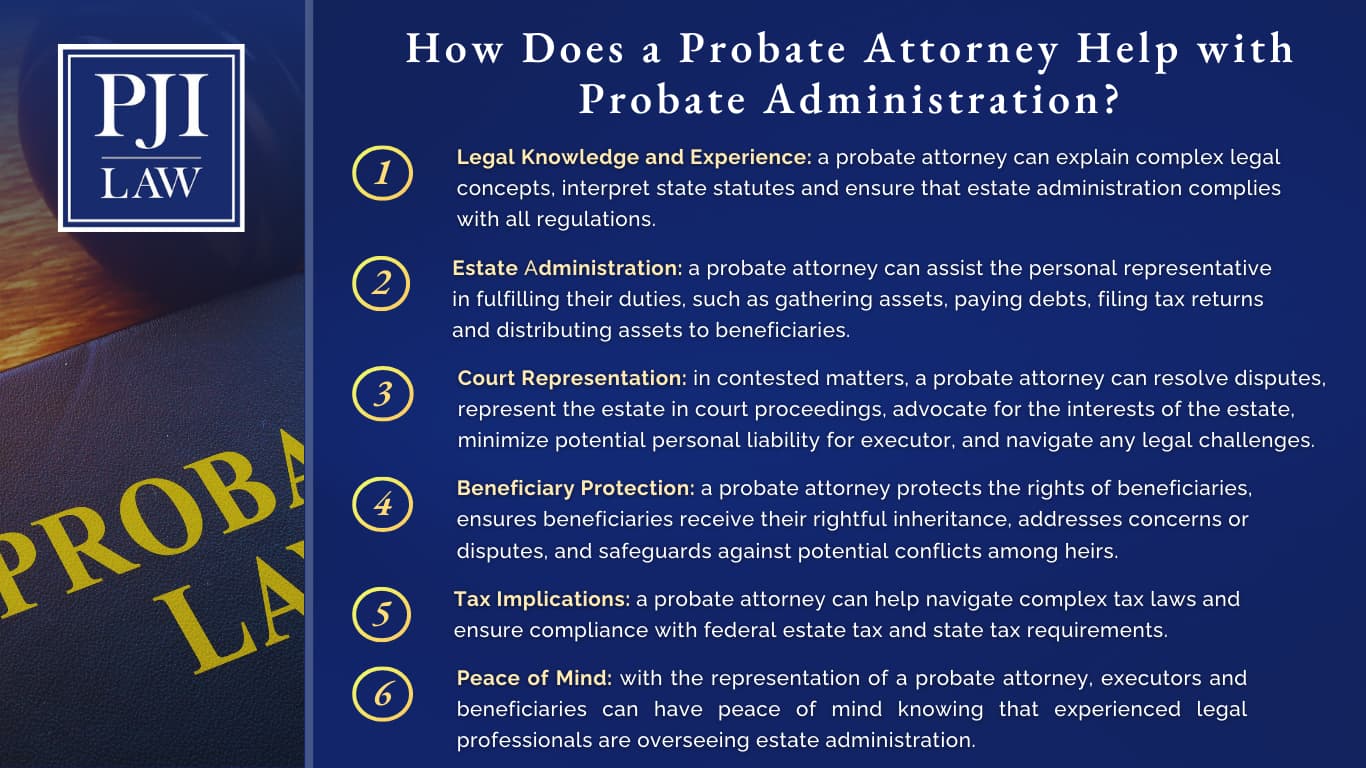
    Given the complexities involved in marshalling assets, many executors in Virginia choose to work with professionals. Virginia probate attorneys experienced in probate law can guide you through the process, ensuring compliance with state laws and deadlines. Financial advisors and appraisers can also assist in valuing complex assets accurately.

    Consequences of Improper Asset Marshalling

    As an executor, you have a fiduciary duty to the estate and its beneficiaries. Failing to properly marshal assets can lead to serious consequences, including:

    • Personal liability for missing or undervalued assets 
    • Legal action from beneficiaries or creditors 
    • Delays in the probate process 
    • Potential removal as executor by the court

    Marshalling of assets is a fundamental aspect of the Virginia probate process. By understanding its importance and following the proper procedures, you can ensure a smooth administration of the estate. While the task may seem challenging, remember that resources and professional help are available to guide you through each step.

    As you manage this process, keep in mind that thorough documentation and transparency are key. By diligently marshalling assets, you fulfill your legal obligations and protect the interests of all parties involved, all while honoring the wishes of the deceased.

    Need Guidance on Marshalling Assets in Virginia Probate?

    Marshalling assets is a crucial step in the probate process, and as an executor, you want to ensure you’re handling this responsibility correctly. The process can be complex, but you don’t have to navigate it alone. At PJI Law, we’re here to support you through every stage of probate administration.

    Our experienced probate attorneys understand the intricacies of Virginia probate law and can guide you through the asset marshalling process with confidence. We’ll work closely with you to identify, locate, and secure all assets of the estate, ensuring nothing is overlooked and all legal requirements are met.

    Whether you’re just starting the probate process or you’ve encountered challenges along the way, we’re here to help. Our team can provide the knowledge and support you need to fulfill your duties as an executor and honor your loved one’s legacy.

    Take the first step towards a smooth and efficient probate process. If you’ve been searching online for “probate attorneys near me,” contact PJI Law instead to schedule a consultation with our knowledgeable Virginia probate attorneys. Call us at (703) 865-6100 or reach out through our confidential online form.

    At PJI Law, you’ll receive personalized service and attention!

    Copyright © 2024. PJI Law, PLC. All rights reserved.

    The information in this blog post (“post”) is provided for general informational purposes only and may not reflect the current law in your jurisdiction. No information in this post should be construed as legal advice from the individual author or the law firm, nor is it intended to be a substitute for legal counsel on any subject matter. No reader of this post should act or refrain from acting based on any information included in or accessible through this post without seeking the appropriate legal or other professional advice on the particular facts and circumstances at issue from a lawyer licensed in the recipient’s state, country, or other appropriate licensing jurisdiction.

    PJI Law, PLC
    3900 Jermantown Rd, 2nd Floor
    Fairfax, Virginia 22030
    (703) 865-6100
    https://pjibe.webteam.ai/
  • Understanding Intestate Succession in Virginia

    Understanding Intestate Succession in Virginia

    Caroline, a lifelong Richmond resident, recently faced a difficult and unexpected situation. When her beloved uncle, David, passed away suddenly, he left no will. As the family’s go-to person for handling such matters, Caroline found herself overwhelmed with questions about what would happen to David’s estate. With no written directive from her uncle, she had no idea about his preferences for administering his estate or even where to start.

    Through this experience, Caroline discovered the complexities of intestate succession in Virginia. The legal process of determining the distribution of property and assets when someone dies without a valid will, intestate succession determines the distribution of a decedent’s assets and property among surviving relatives.

    This blog, from a knowledgeable and experienced Richmond estate planning attorney, delves into the specifics of intestate succession. Whether dealing with an estate for which a decedent did not establish a valid will or planning to protect your own assets, understanding these laws is crucial. Continue reading to learn more about how intestate succession works, who stands to inherit, and the steps you need to take.

    For personalized service and attention, contact PJI Law at (804) 653-3450. Discover how establishing a will as part of a comprehensive estate plan can help you avoid complex situations and ease your family’s burdens after you pass away.

    Who are the Heirs at Law in Virginia?

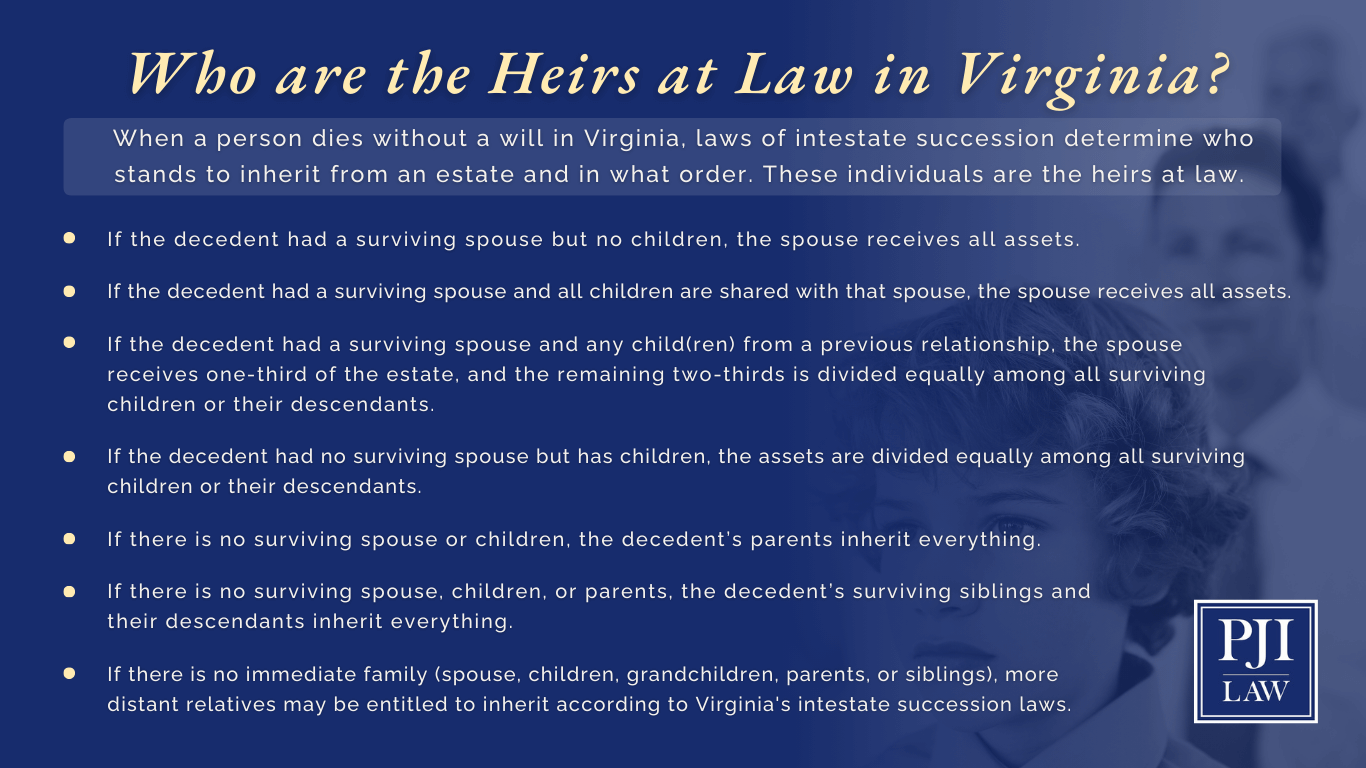
    As Virginia probate attorneys know, when a person dies without a will, laws of intestate succession determine who stands to inherit from an estate and in what order. These individuals are the heirs at law.

    In general, Virginia intestate succession abides by the following:

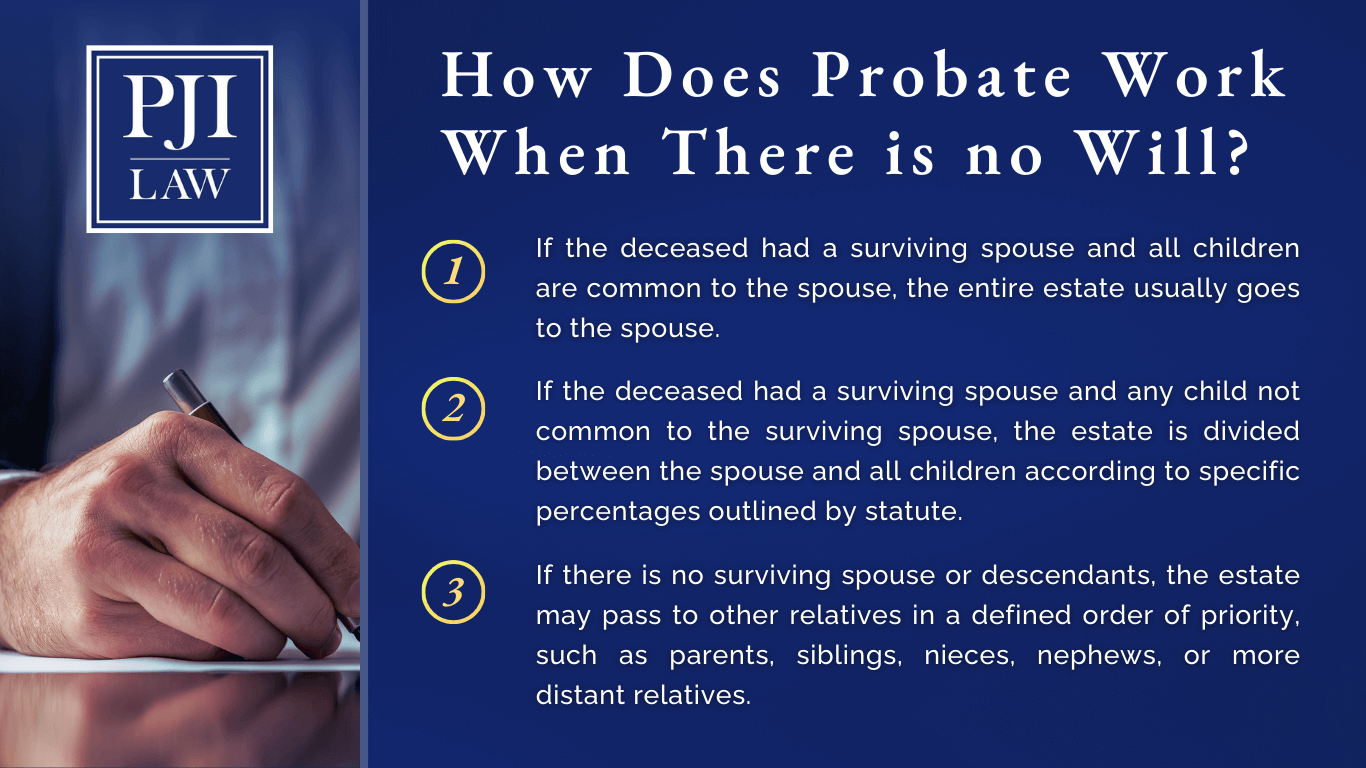
    • If the decedent had a surviving spouse but no children, the spouse receives all assets.
    • If the decedent had a surviving spouse and all children are shared with that spouse, the spouse receives all assets.
    • If the decedent had a surviving spouse and any child(ren) from a previous relationship, the spouse receives one-third of the estate, and the remaining two-thirds is divided equally among all surviving children or their descendants.
    • If the decedent had no surviving spouse but has children, the assets are divided equally among all surviving children or their descendants.
    • If there is no surviving spouse or children, the decedent’s parents inherit everything.
    • If there is no surviving spouse, children, or parents, the decedent’s surviving siblings and their descendants inherit everything.
    • If there is no immediate family (spouse, children, grandchildren, parents, or siblings), more distant relatives may be entitled to inherit according to Virginia’s intestate succession laws.

    Complications arise in cases of blended families, adopted children, or situations where a child has died before the decedent. Consulting trust and estate counsel can help you clarify these circumstances and reach an amicable resolution.

    Need help with intestate succession in Virginia? Call (703) 865-6100

    Terms to Know Concerning Virginia Wills and Intestate Succession

    Term Definition
    Wills Legal documents that outline how a person’s assets and affairs should be handled after their death.
    Administrator A person appointed by the court to manage and distribute the estate of a deceased person who died without a will.
    Beneficiaries Individuals or entities designated to receive assets or benefits from a will or estate.
    Decedents Persons who have died, particularly in relation to their estate.
    Escheat The process by which unclaimed or abandoned property reverts to the state.
    Executor An individual appointed in a will to administer the estate and carry out the wishes of the deceased.
    Heir A person who is legally entitled to inherit some or all of the estate of another person who has died intestate.
    Intestate The condition of having died without a valid will in place.
    Intestate Succession The legal process for distributing the assets of a deceased person who did not leave a valid will.
    Per Stirpes A method of distribution where descendants inherit a deceased person’s estate by branch, ensuring each branch receives an equal share.
    Probate The legal process of verifying a will’s validity and administering the deceased’s estate.
    Probate Tax Taxes imposed on the estate of a deceased person during the probate process.
    Testate The condition of having died with a valid will in place.
    Testator An individual who has made a will or given a testament.

    Virginia Probate Attorneys Explain the Process

    Navigating probate in Virginia can be straightforward for those with a will, known as testate estates. A valid will guides the court in distributing the estate according to the deceased’s wishes. However, not all testate estates are handled the same way since the nature of the estate determines the probate court’s approach.

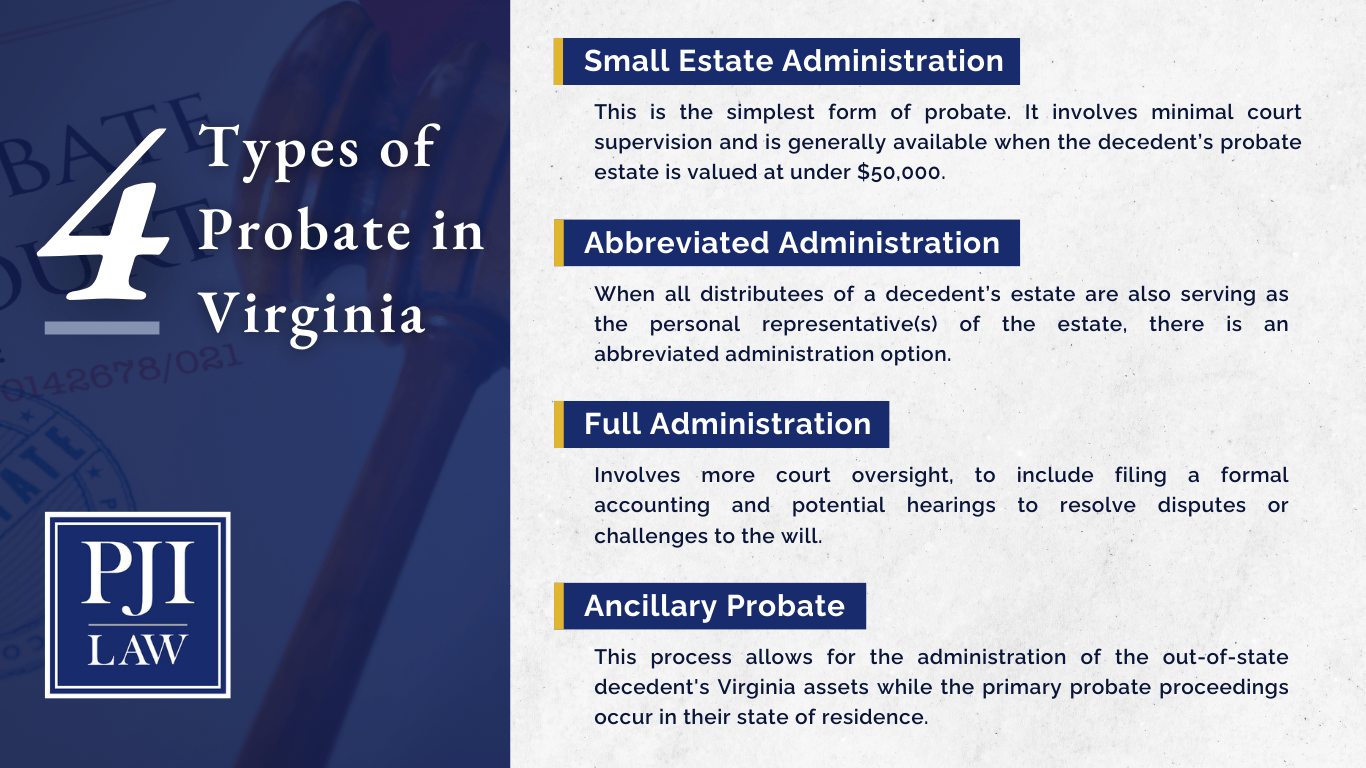
    Estates excluding real estate and consisting of personal property valued at $50,000 or less are classified as “small estates” under Virginia’s inheritance laws. Such estates can skip probate if 60 days have passed since the individual’s death. On the other hand, larger estates must undergo formal probate administration.

    Understanding the distinction between real and personal property is essential. Real property includes land and attached structures like houses, while personal property encompasses items such as cars, furniture, jewelry, and financial investments. Assets like insurance policies and IRAs are typically not subject to probate and can be handled separately if properly designated.

    In situations where there is no will, the court appoints an administrator to oversee the estate, prioritizing relatives of the deceased based on a specific order. The administrator manages debts and distributes assets according to intestacy laws.

    Whether a valid will exists or not, an estate must settle debts such as taxes, expenses, and liabilities before distributing assets to heirs. This duty falls on either the executor named in the will or the administrator appointed by the court.

    In Virginia, circuit courts handle probate cases in the county where the deceased lived for proper legal oversight and administration of estates.

    Did your loved one die without a will? - Northern Virginia - Call (703) 865-6100

    Summary of Virginia Intestate Succession

    Inheritance Rights of Surviving Spouses

    In Virginia, if a decedent dies without a will, their spouse is entitled to a significant portion of the estate. The specific inheritance rights depend on whether the decedent had children and whether those children are shared with the spouse. If there are no children or other descendants, the spouse typically inherits the entire estate. If the marriage resulted in children with the decedent, the surviving spouse receives the entire estate. If there are any children/descendants from a separate relationship, the spouse receives one-third of the estate and the remaining two-thirds are divided between all children.

    Inheritance Rights of Children

    According to VA Code 64.2-200, if the deceased has a surviving spouse and children (or their descendants) who are not also the children of the surviving spouse, the children receive two-thirds of the estate and the surviving spouse receives one-third.

    If all children are also the children of the surviving spouse, the entire estate goes to the surviving spouse. If there is no surviving spouse, the deceased’s children and their descendants receive the entire estate. Virginia law treats adopted children the same as biological children.

    Unmarried Individuals Without Children

    For unmarried individuals without children, the estate is distributed to other family members according to a specific hierarchy. If the deceased did not leave behind a spouse or children, the decedent’s parents inherit everything. If the parents have also passed, the estate transfers to the decedent’s siblings. In the absence of immediate family such as parents or siblings, more distant relatives like aunt, uncles, nieces, nephews, or cousins may inherit. If no relatives can be found, the estate may eventually escheat to the state of Virginia. This hierarchy ensures the distribution of the decedent’s assets to their family members in a manner reflecting their closest biological or legal relationships.

    Unclaimed Estate / No Surviving Heirs

    When no heirs are found, the estate is transferred to Virginia. Creditors can also step in to manage the estate if there are outstanding debts.

    What are Non-Probate Assets?

    Non-Probate Assets in Virginia | Call (703) 865-6100

    As an estate attorney knows, non-probate assets bypass probate and pass directly to beneficiaries, avoiding an often time-consuming and costly process.

    Examples of Non-Probate Assets

    Non-probate assets can include:

    • Real property owned by the decedent if there’s a transfer-on-death (TOD) deed
    • Life insurance payouts
    • Investment accounts
    • Jointly titled real estate assets
    • Retirement accounts
    • Trust assets
    • Payable on death or transfer on death assets

    If an asset is owned with right of survivorship or has been proper beneficiary designated, these assets can be distributed directly to a beneficiary or beneficiaries without the requirement of probate, offering a more efficient vehicle for transferring assets and reducing the hardships on loved ones during a time of grief. Consulting a knowledgeable estate attorney can help you manage your non-probate assets and distribute them in alignment with your desires.

    Naming Beneficiaries

    Naming a beneficiary or beneficiaries for non-probate assets facilitates a smooth transfer of assets and prevents potential disputes among heirs. Non-probate assets, such as life insurance policies, retirement accounts, and bank accounts, generally require the completion and submission of a designated beneficiary form to the relevant financial institution.

    Keeping these forms current is critical for transferring the assets to the designated beneficiary. A seasoned estate planning lawyer knows that taking the time to designate beneficiaries for your non-probate assets enables you to design a comprehensive estate plan that maximizes the value of your assets and offers your loved ones financial security.

    Protecting Your Assets: The Importance of Wills & Comprehensive Estate Planning

    While intestate succession laws provide for the distribution of assets in the absence of a will, they may not align with your personal wishes or values. Furthermore, without a will, you have no control over who will manage your estate and cannot ensure the proper care of your loved ones after you pass away.

    Creating a will allows you to make clear and specific directives about how your assets should be distributed and who should oversee this process. You can also include provisions for minor children or dependents and designate guardianship. By outlining your wishes in a will, you can potentially avoid conflicts and disputes among family members after your passing.

    However, comprehensive estate planning goes beyond just creating a will. Other critical documents such as powers of attorney and advance medical directives can secure the management of your affairs if you become incapacitated or unable to make decisions for yourself. These documents also alleviate the burden on loved ones who would have to make difficult decisions without your guidance.

    Don't leave your family's future to chance | Northern Virginia | Call (703) 865-6100

    How Can Virginia Estate Planning Lawyers Help?

    Estate administration — the maintenance and distribution of your assets after death, which includes probate — involves settling estate taxes and debts and carrying out your wishes. Due to the complexities of the laws surrounding these matters, consulting knowledgeable and experienced Richmond estate planning attorneys can protect your assets and distribute them according to your wishes.

    A lawyer well-versed in estate planning will work closely with you to understand your goals and develop a personalized plan that meets your specific needs, assist with the preparation of legal documents, provide guidance on asset protection strategies, and offer insights into how to minimize potential estate taxes or other financial obligations upon your passing.

    A will forms the foundation of a well-devised estate plan, but estate planning does not end there. Depending on your unique circumstances and goals, your attorney may recommend trusts, powers of attorney, and other legal instruments. More complex situations may require business succession planning if you’re a business owner or a transfer-on-death deed if you’re concerned about what will happen to your home after you pass away.

    PJI Law: Experienced Probate Attorneys & Estate Planning Attorneys in Richmond, Virginia

    For grieving family members, undergoing intestate succession can be overwhelming and time-consuming. Don’t leave your estate administration to chance by failing to establish a will as the foundation of a well-designed estate plan. Take control of your legacy and care for your loved ones after your passing by consulting an experienced estate planning attorney.

    Have you been typing “probate attorneys near me” or “estate law firms near me” into your search bar?

    Whether you have recently lost a loved one and need assistance navigating intestate succession, or want to create an estate plan for yourself, contact PJI Law at (804) 653-3450 to schedule a consultation.

    When you hire a knowledgeable and experienced lawyer from PJI Law, you can expect personalized service and attention from our entire team and peace of mind knowing you have prepared well for the future. Let PJI Law be your guide and advocate.

    Copyright © 2024. PJI Law, PLC. All rights reserved.

    The information in this blog post (“post”) is provided for general informational purposes only and may not reflect the current law in your jurisdiction. No information in this post should be construed as legal advice from the individual author or the law firm, nor is it intended to be a substitute for legal counsel on any subject matter. No reader of this post should act or refrain from acting based on any information included in or accessible through this post without seeking the appropriate legal or other professional advice on the particular facts and circumstances at issue from a lawyer licensed in the recipient’s state, country, or other appropriate licensing jurisdiction.

    PJI Law, PLC
    4108 E Parham Rd,
    Richmond, VA 23228
    (804) 653-3450
    https://pjibe.webteam.ai/

  • Things to Keep in Mind When Naming a Trust in Virginia

    Things to Keep in Mind When Naming a Trust in Virginia

    When you’re setting up a trust in Virginia, choosing the right name might seem like a minor detail. However, the name you select can have significant implications for your estate planning goals, privacy, and the trust’s administration. In this blog, an estate planning lawyer from PJI Law, PLC shares key considerations to keep in mind in naming a trust.  But before we delve into the naming process, let’s start with the fundamentals of a trust.

    What is a Trust?

    A trust is a legal arrangement in which you (the settlor) transfer assets to a trustee, who manages those assets for the benefit of your chosen beneficiaries. Think of it as a container that holds and protects your assets, governed by specific rules you set.

    Key points to understand about trusts include:

    • Types of trusts: Trusts can be revocable (modifiable during your lifetime) or irrevocable (generally unchangeable once established).
    • Benefits: Trusts can help avoid probate, reduce estate taxes, streamline the transfer of assets to your beneficiaries, and provide for loved ones with special needs.
    • Components: Every trust has a settlor (you), trustee(s) (who manage the trust), beneficiaries (who receive benefits), and trust property (the assets placed in the trust).
    • Legal status: In Virginia, a trust is a distinct legal entity, separate from you as an individual.

    Understanding these basics will help you appreciate why naming your trust carefully is so important. The name you choose will be used in legal documents, financial transactions, and potentially public records.

    Understand the Purpose of Your Trust

    Before discussing naming conventions, reflect on why you’re creating the trust in the first place. Are you primarily concerned with:

    • Avoiding probate?
    • Minimizing estate taxes?
    • Simplify the transfer of assets after your death?
    • Providing for a loved one with special needs?
    • Managing property for minor children?

    Your trust’s purpose should inform its name. For example, if privacy is a top priority, you’ll want to choose a name that doesn’t immediately reveal the trust’s purpose or beneficiaries.

    Consider Privacy vs. Transparency

    In Virginia, as in most states, trusts are generally private documents. However, the name of your trust may become public record in certain situations, such as when the trust purchases real estate. You need to balance your desire for privacy with practical considerations:

    • Imagine you create a trust named “The Johnson Family Special Needs Trust” to provide for a relative with disabilities. While this name clearly communicates the trust’s purpose, it might also inadvertently disclose personal and sensitive information about the beneficiary’s situation. This could be a concern if privacy is a top priority for you.
    • A more generic name like “The Oak Trust” offers greater privacy but may be less intuitive for beneficiaries and trustees.

    Weigh these factors carefully based on your specific circumstances and goals.

    Incorporate Key Identifying Information

    While maintaining privacy, your trust’s name should still include enough information to distinguish it from other trusts. Consider including:

    • Your initials or last name
    • The year of creation
    • A unique identifier or number

    For example, “JDS 2024 Trust” or “Fairfax Family Trust #1” provide some identifying details without revealing too much.

    Avoid Potentially Problematic Terms

    When naming your trust, be mindful of terms that might cause confusion or legal issues. Here are a few to avoid:

    • Business Terms: Don’t use terms like “Inc.,” “LLC,” or “Corp.” unless your trust is actually set up as a business entity, which is rare. These terms might make it look like your trust is a company, which could lead to misunderstandings or legal complications.
    • Financial Institution Terms: Avoid using words like “Bank” or “Insurance.” These terms might suggest that your trust is a financial institution, which could be misleading and might lead to legal issues.
    • Trademarked Names: Be careful not to use names that are trademarked or associated with well-known brands. This could lead to conflicts or legal disputes with those brands.

    Keeping the name simple and straightforward will help avoid confusion and make it easier for everyone involved.

    Keep It Simple and Clear

    While creativity can be fun, remember that your trust’s name will be used in legal documents and financial transactions. Aim for a name that is:

    • Easy to spell and pronounce
    • Not overly long or complex
    • Clear and unambiguous

    This will make life easier for you, your trustees, and any institutions dealing with the trust.

    Consider Multiple Trusts

    If you’re setting up multiple trusts, develop a naming convention that clearly distinguishes between them. You might use:

    • Sequential numbers (Smith Family Trust #1, Smith Family Trust #2)
    • Different family members’ names (John Smith Trust, Jane Smith Trust)
    • Specific purposes (Smith Charitable Trust, Smith Grandchildren’s Education Trust)

    Consistency in naming will help you and your advisors keep track of multiple trusts more easily.

    Be Mindful of Virginia-Specific Considerations

    While Virginia doesn’t have unique laws governing trust names, keep in mind:

    • If your trust will own real estate in Virginia, the trust’s name will appear in public property records.
    • Virginia recognizes both revocable and irrevocable trusts. You might consider including “Revocable” or “Irrevocable” in the name if you want to make the trust’s nature clear.
    • If you’re creating a special needs trust, be cautious about using terms that might impact the beneficiary’s eligibility for government benefits.

    Think About Future Changes

    Remember that your circumstances may change over time. Choose a name that allows for some flexibility:

    • Avoid using specific dates or ages that might become outdated.
    • If you think you might move out of state, consider whether the name would still be appropriate elsewhere.
    • If you’re creating a revocable trust, keep in mind that you may want to modify it in the future.

    Consult with Legal and Financial Advisors

    While these guidelines provide a good starting point, it’s always wise to consult with your local trust lawyers and financial advisor before finalizing your trust’s name. They can offer insights based on your specific situation and ensure that the name aligns with your overall estate plan.

    Naming your trust in Virginia requires thoughtful consideration of various factors, from privacy concerns to practical administration issues. By keeping these points in mind, you can choose a name that serves your trust’s purpose effectively while avoiding potential pitfalls. Remember, the right name is an important step in creating a trust that will protect your assets and provide for your beneficiaries as intended.

    Ready to Create a Well-Named Trust in Virginia? 

    Setting up a trust and choosing the right name are important steps in your estate planning journey. These decisions can have a lasting impact on how your assets are managed and protected. At PJI Law, we’re committed to helping you create a trust that meets your unique needs and goals.

    Our experienced estate planning lawyers will work closely with you throughout the trust creation process. We’ll ensure your trust is properly structured and thoughtfully named, taking into account Virginia trust law, your privacy concerns, and practical considerations.

    Take the first step towards securing your legacy and safeguarding your assets. Contact PJI Law today for a consultation with our knowledgeable trust attorneys. Call us at (703) 865-6100 or reach out through our confidential online form. Let us help you create a trust that serves your purposes effectively, starting with a name that sets the right foundation for your future.

    Copyright © 2024. PJI Law, PLC. All rights reserved.

    The information in this blog post (“post”) is provided for general informational purposes only and may not reflect the current law in your jurisdiction. No information in this post should be construed as legal advice from the individual author or the law firm, nor is it intended to be a substitute for legal counsel on any subject matter. No reader of this post should act or refrain from acting based on any information included in or accessible through this post without seeking the appropriate legal or other professional advice on the particular facts and circumstances at issue from a lawyer licensed in the recipient’s state, country, or other appropriate licensing jurisdiction.

    PJI Law, PLC
    3900 Jermantown Rd, 2nd Floor
    Fairfax, Virginia 22030
    (703) 865-6100
    https://pjibe.webteam.ai/
  • What is a Non-Disclosure Agreement in Virginia?

    What is a Non-Disclosure Agreement in Virginia?

    Protecting a company’s confidential information is essential for maintaining a competitive edge and ensuring the success of sensitive projects. In this regard, a non-disclosure agreement (NDA) serves as a powerful legal tool. But what is a non-disclosure agreement in Virginia, and how can businesses and professionals leverage its protective powers?

    In this comprehensive guide, we’ll explore the ins and outs of NDAs in the Old Dominion State, providing you with the essential knowledge needed to make critical decisions about these agreements in your organization. Whether you’re an entrepreneur safeguarding your startup’s trade secrets or a seasoned professional looking to keep your next big project under wraps, you’ll discover the key considerations and best practices for using non-disclosure agreements to your advantage. By the end of this guide, you’ll have a thorough understanding of the role NDAs play in Virginia and be equipped with the insights to ensure your confidential information remains secure.

    Continue reading to learn more, then contact us at (703) 865-6100 for personalized service and attention. 

    What is a Non-Disclosure Agreement?

    Fairfax, VA employment contract attorney answers, “What is a non-disclosure agreement?” Call (703) 865-6100 to schedule a consultation.

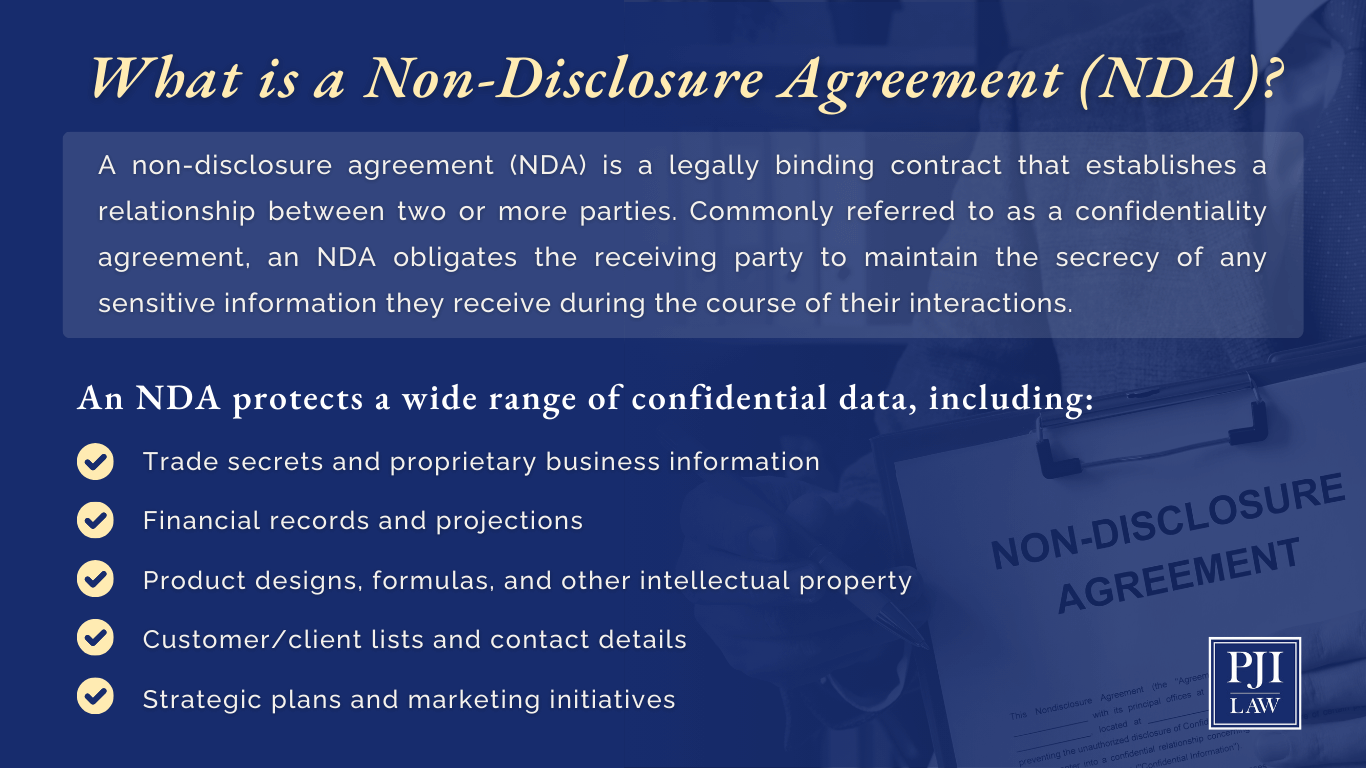
    At its core, a non-disclosure agreement (NDA) is a legally binding contract that establishes a confidential relationship between two or more parties. Also commonly referred to as a confidentiality agreement, an NDA obligates the receiving party to maintain the secrecy of any sensitive information they receive during the course of their interactions.

    In practical terms, an NDA serves to protect a wide range of confidential data, including:

    • Trade secrets and proprietary business information
    • Financial records and projections
    • Product designs, formulas, and other intellectual property
    • Customer/client lists and contact details
    • Strategic plans and marketing initiatives

    By signing an NDA, the recipient agrees not to share, use, or disclose this information without the express permission of the disclosing party. Violation of an NDA can result in significant legal consequences, such as financial penalties or even litigation.

    NDAs are also commonly used in a variety of business contexts, including:

    • Partnerships and joint ventures
    • Mergers, acquisitions, and other corporate transactions
    • Employment relationships and consulting agreements
    • Product development and research collaborations

    Crafting an effective NDA requires a thorough understanding of state laws, industry best practices, and the unique needs of your organization. That’s why it’s often advisable to work with experienced contract lawyers who can ensure your confidentiality agreement is tailored to your specific requirements and provides the robust legal protection you need.

    Fairfax, VA employment contract attorney answers, “What is a non-disclosure agreement?” Call (703) 865-6100 to schedule a consultation.

    Non-Disclosure Agreement Considerations for Virginia Residents

    While non-disclosure agreements are widely used across the United States, the specific laws and regulations governing these contracts can vary from state to state. As a Virginia resident, it’s important to understand how NDAs are viewed and enforced within the Commonwealth.

    Unlike some other states, Virginia does not have any overarching statutes that explicitly address the requirements or limitations of non-disclosure agreements. However, the courts in Virginia have established certain common law principles and precedents that shape how these contracts are interpreted and applied.

    For example, Virginia’s courts generally take a fairly broad and permissive view when it comes to the scope of information that can be protected under an NDA. As long as the confidential data in question provides a genuine competitive advantage and the agreement’s terms are deemed reasonable, Virginia courts have shown a willingness to uphold NDAs and enforce their provisions.

    At the same time, there are still important nuances and potential pitfalls that Virginia residents must consider when drafting or signing a non-disclosure agreement. Issues like the duration of the agreement, the types of activities that are restricted, and the remedies available for breach can all have significant implications.

    Working with an experienced non-disclosure lawyer who is well-versed in Virginia’s legal landscape can help ensure your NDA aligns with state-specific requirements and provides the airtight safeguards you need to keep your sensitive information secure. With the right legal counsel, you can have confidence that your confidentiality agreement will stand up in court if challenged.

    Fairfax, VA employment contract attorney answers, “What is a non-disclosure agreement?” Call (703) 865-6100 to schedule a consultation.

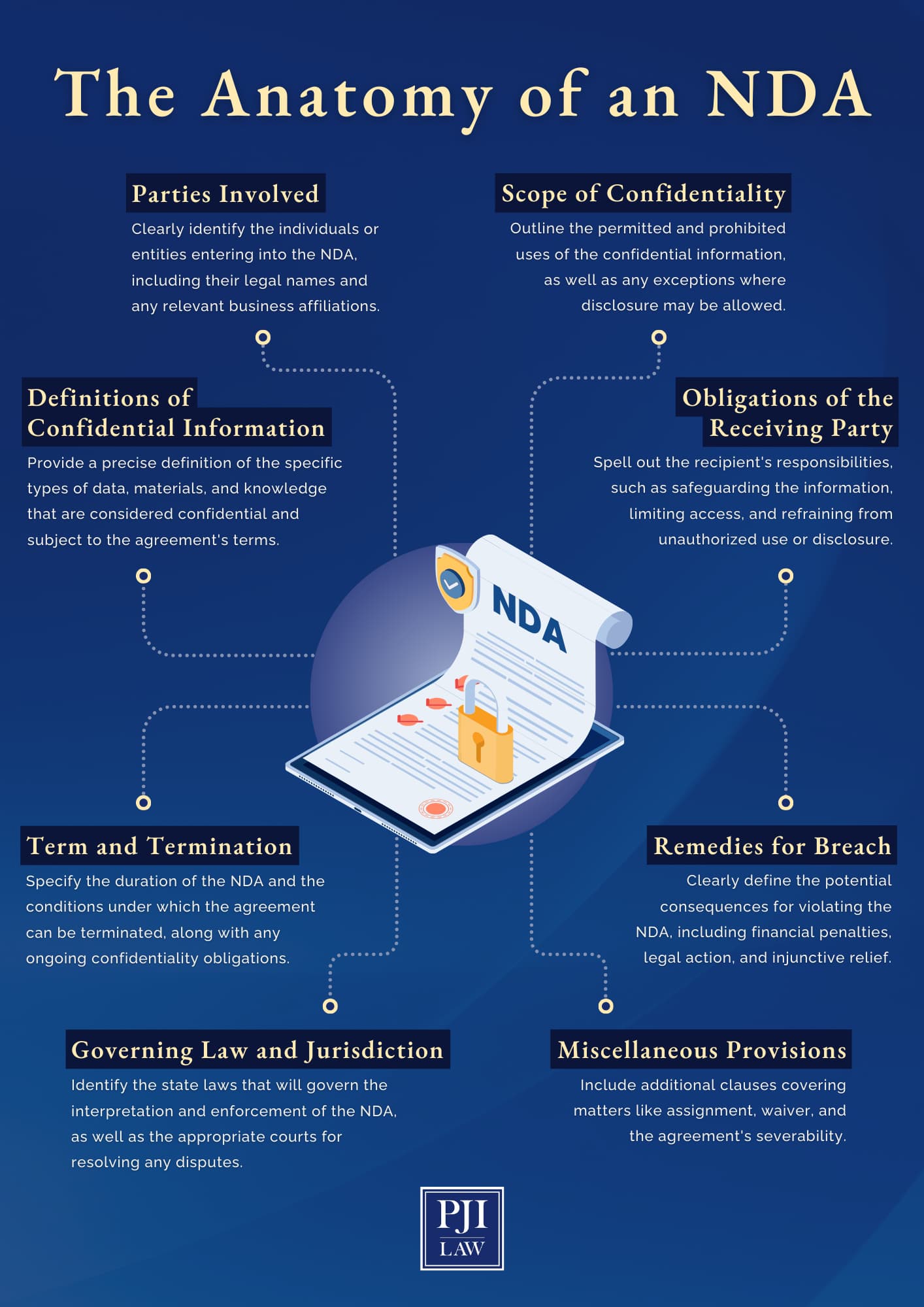
    The Anatomy of an NDA

    When drafting a comprehensive non-disclosure agreement, several key components should be included for its effectiveness. An experienced employment contract attorney can help you ensure your NDA covers all the necessary elements:

    Parties Involved

    Clearly identify the individuals or entities entering into the NDA, including their legal names and any relevant business affiliations.

    Definitions of Confidential Information

    Provide a precise definition of the specific types of data, materials, and knowledge that are considered confidential and subject to the agreement’s terms.

    Scope of Confidentiality

    Outline the permitted and prohibited uses of the confidential information, as well as any exceptions where disclosure may be allowed.

    Obligations of the Receiving Party

    Spell out the recipient’s responsibilities, such as safeguarding the information, limiting access, and refraining from unauthorized use or disclosure.

    Term and Termination

    Specify the duration of the NDA and the conditions under which the agreement can be terminated, along with any ongoing confidentiality obligations.

    Remedies for Breach

    Clearly define the potential consequences for violating the NDA, including financial penalties, legal action, and injunctive relief.

    Governing Law and Jurisdiction

    Identify the state laws that will govern the interpretation and enforcement of the NDA, as well as the appropriate courts for resolving any disputes.

    Miscellaneous Provisions

    Include additional clauses covering matters like assignment, waiver, and the agreement’s severability.

    By ensuring your NDA comprehensively addresses these key elements, you can create a robust and legally-sound agreement that effectively protects your confidential information.

    What Happens if I Break an NDA?

    Violating the terms of a non-disclosure agreement can have serious consequences, both for the individual who breaches the contract and for the company or individual whose confidential information is compromised.

    Under Virginia law, the primary recourse for a party whose NDA has been breached is to pursue legal action against the offending individual or entity. This can take the form of:

    Civil Litigation

    The disclosing party may file a civil lawsuit alleging breach of contract, misappropriation of trade secrets, or other related claims. If successful, they may be awarded monetary damages to compensate for any financial harm caused by the disclosure.

    Injunctive Relief

    In addition to or instead of monetary damages, the court may issue an injunction to prevent further dissemination of the confidential information and compel the return or destruction of any materials containing the data.

    Criminal Charges

    In some cases, the unauthorized use or disclosure of certain types of highly sensitive information protected by an NDA may also rise to the level of criminal activity, such as theft of trade secrets. This could result in fines or even jail time for the offending party.

    The specific consequences will depend on the details of the NDA, the nature and extent of the breach, and the extent of the harm caused. That’s why it’s crucial to work with experienced contract lawyers who can ensure your NDA is structured to provide the maximum legal protections and enforceability.

    Fairfax, VA employment contract attorney answers, “What is a non-disclosure agreement?” Call (703) 865-6100 to schedule a consultation.

    How Binding Is a Non-Disclosure Agreement?

    The binding nature of a non-disclosure agreement (NDA) is a critical consideration for anyone asked to sign one, whether you’re an employee, a business partner, or a vendor. Ultimately, the enforceability and strength of an NDA depends on a variety of factors, making it essential to work with a skilled non-disclosure lawyer.

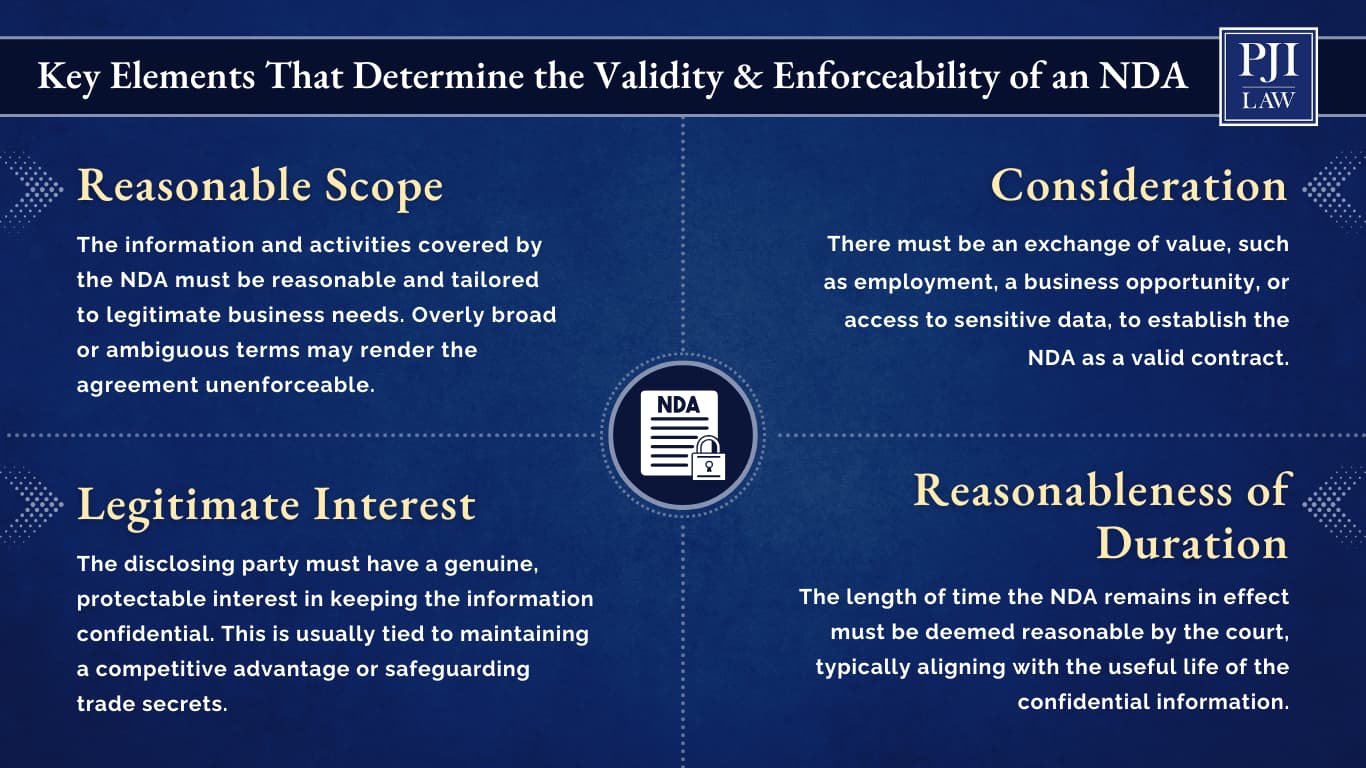
    In Virginia, NDAs are generally viewed as legally binding contracts, meaning that violating the agreement’s terms can expose the offending party to significant consequences. However, the courts will scrutinize several key elements when determining the validity and enforceability of a particular NDA:

    Fairfax, VA employment contract attorney answers, “What is a non-disclosure agreement?” Call (703) 865-6100 to schedule a consultation.

    • Reasonable Scope: The information and activities covered by the NDA must be reasonable and tailored to legitimate business needs. Overly broad or ambiguous terms may render the agreement unenforceable.
    • Legitimate Interest: The disclosing party must have a genuine, protectable interest in keeping the information confidential. This is usually tied to maintaining a competitive advantage or safeguarding trade secrets.
    • Consideration: There must be an exchange of value, such as employment, a business opportunity, or access to sensitive data, to establish the NDA as a valid contract.
    • Reasonableness of Duration: The length of time the NDA remains in effect must be deemed reasonable by the court, typically aligning with the useful life of the confidential information.

    If an NDA meets these criteria, Virginia courts have generally shown a willingness to uphold the agreement and grant appropriate legal remedies, such as monetary damages or injunctions, in the event of a breach. However, the specific enforceability can vary based on the unique circumstances of each case.

    How Long Does a Non-Disclosure Agreement Last?

    In many cases, NDAs will remain in effect for a set number of years, often ranging from 1 to 5 years. However, some agreements may also contain “perpetual” confidentiality clauses, rendering the NDA binding for an indefinite period. The enforceability of such provisions can depend on the nature of the information and the circumstances of the case.

    Consulting experienced contract lawyers is crucial when determining the appropriate length for your NDA. They can help ensure the duration aligns with industry standards, adequately safeguards your confidential data, and stands up to potential legal challenges down the road.

    Can I Work for a Competitor if I Signed an NDA?

    The question of whether an employee can work for a competitor after signing a non-disclosure agreement (NDA) is a complex one that often requires the guidance of an experienced employment contract attorney.

    In Virginia, the courts typically recognize the enforceability of non-compete clauses and other restrictive covenants contained within NDAs, as long as the terms are deemed reasonable. This means that even after the termination of employment, an individual may be legally prohibited from taking a job with a direct competitor if doing so would inevitably lead to the disclosure of the former employer’s trade secrets or confidential information.

    However, the specific restrictions will depend on the language and scope of the NDA. For example, an NDA may only prohibit the employee from directly competing or from soliciting clients, but allow them to work in a non-competing role. Additionally, Virginia courts have shown a tendency to balance the employer’s legitimate business interests with the employee’s right to pursue their career.

    An employment contract attorney can review the terms of your NDA, assess the potential risks, and advise you on your options. They may be able to negotiate modifications to the agreement or seek a “carve-out” that permits you to accept a position with a competitor without violating the NDA. Ultimately, the enforceability of post-employment restrictions in an NDA is highly situational.

    PJI Law: Your Virginia Employment Contract Attorney

    Navigating the complexities of non-disclosure agreements can be a daunting task, but you don’t have to go it alone. At PJI Law, our experienced employment contract attorney is here to provide the guidance you need.

    As your trusted legal partner, we’ll work closely with you to carefully review any NDA language, ensuring it aligns with your best interests and the applicable laws in your state. Our team is well-versed in the nuances of employment contracts, and we’ll leverage that experience to identify potential pitfalls, negotiate favorable terms, and give you the peace of mind that your confidential information is properly protected.

    Whether you’re an employer seeking to implement robust NDAs or an employee presented with an agreement, PJI Law can help you make informed decisions that safeguard your rights. Call us at (703) 865-6100 or complete our online form to schedule your consultation. 

    Copyright © 2024. PJI Law, PLC. All rights reserved.

    The information in this blog post (“post”) is provided for general informational purposes only and may not reflect the current law in your jurisdiction. No information in this post should be construed as legal advice from the individual author or the law firm, nor is it intended to be a substitute for legal counsel on any subject matter. No reader of this post should act or refrain from acting based on any information included in or accessible through this post without seeking the appropriate legal or other professional advice on the particular facts and circumstances at issue from a lawyer licensed in the recipient’s state, country, or other appropriate licensing jurisdiction.

    PJI Law, PLC
    3900 Jermantown Rd, 2nd Floor
    Fairfax, Virginia 22030
    (703) 865-6100
    https://pjibe.webteam.ai/

  • What Happens When You Contest a Will in Richmond, Virginia?

    What Happens When You Contest a Will in Richmond, Virginia?

    As Alexa sat across the polished mahogany desk from her mother’s attorney, a sense of unease settled in the room. The heavy silence hung between them, punctuated only by the scratch of pen on paper as the estate administrator flipped through the pages of her late mother’s will. This meeting was meant to bring closure, a final farewell to a beloved matriarch and a smooth transition of assets. However, what unfolded before Alexa shattered her expectations and left her reeling with disbelief.

    Alexa had always been close to her mother, Lisa, sharing secrets, dreams, and even discussions about inheritance. During countless evenings spent in the cozy living room, where they sipped tea and talked about life, her mother reassured Alexa that she would be well taken care of and that her two estranged siblings would not benefit from their family’s wealth. Yet, as the attorney outlined the asset distribution stated in the will, it became painfully clear that the reality painted on those legal pages bore no resemblance to the promises her mother had made to her.

    The shock of seeing her siblings listed as primary beneficiaries, with generous portions of the estate assigned to them, left Alexa struggling with a mix of confusion and disbelief. How could this be? Had her mother’s intentions changed so dramatically at the end of her life? The discrepancy between the previous version and the version before her was jarring, raising questions about the validity of her mother’s last will and testament.

    As Alexa’s mind raced with uncertainty and a growing sense of injustice, she wondered, “What happens when you contest a will?”

    This blog, from an experienced Richmond will contest attorney, explains the process for contesting a will, exploring the legal grounds, heir challenges, and potential outcomes the person challenging the will can expect from will contest cases.

    Continue reading to learn more, then contact us at (804) 653-3450 for personalized service and attention.

    What is a Will?

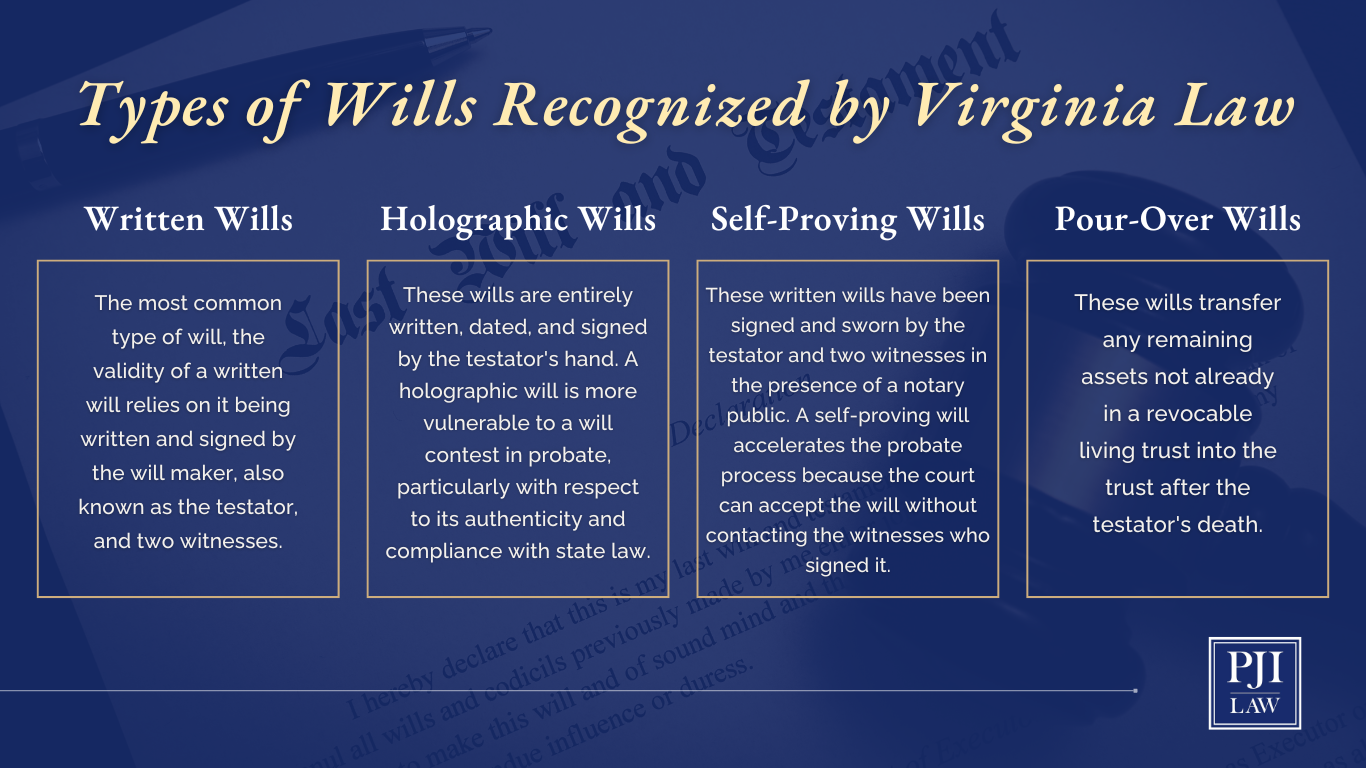
    Before we delve into will contests, let’s first define a will. A will is a legal document that stipulates the wishes of the person making the will for the distribution of their estate assets and care of their minor children, if applicable, upon their death. Virginia law recognizes several types of wills, including:

    • Written Wills: These remain the most common type of will. The validity of a written will wholly relies on it being written and signed by the will maker, also known as the testator, and two witnesses.
    • Holographic Wills: Virginia also accepts holographic wills, which are entirely written, dated, and signed by the testator’s hand. Although a holographic will can have legal validity, it’s more vulnerable to a will contest in probate, particularly relating to its authenticity and compliance with state law.
    • Self-Proving Wills: Also called self-proving affidavits, these written wills have been signed and sworn to by the testator and two witnesses in the presence of a notary public. A self-proving will accelerates the probate process because the court can accept the will without contacting the witnesses who signed it.

    In Virginia, people also like to create pour-over wills, which transfer any remaining assets not already in a revocable living trust into the trust after the death of the person.

    What Makes a Will Valid in Virginia?

    As a knowledgeable and experienced Richmond estate planning attorney knows, Virginia requires specific elements to render a will legally valid and binding and a clear representation of the final wishes of the person creating it. If the person died and neglected to include these vital components in their will, interested parties could pursue a will contest.

    Requirements 

    1. Testamentary Capacity: The testator must be of sound mind and legal age (18 years or older) at the time of executing the will. They should understand the nature of the document they are creating and its implications.
    2. Voluntariness: The creation of the will must be voluntary, without any undue influence or coercion from others.
    3. Proper Execution: The will must be in writing and signed by the testator or by someone else in their presence and at their direction. Additionally, the signing must be witnessed by at least two competent individuals who also sign the will in the presence of the testator.
    4. Attestation Clause: Including an attestation clause, where the witnesses confirm that they observed the testator signing the will and that they signed it in the testator’s presence, can strengthen the will’s validity.
    5. Revocation: If the person wishes to revoke or amend the will, they must do so in accordance with Virginia law. Simply destroying the original will may not be sufficient to revoke it legally.
    6. No Contest Clause: While not required, including a no-contest clause in the will can discourage challenges to its validity after the testator’s death. No contest clauses deter beneficiaries from engaging in a will contest by threatening the forfeiture of their inheritance if they unsuccessfully challenge the document.
    7. Legal Compliance: The will must comply with all relevant Virginia laws and regulations regarding estate planning and will execution.

    Who Can Contest a Will in Virginia?

    Virginia law dictates who has the legal standing to contest a will. If you’re the person bringing the matter to a contest, you must meet one of the following requirements:

    • You are a beneficiary named in the current will or a previous will: If you were a beneficiary in a previous will but were removed or had your inheritance reduced in the current will, you may have grounds to contest someone’s will. 
    • You are an heir at law: If you would have been a beneficiary under Virginia’s intestacy laws if no will had existed, you have the right to contest the will.
    • You are an interested party: If you have a legal interest in the estate, such as a creditor or a child born after the deceased person executed the will, you may have standing to contest the will.

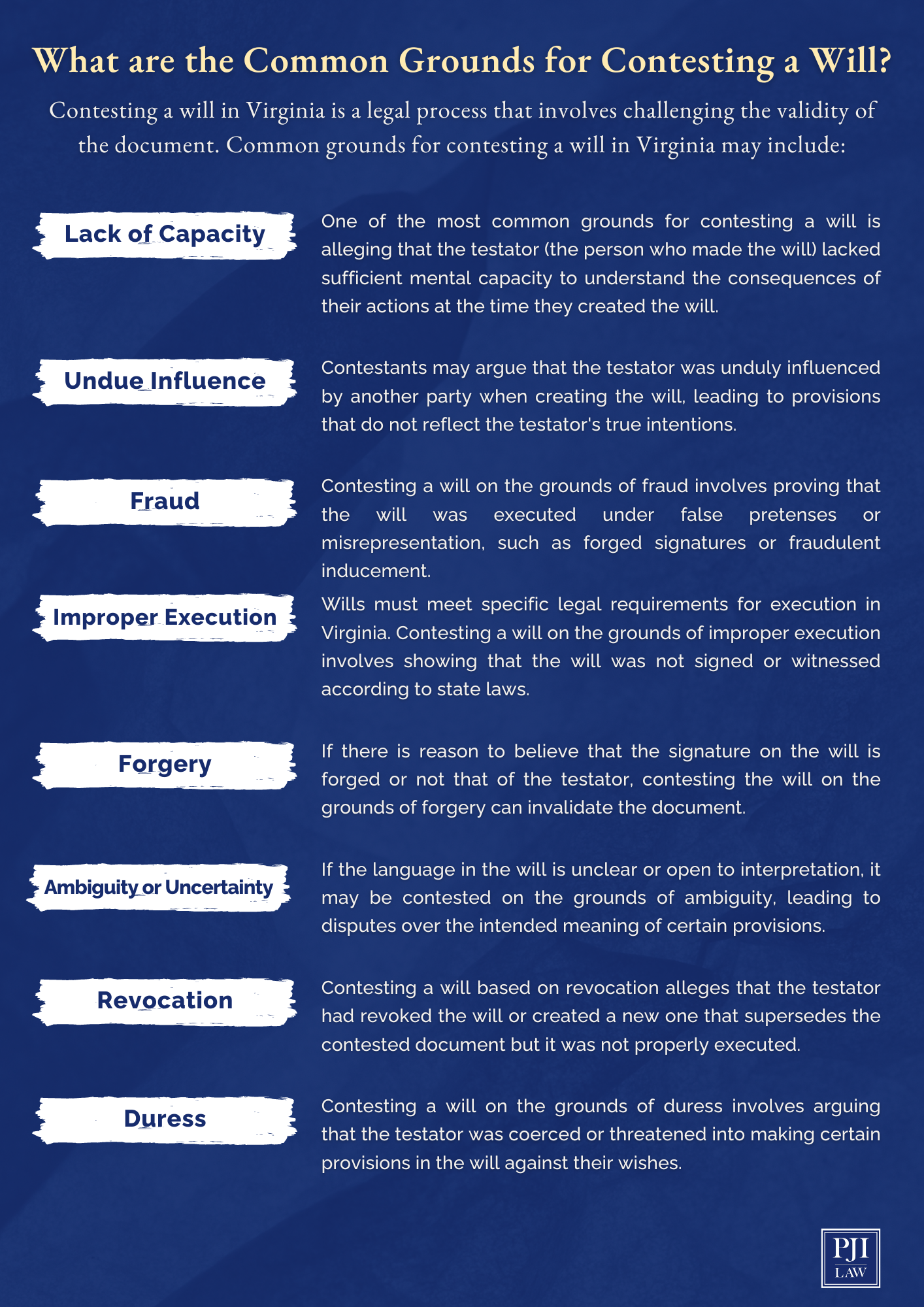
    What are the Common Grounds for Contesting a Will?

    Contesting a will in Virginia is a legal process that involves challenging the validity of the document. Common grounds for contesting a will in Virginia may include:

    1. Lack of Capacity: One of the most common grounds for contesting a will is alleging that the testator (the person who made the will) lacked sufficient mental capacity to understand the consequences of their actions at the time they created the will.
    2. Undue Influence: Contestants may argue that the testator was unduly influenced by another party when creating the will, leading to provisions that do not reflect the testator’s true intentions.
    3. Fraud: Contesting a will on the grounds of fraud involves proving that the will was executed under false pretenses or misrepresentation, such as forged signatures or fraudulent inducement.
    4. Improper Execution: Wills must meet specific legal requirements for execution in Virginia. Contesting a will on the grounds of improper execution involves showing that the will was not signed or witnessed according to state laws.
    5. Forgery: If there is reason to believe that the signature on the will is forged or not that of the testator, contesting the will on the grounds of forgery can invalidate the document.
    6. Ambiguity or Uncertainty: If the language in the will is unclear or open to interpretation, it may be contested on the grounds of ambiguity, leading to disputes over the intended meaning of certain provisions.
    7. Revocation: Contesting a will based on revocation alleges that the testator had revoked the will or created a new one that supersedes the contested document but it was not properly executed.
    8. Duress: Contesting a will on the grounds of duress involves arguing that the testator was coerced or threatened into making certain provisions in the will against their wishes.

    If you are wondering whether a will contest is worth pursuing, consult a knowledgeable and experienced will contest lawyer. A contest lawyer can provide personalized guidance based on your specific circumstances and help navigate the legal process of challenging a will in compliance with Virginia laws.

    Virginia Will Contests Begin with Filing a Complaint

    If you think you have the legal standing for a will contest you have to file a complaint with the Circuit Court in the county where the testator lived. In most cases, you must file this complaint within one year from the date that the circuit court clerk admits the will into probate court.

    However, exceptions to this rule include:

    • Minors – If the person bringing the contest is a minor, the time limit starts when they reach 18
    • Incapacitated Individuals – For individuals incapacitated at the time of probate, the probate court extends the time limit
    • Individuals Not Served Personally – Individuals who were not served personally and did not join when the will was presented to probate court receive an extended time limit
    • The Person Bringing the Contest was Proceeded Against by Publication – The time limit extends to two years if the person bringing the contest was proceeding against by publication, which refers to a method of providing notice to parties involved in a legal proceeding when their whereabouts are unknown or they cannot be personally served with legal documents.

    In the complaint, clearly explain your reasons for initiating a will contest and provide evidence to support your claim. As a will contest lawyer knows, acting promptly to challenge your loved one’s will is urgent; exceeding the time limits can result in forfeiting your right to contest the will.

    Due to the nuances of time limits and the legal complexities of contesting a will in Virginia, if you’re considering challenging the validity of a will, consult an experienced attorney. An estate planning attorney can provide legal advice and clarity on the specific rules and procedures involved in a will contest within the state’s legal framework. Furthermore, your attorney can let you know if it’s worth contesting the will and initiating a legal battle with a family member or multiple family members, depending on your unique circumstances.

    Collecting Evidence

    Successful will contests demand supporting evidence. This evidence may include medical records indicating that the person was mentally incompetent, witness statements suggesting undue influence, or handwriting analysis to prove fraud. An experienced will contest attorney can help you collect and present this evidence to the court. Your estate attorney may also recommend hiring experts, such as medical professionals or handwriting analysts, to strengthen your case.

    The Role of an Executor in a Will Contest

    As a probate attorney will tell you, if you are the executor (also known as the personal representative) of the will undergoing a contest, you have a legal duty to defend the will’s validity. This effort involves gathering evidence supporting the will’s validity and defending against the contestant’s claims. As an executor, you may find yourself in a difficult position especially if you are also a named beneficiary or have a personal relationship with the contestant. Seek legal guidance from an experienced probate attorney to help you fulfill your duties and protect your best interest.

    Resolving a Will Contest

    The cost of a will contest will vary depending on the specific circumstances. In some cases, mediation or settlement negotiations can resolve the contest, either of which can be less costly and less stressful than going to trial. Mediation involves a neutral third party who helps the contestants and the executor arrive at a mutually agreeable resolution. If they reach a settlement, the terms must be put in writing and submitted to the probate court for approval. However, if they cannot come to a favorable settlement, the case will proceed to trial, where a judge will hear evidence and render a decision.

    Is a Will Contest Worth the Emotional Cost?

    Contesting a will extracts a significant emotional toll on you and your family. Before initiating the process, consider the potential impact on your relationships with your siblings and other family members. As the person bringing the contest, you may feel justified that your decision will protect your interests and honor the testator’s true wishes; however, your loved ones may have an entirely different outlook. Be aware of the emotional challenges that may accompany the process, and consider seeking support from friends, family, or a mental health professional.

    Seeking Professional Legal Guidance and Support

    If you’re considering a will contest in and around Richmond, Virginia, seek the guidance of an experienced contest attorney. They can listen to the details of your case, collect evidence, and guide you through the legal complexities. The decision to initiate a will contest demands thoughtful consideration for legal, practical, and emotional reasons. However, if you believe that the decedent’s assets are not being distributed according to their true wishes or that the will is invalid, a will contest may be a suitable choice for you. A contest lawyer can help you weigh your options and make an informed decision.

    Considering a Will Contest in and around Richmond, Virginia? Let the Contest Attorneys at PJI Law Offer Personalized Service and Attention

    Initiating a will contest wreaks havoc on your mind and emotions during a time of mourning and family turmoil. At PJI Law, our will contest attorneys understand the delicate nature of these situations. Let us provide you with compassionate, personalized attention and guidance to help you through this harrowing process.

    Whether you’re a named beneficiary, heir, or interested party who wants to contest a will on the grounds of lack of testamentary capacity, undue influence, fraud, or improper execution, our will contest attorneys will fight with you for fairness and justice.

    If you’re considering a will contest in and around Richmond, Virginia, you don’t have to go it alone. The contest attorneys at PJI Law will be your guide and advocate. Call PJI Law, PLC at (804) 653-3450 or complete our online form to schedule your consultation.

    Copyright © 2024. PJI Law, PLC. All rights reserved.

    The information in this blog post (“post”) is provided for general informational purposes only and may not reflect the current law in your jurisdiction. No information in this post should be construed as legal advice from the individual author or the law firm, nor is it intended to be a substitute for legal counsel on any subject matter. No reader of this post should act or refrain from acting based on any information included in or accessible through this post without seeking the appropriate legal or other professional advice on the particular facts and circumstances at issue from a lawyer licensed in the recipient’s state, country, or other appropriate licensing jurisdiction.

    PJI Law, PLC
    4108 E Parham Rd,
    Richmond, VA 23228
    (804) 653-3450
    https://pjibe.webteam.ai/

  • How To Become a Guardian in Virginia

    How To Become a Guardian in Virginia

    In a previous blog, we discussed the different types of adult guardianships. In this blog, we’ll discuss how to become a guardian. Becoming a guardian for a loved one is a significant responsibility that requires careful consideration and adherence to legal procedures. If someone close to you becomes incapacitated, you might need to step in and seek guardianship in Virginia. This blog will explain the process, helping you understand your responsibilities and the legal requirements involved.

    What is an “Incapacitated Person”?

    Before discussing how to become a guardian, it’s important to understand how Virginia defines an “incapacitated person.” According to Virginia law, an “incapacitated person” means an adult who has been found by a court to be incapable of receiving and evaluating information effectively or responding to people, events, or environments to such an extent that the individual lacks the capacity to:

    • Meet the essential requirements for their health, care, safety, or therapeutic needs without the assistance or protection of a guardian

    Guardianship becomes necessary when a person meets this definition of incapacitation. It’s important to note that poor decision-making alone doesn’t necessarily mean someone is incapacitated. The court looks for an inability to process information adequately, regardless of the quality of decisions made.

    Understanding Guardianship

    Guardianship is a legal arrangement where the court appoints someone (the guardian) to make personal and health-related decisions for an incapacitated person. This can include decisions about living arrangements, medical care, and overall well-being. 

    The incapacitated person could be in this situation due to various reasons, such as mental illness, disability, or age-related conditions. It’s important to note that managing financial affairs falls under conservatorship, which is a separate legal arrangement. In Virginia, guardianship is not taken lightly, as it involves making crucial decisions about someone else’s life. 

    The Guardianship Process in Virginia

    Filing the Petition

    To initiate the guardianship process, you need to submit a petition to the circuit court. As the petitioner, you must clearly explain why the person, known as the respondent, needs a guardian. The petition should be filed in the circuit court for the locality where the incapacitated person currently resides or where they lived before moving to a care facility. 

    Before filing, it’s often beneficial to discuss your intentions with the respondent’s immediate family members to ensure everyone is on the same page. The necessary information for the petition is specified in Virginia Code Section 64.2-2002.

    Evaluation by a Guardian Ad Litem

    After filing the petition, the court will appoint a Guardian ad Litem (GAL) to assess the situation and provide an objective report to the judge. The GAL’s role is to offer the court a clearer understanding of the case, without representing either you or the respondent. The respondent retains the right to hire their own attorney or request that the court appoint one if necessary.

    Notice and Evidence

    The respondent must be personally served with the notice of the hearing, a copy of the petition, and the order appointing the GAL. As the petitioner, you are responsible for gathering and presenting the evidence that demonstrates the respondent’s incapacity and the necessity for a guardian.

    The Guardianship Hearing

    A hearing will be scheduled where you will present your case. The respondent has the right to attend and may be represented by a lawyer. The judge will review the evidence, including the GAL’s report, to decide if guardianship is warranted. Family members who did not file the petition can attend the hearing and express their views or file responses.

    Court Order

    If the judge decides in your favor, you or your attorney will need to prepare a court order for the judge to sign, officially appointing you as the guardian.

    Qualifying as a Guardian

    Once the court order is signed, you need to go through a qualification process with the Clerk of the Circuit Court. This involves taking an oath to dutifully carry out your responsibilities and securing a surety bond if the court requires it. It’s important to contact the Probate Department of the Clerk of the Circuit Court to arrange this qualification, preferably on the same day as the hearing or within thirty days of the court order.

    Responsibilities of a Guardian

    As a guardian, some of your responsibilities will include:

    • Ensuring the incapacitated person has appropriate living arrangements 
    • Making medical decisions on their behalf 
    • Overseeing their mental and physical health care

    Your role is to balance providing necessary care while allowing the incapacitated person as much independence as possible. Regular visits are crucial to understanding their needs and capabilities. You must also file annual reports with the local Department of Social Services detailing the person’s condition and your recommendations.

    Ending Guardianship

    Your role as a guardian concludes when the incapacitated person either passes away or regains capacity as determined by the court. If the individual’s condition improves or if you seek to be discharged from your duties, you must return to court to formally end your guardianship. 

    Seeking Legal Assistance

    Given the complexity of guardianship cases, working with an experienced attorney is advisable. An attorney for legal guardianship can help you:

    • Determine if guardianship is necessary 
    • Prepare and file the petition 
    • Represent you at the hearing 
    • Navigate the qualification process 
    • Meet bonding requirements

    Balancing Care and Independence

    While guardianship grants you significant authority over another person’s life, it’s important to remember that the goal is to provide necessary care while preserving as much of the incapacitated person’s independence as possible. Always consider their wishes and preferences when making decisions on their behalf.

    Becoming a guardian in Virginia is a serious undertaking that requires careful consideration and legal procedures. By understanding the process and responsibilities involved, you can make an informed decision about whether guardianship is the right choice for your situation. Remember, the ultimate goal is to ensure the best care and quality of life for your loved one while respecting their dignity and independence as much as possible.

    Need Help Becoming a Guardian in Virginia? Contact PJI Law Today

    Navigating the guardianship process can be complex and emotionally taxing. At PJI Law, we understand the importance of making informed decisions for your loved one’s well-being. Our team is committed to providing you with the personalized guidance and support you need during this challenging time.

    If you’re considering becoming a guardian for an incapacitated person in Virginia, our dedicated attorneys are here to assist you every step of the way. We can help you understand your responsibilities, prepare and file the necessary documents, and represent you in court.

    Don’t go through this process alone. Contact the experienced team at PJI Law for a consultation with an adult guardianship lawyer. Call us today at (703) 865-6100 or reach out through our secure online form. Let us help you ensure the best care and quality of life for your loved one.

    Copyright © 2024. PJI Law, PLC. All rights reserved.

    The information in this blog post (“post”) is provided for general informational purposes only and may not reflect the current law in your jurisdiction. No information in this post should be construed as legal advice from the individual author or the law firm, nor is it intended to be a substitute for legal counsel on any subject matter. No reader of this post should act or refrain from acting based on any information included in or accessible through this post without seeking the appropriate legal or other professional advice on the particular facts and circumstances at issue from a lawyer licensed in the recipient’s state, country, or other appropriate licensing jurisdiction.

    PJI Law, PLC
    3900 Jermantown Rd, 2nd Floor
    Fairfax, Virginia 22030
    (703) 865-6100
    https://pjibe.webteam.ai/

  • Who Has Authorization to Sign on Behalf of the Company in Virginia?

    Who Has Authorization to Sign on Behalf of the Company in Virginia?

    Running a business in Virginia comes with its fair share of legal complexities — and one of the most critical yet often overlooked areas is determining who has the authorization to sign on behalf of the company. Whether you’re inking a major contract, opening a new bank account, or finalizing an important transaction, understanding the ins and outs of signing authorization is essential to protecting your organization and avoiding costly missteps.

    In this comprehensive guide, we’ll walk you through the ins and outs of signing authority in the state of Virginia. You’ll learn about the different roles and titles that typically carry this power, how to properly document and delegate signing privileges, and strategies for maintaining tight control over who can legally bind your company. By the end, you’ll have the knowledge and tools you need to ensure your organization is always operating within the bounds of the law when it comes to authorizing signatures.

    virginia business attorney

    Understanding Corporate Organizational Structure

    When it comes to determining who has the authorization to sign on behalf of a Virginia-based company, the first step is understanding the organization’s core structure and hierarchy:

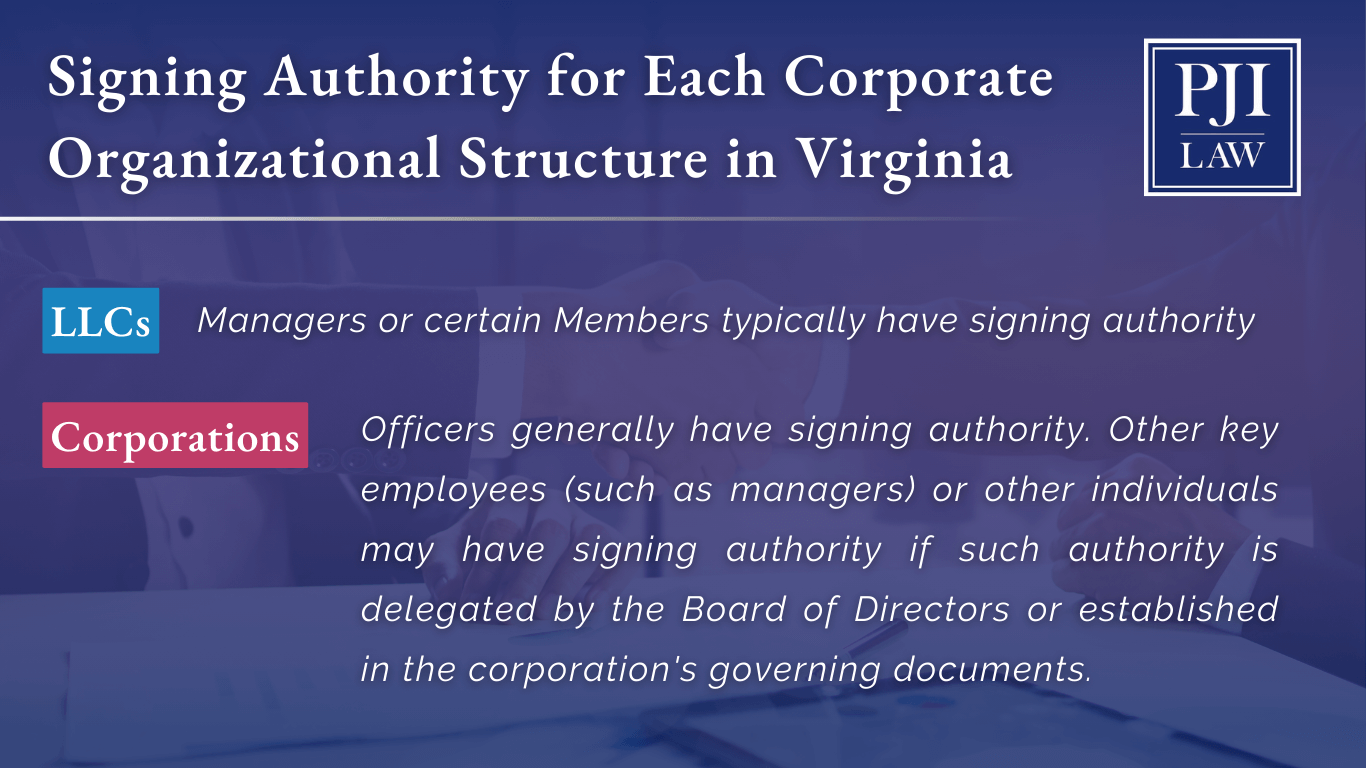
    Limited Liability Company (LLC)

    In a Virginia LLC, the default signing authority typically lies with the manager or managing members. This means the individual(s) designated as the LLC’s managers or managing members will hold the broadest power to enter into agreements and legally bind the company. However, the operating agreement may also grant signing privileges to non-managing members or even specific employees, so it’s important to review your LLC’s documentation closely.

    Corporations 

    For Virginia corporations, the Board of Directors usually holds the primary signing authority. The President, CEO, CFO and other C-suite executives derive their signing power from the Board’s delegation. Lower-level employees may also be granted more limited authority, but this should be clearly documented in the articles of incorporation or bylaws.

    Regardless of your business entity type, developing a thorough understanding of your corporate organizational structure is crucial. A business attorney in Virginia can provide invaluable guidance in navigating these complexities.

    guidance in navigating these complexities.

    Incorporating Signing Authority into a Company’s Organizational Documents 

    While the managing members of an LLC and the Board of Directors of a corporation typically hold the broadest signing privileges, Virginia businesses may also choose to delegate more limited authority to members and employees (LLC) or the highest-ranking officers and directors (corporation). A Virginia business attorney can properly document and align this process with state regulations.

    Department heads, regional managers, and other mid-level roles may be granted the ability to sign off on routine transactions or contracts within their specific areas of responsibility. Administrative staff may also be empowered to affix their signatures for particular purposes, such as processing invoices or opening bank accounts.

    Businesses should have clear policies and procedures outlining the specific parameters, documentation requirements, and oversight mechanisms. Regularly reviewing and updating these guidelines can help mitigate risks and ensure compliance.

    Operating Agreements for LLCs and Company Bylaws for Corporations

    For Virginia businesses, clearly documenting signing authority protocols is crucial, regardless of the business structure. LLCs rely on operating agreements, while corporations rely on bylaws. Operating agreements and bylaws serve as the foundational legal documents for LLCs and corporations respectively, governing an organization’s internal operations and decision-making processes.

    When it comes to signing authority, operating agreements and bylaws should outline the specific roles and positions that hold the power to legally bind the company. This effort typically includes defining the signing privileges of managing members, members, and employees for LLCs, and officers like the President, CEO, CFO, other C-suite executives, and the Board of Directors for corporations.

    Operating agreements and bylaws may also address the delegation of more limited signing authority to managers, department heads, and other employees. Establishing these parameters in the governing documents helps ensure consistency, accountability, and compliance with state regulations. Additionally, the operating agreements and bylaws should detail the procedures for updating or amending the company’s authorized signatories to allow a business to adapt to changes in leadership, organizational structure, or operational needs over time.

    Working closely with a Virginia business attorney is crucial when incorporating signing authority protocols into a company’s operating agreements or bylaws. An attorney can provide guidance in establishing legally sound language aligned with the business’s unique requirements.

    Documenting Signing Authority: Resolutions and Powers of Attorney

    In addition to incorporating signing authority protocols into the operating agreements and company bylaws, Virginia businesses should also maintain clear documentation through formal resolutions and powers of attorney. These supplementary legal instruments help solidify and communicate the specific individuals empowered to sign on the organization’s behalf.

    Corporate resolutions are official actions taken by a company’s Board of Directors or other governing body to authorize certain individuals to sign contracts, open bank accounts, or execute other binding agreements. These resolutions should precisely identify the authorized signatories, outline the scope of their authority, and be properly recorded in the company’s records.

    For LLC managing members, powers of attorney (POA) offer a legal means of delegating signing powers by granting a designated individual the legal right to act on the company’s behalf. Through a POA, managing members of a LLC can empower members or employees to sign specific documents, manage financial transactions, or make other decisions that obligate the organization. For these reasons, powers of attorney require careful drafting and record-keeping.

    If you’re wondering, “What type of Virginia POA do I need?”, we invite you to read our detailed blog on the topic.  

    When making decisions about your organization’s signing authority, whether a LLC or a corporation, working closely with a business attorney in Virginia can make a world of difference. They can employ language and procedures that fully comply with state laws, protect the company’s interests, and withstand potential legal challenges down the line.

    Restrictions on Signing Authority Based on Transaction Type

    While certain high-ranking officers and directors may hold broad signing privileges, businesses often place specific restrictions on their authority based on the type or size of the transaction. These limitations help maintain appropriate oversight and controls over the company’s critical financial and legal affairs.

    For example, a business may grant the CEO the ability to sign off on routine vendor contracts up to a certain dollar value, while requiring Board approval for any agreements exceeding that threshold. Similarly, the CFO may have signing authority for standard accounting and payroll functions, but not for major capital expenditures or debt financing.

    Documenting these transaction-based restrictions is crucial, whether through corporate bylaws, board resolutions, or other formal policies. Clearly outlining the specific signing parameters for different business activities allows the company to enforce appropriate controls and accountability.

    Maintaining a Centralized Record of Authorized Signatories

    Beyond simply documenting signing authority protocols, an experienced Virginia business attorney would also recommend you establish a centralized system for tracking and managing the individuals who are empowered to legally bind the company. This creates a single, authoritative source of truth that can be consistently referenced and updated as needed.

    One effective approach is to maintain a master list of all authorized signatories, including their names, titles, the specific scope of their signing privileges, and the supporting documentation (e.g. board resolutions, powers of attorney) that grants them this authority. This record should be securely stored and accessible to relevant personnel, such as the executive team, legal counsel, and accounting/finance departments. Also, anytime there is a shift in leadership, a new hire in a position with signing authority, or a modification to the company’s policies, the master record must be promptly adjusted to reflect the current state of affairs.

    Distributing the authorized signatory list to key external partners, such as banks, vendors, and other counterparties, can also help maintain transparency and ensure all parties are aware of who has the power to legally obligate the business. This minimizes the risk of unauthorized signatures or other potential issues.

    Implementing robust controls and procedures around the management of authorized signatories demonstrates a company’s commitment to compliance and responsible governance. It’s a simple yet critical step that can pay major dividends in protecting the organization’s interests down the line.

    organization's interests down the line.

    Reviewing and Updating Signing Authority as the Company Evolves

    As a company grows and evolves, it’s crucial to regularly review and update its signing authority protocols. What may have been an appropriate structure for a fledgling startup can quickly become insufficient as the business expands and takes on more complexity.

    Virginia companies should proactively reassess their authorized signatories on a recurring basis — whether annually, semi-annually, or whenever major milestones or transitions occur. This ensures the individuals empowered to legally bind the organization remain aligned with the current leadership, operational structure, and risk profile.

    Some of the key triggers that should prompt a review of signing authority include:

    • Changes in executive leadership or the Board of Directors
    • Expansion into new markets, product lines, or service offerings
    • Significant increases in revenue, assets, or number of employees
    • Mergers, acquisitions, or other major organizational changes
    • Updates to corporate bylaws, policies, or compliance requirements

    bylaws, policies, or compliance requirements

    Working closely with a Virginia business attorney can help guide this review and update process by providing an objective, third-party perspective. They can identify potential gaps or vulnerabilities in the existing signing authority framework and recommend revisions to bolster oversight, reduce liability, and keep the company operating efficiently.

    Outdated or overly rigid systems of authorized signatories can create unnecessary friction, expose the business to risk, and even lead to costly legal disputes. Prioritizing the ongoing management of this critical function is an investment that pays dividends in the long run.

    Ensuring Compliance with Virginia State Laws on Signing Authority

    Have you been searching for a “business lawyer near me?” 

    At PJI Law, our experienced Virginia business attorney is here to provide the essential support and guidance you need. Our team is deeply versed in the nuances of business law, and the documentation required to properly delegate signing privileges. We can work closely with you to review and update your company bylaws or operating agreements, establish robust policies and procedures for managing signing authority, help identify appropriate signing restrictions based on transaction types, and much more.

    With PJI Law on your side, you move with confidence, knowing that your Virginia business is operating with the proper controls and oversight. Call us at (703) 865-6100 or complete our online form to schedule your consultation. 

    Copyright © 2024. PJI Law, PLC. All rights reserved.

    The information in this blog post (“post”) is provided for general informational purposes only and may not reflect the current law in your jurisdiction. No information in this post should be construed as legal advice from the individual author or the law firm, nor is it intended to be a substitute for legal counsel on any subject matter. No reader of this post should act or refrain from acting based on any information included in or accessible through this post without seeking the appropriate legal or other professional advice on the particular facts and circumstances at issue from a lawyer licensed in the recipient’s state, country, or other appropriate licensing jurisdiction.

    PJI Law, PLC
    3900 Jermantown Rd, 2nd Floor
    Fairfax, Virginia 22030
    (703) 865-6100
    https://pjibe.webteam.ai/
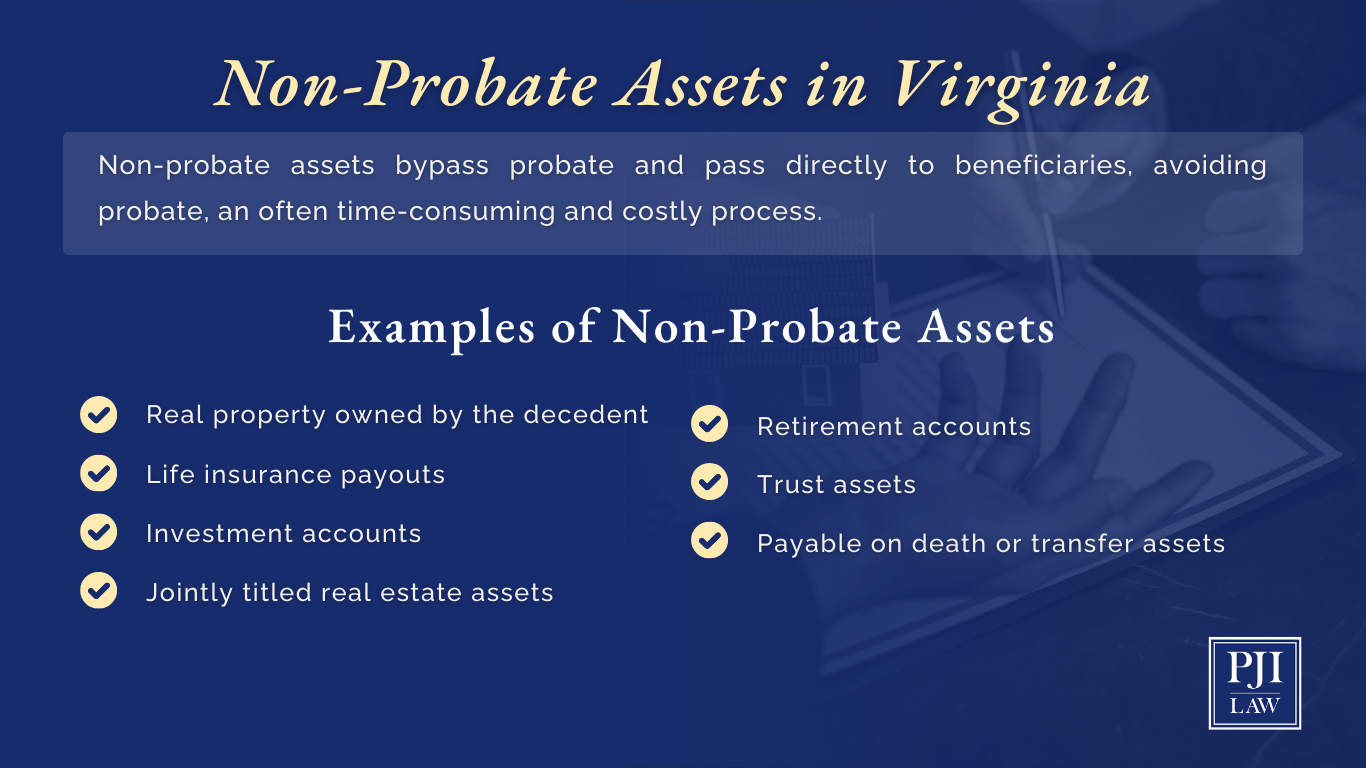
  • What Does It Mean to be an Executor of Estate in Richmond, Virginia?

    What Does It Mean to be an Executor of Estate in Richmond, Virginia?

    When AJ agreed to be the executor (also known as the personal representative) in his widowed father’s estate, he’d been busy raising a young family, providing for his wife and children, and climbing the corporate ladder. To put his father’s mind at ease, he accompanied him to the office of the estate attorney, where he didn’t ask many questions or pay too close attention to the responsibilities he would take on as the named executor.

    Now, nearly 20 years later, AJ is grieving the loss of his father and wondering what to do with his last will and testament. How can he be sure he complies with estate law in Virginia? Is he personally liable if he makes a mistake? Should he look for an estate administration attorney near his home in Richmond to help him understand Virginia state law, an executor’s job, and how to do right by each beneficiary?

    Like AJ, are you a designated executor in someone’s will and uncertain about your responsibilities? You’re not alone. Many family members and others who have accepted this responsibility do not know what an executor of estate does or how to serve in this capacity. Furthermore, some complex estates require full administration, while others are relatively simple to administer.

    This blog, from an experienced estate administration lawyer from PJI Law, PLC, in Richmond, Virginia, explains an executor’s responsibilities and how an attorney can guide you through this complicated legal process. Continue reading to learn more, then contact us at (804) 653-3450 for personalized service and attention.

    Who Can Serve as an Executor/Personal Representative of a Virginia Estate?

    Any competent adult over 18 can serve as an executor. During the estate planning process, many people designate a spouse or a family member as their executor. However, they can also choose to appoint a professional executor or a lawyer to handle their estate administration after their death.

    Executors must be responsible, trustworthy, and willing to fulfill the duties of an estate representative. Anyone who takes on the executor role is legally obligated to promote the best interest of the decedent’s (deceased individual) estate according to their will. Violating the law could lead to the executor’s removal and dire legal consequences, including lawsuits, fines, and even jail time.

    In some cases, the appointed executor may be required to obtain a bond to fulfill their duties, as they have been entrusted with the person’s estate and all property contained within it. A bond guarantees that executors will obey the law and fulfill their responsibility to distribute the estate’s assets.

    executor of estate

    Initiating Probate According to Virginia Probate Law

    Probate is the legal process of distributing the estate of a deceased person. After their death, the executor of the deceased person’s estate can start the probate process by scheduling an appointment with the Clerk of the Circuit Court in the proper jurisdiction. In addition to other information, the will’s designated executor must take the original will and a certified copy of the death certificate to the probate appointment.

    After keeping the appointment and qualifying before the Clerk, the executor has the authority to administer the decedent’s estate. Once the Clerk determines that they are indeed qualified, they will issue Certificates of Qualification, also known as letters testamentary – a written document with the Court’s seal authorizing the executor to act on the estate’s behalf.

    Duties of An Executor

    probate attorneys near me

    Among other duties, a qualified estate executor must:

    Send Notice of Probate

    The executor must send a Notice of Probate to all beneficiaries and heirs within 30 days of qualifying before the Clerk of the Court. The notice informs each beneficiary about the opening of probate. The appointed executor must also file an affidavit with the Clerk within four months, proving they gave notice.

    Open an Estate Checking Account

    When opening a checking account for the estate, the executor must give the bank a death certificate, certificate of qualification, and provide the tax identification number for the estate that they have obtained from the Internal Revenue Service.

    Next, the executor must transfer the contents of the decedent’s personal bank accounts to the estate checking account, keeping thorough records of each bank account transaction. When the probate process ends, any funds remaining after paying estate taxes, valid debts, or other fees, will be distributed to the beneficiaries.

    Locate the Person’s Assets

    An executor must locate and protect any estate assets passing through probate. This effort generally excludes accounts that pass directly to beneficiaries, property the decedent previously co-owned with a surviving spouse, and property in revocable living trusts.

    Establish Date-of-Death Values

    The executor must determine the value of all assets belonging to the estate. Ordering appraisals of any real property or business assets of disputable value is often recommended. Accurately valuing probate assets is indispensable; however, even non-probate assets could potentially require valuation if the estate owes estate taxes. Why? A taxable estate includes probate and non-probate assets.

    File Inventory of the Decedent’s Property and Assets

    The executor must take inventory of the decedent’s probate estate and file it with the Commissioner of Accounts within four months. For small estates, this requirement can sometimes be waived.

    Prepare and File Final Income and Estate Tax Returns

    The executor must prepare any federal and state tax documentation on the decedent’s behalf, including personal income tax returns and estate tax returns.

    Pay Bills, Claims Against Estate, and Administrative Expenses

    The executor must pay the estate administration expenses, including appraisal, court, and estate attorney fees, using funds in the estate checking account. If necessary, the executor may also be tasked with selling property or other estate assets to fulfill these financial obligations. Aside from satisfying any tax obligations, the executor must pay the deceased’s final bills and debts and any claims against the estate.

    File Annual Accounting 

    These accountings inform the Probate Court of the executor’s actions on behalf of the estate. The executor must submit the first accounting within 16 months, which covers the first year of probate. If subsequent accountings are required, they are due within four months of the end of the accounting period of the executor’s preference — but no later than 12 months after the last accounting was due. It requires filing all the necessary documentation, such as a list of all probate assets with their values at the beginning of the account period and proof of any receipts, disbursements, or distributions the representative received or made.

    Distribute Assets to Beneficiaries

    After discharging all debts, fees, and taxes, the executor will distribute the estate balance to the beneficiaries. Asset distribution to beneficiaries usually takes place at the end of the probate process.

    How a Richmond Estate Administration Attorney Can Help Estate Executors

    A Richmond, Virginia estate administration attorney can help estate executors with:

    • Identifying, securing, and obtaining appraisals for estate assets
    • Collecting life insurance policy proceeds
    • Discharging debts and bills
    • Preparing and filing all probate court documents
    • Managing the estate account
    • Handling all of the steps in the probate process

    probate attorneys near me

    What About Guardians for Minor Children Named in the Will?

    When a will contains guardian designations for minor children, a Richmond VA estate administration lawyer can assist the executor with making a smooth transition.

    1. Legal Guidance: An estate attorney can provide legal guidance on interpreting the guardian designations outlined in the will, explain the responsibilities and legal implications, and ensure the executor fully understands their role in the process.
    2. Court Procedures: If the designated guardians need to be officially appointed by the court, estate administration attorneys can navigate the necessary legal procedures, including preparing and filing the required documentation with the court.
    3. Communication: An estate attorney can facilitate communication between the executor, the designated guardians, and any other relevant parties involved in the guardianship process. Clear communication ensures that everyone knows what their roles and responsibilities entail.
    4. Conflict Resolution: In cases where there may be disagreements or disputes regarding the guardian designations or the care of the children, the estate administration lawyer can help mediate and resolve conflicts to protect the best interests of the children.
    5. Compliance with Laws: The lawyer ensures that all actions taken concerning the guardianship of children are in compliance with Virginia laws and regulations. They help the executor uphold the wishes expressed in the will while adhering to legal requirements.
    6. Documentation and Record-Keeping: Keeping accurate records of all communications, decisions, and actions taken regarding the guardian designations is crucial. The lawyer can assist the executor in maintaining detailed documentation to ensure transparency and accountability throughout the process.

    Should I Begin Estate Planning Now?

    Individuals 18 and over of all income levels should create an estate plan with the help of an experienced estate planning attorney. As a qualified attorney can attest, the estate planning process involves more than just a will, although it is the foundation of a comprehensive estate plan.

    The documents required will vary depending on the individual, but with the guidance of trust and estate counsel, who will ask the right questions, listen to your answers, consider your unique circumstances, then make recommendations, your estate plan could potentially include:

    • A last will and testament
    • Revocable Living Trust
    • Advance medical directives
    • Powers of attorney
    • Business succession planning
    • Transfer-on-death deeds

    Many attorneys claim to be estate planners. When choosing an estate planning attorney, read online reviews, ask for references from other clients, inquire as to whether they offer a flat fee or a simple hourly rate, and listen to their answers to your questions during a consultation. Your estate planning attorney should demonstrate their willingness to listen and customize an estate plan that meets your needs and fulfills your wishes, recommend that you update your estate plan regularly to keep pace with life’s inevitable changes, and treat you as a valued client for life.

    PJI Law, PLC: Your Estate Administration Attorneys in Richmond Virginia

    At PJI Law, PLC, each client receives our complete dedication, personal attention, and courteous, white-glove service. To provide the best experience possible, our skilled team responds quickly to each client and employs cutting-edge technology. 

    Have you been typing “probate attorneys near me” into your search bar? If you’ve been named an executor of someone’s estate and are seeking the services of a knowledgeable and experienced estate administration lawyer in Richmond, Virginia, our team is here to guide you through the complexities of probate law and help you fulfill your responsibilities with peace of mind.

    And if this blog has inspired you to establish an estate plan, our estate planning attorneys are ready to listen to your goals, consider your unique circumstances, and guide you through your estate planning with care and precision. 

    Call PJI Law, PLC at (804) 653-3450 or complete our online form to schedule your consultation.

    Copyright © 2024. PJI Law, PLC. All rights reserved.

    The information in this blog post (“post”) is provided for general informational purposes only and may not reflect the current law in your jurisdiction. No information in this post should be construed as legal advice from the individual author or the law firm, nor is it intended to be a substitute for legal counsel on any subject matter. No reader of this post should act or refrain from acting based on any information included in or accessible through this post without seeking the appropriate legal or other professional advice on the particular facts and circumstances at issue from a lawyer licensed in the recipient’s state, country, or other appropriate licensing jurisdiction.

    PJI Law, PLC
    4108 E Parham Rd, 
    Richmond, VA 23228
    (804) 653-3450
    https://pjibe.webteam.ai/ 

  • How Do You Contest a Will in Virginia?

    How Do You Contest a Will in Virginia?

    Imagine receiving a copy of your late father’s will from his attorney. Your father, a successful businessman with a sizable estate, passed away a few weeks ago. As you read through the will, you’re shocked to discover that the distribution of assets is vastly different from what you expected. You can’t help but feel that something is seriously wrong. 

    Could your father have been unduly influenced? Was he mentally capable of making such decisions towards the end of his life? If you find yourself in a situation like this, you may be questioning the validity of the will and wondering about your rights. You might be asking yourself, “How do you contest a will in Virginia?” and “Do I have the grounds to do so?”

    Who Can Contest a Will in Virginia?

    In Virginia, not everyone has the legal standing to contest a will. You can challenge a will if you are:

    • A beneficiary named in the current will or a previous will: If you were a beneficiary in a previous will but were removed or had your inheritance reduced in the current will, you may have grounds to contest. 
    • An heir at law: If you would have been entitled to inherit under Virginia’s intestate succession laws had there been no will, you have the right to contest the will. 
    • An interested party: If you have a legal interest in the estate, such as a creditor or a child who was born after the will was executed, you may have standing to contest the will.

    Understanding the Grounds for Contesting a Will

    To contest a will in Virginia, you must have valid grounds. These grounds include:

    • Lack of Testamentary Capacity: You must prove that the testator (the person making the will) lacked the mental capacity to understand the will’s contents and the consequences of their decisions. This includes understanding the extent of their assets and who would inherit them. The lack of capacity may have been due to conditions such as dementia, Alzheimer’s disease, or other cognitive impairments. 
    • Undue Influence: If you suspect that someone exerted undue influence on the testator, causing them to make changes to their will that they would not have otherwise made, you may have grounds to contest the will. This often involves a person in a position of trust, such as a caregiver or family member, who uses their influence to manipulate the testator’s decisions. 
    • Fraud: If the testator was tricked into signing the will or if the will was forged, you can contest it on the grounds of fraud. This may involve someone presenting a false document to the testator or misleading them about the contents of the will. 
    • Improper Execution: If the will was not signed, witnessed, or executed according to Virginia law, you may be able to contest it. In Virginia, a will must be signed by the testator and two witnesses who are present at the same time and who also sign the will in the presence of the testator and each other.

    Filing a Complaint to Contest the Will

    If you believe you have grounds to contest the will, you’ll need to file a complaint with the Circuit Court in the county where the testator resided. You must file this complaint within one year of the will being admitted to probate. In your complaint, clearly state the grounds for contesting the will and provide any evidence you have to support your claim. It’s essential to act quickly, as missing the deadline can result in losing your right to contest the will.

    Gathering Evidence

    To successfully contest a will, you’ll need to gather evidence that supports your grounds for contesting. This evidence may include medical records indicating a lack of testamentary capacity, witness statements suggesting undue influence, or handwriting analysis to prove fraud. An experienced will contest attorney can help you gather and present this evidence effectively. They may also recommend hiring experts, such as medical professionals or handwriting analysts, to strengthen your case.

    The Role of an Executor in a Will Contest

    If you are the executor of the will being contested, you have a legal duty to defend the will’s validity. This means that you’ll need to gather evidence supporting the will’s validity and argue against the contestant’s claims. As an executor, you may find yourself in a difficult position, especially if you are also a beneficiary or have a personal relationship with the contestant. It’s crucial to seek legal guidance to ensure that you fulfill your duties as an executor while protecting your own interests.

    Resolving the Dispute

    In some cases, it may be possible to resolve the dispute through mediation or settlement negotiations. This can be less expensive and less stressful than going to trial. Mediation involves a neutral third party who helps the contestants and the executor reach a mutually agreeable resolution. If a settlement is reached, the terms will be put in writing and submitted to the court for approval. However, if a resolution cannot be reached, the case will proceed to trial, where a judge will hear evidence and make a decision.

    The Emotional Toll of Contesting a Will

    Contesting a will can take a significant emotional toll on you and your family. It’s essential to consider the potential impact on your relationships with your siblings and other family members. While you may feel that contesting the will is necessary to protect your interests and honor the testator’s true wishes, others may view it differently. Be prepared for the emotional challenges that may come with the process, and consider seeking support from friends, family, or a mental health professional.

    Seeking Professional Guidance

    If you’re considering contesting a will in Virginia, it’s crucial to seek the guidance of an experienced will contest attorney. They can help you evaluate your case, gather evidence, and guide you through the complex legal process. Remember, contesting a will is not a decision to be made lightly. It can be a long, expensive, and emotionally draining process. However, if you believe that the testator’s true wishes are not being honored or that the will is invalid, contesting it may be the right choice for you. An attorney can help you weigh your options and make an informed decision.

    Guiding You Through the Process of Contesting a Will in Virginia

    Contesting a will can be an emotionally challenging and legally intricate process, especially during a time of grief and family turmoil. At PJI Law, our will contest attorneys understand the sensitivity of these situations and are committed to providing compassionate, personalized attention and guidance to help you through this difficult journey.

    Whether you’re a beneficiary, heir, or interested party seeking to contest a will on the grounds of lack of testamentary capacity, undue influence, fraud, or improper execution, our will contest attorneys are here to stand by your side and fight for what’s fair and just. We’re committed to using our skills and resources to help you achieve the best possible outcome in your case.

    If you’re considering contesting a will in Virginia, don’t face this challenging process alone. Let the dedicated team of lawyers that contest wills at PJI Law be your guide and advocate. To schedule a consultation, call us today at (703) 865-6100 or through our secure online form. Together, we can work towards ensuring that your loved one’s true wishes are honored and that your interests are protected.

    Copyright © 2024. PJI Law, PLC. All rights reserved.

    The information in this blog post (“post”) is provided for general informational purposes only and may not reflect the current law in your jurisdiction. No information in this post should be construed as legal advice from the individual author or the law firm, nor is it intended to be a substitute for legal counsel on any subject matter. No reader of this post should act or refrain from acting based on any information included in or accessible through this post without seeking the appropriate legal or other professional advice on the particular facts and circumstances at issue from a lawyer licensed in the recipient’s state, country, or other appropriate licensing jurisdiction.

    PJI Law, PLC
    3900 Jermantown Rd, 2nd Floor
    Fairfax, Virginia 22030
    (703) 865-6100
    https://pjibe.webteam.ai/

  • What You Need to Know About Probate in Virginia

    What You Need to Know About Probate in Virginia

    In the living room of her Richmond, Virginia home, Sarah faces a daunting task after the passing of her beloved aunt. When she’d agreed to be the person named to handle probate administration in her aunt’s will (known as the executor or personal representative), Sarah had no idea what these responsibilities would entail.

    Now overwhelmed with grief and uncertainty, she struggles to navigate probate in Virginia — the intricate legal process involved in distributing her aunt’s estate assets, paying estate taxes, and fulfilling her obligation to pay debts owed by the decedent’s estate. This lack of clarity has left her feeling lost and anxious during a time of mourning, emphasizing the importance of understanding probate for personal representatives and loved ones of a deceased person.

    At PJI Law, we recognize that many individuals like Sarah may find themselves in similar situations, uncertain about what steps to take in the probate process. This blog sheds light on the often misunderstood aspects of probate in Virginia, answers common questions, and demystifies the complexities of probate.

    Continue reading to learn more about the probate process, then contact us at (804) 653-3450 for personalized service and attention. Whether you have been named a personal representative in a deceased person’s will or want to establish a valid will as part of a comprehensive estate plan, let us handle all of your legal needs, drawing upon our extensive knowledge and experience.

     probate in virginia

    What Is Probate?

    Probate is the legal process of administering a decedent’s (the legal term for the person who has died) estate, including their property and assets after their death. It is also a matter of public record. If a decedent dies with a valid will, the will dictates the distribution of the decedent’s assets. However, if an individual dies without a valid will (intestate), Virginia law determines the distribution of the decedent’s assets — which may or may not align with their wishes.

    Does Every Death Have to Go Through Probate?

    Probate isn’t always required. Whether or not a decedent’s estate is subject to probate depends on the deceased person’s assets. Among all the decedent’s assets, some can bypass probate and be directly distributed to the beneficiaries. Non-probate assets could include the following:

    • Retirement accounts
    • Payable-on-death or transfer-on-death accounts
    • Joint tenancy assets
    • Property in a living trust
    • Life insurance proceeds
    • Pension benefits payable to a beneficiary
    • Assets that have proper beneficiary designations

    Probate is especially beneficial if the decedent owned property solely in their name because probating the will formally transfers the title of the property to the recipients or heirs according to the will. Typically, probate is required whenever a decedent dies and leaves behind property titled exclusively in their name. However, if an estate is small enough, the probate process may be abbreviated allowing the survivors to go through a streamlined administration process instead.

    How Does Probate Work When There is No Will?

    When an individual passes away in Virginia without a will, the estate is subject to the laws of intestacy. In such cases, the probate process follows a predetermined set of rules to distribute the deceased person’s assets among their heirs.

     probate in virginia

    According to Virginia statute 64.2-200, the distribution of assets in intestate succession typically follows this hierarchy:

    1. If the deceased had a surviving spouse and all children are common to the spouse, the entire estate usually goes to the spouse.
    2. If the deceased had a surviving spouse and any child not common to the surviving spouse, the estate is divided between the spouse and all children according to specific percentages outlined in the statute.
    3. If there is no surviving spouse or descendants, the estate may pass to other relatives in a defined order of priority, such as parents, siblings, nieces, nephews, or more distant relatives.

    The probate court oversees the process of identifying heirs, establishing the validity of claims, and distributing the assets accordingly. While every Virginia resident should understand state laws governing intestate succession to ensure a smooth transition of assets in the absence of a will, the best course of action is to establish a legally valid last will and testament with the help of an experienced attorney. In it, parents of minor children can name guardians to care for them in the event of both parents passing, in addition to making a beneficiary designation for their assets.

    Initiating the Probate Process and Qualifying as the Personal Representative If Not Named in the Will

    If the decedent’s will does not specify a personal representative, an individual can initiate the probate process by taking the decedent’s last will and testament and a certified death certificate to the clerk of the court and requesting to qualify as an administrator of their estate. They must go to the circuit court in the city or county where the decedent owned property or passed away.

    To qualify as a personal representative, an individual must:

    • Be over 18 years old
    • Acquire a bond or surety, although that may sometimes be waived
    • Persuade the court that they are competent and capable of serving as the personal representative

    People who live outside of Virginia may still be eligible, but a Virginia resident must accompany them to the Clerk’s Office or agree to serve as the Resident Agent of the estate.

    virginia probate laws

    The Role of the Personal Representative in Virginia Probate

    In the Virginia probate process, a personal representative administers the estate of a deceased individual. As noted above, the personal representative is appointed either through the decedent’s will, or by the court if there is no will or if the will does not designate an executor.

    Duties and responsibilities of a personal representative in the Virginia probate process include:

      1. 1. Initiating the Virginia Probate Process

    The personal representative initiates the probate process by filing the necessary documents with the circuit court clerk, including the will (if there is one), a petition for probate, and a form listing all heirs or beneficiaries with a claim to estate assets.

      1. 2. Inventorying Assets

    The personal representative identifies, locates, and takes control of the decedent’s assets, which may include bank accounts, real estate, vehicles, investments, and personal belongings.

      1. 3. Paying Debts and Expenses

    The personal representative must identify and pay debts and expenses owed by the decedent, including funeral expenses, outstanding bills, the final individual tax return, and other taxes owed by the estate. Probate fees and taxes are paid from estate assets.

      1. 4. Distributing Assets

    After valid debts have been settled, the personal representative distributes the remaining assets of the estate to the beneficiaries according to the terms of the will or Virginia’s intestacy laws.

      1. 5. Accounting and Reporting

    The personal representative must keep accurate records of all estate transactions, including income, bank statements, expenses, and distributions. They may be required to file periodic accountings with the court.

      1. 6. Seeking Legal Representation

    The personal representative may seek legal counsel to navigate complex legal issues, interpret the will, handle disputes among beneficiaries, and ensure compliance with Virginia probate laws.

      1. 7. Closing the Decedent’s Estate

    Once all debts are paid, assets distributed, and legal requirements met, the court will approve the final settlement of the estate and discharge the personal representative of their duties.

    An executor or personal representative can receive reasonable compensation for fulfilling their duties diligently and in accordance with Virginia probate laws.

    The 4 Types of Virginia Probate

    virginia probate laws

    In Virginia, there are primarily three types of probate proceedings that may be utilized based on the circumstances surrounding the estate:

    1. Small Estate Administration: This is the simplest form of probate. It involves minimal court supervision and is generally available when the decedent’s probate estate is valued at under $75,000.  
    2. Abbreviated Administration: In situations where the value of the decedent’s estate exceeds $75,000but all distributees of a decedent’s estate are also serving as the personal representative(s) of the estate, there is an abbreviated administration option. Once the court approves the filed inventory and confirms all valid debts have been settled, the personal representative can complete the administration of the estate without extensive judicial involvement or the need to file a formal accounting.
    3. Full Administration: In matters where not all residual beneficiaries under a decedent’s will are also serving as the personal representative(s), there are disputes among the beneficiaries, or challenges to the validity of the will, a full administration is needed. This process may involve hearings to resolve disputes and a formal accounting must be filed and approved by the court before the personal representative is discharged of their duties.
    4. Ancillary Probate: When a non-Virginia resident passes away owning property located in Virginia, ancillary probate may be required. This process allows for the administration of the out-of-state decedent’s Virginia assets while the primary probate proceedings occur in their state of residence.

    Understanding the nuances of these probate procedures in Virginia is crucial for personal representatives and beneficiaries to navigate the legal requirements effectively and ensure the efficient distribution of the deceased person’s assets.

    How Long Does the Probate Process Take?

    Probate can be time-consuming, taking as few as six months or lasting for multiple years. After a decedent’s death, state law generally prevents the closure or distribution of their estate before the end of the creditor period. Unlike most states, Virginia does not impose a deadline for creditors to make a claim. However, the executor can impose a deadline by initiating a Debts and Demands Hearing.

    Various other elements can affect the length of probate, including:

    • The existence of a testamentary trust
    • Familial disagreements
    • Individuals contesting the will
    • The degree of estate planning the decedent completed before they died

    The number of assets and the size and value of any real estate upon the decedent’s death can also impact the length of probate administration.

    Can a Deceased Person’s Loved Ones Receive Their Real Property Without a Will?

    Virginia law allows a deceased person to transfer their real estate property to named beneficiaries through the Virginia transfer on death deed (TOD deed). A TOD deed, also known as a “beneficiary deed,” enables an individual to designate a beneficiary to inherit their real estate property upon their death. It’s a simple and straightforward document that can save grieving families time, money, and stress during an emotionally charged time.

    One of the most significant advantages of a TOD deed is that it allows a decedent’s real property to pass directly to their beneficiaries without initiating a formal probate process.

    How Does a Probate Attorney Help with Probate Administration?

    virginia probate laws

    A Virginia probate attorney can guide personal representatives and beneficiaries through the probate process in multiple ways.

    1. Legal Knowledge and Experience: A probate attorney has extensive knowledge of the laws and procedures governing probate in Virginia. They can explain complex legal concepts, interpret state statutes, and ensure that the estate administration complies with all regulations.
    2. Estate Administration: A probate attorney can assist the personal representative in fulfilling their duties, such as gathering assets, paying debts, filing tax returns, and distributing assets to beneficiaries. They help streamline the administrative tasks and ensure everything is handled correctly.
    3. Court Representation: In contested matters, a probate attorney can resolve disputes, represent the estate in court proceedings, advocate for the interests of the estate, minimize potential personal liability for the executor, and navigate any legal challenges that may arise during the probate process.
    4. Beneficiary Protection: A probate attorney protects the rights of beneficiaries, ensures that beneficiaries receive their rightful inheritance, addresses any concerns or disputes that may arise, and safeguards against potential conflicts among heirs.
    5. Tax Implications: Probate attorneys can provide guidance on estate tax issues, including claiming estate tax portability for surviving spouses and maximizing the benefit for beneficiaries. They can help navigate complex tax laws and ensure compliance with federal estate tax and state tax requirements.
    6. Peace of Mind: By hiring a probate attorney to handle the legal aspects of the probate process, executors and beneficiaries can have peace of mind knowing that experienced professionals are overseeing the estate administration and addressing any legal complexities that may arise.

    Overall, a Virginia probate attorney’s knowledge and experience ensure a smooth and efficient probate process, facilitating the proper distribution of assets and the resolution of any legal matters that may arise.

    Let PJI Law’s Probate Lawyers in Richmond, VA Guide You Through Probate Administration with Personal Attention to Detail

    Are you dealing with a probate matter in and around Richmond, Virginia? Have you been searching online for a “probate attorney near me?” Established in 2010, PJI Law takes pride in offering superior probate services our clients can trust. Our attorneys and legal team have extensive experience with probate cases, providing each client with our total commitment, personal attention, and courteous, white-glove service.

    Let us put you at ease as we handle your case with care and precision and ensure legal compliance. We can also help you prepare for the future by establishing a legally valid will as part of a comprehensive estate plan that fulfills your wishes, complies with Virginia law and federal law, and offers peace of mind for you and your loved ones.

    To learn more about probate administration and estate planning and how we can tailor a plan for you, contact us at (804) 653-3450 or complete our online form to schedule a consultation.

    Copyright © 2024. PJI Law, PLC. All rights reserved.

    The information in this blog post (“post”) is provided for general informational purposes only and may not reflect the current law in your jurisdiction. No information in this post should be construed as legal advice from the individual author or the law firm, nor is it intended to be a substitute for legal counsel on any subject matter. No reader of this post should act or refrain from acting based on any information included in or accessible through this post without seeking the appropriate legal or other professional advice on the particular facts and circumstances at issue from a lawyer licensed in the recipient’s state, country, or other appropriate licensing jurisdiction.

    PJI Law, PLC
    4108 E Parham Rd, 
    Richmond, VA 23228
    (804) 653-3450
    https://pjibe.webteam.ai/