Author: admin

  • How Fiduciary Services Can Simplify Estate Administration in Richmond, VA for Churches, Nonprofits, & Long-Distance Heirs

    How Fiduciary Services Can Simplify Estate Administration in Richmond, VA for Churches, Nonprofits, & Long-Distance Heirs

    A Richmond resident leaves a house and its contents to a local church. Although the gift is meaningful, the church’s leaders and volunteers may not have the time, personnel, or knowledge to secure the property, review decades of belongings, hire an appraiser, or oversee a sale. In another estate, a nonprofit beneficiary or the deceased person’s heirs live outside Virginia and cannot repeatedly travel to Richmond to maintain the home, meet vendors, and supervise the administration.

    Fiduciary services provide a local point of responsibility for this legal, financial, and practical work. Services may include securing property, coordinating cleanouts and appraisals, hiring vendors, overseeing sales, maintaining financial records, and completing the final distribution.

    For churches, nonprofits, and long-distance heirs facing these circumstances, PJI Law provides comprehensive fiduciary services for managing a Richmond estate. The firm can coordinate the legal administration and property-related responsibilities from start to finish. Knowing how these services work, what they include, and how they fit within the Virginia probate process can help an organization or heir determine what support the estate requires.

    At a Glance

    • Fiduciary services may cover legal administration, financial recordkeeping, property management, vendor coordination, sales, and distributions.
    • A personal representative must have proper authority before controlling, selling, or distributing probate property.
    • Virginia requires personal representatives to complete specific notices, inventories, accountings, and other filings.
    • Churches and nonprofits should evaluate inherited property before accepting responsibility for its expenses, condition, or sale.
    • Long-distance heirs can use local professional fiduciary support to manage many responsibilities without making repeated trips to Richmond.
    • The personal representative’s authority comes from court qualification, the will, and Virginia law, while the professional engagement defines which fiduciary services the law firm will handle.

    What Are Fiduciary Services in Estate Administration?

    Fiduciary services provide professional help with managing an estate after someone dies. These services may include protecting property, locating and valuing assets, maintaining financial records, coordinating cleanouts and appraisals, hiring vendors, preparing property for sale, addressing expenses and taxes, and completing distributions.

    During estate administration, the personal representative has legal authority to act for the estate. A qualified professional providing fiduciary services may be appointed to serve as the personal representative or may assist someone else who serves in that role. If the professional is not the personal representative, the appointed executor or administrator retains the authority to approve decisions, sign documents, and distribute estate property.

    Fiduciary services can be especially helpful when a church, nonprofit, or long-distance heir lacks the time, personnel, or proximity to manage the work. Rather than coordinating each legal filing, property visit, vendor, and financial record independently, the organization or family can obtain local assistance with the responsibilities included in the professional engagement.

    Why Can Estate Administration Be Difficult for Churches, Nonprofits, and Long-Distance Heirs?

    Estate administration often involves far more than preparing legal documents and completing court filings. Someone must protect the deceased person’s assets, maintain accurate records, and manage the property while the probate process is pending.

    A vacant home may require new locks, continued insurance, utility service, lawn care, repairs, mail collection, security monitoring, and protection from weather damage. Contents may need to be inventoried, appraised, stored, sold, donated, or distributed. Each expense and transaction must also be documented for the estate’s accounting.

    Distance adds another layer of difficulty. An heir may review documents electronically, but they cannot inspect a house after a storm or admit an appraiser from another state. A charitable organization may have capable directors but no local staff member available to supervise vendors in Richmond.

    Professional fiduciary services connect the legal administration with the work taking place at the property. The scope of assistance can be tailored to the estate’s assets, condition, beneficiaries, and location.

    What Do Full-Service Fiduciary Services Include?

     

    The services required depend on the estate’s assets, debts, governing documents, beneficiaries, and condition. An estate holding liquid, well-documented assets may require less hands-on administration than one containing multiple properties, private investments, closely held business interests, vehicles, valuable collections, or years of personal belongings.

    Full-service fiduciary services go beyond preparing probate paperwork. Depending on the scope of the engagement and the authority granted, a law firm can oversee the practical, financial, and administrative work from securing estate property through final distribution. The personal representative retains authority over decisions reserved to that role unless a qualified professional has been appointed to serve as the personal representative.

    Complete fiduciary services may include the following responsibilities:

    Securing and maintaining estate property

    Vacant property can deteriorate quickly. A fiduciary may need to:

    • Confirm who has keys or access codes
    • Change locks when appropriate
    • Locate and protect cash, jewelry, legal documents, and financial records
    • Confirm that property and vehicle insurance remain in place
    • Notify the insurer when a home becomes vacant
    • Maintain necessary utilities and security systems
    • Arrange lawn care, cleaning, pest control, or repairs
    • Forward mail and monitor notices sent to the deceased
    • Document the property’s initial condition

    Family members, heirs, and beneficiaries should not remove property before the personal representative confirms who owns it and how it must be handled. Premature removal can cause disputes and make an accurate inventory more difficult.

    Identifying and valuing assets

    The personal representative must determine what the decedent owned and which assets belong to the probate estate. The review may include financial accounts, multiple real estate holdings, closely held business interests, private investments, vehicles, artwork, jewelry, valuable collections, storage units, safe-deposit boxes, and money owed to the deceased.

    However, not every asset passes through probate. A joint account, payable-on-death account, life insurance policy, retirement account, or property held in a living trust may pass under a separate legal arrangement. Correctly classifying the assets affects the inventory, accounting, taxes, and distribution.

    Unless an exception or waiver applies, Virginia law requires a personal representative to file an inventory within four months after qualification. The inventory includes covered property under the personal representative’s control and its market value as of the date of death. Reasonable valuation expenses may be treated as an administration cost.

    Coordinating cleanouts, storage, and appraisals

    Preparing a residence and its contents for transfer, storage, sale, donation, or disposal requires a documented process. Among the belongings may be specifically gifted property, valuable items, family photographs, sensitive records, or documents identifying additional assets.

    A structured cleanout may involve:

    1. Photographing and documenting the contents
    2. Separating legal and financial records
    3. Identifying items addressed in the will
    4. Setting aside property requiring appraisal
    5. Consulting beneficiaries about sentimental items when appropriate
    6. Arranging secure storage
    7. Selecting property for sale, donation, transfer, or disposal
    8. Retaining records of the decisions and expenses

    A local fiduciary can meet vendors, answer questions, and document how the contents were handled without requiring beneficiaries or organizational representatives to attend each appointment.

    Hiring and supervising vendors

    An estate may require assistance from specialized appraisers, auction houses, estate-sale professionals, real estate brokers, property managers, contractors, cleaners, movers, locksmiths, landscapers, storage companies, accountants, and tax preparers.

    The fiduciary should review each vendor’s role, fees, insurance, and proposed scope of work. Contracts, invoices, receipts, and sale records must be retained. Centralized coordination can also reduce missed appointments, duplicated services, and uncertainty about who approved an expense.

    Preparing property for sale

    Real estate may require cleaning, repairs, removal of personal property, valuation, or title work before it can be listed. The personal representative must also confirm the authority to sell.

    That authority can depend on how title was held, the language of the will, whether the property belongs to the probate estate, outstanding liens, and the purpose of the proposed sale. The rights of a surviving spouse or other interested person may also affect the decision.

    Sale proceeds must be deposited and documented as estate assets. They should not be distributed until the personal representative has accounted for debts, taxes, filing requirements, and other obligations.

    Addressing debts, expenses, and taxes

    A personal representative identifies and addresses proper estate obligations before distributing the remaining assets. These obligations may include funeral expenses, property costs, administration fees, valid creditor claims, and taxes.

    The personal representative may need to obtain an employer identification number and open an estate account. Estate money should remain separate from the personal representative’s personal funds or a beneficiary organization’s operating accounts.

    Tax responsibilities may include:

    • The deceased person’s final individual income tax return
    • A federal estate income tax return on Form 1041
    • A Virginia fiduciary income tax return
    • A federal estate tax return on Form 706 when required

    The IRS requires an estate income tax return for a domestic decedent’s estate with gross income of $600 or more during the tax year, among other filing circumstances. For 2026, the federal basic exclusion amount is $15 million, although prior taxable gifts and portability can affect the filing analysis.

    An estate that owes no federal estate tax may still file Form 706 to elect portability of a deceased spouse’s unused exclusion. Virginia does not impose an inheritance tax merely because a beneficiary receives an inheritance, but other tax consequences may depend on the property and income earned during administration.

    Maintaining records and completing fiduciary accounts

    Virginia’s Commissioner of Accounts reviews inventories and accounts filed by personal representatives. Under Virginia Code § 64.2-1304, the first account is due within 16 months after qualification and reports the money and property received or disbursed during the first 12 months.

    Bank statements, invoices, canceled checks, sale documents, appraisals, tax records, and distribution receipts may be needed to support the accounting. Complete records help beneficiaries understand how the estate was managed and allow the personal representative to respond to questions or objections.

    Completing the final distribution

    The personal representative can complete the final distribution after identifying the beneficiaries or heirs, addressing appropriate obligations, completing required filings, and determining what remains. A valid will controls the distribution when one exists. If the person died intestate, Virginia’s intestacy laws determine who inherits.

    A church or nonprofit might receive a specific amount, a percentage of the remaining estate, identified property, real estate, trust distributions, or sale proceeds. Before the gift is distributed, the organization’s legal name, tax identification information, authorized recipient, and delivery instructions should be confirmed.

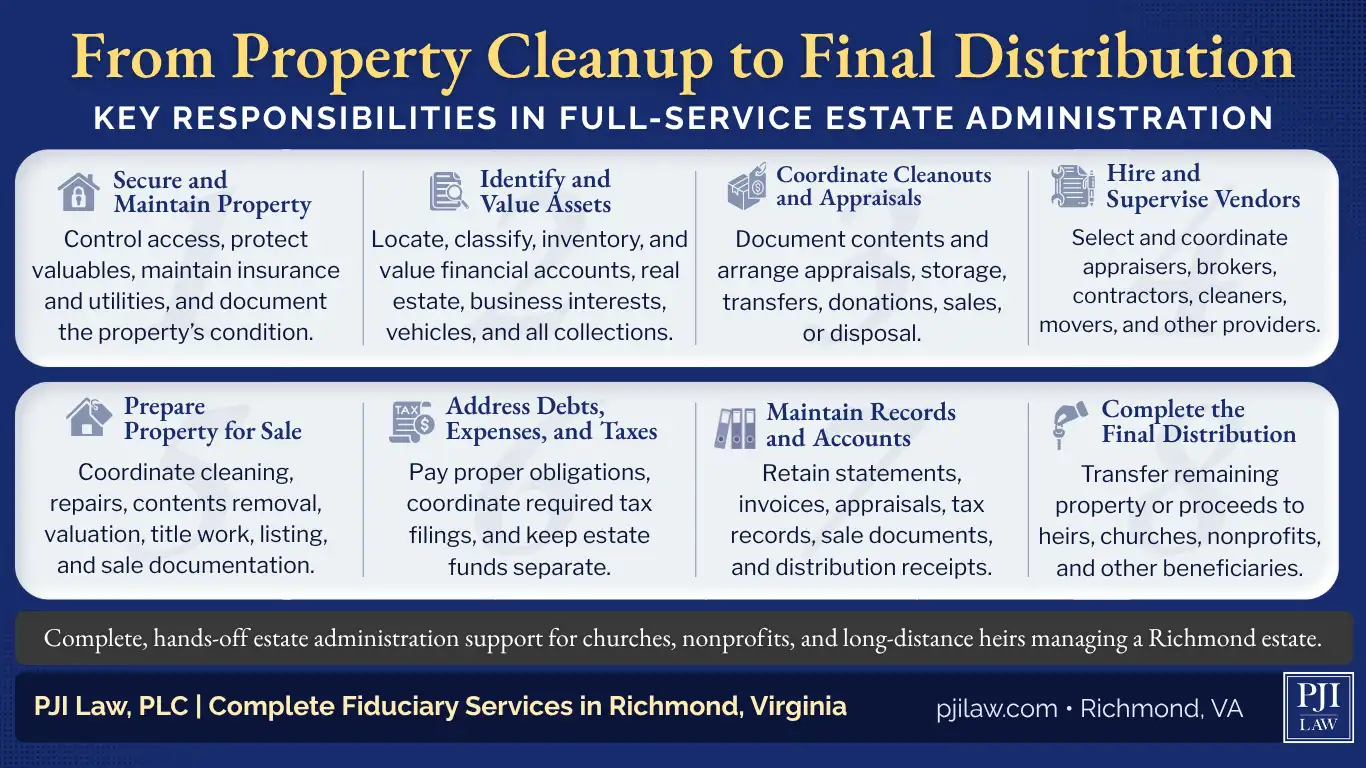
    The infographic below summarizes how these responsibilities fit together, from securing and maintaining estate property through final distribution.
    How Do Fiduciary Services Fit Into the Virginia Probate Process?

    Probate is the legal process for admitting a will, qualifying a personal representative, administering probate assets, and transferring the remaining property to beneficiaries or heirs. In Virginia, the circuit court clerk and Commissioner of Accounts oversee different parts of the administration.

    Fiduciary services can support the administration at each stage of the Virginia probate process. The scope of the engagement determines whether a qualified professional serves as the personal representative or assists a separately appointed executor or administrator with the estate’s legal, financial, and property-related responsibilities.

    A Virginia probate proceeding may include the following steps:

    1. Determine the proper jurisdiction. A will is offered for probate in the circuit court for the city or county where the decedent had a known place of residence.
    2. Locate and present the will. If the decedent left a valid will, it is presented for probate. If the decedent died intestate, an eligible person may seek appointment as administrator.
    3. Qualify the personal representative. An executor named in a will does not receive full authority merely from being named. The person must qualify, take the required oath, and provide any required bond or surety.
    4. Provide required notice. Virginia law requires the personal representative or proponent of the will to send notice to specified parties within 30 days after qualification or admission of the will to probate.
    5. Identify and secure estate assets. The personal representative identifies, collects, and protects probate assets within the scope of the appointment and determines their date-of-death values. Fiduciary services may include securing a residence, locating records, confirming insurance coverage, arranging appraisals, and coordinating the inventory of personal property.
    6. File the inventory. The inventory is ordinarily due within four months after qualification. Property documentation, account records, and appraisals provide the information needed to prepare the inventory.
    7. Address expenses, claims, and taxes. The personal representative evaluates and pays proper obligations in the legally applicable order. Fiduciary services may include maintaining financial records, organizing invoices and creditor information, coordinating tax filings, and documenting payments.
    8. File the accounting. The accounting documents receipts, expenses, sales, distributions, and property still held. Complete records of maintenance, vendors, appraisals, sales, and other transactions support the required fiduciary accounts.
    9. Distribute the remaining property. Once the estate is ready, the personal representative transfers the remaining assets to the beneficiaries or heirs. Fiduciary services can help coordinate property transfers, confirm beneficiary information, collect distribution receipts, and complete the remaining administrative work.

    Fiduciary services connect the court-supervised requirements of probate with the financial and property-related work required to complete the administration. This support can be particularly valuable when an estate contains multiple properties, closely held businesses, private investments, valuable collections, deferred maintenance, or beneficiaries who cannot manage the work locally.

    How Can Fiduciary Services Help Churches and Nonprofits?


    A gift of real estate can be valuable to a church or nonprofit while also creating immediate responsibilities. The property may have a mortgage, deferred maintenance, unpaid taxes, tenants, valuable contents, environmental concerns, or insurance issues. The organization may operate outside Virginia or lack staff familiar with Virginia probate administration.

    A vacant or deteriorating property may also present safety and insurance risks, making prompt inspection, appropriate coverage, controlled access, and necessary maintenance important while the estate is being administered.

    Before accepting or directing the handling of a gift, organizational leaders should determine:

    • What the will or trust gives the organization
    • Whether it will receive the property or the sale proceeds
    • Who has legal authority over the property
    • Whether the organization has a gift-acceptance policy
    • Who can approve the gift and sign documents
    • What debts and ongoing expenses accompany the property
    • Whether restrictions affect the property’s use or sale
    • Whether accepting the gift is consistent with the organization’s mission and internal policies

    Being named as a beneficiary does not make the church or nonprofit the personal representative. Its leaders, employees, or volunteers should not enter the property, remove belongings, hire vendors, or agree to a sale without confirming who has authority to act.

    Instead, a law firm providing fiduciary services can collect information for the organization’s decision-makers, maintain the property, coordinate appraisals and vendors, document expenses, and oversee a sale when authorized. This arrangement allows the organization to receive and evaluate the gift without assigning staff members or volunteers to manage each task in Richmond.

    How Can Long-Distance Heirs Manage a Virginia Estate?

    Living outside Virginia does not automatically prevent you from participating in estate administration or serving as a personal representative. A remote appointment can still create legal and logistical complications.

    You may be able to review documents, attend meetings, approve work, and communicate with beneficiaries electronically. Local tasks still require someone to inspect the property, meet appraisers and contractors, locate records, supervise a cleanout, monitor repairs, and coordinate a sale.

    Professional fiduciary services can reduce repeated travel while keeping you informed. A communication plan may include scheduled updates, photographs, vendor proposals, expense reports, and copies of important filings.

    Remote administration does not mean you give up every decision. The engagement should explain which decisions remain with the appointed personal representative, which responsibilities PJI Law would manage, and when additional approval is required.

    What Should You Ask Before Hiring Fiduciary Services?

    Before engaging a law firm for fiduciary services, determine whether its assistance extends beyond probate paperwork. Confirm who has legal authority to act for the estate, which decisions require the personal representative’s approval, and which responsibilities the law firm will manage.

    Churches, nonprofits, and long-distance heirs may benefit from complete, hands-off estate administration support when they lack the time, proximity, or resources to manage an estate themselves. Ask whether the services include protecting and maintaining property, coordinating cleanouts and appraisals, supervising vendors, preparing property for sale, maintaining financial records, and assisting with final distribution. If the estate includes a home, determine whether the law firm will coordinate the property and its contents or whether those responsibilities will remain with the beneficiaries or organization.

    You should also ask how vendors will be selected, how legal fees and outside expenses will be calculated, how you will receive updates, and what will happen if a dispute develops. A written scope of services establishes who will handle each responsibility and which decisions require additional approval.

    Frequently Asked Questions About Fiduciary Services

    What are professional fiduciary services for an estate?

    Professional fiduciary services provide assistance with the legal, financial, and practical responsibilities of estate administration. A qualified professional may serve as the personal representative or support a separately appointed executor or administrator. Services may include protecting property, maintaining financial records, coordinating vendors, preparing filings, overseeing sales, and completing distributions.

    Can an attorney serve as an executor or administrator in Virginia?

    An attorney may serve if properly nominated or appointed and qualified under Virginia law. Hiring an attorney to represent the estate does not automatically make that attorney the personal representative.

    Can I administer a Virginia estate if I live in another state?

    A nonresident may be able to serve, but additional qualification, bond, resident-agent, or procedural requirements may apply. The estate’s location and complexity also affect whether remote administration is practical.

    Must an out-of-state heir travel to Richmond for probate?

    Not every task requires an in-person visit. Many communications and document reviews can occur remotely. Whether you must travel depends on your role, qualification requirements, court procedures, and the condition of the estate property.

    What happens when a church or nonprofit inherits a house?

    The organization should confirm the terms of the gift, who controls the property during administration, the building’s condition, ongoing expenses, title issues, and its own gift-acceptance procedures. It can then decide whether accepting the property or receiving sale proceeds is appropriate.

    Who pays for cleanouts, appraisals, maintenance, and estate sales?

    Authorized and reasonable expenses may be paid from estate assets when they are proper administration costs. The personal representative should retain contracts, invoices, receipts, and proof of payment for the accounting.

    Can a professional fiduciary sell estate property?

    A fiduciary may sell estate property when the fiduciary has the required authority. That authority can depend on title, the will, court qualification, Virginia law, and the nature of the proposed sale.

    How long does estate administration take in Virginia?

    The timeline for estate administration depends on the property, creditor issues, taxes, required filings, disputes, and whether assets must be sold. An estate containing a house and substantial personal property can take longer than an estate holding only accessible financial accounts.

     

    Trusted Fiduciary Services for Churches, Nonprofits, and Long-Distance Heirs

    Complete Fiduciary Services from Property Cleanup to Final Distribution

    A gift left through an estate can carry deep personal meaning. A longtime member may leave a home to the church that supported them. A donor may remember a nonprofit whose work shaped their life. A relative may leave you property in Richmond while you live hundreds or thousands of miles away.

    Honoring that gift can require someone to protect the property, sort and value its contents, supervise vendors, maintain financial records, complete the probate filings, and prepare the remaining assets for distribution. Those responsibilities can quickly exceed the time and resources available to a family member or charitable organization.

    PJI Law, PLC provides complete, hands-off estate administration support for churches, nonprofits, and long-distance heirs. Our Richmond estate administration attorneys can manage the legal and practical details, including property protection, cleanouts, appraisals, sales, vendor coordination, financial records, and final distribution. Our goal is to provide peace of mind by managing the details efficiently, professionally, and respectfully while helping make sure the estate is properly administered from start to finish.

    Call (804) 653-3450 to schedule your complimentary consultation. You can also complete our confidential online form if that is more convenient.

    At PJI Law, you’ll receive white-glove service and personal attention from a team that treats you like family.

    Copyright © 2026. PJI Law, PLC. All rights reserved.

    The information in this blog post (“post”) is provided for general informational purposes only and may not reflect the current law in your jurisdiction. No information in this post should be construed as legal advice from the individual author or the law firm, nor is it intended to be a substitute for legal counsel on any subject matter. No reader of this post should act or refrain from acting based on any information included in or accessible through this post without seeking the appropriate legal or other professional advice on the particular facts and circumstances at issue from a lawyer licensed in the recipient’s state, country, or other appropriate licensing jurisdiction.

    PJI Law, PLC
    4108 E Parham Road
    Richmond, VA 23228
    (804) 653-3450
    https://www.pjilaw.com/

  • Can You Sue a Seller for Failure to Disclose Property Defects in Virginia?

    Can You Sue a Seller for Failure to Disclose Property Defects in Virginia?

    The first heavy rain after closing sends water across your new basement floor. A contractor pulls back the finished wall and finds staining, damaged framing, and signs of earlier repairs. Now you’re facing a repair estimate while trying to work out whether the seller knew and whether you have any way to recover your costs.

    A claim for failure to disclose property defects in Virginia depends on more than finding serious damage after closing. Under Virginia’s buyer-beware doctrine, buyers are expected to investigate a property’s condition before closing, including arranging inspections when appropriate. Whether you can seek compensation, pursue another legal remedy, or must bear the repair costs depends on what the seller was required to disclose, what the seller said or did, the terms of your contract, and the evidence you can gather.

    The rules also differ between a residential home purchase and a commercial real estate transaction. This blog explains both, so you can identify the questions that matter before the evidence disappears or a deadline passes.

    At a Glance

    At a Glance

    • Virginia follows a buyer-beware doctrine. A home seller does not have to provide a general list of every defect, and buyers are expected to conduct their own due diligence.
    • For a residential transaction covered by the Virginia Residential Property Disclosure Act (Act), the seller must provide the residential property disclosure statement and any other disclosures the Act requires. Some transfers are exempt, and a newly built home’s first sale has separate rules.
    • A buyer may have a claim if the seller failed to provide a required disclosure, made an actionable false statement, actively concealed a defect, or broke a promise in the purchase contract.
    • The evidence must do more than show that a defect exists. It should help establish what the seller knew, said, concealed, or agreed to do before the sale.
    • The residential disclosure law has its own remedies and deadlines. A fraud or contract claim requires a separate analysis.
    • Commercial buyers should have their purchase agreement, due diligence materials, and the seller’s written representations reviewed. The Act applies to specified residential transactions, not commercial-property sales.

    Have you purchased a home in Virginia with property defects that were not disclosed to you_

    Can You Sue a Seller for an Undisclosed Property Defect in Virginia?

    You may be able to sue, but the reason matters. A roof leak discovered after closing raises a different legal question from evidence that the seller covered water damage with new drywall or gave you a false answer about prior leaks.

    A useful first step is to identify which of these situations fits your transaction:

    What happened? What you need to investigate
    You found a defect the seller never mentioned. Did the seller have a specific duty to disclose it? Could an inspection have revealed it?
    You did not receive a disclosure required for a residential sale. Which disclosure was required, when should it have been delivered, and what loss did the omission cause?
    The seller made a statement that appears false. What exactly was said, when was it said, and what evidence shows it was false?
    The seller may have covered up the problem. Is there evidence of prior repairs, concealment, or efforts to prevent you from finding it?
    The contract promised a repair or made a statement about the property’s condition. What did the signed contract require, and was that obligation met?

    These possibilities can overlap. For example, a seller might fail to provide a required disclosure and separately make a false statement about the same property. An attorney can evaluate each possible claim against the transaction documents and available evidence.

    What Does Virginia’s Buyer-Beware Doctrine Mean?

    Virginia’s doctrine of caveat emptor, or “buyer beware,” places substantial responsibility on the buyer to investigate real property before settlement. The Virginia Residential Property Disclosure Act requires an owner in a covered residential transaction to furnish a residential property disclosure statement.

    Under Va. Code § 55.1-703, that statement tells the purchaser that the owner makes no general representations or warranties about the condition of the property or its improvements. It is not a seller-completed list of known defects. It advises the purchaser to exercise due diligence, including obtaining a home inspection under the terms of the purchase contract.

    This does not mean Virginia law requires every buyer to order a home inspection. It means an inspection is an important way to investigate before closing, subject to the rights and deadlines in the purchase agreement. Nor does buyer beware give a seller permission to make a false statement or intentionally misrepresent the property’s condition. The disclosure statute expressly preserves otherwise available remedies for an owner’s intentional or willful misrepresentation.

    What can a home inspection tell you?

    An inspection may identify visible signs of water intrusion, foundation movement, roof damage, electrical problems, or concerns with a plumbing system. Its scope depends on the inspection agreement and what the inspector could access. A finished wall, stored belongings, or a recently covered surface may keep a problem out of view.

    Review the inspection report carefully rather than assuming it either proves or defeats a claim. Did the inspector flag a stain and recommend further evaluation? Was the affected area inaccessible? Did the report identify signs that called for a structural engineer, roofer, or other contractor before settlement? Those details help show what the buyer could have discovered before closing.

    Different issues may call for different work. A standard home inspection is not a substitute for every specialized assessment, such as an evaluation of septic tanks, a mold assessment, a survey, or a structural inspection. The purchase contract determines whether the buyer had time and a contractual right to obtain those assessments before closing.

    What Must a Residential Property Seller Disclose in Virginia?

    The requirements depend on the type of sale. For a covered resale, Virginia does not impose a blanket requirement that sellers volunteer every known material defect. Instead, Virginia seller disclosure requirements combine a buyer-beware statement with specific disclosures that apply when the statutory conditions are met.

    The first sale of a newly built home follows different rules: A builder must disclose known material defects that violate an applicable building code.

    Examples include:

    • Certain pending building or zoning violations. A residential owner with the actual knowledge described in Va. Code § 55.1-706 must provide the required written disclosure. The statute is specific about the type of enforcement action or violation; an old permit question is not automatically the same thing.
    • Certain repetitive flood losses. An owner who actually knows that the dwelling is a “repetitive risk loss structure,” as defined in Va. Code § 55.1-708.2, must disclose that fact on the Real Estate Board’s form. This is a defined National Flood Insurance Program claims category, not a general requirement to recount every instance of water entering the property.
    • Location in a designated military air installation zone. When the conditions in Va. Code § 55.1-704 apply, the seller must identify the designated noise or accident potential zone on the required form.
    • Prior methamphetamine manufacturing without the required cleanup. Under Va. Code § 55.1-708, an owner who actually knows the dwelling was previously used to manufacture methamphetamine must provide written disclosure if it has not been cleaned up in accordance with the applicable requirements.

    A separate federal rule also requires disclosures about known lead-based paint and lead-based paint hazards in most housing built before 1978, along with available records and other required information. This is not a general promise that the home is free of lead-based paint.

    Other provisions may apply depending on the property. The point for a buyer is to compare the exact condition and facts discovered with the statute and the disclosures delivered in that transaction. A seller’s duty concerning a defined flood-loss designation, for example, is different from the buyer’s responsibility to investigate broader flood risk before settlement.

    When should the disclosure statement be delivered?

    Under Va. Code § 55.1-709, an owner subject to the Act is to provide notice of the required disclosures before ratification of the real estate purchase contract. If the disclosures arrive after ratification, the statute sets a limited right to terminate.

    That right can expire three days after delivery in person or electronically, or five days after the postmark if the disclosures are mailed. It may end sooner upon settlement, occupancy, a separate written waiver, or a mortgage loan application that contains the notice specified in the statute. The buyer must give the seller written notice of termination within the applicable period using a method permitted by the statute.

    If you are still under contract, do not assume that a late statement gives you an open-ended chance to cancel. Check when and how it was delivered, your contract terms, and the statutory deadline promptly.

    When Can a Seller’s Conduct Support a Fraud Claim?

    When Can a Seller’s Conduct Support a Fraud Claim

    A claim involving real estate fraud in Virginia requires more than proof that the property has a defect. To prove intentional fraud, a buyer must establish a false representation of material fact, which may include deliberate concealment, made knowingly with intent to mislead; the buyer’s reliance on it; and damage caused by that reliance. 

    A broad opinion such as “this is a great building” is different from a specific statement about a past foundation repair, recurring leak, or completed remediation. PJI Law discusses these requirements further in its article on fraudulent misrepresentation in Virginia.

    False statements about past problems or completed repairs

    A seller might tell a buyer that a roof has never leaked, that a drainage problem was repaired, or that construction was completed with the required approvals. If evidence later contradicts a material factual statement, the buyer can ask whether it supports a fraud or contract claim.

    Keep the original wording whenever possible. A listing description, email, text message, signed addendum, or contractor receipt is more useful than a later recollection that “the seller said everything was fine.” The date matters, too. A statement made before the buyer removed an inspection contingency or agreed to close may have a different effect from one made after the transaction was completed.

    Active concealment of a defect

    The buyer-beware doctrine does not give an owner a license to hide a problem or intentionally misrepresent the property’s condition. Evidence that a seller placed a temporary covering over damaged material, concealed recurring water intrusion, or interfered with an inspection deserves careful review.

    Still, a recently painted wall does not prove concealment by itself. There may be an innocent explanation, and the buyer must connect the seller’s conduct to the defect and the purchase. Virginia’s disclosure statute preserves remedies otherwise available for intentional or willful misrepresentation.

    Can a Broken Promise in the Purchase Agreement Support a Claim?

    Some disputes turn on the contract rather than a general duty to disclose. The seller may have agreed in writing to repair a drainage issue, provide documentation, or deliver the property in a stated condition. Compare the signed purchase agreement and all addenda with the work actually completed. A seller can break a contractual promise without having committed fraud; the available claim depends on the agreement and what happened.

    PJI Law’s blog about Virginia purchase agreements explains how contingencies and written terms shape a transaction. For a post-closing defect claim, the questions are narrower: What did this seller promise, what was completed, and what does the contract say about inspection, repairs, and remedies?

    Does Buying a Property “As Is” End Your Options?

    An “as is” clause is important, but it is not a complete answer without the rest of the contract and facts. It may show that the buyer accepted responsibility for investigating the property’s condition and that the seller did not agree to make repairs. It does not make a false factual statement true or erase every separately supported claim involving intentional misrepresentation.

    The details matter. Did the buyer have an inspection contingency and use it? Did the seller make a specific statement outside the general buyer-beware form? Was a defect visible or hidden? Did the contract contain representations, waivers, or limits on remedies? A lawyer needs the entire signed agreement and its addenda, not merely the page bearing the words “as is.”

    Do you need to know your rights and options after you bought or sold a property without knowing or disclosing its defective conditions_

    What Changes When the Defective Property Is Commercial?

    PJI Law also handles business and real estate disputes, so a buyer of a commercial building may face a similar financial crisis: a damaged roof interrupts operations, an undisclosed condition delays planned construction, or a structural defect changes the economics of the investment. The Virginia Residential Property Disclosure Act is directed at covered residential real estate transactions. Its residential property disclosure statement and chapter-specific termination rules should not simply be applied to a commercial purchase.

    For commercial buyers, start with the negotiated documents and the due diligence record:

    • What did the purchase agreement say about the building, improvements, environmental conditions, permits, or compliance?
    • Did the seller make written representations or warranties, and did any survive closing?
    • What reports and records did the buyer request or receive?
    • Was there an inspection period, an opportunity to obtain specialized assessments, or a procedure for notifying the seller of a problem?
    • Did the agreement limit available remedies, set notice requirements, or require a particular dispute resolution process?

    Commercial buyers should also examine whether the defect affects a tenant’s use, planned construction, financing, or the property’s value. Those consequences can affect the practical stakes and the documentation needed to evaluate damages. They do not, on their own, establish seller liability.

    How Can You Prove the Seller Knew About a Defect?

    A current contractor’s report may establish that the foundation has moved or that water has entered a wall for some time. It may not establish who knew about the condition before the sale. To bridge that gap, gather records that show the property’s history and what the seller communicated.

    Useful evidence may include:

    • Transaction documents: The signed purchase contract, addenda, disclosure forms, inspection contingency, repair agreement, listing, and closing documents.
    • Communications: Emails, texts, messages through a real estate agent, and written answers to the buyer’s questions.
    • Earlier work: Invoices, warranties, estimates, insurance correspondence, or contractor records showing prior attempts to address the same condition.
    • Official records: Permit and inspection records, notices of building or zoning violations, and other records tied to the defect. In Northern Virginia, you can start with Fairfax County’s PLUS portal, Loudoun County’s LandMARC system, or Prince William County’s ePortal, depending on where the property is located. However, an online search may not show every relevant record.
    • Condition evidence: Dated photos and videos, inspection reports, expert assessments, and photographs taken while damaged material is exposed.
    • Witness information: People with firsthand knowledge of prior leaks, repairs, or statements about the property.

    You may have some of these records already, while others may require an attorney’s investigation or formal discovery if a lawsuit is filed. Look for a timeline, not just a stack of documents. When did signs of the defect first appear? When was repair work performed? What did the seller learn? What was said to the buyer? What could the buyer’s inspector see? When was the problem discovered after closing?

    What should you do while preserving evidence?

    If the defect creates an immediate safety risk or ongoing damage, keep people away from the affected area and contact an appropriately qualified professional. Photograph the condition before emergency work when it is safe to do so, and ask what removed materials can reasonably be preserved. Do not delay necessary repairs solely to collect evidence. Keep the repair reports and invoices, and speak with a real estate dispute attorney promptly about potential claims and deadlines.

    Review any applicable homeowners or commercial property insurance policy and its notice requirements, too. Insurance coverage for the damage is a separate question from whether the seller is legally responsible.

    What Can a Buyer Recover?

    The available relief depends on the claim proved and the loss it caused. Under Va. Code § 55.1-713, a purchaser may seek actual damages when the owner fails to provide an applicable disclosure required by the residential chapter or misrepresents information required in that disclosure, and the violation causes a loss. 

    Whether the buyer can recover depends on the statute’s specific requirements and exceptions; a disclosure delivered late does not automatically establish a damages claim. The chapter also preserves other remedies that may be available for intentional or willful misrepresentation.

    In a supported fraud or contract dispute, an attorney may evaluate repair costs, a difference in property value, or other documented losses under the rules applicable to that claim. The amount spent fixing a problem is not automatically the amount a court will award. You must connect the claimed loss to actionable conduct and the proper measure of damages.

    A buyer may also ask whether the completed sale can be canceled and the property returned to the seller. That requires a separate legal analysis. Discovering a major defect does not, by itself, give the buyer the right to return the property and recover the purchase price.

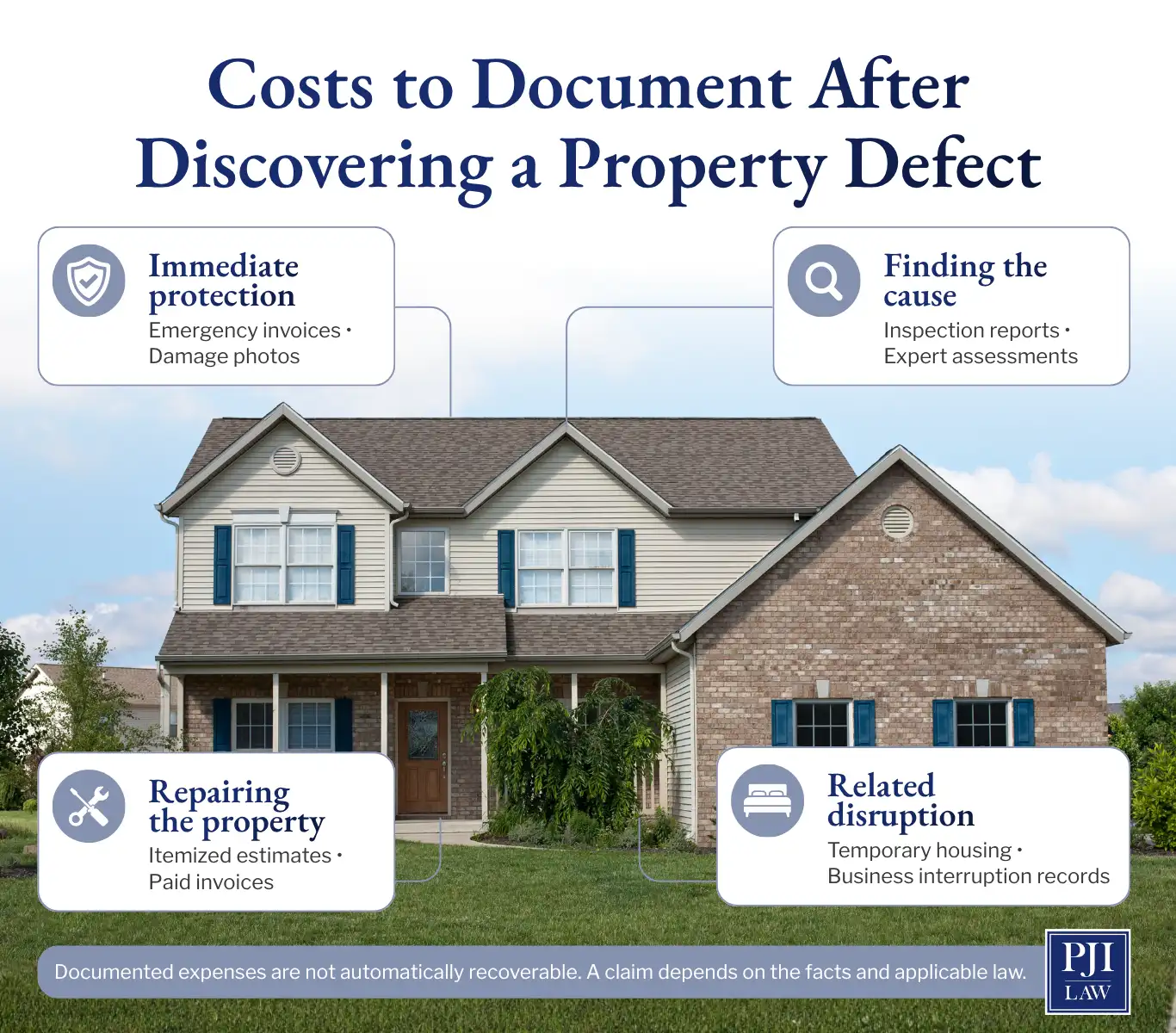
    Costs to Document After Discovering a Property Defect

    How Long Do You Have to Sue?

    The deadline depends on the claim. Do not assume you have one year from closing, or that discovering a hidden defect starts every deadline.

    • Claim under the Virginia Residential Property Disclosure Act: You generally must file within one year after receiving the required disclosure. If the required disclosure was never delivered, the one-year period runs from settlement in a sale. (Va. Code § 55.1-713)
    • Fraud claim: Virginia generally allows two years from when you discovered the fraud or reasonably should have discovered it through due diligence. (Va. Code §§ 8.01-243 and 8.01-249.)
    • Certain written-contract claims: Virginia provides five years from the breach for an action on a contract signed by the party being sued. Discovering the defect later does not, by itself, restart that period. (Va. Code § 8.01-246.)

    More than one claim may be possible, and each can have a different deadline. Have an attorney review your contract, disclosures, and the dates you learned about the problem before relying on any of these periods.

    Frequently Asked Questions

    Does a Virginia seller have to disclose every known problem with a house?

    No. Virginia’s residential disclosure statement follows the buyer-beware doctrine rather than requiring a complete inventory of property defects. Specific statutory disclosures may still be required, and a seller’s false statements or intentional misrepresentation can support a separate claim. What the seller said or did, and what the buyer can prove, are key.

    Can I sue if the home inspector missed the defect?

    Possibly, but an inspector missing a defect does not establish that the seller committed fraud. Review the inspection agreement and report, what was visible at the time, and any evidence that the seller knew about or hid the condition. Whether the inspector has a separate responsibility depends on the scope of the inspection and the inspector’s work.

    What if the seller told me a past leak had been fixed?

    Keep the seller’s exact statement and gather records of the earlier leak and repair. A new leak does not necessarily mean the seller’s statement was false when made. Evidence of recurring problems after the purported repair, prior contractor warnings, or repairs that failed before the sale may change the analysis.

    Can I sue after buying the property “as is”?

    An “as is” term can affect what condition the buyer agreed to accept and what inspections the buyer should have performed. It does not, by itself, resolve a claim based on an actionable false statement or intentional misrepresentation. The complete contract, the seller’s conduct, and the buyer’s due diligence need to be reviewed together.

    Does the one-year deadline apply to a commercial property purchase?

    The one-year action deadline discussed above comes from the Virginia Residential Property Disclosure Act. It should not be applied automatically to a commercial purchase. A commercial buyer’s potential fraud or contract claim has to be evaluated under the applicable agreement and law.

    What if the seller says they did not know about the defect?

    A defect’s existence does not prove the seller knew about it. Earlier repair invoices, contractor messages, insurance correspondence, or other records may help establish what the seller learned before the sale. A buyer should also examine any specific disclosure duty or contract promise, because the requirements depend on the claim.

    Can I cancel a purchase contract if the seller provides disclosures late?

    You may have a limited right to terminate a covered residential purchase under Va. Code § 55.1-709. The deadline can be only days after delivery and can end sooner upon certain events, including settlement. The statute requires timely written notice using a permitted delivery method, so review a late disclosure immediately.

    Can the seller’s real estate agent be responsible for an undisclosed defect?

    Possibly. A Virginia real estate agent working for the seller must not knowingly give prospective buyers false information and must disclose in writing material adverse facts about the property’s physical condition that the agent actually knows. The agent is not automatically responsible for every hidden defect. If you had your own agent, that agent’s duties to you may also need review. Keep the listing and your communications with both agents.

    What should a commercial buyer look for in the purchase agreement?

    Review the seller’s written representations and warranties, inspection and due diligence provisions, notice requirements, limits on remedies, and any terms that remain enforceable after closing. The agreement and the evidence of what the seller communicated will shape a potential claim.

    Can I recover everything I spend on repairs?

    Not automatically. Repair invoices help document your loss, but the recoverable amount depends on the claim, the proper measure of damages, and whether you can connect those costs to the seller’s actionable conduct or broken contract promise. Keep estimates, invoices, payment records, and photographs showing the work performed.

    Do you need to seek monetary recovery for expenses or losses due to an undisclosed property defect in Virginia_

    When Should You Contact PJI Law About an Undisclosed Property Defect?

    Contact a real estate dispute attorney if a serious defect has left you with a substantial repair estimate, you found evidence of earlier problems or repairs, or the seller’s statements conflict with what an inspector or contractor has uncovered. An attorney can also help if the seller denies knowing about the condition, points to an “as is” clause, or you are concerned that a filing deadline is approaching. You don’t need to obtain every record yourself before asking for a review.

    At PJI Law, PLC, our Virginia real estate dispute attorneys represent individuals and businesses. We can examine your purchase agreement, disclosures, inspection reports, communications, and repair history to identify the questions your claim turns on. When a defect requires technical evaluation, our attorneys can work with contractors, engineers, land surveyors, and other real estate professionals. We can pursue a resolution through negotiation or, when necessary, prepare the dispute for court.

    If you discovered serious defects after buying a home or commercial property in Virginia, call (703) 865-6100 or contact us online to schedule your complimentary consultation.

    At PJI Law, you’ll receive white-glove service and personal attention from a team that treats you like family.

    Copyright © 2026. PJI Law, PLC. All rights reserved.

    The information in this blog post (“post”) is provided for general informational purposes only and may not reflect the current law in your jurisdiction. No information in this post should be construed as legal advice from the individual author or the law firm, nor is it intended to be a substitute for legal counsel on any subject matter. No reader of this post should act or refrain from acting based on any information included in or accessible through this post without seeking the appropriate legal or other professional advice on the particular facts and circumstances at issue from a lawyer licensed in the recipient’s state, country, or other appropriate licensing jurisdiction.

    PJI Law, PLC
    3900 Jermantown Road, 2nd Floor
    Fairfax, VA 22030
    (703) 865-6100
    https://www.pjilaw.com

  • Understanding the New Standard for Undue Influence in Trust Contest Cases in Virginia

    Understanding the New Standard for Undue Influence in Trust Contest Cases in Virginia

    Your father’s estate plan had divided his property among his children for years. Near the end of his life, however, he changed his trust so that one family member received most of the assets. That person had also become increasingly involved in his care and finances. If you question whether the change reflected your father’s wishes, you may be considering a trust contest based on undue influence.

    Virginia changed the law governing these cases on July 1, 2026. Under the new standard, when the facts establish a presumption of undue influence, the court must presume that undue influence occurred unless the evidence shows that the deceased person actually intended the transfer reflected in the challenged trust or trust instrument.

    For beneficiaries and others involved in a trust dispute, the change can have a significant effect on how an undue influence claim is presented and defended.

    At a Glance

    • Virginia Code § 64.2-724 provides that a trust is void to the extent its creation was induced by fraud, duress, or undue influence.
    • A new law, Virginia Code § 64.2-724.1, took effect July 1, 2026, and changes how the presumption of undue influence operates in certain trust contests.
    • The new law does not create an automatic presumption of undue influence whenever someone challenges a trust.
    • Once the facts giving rise to the presumption are established, the finder of fact (the judge or jury deciding the facts of the case) must presume undue influence occurred unless the evidence shows that the deceased settlor intended the transfer in the challenged document.
    • Evidence concerning the settlor’s condition, relationships, prior wishes, and circumstances surrounding the creation or modification of the trust can become important.
    • The new standard brings Virginia trust contests more closely in line with the standard already applicable to will contests involving undue influence.

    What Is Undue Influence in a Virginia Trust Contest?

    A person who creates a trust, known as the settlor, has the right to decide how property will be managed and distributed. Those decisions do not become invalid merely because a beneficiary encouraged the settlor to make them or because other family members disagree with the choices.

    Undue influence goes further. Virginia courts have described it as influence that overcomes the person’s free will and causes the person to make a disposition they otherwise would not have made. Persuasion, advice, requests, and suggestions do not by themselves establish undue influence.

    Under Virginia Code § 64.2-724, a trust is void to the extent its creation was induced by fraud, duress, or undue influence. A trust contest can challenge the validity of a trust or, depending on the circumstances, a later trust amendment. The dispute may center on whether the document reflects the settlor’s actual intent or whether another person improperly influenced the decisions reflected in it.

    What Changed Under Virginia’s New Undue Influence Law?

    Virginia’s General Assembly enacted a new statute in 2026 that significantly changes what happens after a presumption of undue influence arises in a trust contest.

    What does the new law require?

    Effective July 1, 2026, Virginia Code § 64.2-724.1 provides that when a presumption of undue influence arises in an action contesting the validity of a trust or trust instrument created under Article 1 of Virginia’s Uniform Trust Code, the finder of fact must presume that undue influence was exerted over the deceased settlor.

    That presumption applies unless, based on all the evidence introduced at trial, the finder of fact determines that the settlor intended the property to be transferred as stated in the contested document.

    How is this different from the previous standard?

    Before the new law, Virginia followed a rule under which a presumption of undue influence shifted the burden of producing evidence. Once the party defending the document introduced evidence tending to show that the settlor acted freely, the presumption could disappear. The person challenging the document retained the ultimate burden of proving undue influence by clear and convincing evidence.

    Under the new statute, the presumption does not simply disappear because contrary evidence is introduced. The finder of fact must consider the evidence and determine whether the settlor actually intended the transfer reflected in the challenged trust or trust instrument.

    When Does a Presumption of Undue Influence Arise?

    The new statute does not mean every unusual change to a family trust creates a presumption of undue influence. The person bringing the challenge must first establish facts that give rise to the presumption.

    Virginia courts have recognized circumstances that can give rise to a presumption of undue influence. These can include evidence of a weakened mental condition together with suspicious circumstances, or circumstances involving a confidential or fiduciary relationship and improper influence over the settlor’s decision. Whether the presumption arises depends on the evidence and the legal standards established by Virginia case law.

    These issues are highly fact-specific. A close family relationship alone does not prove undue influence. Neither does advanced age.

    What could undue influence look like in a family trust?

    The surrounding circumstances can be as important as the terms of the trust itself. For example, an adult child might provide transportation, help a parent pay bills, or attend medical appointments without exerting improper influence.

    The analysis changes when evidence suggests that a vulnerable parent depended heavily on that child, the child became involved in arranging or directing changes to the estate plan that benefited the child, and the changes conflicted with wishes the parent had previously expressed.

    How Does the New Standard Affect the Burden in a Trust Contest?

    Virginia Code § 64.2-724.1 gives the presumption greater effect. Once it arises, the finder of fact must presume undue influence was exerted unless the evidence presented at trial persuades the finder of fact that the deceased settlor actually intended the property transfer described in the contested document.

    The change does not mean that someone contesting a trust automatically wins. It does, however, change the framework the judge or jury uses to evaluate the evidence after the presumption has been established.

    The change also aligns trust contests more closely with Virginia will contests. Since 2022, Virginia Code § 64.2-454.1 has applied a similar presumption when undue influence is at issue in a will contest.

    What Evidence Can Help Prove Undue Influence?

    Undue influence often occurs privately, so there may be no witness who heard someone threaten or pressure the settlor. Instead, trust litigation involving undue influence can require examining the circumstances surrounding the challenged document.

    Depending on the facts, relevant evidence may include:

    • Earlier versions of the trust and later amendments
    • Wills and other estate planning documents
    • Emails, text messages, letters, and other communications
    • Medical records concerning the settlor’s mental or physical condition
    • Statements the settlor made about intended beneficiaries
    • Evidence showing who arranged meetings concerning changes to the trust
    • Information about who communicated with the attorney preparing the document
    • Evidence concerning the settlor’s dependence on the person who benefited from the change
    • Witness testimony about the settlor’s relationships, condition, and previously expressed wishes

    A dramatic change in an estate plan does not establish undue influence on its own. However, comparing earlier documents and statements with a later trust or amendment may help establish whether the challenged transfer reflected the settlor’s actual intent.

    Preserving documents and communications can be especially important when concerns arise. Deleting messages, discarding older estate planning documents, or waiting until records become difficult to locate can make the factual investigation harder.

    How Long Do You Have to Contest a Trust in Virginia?

    The time available to bring a trust contest can depend on the type of trust and the notice you receive. Under Virginia Code § 64.2-753, a proceeding challenging the validity of a trust that was revocable at the settlor’s death must be filed by the earlier of:

    • Two years after the settlor’s death, or
    • Six months after the trustee sends you a copy of the trust instrument and notice informing you of the trust’s existence, the trustee’s name and address, and the time allowed to commence a proceeding.

    The shorter six-month period can become important when you receive the notice required by the statute from the trustee. If you have concerns about undue influence or another potential challenge to a trust, having the documents and circumstances reviewed promptly by an attorney can help determine what deadline applies to your claim.

    What Does the New Law Mean If You Want to Contest a Trust?

    If you believe a trust or amendment resulted from undue influence, the first question is not simply whether the distribution seems unfair. The issue is whether the available facts provide a legally valid basis for challenging the document.

    An attorney can examine the trust and amendments, the settlor’s earlier estate planning documents, relationships among the people involved, and evidence surrounding the disputed change. That review can help determine whether the facts may support the presumption of undue influence and what additional evidence may need to be obtained.

    The new statute can make that analysis especially important. Once the presumption arises, a key question becomes whether the evidence demonstrates that the deceased settlor actually intended the property transfer reflected in the challenged document.

    What If You Are Defending a Trust Against an Undue Influence Claim?

    The new law also affects trustees and beneficiaries defending a trust. A beneficiary may know that the settlor had valid personal reasons for changing an estate plan, even if other family members were surprised or disappointed. The settlor may have discussed those reasons with an attorney, friends, financial advisers, or other witnesses. 

    Earlier communications or other documents may also support the position that the change reflected a deliberate choice. Someone defending against an undue influence claim may need evidence showing both the settlor’s decision-making process and actual intent.

    PJI Law’s Northern Virginia trust litigation attorneys represent trustees and beneficiaries in disputes involving the validity and administration of trusts. Whether you’re bringing a trust contest or defending against one, identifying and preserving evidence early can help us evaluate the claim under Virginia’s new standard.

    Frequently Asked Questions

    What is a trust contest in Virginia?

    A trust contest is a legal challenge to the validity of a trust or trust instrument. Depending on the facts, grounds for contesting a trust may include undue influence, fraud, duress, lack of capacity, or whether the statutory requirements for creating a valid trust were satisfied.

    What is considered undue influence in a Virginia trust case?

    Undue influence involves influence that overcomes the settlor’s free will and affects the disposition of property. Courts examine the circumstances surrounding the creation or modification of the trust rather than assuming that persuasion or a close relationship constitutes undue influence.

    Does Virginia now presume every disputed trust involved undue influence?

    No. Virginia Code § 64.2-724.1 applies where a presumption of undue influence arises. The person challenging the trust must first establish facts sufficient to trigger that presumption. A disagreement over an inheritance or an unexpected distribution does not automatically do so.

    What evidence can help prove undue influence in a trust contest?

    Evidence may include prior estate planning documents, communications, medical records, witness testimony, evidence of a confidential or dependent relationship, and information showing who participated in arranging or preparing the disputed trust or amendment. The evidence needed depends on the facts of the case.

    Can you challenge a trust amendment instead of the entire trust?

    Virginia Code § 64.2-724 provides that a trust is void to the extent its creation was induced by fraud, duress, or undue influence. A dispute may concern a particular trust instrument or amendment rather than every provision of the underlying trust.

    When did Virginia’s new undue influence standard take effect?

    Virginia Code § 64.2-724.1 took effect on July 1, 2026. The statute changes the effect of a presumption of undue influence in actions contesting the validity of a trust or trust instrument covered by the law.

    Questioning a Trust or Defending One?

    A dispute over a loved one’s trust can involve much more than disagreement about an inheritance. When undue influence is alleged, the circumstances surrounding the settlor’s relationships, condition, prior wishes, and estate planning decisions can all become part of determining whether the challenged document reflects the settlor’s actual intent.

    At PJI Law, PLC, our Virginia estate litigation attorneys represent beneficiaries, trustees, and others involved in trust disputes. We can evaluate the trust documents and available evidence, explain how Virginia’s new undue influence standard may apply, and represent you in pursuing or defending a trust contest.

    If you have concerns about the validity of a trust or are facing a challenge to one, schedule your complimentary consultation by calling (703) 865-6100 or completing our confidential online form.

    At PJI Law, you’ll receive white-glove service and personal attention from a team that treats you like family.

    Copyright © 2026. PJI Law, PLC. All rights reserved.

    The information in this blog post (“post”) is provided for general informational purposes only and may not reflect the current law in your jurisdiction. No information in this post should be construed as legal advice from the individual author or the law firm, nor is it intended to be a substitute for legal counsel on any subject matter. No reader of this post should act or refrain from acting based on any information included in or accessible through this post without seeking the appropriate legal or other professional advice on the particular facts and circumstances at issue from a lawyer licensed in the recipient’s state, country, or other appropriate licensing jurisdiction.

    PJI Law, PLC
    3900 Jermantown Rd, 2nd Floor
    Fairfax, VA 22030
    (703) 865-6100
    https://www.pjilaw.com

  • Can a Trust Beneficiary Be a Trustee in Virginia?

    Can a Trust Beneficiary Be a Trustee in Virginia?

    You may rely on one of your children to handle financial matters more than anyone else in your family. That can make the person seem like a natural choice to serve as trustee. But what if that child will also inherit from the trust? Can a trust beneficiary be a trustee?

    Yes. A trust beneficiary can be a trustee in Virginia. However, Virginia law does not allow the same person to be both the sole trustee and sole beneficiary of a trust. A beneficiary who serves as trustee must also follow the trust document and comply with the fiduciary duties Virginia law imposes on trustees.

    The more important estate planning question may not be whether you can name a beneficiary as trustee, but whether that person is the right trustee for your family situation.

    At a Glance

    • Virginia law allows a beneficiary to serve as trustee, but the same person cannot be both the sole trustee and sole beneficiary.
    • A beneficiary-trustee must follow the trust document and comply with the fiduciary duties imposed on trustees.
    • Conflicts can arise when a trustee’s decisions affect their own financial interest and the interests of other beneficiaries.
    • Virginia law limits certain discretionary distributions a beneficiary-trustee can make for their own benefit.
    • Choosing the right trustee requires considering the person’s judgment, financial abilities, relationship with other beneficiaries, and the complexity of the trust assets.

    What Does Virginia Law Say About a Beneficiary Serving as Trustee?

    Virginia law does not prohibit a trust beneficiary from also serving as trustee. Family members can play more than one role in an estate plan. A parent might create a trust for three adult children, for example, while naming one of those children as successor trustee.

    However, there is an important limitation. Under Virginia Code § 64.2-720, when a trust is created, the same person cannot be both the sole trustee and sole beneficiary. However, the sole beneficiary can serve as successor trustee. The statute also requires a trust to have a definite beneficiary, subject to specified exceptions.

    The restriction reflects a basic feature of a trust: the trustee manages property subject to duties involving the beneficiary’s interest. When other beneficiaries or trustees are involved, one person may occupy both roles without eliminating that relationship.

    Whether combining the roles is advisable is a separate question. A trustee who is also a beneficiary may have to make decisions affecting their own interest and the interests of other beneficiaries.

    What Is the Difference Between a Trustee and a Trust Beneficiary?

    A trustee and beneficiary have different roles even when the same person fills both. The settlor creates the trust and establishes how its property should be managed and distributed. A trustee administers the trust. Depending on the trust document, those responsibilities can include managing and investing trust assets, maintaining records, paying appropriate expenses, making distributions, providing information to beneficiaries, and handling other administrative duties.

    A trust beneficiary is someone who has a beneficial interest in the trust. Virginia Code § 64.2-701 defines a beneficiary to include a person with a present or future, vested or contingent beneficial interest in a trust, among others.

    A beneficiary’s right to receive income or property depends on the trust’s terms and the nature of that person’s interest. Being a beneficiary does not necessarily create an immediate right to receive all trust assets.

    When a beneficiary also serves as trustee, the roles remain legally distinct. The trustee cannot disregard their administrative and fiduciary responsibilities simply because they also stand to benefit from the trust.

    What Fiduciary Duties Does a Beneficiary-Trustee Have?

    Serving as both trustee and beneficiary does not eliminate trustee fiduciary duties. Under Virginia Code § 64.2-763, a trustee must administer the trust and invest its assets in good faith, according to its terms and purposes, the interests of its beneficiaries, and applicable law.

    Other important duties include:

    • Loyalty: Virginia Code § 64.2-764 requires a trustee to administer the trust solely in the interests of the beneficiaries.
    • Impartiality: When a trust has two or more beneficiaries, § 64.2-765 requires the trustee to act impartially in investing, managing, and distributing trust property while giving due regard to their respective interests.
    • Prudent administration: A trustee must exercise reasonable care, skill, and caution while considering the trust’s purposes, terms, distribution requirements, and circumstances.
    • Protecting trust property: Trustees have responsibilities involving control and protection of trust property.
    • Recordkeeping: Trustees must maintain adequate records and keep trust property separate from their own property.

    These duties are especially important when a trustee is also a beneficiary. For example, if three siblings are beneficiaries and one serves as trustee, that sibling cannot manage the trust solely to increase their own inheritance or disregard the interests created for the others.

    However, acting impartially does not necessarily require identical distributions. The trust document may create different rights among beneficiaries. The trustee must follow those terms while giving appropriate regard to each beneficiary’s interest.

    Can a Trustee Make Trust Distributions to Themselves?

    A beneficiary serving as trustee does not automatically lose the ability to receive distributions. The trustee’s authority depends on the trust document and Virginia law. Virginia Code § 64.2-776 specifically addresses a person other than the settlor who is both beneficiary and trustee and has discretionary authority to make distributions for their own personal benefit. 

    Subject to the exceptions in the statute and the trust’s terms, that authority is limited to an ascertainable standard. Virginia law defines an ascertainable standard by reference to an individual’s health, education, support, or maintenance under applicable federal tax law.

    This restriction is important when drafting a trust. Giving a beneficiary-trustee overly broad discretion to distribute trust funds to themselves can create fiduciary and tax issues. Clear distribution provisions can define the trustee’s authority and reduce uncertainty about when distributions are permitted.

    What Problems Can Arise When a Beneficiary Is Also Trustee?

    Naming a beneficiary as trustee can work well when the person is responsible, understands your wishes, and has a good relationship with other beneficiaries. The dual role can also create conflicts that should be considered during estate planning.

    Conflicts of interest and self dealing

    A beneficiary-trustee may have to make decisions that affect their own financial interest. For example, the trustee may need to approve expenses, make investments, or decide whether a discretionary distribution is appropriate.

    Virginia’s duty of loyalty addresses transactions affected by conflicts between a trustee’s fiduciary and personal interests. A trustee also cannot treat trust property as personal property simply because they are a beneficiary. Trust funds and personal funds should remain separate, and transactions involving trust property should be properly documented.

    Disputes among family members

    Family dynamics can make trust administration more difficult. A sibling may question why the sibling serving as trustee made a particular investment, incurred an expense, delayed a distribution, or interpreted the trust document in a particular way.

    Disagreement does not necessarily mean the trustee breached a duty. However, recordkeeping and communication become especially important when the trustee also has a financial interest in the trust.

    Discretion over distributions

    Broad discretion can also lead to disputes. Other beneficiaries may question whether a trustee-beneficiary is using that discretion according to the trust or favoring their own interests. Clear, objective distribution provisions can give trustees more direction and reduce uncertainty.

    What Information Must a Trustee Provide to Beneficiaries?

    Virginia Code § 64.2-775 requires trustees to keep qualified beneficiaries reasonably informed about trust administration and material facts necessary to protect their interests. Unless unreasonable under the circumstances, a trustee must also promptly respond to a beneficiary’s request for information related to administration.

    The statute creates additional reporting requirements for applicable trusts. Beneficiaries may have rights to request a copy of the trust instrument, and trustees may be required to provide reports describing trust property, liabilities, receipts, disbursements, trustee compensation, and assets. Section 64.2-775(C) requires at least annual reports for specified beneficiaries, subject to the statute’s applicability provisions and certain waiver rights.

    Complete records can protect beneficiaries while also helping trustees show that they administered the trust according to its terms and Virginia law.

    What Are the Benefits of Naming a Beneficiary as Trustee?

    Potential conflicts do not mean a beneficiary is necessarily a poor trustee choice. A family member may already understand your property, wishes, and beneficiaries’ circumstances. When considering how to choose a trustee, look beyond the person’s relationship to you. The right trustee should be able and willing to:

    • Exercise sound financial judgment
    • Maintain careful records
    • Follow the trust document
    • Communicate with beneficiaries
    • Devote sufficient time to administrative responsibilities
    • Obtain professional guidance when necessary
    • Separate personal interests from fiduciary responsibilities

    The decision should focus on the responsibilities the trustee will actually face rather than simply choosing the oldest child, closest family member, or person who lives nearby.

    How Do You Choose the Right Trustee?

    The trustee may eventually manage substantial assets and make decisions affecting your family for years. Consider what your particular trust will require. For example, a trust holding financial accounts for adult beneficiaries may require different skills than a long-term irrevocable trust containing real estate, business interests, or complicated investments. A trust giving the trustee significant discretion over distributions can also require considerable judgment.

    Family relationships also deserve attention. If siblings have a history of serious disputes, placing one in control of another’s inheritance may create unnecessary conflict even if that person is financially capable.

    Depending on your estate planning needs, you might name one family member, co-trustees, another trusted person who is not a beneficiary, or a qualified institution. Co-trustees can provide additional oversight, but disagreement between them can also interfere with administration.

    A Virginia trust attorney can help you evaluate the duties created by your proposed trust and whether the person you have in mind is suited to carry them out.

    What Can Beneficiaries Do If a Trustee Misuses Their Position?

    Trust beneficiary rights include legal protections when a trustee fails to perform required duties. Under Virginia Code § 64.2-759, a beneficiary may petition the court to remove a trustee. Grounds can include a serious breach of trust, persistent failure to administer the trust effectively, and other circumstances specified by law.

    Virginia law also provides remedies for breach of trust. Under § 64.2-792, a court may, depending on the circumstances, compel performance or an accounting, suspend or remove a trustee, require restoration of property or payment of money, reduce or deny compensation, or provide other appropriate relief.

    A disagreement with a trustee does not by itself establish a breach. The trust document, trustee’s conduct, beneficiaries’ rights, and applicable law determine what legal options may be available.

    Frequently Asked Questions

    Can the sole beneficiary of a trust also be the sole trustee in Virginia?

    A trust cannot be created with the same person serving as both the sole trustee and sole beneficiary. However, the sole beneficiary can serve as successor trustee. Virginia Code § 64.2-720 establishes the requirements for creating a valid trust.

    Can my child be both trustee and beneficiary of my trust?

    Yes. Virginia law allows a child or other family member to serve as trustee while also being a beneficiary, provided the trust satisfies Virginia’s requirements. Whether the arrangement makes sense depends on the person’s abilities, trust terms, other beneficiaries, and potential conflicts.

    Can siblings be trustees and beneficiaries of the same trust?

    Yes. A trust may have multiple trustees and beneficiaries. Before naming siblings as co-trustees, consider whether they can make decisions together and effectively manage the trust.

    Can a trustee distribute trust money to themselves?

    A trustee who is also a beneficiary may receive distributions when authorized by the trust and applicable law. Virginia Code § 64.2-776 places specific limits on certain discretionary distributions a beneficiary-trustee can make for their own benefit.

    Does a beneficiary-trustee have to treat all beneficiaries equally?

    Virginia law requires a trustee of a trust with two or more beneficiaries to act impartially while giving due regard to their respective interests. The trustee must also follow the rights and distribution provisions created by the trust document.

    Can a beneficiary-trustee be paid for serving as trustee?

    Virginia law permits trustees to receive compensation. The amount may be governed by the trust terms or, when the trust does not specify compensation, applicable Virginia law. Being a beneficiary does not necessarily prevent the person from receiving trustee compensation.

    Can a beneficiary have a trustee removed?

    A beneficiary may petition a Virginia court for removal under § 64.2-759. The court may remove a trustee on statutory grounds, including a serious breach of trust or persistent failure to administer the trust effectively.

    Can a beneficiary be the successor trustee of a revocable trust?

    Yes. A settlor can name a beneficiary as successor trustee, subject to the trust’s terms and Virginia law. The proposed successor should be capable of handling the administrative and fiduciary responsibilities involved.

    Is it better to name a family member or an independent trustee?

    Neither choice is appropriate for every trust. A family member may know your wishes and beneficiaries well, while an independent trustee may be useful when family conflict, complicated assets, or impartiality concerns could make administration more difficult.

    Should I name more than one trustee?

    Co-trustees can provide shared decision-making and oversight, but they can also complicate administration. Consider whether the proposed trustees can work together and how the trust document addresses decision-making and disagreements.

    Planning Who Will Manage Your Trust? PJI Law Can Help

    Choosing a trustee involves more than naming someone you trust personally. That person may eventually manage investments and other property, make distributions, maintain records, communicate with beneficiaries, and carry out instructions affecting your family for years. When a trustee will also be a beneficiary, careful planning can define that person’s authority and address potential conflicts before administration begins.

    At PJI Law, PLC, our Virginia trust attorneys help individuals and families create trusts based on their assets, beneficiaries, family circumstances, and estate planning needs. We can help you consider who should serve as trustee and establish distribution provisions that reflect your wishes.

    If you have questions about creating or updating a trust, schedule your complimentary consultation by calling (703) 865-6100 or completing our confidential online form.

    At PJI Law, you’ll receive white-glove service and personal attention from a team that treats you like family.

    Copyright © 2026. PJI Law, PLC. All rights reserved.

    The information in this blog post (“post”) is provided for general informational purposes only and may not reflect the current law in your jurisdiction. No information in this post should be construed as legal advice from the individual author or the law firm, nor is it intended to be a substitute for legal counsel on any subject matter. No reader of this post should act or refrain from acting based on any information included in or accessible through this post without seeking the appropriate legal or other professional advice on the particular facts and circumstances at issue from a lawyer licensed in the recipient’s state, country, or other appropriate licensing jurisdiction.

    PJI Law, PLC
    3900 Jermantown Rd, 2nd Floor
    Fairfax, VA 22030
    (703) 865-6100
    https://www.pjilaw.com

  • What Are the Legal Implications of Terminating a Contract Due to Breach in Virginia?

    What Are the Legal Implications of Terminating a Contract Due to Breach in Virginia?

    A vendor has repeatedly failed to deliver what your agreement requires. A customer has stopped making payments. A service provider has missed an important deadline and put your own business commitments at risk. At some point, you may decide you’ve had enough and want to end the relationship.

    But terminating a contract because the other party breached it isn’t always as simple as sending a notice that you’re done. Whether you have the right to terminate can depend on the seriousness of the breach, the contract’s terms, which party failed to perform first, and whether notice or an opportunity to correct the problem is required.

    Before ending the agreement, it’s important to know whether the breach gives you a legal basis to stop your own performance and what obligations or claims could remain afterward.

    At a Glance

    • Not every breach necessarily gives the other party the right to terminate a contract.
    • Under Virginia law, a material breach may excuse the non-breaching party from further performance.
    • Your contract may establish specific grounds for termination and require notice or an opportunity to cure a breach.
    • Terminating without sufficient contractual or legal grounds could expose you to a breach of contract claim.
    • Ending the contract doesn’t necessarily eliminate claims arising from an earlier breach or obligations intended to survive termination.

    When Can You Terminate a Contract Due to Breach in Virginia?

    A breach of contract occurs when a party fails to perform an obligation required by a valid contract without a legal excuse. However, the existence of a breach doesn’t necessarily mean the aggrieved party can immediately end the agreement.

    The first place to look is the contract itself. Well-drafted written contracts often include provisions identifying events that constitute default, circumstances allowing termination, notice requirements, and whether the party that breached must receive a reasonable time to correct the problem.

    Virginia common law can also affect whether a party’s own performance remains required following a breach. Virginia courts apply the first material breach doctrine, which can prevent a party that materially breached an agreement first from enforcing the contract against the other party. A 2026 Virginia Court of Appeals decision examining the doctrine explained that a breach must go to the “root of the contract” rather than involve only a minor part of the agreement to qualify as a first material breach.

    That distinction is important because ending a contract over a minor problem may have very different legal implications from terminating after the other party has failed to perform a central obligation.

    How Do You Know Whether a Breach Is Material?

    A material breach goes to the heart of what the parties agreed to do. Rather than focusing only on whether a contract term was violated, the analysis considers the significance of that failure to the agreement as a whole.

    Suppose a business hires a vendor to provide an essential component by a specific date so the business can fulfill a major customer order. The vendor’s complete failure to deliver may affect the central purpose of the contract. A brief delay involving something that has little effect on the value of the promised performance could present a different situation.

    Whether a breach is material depends on the contract and circumstances. The size of the financial loss isn’t necessarily the only issue. Courts can examine the nature of the obligation, the extent of the failure to perform, and how that failure affected what the parties expected to receive from the agreement.

    This is one reason businesses should be cautious about assuming that any violation of a contract’s terms permits termination.

    Why Does the First Material Breach Affect Your Right to Stop Performing?

    When contract disputes develop, both parties sometimes accuse the other of failing to comply with the agreement. Virginia’s first material breach rule can make the sequence of events significant. A party that committed the first material breach may not be able to rely on a later failure by the other party to perform its contractual obligations.

    Consider a company that stops making required payments because it believes a service provider has breached the agreement. If the provider’s earlier failure was material, the company may have grounds for refusing further performance. But if that earlier problem wasn’t a material breach, stopping payment could create a new breach by the company.

    The question therefore isn’t simply whether the other party breached the contract. It may also be necessary to determine:

    • What obligation did each party have?
    • Which failure occurred first?
    • Was that failure material?
    • Had the other party substantially performed?
    • Did later conduct affect either party’s rights?

    Those questions can become especially important before a business takes an irreversible step based on its interpretation of the agreement.

    What Should You Review Before Terminating a Contract?

    Even when the other party’s failure appears significant, review the agreement carefully before sending a termination notice or stopping your own performance.

    Grounds for Termination

    A termination clause may identify specific circumstances that allow one party to end the agreement. Some contracts permit termination for a defined breach, while others contain broader termination-for-convenience provisions that allow a party to exit without alleging wrongdoing if specified conditions are satisfied.

    The contract may also end automatically after a stated period or event. Don’t assume that a contract permits termination simply because a dispute has developed. Identify the provision you intend to rely upon and determine whether the circumstances satisfy it.

    Notice Requirements

    The agreement may require written notice before termination becomes effective. It may specify what the notice must contain, how it must be delivered, who must receive it, and how much advance notice is required.

    An informal email or telephone conversation may not comply with a provision requiring notice in writing to a particular person or address.

    An Opportunity to Cure

    Some agreements give the party that breached a specific period to correct the problem before the other party can terminate.

    For example, a contract might require written notice of non-performance followed by 10 or 30 days to cure. Attempting contract termination before that period expires could create a dispute about whether the termination complied with the agreement.

    Your Own Performance

    Before accusing the other party of breach, examine whether you have satisfied your own contractual obligations.

    Payment records, invoices, delivery documentation, correspondence, project records, and other evidence can help establish what each party was required to do and what actually occurred.

    Waiver and Acceptance of Performance

    Your conduct after learning about a breach can also become relevant. For example, repeatedly accepting performance that doesn’t comply with the agreement without objecting may lead to arguments about whether you waived strict compliance with a particular requirement. Because waiver is highly dependent on the facts and the parties’ conduct, businesses should be deliberate about how they respond when potential breaches occur.

    What If the Other Party Says It Won’t Perform?

    You don’t necessarily have to wait until a future deadline passes to address every potential breach. Anticipatory repudiation can arise when a party clearly indicates that it won’t perform future contractual obligations. The Supreme Court of Virginia has recognized that repudiation of future duties may constitute an anticipatory breach, including in some circumstances after performance under a continuing contract has already begun.

    A disagreement, concern about future performance, or ambiguous statement isn’t necessarily enough. Whether conduct amounts to repudiation depends on what was communicated and the circumstances surrounding it.

    If the other party tells you it will no longer perform, preserve that communication and obtain legal guidance before deciding whether to stop your own performance or terminate the agreement.

    What Can Happen If You Terminate a Contract Without Sufficient Grounds?

    Wrongful termination can turn the party claiming a breach into a party defending against one. If your contract doesn’t permit termination under the circumstances and the other party’s conduct wasn’t sufficient to excuse your continued performance, ending the agreement could expose you to claims for damages caused by your failure to perform.

    Depending on the agreement and circumstances, a dispute could involve:

    • Lost payments or other compensatory damages
    • Enforceable liquidated damages provisions
    • Costs associated with replacing promised goods or services
    • Attorney fees when recoverable under the contract or applicable law
    • Claims concerning property, confidential information, or unfinished work
    • Arbitration or litigation over which party breached first

    The legal consequences of a breach of contract depend heavily on the agreement and the losses that can be proven. Reviewing your legal options before terminating can help you compare the risks of ending the relationship with other potential ways to address the dispute.

    What Happens to Your Obligations After the Contract Ends?

    Terminating a contract doesn’t always mean every contractual obligation immediately disappears. The agreement may expressly provide that certain clauses survive termination. Depending on the contract, these could include confidentiality requirements, indemnification provisions, payment obligations that have already accrued, intellectual property restrictions, dispute-resolution procedures, or other continuing duties. Rights arising from an earlier breach may also survive.

    Contracts for the sale of goods are subject to additional rules under Virginia’s Uniform Commercial Code (UCC). The UCC distinguishes between “termination,” which ends a contract other than for breach, and “cancellation” based on the other party’s breach. It also provides that cancellation or rescission ordinarily doesn’t eliminate a damages claim for an earlier breach unless the parties clearly intended otherwise.

    The rules governing your agreement therefore depend partly on the type of contract involved. A contract for the sale of goods may be governed by different statutory provisions than an agreement primarily involving services.

    What Should You Do Before Sending a Termination Notice?

    If you believe the other party has breached your agreement, acting quickly may be necessary, but that doesn’t mean acting without first evaluating your position.

    Before terminating the contract:

    1. Review the complete agreement. Include amendments, addenda, statements of work, and other documents that may modify the original terms.
    2. Identify the specific breach. Determine exactly which contractual obligation the other party failed to perform.
    3. Document the timeline. Preserve correspondence, invoices, payment records, delivery information, and other evidence showing what occurred and when.
    4. Check termination procedures. Identify any notice requirements, cure periods, deadlines, or required methods of delivery.
    5. Evaluate your own performance. Determine whether you complied with your obligations and whether the other party could claim that you breached first.
    6. Assess the financial impact. Document losses associated with the breach and expenses you may incur if the agreement ends.
    7. Identify continuing obligations. Determine which provisions remain effective after termination.
    8. Evaluate your legal options. Termination may be appropriate, but negotiation, a demand for performance, damages, or another remedy may better serve your business objectives.

    A contract dispute attorney can review both the language of the agreement and the parties’ conduct before you take action that may be difficult to reverse.

    Frequently Asked Questions

    Does every breach of contract allow termination in Virginia?

    A breach may violate a legally binding contract without being serious enough to excuse the other party from further performance. The contract’s termination provisions and whether the breach is material can affect your rights.

    What is considered a material breach of contract in Virginia?

    A material breach of contract involves a failure to perform an obligation that is central to the agreement rather than a minor or technical failure. Whether a particular breach is material depends on the contract and the circumstances.

    Do I have to give the other party a chance to fix a breach before terminating?

    It depends on the contract and the law governing the agreement. Some contracts contain cure provisions requiring notice and a specified opportunity to correct a breach before termination. Review the contract’s terms before proceeding.

    Can I recover damages after terminating a contract?

    Potentially. Ending the contractual relationship doesn’t necessarily eliminate claims for damages caused by a breach that occurred before termination. The available breach of contract remedies depend on the agreement, applicable law, and losses involved.

    What happens if I terminate a contract and the other party’s breach wasn’t material?

    If you lacked a contractual or legal basis for terminating, the other party may claim that your refusal to continue performing was itself a breach. That can lead to a dispute over which party failed to comply with the agreement and whether either party suffered damages.

    Can I terminate a contract if the other party says it won’t perform?

    Under Virginia law, anticipatory repudiation may occur when a party clearly indicates that it won’t perform its future contractual obligations. However, not every disagreement or statement about future performance amounts to repudiation. Before terminating the contract or stopping your own performance, consider whether the other party’s words or conduct provide a sufficient legal basis for doing so.

    Does a contract termination notice have to be in writing in Virginia?

    Not in every situation, but many written contracts specify how notice must be provided. Your agreement may require written notice, delivery to a particular person or address, or a specific method of delivery. Following the contract’s notice provisions can help avoid a later dispute over whether termination was effective.

    Can a contract be terminated if both parties agree?

    Parties can agree to end a contract early even when the original agreement doesn’t otherwise provide grounds for termination at that time. A written termination agreement can document the effective date, remaining payment obligations, treatment of pending work, releases, and any provisions that will continue after the relationship ends.

    What is the difference between terminating a contract for cause and for convenience?

    Termination for cause is based on a reason recognized by the contract, such as a specified default or breach. A termination-for-convenience clause allows a party to end the agreement without proving that the other party breached it, provided the requirements of the clause are satisfied. Not every contract permits termination for convenience.

    Should I have an attorney review a contract before sending a termination notice?

    While an attorney isn’t required to send every termination notice, legal review can be particularly helpful when significant money, disputed performance, or continuing obligations are involved. A contract dispute attorney can evaluate the grounds for termination, notice and cure requirements, each party’s performance, and potential liability before you take action that could lead to additional claims or litigation.

    Before Ending a Contract, Know What the Agreement and Virginia Law Allow

    When another party’s failure is costing your business money or interfering with operations, terminating the relationship may seem like the most practical response. But the decision can carry significant legal and financial consequences. The language of the agreement, materiality of the breach, sequence of the parties’ performance, notice requirements, and potential damages can all affect what you should do next.

    The Northern Virginia contract dispute attorneys at PJI Law, PLC help individuals and businesses evaluate contract disputes before and after a business relationship breaks down. Our attorneys can review the agreement and surrounding communications, assess the alleged breach and termination provisions, and help you determine whether termination, negotiation, litigation, or another approach aligns with your legal and business objectives.

    PJI Law provides personalized attention and strategic counsel based on the circumstances of each dispute. If you’re considering terminating a contract because the other party failed to perform, call (703) 865-6100 or contact us online to schedule your complimentary consultation.

    At PJI Law, you’ll receive white-glove service and personal attention from a team that treats you like family.

    Copyright © 2026. PJI Law, PLC. All rights reserved.

    The information in this blog post (“post”) is provided for general informational purposes only and may not reflect the current law in your jurisdiction. No information in this post should be construed as legal advice from the individual author or the law firm, nor is it intended to be a substitute for legal counsel on any subject matter. No reader of this post should act or refrain from acting based on any information included in or accessible through this post without seeking the appropriate legal or other professional advice on the particular facts and circumstances at issue from a lawyer licensed in the recipient’s state, country, or other appropriate licensing jurisdiction.

    PJI Law, PLC
    3900 Jermantown Road, 2nd Floor
    Fairfax, VA 22030
    (703) 865-6100
    https://www.pjilaw.com

  • What Does the “Discovery Process” Mean in a Civil Suit in VA and Why Does It Take So Long?

    What Does the “Discovery Process” Mean in a Civil Suit in VA and Why Does It Take So Long?

    You’ve been served with a summons and complaint in a Virginia civil lawsuit. After responding, you may receive written questions, requests for documents, and notices that require you to provide information about the dispute. Or perhaps you’re considering filing a lawsuit and have heard that the case could spend months in something called “discovery.” Why can this stage take so long, and what happens during all that time?

    The discovery process is where each side formally gathers information and evidence about a civil dispute before trial. What can look like inactivity from the outside may involve attorneys reviewing documents, questioning witnesses, obtaining third-party records, addressing objections, and following up on new information.

    Discovery can also change how the parties view a case. An email that appears damaging on its own may have a different meaning when the entire conversation is produced. A witness who seemed certain about what happened may give different testimony under oath. Financial records may support or contradict a claim for damages.

    Whether you’re considering bringing a lawsuit, have recently been sued, or are trying to determine what comes next in a Virginia civil dispute, knowing what discovery involves can help you make more informed decisions about litigation.

    At a Glance

    At a Glance

    • Discovery is the formal process parties use to obtain information and evidence before trial.
    • Virginia discovery methods include interrogatories, requests for documents, requests for admission, and depositions.
    • Parties can seek relevant, nonprivileged information within the scope permitted by Virginia’s discovery rules.
    • Emails, texts, photographs, business files, and other electronic information may be discoverable.
    • Discovery can take months when a case involves extensive records, numerous witnesses, third parties, experts, or disputes over what must be disclosed.
    • Failing to comply with discovery obligations can lead to court intervention and, in some circumstances, sanctions.
    • What the parties learn during discovery can affect settlement discussions, mediation, and preparation for trial.

    What Is the Discovery Process in a Virginia Civil Lawsuit?

    The discovery process is the pretrial procedure through which parties obtain information relevant to a lawsuit. In Virginia circuit courts, discovery is governed primarily by Part Four of the Rules of the Supreme Court of Virginia.

    Virginia Rule 4:1 identifies discovery methods that include depositions upon oral examination or written questions, interrogatories, requests for production of documents and electronically-stored information, physical and mental examinations, and requests for admission.

    Discovery serves a practical purpose. A civil trial isn’t supposed to be the first time one side learns about the evidence supporting the other side’s claims or defenses.

    Consider a homeowner who is thinking about suing a contractor after discovering extensive defects in a renovation. The homeowner may have photographs, repair estimates, invoices, text messages, and an inspection report. The contractor may have subcontractor records, change orders, emails, photographs, and witnesses who dispute the homeowner’s account.

    If litigation begins, discovery gives both sides a formal way to obtain relevant information before trial. It also illustrates why even a dispute that initially appears straightforward can require considerable time and work once civil litigation begins.

    "Civil

    What Information Can the Other Side Obtain During Discovery?

    Virginia Rule 4:1 permits discovery concerning nonprivileged information relevant to the subject matter of the pending action. Information doesn’t necessarily have to be admissible at trial to fall within the permitted scope of discovery.

    Depending on the civil matters involved, discoverable information could include:

    • Contracts and amendments
    • Emails and text messages
    • Financial and accounting records
    • Photographs and videos
    • Invoices and receipts
    • Property and business records
    • Communications between the parties
    • Information about potential witnesses
    • Electronic files and other electronically stored information
    • Relevant records held by third parties

    That doesn’t mean the other party is entitled to every document or piece of personal information you possess. Privilege and other protections can apply. Rule 4:1 also permits courts to limit discovery that is unreasonably cumulative or duplicative, obtainable from a more convenient or less burdensome source, or unduly burdensome or expensive under the circumstances.

    For example, if one party demands years of unrelated personal financial information in a dispute involving a single real estate transaction, a lawyer can evaluate whether an objection or request for court protection is appropriate.

    If you’ve received discovery requests, don’t decide on your own what to disclose, delete, or withhold. A civil litigation attorney can review the requests and help determine how to respond.

    Seeking a civil litigation attorney to pursue a civil lawsuit in Virginia_

    What Are the Main Types of Discovery in Virginia?

    Different discovery methods serve different purposes. Some require written answers, others seek documents or electronic information, and depositions allow attorneys to question witnesses and parties under oath.

    Interrogatories

    Interrogatories are written questions one party serves on another party. The responding person must answer separately and fully in writing under oath unless an objection applies.

    Under Virginia Rule 4:8(g), a party may not serve more than 30 interrogatories, including parts and subparts, on another party without leave of court for good cause.

    Interrogatories can ask a party to identify witnesses, explain the factual basis for a claim or defense, identify documents, or provide information about alleged damages. An answer may also uncover information that leads to additional discovery.

    Requests for Production

    Requests for production allow one party to seek documents, electronically-stored information, tangible items, or access to property within the scope of discovery.

    Business-related civil litigation can involve years of records and communications. Suppose a company alleges that a former business partner breached a contract after a four-year relationship. Relevant information could be scattered across employee email accounts, shared folders, invoices, contracts, accounting systems, texts, and archived files.

    Finding the material is only part of the process. Attorneys may also need to determine which materials must be produced in response to the requests, identify privileged communications, address objections, organize the production, and review what the other side produces.

    This electronically-stored information, often called ESI, can be one reason discovery becomes time-consuming in document-heavy disputes.

    Requests for Admission

    Requests for admission ask another party to admit or deny specific facts or the genuineness of documents. They can narrow the issues that actually need to be proven at trial.

    For example, two individuals in a property dispute might disagree about representations made before a sale but agree that they signed a particular contract on a certain date. Admissions can establish facts that aren’t genuinely disputed so the parties and court can focus on the issues that remain.

    Depositions

    A deposition is sworn testimony taken outside the courtroom as part of discovery. During oral depositions, attorneys ask oral questions and a court reporter creates a record of the testimony. The person being questioned might be a party, company representative, employee, contractor, fact witness, or expert.

    Depositions allow attorneys to learn what witnesses know and how they describe events under oath. Virginia’s rules also permit depositions upon written questions, but oral depositions allow attorneys to ask follow-up questions based on a witness’s testimony.

    Sometimes that testimony reveals a new person, document, or event that leads to additional discovery.

    What Happens During Discovery in a Virginia Civil Lawsuit_

    Why Does the Discovery Process Take So Long?

    There is no single amount of time discovery takes in every Virginia lawsuit. A focused dispute involving a few documents and witnesses is very different from litigation involving years of business records, electronic evidence, experts, and multiple contested issues. Several factors can slow the process.

    Electronic Evidence Can Take Time to Find and Review

    Imagine being asked to locate relevant emails exchanged by five employees over four years. The information may exist in different accounts and systems. Attorneys may need to determine which documents respond to the requests, identify privileged material, and organize large quantities of information before producing it.

    One Discovery Response Can Lead to Another

    Discovery isn’t always a single exchange. An interrogatory might identify a previously unknown witness. That witness’s deposition could reveal new communications. Those communications might lead to records held by a third party. What attorneys learn can affect what they need to investigate next.

    Depositions Require Coordination and Preparation

    A deposition can involve the witness, attorneys, a court reporter, and sometimes other participants. Coordinating schedules can become difficult when a case has numerous witnesses.

    Attorneys also need time to prepare by reviewing pleadings, discovery responses, emails, contracts, photographs, financial records, or other evidence before asking questions.

    Third Parties May Have Important Evidence

    A bank, former employee, accountant, contractor, property manager, or other nonparty may possess information relevant to the case.

    Subpoenas can be used in appropriate circumstances to require witnesses to appear or nonparties to provide documents. Obtaining that information adds another step to discovery.

    The Parties May Disagree About What Must Be Disclosed

    Discovery can stall when the parties disagree about whether information must be produced. One side may argue that a request is irrelevant or overly burdensome. There may also be disputes about privilege, missing documents, incomplete answers, or the scope of a deposition.

    When the attorneys cannot address the issue without court involvement, a party may seek an order compelling discovery or other relief under Rule 4:12.

    Some Cases Require Experts

    Certain disputes require expert analysis. A construction case might involve opinions about defects or repair costs, while a business dispute could involve accounting or valuation questions.

    Expert involvement can add reports, information requests, testimony, and additional preparation to the discovery process.

    Do you need a civil litigation attorney to guide your strategy and pursue evidence for a civil lawsuit in Virginia_

    What Happens If Someone Doesn’t Cooperate With Discovery?

    A party can’t simply ignore valid discovery obligations because responding is inconvenient or because the information might hurt that party’s position. Virginia Rule 4:12 provides procedures for seeking orders compelling discovery and authorizes sanctions in circumstances covered by the rule.

    However, refusing discovery isn’t the same as making a legally supported objection. A request may implicate privilege, exceed the permissible scope of discovery, or warrant a protective order.

    If you’re handling a lawsuit without an attorney, discovery can significantly increase the demands of representing yourself. Interrogatories, document production, objections, depositions, subpoenas, and discovery motions involve procedural requirements and deadlines.

    Speaking with a civil litigation attorney before a discovery dispute develops may provide more options than waiting until the other party asks the court to compel a response.

    Why Is Preserving Evidence Important?

    Why Is Preserving Evidence Important

    Deleting a troublesome text or throwing away old records can create a larger problem than the information itself. Virginia Code § 8.01-379.2:1 provides that a party or potential litigant has a duty to preserve evidence that may be relevant to reasonably foreseeable litigation. Whether and when that duty arises depends on the totality of the circumstances.

    When evidence that should have been preserved is lost because reasonable preservation steps weren’t taken and it can’t be restored or replaced through additional discovery, a court can take measures to address prejudice. Reckless conduct or an intent to deprive another party of evidence can support more serious consequences under the statute.

    Preservation can apply to emails, texts, photographs, electronic files, contracts, invoices, business records, and physical evidence.

    Importantly, this can become an issue before a lawsuit is filed. If a business disagreement, property dispute, fraud claim, or other conflict appears likely to lead to litigation, getting legal advice early can help identify information that should be preserved.

    Can Discovery Change the Direction of a Civil Lawsuit?

    Yes. Discovery often reveals whether the evidence supports what each side believed when the civil lawsuit began. Consider an individual who brings a fraud claim involving statements made during a real estate transaction. Several emails initially appear to support the claim. During discovery, however, the other side produces the complete email chain, and a deposition provides additional context. That new information could strengthen the claim, weaken it, or reveal a different factual dispute.

    The same can happen to a defendant. A company may believe its records support its defense, only to learn during a deposition that an employee remembers an important conversation differently.

    Discovery isn’t only about finding evidence against the opposing party. It can expose weaknesses and strengths on both sides, giving the parties more information with which to evaluate litigation strategy, settlement, or mediation.

    Where Do Mediation and Arbitration Fit?

    Mediation and arbitration are different from discovery.

    • Mediation uses a neutral mediator to help the parties try to reach a voluntary settlement. Discovery can make mediation more productive because the parties may have a clearer view of the evidence by that point. The mediator doesn’t decide the case if the parties cannot agree.
    • Arbitration is different. An arbitrator hears the dispute and makes a decision, and some written contracts require disputes to be arbitrated instead of decided through court litigation. Virginia law recognizes written arbitration agreements subject to applicable legal requirements, and courts can be asked to determine whether the parties must proceed with arbitration.

    An arbitration requirement can affect where a dispute proceeds and the procedures used to prepare it. Discovery in arbitrations may also differ from discovery in a Virginia circuit court.

    If you’re considering a lawsuit involving a contract, having an attorney review the agreement early can identify an arbitration provision before significant litigation decisions are made.

    What Happens After Discovery?

    By the end of discovery, the parties should have a much fuller picture of the dispute. They may know which documents support or contradict their positions, what important witnesses are likely to say, which facts remain contested, and what damages can be supported with evidence.

    That information can affect settlement negotiations or mediations. If the dispute doesn’t settle, attorneys use what they learned during discovery to prepare witnesses, evidence, legal issues, motions, hearings, and the case for trial.

    When Should You Talk to a Virginia Civil Litigation Attorney?

    You don’t need to wait until you’re facing a deposition or discovery dispute to seek legal advice. If you’re considering bringing a lawsuit, a civil litigation attorney can evaluate the dispute and available evidence and explain what litigation could involve before you file.

    If you’ve recently been sued, getting counsel involved early provides time to evaluate the allegations, deadlines, evidence-preservation issues, and discovery likely to follow. If you’ve started handling a lawsuit on your own, formal discovery may also change whether self-representation remains practical.

    A Virginia civil litigation attorney can help clients:

    • Evaluate potential claims and defenses
    • Identify and preserve relevant evidence
    • Prepare and respond to discovery requests
    • Identify potential objections and privileged information
    • Prepare clients and witnesses for depositions
    • Question witnesses during depositions
    • Address discovery disputes
    • Seek court intervention when necessary
    • Evaluate evidence as the case develops
    • Prepare for settlement discussions, mediation, arbitration when applicable, hearings, or trial

    Whether you’re considering filing a lawsuit or responding to one, speaking with an attorney before significant procedural and discovery decisions have been made gives you an opportunity to evaluate your legal options and what pursuing or defending the case may involve.

    Searching for a Virginia civil litigation attorney to answer your questions and pursue a civil suit_

    Frequently Asked Questions

    What does discovery mean in a Virginia civil lawsuit?

    Discovery is the formal pretrial process parties use to collect relevant information and evidence from each other and, when permitted, third parties. Methods include interrogatories, document requests, requests for admission, and depositions.

    How long does the discovery process take in Virginia?

    Virginia law doesn’t establish one discovery period for every civil lawsuit. The timeline depends on the court’s scheduling requirements and factors such as the number of parties and witnesses, volume of evidence, experts, third-party discovery, and disputes over requests or responses.

    Do I have to answer every discovery question?

    You must comply with valid discovery obligations, but a particular request may be subject to an objection, privilege, protective order, or another limitation. An attorney can review the request and determine the appropriate response.

    Can the other side get my emails or text messages?

    Emails, texts, and other electronically stored information can fall within the scope of discovery when they are relevant and nonprivileged. Whether particular communications must be produced depends on the circumstances and applicable legal protections.

    What is the difference between interrogatories and a deposition?

    Interrogatories are written questions served on another party and answered in writing under oath. During an oral deposition, attorneys question a person under oath and create a record of the person’s testimony.

    What happens if someone doesn’t respond to discovery?

    The requesting party may seek court intervention. Virginia Rule 4:12 provides mechanisms for compelling discovery and permits sanctions in circumstances addressed by the rule.

    Can I object to a discovery request in Virginia?

    An objection must have a legal basis. Virginia Rule 4:1 also prohibits general or blanket objections to discovery requests.

    Are conversations with my attorney discoverable?

    The attorney-client privilege protects qualifying confidential communications between an attorney and client made for the purpose of obtaining or providing legal advice. Whether a particular communication is privileged can depend on the circumstances.

    Can a civil case settle during discovery?

    Settlement discussions can occur while discovery is underway. Information obtained through documents or testimony may give the parties a better basis for evaluating settlement or mediation.

    What happens when discovery is finished?

    After discovery, the parties evaluate the evidence and prepare for the next stages of the case. Depending on the dispute, that can include motions, settlement discussions, mediation, pretrial proceedings, hearings, and trial preparation.

    Contact PJI Law About Your Virginia Civil Dispute

    Discovery can influence what evidence is available, what witnesses will say, how long litigation takes, and whether a dispute ultimately proceeds to trial. If you’re considering filing a lawsuit, have recently been sued, or are attempting to handle a civil case without counsel, getting legal advice before discovery problems arise can help you make informed decisions about what comes next.

    At PJI Law, PLC, our Virginia civil litigation attorneys represent individuals and businesses in a wide range of disputes. Our team evaluates claims and defenses, handles discovery, addresses disputes with the other side, and prepares cases for settlement negotiations, mediation, arbitration, court hearings, or trial.

    If you’re considering civil litigation, have been sued, or need representation in an existing Virginia civil matter, call (703) 865-6100 or contact us online to schedule your complimentary consultation.

    At PJI Law, you’ll receive white-glove service and personal attention from a team that treats you like family.

    Copyright © 2026. PJI Law, PLC. All rights reserved.

    The information in this blog post (“post”) is provided for general informational purposes only and may not reflect the current law in your jurisdiction. No information in this post should be construed as legal advice from the individual author or the law firm, nor is it intended to be a substitute for legal counsel on any subject matter. No reader of this post should act or refrain from acting based on any information included in or accessible through this post without seeking the appropriate legal or other professional advice on the particular facts and circumstances at issue from a lawyer licensed in the recipient’s state, country, or other appropriate licensing jurisdiction.

    PJI Law, PLC
    3900 Jermantown Road, 2nd Floor
    Fairfax, VA 22030
    (703) 865-6100
    https://www.pjilaw.com

  • What Is a Partition Suit in Virginia?

    What Is a Partition Suit in Virginia?

    Sharing ownership of a house, land, or an investment property can become frustrating when you no longer agree on its future. You may need to sell, while another co-owner wants to hold on to it. Or you may want to keep a family home while a relative threatens legal action to force a sale. Meanwhile, mortgage payments, taxes, and maintenance costs continue.

    When co-owners cannot agree, one may turn to a legal action called a partition suit. But what is a partition suit, and does it mean you’ll have to sell? This type of civil lawsuit allows qualifying co-owners to ask a court to separate their interests in jointly owned property. Virginia law provides for physical division, a buyout through allotment, or a court-supervised sale, depending on the circumstances. A forced sale isn’t automatic, and it may not be your only option. Virginia’s partition statutes establish how those choices are considered.

    At a Glance

    • A partition action can help end joint ownership when co-owners cannot agree.
    • Virginia requires consideration of practicable physical division before allotment or sale.
    • A co-owner who wants to keep the property may seek to buy out the others.
    • Ownership interests, valuation, expenses, and legal costs affect the financial decisions involved.

    Who Can File a Partition Suit in Virginia?

    Under Virginia Code § 8.01-81, tenants in common and joint tenants can seek partition. Certain other parties, including an executor whose power of sale is properly exercisable, may also qualify.

    You don’t have to hold a majority interest to bring a partition action. However, your legal right to proceed depends on the form of ownership and any applicable restrictions, not simply your relationship with the other co-owners.

    For example, being a joint tenant or tenant in common is different from merely helping with household bills. An attorney should examine the deed and relevant agreements to determine your property interests. Special rules apply to some arrangements, including property held by married spouses as tenants by the entirety.

    A partition lawsuit concerns dividing real property interests. It isn’t a substitute for every disagreement involving a home, an estate, or a relationship.

    A partition action can involve jointly owned houses, condominiums, rental properties, commercial buildings, farms, or undeveloped land. The type of real estate affects whether physical division is practical, but your ownership interest determines whether you can seek partition.

    Can a Co-Owner Force the Sale of Jointly Owned Property?

    A qualifying co-owner can ask for a partition sale without unanimous consent. However, a forced sale of jointly owned property must meet Virginia’s legal requirements. The legal process considers whether the real estate can be divided and whether one or more co-owners can acquire the others’ interests before proceeding to a sale.

    Dividing the Property Physically

    Partition in kind means dividing land into separate portions. Under § 8.01-81, the judge must order this method when a practicable division is possible.

    A tract of land might support separate parcels, while a house on a small lot may not. The question is not whether you can simply split the acreage equally. The division must account for the value of the interests involved. Local subdivision requirements may also need review.

    Buying Out the Other Co-Owners

    When physical division isn’t practicable, Virginia Code § 8.01-83 requires consideration of allotment. This allows one or more co-owners to take the property and compensate the others at the value established through the statutory process.

    If multiple parties want it, the judge weighs factors including ownership history, emotional ties, lawful use, and contributions to expenses and upkeep. No single factor decides the issue.

    Wanting to keep the entire property is not enough by itself. You must also be able to make the required payment. Discuss financing early if you want to pursue allotment in a partition action.

    Selling the Property

    If the required findings support a sale, the judge can order partition by sale. The co-owners then receive money according to their respective rights rather than continuing to hold the real estate together.

    Virginia also allows consideration of allotting part and selling the remainder. A partition sale therefore requires more analysis than deciding which of the co-owners most wants to force a sale.

    What If You and Your Siblings Disagree About Inherited Property?

    When siblings inherit a home, their financial needs may differ. One child may live there, another may need cash, and another may want to rent it out. Those differences can make inherited property disputes difficult even when everyone accepts their ownership shares.

    A partition action may address the impasse, but a voluntary agreement is worth evaluating. Co-owners might negotiate a buyout or agree to a voluntary sale with written terms addressing expenses and distribution.

    If you want to preserve the family home, tell your attorney at the beginning. That allows time to evaluate a proposed purchase before positions harden around a forced sale.

    If the disagreement concerns who inherited the home or whether an executor acted improperly, those issues need separate review. Estate litigation attorneys can address disputes involving wills and estate fiduciaries. A partition lawsuit should not assume ownership questions have already been settled.

    How Can a Real Estate Dispute Attorney Help?

    A real estate dispute attorney can help you evaluate whether negotiation, allotment, or a partition action fits your circumstances. The starting point is what you want to accomplish and what the ownership documents permit.

    At PJI Law, our attorneys review deeds and other documentation in co-owner disputes and consider resolution outside litigation where appropriate. Depending on your situation, legal assistance may include:

    • Examining a title report, ownership agreements, and liens.
    • Evaluating a buyout proposal or terms for a voluntary sale.
    • Reviewing payment records and possible accounting claims.
    • Working with appraisers and other real estate professionals.
    • Preparing or responding to a partition lawsuit and presenting your position.

    The mere threat of legal action does not mean you must accept the other party’s proposed price. However, if you’ve received lawsuit papers, seek advice promptly about your response obligations. Waiting can limit your ability to participate effectively in the legal process.

    What Happens During a Partition Suit?

    The details vary, but the following overview explains the main stages of a partition action.

    Confirming Title and Preparing the Case

    Your attorney reviews who owns the real estate, the interests involved, and the relief to request. Identifying all co-owners and other necessary parties helps avoid leaving someone with an affected interest out of the case.

    A partition lawsuit proceeds in circuit court. The county or city where the land, or part of it, is located is the preferred venue under Virginia Code § 8.01-261. Filing is followed by the required service and opportunity to respond.

    Establishing Fair Market Value

    Virginia Code § 8.01-81.1 requires an appraisal in a partition action unless a statutory exception applies. For example, co-owners may agree on the value or another valuation method. An exception also addresses situations where appraisal cost outweighs its evidentiary value.

    When an appraisal is ordered, a disinterested, Virginia-licensed appraiser submits a sworn or verified appraisal. The process provides an opportunity to object and a hearing before the judge determines fair market value.

    That value can affect an allotment or partition sale. Your attorney can review whether the evidence adequately reflects the subject property’s condition and characteristics rather than relying solely on an informal estimate.

    Deciding and Carrying Out the Partition

    After addressing valuation and disputed issues, the judge determines the appropriate relief. A partition action may end with physical division, allotment, or partition by sale under the statutory requirements.

    For a partition sale, Virginia Code § 8.01-83.1 calls for an open-market sale unless sealed bids or auction would be more economically advantageous and serve the parties’ collective interests.

    The appointed real estate broker markets the home under established terms. A qualifying offer is reported for approval, and a special commissioner completes the sale and executes the deed. If a suitable offer does not arrive within a reasonable time, further proceedings can address price or sale method.

    A court-ordered sale does not automatically mean a public auction. Nor does filing a partition action immediately transfer your interest to someone else.

    How Are Sale Proceeds Divided?

    Ownership percentages provide the starting point, but the final distribution may require more than multiplying the purchase price by your share. Liens, approved sale expenses, and properly raised accounting claims can affect the sale proceeds available to co-owners.

    For example, an attorney may need to examine mortgage payments, taxes, insurance, necessary repairs, and rent received. Paying an expense does not automatically increase your ownership percentage or establish a right to full reimbursement. The type of payment, supporting evidence, and applicable law affect whether a credit is available.

    Properly presenting these claims is also necessary. In Lehmann v. WFV Holdings, LLC, the Virginia Court of Appeals reversed an expense award where the requested reimbursement had not been pleaded. An accounting issue should not be saved until after the partition sale on the assumption that the judge will adjust everything then.

    Keep bank statements, invoices, rental records, and communications about expenses. These records help your attorney evaluate the distribution of sale proceeds and respond to unsupported claims from other co-owners.

    What Affects the Cost and Timing?

    There is no dependable completion date for every partition action. How long the legal process takes depends on service, disputed title, valuation, financing for a buyout, hearing availability, and any necessary marketing and sale.

    A partition sale adds steps that an agreed buyout may avoid. Conversely, disagreement over the buyout price or financing can prolong negotiations. An attorney can assess which issues are likely to require the most work in your case.

    Costs may include filing and service charges, appraisal expenses, attorney fees, and expenses associated with a partition sale. Ask how legal fees are billed and which costs you may need to advance.

    Do not assume all attorney fees are automatically deducted from sale proceeds and shared equally. Virginia Code § 8.01-92 addresses fees for services rendered to interests unrepresented by counsel. Its application requires case-specific review.

    Frequently Asked Questions

    Can I file a partition action if I own less than half the property?

    Yes, a qualifying tenant in common or joint tenant does not need a majority share to seek partition. Your attorney should confirm your interest and any restrictions before filing.

    Can another co-owner prevent a case by refusing to cooperate?

    Refusing to negotiate does not itself prevent a partition action. The required notice, evidence, and legal standards still apply; lack of cooperation does not automatically authorize a forced sale.

    Can I keep the house instead of allowing a partition sale?

    Possibly. A negotiated buyout or allotment may allow you to acquire the other interests. Your ability to pay and the statutory requirements will affect whether that option is available.

    What happens if two co-owners both want to buy the home?

    When competing allotment requests arise, the judge weighs the statutory factors together. Neither filing first nor having the strongest emotional attachment automatically gives someone priority.

    Does living in the home prevent partition by sale?

    Occupancy alone does not give you an automatic veto. However, lawful use and the harm from losing that use can be relevant to the statutory analysis. Explain your living arrangements to your attorney.

    Will paying more expenses give me a larger share?

    Not automatically. A possible reimbursement or accounting credit differs from a change in title. Give your attorney payment records early so any supported claims can be properly raised in the pleadings, rather than waiting until the property is sold or proceeds are distributed.

    Can a partition sale happen below the appraised value?

    Potentially. If marketing does not produce an offer at the determined value within a reasonable time, § 8.01-83.1 permits further decisions after a hearing, including approval of the highest outstanding offer or a new valuation.

    What if one of the co-owners cannot be found?

    Missing co-owners can require additional efforts to identify and notify the necessary parties. Their interests cannot be ignored. Counsel can evaluate the applicable procedures for notifying those co-owners.

    Can we settle after a partition lawsuit begins?

    A negotiated resolution may remain possible during litigation. Any agreement must address the pending case, the transfer or sale terms, and the interests of the necessary parties.

    Can I handle a partition case with online legal forms?

    Generic legal forms may not address disputed title, valuation, accounting, or service issues. Having a legal professional assess those issues can help you avoid pursuing relief that does not fit your circumstances.

    When Co-Owners Disagree, Turn to PJI Law

    A disagreement over a home or other property can leave you paying ongoing expenses while important decisions remain unresolved. Whether you want to leave joint ownership, retain the property, or respond to a request to force the sale, you need advice that accounts for both your rights and your financial circumstances.

    The Northern Virginia real estate dispute attorneys at PJI Law, PLC can review your documents, explain the available options, and represent your interests in negotiations or a partition action. Our attorneys take the time to learn what you want to preserve and what you need to change before recommending a course of action.

    Call (703) 865-6100 or contact us online to schedule a consultation about your jointly owned property.

    At PJI Law, you’ll receive white-glove service and personal attention from a team that treats you like family.

    Copyright © 2026. PJI Law, PLC. All rights reserved.

    The information in this blog post (“post”) is provided for general informational purposes only and may not reflect the current law in your jurisdiction. No information in this post should be construed as legal advice from the individual author or the law firm, nor is it intended to be a substitute for legal counsel on any subject matter. No reader of this post should act or refrain from acting based on any information included in or accessible through this post without seeking the appropriate legal or other professional advice on the particular facts and circumstances at issue from a lawyer licensed in the recipient’s state, country, or other appropriate licensing jurisdiction.

    PJI Law, PLC
    3900 Jermantown Road, 2nd Floor
    Fairfax, VA 22030
    (703) 865-6100
    https://www.pjilaw.com

  • Can You Put a Car in a Trust in Richmond, Virginia?

    Can You Put a Car in a Trust in Richmond, Virginia?

    If you’ve created a trust as part of your estate plan, you may have already transferred your home, bank accounts, or other property into it. But what about the vehicle sitting in your driveway? Can you put a car in a trust, and does doing so make sense in Virginia?

    Yes. Virginia allows a vehicle to be held in a trust, but placing it there requires more than simply listing the car in your estate planning documents. You must transfer the vehicle’s title through the Virginia Department of Motor Vehicles (DMV) so the title reflects the trust arrangement. Depending on the circumstances, you may also need to address an existing lien, insurance coverage, and potential tax implications.

    Putting a vehicle in a revocable living trust can help keep it out of the probate process and allow the trustee to manage or transfer it according to the trust’s terms. At PJI Law, PLC, our Richmond estate planning attorneys help clients determine how different assets and property fit into their overall estate plans.

    Before retitling your car, it helps to know what the process involves, the potential advantages and disadvantages, and whether placing the vehicle in your trust is appropriate for your circumstances.

    At a Glance

    At a Glance

    • Virginia permits vehicles to be held in trusts.
    • Putting a car in a trust requires retitling the vehicle through the DMV.
    • A revocable living trust can allow a vehicle to pass outside the probate process.
    • Certain transfers involving revocable trusts may qualify for an exemption from motor vehicle sales and use tax.
    • Liens, lender requirements, and auto insurance should be reviewed before retitling a vehicle.

    Why Would You Put a Car in a Trust?

    A revocable living trust can hold and manage property and other assets during the grantor’s lifetime and provide instructions for their management and distribution after death.

    Whether your vehicle belongs in the trust depends on your estate planning goals, but there are several potential reasons to consider transferring it.

    Keeping the Vehicle Out of Probate

    A primary reason for putting a car in a living trust is probate avoidance. If you want to avoid probate in Virginia for a particular asset, that property must be titled or otherwise structured so it can pass outside the probate estate.

    A vehicle properly transferred to a revocable living trust during your lifetime can be administered under the trust rather than becoming part of your probate estate solely because of your death.

    Providing for Management During Incapacity

    A revocable living trust can also address what happens if you become unable to manage your property or make financial decisions during your life. If the vehicle is owned through the trust, a successor trustee may be able to manage it when the requirements in the trust document for successor management are satisfied. This can be useful when the trustee needs to sell or otherwise handle trust property during the grantor’s incapacity.

    Coordinating the Vehicle With Your Estate Plan

    A trust can provide more detailed instructions than simply naming the person who should receive a vehicle. For example, trust terms can address property intended for younger beneficiaries or coordinate the vehicle with other trust assets. A direct beneficiary designation may be sufficient when you simply want one individual to receive the car after your death.

    This is why transferring property to a trust should be considered asset by asset rather than assuming every piece of property belongs in the trust. An estate planning attorney can also review how the ownership of real property, financial accounts, vehicles, and other assets coordinates with your trust and beneficiary designations.

    How Do You Put a Car in a Trust in Virginia?

     
    How Do You Put a Car in a Trust in Virginia

    Putting a car in a trust requires retitling the vehicle through the DMV. The Virginia DMV provides specific procedures for titling vehicles in living trusts.

    To transfer your vehicle to a trust, the process typically includes these steps:

    1. Complete the assignment on your current title. Fill out the applicable transfer information on your current Certificate of Title to transfer the vehicle to the trust.
    2. Apply for a new title in the trust’s name. Submit a Virginia DMV Application for Certificate of Title and Registration (Form VSA 17A) using the trust ownership information required by the DMV.
    3. Provide your trust documents. Submit the trust documentation required by the DMV showing the trustee’s name.
    4. Address any existing lien. If the vehicle has a lien, additional documentation is required. The DMV requires a Transfer of Certificate of Title with Lien (Form SUT 4) when transferring a title with an existing lien.
    5. Claim a tax exemption if applicable. Certain transfers to qualifying revocable living trusts may be exempt from Virginia’s motor vehicle sales and use tax. If applicable, a Purchaser’s Statement of Tax Exemption (Form SUT 3) may be used to document the exemption.
    6. Pay the applicable DMV fees. Title, license plate, and other fees may apply depending on the transaction.
    7. Update your auto insurance. Contact your insurance carrier so the policy accurately reflects the vehicle’s new ownership arrangement.

    Once the transfer is complete, keep the updated title information with your estate planning records and review it whenever you replace the vehicle or make significant changes to your trust or estate plan.

    Do You Pay Tax When Transferring a Car to a Trust in Virginia?

    State law imposes a motor vehicle sales and use tax on many vehicle transactions, but certain transfers involving revocable trusts may qualify for an exemption. Under Virginia Code § 58.1-2403, certain vehicle transfers to trustees of a revocable inter vivos trust, also known as a revocable living trust, may qualify for an exemption from Virginia’s motor vehicle sales and use tax when the statutory requirements are met.

    The exemption doesn’t mean that transferring any vehicle to any trust is automatically tax-free. The type of trust, identity of the parties, value and ownership of the vehicle, and nature of the transaction can affect whether the exemption applies.

    DMV guidance also requires the trust documents to establish that the trust is revocable for a qualifying transfer to receive the applicable sales and use tax exemption. An estate planning attorney can review the trust, vehicle title, and financing before the transfer to help determine whether the transaction meets the applicable requirements.

    Can You Put a Financed Car in a Trust?

    Having a loan on your vehicle doesn’t necessarily prevent a trust transfer, but it adds another party to the process because the lender has a financial interest in the vehicle. An existing lien doesn’t disappear when the car is transferred into a trust. Before retitling the vehicle, review the loan agreement and contact the lender to determine whether approval or additional documentation is required.

    DMV guidance also distinguishes between a vehicle transferred with an existing lien and a transaction involving a new lien contract when determining whether the trust transfer qualifies for the sales and use tax exemption.

    If your vehicle is financed, addressing the lender’s requirements before submitting the title transfer can help prevent problems with the process.

    Does Putting a Car in a Trust Affect Auto Insurance?

    Transferring a vehicle to a trust changes its titled ownership, so review your auto insurance before completing the transfer. Contact your insurance carrier and explain the proposed trust ownership. Ask how the trust, trustee, and drivers should be identified on the policy and whether any changes to your coverage are required. If you have an umbrella policy, review that coverage as well.

    Putting a vehicle in a trust doesn’t eliminate liability associated with owning or operating it. Because changing the titled owner may affect the insurance requirements for the vehicle, the title and insurance policy should accurately reflect the ownership arrangement.

    Should You Put Your Car In a Trust_

    What Are the Downsides of Putting a Car in a Trust?

    Putting a car in a revocable living trust can help keep the vehicle out of probate and allow the trustee to manage it during incapacity, but there are tradeoffs to consider.

    One is that a revocable living trust doesn’t provide asset protection simply because the car is titled in the trust. Under Virginia Code § 64.2-747, property in a revocable trust remains subject to creditor claims against the person who created the trust during that person’s lifetime. Because owning or operating a vehicle can give rise to liability claims, adequate insurance remains particularly important.

    Other potential downsides include:

    • Additional administration: Transferring the car requires retitling it through the DMV and coordinating the ownership change with your insurer and any lender.
    • More work when you change vehicles: If you sell or trade the car, you’ll need to address the trust ownership as part of the transaction. People who replace vehicles frequently may find this added administration inconvenient.
    • The trust may be more than you need: If your only goal is to keep a paid-off vehicle out of probate and transfer it directly to one person after your death, Virginia’s Transfer on Death beneficiary designation may provide a simpler alternative, although it has its own requirements and limitations.

    Whether these drawbacks outweigh the benefits depends on the vehicle, your insurance and financing, and what you want the trust to accomplish as part of your estate plan.

    Is a Transfer on Death Title an Alternative to Putting a Car in a Trust?

    If your primary goal is keeping a vehicle out of probate, Virginia provides another option. Under Virginia Code § 46.2-633.2, an eligible vehicle owner can designate one individual to receive the vehicle after the owner’s death.

    A Transfer on Death (TOD) designation doesn’t give the beneficiary an ownership interest during your lifetime. However, it has limitations. According to the Virginia DMV, a vehicle with a lien isn’t eligible, and the beneficiary generally must apply for a new title within 120 days after the owner’s death.

    A TOD title may be worth considering when your primary goal is transferring a paid-off vehicle directly to one person. A revocable living trust may provide greater flexibility when the vehicle is part of broader planning for incapacity, multiple assets, or more detailed beneficiary instructions.

    Should You Put Your Car in Your Trust?

    Whether your car belongs in your trust depends on the vehicle, its value, and what you want your estate plan to accomplish.

    Before deciding, consider:

    • Is the vehicle owned outright or financed?
    • Who should receive the vehicle after your death?
    • Would someone need authority to manage or sell the property if you become incapacitated?
    • Does your trust contain instructions relevant to the vehicle or its beneficiaries?
    • Would a TOD designation accomplish your goal more simply?
    • What does your insurance carrier require for a trust-owned vehicle?
    • Does the proposed transfer qualify for the sales and use tax exemption?
    • How does the vehicle fit with your other property and beneficiary designations?

    A person with a paid-off vehicle and one intended beneficiary may reach a different decision than a grantor whose revocable trust contains provisions for multiple beneficiaries or continuing management of assets.

    An estate planning attorney can review the vehicle alongside your other property, financial accounts, and estate documents to determine which ownership method fits your broader plan.

    Are you trying to place your car in a trust to avoid probate and common estate planning mistakes in Richmond, Virginia_

    Frequently Asked Questions

    Can you put a car in a trust in Virginia?

    Yes. State law recognizes vehicles held in trusts, and the DMV provides procedures for titling vehicles in living trusts. You must complete the appropriate title transfer and provide the required documentation.

    Should I put my car in my living trust?

    It depends on your estate plan. Trust ownership may be useful for probate avoidance, incapacity planning, or coordinating the car with other trust property and assets. A TOD designation may be simpler when you only want one individual to receive the vehicle after your death.

    Does putting a car in a trust avoid probate in Virginia?

    A vehicle properly transferred to a revocable living trust during your lifetime can generally be administered under the trust rather than becoming part of your probate estate solely because of your death.

    How do I transfer my Virginia car title to a trust?

    You must retitle the vehicle through the DMV and provide the required title, application form, and trust documentation. Additional requirements may apply when a lender has an interest in the vehicle.

    Can I put a financed car in a trust?

    Possibly. An existing lien doesn’t automatically disappear or necessarily prevent a trust transfer. Review your loan agreement and contact the financial institution or other lender before attempting to change the vehicle’s title.

    Will putting my car in a trust affect my insurance?

    It may affect how ownership should be reflected on the policy. Contact your insurance carrier before transferring the title to determine how the trust arrangement should be documented and whether coverage changes are necessary to protect the vehicle and other property.

    Do I have to pay taxes when transferring my car to my trust in Virginia?

    Certain transfers involving qualifying revocable trusts may be exempt from motor vehicle sales and use tax when the statutory requirements are satisfied. Not every inter vivos transfer of a vehicle to a trust automatically qualifies for the exemption.

    Can I name a beneficiary on my car title in Virginia?

    Yes. State law allows eligible vehicle owners to designate one individual as a Transfer on Death beneficiary. The designated beneficiary doesn’t receive an ownership interest during your life, and a vehicle with a lien isn’t eligible for a TOD designation.

    What happens to my car if I die without putting it in a trust?

    If another ownership or beneficiary arrangement doesn’t control the transfer, a vehicle titled solely in your name may become part of your probate estate. The personal representative may then need to address the property with other estate assets through the probate process.

    Can a trustee sell a car owned by a trust?

    Yes. Virginia law gives trustees authority to sell trust property, subject to the terms of the trust and the trustee’s fiduciary duties. When selling a vehicle owned by the trust, the trustee must also address the vehicle’s title and any existing lien as part of the transaction.

    Decide Whether Your Car Belongs in Your Trust

    If you’re considering putting a car in a revocable living trust, the decision involves more than avoiding probate. How the vehicle is titled can affect insurance, financing, liability, taxes, and how the car is managed if you become incapacitated or after your death. Reviewing the vehicle as part of your broader estate plan can help you determine whether transferring it to your trust is appropriate for your circumstances.

    At PJI Law, PLC, our Richmond, Virginia, estate planning attorneys help clients create and maintain estate plans tailored to their property, family, and long-term goals. An attorney can review how your vehicles and other assets are titled, explain the available options under Virginia law, and help you coordinate those choices with the rest of your estate plan.

    Call (804) 653-3450 to schedule your complimentary consultation. You can also complete our confidential online form if that’s more convenient.

    At PJI Law, you’ll receive white-glove service and personal attention from a team that treats you like family.

    Copyright © 2026. PJI Law, PLC. All rights reserved.

    The information in this blog post (“post”) is provided for general informational purposes only and may not reflect the current law in your jurisdiction. No information in this post should be construed as legal advice from the individual author or the law firm, nor is it intended to be a substitute for legal counsel on any subject matter. No reader of this post should act or refrain from acting based on any information included in or accessible through this post without seeking the appropriate legal or other professional advice on the particular facts and circumstances at issue from a lawyer licensed in the recipient’s state, country, or other appropriate licensing jurisdiction.

    PJI Law, PLC
    4108 E Parham Road
    Richmond, VA 23228
    (804) 653-3450
    https://www.pjilaw.com/

  • How Long Does It Take to Get Your Inheritance in Virginia?

    How Long Does It Take to Get Your Inheritance in Virginia?

    For many people, creating an estate plan is one final way to care for the people and causes that matter most. Whether someone leaves a family home to a child, financial resources to a surviving spouse, or a cherished heirloom to a close friend, those gifts reflect the person’s wishes for what should happen after their death. Before an inheritance can be distributed, however, the estate administration process must be completed according to Virginia law.

    If you’re a beneficiary asking, “How long does it take to get your inheritance?” the answer depends on several factors, including whether the probate process is required, the types of estate assets involved, outstanding debts, tax obligations, and the responsibilities the personal representative must fulfill. While some inheritances are distributed within several months, others take a year or longer.

    Understanding the estate administration process can help explain why receiving an inheritance often takes time and what factors may affect when it is ultimately distributed.

    At a Glance

    • Receiving an inheritance through the Virginia probate process often takes approximately 12 to 18 months, although simple estates may be completed sooner and complex estates can take several years.
    • Before distributing estate assets, the personal representative must identify assets, notify interested parties, pay valid debts and taxes, complete required court filings, and satisfy other legal obligations.
    • Certain financial assets with designated beneficiaries, jointly owned property, and many trust assets may transfer outside probate and reach beneficiaries much sooner.
    • Working with an experienced Virginia probate and estate administration attorney can help personal representatives complete required tasks, address complications, and reduce avoidable delays during estate administration.

    What Affects How Long It Takes to Receive an Inheritance?

    There is no single answer because every estate is different. In many cases, beneficiaries may receive their inheritance approximately 12 to 18 months after a person dies, but the timeline depends on numerous factors. A simple estate with few assets, no disputes, and minimal debt may be settled in 6 to 9 months, while larger or more complicated estates can remain open for several years.

    Whether an inheritance is distributed sooner or later depends largely on the work that must be completed before property can be transferred to beneficiaries. If the estate must go through Virginia probate, the process often takes longer because Virginia law requires the personal representative, who may be the executor named in a Will, to complete specific legal and financial responsibilities before making distributions.

    Before distributing inheritances, the personal representative must:

    • Obtain certified copies of the death certificate
    • Locate the original Will
    • File the Will with the appropriate circuit court
    • Qualify as the personal representative and obtain Letters Testamentary, if applicable
    • Identify and secure all estate assets
    • Notify interested parties and beneficiaries as required by Virginia law
    • Determine whether the decedent owned property that requires probate
    • Review outstanding bills and settle debts
    • Pay applicable taxes and determine whether the decedent’s final income tax return, fiduciary income tax returns, or a Federal Estate Tax Return must be filed
    • Complete required inventories and accountings before making final distributions

    Virginia law also establishes filing deadlines during estate administration. For example, the personal representative typically must file an inventory within four months after receiving authority and file the first accounting within 16 months of qualification. These required steps, along with paying debts, resolving claims, and completing other legal obligations, help explain why probate often takes a year or longer before an inheritance can be distributed.

    Only after these responsibilities have been completed can the personal representative determine what property remains available for distribution to the estate’s beneficiaries.

    What Can Delay Receiving an Inheritance?

    Although many Virginia estates are settled within a year or so, numerous factors can extend the timeline.

    Some of the most common causes of delay include:

    • Questions about the validity of the Will
    • Family disagreements between beneficiaries or other heirs
    • Difficulty locating estate assets
    • The need to sell real estate or closely held business interests
    • Complicated investment accounts or hard-to-value property
    • Creditor claims that require investigation
    • Preparing required inventories and accountings
    • Filing necessary tax returns
    • Litigation involving the estate
    • Difficulty locating beneficiaries or other interested parties

    As a practical matter, the more complicated the decedent’s estate, the longer the probate process may take. While delays can be frustrating, they do not necessarily mean the personal representative is doing anything wrong. In many cases, the personal representative is fulfilling legal obligations designed to protect both the estate and its beneficiaries.

    Can Some Assets Pass to Beneficiaries Without Probate?

    Yes. Not every asset a decedent owned becomes part of the probate estate. Certain assets transfer directly to designated beneficiaries by operation of law and may be available much sooner than assets passing through probate.

    Examples include:

    • Life insurance policies with named beneficiaries
    • Retirement accounts with designated beneficiaries
    • Payable-on-death (POD) bank accounts
    • Transfer-on-death (TOD) investment accounts
    • Property owned jointly with rights of survivorship
    • Many trust assets held in a revocable trust

    Because these assets transfer outside the court-supervised process, they often avoid the delays associated with probate. Thoughtful estate planning can help families avoid probate for many types of property, reducing both administrative costs and the time beneficiaries wait to receive their inheritance.

    In some situations, Virginia law also provides simplified procedures for qualifying small estates that meet certain statutory requirements. When those procedures are available, beneficiaries may be able to receive certain property more quickly than they would through a full probate administration.

    What Can Beneficiaries Do If an Inheritance Is Taking Too Long?

    Waiting for an inheritance can be frustrating, particularly when communication has been limited. However, a lengthy administration does not automatically indicate misconduct by the personal representative.

    If you’re concerned about delays, you may wish to:

    • Ask the personal representative for a status update.
    • Request information about the remaining steps in the estate administration process.
    • Determine whether creditor claims, taxes, litigation, or other issues remain unresolved.
    • If you continue to have concerns after discussing the matter with the personal representative, consider consulting an attorney to better understand your rights and options under Virginia law.

    Likewise, if you’re serving as a personal representative, seeking legal advice from a Virginia probate and estate administration attorney can help you understand your responsibilities, comply with Virginia law, and reduce the risk of mistakes that could delay estate settlement or expose you to personal liability.

    Frequently Asked Questions

    How long does probate usually take in Virginia?

    Many probate estates are administered within approximately 12 to 18 months. Smaller or less complicated estates may be completed sooner, while estates involving disputes, complex assets, or litigation can take significantly longer.

    Does every inheritance go through probate?

    No. Property with designated beneficiaries, jointly owned property with survivorship rights, and many trust assets pass directly to beneficiaries without going through probate.

    Can an executor distribute money before probate is finished?

    In some situations, a personal representative may make partial distributions if there are sufficient estate assets to satisfy anticipated debts, taxes, and expenses. Whether doing so is appropriate depends on the specific circumstances of the estate.

    Why does the executor have to pay debts before distributing property?

    Virginia law requires the personal representative to administer the estate properly, including paying valid claims before distributing inheritances. Doing otherwise may expose the personal representative to personal liability.

    Does Virginia have an estate tax?

    No. Virginia does not impose a state estate tax. However, some larger estates may still be required to file a Federal Estate Tax Return.

    What tax returns may be required after someone dies?

    Depending on the circumstances, the personal representative may need to file the deceased person’s final income tax return, one or more fiduciary income tax returns, or a Federal Estate Tax Return.

    Can family disputes delay inheritance?

    Yes. Will contests, disagreements among beneficiaries, and disputes involving the administration of the estate can significantly extend the probate timeline.

    Can the personal representative be removed for delaying an estate?

    Virginia courts may remove a personal representative under certain circumstances. However, delays caused by legitimate administrative responsibilities or complex estate issues do not necessarily justify removal.

    Can estate planning reduce delays for beneficiaries?

    Often, yes. Proper estate planning may reduce probate delays, simplify administration, and allow certain assets to pass directly to beneficiaries outside the probate process.

    When should I speak with a probate and estate administration attorney?

    Whether you’re serving as a personal representative or waiting to receive an inheritance, speaking with a probate and estate administration attorney can help you understand your rights, responsibilities, and options under Virginia law. Legal guidance may be particularly helpful when communication has stopped, disputes have arisen, assets appear to be mismanaged, or the administration has continued without a clear explanation.

    Questions About an Inheritance Delay? PJI Law is Here to Help

    The time it takes to distribute an inheritance often depends on the estate’s assets, debts, tax obligations, and the responsibilities that must be completed under Virginia law. Whether you’re administering a loved one’s estate, concerned about an inheritance delay, or planning ahead for your own family, knowledgeable legal guidance can help you determine what steps should come next.

    At PJI Law, PLC, our probate and estate administration attorneys assist personal representatives and beneficiaries with questions involving probate, estate assets, creditor claims, required filings, and inheritance distributions.

    If you have questions or need assistance, schedule your complimentary consultation by calling (703) 865-6100 or completing our confidential online form.

    At PJI Law, you’ll receive white-glove service and personal attention from a team that treats you like family.

    Copyright © 2026. PJI Law, PLC. All rights reserved.

    The information in this blog post (“post”) is provided for general informational purposes only and may not reflect the current law in your jurisdiction. No information in this post should be construed as legal advice from the individual author or the law firm, nor is it intended to be a substitute for legal counsel on any subject matter. No reader of this post should act or refrain from acting based on any information included in or accessible through this post without seeking the appropriate legal or other professional advice on the particular facts and circumstances at issue from a lawyer licensed in the recipient’s state, country, or other appropriate licensing jurisdiction.

    PJI Law, PLC
    3900 Jermantown Rd, 2nd Floor
    Fairfax, VA 22030
    (703) 865-6100
    https://www.pjilaw.com

  • Breach of Contract in Virginia: What Counts and What Doesn’t

    Breach of Contract in Virginia: What Counts and What Doesn’t

    When someone fails to honor an agreement, it’s easy to assume they’ve breached the contract. Maybe a contractor walked off the job before finishing the work, a vendor never delivered the products your business paid for, or a client refused to pay after receiving your services. Situations like these can disrupt your finances, strain business relationships, and leave you wondering what legal options you have.

    Not every disagreement, missed deadline, or broken promise qualifies as a breach of contract in Virginia. Whether a contract breach has occurred depends on the specific terms of the agreement, each party’s contractual obligations, the extent of the alleged failure to perform, and whether that failure caused measurable harm.

    In the sections below, you’ll learn what counts as a breach of contract in Virginia, what may not qualify as a legal breach, the difference between a material and minor breach, the remedies that may be available, and the steps you can take to protect your interests if a contract dispute arises.

    At a Glance

    At a Glance

    • A breach of contract occurs when one party fails to fulfill contractual obligations without a valid legal excuse.
    • Virginia courts evaluate whether the breach is material or minor when determining the available remedies.
    • Not every contract dispute results in a successful breach of contract claim.
    • Depending on the circumstances, available remedies may include contract damages, specific performance, rescission, or other forms of monetary compensation.
    • Preserving contracts, emails, invoices, payment records, and other evidence can strengthen your position if legal proceedings become necessary.

    Do you need a contract attorney to pursue a civil action for breach of contract in Virginia_

    What Is a Breach of Contract in Virginia?

    A breach of contract in Virginia occurs when one party fails to perform a legal obligation required by an enforceable agreement without a valid legal excuse. The breach may involve failing to complete promised work, refusing to make payment, delivering goods or services that do not comply with the contract terms, or otherwise failing to perform as the agreement requires.

    Not every contract breach looks the same. Some breaches involve a complete refusal to perform, while others involve delayed performance, incomplete work, or failure to satisfy specific provisions within the agreement. Whether a breach has occurred depends on the language of the contract and the circumstances surrounding the parties’ performance.

    Virginia law also recognizes that some failures are more significant than others. A substantial failure that defeats the primary purpose of the agreement may qualify as a material breach, while a relatively minor issue may not excuse the other party from continuing to perform under the contract. That distinction often affects whether the contract remains enforceable and which remedies may be available.

    Although Virginia’s breach of contract principles are largely derived from common law rather than a single statute, contracts involving the sale of goods may also be governed by Virginia’s Uniform Commercial Code, including Article 2 of the Virginia Code when applicable.

    Before Assuming You Have a Breach of Contract, Ask Yourself These Four Questions

    Before deciding how to respond, consider four questions that can help distinguish an actionable breach from an ordinary contract disagreement. These questions reflect the issues Virginia courts examine when evaluating a breach of contract claim.

    1. Is There a Valid Contract?

    The first question is whether a legally enforceable contract exists. Depending on the circumstances, this may involve written contracts, oral agreements, or a combination of written communications and conduct demonstrating mutual agreement. The contract should clearly identify each party’s obligations.

    If you’re unsure whether an oral agreement may be enforceable, our blog discussing verbal contracts in Virginia explains when those agreements may be legally recognized.

    2. Did the Other Party Actually Fail to Perform?

    Not every disagreement constitutes a breach. Ask yourself whether the other party failed to fulfill a specific obligation required by the agreement. This might include failing to deliver products, refusing to complete agreed-upon services, missing contractual deadlines, or violating another important provision.

    The answer depends on what the contract actually required, not what either party assumed should have happened.

    3. Was the Failure Legally Excused?

    Sometimes a party’s performance is excused by the contract itself or by applicable law. In other situations, the other party may argue that you materially breached the agreement first, both parties agreed to modify the contract, or certain contractual duties were waived.

    Determining whether a legal excuse applies often requires a careful review of the contract language, the parties’ communications, and the events leading to the dispute.

    4. Did the Breach Cause Financial Harm?

    Finally, ask whether the alleged breach caused measurable losses. A successful breach of contract claim typically requires more than showing someone failed to perform. You must also demonstrate that the breach resulted in recognizable losses, such as unpaid amounts, additional completion costs, lost business opportunities in appropriate circumstances, or other damages recognized under Virginia law.

    Once these four questions have been considered, real-world examples can help show how the same principles apply to different types of contract disputes.

    Situations That Often Count as a Breach of Contract

     
    Situations That Often Count as a Breach of Contract

    The following examples show how a failure to perform may appear in common business and service agreements. Whether any particular event constitutes a breach ultimately depends on the contract terms, the parties’ conduct, and whether a legal excuse applies.

    A Customer or Client Refuses to Pay

    One of the most common contract disputes arises when a customer or business fails to pay after receiving the agreed-upon goods or services. If payment was required under the agreement and no legal excuse applies, failing to pay may constitute a breach of contract.

    A Contractor or Service Provider Walks Away from the Job

    A contractor, consultant, or service provider who abandons a project before completing the required work may be in breach if the agreement required completion and no legal excuse exists. Whether the breach is material often depends on how much work remains and how the unfinished performance affects the other party.

    Products or Services Do Not Meet the Contract Requirements

    A breach may occur when delivered goods or completed work fail to comply with the quality standards, specifications, quantities, or other provisions outlined in the agreement. For example, a supplier who delivers substantially fewer products than required or a contractor who performs work that fails to satisfy the contract specifications may have breached the agreement.

    A Party Refuses to Perform Its Contractual Duties

    Sometimes a party simply refuses to fulfill its obligations despite being capable of doing so. A vendor may decline to deliver products after accepting payment, or a business may refuse to provide services it agreed to perform. Depending on the circumstances, this type of refusal may constitute a material breach.

    A Confidentiality or Non-Disclosure Obligation Is Violated

    Many business contracts include confidentiality or non-disclosure provisions designed to protect sensitive information. If one party improperly discloses confidential information in violation of the agreement, that conduct may support a breach of contract claim, particularly if it causes financial harm.

    A Time-Sensitive Obligation Is Not Completed

    A missed deadline may support a breach of contract claim when timely performance was a significant part of the agreement and the delay caused measurable losses. For example, failing to deliver materials needed for a scheduled construction project or business event may have more serious consequences than a short delay that causes no disruption.

    Situations That May Not Count as a Breach of Contract

    Even when another party fails to do what you expected, the law does not always treat that conduct as a breach of contract. The contract terms, the parties’ actions, and the surrounding circumstances may show that no actionable breach occurred.

    A Minor Delay That Does Not Affect the Agreement’s Purpose

    Missing a deadline does not automatically constitute a material breach. If a supplier delivers products one day late but the delay causes no meaningful disruption or financial loss, the court may determine that the agreement was substantially performed.

    Whether a delay constitutes a breach often depends on the contract terms, the reason for the delay, and whether timely performance was an essential part of the agreement.

    The Parties Agreed to Change the Contract

    Business relationships often evolve after a contract is signed. The parties may agree to extend deadlines, modify pricing, change the scope of work, or revise other provisions.

    If both parties agreed to those changes, conduct that would otherwise appear to violate the original agreement may no longer constitute a breach.

    The Contract Allowed the Conduct

    Some agreements provide flexibility by allowing delays, substitutions, extensions, or alternative methods of performance under certain circumstances.

    Before concluding that a breach occurred, it’s important to review the entire agreement rather than relying on a single provision.

    The Other Party Breached First

    Virginia recognizes circumstances where one party’s prior material breach may affect the other party’s obligation to continue performing under the contract.

    For example, if a customer refuses to make required payments, the contractor may argue that continuing performance was no longer required because the other party materially breached the agreement first.

    The Agreement May Not Be Legally Enforceable

    Not every agreement creates a legally enforceable contract. If the parties never reached a binding agreement or an essential contract requirement is missing, a breach of contract claim may not succeed.

    Determining whether a valid contract exists often requires examining the specific facts, communications between the parties, and applicable Virginia law.

    Wondering whether your situation counts as a breach of contract in Virginia_Wondering whether your situation counts as a breach of contract in Virginia_

    When Does a Breach Become Material?

    Whether a breach is material can affect both parties’ remaining duties under the agreement. A material breach of contract is a substantial failure to perform that defeats the primary purpose of the agreement. Because the breach significantly affects what the other party expected to receive, Virginia courts may conclude that the non-breaching party is no longer required to continue performing its own contractual obligations.

    By contrast, a minor breach involves a less significant failure that does not substantially undermine the overall agreement. While the injured party may still have a claim for damages, the contract itself often remains enforceable, and both parties may still have continuing duties.

    Compare these examples:

    • A contractor abandons a commercial construction project after completing only 25% of the work. This is more likely to constitute a material breach because the unfinished work defeats the primary purpose of the agreement.
    • A software developer delivers a completed project one day late without causing any measurable business interruption. This is less likely to constitute a material breach because the delay did not substantially deprive the other party of the benefit of the bargain.
    • A supplier refuses to deliver products after accepting payment. This often constitutes a material breach because the supplier failed to perform a fundamental contractual obligation.
    • A consultant submits a required report one day after the agreed deadline without affecting the project. This is less likely to constitute a material breach because the agreement was still substantially performed.

    Every situation depends on the specific facts, the contract terms, and the extent to which the breach deprived the non-breaching party of the benefit of the bargain.

    Can Several Small Problems Become a Material Breach?

     
    Can Several Small Problems Become a Material Breach

    Sometimes no single issue appears serious enough to justify terminating the agreement. However, the cumulative effect of repeated failures may tell a different story.

    For example, a vendor who repeatedly misses delivery deadlines, ships incomplete orders, ignores quality requirements, and fails to correct ongoing problems may create a pattern of noncompliance that substantially interferes with the agreement’s purpose.

    Rather than viewing each incident in isolation, a court may evaluate whether the cumulative effect of multiple breaches demonstrates a substantial failure to perform contractual obligations.

    This is one reason it’s important to document ongoing performance issues instead of focusing only on the most recent event.

    What Remedies May Be Available for a Breach of Contract?

    If a breach of contract claim is successful, Virginia law recognizes several remedies depending on the nature of the agreement and the harm suffered. The appropriate remedy depends on the contract, the circumstances of the breach, and the losses experienced by the injured party.

    Compensatory Damages

    Compensatory damages are the most common remedy in breach of contract actions. Their purpose is to place the non-breaching party as close as reasonably possible to the financial position they would have occupied had the contract been performed as agreed.

    Examples may include unpaid contract amounts, additional completion costs, or other proven financial losses resulting from the breach.

    Liquidated Damages

    Some contracts contain liquidated damages provisions that establish in advance the amount one party must pay if certain types of breaches occur.

    Virginia courts may enforce these provisions when they represent a reasonable estimate of anticipated damages rather than an unenforceable penalty. For contracts involving the sale of goods, liquidated damages provisions are specifically addressed under Virginia Code § 8.2-718.

    Specific Performance

    In some situations, monetary compensation alone may not adequately address the harm caused by a contract breach. A court may order specific performance, requiring the breaching party to fulfill contractual obligations.

    This remedy is more commonly considered when the contract involves unique goods or real property that cannot easily be replaced. For contracts involving unique goods, Virginia Code § 8.2-716 expressly authorizes specific performance in appropriate circumstances.

    Rescission

    Rescission cancels the agreement and seeks to restore the parties to substantially the same position they occupied before entering into the contract.

    This remedy may be appropriate in certain circumstances where continuing the contractual relationship is no longer practical.

    Restitution and Unjust Enrichment

    A court may also award restitution to prevent unjust enrichment when one party received a benefit under circumstances where retaining that benefit would be inequitable.

    Nominal Damages

    In limited situations, nominal damages may be awarded when a breach occurred but the plaintiff cannot demonstrate significant financial loss.

    Are Punitive Damages Available?

    Punitive damages are not typically available in ordinary breach of contract cases. However, they may become relevant when the dispute also involves an independent tort, such as fraud, and Virginia law otherwise permits their recovery.

    Does This Situation Constitute a Breach of Contract_

    What Should You Do if You Believe a Contract Was Breached?

    If you believe another party violated a contract, the actions you take immediately afterward may affect your legal options.

    Consider taking the following steps:

    • Review the contract carefully before concluding that a breach occurred.
    • Preserve the signed agreement, amendments, emails, text messages, invoices, payment records, and other relevant evidence.
    • Document how the alleged breach affected your business or finances.
    • Continue complying with your own contractual duties unless the agreement or applicable law allows otherwise.
    • Avoid making assumptions about your legal rights without first evaluating the specific circumstances.
    • Consult experienced Virginia contract attorneys if significant financial interests are involved or you’re uncertain how to respond.

    Early legal guidance may help identify available remedies, preserve important evidence, and evaluate whether negotiation, mediation, or legal proceedings provide the most appropriate path toward resolving the dispute.

    Frequently Asked Questions

    What is considered a breach of contract in Virginia?

    A breach of contract occurs when one party fails to fulfill contractual obligations required by a valid agreement without a legal excuse, and the breach leads to legally recognized harm.

    Does every broken promise qualify as a breach of contract?

    Not every disagreement, missed deadline, or disappointing outcome constitutes a breach of contract. The answer depends on the agreement’s language, the surrounding circumstances, and whether the failure materially affected the contract.

    What is a material breach?

    A material breach is a substantial failure to perform that defeats the primary purpose of the agreement. A material breach may excuse the non-breaching party from continuing to perform under the contract.

    Can several minor breaches become a material breach?

    In some situations, Virginia courts may consider the cumulative effect of repeated failures when determining whether the overall performance amounts to a material breach.

    How long do I have to file a breach of contract lawsuit in Virginia?

    The statute of limitations is generally five years for written contracts and three years for oral contracts under Virginia Code § 8.01-246. The applicable deadline depends on the type of agreement and the specific facts of your case.

    What damages are available in a breach of contract case?

    Depending on the circumstances, breach of contract damages may include compensatory damages, liquidated damages, specific performance, rescission, restitution, or nominal damages. The appropriate remedy depends on the contract, the nature of the breach, and the losses suffered by the non-breaching party.

    Can I recover attorney’s fees?

    Attorney’s fees are not automatically awarded in Virginia breach of contract cases. Whether they are recoverable often depends on the language of the contract or another applicable legal basis.

    Can a verbal agreement be enforced?

    In some situations, yes. Virginia recognizes certain oral agreements, although proving their terms may present additional challenges. The specific facts determine whether an oral agreement is legally enforceable.

    Do I have to file a lawsuit immediately?

    Depending on the circumstances, negotiation, mediation, or other dispute resolution methods may resolve contract disputes without litigation.

    When should I contact a Virginia contract attorney?

    You should consider speaking with a contract attorney if the dispute involves significant financial losses, complex contract terms, uncertainty about your legal rights, or questions about the remedies that may be available.

    Are you searching for “contract attorney near me” to pursue a breach of contract claim in Virginia_

    Find Out Where You Stand Before a Contract Dispute Escalates

    A contract dispute can interrupt your business, affect important relationships, and create uncertainty about your next steps. Whether you’re evaluating a potential breach, responding to allegations that you’ve violated an agreement, or trying to resolve a dispute before litigation becomes necessary, evaluating your legal options early can help you avoid decisions that may affect your claim or your ability to enforce the agreement.

    At PJI Law, PLC, our Virginia contract dispute lawyers represent businesses and individuals throughout Northern Virginia in a wide range of contract matters, including drafting agreements, resolving contract disputes, and pursuing or defending breach of contract claims. We provide white-glove service and personal attention while developing legal strategies tailored to your specific circumstances.

    If you have questions about a potential breach of contract in Virginia, call (703) 865-6100 or contact us online to schedule your complimentary consultation.

    At PJI Law, you’ll receive white-glove service and personal attention from a team that treats you like family.

    Copyright © 2026. PJI Law, PLC. All rights reserved.

    The information in this blog post (“post”) is provided for general informational purposes only and may not reflect the current law in your jurisdiction. No information in this post should be construed as legal advice from the individual author or the law firm, nor is it intended to be a substitute for legal counsel on any subject matter. No reader of this post should act or refrain from acting based on any information included in or accessible through this post without seeking the appropriate legal or other professional advice on the particular facts and circumstances at issue from a lawyer licensed in the recipient’s state, country, or other appropriate licensing jurisdiction.

    PJI Law, PLC
    3900 Jermantown Road, 2nd Floor
    Fairfax, VA 22030
    (703) 865-6100
    https://www.pjilaw.com