Author: PJI Law, PLC

  • What to Do if Your Car Is a Lemon in Virginia

    What to Do if Your Car Is a Lemon in Virginia

    With interest rates at record highs, financing a new car has become a significant financial commitment, one that requires careful planning and consideration. You’ve diligently saved for a substantial down payment to ease the burden of high monthly payments. You meticulously select a car that seems perfect, expecting it to be a reliable companion on Virginia’s roads for years to come. However, just when you think you’ve made a wise investment, your car starts showing signs of serious defects breaking down several times on the side of the road. It’s a situation that’s both disheartening and distressing.

    Fortunately, in Virginia you’re not left without recourse. The state’s lemon law is designed to protect consumers who find themselves saddled with a defective vehicle. In this blog, an attorney for lemon law from our team shares what to do if your car is a lemon and your big investment has turned sour.  Continue reading to learn more.

    Understanding Virginia’s Lemon Law

    The Virginia Motor Vehicle Warranty Enforcement Act, or lemon law, provides a remedy for consumers who purchase or lease new vehicles with significant defects. For purposes of this blog, we’ll refer to this as the Virginia Lemon Law or lemon law. To benefit from the lemon law, you must meet certain criteria and understand what constitutes a lemon vehicle.

    Eligibility Criteria

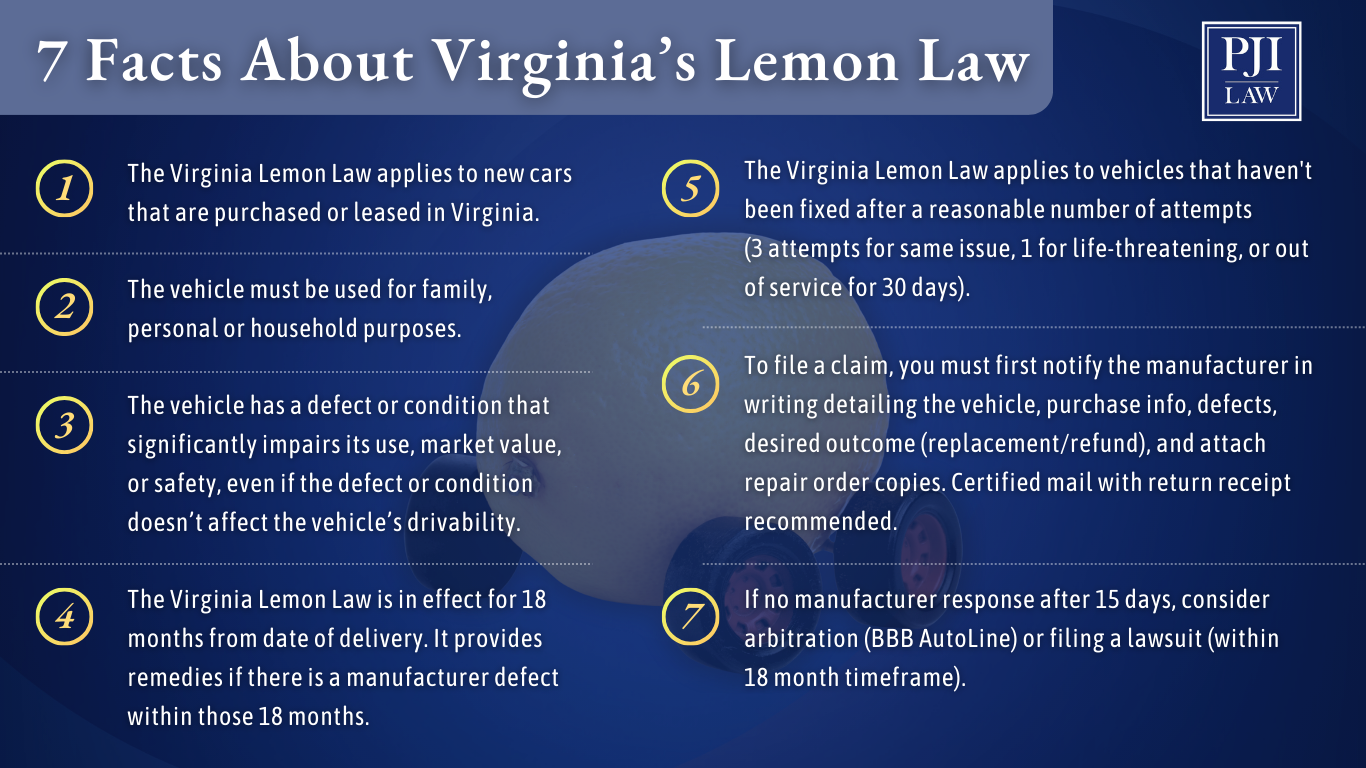
    • Purchase or Lease: You must have purchased or leased a new vehicle in Virginia.
    • Timeframe: The defect must occur within 18 months of the vehicle’s delivery date.
    • Usage: The vehicle must be intended for personal, family, or household use.
    • Attempts to Repair: The manufacturer or its agents must have had a reasonable number of attempts to repair the vehicle.
      • Quantifying Attempts: A “reasonable number of attempts” is defined as either three attempts for the same defect, one attempt if the defect is life-threatening, or if the vehicle is out of service for a cumulative total of 30 days for any number of issues.

    Note: If you have a used car, it might be protected under the lemon law if the previous owner had purchased it as a new car within the previous 18 months.

    Definition of a Lemon Vehicle

    A “lemon vehicle” is identified by its failure to conform to the manufacturer’s express warranties, which significantly affects the use, value, or safety of the vehicle. According to the Virginia Lemon Law:

    • Conformity to Warranties: The vehicle must exhibit a defect or condition that substantially impairs its use, value, or safety.
    • Manufacturer’s Obligation: The manufacturer must be unable to fix the vehicle’s defect within a reasonable number of attempts.
    • Substantial Impairment: The vehicle has a defect or condition that significantly impairs its use, market value, or safety, even if the defect or condition doesn’t affect the vehicle’s drivability.

    Initial Steps to Take

    If you suspect your car is a lemon as defined by Virginia law, swift and methodical action is crucial due to the 18-month timeframe. For example, you must gather comprehensive repair records and notify the manufacturer as prescribed by state law if your vehicle defect(s) have not been repaired.

    Maintenance and Record-Keeping Tips


    Maintaining a vehicle and keeping thorough records are essential steps in managing a lemon law case. Well-documented maintenance can provide evidence that car issues are due to manufacturing defects rather than owner negligence.

    Documentation Best Practices

    Organized Records: It is crucial to keep all maintenance receipts, work orders, and inspection reports in an organized manner. They should include:

    • Date of service
    • Description of the service provided
    • Mileage at the time of service
    • Detailed notes on any car issues reported or observed

    Digital Backups: In addition to physical copies, vehicle owners should create digital backups of all records. Cloud storage services or dedicated folders on a computer can serve as secure backup options.

    Timely Filing: After each service, promptly file the documents in the designated location. This ensures that no crucial information is lost and that everything is readily accessible for lemon law proceedings. This documentation will be vital for substantiating a lemon law claim.

    Notifying the Manufacturer

    Initiating your lemon law claim requires notifying the vehicle manufacturer in writing. This detailed letter serves as a crucial first step in asserting your legal rights and seeking remedies for persistent vehicle defects.

    Essential Information to Include:

    • Vehicle Identification: Clearly state your vehicle’s year, make, model, and Vehicle Identification Number (VIN) for easy reference.
    • Purchase Details: Specify the name and address of the dealership where you purchased the vehicle, along with the exact delivery date.
    • Defect Documentation: List each recurring vehicle problem in detail, including the dates you attempted repairs at the dealership and the nature of any outstanding issues.
    • Desired Outcome: Indicate your preferred resolution, whether it’s vehicle replacement or a full refund.
    • Supporting Documents: Enclose copies (not originals) of all purchase-related paperwork and repair orders to substantiate your claims.

    Formatting and Submission:

    • Sign and date your letter for legal validity
    • Make a copy for your records

    Consider sending the letter via certified mail with a return receipt requested. This provides documented proof of delivery and protects your legal interests. Keep both the certified mail receipt and the green return receipt as evidence. It’s essential to adhere to these initial steps to set a strong foundation for your lemon law claim.

    Filing a Lemon Law Claim

    If the manufacturer does not contact you to schedule a final repair within 15 days from receipt of the written notice or is not forthcoming with a refund or replacement, you will need to take any further action within the 18-month timeframe. This can mean arbitration or filing a lawsuit against the manufacturer. Arbitration is an avenue if you wish to resolve your disputes without going to court. However, you can still file a lawsuit if you’re unhappy with the decision of arbitration.

    Initiating Arbitration


    Before engaging in a civil lawsuit, there is often the option of informal dispute resolution. The Better Business Bureau’s (BBB) AutoLine program represents a resource for facilitating settlements between consumers and automobile manufacturers. This program acts as a bridge of communication, offering mediation services provided the manufacturer participates in the AutoLine network.

    Before initiating arbitration, verify manufacturer participation through the BBB website. Upon registering your complaint, the BBB will initiate contact with the manufacturer. Subsequently, you may be contacted directly by the manufacturer representative seeking a mutually agreeable resolution. Alternatively, you can request BBB representative intervention to advocate on your behalf.

    If the dispute remains unresolved at this stage, or if you decide to skip the dispute process (as many do), consulting with lawyers who deal with lemon law is typically the next prudent step. Remember, you only have 18 months from the date your vehicle was delivered to file a lemon law lawsuit. This time frame provides a crucial window to seek legal remedies for persistent vehicle defects.

    Extended Deadline if Using Manufacturer’s Dispute Resolution

    If you attempt to resolve lemon law issues through the manufacturer’s informal dispute resolution process (e.g., arbitration), you receive additional time to file a lawsuit. In such cases, the filing deadline expands to 12 months after the manufacturer’s final action in the dispute resolution process.

    Importantly, you still retain the original 18-month deadline as a fallback. You can choose whichever deadline provides the most time to file your lawsuit, depending on the timing of the manufacturer’s final action.

    While BBB AutoLine presents a worthwhile avenue for dispute resolution, manufacturer-provided arbitration generally warrants caution. These programs often prioritize compromises over the full legal remedies you may be entitled to.

    Consider BBB AutoLine a strategic stepping stone towards a favorable outcome. Remember, swift action is crucial, and the BBB can bridge the gap towards securing a satisfactory resolution within the legal timeframe.

    Pursuing Legal Action

    If your case cannot be resolved through arbitration or with the manufacturer, you can file a civil lawsuit. A lawsuit can lead to either a replacement vehicle, a buyback, or monetary compensation for your losses.

    Replacement or Repurchase of the Vehicle

    Under the Virginia Lemon Law, if a vehicle is classified as a lemon, you may be entitled to a replacement vehicle or a repurchase. The law stipulates that the manufacturer should replace the vehicle with an identical or comparable new vehicle. If you choose repurchase, the manufacturer must refund:

    • The full contract price
    • All licensing fees
    • Registration fees
    • Taxes

    Choosing Vehicle Replacement:

    If you opt for a replacement and the manufacturer agrees, you are entitled to a comparable vehicle acceptable to you. This ensures a satisfactory resolution that upholds your investment and expectations.

    You will receive a replacement valued at the original contract price, minus a fair usage deduction. This deduction is calculated based on the mileage accumulated before reporting the first issue. Should the manufacturer disagree with replacement, you retain the right to return your vehicle for a full refund, further protecting your consumer rights.

    You can continue driving your current vehicle until you receive either the replacement or your refund, ensuring uninterrupted transportation throughout the process.

    Opting for Refund:

    Selecting a refund allows you to return your vehicle and receive a complete financial reimbursement. The manufacturer cannot object to this preference. Similar to the replacement scenario, the refund amount will be the original contract price minus a mileage-based usage deduction. Once again, you maintain driving privileges until the refund is finalized, minimizing inconvenience and disruption.

    Additionally, any charges for financing, towing, and rental car expenses during the repair periods may also be recovered. Remember, documentation of all expenses is crucial for reimbursement claims, and you must provide receipts or proof of payment.
    Why You Need an Attorney When Facing a Lemon Car

    Navigating the complexities of Virginia Lemon Law while contending with a defective vehicle can be a frustrating and overwhelming ordeal. While notifying the manufacturer and outlining your desired remedies may seem straightforward, seeking the guidance of an experienced attorney for lemon law offers crucial advantages:

    Skill and Experience

    Lemon law attorneys possess in-depth knowledge of your state’s specific regulations, ensuring every step of your claim adheres to legal requirements. They understand the intricacies of paperwork, deadlines, and communication strategies to maximize your chances of a successful outcome.

    Leveling the Playing Field

    Manufacturers often have dedicated legal teams focused on minimizing their liability in lemon law cases. An attorney acts as your advocate, protecting your rights and ensuring your voice is heard with equal force.

    Building a Strong Case

    Attorneys can skillfully gather evidence, document every detail of your vehicle’s issues, and construct a compelling case on your behalf. This includes obtaining repair records, negotiating with dealerships, and, if necessary, preparing for litigation.

    Emotional Support and Guidance

    Dealing with a “lemon” car can be emotionally draining. Your attorney will provide support throughout the process, answer your questions, and alleviate anxieties, allowing you to focus on your daily life while they handle the legal complexities.

    Negotiating the Best Outcome

    Attorneys are skilled negotiators who can secure the best possible resolution for your case, whether it’s a favorable replacement vehicle, a full refund, or additional compensation. Their experience often means they can obtain more favorable settlements than individuals facing manufacturers alone.

    Peace of Mind

    Knowing your rights are protected by a competent legal professional allows you to navigate this stressful situation with peace of mind. You can be confident that your claim is being handled effectively and professionally, maximizing your chances of a successful outcome.

    While you have the right to navigate a lemon law claim on your own, partnering with an experienced attorney significantly increases your chances of securing a favorable outcome and achieving justice for your defective vehicle.

    Don’t Let a Lemon Car Leave You Feeling Sour

    Dealing with a lemon car in Virginia can be a complex and stressful ordeal, but you don’t have to handle it alone. PJI Law is here to provide essential support and guidance in navigating Virginia’s lemon law. Our team of local lemon law lawyers is well-versed in the nuances of these laws and is committed to advocating for your rights as a consumer.

    At PJI Law, we understand the challenges you face with a lemon vehicle. We approach each case with a personalized strategy, ensuring that your situation is handled with attention and care. Our goal is to help you move forward from this frustrating experience with a positive outcome, protecting your consumer rights every step of the way.

    If you’re struggling with a lemon car, let PJI Law be your ally. Contact us by calling (703) 865-6100 or fill out our online form to schedule your consultation in Fairfax, Virginia. Together, we can tackle your lemon law issues with confidence and clarity, helping you turn a challenging situation into a resolved matter.

    Copyright © 2024. PJI Law, PLC. All rights reserved.

    The information in this blog post (“post”) is provided for general informational purposes only and may not reflect the current law in your jurisdiction. No information in this post should be construed as legal advice from the individual author or the law firm, nor is it intended to be a substitute for legal counsel on any subject matter. No reader of this post should act or refrain from acting based on any information included in or accessible through this post without seeking the appropriate legal or other professional advice on the particular facts and circumstances at issue from a lawyer licensed in the recipient’s state, country, or other appropriate licensing jurisdiction.

    PJI Law, PLC
    3900 Jermantown Rd, 2nd Floor
    Fairfax, Virginia 22030
    (703) 865-6100
    https://pjibe.webteam.ai/

  • The Importance of Estate Planning in Virginia

    The Importance of Estate Planning in Virginia

    Imagine this scenario: Mariah, a hard-working single mother living paycheck to paycheck, suddenly passes away without an estate plan. Her children, already grieving her loss, now face the daunting task of navigating the complexities of her estate. Compounding their emotional turmoil is the stress of financial uncertainty as they try to determine how to manage her assets and fulfill her wishes.

    Like Mariah, many people have the misconception that estate planning is solely a concern for the wealthy. However, everyone, regardless of their financial status, can benefit from a well-crafted estate plan. In Virginia, estate planning encompasses a wide range of components that go beyond distributing assets to include Advance Medical Directives, Power of Attorney, Business Succession Planning (for business owners), Guardianship appointments for minor children, and more, based on each individual’s unique needs and preferences.

    This blog, from a knowledgeable and experienced Northern Virginia estate planning attorney, explains the importance of estate planning and why a well-crafted, legally sound estate plan is a must. Continue reading to learn more about the estate planning process and its various legal instruments, then contact us at (703) 865-6100 for personalized service and attention.

    5 Reasons Why Everyone Needs An Estate Plan

    As experienced estate planning attorneys know, a well-devised estate plan can:

    1. Guarantee your intended beneficiaries receive assets responsibly
    2. Minimize probate complexities and avoid additional legal hurdles
    3. Ensure asset management in the event of incapacity
    4. Shield assets from creditors to safeguard your legacy
    5. Result in substantial reductions in estate taxes upon your passing

    Four Essential Estate Planning Documents

    Will 

    A will is the foundation of your estate plan. This document ensures that your property is distributed according to your wishes after you pass away. Wills allow individuals with minor children to appoint a guardian to secure their future should they tragically die before their children turn 18.

    Moreover, your will can be a vehicle for giving back to society, as you can use it to leave a legacy by contributing to a charity of your choice.

    Unlike a trust or a power of attorney, which addresses incapacitation, a will only takes effect after your death. Do not delay the process of crafting your will; acting now will provide you and your loved ones with the peace of mind that comes from having a well-planned estate.

    Key Requirements for a Legally Valid Will

    A will must meet several requirements to be legally binding, including:

    Age: The testator (person creating the will) must be 18 years old or above.

    Written: The will must be documented in writing; oral wills hold no legal weight.

    Testator signature: The document must bear the signature of the testator.

    Competence and voluntary creation: The testator must be of sound mind and create the will freely, without the undue influence of another.

    Witnesses: Two individuals must witness the will to validate its authenticity.

    Trust

    Contrary to a popular misconception, trusts are an excellent estate planning tool for all income levels. With a trust, you can:

    • Minimize your tax obligations
    • Bypass probate
    • Ensure the distribution of your assets as you desire

    Additionally, trusts can provide for the continued care of disabled children and cherished pets long after you’re gone.

    There are various options for creating trusts in Northern Virginia, including:

    • Revocable living trusts
    • Irrevocable trusts
    • Special needs trusts
    • Qualified terminable interest property trusts
    • Testamentary trusts
    • Charitable trusts
    • Pet trusts
    • Spendthrift trusts
    • Generation-skipping trusts

    Power of Attorney (POA)

    What would happen if you became incapacitated? Who would manage your affairs? With a power of attorney, you can designate a trusted person to step in and handle your responsibilities, without the need for a court petition. A POA provides a sense of security and saves your loved ones the emotional turmoil of a lengthy legal process.

    The alternative—seeking a Conservatorship or Guardianship through the courts—can be an overwhelming ordeal for families and delay much-needed assistance.

    A power of attorney safeguards your well-being and upholds your intentions, even in unforeseen circumstances.

    Types of Powers of Attorney

    • Durable power of attorney
    • General power of attorney
    • Limited power of attorney
    • Springing power of attorney

    Advance Medical Directive

    While a POA manages financial affairs should you become incapacitated, an Advance Medical Directive allows you to designate a trusted person to make medical decisions on your behalf. Medical directives give individuals the peace of mind of knowing that their wishes will be honored even if they cannot communicate them. With the help of a knowledgeable and experienced Northern Virginia estate planning attorney, you can create a directive that leaves no room for misinterpretation.

    What Can You Achieve with Advance Medical Directives?

    1. Designate a Trusted Healthcare Agent

    Choose someone who will advocate for your wishes if you cannot speak for yourself. Our attorneys will assist you in appointing an agent who will have the legal authority to make medical decisions for you.

    1. Specify Your Healthcare Instructions

    Take control of your medical care by outlining your preferences and wishes explicitly. Our attorneys will ensure your instructions are clear and legally binding.

    1. Donate Organs or Tissues

    Make a life-saving impact by expressing your desire to donate organs or tissues to others in need or to research institutions.

    What Powers Does a Healthcare Agent Have?

    Your appointed Healthcare Agent will only act if medical professionals determine that you are unable to make decisions for yourself, honoring your specific instructions regarding issues such as life support, whenever possible. If no instructions address a particular situation, the agent will make decisions based on your values and preferences.

    Choose the Right Agent for your Advance Directive

    A knowledgeable and compassionate estate planning attorney can help you navigate the process of selecting a trustworthy Healthcare Agent. Designating the right person, with whom you feel comfortable making critical decisions on your behalf, will give you peace of mind.

    More Complex Situations Require Additional Estate Planning Documents

    For business owners, business succession planning is a vital part of estate planning. It ensures that the business can continue to operate smoothly after the owner’s passing, preserving its legacy and protecting the interests of employees and stakeholders.

    Guardianship is another critical aspect of estate planning, especially for parents with minor children. By designating a guardian, parents can have peace of mind knowing that their children will be cared for by someone they trust if anything were to happen to them.

    PJI Law, PLC: Your Estate Attorneys in Fairfax, Virginia

    Have you been searching online for “estate planning attorneys” or “estate lawyers near me” in Virginia? Established in Northern Virginia in 2010 to provide personalized, high-quality legal services to every client, our law firm has been guiding clients through the estate planning process for over a decade. At PJI Law, our estate attorneys care about your legal needs and want you to be comfortable telling us how we can implement a comprehensive estate plan that secures your long-term care, provides for your loved ones after your death, and addresses more complex situations that may require additional documents. As your trust and estate counsel, we will discuss your unique circumstances and work with you to create a comprehensive and legally valid estate plan.

    We’re committed to providing personal attention and premium service to our valued clients. To discuss the estate planning process and how we can tailor your plan to fulfill your intended purpose, please contact us at (703) 865-6100 or complete our online form to schedule a consultation in Fairfax, Virginia.

    Copyright © 2024. PJI Law, PLC. All rights reserved.

    The information in this blog post (“post”) is provided for general informational purposes only and may not reflect the current law in your jurisdiction. No information in this post should be construed as legal advice from the individual author or the law firm, nor is it intended to be a substitute for legal counsel on any subject matter. No reader of this post should act or refrain from acting based on any information included in or accessible through this post without seeking the appropriate legal or other professional advice on the particular facts and circumstances at issue from a lawyer licensed in the recipient’s state, country, or other appropriate licensing jurisdiction.

    PJI Law, PLC
    3900 Jermantown Rd, 2nd Floor
    Fairfax, Virginia 22030
    (703) 865-6100
    https://pjibe.webteam.ai/

  • Understanding Inheritance Laws in Virginia

    Understanding Inheritance Laws in Virginia

    Passing away without a will can lead to significant unintended consequences. In Virginia, the absence of a will means that the distribution of your estate is governed strictly by the state’s intestacy laws, not by your personal wishes. This situation can potentially create expensive and lengthy disputes among family members over your assets and the appointment of an estate administrator by the court. More concerning is the possibility that those who end up inheriting your estate may not be the individuals you would have chosen.

    While trusts and advance directives are also an essential part of a comprehensive estate plan, a will remains an indispensable component. It provides a clear and legally binding directive for the distribution of your assets to beneficiaries of your choosing, ensuring your wishes are carried out after you pass.

    For those without a will, it’s critical to understand the implications of dying intestate. In this blog, we’ll share what you need to know about inheritance laws in Virginia and what the absence of a will in your estate plan means for the management and allocation of your estate.

    If you have questions about including a will as part of your estate plan, contact us at (703) 865-6100 to schedule your consultation with a member of our Virginia estate planning attorney team. At PJI Law, you’ll receive personalized service and attention.

    Glossary of Terms

    Before delving into the specifics of Virginia’s intestate succession laws, it’s important to be familiar with some key terms we’ll be using throughout the blog.

    Term Definition
    Administrator A person appointed by the court to manage the estate of someone who died intestate
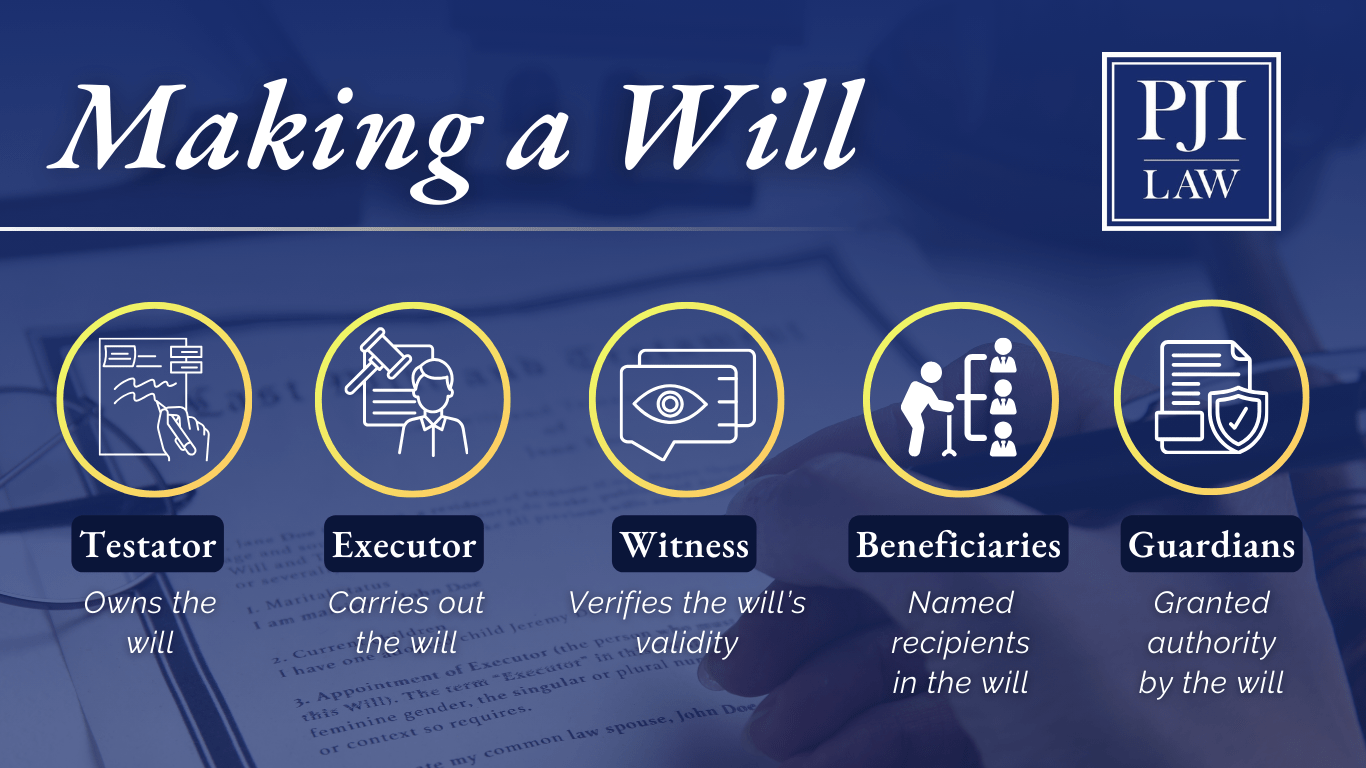
    Beneficiary A person named in a will to receive a part of the deceased’s estate
    Decedent The legal term for a person who has passed away. Often used interchangeably with “deceased,” which is a more general term with the same meaning
    Escheat The process by which a deceased person’s estate is turned over to the state if no heirs can be found
    Estate All property, assets, and debts left by an individual at death
    Executor A person appointed in a will to administer the deceased’s estate. They’re responsible for ensuring the will’s instructions are carried out
    Heir A person legally entitled to receive a share of the deceased’s estate under intestate succession laws
    Intestate Succession The condition of dying without a valid will. In such cases, Virginia’s intestate succession laws determine the distribution of the estate
    Per Stirpes Per stirpes ensures that each branch of the family tree receives an equal share of the inheritance, regardless of whether any beneficiaries have died before the testator
    Probate The legal process through which a deceased person’s will is validated and their estate is administered
    Probate Tax A tax levied on the estate as it goes through the probate process
    Testate The condition of dying with a valid will. The will dictates how the estate should be distributed
    Testator A person who has made a will
    Will A legal document in which a person specifies how their estate should be managed and distributed after death

    The Critical Importance of Having a Will

    The presence or absence of a will (testate vs. intestate) significantly impacts estate distribution. A will offers control and clarity, while dying without one leaves the distribution of assets up to the state’s intestacy laws. These laws determine who inherits, but may not reflect the decedent’s personal wishes, emphasizing the importance of proactive estate planning.

    Probate in Virginia varies depending on whether the decedent had a will. When a person passes away without a will, known as dying intestate, their estate is subject to the state’s intestate succession laws. These laws dictate the distribution of assets and property among a hierarchy of relatives and entities.

    Having Trusts Doesn’t Mean You Don’t Need a Will

    Even if you have trusts set up with beneficiaries, having a will is still important for several reasons:

    • Distributing Assets Not Held in Trust: A will can be used to distribute any assets that are not held in your trusts. This could include assets such as real estate, personal belongings, and bank accounts.
    • Appointing Guardians for Minor Children: If you have minor children, a will can be used to appoint guardians for them in the event of your death. This will ensure that your children have someone to care for them and make important decisions on their behalf.
    • Naming an Executor: A will can be used to name an executor, who is responsible for managing your estate after your death. This includes tasks such as paying your debts, distributing your assets, and carrying out your wishes as expressed in your will.
    • Providing Clarity and Certainty: A will provides clarity and certainty regarding your wishes for the distribution of your assets. This can help to avoid disputes among your heirs and ensure that your wishes are carried out as intended.
    • Addressing Unexpected Circumstances: A will can be used to address unforeseen circumstances, such as the death of a beneficiary or a change in your family situation.
    • Completing Your Estate Plan: A will is an essential part of a comprehensive estate plan. It works together with your trusts to ensure that your assets are distributed according to your wishes and that your loved ones are cared for as you would want them to be.

    Even if you have trusts set up, a will is still an essential document that can help to protect your assets, ensure your wishes are carried out, and provide peace of mind for your loved ones. So what happens if you die without a will? Let’s take a look at the probate process next.

    Probate in Virginia: With or Without a Will


    For those who pass away with a will, or testate estates, the probate process is generally more straightforward. A valid will guides the court in distributing the estate according to the decedent’s wishes. However, not all testate estates are handled identically. The nature of the estate determines the probate court’s approach.

    Estates that exclude real estate and comprise personal property valued at $50,000 or less are classified as “small estates” under Virginia’s inheritance laws. Such estates can bypass the probate process altogether if 60 days have passed since the individual’s death. Conversely, larger estates must go through formal probate administration.

    Understanding the difference between real and personal property is crucial in this context. Real property includes land and structures attached to it, like houses. Personal property, on the other hand, covers items like cars, furniture, electronics, jewelry, financial investments, and cash. Certain assets, such as insurance policies and Individual Retirement Accounts (IRAs), are not subject to probate and are treated separately. We’ll discuss this in more detail in a later section.

    In the absence of a will, the court appoints an administrator to oversee the estate, prioritizing relatives of the decedent based on a specific order. This administrator is responsible for managing the estate’s debts and distributing the remaining assets as per the intestacy laws.

    In all scenarios, an estate must first clear the deceased’s debts, including taxes, final expenses, credit bills, and other liabilities, before distribution to heirs. This responsibility falls on the executor (named in the will) or administrator (appointed by the court if there is no will).

    Probate cases in Virginia, whether intestate or testate, are handled by the circuit courts in the county where the deceased resided, ensuring proper legal oversight and administration of the estates.

    Overview of Intestate Succession in Virginia


    Intestate succession laws in Virginia provide a hierarchy of beneficiaries, which is strictly followed in the absence of a will. These laws are designed to distribute assets to the closest relatives first, but the specifics can vary based on the deceased’s family situation.

    Inheritance Rights of Spouses

    Virginia’s inheritance laws grant significant rights to spouses in cases of intestate succession, aligning with the norms of many other states. In situations where the decedent leaves behind only a spouse and no children, the entirety of the estate is inherited by the surviving spouse. This provision also applies if all the decedent’s children are shared with the surviving spouse.

    However, if there are surviving children from a previous relationship, the dynamics change. In such cases, the surviving spouse is entitled to only one-third of the estate, while the remaining two-thirds are distributed evenly among the children, following the principle of per stirpes distribution.

    Inheritance Rights for Children

    In Virginia, the inheritance rights for children vary based on the presence of a surviving spouse. If there is no surviving spouse, the entire estate naturally passes to the children. However, when a spouse survives, the distribution of the estate to children depends on their relationship with the surviving spouse. If there are only children shared with the surviving spouse they may not inherit, but if there are children from another relationship then the decedent’s children could receive up to two-thirds of the estate.

    Virginia law does not differentiate between biological and adopted children regarding inheritance rights. Both are equally entitled to inherit from an intestate (without a will) estate. Grandchildren, however, do not have inherent rights to inheritance in the absence of a will, unless their parent (the decedent’s child) has passed away before the decedent.

    A child conceived before but born after the death of a parent inherits as if they were born during the parent’s lifetime. This also holds true for children born via artificial insemination using the genetic material of the deceased.

    If a decedent wishes to bequeath property to a stepchild or foster child, they must explicitly include them in their will.

    Unmarried Individuals Without Children

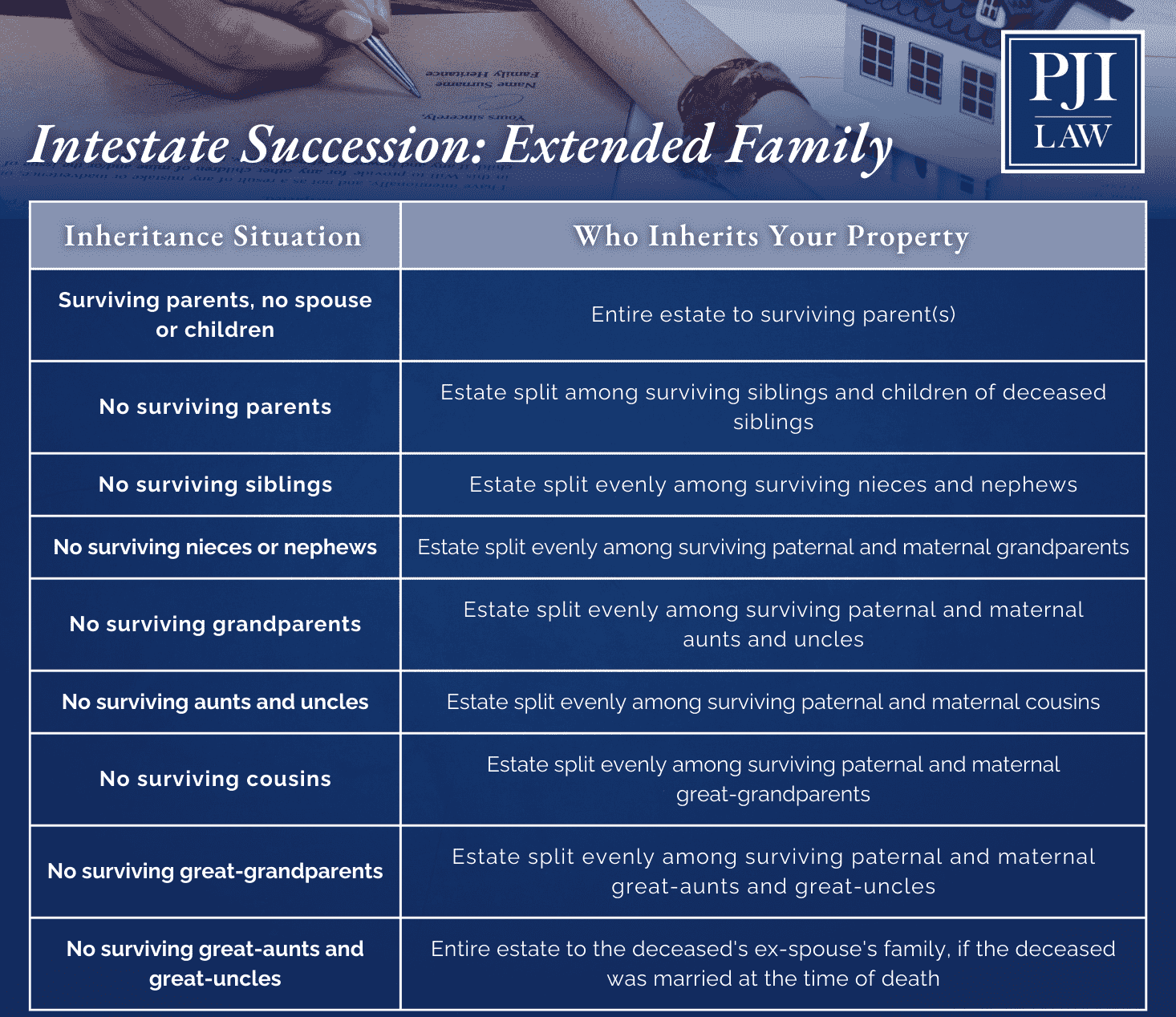
    For those who pass away without a will and leave no surviving children or spouse, Virginia’s intestate succession laws establish the order in which relatives inherit the deceased’s property. This process, known as intestate succession, aims to identify and locate any potential heirs within the deceased’s extended family, ensuring that the estate remains within the family lineage.

    Extended Family

    No Surviving Heirs

    In rare cases where no family can be located, the estate escheats to the Commonwealth of Virginia. Additionally, creditors may have a role in estate administration if they seek to serve as administrators, particularly in cases where the estate owes significant debts.

    Non-Probate Assets in Virginia

    As mentioned in an earlier section, non-probate assets in Virginia are assets that can bypass the probate process, passing directly to your beneficiaries without going through the often time-consuming and costly probate proceedings.

    Types of Non-Probate Assets


    Non-probate assets can include a variety of asset types, such as:

    • Real property owned by the decedent
    • Life insurance proceeds
    • Investment accounts
    • Jointly titled real estate assets
    • Retirement accounts
    • Trust assets
    • Payable on death or transfer assets

    These assets can pass directly to your beneficiaries without going through the probate process, providing a more efficient method for transferring assets and minimizing the burden on your loved ones during a difficult time. Working with a skilled attorney ensures that your non-probate assets are properly managed and distributed according to your wishes.

    Designating Beneficiaries

    Designating beneficiaries for non-probate assets is crucial for ensuring a smooth transfer of assets and can help avoid potential disputes among heirs. Non-probate assets, such as life insurance policies, retirement accounts, and bank accounts, typically require a designated beneficiary form to be filled out and submitted to the relevant financial institution.

    It’s essential to keep these forms up to date to ensure that the assets are transferred to the designated beneficiary. Taking the time to designate beneficiaries for your non-probate assets allows you to create a comprehensive estate plan that maximizes the value of your assets and provides financial security for your loved ones.

    Avoiding Unintended Outcomes

    As you can see, dying intestate can lead to outcomes that might not align with your wishes. To ensure your assets are distributed according to your personal preferences, creating a will is vital. This provides clarity and direction for the distribution of your assets and can prevent potential disputes among family members. For further reading, we invite you to read our blog, “How to Create a Will in Virginia.”

    For added control and flexibility, consider establishing a trust in conjunction with your will if you have not already done so. A trust can provide numerous benefits, such as asset protection, distribution to beneficiaries, and privacy. You can read more about trusts in our blog here.

    Understanding Virginia’s intestate succession laws is crucial for estate planning and for those handling the estate of a deceased without a will. These laws dictate who inherits in various family scenarios, emphasizing the importance of having a will to ensure your assets are distributed according to your wishes. For tailored legal advice, especially when dealing with complex family situations or significant assets, consulting with a Virginia estate planning attorney is advisable.

    Secure Your Legacy and Honor Your Wishes with PJI Law

    Navigating the complexities of estate planning and intestate laws in Virginia can be daunting, but with PJI Law by your side, you can craft an estate plan that precisely reflects your wishes and secures your legacy.

    At PJI Law, we understand that each estate plan is as unique as the individual it represents. Our dedicated team of legal professionals combines in-depth knowledge of Virginia estate law with a personalized approach to ensure your estate plan is tailored to your specific needs and circumstances.

    Whether you’re starting from scratch or need to update an existing plan, our commitment is to provide you with an estate plan that not only adheres to legal standards but also provides peace of mind for you and your loved ones.

    Don’t leave your legacy to chance. If you’ve been searching online for a “estate planning attorney near me,” contact PJI Law instead. You can reach us by calling (703) 865-6100 or filling out our online form to schedule your consultation in Fairfax, Virginia. Let us help you create an enduring and effective estate plan that honors your wishes and protects your loved ones from Virginia’s inheritance laws.

    Copyright © 2023. PJI Law, PLC. All rights reserved.

    The information in this blog post (“post”) is provided for general informational purposes only and may not reflect the current law in your jurisdiction. No information in this post should be construed as legal advice from the individual author or the law firm, nor is it intended to be a substitute for legal counsel on any subject matter. No reader of this post should act or refrain from acting based on any information included in or accessible through this post without seeking the appropriate legal or other professional advice on the particular facts and circumstances at issue from a lawyer licensed in the recipient’s state, country, or other appropriate licensing jurisdiction.

    PJI Law, PLC
    3900 Jermantown Rd, 2nd Floor
    Fairfax, Virginia 22030
    (703) 865-6100
    https://pjibe.webteam.ai/

  • Planning on Buying a Business in Virginia? Tips on How to Write a Business Purchase Agreement

    Planning on Buying a Business in Virginia? Tips on How to Write a Business Purchase Agreement

    Whether you’re a seasoned entrepreneur looking to expand your portfolio or someone transitioning into business ownership for the first time, navigating the legal intricacies of transferring ownership can feel overwhelming.

    However, having the right documents in place upfront will help make negotiations clearer and set both parties up for long-term success. One of these crucial documents — perhaps the most crucial — is a business purchase agreement.

    This blog aims to help any would-be business owners in Virginia feel informed and confident as they craft their own business purchase agreement.

    For those who want to leave nothing up to chance, the best thing you can do is hire an experienced business transaction lawyer. A knowledgeable and experienced Fairfax business lawyer can ensure that all legal bases are covered, and help navigate any unforeseen issues that could derail the purchase process.

    At PJI Law, PLC, our clients are our top priority. We’re committed to providing personal attention and premium service. If you want to create a legally sound business purchase agreement that protects your interests, contact us at (703) 865-6100.

    What is a Business Purchase Agreement?

    A business purchase agreement, sometimes also referred to as a buy-sell agreement in Virginia, is the central legal document that governs the terms of the transaction between a buyer and seller of a business.

    This contract outlines vital components of the deal, including:

    • Purchase price 
    • Timeline for closing
    • Specific assets and liabilities being transferred
    • Conditions of sale
    • Representations and warranties 
    • Consequences of default

    The agreement protects both parties by formally establishing their respective obligations and rights in writing. Essentially, it is a roadmap for facilitating an orderly transition of business ownership that clearly defines expectations. With a comprehensive business purchase agreement, the buyer and seller can enter the deal with confidence, knowing their interests and rights are protected.

    What’s Included in a Business Purchase Agreement?

    While business purchase agreements can be complex, they generally contain several standard components. Crafting a comprehensive agreement requires the help of an experienced attorney; however, familiarizing yourself with the basic structure and key provisions is certainly worthwhile. Entering negotiations with a working knowledge of standard terms can help facilitate crucial discussions.

    Party Identification

    The first provision in a business purchase agreement establishes the identities of the buyer and seller transacting the deal. It provides their full legal names, entity types (if relevant), and contact details. Misidentifying parties in the contract has legal implications, so ensure names, signatures and all details are accurate.

    Business Description

    This section paints a full picture of the business being sold, including an overview of its operations. It also confirms the seller’s capacity to legally authorize the transaction. Representations and warranties about the company’s good standing, compliance with relevant laws, and absence of pending or threatened litigation provide both reassurance and recourse for buyers. A factual yet comprehensive business synopsis at this stage establishes full transparency about what the buyer is purchasing.

    Financial Terms

    Key transactional details are outlined here, beginning with the agreed-upon purchase price. Provisions indicate any deposits payable, how and when funds will change hands, including details about the closing date and transfer of ownership. By clearly spelling out payment expectations and the financial mechanics of the deal, this section sets the stage for a smooth exchange.

    Terms of Sale

    This section unambiguously defines the type of sale, as well as the assets that are included or excluded from the deal. Additionally, it provides important information abound the transfer of tangible property, with details on the condition and value of equipment, tools, facilities and other resources that are critical to operations.

    Covenants

    This part of the agreement delineates responsibilities for both parties as ownership changes hands. It spells out obligations the seller must fulfill regarding matters like tax commitments, loan repayments, transferring employment benefits and wages, etc. Post-closing, ongoing protections are listed here, as well.

    Transition

    To facilitate a seamless leadership change, this section establishes expectations for responsibilities like outlining the seller’s ongoing advisory or support role (if any). It also determines who will manage the training of new hires to ensure business continuity, and how customers, vendors and other stakeholders will be informed of the sale to maintain key relationships.

    Third Parties

    When third parties aid the transaction, this part of the business purchase agreement records their formal details. It lists their full names and contact information, and clearly assigns responsibility for paying commission fees or other forms of compensation.

    Closing Details

    To smoothly wrap up the purchase, this straightforward section lays out the logistical plan. It establishes the definitive closing date, timeframe, location where title transfers will occur, and the monetary sum to be paid at closing.

    Dispute Resolution Clause

    This section outlines procedures for resolving any transaction-related conflicts via mediation or litigation, providing clarity upfront on addressing issues that could arise after closing.

    These standard provisions cover common bases, but business purchase agreements can vary in complexity depending on factors like business type and the assets/liabilities involved. Additional terms may require negotiation. To ensure a smooth purchase, consult an experienced Virginia business transaction lawyer.

    Can You Write Your Own Business Purchase Agreement?

    Yes, you can. However, while it is legal for a buyer and seller to write their own business purchase agreement, it is not always advisable. Drawing up a legally binding contract on your own carries certain risks. Critical terms and disclosures could be overlooked or clauses can be written in a way that leaves potential loopholes.

    How Can a Business Transaction Attorney Help?

    A business transaction lawyer can provide valuable assistance to buyers and sellers involved in a business purchase agreement. They understand the legal intricacies and can identify issues that an individual may miss. Attorneys will make sure all regulatory disclosure requirements are satisfied. They can review financials, contracts, and other documentation to catch any problems.

    Additionally, an attorney can draft ancillary documents like non-compete agreements, and ensure a smooth closing process. Their expertise helps minimize risks so both parties are properly protected through every phase of the transaction.

    Ensure Your Business Purchase Agreement Protects Your Interests with the Transaction Attorneys at PJI Law, PLC

    Purchasing a business isn’t something you do every day. Given the high stakes involved, enlisting the help of an experienced business transaction lawyer is wise.

    With personalized service and attention, our dedicated team at PJI Law, PLC will leave no stone unturned to ensure that your business purchase agreement reflects your best interests and protects your rights. Take the first step today and call our office at (703) 865-6100 or complete our online form to schedule your consultation.

    Copyright © 2023. PJI Law, PLC. All rights reserved.

    The information in this blog post (“post”) is provided for general informational purposes only and may not reflect the current law in your jurisdiction. No information in this post should be construed as legal advice from the individual author or the law firm, nor is it intended to be a substitute for legal counsel on any subject matter. No reader of this post should act or refrain from acting based on any information included in or accessible through this post without seeking the appropriate legal or other professional advice on the particular facts and circumstances at issue from a lawyer licensed in the recipient’s state, country, or other appropriate licensing jurisdiction.

    PJI Law, PLC
    3900 Jermantown Rd, 2nd Floor
    Fairfax, Virginia 22030
    (703) 865-6100
    https://pjibe.webteam.ai/

  • An Experienced Virginia Estate Planning Attorney Debunks 5 Estate Planning Myths

    An Experienced Virginia Estate Planning Attorney Debunks 5 Estate Planning Myths

    Emily, a young and vibrant 30-year-old with a thriving career and an active social life, never gave much thought to estate planning. That is, until her best friend Juliet’s brother unexpectedly passed away without a will or an estate plan, leaving his family at the mercy of Virginia estate law. State law dictated how his assets would be divided among his beneficiaries, which may or may not have aligned with his wishes. Watching her friend’s family argue over money and other personal matters while grieving their loss caused Emily to reconsider the idea of estate planning.

    Unfortunately, dying without a will is common in the United States. According to a CNBC survey, 67% of Americans have no estate plan. Although the COVID-19 pandemic alerted people to the importance of having a will, only about 33% of Americans have an estate plan. The article reveals that the most significant reason for this is that they just haven’t taken the time to do it, as reported by 40% of respondents. However, the reasons given by the remaining 60% demonstrate the prevalence of many misconceptions Americans have about estate planning.

    This blog, from a knowledgeable and experienced estate planning attorney, debunks the five most common estate planning myths.  Continue reading to discover more, then contact our seasoned team of lawyers for estates and wills at (703) 865-6100 for personalized service and attention. During the interview process, we’ll get to know you so we can collaborate and prepare a comprehensive plan that addresses your concerns and protects you and your loved ones.

    Myth #1: Estate Planning is Only for the Wealthy/I Don’t Have Enough Assets

    Contrary to this myth, everyone, regardless of income or net worth, can benefit from estate planning. Working with the right estate planning attorney, you can ensure the proper distribution of your belongings—regardless of their value—by designating beneficiaries. An estate plan also ensures that your financial and healthcare wishes will be respected if you become unable to make decisions. Legally valid estate planning documents allow your preferred guardian to take responsibility for your minor children, rather than someone appointed by the court, in the unfortunate event of your passing.

    Myth #2: Young People Don’t Need Estate Planning

    Like Emily, many young people believe that estate planning is only for middle-aged or older people, but nothing could be further from the truth. As her friend Juliet’s story illustrates, unexpected events can happen at all ages. A legally sound estate plan carries out your intentions if tragedy strikes and you pass away at an early age.

    Myth #3: A Will Takes Care of All Assets

    While vitally important, a will alone does not constitute a comprehensive estate plan because it doesn’t cover all of your assets. Specific assets, such as life insurance or retirement accounts, bypass the will and pass directly to named beneficiaries.

    Myth #4: Estate Planning Focuses Solely on What Happens After Your Death

    Estate planning goes beyond what happens after your death to address situations where you cannot make decisions for yourself due to incapacitation. With components like a Power of Attorney (POA) and an Advance Medical Directive, you can designate a trusted individual to act on your behalf for financial and medical matters.

    Myth #5: Estate Planning is a One-Time Process

    Updating your estate plan is crucial to it reflecting your current circumstances. Changes in your life, like marriage, divorce, or the arrival of a new baby, may necessitate revisions. Regularly review your plan so it aligns with your specific needs and circumstances.

    What are the Components of a Robust Virginia Estate Plan?

    Now that we’ve debunked the most common myths about estate planning, let’s delve into an estate plan’s crucial components. As experienced estate planning attorneys can attest, the estate planning process involves much more than managing your finances, and each individual must tailor their estate plan to their unique preferences.

    Will

    A will is a foundational document in the estate planning process. It empowers you to determine the distribution of your property, appoint a guardian for your children, and support a charitable cause after your passing.

    Unlike a living will, which takes effect if you become unable to make decisions, your last will and testament only becomes valid after your death.

    For a will to meet legal standards, it must adhere to the following:

    • The individual creating the will (known as the testator) must be at least 18 years old.
    • The will must be in written form; oral wills are not recognized by the law.
    • The testator must sign the document.
    • The testator must be mentally capable and must create the will willingly and without coercion.
    • Two witnesses must also sign the document, attesting to its authenticity.

    The well-being of your minor children is paramount. You can retain control of their future by designating a guardian for them in your will. In the unfortunate event of both parents passing away while your child is under 18, the court will examine your will for guidance, rather than making an independent choice on guardianship.

    To further safeguard your children’s future, select one or two additional backup guardians. These individuals should have the ability to care for them until they reach adulthood.  Consider guardians who will raise your children according to your values.

    Trust

    Contrary to a persistent misconception, you do not have to be wealthy to benefit from a trust. Trusts can minimize your tax obligations, sidestep probate complexities, and allocate property according to your directives. Furthermore, trusts can provide ongoing care for disabled loved ones and cherished pets long after you’re gone.

    Trust Options Include:

    • Revocable living trusts: Maintain control over your assets while alive, with the flexibility to make changes as needed.
    • Irrevocable trusts: Securely protect your assets and minimize tax obligations with this permanent trust option.
    • Special needs trusts: Safeguard the financial future of loved ones with special needs, ensuring their care and well-being.
    • Qualified terminable interest property trusts: Ensure the efficient transfer of assets to your spouse while maintaining control over their ultimate distribution.
    • Testamentary trusts: Preserve and direct the distribution of assets according to your wishes after your passing.
    • Charitable trusts: Leave a lasting impact by supporting causes close to your heart while potentially enjoying tax benefits.
    • Pet trusts: Provide for the continued care and well-being of your beloved pets even after you’re gone.
    • Spendthrift trusts: Safeguard assets from extravagance or poor money management, ensuring a controlled distribution over time.
    • Generation-skipping trusts: Efficiently pass assets to future generations while minimizing taxes, potentially creating a lasting legacy.

    Power of Attorney

    As many estate planning lawyers know from their meetings with clients, power of attorney is an often overlooked aspect of the estate planning process. With a power of attorney, you can safeguard yourself in the event of incapacitation. In such a scenario, the agent you select will seamlessly step in and manage your affairs, eliminating the need for court intervention. This saves families from the emotional burdens of seeking conservatorship or guardianship through the court and procures timely assistance.

    Power of Attorney Options Include:

    • Durable power of attorney
    • General power of attorney
    • Limited power of attorney
    • Springing power of attorney

    Advance Medical Directive

    Take control of your future with an Advance Medical Directive, a simple legal tool that allows you to designate someone you trust to make medical decisions for you. With a clear and concise directive, there will be no room for misinterpretation.

    An Advance Medical Directive allows you to:

    • Name a healthcare agent
    • Designate decision-making powers to that agent
    • Provide healthcare instructions
    • Donate organs or tissues to other people or research institutions

    Should I Hire a Virginia Estate Planning Attorney?

    While you might be tempted not to hire an estate planning attorney and DIY your estate planning documents with the help of the internet, it’s a risky proposition. Many internet forms are insufficient, may not account for complex situations, and do not comply with Virginia laws. When considering the well-being of your family and other loved ones, the attorney’s fees for estate counsel are a worthy investment. Whether you have an existing plan or seek to create a new one, a knowledgeable and experienced estate attorney in Virginia can listen to your specific needs and preferences and guide you through the legal process.

    PJI Law, PLC: Your Trusted Estate Planning Attorneys in Fairfax, Virginia

    Have you been typing “lawyers for estate planning” or “estate planning lawyers near me” into your search bar? We understand your desire to find an estate planning attorney you can trust with your legal needs and documents to ensure a stable future for you and your loved ones.

    At PJI Law, we’re committed to providing personal attention and premium service to our valued clients. To discuss the estate planning process and how we can tailor your plan to fulfill your intended purpose, we invite you to contact us at (703) 865-6100 or complete our online form to schedule a consultation in Fairfax, Virginia.

    Copyright © 2023. PJI Law, PLC. All rights reserved.

    The information in this blog post (“post”) is provided for general informational purposes only and may not reflect the current law in your jurisdiction. No information in this post should be construed as legal advice from the individual author or the law firm, nor is it intended to be a substitute for legal counsel on any subject matter. No reader of this post should act or refrain from acting based on any information included in or accessible through this post without seeking the appropriate legal or other professional advice on the particular facts and circumstances at issue from a lawyer licensed in the recipient’s state, country, or other appropriate licensing jurisdiction.

    PJI Law, PLC
    3900 Jermantown Rd, 2nd Floor
    Fairfax, Virginia 22030
    (703) 865-6100
    https://pjibe.webteam.ai/

  • How to Create a Will in Virginia

    How to Create a Will in Virginia

    A Last Will and Testament (will) is a crucial step in safeguarding your legacy and ensuring your loved ones are cared for according to your wishes. In Virginia, this vital document sits at the heart of estate planning—not only as a tool for distributing assets but also as a way to prevent potential family disputes and embody your life’s values and desires.

    Creating a will is the foundation for any comprehensive estate plan, which may also include other important documents for various needs and concerns. So, are you ready to take the first step towards securing your family’s future by learning how to create a will in Virginia?

    This blog post will guide you through the process of creating a will in Virginia, covering everything from understanding the legal requirements and types of wills accepted to the essential components of a Virginia will. We’ll also discuss additional estate planning documents to consider and the pros and cons of DIY wills versus hiring local attorneys for wills.

    If you’re ready to create a will or would like us to review an existing one, contact us at (703) 865-6100 to schedule your consultation. At PJI Law, you’ll receive personalized service and attention.

    Key Takeaways

    • Understanding Virginia wills is essential for a comprehensive estate plan.
    • Legal requirements and types of accepted wills must be adhered to in order to ensure assets are distributed as desired.
    • Consulting with local attorneys for wills is crucial to get accurate legal advice and ensure your will meets all necessary legal standards and effectively captures your wishes.

    Understanding Virginia Wills: An Overview

    Understanding Virginia Wills: An Overview

    In the Commonwealth of Virginia, having a complete estate plan is the most effective way to ensure that your assets are distributed according to your wishes upon your passing. A will is one of the key legal documents in your estate plan that outlines your desires for the distribution of your property and the care of any minor children. 

    Understanding the various types of wills that Virginia law recognizes is crucial in crafting a well-rounded estate plan. The most common will in the state is the witnessed will, while holographic (handwritten) wills are also accepted.  Electronic wills are not yet legally accepted.

    Legal Requirements for a Will in Virginia

    Legal Requirements for a Will in Virginia

    Certain legal conditions must be fulfilled for crafting a valid will in Virginia. These conditions include:

    1. The testator must be of legal age (18 years or older) and of sound mind.
    2. The will must be in writing and signed by the testator in their own handwriting.
    3. Two disinterested witnesses must be present during the signing to ensure the testator’s intent is properly executed.

    Types of Wills Accepted in Virginia

    Virginia accepts various types of wills including the following:

    • Written Wills: These are the most common type of will and must be in writing and signed by the testator and two witnesses.
    • Holographic Wills: In Virginia, holographic wills are also recognized. These are wills entirely written, dated, and signed by the hand of the testator. While this type of will can be legally valid, it’s more prone to challenges and issues in probate, especially regarding its authenticity and compliance with state law requirements.
    • Self-Proving Wills: These are also known as self-proving affidavits and are written wills that have been signed and sworn to by the testator and two witnesses in the presence of a notary public. This type of will speeds up the probate process because the court can accept the will without needing to contact the witnesses who signed it.

    Pour-over wills are another type of will that is commonly used in Virginia. A pour-over will is a will that is used to transfer any remaining assets that are not already in a revocable living trust into the trust after the testator’s death.

    Essential Components of a Virginia Will

    Creating a valid and effective will is a crucial part of estate planning. In Virginia, certain key elements are necessary to ensure that your will is legally binding and clearly communicates your final wishes. Understanding these essential components can help in drafting a will that accurately reflects your intentions and stands up to legal scrutiny.

    If you leave out these important parts, your family might end up arguing over your assets, the probate process could get held up, or the court might have to decide how to split your assets, possibly in ways you wouldn’t have chosen. Now, let’s take a closer look at each of these components.

    • Testator’s Details

    Your will must clearly identify you, the testator, including your full legal name and residence. This helps in affirming the will’s ownership and validity.

    • Declaration of Intent

    Your will should start with a declaration stating that the document is your will and that you are creating it willingly, free of undue influence or duress.

    • Capacity and Sound Mind

    The will must state that you are of legal age (at least 18 years old in Virginia) and of sound mind. This assertion confirms your legal and mental capacity to make informed decisions about your estate.

    • Appointment of an Executor

    The appointment of an executor is a critical step in crafting a will in Virginia. The executor is responsible for ensuring that the provisions in your will are fulfilled upon your death, making them an essential player in your estate planning process. In order to appoint an executor, you must choose an individual who is of legal age and mentally competent. This person can be a family member, a friend, or even a professional, such as an attorney or financial advisor.

    If an executor is not specified in your will, the probate court will assign someone to oversee the settlement of your estate. While it’s not a requirement, you may consider having your attorney serve as the executor of your will, depending on the relevant state or local laws. This can provide peace of mind, knowing that your estate is in capable and experienced hands.

    • Naming Beneficiaries

    Beneficiaries refer to the individuals or organizations nominated to inherit assets from your estate. To name beneficiaries in your Virginia will, you must provide the relevant information, such as the name, address, and relationship of each beneficiary. This ensures that your assets are distributed according to your wishes, providing financial support and security for your loved ones after your passing.

    You should be aware that in Virginia, you also have the option to disinherit your children by explicitly indicating in your will whom you are denying an inheritance and the rationale for doing so. Though making such a decision could be challenging, addressing these issues in your will is vital for clarity of your intentions, minimizing the potential for family disputes and legal challenges.

    • Guardianship Designations (if applicable)

    If you have minor children or dependents, it’s vital to appoint a guardian. This person will be responsible for their care if you’re unable to do so.

    • Property Distribution

    Property Distribution

    Property distribution refers to the act of assigning your assets to your designated beneficiaries as per your will. In Virginia, the probate court oversees this process, ensuring that all assets are appropriately distributed. Properly outlining how you wish to distribute your property can prevent misunderstandings and disputes among your beneficiaries, allowing for a smoother probate process.

    • Signatures

    For a will to be valid in Virginia, it must be signed by you and witnessed by at least two independent witnesses in your presence. These witnesses should also sign the will, affirming they observed your signature and that you were of sound mind and under no duress when signing.

    • Specific Bequests or Legacies

    If you have specific items or fixed sums of money that you want to leave to particular individuals or organizations, these should be clearly mentioned.

    • Revocation Clause

    Including a statement that explicitly revokes any previous wills or codicils prevents confusion and potential legal challenges.

    Additional Estate Planning Documents in Virginia

    Additional Estate Planning Documents in Virginia

    While a will is a fundamental part of your estate planning, there are additional documents to consider in Virginia. These documents can provide further protection and guidance for your family and loved ones in the event of your incapacitation or death. Incorporating these documents into your comprehensive estate plan allows you to tackle numerous concerns and guarantees the fulfillment of your desires.

    Some of the additional estate planning documents to consider in Virginia include living trusts, advance medical directive, durable power of attorney, and guardianship and conservatorship arrangements. Each of these documents serves a unique purpose, allowing you to address specific aspects of your personal, medical, and financial affairs.

    Living Trust

    A living trust is a legal document that allows you to transfer ownership of your assets to a trustee, who will manage and distribute the assets according to your instructions. Living trusts can be either revocable or irrevocable.

    Revocable living trusts can be changed or revoked at any time during the grantor’s lifetime. This means that you can add or remove assets from the trust, change the trustee, or even terminate the trust altogether.

    Irrevocable living trusts, on the other hand, cannot be changed or revoked once they are created. This means that the assets that you transfer to the trust are no longer yours, and you have no control over how they are managed or distributed.

    Advance Medical Directive

    Advance Medical Directive

    An Advance Medical Directive is a legal tool that empowers you to outline your wishes regarding medical treatment and care in case you become unable to communicate those decisions yourself. This directive serves not only as a guide for healthcare providers but also provides peace of mind for you and your loved ones. You can read about Advance Medical Directives in more detail here.

    Durable Power of Attorney

    A durable power of attorney (POA), a legal document, empowers you to appoint another person to manage your financial matters if you become incapacitated or pass away. The chosen individual, known as your agent, will have the authority to make financial decisions on your behalf, such as managing your bank accounts, paying bills, and handling property transactions.

    Incorporating a durable power of attorney into your estate plan can provide added protection and assistance when you’re unable to manage your financial affairs. This document ensures that your financial matters are handled appropriately and in accordance with your wishes, providing security and peace of mind for you and your family.

    Guardianship and Conservatorship

    Guardianship and Conservatorship

    Legal documents known as guardianship and conservatorship arrangements allow you to appoint another individual to supervise your personal, medical, and financial affairs in the event of your incapacity or passing. In Virginia, a guardian is responsible for the personal affairs of an incapacitated individual, whereas a conservator is tasked with managing their financial affairs.

    These arrangements can be especially important if you have minor children or adult dependents with special needs. By establishing guardianship and conservatorship, you can ensure that your loved ones receive the care and support they need when you’re no longer able to provide it yourself. Consulting with an estate planning attorney can help you determine the best approach for your family’s unique circumstances.

    Updating and Revoking a Will in Virginia

    In Virginia, as in other states, life’s inevitable changes often necessitate updates to your legal documents, including your will. Regularly reviewing and, if needed, revising your will ensures that it accurately reflects your current wishes and circumstances. Understanding when and why to update or revoke your will is crucial for effective estate planning.

    Key Reasons to Update Your Will

    Marital Changes: Changes in your marital status, whether through marriage, divorce, or the death of a spouse, significantly impact your estate planning. It’s wise to review and update your will to reflect these changes clearly.

    Birth or Adoption of Children or Grandchildren: The arrival of new family members is a common reason to update your will. You may want to include provisions for their guardianship, care, and inheritance, ensuring they are cared for according to your wishes.

    Birth or Adoption of Children or Grandchildren

    Change in Assets: Significant changes in your financial situation — such as acquiring or disposing of major assets like real estate, stocks, or valuable personal property — should prompt a will review. This ensures your will accurately reflects your current asset portfolio and distribution wishes.

    Relocation: Moving to a different state can affect your will, as estate laws vary by state. If you’ve moved to or from Virginia, it’s important to ensure your will adheres to the local laws and taxation regulations.

    Beneficiary Changes: Changes in relationships or circumstances may lead you to reconsider who you have named as beneficiaries. This includes adding new beneficiaries or removing existing ones due to changed relationships, death, or other reasons.

    Changes in Tax Laws: Tax laws can significantly impact estate planning. Staying informed about changes in both federal and Virginia state tax laws, and updating your will accordingly, can ensure maximum benefit for your beneficiaries.

    Choice of Executor or Guardians: If your chosen executor or guardian is no longer able to fulfill their role due to death, incapacity, or a change in relationship, updating your will is necessary to appoint someone suitable.

    Methods for Updating a Will

    Methods for Updating a Will

    In Virginia, updating a will can be accomplished by creating a codicil or drafting a new will altogether. A codicil is a written amendment to your will that must be signed by you and two witnesses. It should include the date of the codicil, a reference to the original will, and the changes you wish to make. This method can be useful for making minor updates or adjustments to your existing will.

    Alternatively, you can draft a new will to replace your previous one. This requires creating a document that meets the legal requirements, such as including your name, the date of the will, and the names of two witnesses. In addition, you must outline your wishes for the distribution of your property and the appointment of an executor. Drafting a new will can be a more comprehensive approach, particularly if your estate plan has undergone significant changes or if you wish to revoke a previous will.

    Revoking a Will

    Revoking a will in Virginia can be accomplished by either physically destroying the document, such as tearing, ripping, or burning it, or by having another person destroy it at your direction and in your presence. Demonstrating the intent to cancel the will is essential for the revocation to be legally valid.

    Another way to revoke a will is by creating a new will that explicitly states it revokes all previous wills. This method allows you to start with a clean slate and develop a new estate plan that better reflects your current wishes and circumstances. Regardless of the method, consulting a Virginia estate planning attorney to ensure proper revocation of your will and legal validity of your new estate plan is crucial.

    Revoking a Will

    Failure to update your documents can result in unintended consequences and distributions upon your passing. Consulting with experienced Virginia estate planning attorneys can provide professional guidance and ensure your estate plan remains valid, comprehensive, and aligned with your intentions.

    DIY vs. Hiring an Estate Planning Attorney

    The appeal of saving time and money may tempt you to opt for a DIY approach when crafting a will in Northern Virginia. However, this approach may not always be the best choice. While DIY wills can appear to be more cost-effective and convenient, they may also be more prone to errors and legal challenges.

    Conversely, retaining lawyers for wills ensures the legal validity of your will and provides professional guidance throughout the process.

    Benefits of Hiring Local Attorneys for Wills

    Benefits of Hiring

    • Local Legal Knowledge: Understands specific Virginia laws and regulations affecting wills and estate planning. 
    • Convenience: Easy access for meetings, document signings, and personal consultations. 
    • Community Insight: Familiar with local judges, courts, and administrative processes, which can be advantageous in estate planning and execution. 
    • Personalized Service: Offers more individual attention and tailored advice based on local trends and practices. 
    • Networking Resources: Access to a network of local professionals (like financial planners and accountants) who can assist in comprehensive estate planning. 
    • Responsive Communication: Quicker and more direct communication, providing prompt updates and answers to queries. 
    • Support Local Business: Contributing to the local economy and fostering community relationships. 
    • Familiarity with Local Real Estate: Knowledge of Virginia property laws, essential for estate plans involving local real estate holdings.

    Your attorney can provide the following services:

    • Ensuring that your will is legally valid
    • Accurately and properly documenting all of your wishes
    • Assisting you in updating and revoking your will as needed
    • Ensuring that your estate plan remains current and reflective of your desires

    By utilizing the services of lawyers for wills, you can have peace of mind knowing that your will and estate plan are in order. Ultimately, working with a law firm can help protect your assets and family members, giving you the confidence that your estate plan is in good hands, and addressing any potential legal issues.

    Frequently Asked Questions

    Frequently Asked Questions

    Q: What happens if I die without a will in Virginia?
    A: If you die without a will (intestate), your assets will be distributed according to Virginia’s intestacy laws, typically to your closest relatives, which might not align with your personal wishes.

    Q: How do I include my pets in my will in Virginia?
    A: In Virginia, you can include provisions for pet care in your will, such as designating a caregiver and setting aside funds for your pet’s care. However, pets are legally considered property, so you can’t leave money or assets directly to them.

    Q: Can my will in Virginia dictate funeral arrangements?
    A: While you can include funeral wishes in your will, it’s often better to convey these preferences in a separate document or discussion, as wills are sometimes not reviewed until after the funeral.

    Q: Can I leave a conditional gift in my will in Virginia (e.g., money to a grandchild only if they graduate college)?
    A: Yes, you can include conditional gifts in your will, such as bequests contingent on the beneficiary meeting certain criteria like graduating college. However, these conditions should be clear and legally enforceable.

    Q: If I have a living trust, do I still need a will in Virginia?
    A: Yes, even if you have a living trust, a will is important to cover any assets not included in the trust. A will can also designate guardians for minor children, something a trust cannot do.

    Q: Can a will in Virginia include instructions for my digital assets?
    A: Yes, a will in Virginia can include instructions for digital assets. It’s essential to provide clear directions and access information for handling your digital assets, like social media accounts, digital currencies, or online banking.

    Protect Your Loved Ones and Ensure Your Final Wishes with a Well-Drafted Will

    Crafting a detailed and legally sound will is crucial for ensuring your final wishes are respected and fulfilled. If you’re looking online for “local lawyers for wills,” consider the seasoned team at PJI Law for dependable and knowledgeable estate planning guidance.

    At PJI Law, we place immense value on our client relationships, dedicating ourselves to delivering personalized service and superior legal experience. We understand the nuances of Virginia estate law and are committed to helping you draft a will that not only captures your wishes accurately but also safeguards your family’s future and legacy.

    Ready to establish or revise a will that truly represents your intentions and benefits those you care about most? Reach out to PJI Law at (703) 865-6100 or use our online form to book your consultation in Fairfax, Virginia. Let us assist you in creating an estate plan that stands the test of time.

    Copyright © 2023. PJI Law, PLC. All rights reserved.

    The information in this blog post (“post”) is provided for general informational purposes only and may not reflect the current law in your jurisdiction. No information in this post should be construed as legal advice from the individual author or the law firm, nor is it intended to be a substitute for legal counsel on any subject matter. No reader of this post should act or refrain from acting based on any information included in or accessible through this post without seeking the appropriate legal or other professional advice on the particular facts and circumstances at issue from a lawyer licensed in the recipient’s state, country, or other appropriate licensing jurisdiction.

    PJI Law, PLC
    3900 Jermantown Rd, 2nd Floor
    Fairfax, Virginia 22030
    (703) 865-6100
    https://pjibe.webteam.ai/

  • 5 Biggest Mistakes People Make with Their Wills in Virginia

    5 Biggest Mistakes People Make with Their Wills in Virginia

    Whether you’re in your 30s or advancing into your senior years, planning for the future is essential. Estate planning is more than just deciding where your assets go after you’re gone; it’s about ensuring your loved ones are cared for and preventing potential disputes.

    A critical component of this planning is creating a will—a legal document that articulates your final wishes. However, having a will is not enough; you need to avoid certain mistakes that can compromise your wishes.

    In this blog post, we’ll share the five biggest mistakes people make with their wills in Virginia and how to avoid them. We’ll also share other estate planning documents you may want to add to your estate plan.

    If you’d like to create a will or have us review an existing one, contact us at (703) 865-6100 to schedule a consultation with a Virginia estate planning attorney. At PJI Law, you’ll receive personalized service and attention.

    The Importance of Wills

    A will is more than just a legal document; it’s a reflection of your wishes and intentions for your assets and loved ones after you’re gone. By creating a will, you retain control over how your assets are distributed, rather than leaving such decisions to state laws.

    It serves as a clear roadmap, reducing potential conflicts among heirs and ensuring your legacy is preserved as you envisioned.

    Additionally, for those with minor children, a will is the designated space to appoint a trusted guardian, ensuring they are cared for in the manner you deem best. Given its pivotal role in estate planning, it’s paramount to ensure you avoid the five biggest mistakes people make with their wills.

    Mistake 1: Not Seeking Legal Help

    Many people make the mistake of trying to draft their will without professional help. While a “do-it-yourself” (DIY) will might save money in the short term, it can lead to costly legal battles in the future.

    For example, Virginia has specific requirements for a will to be valid, such as being in writing, being signed in the presence of two competent witnesses, and being signed by the testator.

    A surprising number of people either aren’t aware of these stipulations or overlook them, leading to wills being contested or deemed invalid. It’s crucial to seek help from lawyers for wills when drafting your will to avoid any potential legal issues.

    Mistake 2: Ignoring the Need for Regular Updates

    Your will isn’t a static document; it’s a reflection of your life’s ever-changing circumstances. Major life events, such as marriages, divorces, the birth of children or grandchildren, the passing of loved ones, or substantial shifts in your financial situation, all necessitate a re-evaluation and potential revision of your will.

    Additionally, changes in state or federal laws might impact provisions within your will or the distribution of your assets. Neglecting to periodically review and update your will can result in a document that no longer aligns with your intentions or the well-being of your heirs.

    An outdated will can cause confusion, lead to disputes among beneficiaries, and might even be contested in court. It’s imperative to ensure your will is an accurate representation of your current wishes and circumstances, reducing potential legal complications and family strife in the future.

    Mistake 3: Overlooking Potential Estate Tax

    While Virginia no longer has an estate tax, the federal government does. Many individuals mistakenly believe they won’t be affected by estate taxes or fail to understand the thresholds and exemptions.

    As estates grow in value, especially with rising property prices and investment growth, more individuals may find their estates approaching or surpassing the federal exemption limit. By not planning for these taxes, beneficiaries could face unexpected and significant tax bills, which might necessitate the sale of assets or properties to cover the tax liability.

    Proper estate planning with an informed attorney can help mitigate these potential federal estate tax burdens, ensuring that beneficiaries receive the maximum benefit of the inheritance.

    Mistake 4: Not Properly Planning for Minor Children

    Having minor children adds an essential layer of complexity to estate planning. One of the most critical decisions parents must make is designating a trustworthy guardian in their will. This individual or couple will assume responsibility for your children’s well-being if you’re no longer there to care for them.

    Overlooking this crucial step can result in a court deciding who will raise your children, potentially leading to contentious legal battles among family members and causing unnecessary emotional distress for the children.

    Beyond guardianship, it’s equally vital to think about your children’s financial future. Setting up a trust is a proactive way to manage and protect assets intended for your children until they reach an age or milestone you’ve determined appropriate for inheritance.

    A well-structured trust can provide for their education, healthcare, and other essential needs in your absence, ensuring they are well taken care of, both physically and financially.

    By thoroughly addressing the needs of minor children in your will, you’ll offer them a shield of protection, comfort, and stability in an uncertain world.

    Mistake 5: Failure to Clearly Identify Beneficiaries and Appoint an Executor

    When creating a will, two critical decisions involve naming your beneficiaries and appointing an executor. Clearly identifying your beneficiaries means specifying who will receive particular assets, which prevents confusion or disputes later on. General terms or ambiguous descriptions can lead to potential conflicts among loved ones.

    The role of the executor is equally crucial. This person will manage your estate’s affairs after your passing, ensuring debts are settled and assets are distributed as per your will’s instructions. If you don’t appoint an executor, the court will assign someone, which might not align with your preferred choice and could complicate the estate administration process.

    To safeguard the smooth execution of your will, always be clear in your designations and give due thought to your executor’s appointment.

    Additional Estate Planning Documents to Consider

    While a will is certainly a critical part of your estate plan, there are several other documents you should consider signing when you make your will. Each provides additional layers of security and peace of mind for you and your loved ones.

    • Trusts*: Safeguard assets with mechanisms like the revocable living trust, allowing you to control assets during your life and ensure smooth transfers after death. For families with minor children, consider a testamentary trust to manage your children’s inheritances responsibly.
    • Durable Power of Attorney: Appoint someone to handle your finances if you can’t.
    • Advance Medical Directive: Choose a representative for your healthcare decisions if incapacitated.
    • Transfer-on-Death Deed: Bypass probate by letting a beneficiary directly inherit your home after you pass.

    *For more information about trusts, we invite you to read our blog, “Understanding the Different Types of Trusts in Virginia.”

    By avoiding these five biggest will mistakes and setting up additional estate documents tailored to your unique circumstances, you’re taking a proactive step to secure your future and ease concerns for both yourself and your loved ones.

    Safeguard Your Legacy: Comprehensive Wills and Estate Planning in Virginia

    Creating a precise and effective will is paramount to ensuring your wishes are carried out as intended when you pass. As you search online for “local lawyers for wills,” trust the experienced estate planning attorney team at PJI Law to guide you every step of the way.

    At PJI Law, our clients are our top priority, and we’re committed to providing personal attention and premium service.

    If you want to create or update a will that accurately reflects your wishes and benefits your specific circumstances, contact us at (703) 865-6100 or complete our online form to schedule a consultation in Fairfax, Virginia.

    Copyright © 2023. PJI Law, PLC. All rights reserved.

    The information in this blog post (“post”) is provided for general informational purposes only and may not reflect the current law in your jurisdiction. No information in this post should be construed as legal advice from the individual author or the law firm, nor is it intended to be a substitute for legal counsel on any subject matter. No reader of this post should act or refrain from acting based on any information included in or accessible through this post without seeking the appropriate legal or other professional advice on the particular facts and circumstances at issue from a lawyer licensed in the recipient’s state, country, or other appropriate licensing jurisdiction.

    PJI Law, PLC
    3900 Jermantown Rd, 2nd Floor
    Fairfax, Virginia 22030
    (703) 865-6100
    https://pjibe.webteam.ai/

  • Understanding the Different Types of Trusts in Virginia, USA

    Understanding the Different Types of Trusts in Virginia, USA

    Imagine waking up to the devastating consequences of neglecting your estate planning. The assets you’ve worked hard for are suddenly entangled in legal webs, with your loved ones facing unforeseen challenges. It’s a grim reality many Virginians confront, as highlighted in our video, “Devastating Consequences of Neglecting Estate Planning in Virginia.”

    Estate planning isn’t just about paperwork or ticking boxes. It’s a proactive approach to safeguarding your legacy, ensuring a seamless transition of your assets, including property and money, to your heirs.

    A cornerstone of this strategy? Trusts. These legal arrangements empower you to entrust a party (the trustee) to manage and oversee assets for your and your chosen beneficiaries’ benefit.

    In Virginia, trusts span a broad spectrum, with each tailored to specific needs and goals. Continue reading as we explore the different types of trusts in Virginia and their pivotal role in fortifying your estate plan.

    If you’re ready to take control of your future and protect your legacy, contact our seasoned trust attorney team at (703) 865-6100 for personalized service and attention. Let’s collaborate, crafting an estate plan that mirrors your vision and safeguards your loved ones’ best interests.

    Common Trusts in Virginia

    Understanding the variety of trusts available might seem overwhelming at first glance. For clarity, here’s an overview of the common trusts in Virginia:

    Trust Type Description
    Revocable Living Trusts Flexible trusts that can be altered or terminated by the settlor* during their lifetime. Helps avoid probate and provides privacy.
    Irrevocable Trusts Once established, they cannot be easily altered or revoked. Offers asset protection from creditors and reduces the tax burden.
    Special Needs Trusts Designed to provide for a person with disabilities without disqualifying them from government assistance.
    Qualified Terminable Interest Property Trusts (QTIP) Provides income for a surviving spouse and ensures the remaining assets go to the settlor’s desired beneficiaries after the spouse’s death.
    Testamentary Trusts Established by a will and comes into effect only after the settlor’s death. Oversees assets for beneficiaries.
    Charitable Trusts Established to benefit a specific charity or charitable cause, offering tax benefits to the settlor.
    Pet Trusts Created to ensure that a person’s pets are cared for after their passing.
    Spendthrift Trusts Protects beneficiaries from creditors and their own potentially poor financial decisions by limiting access to trust funds.
    Generation-Skipping Trusts Designed to transfer assets to the settlor’s grandchildren, bypassing the children to minimize potential inheritance complications and ensure long-term wealth preservation.

    While the above chart provides an overview of available trusts, let’s delve deeper into some of these trusts to better understand how they might benefit you and align with your estate planning goals.

    *The settlor is the person or entity that creates the trust. The Virginia code often refers to the term “settlor” rather than the term “grantor” to refer to the person who creates the trust.

    Revocable Living Trusts

    One of the most popular and flexible options among the types of trusts in Virginia is the revocable living trust. This trust allows you to maintain control over your trust assets during your lifetime. Its adaptability sets it apart; you can make changes or even revoke it entirely if your circumstances or wishes change.

    A significant benefit of a revocable living trust is that it helps avoid probate court. Assets placed in this trust are directly transferred to the named beneficiaries upon your passing, ensuring a smooth and less time-consuming process.

    Aside from avoiding probate, revocable trusts can provide some level of privacy since the distribution details aren’t made public, unlike with a probated will.

    Irrevocable Trusts

    Contrary to its revocable counterpart, an irrevocable trust cannot be altered once established, locking in the terms and conditions from inception. This rigidity might seem intimidating, but it comes with distinct advantages, such as offering asset protection from creditors and reducing your tax burden.

    By placing assets into an irrevocable trust, they no longer count toward your estate’s value, potentially reducing estate tax liability. Additionally, irrevocable trusts are often used for specific estate planning goals, such as life insurance policies or charitable giving.

    Testamentary Trusts

    Testamentary trusts are often incorporated into wills and come into effect only upon the settlor’s passing. They’re instrumental when you’re looking to safeguard the financial interests of beneficiaries, especially minor children.

    Instead of directly receiving assets, the trust holds them until the beneficiary meets certain conditions, such as reaching a specified age or achieving a particular milestone (like graduating from college).

    This structure ensures that younger or potentially financially inexperienced beneficiaries don’t squander their inheritance. A trustee is appointed to oversee and manage the assets in the interim, ensuring they’re used in the best interests of the beneficiaries.

    Charitable Trusts

    For those inclined towards philanthropy, charitable trusts are an excellent tool. Assets placed in these trusts benefit a charitable organization, either entirely or for a specific duration.

    Beyond the noble cause, charitable trusts can offer substantial tax benefits, making them attractive for those with large estates seeking ways to optimize tax laws while contributing to a charitable purpose.

    A charitable remainder trust (CRT) stands out when seeking a blend of personal and philanthropic objectives. Here’s how it works: assets are transferred into the trust, providing an income to the donor or other beneficiaries for a specific period or for their lifetime. After this duration, the remaining assets go to the chosen charitable organization.

    Conversely, a charitable lead trust (CLT) first provides a portion of the trust income to a charity for a set period. After that, the remaining assets return to the donor or their heirs. Both these trust structures allow for flexibility and can be tailored to suit individual estate planning goals, ensuring a win-win for both personal beneficiaries and charitable causes.

    Probate and the Benefits of Avoiding It

    Probate is the court-supervised process of authenticating a will and distributing the deceased’s assets. This process can be prolonged and costly, tying up assets for extended periods and leaving beneficiaries in limbo. 

    Bypassing probate ensures a quicker transfer of assets to beneficiaries and keeps the estate’s details private and out of public records. Additionally, avoiding probate often leads to reduced legal fees and expenses, maximizing the beneficiaries’ inheritance.

    How Trusts Help Avoid Probate

    Trusts, especially the revocable living trust, are pivotal tools in estate planning that help avoid probate. When assets are housed within such a trust, they’re technically owned by the trust itself.

    Upon the settlor’s death, assets are distributed per the trust’s terms, ensuring beneficiaries receive their inheritance swiftly and discreetly.

    With the intricacies of probate and the vast landscape of trusts in Virginia, it’s easy to feel overwhelmed. Remember, this journey isn’t just about legal documents—it’s about ensuring your peace of mind and providing security for your loved ones.

    The right guidance can make all the difference – and that’s where the assistance of Virginia estate planning attorneys is invaluable.

    Don’t Leave Your Future to Chance: How Trust and Virginia Estate Planning Attorneys Can Help

    Understanding and deciding upon the right trust structure to protect your assets and legacy is both a personal and pivotal decision. It can shape your assets’ future and your loved ones’ well-being. If you’re typing “trust lawyer near me” into your internet search bar, look no further than the experienced team at PJI Law.

    At PJI Law, our clients are our top priority, and we’re committed to providing personal attention and premium service.

    To discuss how a trust can benefit your estate plan, we invite you to contact us at (703) 865-6100 or complete our online form to schedule a consultation in Fairfax, Virginia.

    Copyright © 2023. PJI Law, PLC. All rights reserved.

    The information in this blog post (“post”) is provided for general informational purposes only and may not reflect the current law in your jurisdiction. No information in this post should be construed as legal advice from the individual author or the law firm, nor is it intended to be a substitute for legal counsel on any subject matter. No reader of this post should act or refrain from acting based on any information included in or accessible through this post without seeking the appropriate legal or other professional advice on the particular facts and circumstances at issue from a lawyer licensed in the recipient’s state, country, or other appropriate licensing jurisdiction.

    PJI Law, PLC
    3900 Jermantown Rd, 2nd Floor
    Fairfax, Virginia 22030
    (703) 865-6100
    https://pjibe.webteam.ai/

  • An Experienced Guardianship Lawyer Explains the Different Types of Adult Guardianships in Virginia

    An Experienced Guardianship Lawyer Explains the Different Types of Adult Guardianships in Virginia

    When a loved one becomes incapacitated, questions often arise: Who will care for them? Who will oversee their personal matters, health decisions, and finances? These concerns are particularly acute if there’s no estate plan in place.

    In these challenging situations, you can ask the court to appoint a guardian, who will have the authority to make essential decisions on your loved one’s behalf. At PJI Law, PLC, we understand the profound implications of these decisions and stand ready to guide you.

    For personalized service and attention, contact our experienced guardianship lawyer team at (703) 865-6100 to schedule a consultation to learn more about guardianship in Virginia.

    Understanding Guardians and Conservators in Virginia 

    Before delving into the different types of guardianship in Virginia, it’s important to define not only the role of a guardian but also the role of a conservator. This will provide a better understanding of the different types of adult guardianships.

    Virginia law outlines specific roles and responsibilities for guardians and conservators to protect and care for incapacitated individuals. While these roles can sometimes overlap, they each have unique functions.

    Guardian: The Caregiver

    A guardian is an individual appointed by the court to manage personal decisions for an incapacitated person. These decisions involve aspects such as healthcare, living arrangements, and other daily life matters that substantially impact the individual’s well-being. 

    The appointment of a guardian usually becomes necessary when an incapacitated person cannot manage their personal affairs due to age, a physical condition, or a mental issue.

    Conservator: The Financial Manager

    Conversely, a conservator is responsible for managing the financial affairs and assets of the incapacitated person. This role includes overseeing bank accounts, real estate, investments, and other financial concerns to ensure the individual’s financial health and prevent any misuse or wastage of assets.

    Interplay of Roles

    While the roles of a guardian and conservator are distinct, they can sometimes intersect. For example, a decision regarding medical treatment, while personal in nature, may have substantial financial implications, requiring collaboration between the guardian and the conservator.

    Guardians and Conservators: The Shared Accountability

    Both guardians and conservators are accountable to the court. They must regularly update the court about the incapacitated person’s condition and how they are fulfilling the responsibilities entrusted to them.

    Having established an understanding of what a guardian and conservator are, let’s delve into these different types in the following sections.

    Types of Guardianship in Virginia

    Understanding the varying types of guardianships can be crucial in determining the best possible arrangement for your incapacitated loved one. Courts may grant different forms of guardianship depending on the circumstances, including: 

    Full Guardianship

    Full guardianship is the most encompassing type of guardianship. Here, the guardian has complete authority to make personal decisions on behalf of the incapacitated person, who has been legally deemed unable to make these decisions independently. 

    Full guardianship might be necessary in cases where the incapacitated person has severe cognitive impairment such as Alzheimer’s or other debilitating conditions.

    Limited Guardianship

    A limited guardianship is granted when the incapacitated person can still make some, but not all, personal decisions independently. Here, the court specifies the areas where the guardian has decision-making authority, allowing the incapacitated person to maintain autonomy in other aspects of their life. 

    This type of guardianship respects the principle of “least restrictive means,” ensuring that the incapacitated person retains as much independence as possible.

    Temporary Guardianship

    Temporary guardianship comes into play when an immediate threat to the incapacitated person’s well-being is apparent and immediate action is required. An example would be an allegation of elder abuse.

    This form of guardianship is temporary, generally lasting only as long as it takes to eliminate the threat or until a more permanent solution can be put in place. 

    Contact PJI Law – Your Trusted Legal Advisors for Guardianship

    Guardianship decisions are personal and crucial, and having the right legal support can make a world of difference. Whether you’re exploring guardianship or conservator options for future planning or facing an immediate need, the dedicated team of guardianship lawyers at PJI Law is here to guide you. 

    We can help you understand and decide on the type of guardianship that aligns with your unique circumstances and the needs of your loved ones.

    At PJI Law, our clients are our top priority. We are committed to providing personal attention, and premium service to each case, ensuring your guardianship journey in Virginia is smooth and worry-free. We’re your local attorneys for guardianship equipped with deep knowledge and expertise in the field, allowing us to provide you with the best possible guidance and support.

    If you’re searching online for “attorneys that handle guardianship,” consider partnering with PJI Law. We invite you to contact us at (703) 865-6100 or complete our online form to schedule a consultation with our experienced guardianship legal team in Fairfax, Virginia. Let us shoulder the legal complexities so that you can focus on the well-being of your loved ones.

    Copyright © 2023. PJI Law, PLC. All rights reserved.

    The information in this blog post (“post”) is provided for general informational purposes only and may not reflect the current law in your jurisdiction. No information in this post should be construed as legal advice from the individual author or the law firm, nor is it intended to be a substitute for legal counsel on any subject matter. No reader of this post should act or refrain from acting based on any information included in or accessible through this post without seeking the appropriate legal or other professional advice on the particular facts and circumstances at issue from a lawyer licensed in the recipient’s state, country, or other appropriate licensing jurisdiction.

    PJI Law, PLC
    3900 Jermantown Rd, 2nd Floor
    Fairfax, Virginia 22030
    (703) 865-6100
    https://pjibe.webteam.ai/

  • How to Get Power of Attorney in VA

    How to Get Power of Attorney in VA

    Imagine this scenario: You’re away on an extended business trip, and an urgent matter requires your immediate attention back home. Or perhaps you’re envisioning a future where you might not be able to handle your affairs personally due to health reasons.

    In such situations, wouldn’t it be comforting to know that a trusted person can legally act on your behalf? This is where power of attorney comes into play.

    In Virginia, you can choose from several types of powers of attorney, each with its own set of rules and requirements. In this blog post, we’ll share how to get power of attorney in VA and what else you need to know about the process.

    If you have questions about including a power of attorney in your estate plan, contact a PJI Law, PLC team member at (703) 865-6100 for personalized service and attention.

    What is a Power of Attorney?

    A power of attorney is a legal document that provides an individual, referred to as the “agent” or “attorney-in-fact,” the authority to act on behalf of another person, known as the “principal.” The authority granted can be broad or specific, depending on the type of power of attorney established.

    This legal mechanism is typically used when the principal is unable or unavailable to make decisions or manage their affairs, such as financial transactions, real estate dealings, or healthcare decisions.

    It’s a crucial tool in estate planning, ensuring that the principal’s affairs are handled according to their preferences and best interests. Now let’s talk about the different types of powers of attorney.

    Durable Power of Attorney

    In Virginia, a durable power of attorney offers peace of mind knowing that even in case of an unfortunate event such as sudden mental incapacitation or permanent disability, your affairs will be taken care of.

    Consider a situation where you manage personal finances, properties, or even business matters. A durable power of attorney will allow the person you trust, your agent, to handle these affairs, ensuring that decisions made are aligned with your desires and best interests.

    Springing Power of Attorney

    A springing power of attorney becomes effective under predefined conditions such as mental incapacitation or permanent disability.

    For instance, if you have a known health condition, you might set up a springing power of attorney that activates when your condition reaches a certain level, as documented by a healthcare professional.

    This measure ensures that your personal and financial matters will be handled promptly and effectively, even during health adversities.

    General Power of Attorney

    A general power of attorney allows your appointed agent to oversee various tasks, from personal financial matters to more complex decisions, ensuring that your affairs run smoothly in your absence.

    This could span from managing everyday banking transactions to endorsing significant contracts on your behalf.

    Limited Power of Attorney

    In contrast, a limited power of attorney gives your agent specific powers for a defined purpose or period. For example, a limited power of attorney would empower your agent to complete the transaction on your behalf if you cannot be physically present for a property transaction.

    Using a limited power of attorney is a secure way to ensure specific tasks are accomplished in line with your instructions, regardless of your availability.

    While powers of attorney we’ve discussed so far primarily pertain to financial and specific transactions, it’s worth considering another crucial aspect – your healthcare decisions. For this, Virginia law provides the option of an Advance Medical Directive.

    Advance Medical Directive

    As you plan for your future, preparing for potential health concerns is equally important as part of your advance care planning. A Healthcare Power of Attorney, better known in Virginia as an Advance Medical Directive, allows you to nominate a trusted person to make medical decisions on your behalf should you become unable to communicate your preferences.

    This individual, often referred to as your healthcare agent or proxy, could be entrusted with decisions ranging from minor medical procedures to life-saving measures, depending on the permissions you stipulate.

    They would collaborate with your healthcare team to ensure your treatment preferences are respected and implemented. A skilled attorney can guide you through this process, ensuring your document meets legal standards and reflects your desires accurately.

    For more information about Advance Medical Directives, we invite you to read our blog, “The Importance of Having a Virginia Advance Medical Directive in Place.”

    The Process of Getting Power of Attorney

    The first step in acquiring power of attorney in Virginia is identifying the individual you want to serve as your agent. This person should be a competent adult you trust, as they will have the authority to make decisions on your behalf.

    Next, you must decide on the type and extent of authority you wish to grant your agent. As mentioned, this can range from limited authority, such as handling a real estate transaction, to broad authority over your financial affairs or healthcare decisions.

    Consult an experienced power of attorney lawyer to create a custom document that meets your needs. Your attorney will ensure the document details the authority granted to the agent, as financial institutions and other organizations will need to review the document.

    Notarization

    After the power of attorney document is completed, Virginia law calls for the principal’s signature to be notarized for the signature to be presumed genuine. A notary public will verify your identity to ensure you are signing willingly and under no duress.

    If the power of attorney is durable and might be used to handle real estate transactions, it should also be recorded with the circuit court in the county where the property is located.

    When Power of Attorney Terminates

    It’s important to understand when and how a power of attorney terminates. In Virginia, a power of attorney terminates when you revoke it, when you die, when the specified purpose is accomplished (in case of a limited power of attorney), or when your agent resigns without a named successor.

    Also, if a court appoints a guardian or conservator for you, that could also lead to termination of the power of attorney unless the court order specifies otherwise.

    Successor Agents and Their Role

    You may also name a successor agent in your power of attorney document. This person steps in when the original agent cannot carry out their duties due to illness, incapacity, or other reasons.

    This ensures that even if your initially appointed agent can’t act, there is still someone you trust to take care of your affairs.

    The successor agent has the same authority as the original agent, but their power kicks in only after the original agent can no longer act. It’s essential that the successor agent is aware of their role and is willing to take up the responsibility if required.

    Remember, making informed decisions is crucial when granting power of attorney. Whether you’re granting broad authority over your financial affairs or limited authority over a single transaction, the agent you select should always have your best interests in mind and act in accordance with your wishes.

    Frequently Asked Questions

    Q: What happens if I don’t have a power of attorney and I become incapacitated?
    A: If you become mentally incompetent or permanently incapacitated without a power of attorney, a court may appoint a guardian or conservator to manage your affairs.
    Q: Can I revoke a power of attorney?
    A: Yes, as long as you’re mentally competent, you can revoke a power of attorney at any time by notifying your agent in writing.
    Q: Can the agent use my assets for their own benefit?
    A: No, the agent is legally obligated to act in your best interests and manage your assets for your benefit. Any misuse can be legally prosecuted.
    Q: Does a power of attorney allow the agent to make decisions after my death?
    A: No, a power of attorney terminates upon the death of the principal. After your death, the executor of your will or a court-appointed administrator would manage your estate.

    PJI Law: Your Local Lawyers for Power of Attorney

    With the right power of attorney, you can rest assured that your affairs are in capable hands. Whether you’re preparing for a future need or dealing with an urgent situation, the team of power of attorney lawyers at PJI Law can help you decide on which type of power of attorney is best suited for you and your individual situation.

    At PJI Law, each client receives our complete dedication, personal attention, and courteous, white-glove service, ensuring that your VA power of attorney aligns with your personal goals and family’s needs.

    End your search for “local lawyers for power of attorney” and place your trust in PJI Law. We invite you to contact us at (703) 865-6100 or complete our online form to schedule your consultation with our power of attorney legal team in Fairfax, Virginia.

    Copyright © 2023. PJI Law, PLC. All rights reserved.

    The information in this blog post (“post”) is provided for general informational purposes only and may not reflect the current law in your jurisdiction. No information in this post should be construed as legal advice from the individual author or the law firm, nor is it intended to be a substitute for legal counsel on any subject matter. No reader of this post should act or refrain from acting based on any information included in or accessible through this post without seeking the appropriate legal or other professional advice on the particular facts and circumstances at issue from a lawyer licensed in the recipient’s state, country, or other appropriate licensing jurisdiction.

    PJI Law, PLC
    3900 Jermantown Rd, 2nd Floor
    Fairfax, Virginia 22030
    (703) 865-6100
    https://pjibe.webteam.ai/