Tag: Wills

  • What Should You Never Put in Your Will in Virginia?

    What Should You Never Put in Your Will in Virginia?

    You create a will to protect the people you care about. You want your assets distributed the way you intended, your family shielded from conflict, and your wishes followed without question.

    What many people don’t realize is that a will can work against those goals when it’s built on common mistakes. The wrong provisions can delay the probate process, trigger disputes among beneficiaries, or lead a Virginia court to disregard parts of your will entirely. In some cases, a single problematic clause can affect how your entire will is interpreted.

    Virginia law sets clear rules for how wills must be written and enforced. When a will conflicts with those rules, the result is often uncertainty, legal challenges, and added stress for your loved ones during an already difficult time.

    So, what should you never put in your will?

    At a Glance
     
    At a Glance

    • Assets with beneficiary designations transfer outside of probate and can’t be redirected by your will.
    • Jointly owned property passes automatically to the surviving owner regardless of what your will says.
    • Funeral instructions in a will are rarely seen in time to be followed.
    • Conditional gifts that conflict with public policy may not be enforceable under Virginia law.
    • Illegal or impossible provisions are disregarded by the court, which can alter how the estate is distributed.
    • Some assets, including real estate and business interests, are often better handled through a living trust.
    • Direct distributions to beneficiaries who rely on government benefits can affect their eligibility.
    • A well-structured estate plan coordinates your will with trusts, beneficiary designations, and other legal documents.

    Do you need the guidance of a lawyer for wills in Fairfax, Virginia_

    What Should You Never Put in Your Will?

    Some assets and instructions simply don’t belong in wills. Others can technically be included but create unnecessary complications that undermine your intentions. The following categories come up often in estate planning, and each carries real risk if handled incorrectly.

    Assets With Beneficiary Designations

    Certain assets pass outside of probate entirely, transferring directly to named beneficiaries regardless of what your will says. These typically include:

    • Life insurance policies
    • Retirement accounts
    • Payable-on-death bank accounts

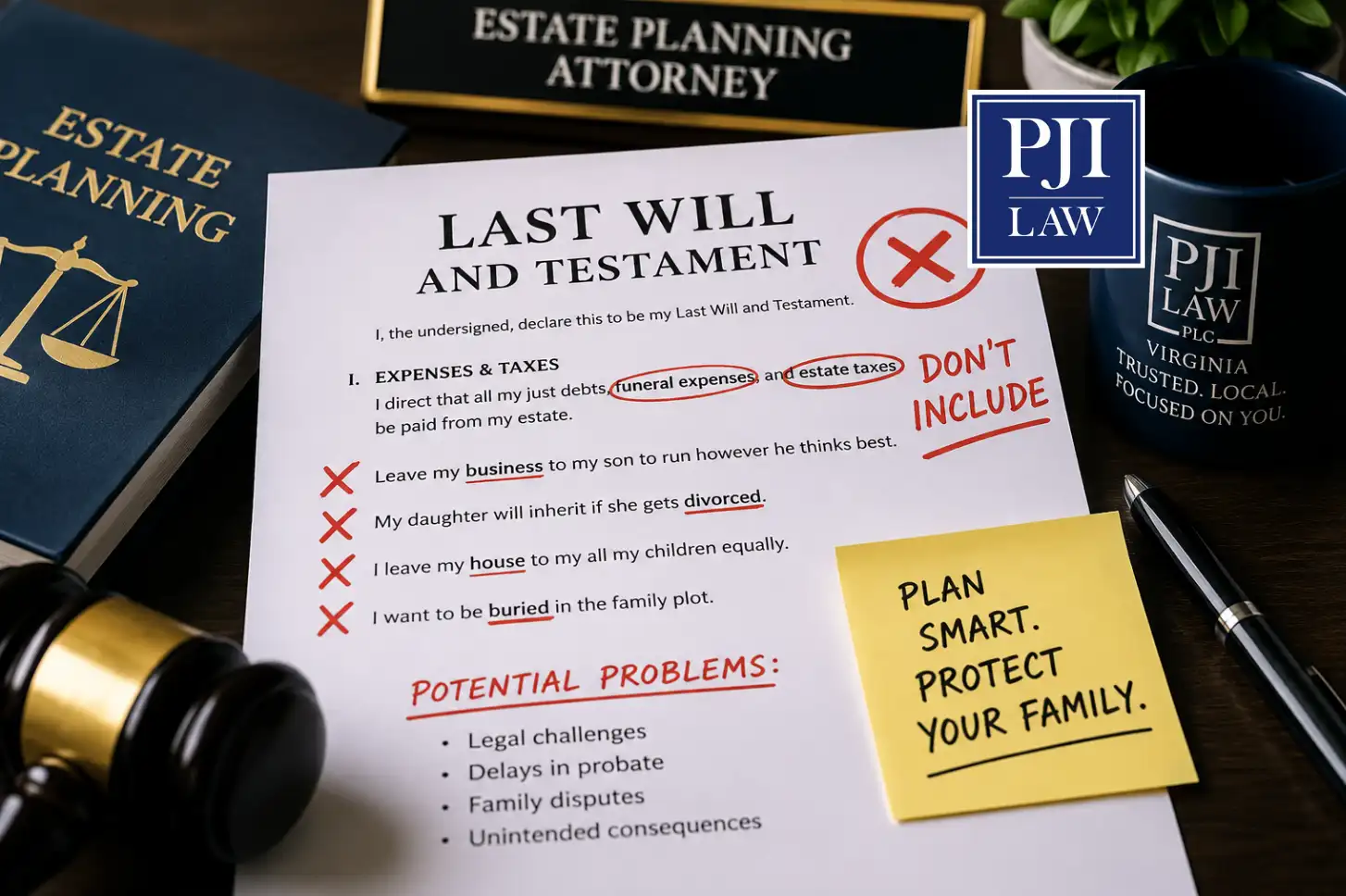
    When you include these assets in your will, you create a conflict between documents. The financial institution follows the beneficiary designation, not your will. Consider this example: a person updates their will after a divorce and leaves everything to their children, but forgets to update a life insurance policy still naming a former spouse.

    After death, the insurance company pays the former spouse. The will doesn’t change that outcome. This is why beneficiary designations must be coordinated with your overall estate planning strategy.

    Jointly Owned Property

    Property held jointly with rights of survivorship passes automatically to the surviving owner. This often includes:

    • Real estate
    • Bank accounts
    • Certain business assets

    If your will attempts to distribute jointly owned property to multiple beneficiaries, the transfer still happens outside of probate. A parent might add one child to a bank account for convenience, intending to divide that money equally among all children later. After death, that account legally belongs to the one child listed as joint owner, which can lead to disputes.

    This rule extends to vehicles, as well. In Virginia, certain vehicle titles may include transfer-on-death or survivorship designations that allow the vehicle to pass outside of probate, regardless of what your will states. This issue isn’t about intent. It’s about how ownership is structured under Virginia law.

    Funeral Instructions as Binding Terms

    Funeral decisions are made within days of death. A will is often not located, reviewed, or admitted to probate until well after those decisions have already been made.

    A person may clearly state they want cremation and a private service. The family, unaware of those instructions, proceeds with a traditional burial. By the time the will is reviewed, those decisions can’t be undone. Funeral instructions should be communicated directly to loved ones and placed in separate documents where appropriate, not buried in a will that may not surface for weeks.

    Conditional Gifts That Create Legal Problems

    You can include certain conditions in a will, but not all conditions are enforceable. Provisions that attempt to control personal decisions, relationships, or beliefs can conflict with public policy. Examples include:

    • Requiring a child to marry within a specific religion to receive an inheritance
    • Conditioning a gift on cutting ties with a partner
    • Restricting distributions based on personal lifestyle choices

    When a court finds these conditions unenforceable, the result is uncertainty about how the distribution should proceed, even when your intent was clear.

    Instructions That Are Illegal or Impossible

    A will can’t direct actions that violate the law or can’t realistically be carried out. Courts will disregard provisions that attempt to:

    • Avoid estate taxes through improper means
    • Hide or misrepresent assets
    • Distribute property in a way that conflicts with legal ownership rights

    That portion of the will is simply set aside, which can alter how the entire estate is distributed. The risk isn’t just that the provision fails. It’s that the confusion it creates affects the broader administration of the estate.

    Assets Better Suited for a Revocable Living Trust

    Some assets can be placed in a will, but doing so may not be the most effective approach for asset protection and efficient distribution. Real estate, business interests, and other high-value assets often benefit from being placed in a revocable living trust instead. This can help avoid probate and allow for more efficient management.

    When these assets are left solely through a will, they must go through the full probate process in Virginia, which can involve:

    • Court oversight and required filings
    • Delays before beneficiaries receive property
    • Months-long proceedings for each property in the estate

    A living trust provides a different structure that can reduce those delays and give beneficiaries a smooth transition of ownership.

    Business Assets Without a Clear Plan

    Business assets require more than a simple transfer instruction in a will. If you own a business, your estate plan should address:

    • Who will manage the business after your passing
    • Whether ownership will transfer to one person or multiple beneficiaries
    • How decision-making authority will be handled

    Without this planning, the business can face operational challenges at a critical time. A business owner may leave equal shares to several children, assuming they’ll work together. In reality, disagreements arise over management, direction, or whether to sell. Estate planning for business interests requires coordination that goes beyond the will itself.

    Distributions That Affect Government Benefits

    If a beneficiary receives government benefits such as Supplemental Security Income, a direct inheritance can create unintended consequences. A sudden influx of assets can instantly disqualify them from the government benefits they rely on.

    A parent may leave funds directly to a child with special needs, intending to provide financial support. Instead, that inheritance can disrupt eligibility under strict Social Security Administration rules, which restrict cash assistance to individuals with limited income and resources. In these situations, a special needs trust is often the better approach. It allows assets to be used for the individual’s benefit without jeopardizing eligibility.

    Why These Mistakes Lead to Legal Challenges

     
    Why These Mistakes Lead to Legal Challenges

    When a will includes conflicting or problematic provisions, it increases the likelihood of legal challenges. Disputes often arise from:

    • The will conflicting with beneficiary designations
    • Instructions that are unclear or contradictory
    • Family members interpreting provisions differently
    • Concerns about undue influence or intent

    These disputes can bring the estate into court, where a judge must interpret the will and resolve disagreements. The probate process is already structured and formal. When disputes are layered on top, it becomes more time-consuming and more expensive, straining relationships among family members during an already difficult period.

    How the Virginia Probate Process Is Affected

    Probate is the legal process through which a will is validated and an estate is administered. The Virginia Judicial System establishes formal requirements for this process, which unfolds within the Circuit Court of the city or county where the individual resided. In Virginia, this involves:

    • Filing the will with the appropriate Circuit Court Clerk
    • Formal qualification of the executor
    • Identification and valuation of assets
    • Payment of debts and taxes
    • Distribution to beneficiaries

    When a will contains problematic provisions, the court may need to step in, leading to additional filings, delays in distribution, and increased legal costs. In some cases, the court may disregard specific provisions while enforcing the rest of the will, which can change how assets are distributed compared to what the testator intended. Issues that surface during probate often cost more to resolve than they would have cost to prevent.

    Looking for an estate planning lawyer to strategically coordinate your will with trusts for more control_

    How to Structure Your Estate Plan to Avoid These Problems

    A well-structured estate plan uses multiple tools, not just a will. The goal isn’t simply to distribute assets, but to create a plan that works under real-world conditions, avoids unnecessary probate issues, and reduces the risk of disputes.

    Use Beneficiary Designations Strategically

    Keeping designations accurate and aligned with your overall plan matters more than most people realize. To stay on top of this:

    • Review beneficiary designations on life insurance policies, retirement accounts, and payable-on-death bank accounts regularly.
    • Update designations after major life events such as marriage, divorce, or the birth of a child.
    • Confirm that the names listed match your current intentions, not outdated decisions.
    • Coordinate these designations with your will so there are no conflicts.

    If these aren’t aligned, your estate plan is working against itself.

    Consider a Revocable Living Trust for Key Assets

    A revocable living trust can be a powerful tool when your goal is to avoid probate and maintain control over how assets are managed and distributed. Key advantages include:

    • Placing real estate, high-value accounts, and significant assets outside the probate process
    • Naming a trustee to manage assets if you become incapacitated or after your passing
    • Maintaining privacy, since trust assets don’t go through the public probate process

    For larger estates or those with complex property holdings, this approach is often more efficient than relying solely on a will.

    Create a Clear Succession Plan for Business Interests

    If you own a business, your estate plan should address more than ownership transfer. A complete succession plan for business interests should:

    • Identify who will take over management responsibilities.
    • Decide whether ownership will pass to one person or multiple beneficiaries.
    • Establish a buy-sell agreement if there are business partners.
    • Coordinate your will with other legal documents governing the business.

    Without this level of planning, even a well-run business can face serious disruption after your passing.

    Use a Special Needs Trust When Appropriate

    If a beneficiary relies on government benefits, careful planning is necessary. A special needs trust:

    • Allows assets to be used for the individual’s benefit without affecting eligibility for Supplemental Security Income or other programs
    • Gives you the ability to appoint a trustee who understands how to manage distributions properly
    • Supplements rather than replaces essential benefits

    This protects the person you’re trying to support instead of inadvertently creating a financial problem for them.

    Communicate Funeral Arrangements Outside the Will

    To avoid confusion when it matters most:

    • Share funeral arrangements directly with trusted family members.
    • Put written instructions in a separate document that can be easily located.
    • Discuss your wishes in advance so there’s no uncertainty.
    • Consider designating a person responsible for carrying them out.

    This keeps your loved ones from having to guess during an already difficult time.

    Coordinate All Legal Documents Into One Plan

    Your will is only one part of your estate planning strategy. It should work together with:

    • Trusts and beneficiary designations
    • Account ownership structures
    • Other legal documents addressing debts, taxes, and executor authority

    Revisit your plan periodically to reflect changes in your life, assets, and family structure. When everything is coordinated, your estate plan functions as a complete system rather than a collection of disconnected documents.

    The Risks of DIY and Online Template Wills

     
    The Risks of DIY and Online Template Wills

    DIY wills and online templates are often marketed as simple solutions. In reality, they can create serious legal risk. These documents aren’t tailored to your situation or to Virginia law, and they often fail to account for how assets are titled, how beneficiary designations operate, or how the probate process works.

    Common issues include:

    • Missing or improper witnesses
    • Lack of a self-proving affidavit
    • Vague or conflicting provisions
    • Failure to coordinate with other legal documents

    A person may complete a template will that appears valid on its face. After death, the document could create confusion because it attempts to distribute assets that pass outside of probate, conflicts with beneficiary designations, and/or doesn’t address debts clearly.

    Family members may disagree about how to interpret the will, and the matter ends up in court. Consulting a Virginia estate planning attorney rather than relying on a template or acting as your own lawyer is one of the most effective ways to avoid this outcome.

    What Virginia Law Says About Enforceable Wills

    Virginia will requirements are straightforward on paper, but easy to get wrong without proper legal guidance. The Code of Virginia outlines requirements a will must meet to be valid. To be enforceable, a will must generally:

    • Be signed by the testator
    • Be witnessed by at least two individuals
    • Reflect the testator’s intent
    • Be created without undue influence

    A self-proving affidavit can help streamline the probate process by confirming the will’s validity without requiring witnesses to appear in court.

    Knowing what invalidates a will in Virginia is just as important as knowing how to create one. Even when a will meets execution requirements, specific provisions may still be unenforceable if they conflict with the law or public policy. Compliance isn’t just about proper execution. It’s about structure, education around your options, and alignment with legal standards that govern how Virginia courts interpret testamentary documents.

    Common Mistakes That Lead to Disputes Among Family Members

    Disputes rarely arise from one issue alone. They develop from a combination of unclear planning and unmet expectations. Common problems include:

    • Leaving unclear distribution instructions
    • Failing to address prior financial support given to one child
    • Overlooking changes in family structure
    • Not updating documents after major life events

    When these issues are present, family members may interpret the will differently, which can delay the probate process, increase costs, and affect relationships for years. The majority of these disputes are preventable. They stem not from bad intentions, but from estate plans that weren’t built to account for real-world complexity.

    What Belongs in Your Will

    How Proper Estate Planning Protects Your Wishes

    Estate planning is about more than distributing assets. It’s about creating a plan that works when it counts. A thoughtful plan can:

    • Reduce the likelihood of legal challenges
    • Help avoid probate where appropriate
    • Provide asset protection for valuable property and business interests
    • Give beneficiaries a clear path forward

    When each element is structured properly, your wishes are more likely to be carried out as intended.

    Frequently Asked Questions

    Can a will override beneficiary designations?

    No. Beneficiary designations control those assets regardless of what your will states.

    Can you include bank accounts in a will?

    You can only include bank accounts in a will if they don’t already have payable-on-death designations. If they do, the designation controls the transfer.

    What happens if part of a will is invalid?

    A court may disregard that portion and enforce the rest of the will, but this can affect the overall distribution of the estate.

    Can a will affect government benefits?

    Yes. Direct distributions can affect eligibility for Supplemental Security Income and other government benefits.

    Do you need an estate planning attorney?

    While not legally required, working with an estate planning attorney rather than acting as your own lawyer helps reduce errors, avoids common pitfalls, and produces a plan built around your specific situation and Virginia law.

    Searching online for a wills and trusts attorney in Fairfax, Virginia_

    Build a Will That Holds Up When It Counts

    A will should give your loved ones clarity, not leave them facing confusion, delay, or court involvement. Including the wrong provisions can delay probate, create disputes, and leave your family facing challenges that could have been avoided.

    At PJI Law, PLC, we work with clients across Fairfax and Northern Virginia to build estate plans that reflect their intentions and align with Virginia law. Our estate planning attorneys take the time to review your assets, beneficiary designations, business interests, and family structure so your plan works as intended.

    Whether you’re creating your first will or revisiting an existing one, our team will help you avoid the mistakes that can undermine your entire estate plan.

    Call (703) 865-6100 or contact us online to schedule your complimentary consultation today.

    At PJI Law, you’ll receive white-glove service and personal attention from a team that treats you like family.

    Copyright © 2026. PJI Law, PLC. All rights reserved.

    The information in this blog post (“post”) is provided for general informational purposes only and may not reflect the current law in your jurisdiction. No information in this post should be construed as legal advice from the individual author or the law firm, nor is it intended to be a substitute for legal counsel on any subject matter. No reader of this post should act or refrain from acting based on any information included in or accessible through this post without seeking the appropriate legal or other professional advice on the particular facts and circumstances at issue from a lawyer licensed in the recipient’s state, country, or other appropriate licensing jurisdiction.

    PJI Law, PLC
    3900 Jermantown Road, 2nd Floor
    Fairfax, VA 22030
    (703) 865-6100
    https://pjibe.webteam.ai/

  • Does a Will Have to Be Recorded in Virginia?

    Does a Will Have to Be Recorded in Virginia?

    When someone tells you, “Your will has to be recorded,” that statement can provoke anxiety: Is it something you neglected? Will you lose control of your legacy? As local lawyers for wills based in Richmond, Virginia, we at PJI Law see these concerns often. The answer is nuanced—and important. In Virginia, a will typically becomes part of the public record only once it is admitted to probate and then recorded by the clerk. But many people wonder: Does a will have to be recorded in Virginia? That depends on factors like whether probate is required, whether real property is involved, how the will is proved, and whether someone wants public notice of devise. 

    These choices can feel overwhelming—especially when family members, minor children, second marriages, or complex assets are involved. Below, as Virginia estate planning attorneys, we will explain how “recording a will” works (and when it’s necessary), how the probate process interacts with recording, and how a wills lawyer can guide you to peace and legal clarity. Then we can guide you regarding your specific needs according to your situation during your consultation.

    Overview of Virginia Wills, Probate, and Recording

    Key Terms and Concepts

    Before diving into the central question, let’s clarify some foundational concepts:

    • Legally valid will: In Virginia, a will must be in writing, signed by the testator (or someone acting at his direction), and witnessed by two competent witnesses (or, in limited cases, wholly handwritten with sufficient proof).
    • Self-proving wills: A common practice is to attach a notarized affidavit (signed by testator and witnesses under oath) so that, at death, the court can accept the will without contacting witnesses.
    • Probate process: Probate is the formal process of proving a will before the circuit court in the decedent’s jurisdiction, qualifying a personal representative (executor or administrator), collecting assets, settling debts/taxes, and distributing the remaining estate.
    • Recording a will: Once admitted to probate, the clerk records the will or an authenticated copy in the clerk’s office (often in a “will book”) so it becomes part of the public record.
    • Devise: In Virginia estate law, a devise is a gift of real property—such as land or a home—made through a will, with the recipient called the devisee. While Virginia Code § 64.2-100 now defines “devise” broadly to include both real and personal property, the term is still commonly used to distinguish gifts of real estate from a bequest, which refers to personal property like money or belongings.

    Thus, a will cannot simply be recorded while the testator lives; it is only recorded as part of probate. That is the crux of the answer to “Does a will have to be recorded in Virginia?” for the majority of practical purposes. The facts of your situation will determine the answer for your specific circumstances.

    Virginia estate planning attorney discusses "Does a will have to be recorded in Virginia?” Call (804) 653-3450 to schedule a consultation.

    The Conditions Affecting When a Will Has to Be Recorded in Virginia

    A will has to be recorded in Virginia only after its admission to probate. The will does not need to be recorded while the testator is alive, nor does every scenario require that recording (for example, when no real property is involved or no public notice is needed beyond the local court). The operative phrase from the statute is “every will or authenticated copy admitted to probate … shall be recorded.”

    Below, we break down circumstances and exceptions to help clarify where the requirement applies and where it might not.

    Scenarios When Recording a Will Is Required

    In Virginia, a will needs to be recorded under the following circumstances:

    • When the decedent owned real property or real estate interests: If the testator owned real property and devised it, the personal representative must make sure that certified copies of the will are recorded in the county or city where such real estate is located. That gives public notice of the devise to third parties (e.g., prospective purchasers).
    • Interests in multiple localities: If real property is located in more than one jurisdiction, the will (or certified copy) must be recorded in each relevant locality to appropriately memorialize the devise.
    • Statutory protection for bona fide purchasers: Recording within one year of death is essential to preserve the devise against bona fide purchasers without notice. If a purchaser acquires land without knowledge of the devise and the will is not recorded in time, the devise may not affect that purchaser’s title. § 64.2-456 addresses this protection.

    Situations Where Recording a Will Is Not (or Less Likely to Be) Required

    The following are exceptions in which it is not necessary to record a will in Virginia:

    • No real property involved: If the decedent only held personal property (bank accounts, stocks, personal possessions, etc.) and nothing required probate beyond perhaps small distributions, the need to record in remote jurisdictions is moot. The will must still be admitted and recorded in the local court, but additional recordings in remote counties may not be necessary.
    • No probate (small or insolvent estates): In certain small estates or estates whose entire assets pass outside probate (e.g., via payable-on-death designations, joint accounts with rights of survivorship, or trusts), the will may never be presented to probate at all. In such cases, there is no admission and thus no recording requirement.
    • Testator dies without a will (intestate): If someone dies intestate (without a valid will), then no will is admitted in the first place, and nothing is recorded as a will. The estate administration proceeds under intestacy statutes.

    Thus, the practical effect is that a will is recorded only when necessary in relation to probate and real property. That means the question “Does a will have to be recorded in Virginia?” is more accurately answered: “It must be recorded after probate, when required by statute, especially if real property is concerned.”

    Virginia estate planning attorney discusses "Does a will have to be recorded in Virginia?” Call (804) 653-3450 to schedule a consultation.

    Associated Difficulties and Real-World Risks If You Do Not Properly Record Your Will in Virginia

    It’s not enough to know whether recording is technically required. Many of the issues people fear, such as family disputes, hidden claims, and defective titles, stem from missteps about whether and where to record.

    The following are some of the common issues we see as local lawyers for wills in Virginia:

    1. Title disputes and clouded real property: If a will is not recorded in the proper county, a purchaser or mortgage lender might not see the devise. Later, heirs or devisees may dispute ownership, leading to costly litigation or demands to reverse transactions.
    2. Delayed distribution to beneficiaries: When probate is contested because the will wasn’t properly proved or recorded, the executor can’t move forward with distributing assets, leaving family members in limbo, especially in second marriage or blended family cases.
    3. Increased legal costs and fiduciary litigation: Fiduciary litigation may arise when heirs accuse the personal representative of failing to record or assert rights. That leads to contested litigation over the validity of the will or accounting.
    4. Confusion among loved ones: Especially when minor children are involved, failure to properly record or publicize the will may lead to uncertainty about guardianships, inheritance rights, or delayed support to children and spouse.
    5. Missed statutory deadlines: The one-year deadline to record a will for protection against bona fide purchasers is absolute under § 64.2-456; missing that window can forfeit a devise.
    6. Multiple jurisdictions and decentralization: If the decedent’s property spans Chesterfield County, Henrico County, Fairfax County, or elsewhere, failing to record in all required localities leaves gaps.
    7. Trusts and revocable living trusts interplay: Some clients believe that placing assets in a revocable living trust entirely removes the need for recording or probate, but real property not transferred into the trust may still require will admission and recording. Coordination is essential.
    8. Changing life circumstances: After divorce, remarriage, or business changes, a will must be updated or revoked. If a legacy devise to a former spouse remains but is not recorded properly in line with current statute, confusion arises.

    These concerns reinforce why clients should work with a local attorney versed in Northern Virginia’s realities. A skilled Virginia estate planning attorney can help you design documents that reduce the need for probate, coordinate multiple jurisdictions, and guide your executor in properly recording wills where needed.

    Q&A: Important Considerations Regarding Recording a Will in Virginia

    Below are frequently asked questions regarding recording a will in Virginia, along with concise answers.

    Q: If I live in Richmond but have property in another county, do I need to record the will there, too?

    Yes. Under Virginia Code § 64.2-455, the personal representative must record a certified copy of the will in any locality where the decedent owned real property or where the will disposes of real estate.

    Failure to do so may prevent devise claims from being enforceable against third parties without notice.

    Q: Can I bring my will to the circuit court and have it recorded now, before my death?

    No. A will must first be admitted to probate before it can be recorded. The clerk’s role to record exists only after the court authenticates the will via probate. Until then, your will remains a private document.

    Q: Must I use a self-proving will to simplify recording?

    While not strictly required, a self-proving will greatly simplifies the probate and recording process. If a will includes a notarial affidavit, the court may admit it without having to locate witnesses to testify. That reduces delays and costs. If the will is not self-proving, one or more witnesses may have to appear or provide a deposition.

    Q: What happens if the will is not recorded within one year of probate?

    Under § 64.2-456, a bona fide purchaser without notice may avoid the devise if the will is not admitted and recorded within one year after death. That means the purchaser may take title free of the devise, leaving the intended beneficiary with no enforceable claim.

    Q: Does the recording requirement apply to trusts or revocable living trusts?

    Not directly. The statutory requirement to record arises only for wills admitted to probate. If assets are entirely within a revocable living trust, the will may not be probated at all. But if you fail to fund the trust with real property and leave residual property under your will, that will still need admission and recording. Be sure to coordinate will and trust together.

    Q: Must I record documents like advance medical directives, a living will, durable power, or health care directives?

    No. Those sensitive documents are typically kept private and do not go through probate or recording in the public record. They operate during life (for incapacity) rather than at death.

    Q: Can someone contest the will during the recording step?

    Yes. Any interested party may appeal the clerk’s probate decision (including admission or denial) within six months of the order. That is part of Virginia’s probate proceedings structure. If contested, the recording could be delayed until resolution.

    Q: What if the will is handwritten (holographic)? Do special recording rules apply?

    Virginia does allow wholly handwritten wills under certain strict proof rules. But even if admitted, they must be recorded like any other will. Proof standards are more demanding (proving handwriting, intent, etc.).

    Q: How do I find a local attorney for wills who understands Northern Virginia’s courts?

    Seek a Virginia estate planning attorney in Richmond or surrounding counties with experience in trusts, estate administration, and probate in Richmond, Arlington, Loudoun, Prince William, Henrico, Chesterfield, and Fairfax. Interview prospective attorneys about their experience in wills, probate procedures, and recording practices. Local lawyers for wills will understand the particular rules and clerk procedures in each jurisdiction.

    Virginia estate planning attorney discusses "Does a will have to be recorded in Virginia?” Call (804) 653-3450 to schedule a consultation.

    When and How Wills Are Recorded in Virginia

    The type of will and other circumstances come into play when determining when and how wills need to be recorded in Richmond, Virginia.

    Statutory Requirement: Virginia Code § 64.2-455

    Virginia law is clear that, once a will is admitted to probate (or an authenticated copy is so admitted), it must be recorded by the clerk of the circuit court and remain in the clerk’s office (except under limited circumstances).

    The statute further provides:

    “Every will or authenticated copy admitted to probate by any circuit court or clerk … shall be recorded by the clerk and remain in the clerk’s office … A certified copy … may be recorded in any county or city wherein there is any estate, real or personal, devised or bequeathed by such will.”

    Further, subsection (B) requires the personal representative to cause a certified copy of the will to be recorded in any locality (county or city) where real property of the decedent is located or is being devised.

    Once recorded, the will (or certified copy) operates as public notice of the devisees’ interest in real property in that jurisdiction.

    So, for estates involving real property, the recording requirement serves as constructive notice to third parties (e.g., potential purchasers) of claims under the will.

    Virginia also protects bona fide purchasers without notice of a devise; unless the will (or certified copy) is admitted to probate and recorded within one year of death, such purchasers may be shielded from certain claims. § 64.2-456 of the Virginia Code addresses this scenario.

    Probate and Recording: The Practical Sequence

    As we explain below, a will in Virginia must be recorded once it is admitted to probate:

    1. Filing the Will for Probate: The person (often the designated executor) presents the original will and death certificate to the circuit court in the jurisdiction where the decedent resided (or where real property is located) to qualify as personal representative and admit the will.
    2. Proof of the Will: The requirements differ by the type of will:
      • For a self-proving will, the attached notarized affidavit suffices, and the court will typically admit it without contacting witnesses.
      • For a will without the self-proving affidavit, one of the witnesses (or both) must often be summoned to testify or give a notarized statement about execution.
      • For purely handwritten (holographic) wills, proof must show that the entire document is in the testator’s handwriting and that the testator intended it as a will, with testimony from at least two disinterested witnesses (unless older statutes apply).
    3. Clerk Admits and Records the Will: Once admitted, the clerk records the will or an authenticated certified copy in the will book of the clerk’s office (i.e., the permanent public record). The recorder indexes it, typically by grantor (testator) name, so anyone searching the deed or will indices may locate it.
    4. Recording Copies Where Real Property Lies: If the decedent held real property in multiple counties or cities, the personal representative must cause certified copies of the will to be recorded in those jurisdictions so that devisees’ interests in local real estate are publicly noted.
    5. Public Notice and Effect: Upon recording, any purchaser or third party is on notice of the devise in that jurisdiction. That serves to protect devisees and prevents later disputes over ownership of real property.

    Thus, by statute, once a will is admitted to probate, it must be recorded — but only after that admission, not before. In other words, a living testator (person yet alive) cannot record their will in the clerk’s office in advance, as the clerk’s authority to record arises only by the act of probate.

    Virginia estate planning attorney discusses "Does a will have to be recorded in Virginia?” Call (804) 653-3450 to schedule a consultation.

    How an Estate Planning Attorney Helps with Recording and Avoiding Problems in Richmond, Virginia

    Working with a Virginia estate planning attorney yields several advantages:

    1. Strategic drafting: A good wills lawyer makes sure your will is legally valid, includes a self-proving affidavit, coordinates properly with trusts, and addresses life changes (e.g., second marriages, divorce, children, minor children, co-owner of real property).
    2. Clerk and circuit court coordination: Local attorneys know the particular rules and deadlines of Richmond, Henrico, Chesterfield, or Fairfax courts. They help to manage the correct submission of the original will, required forms, affidavits, and indexing.
    3. Assisting executors: After your death, your attorney can guide your executor through the probate process, handling proof of wills, recording, preparing inventory and accounting, and liaising with the Commissioner of Accounts.
    4. Multi-jurisdictional property: For clients with real property across counties (or in Richmond, Chesterfield, Henrico), the attorney plans how to record in each needed locality, protecting devise rights across jurisdictions.
    5. Conflict prevention and fiduciary protection: A well-drafted will reduces ambiguity and decreases the risk of future fiduciary litigation. If disputes do arise, the attorney can help defend the estate and represent fiduciaries or beneficiaries.
    6. Probate avoidance strategies: The attorney helps you use trusts, joint ownership, beneficiary designations, and other techniques to reduce the need for probate and minimize public exposure.
    7. Updates over time: As life changes occur (marriage, second marriages, births, divorces, business interests), you’ll need to revise your plan so that your will’s provisions remain aligned with your wishes and the law.

    What Happens in Richmond, Virginia

    To give you a more concrete sense, here’s how the process typically plays out in Richmond, Virginia:

    After death, the named executor contacts a local lawyer and the Richmond Circuit Court Clerk’s Office, submits the original will and a certified death certificate, and applies for probate. The application is made in the city where the decedent resided at the time of death. In this case, it is the City of Richmond. If the decedent lived outside the city but owned real property in Richmond, probate can alternatively be initiated in the jurisdiction where the property lies.

    If the will is self-proving, the clerk or court can usually admit it to probate without requiring witnesses to appear. If it is not self-proving, one or more of the witnesses who signed the will may need to provide an affidavit or appear before the clerk or judge to verify that the will was properly executed.

    Once the will is admitted to probate, the Richmond Circuit Court Clerk records it in the will book maintained in the clerk’s office and indexes it under the testator’s name. This step makes the will a matter of public record, as required by Virginia Code § 64.2-455.

    If the decedent owned real property in other localities—for example, in Henrico County, Chesterfield County, or elsewhere in Virginia–then the executor must secure a certified copy of the recorded will from Richmond and record that copy in each locality where real estate is located. This serves as public notice of the devise and helps protect the interests of the beneficiaries.

    After probate, the executor must complete the next stages of estate administration: preparing and filing an inventory of the estate, notifying heirs and beneficiaries, paying any outstanding debts and taxes, and submitting required accountings to the Commissioner of Accounts assigned by the Richmond Circuit Court. The Commissioner of Accounts reviews and approves each filing to verify that the executor is handling all assets, funds, and distributions appropriately.

    When all debts, taxes, and distributions are finalized, the executor files a final accounting with the Commissioner of Accounts, and the estate is closed.

    The advantage of working with a local attorney for wills familiar with Richmond’s Circuit Court is that they understand the city’s probate appointment procedures, required forms, and communication process with the Commissioner of Accounts. A Richmond wills lawyer helps keep the process organized, timely, and compliant with Virginia’s estate administration laws, including proper recording of wills in the necessary jurisdictions.

    Practical Tips for Clients and Families

    • Always keep the original will in a safe but accessible place (e.g., in the possession of a trusted person or law firm). The probate clerk will not accept copies.
    • Attach a self-proving affidavit at execution to avoid the hassle of locating witnesses later.
    • Inform your executor about the location of the will, your goals, and whether you own property in multiple counties.
    • After the testator’s death, communicate early with an attorney so that the executor can follow proper steps: file for probate in time, record the will, schedule filings to the Commissioner of Accounts, and meet account deadlines.
    • Update your will after major life events (e.g., divorce, second marriages, births) to keep it properly drafted and to avoid unintended consequences.
    • Ask your attorney to map out a recording plan for jurisdictions where you own real estate (Richmond, Henrico, Chesterfield, Fairfax, etc.).
    • Make sure the executor understands the timeline for recording. The one-year statute for protecting devise rights under § 64.2-456 is firm.

    Schedule a Consultation with PJI in Richmond, Virginia

    To sum up the answer to the question of whether a will has to be recorded in Virginia, the answer is yes — but only after it is admitted to probate, and the requirement is most meaningful when real property is involved. A will is not recorded while the testator lives. The statute compels recording by the clerk of any will admitted to probate, and certified copies must be recorded where real estate lies. Failing to record on time can jeopardize the enforceability of devises, especially with bona fide purchasers.

    Because of these technical rules and jurisdictional quirks, working with a local attorney for wills is wise. The attorney makes sure your will is properly drafted, self-proving, coordinated with trusts or powers, and that your executor follows each of the required steps to record in the correct localities. With proper guidance, you reduce the risks of title disputes, fiduciary litigation, and delays in distributing assets to your loved ones.

    If you are in Richmond or Northern Virginia and you want a free consultation to discuss your will, trust, or estate plan, contact PJI Law. Call us at (804) 653-3450 or complete our online form to schedule your consultation today. Our team of local lawyers for wills stands ready to assist you with estate administration, probate questions, recording matters, and long-term planning to protect your legacy and provide peace to your loved ones.

    Copyright © 2025. PJI Law, PLC. All rights reserved.

    The information in this blog post (“post”) is provided for general informational purposes only and may not reflect the current law in your jurisdiction. No information in this post should be construed as legal advice from the individual author or the law firm, nor is it intended to be a substitute for legal counsel on any subject matter. No reader of this post should act or refrain from acting based on any information included in or accessible through this post without seeking the appropriate legal or other professional advice on the particular facts and circumstances at issue from a lawyer licensed in the recipient’s state, country, or other appropriate licensing jurisdiction.

    PJI Law, PLC
    4108 E Parham Rd, 
    Richmond, VA 23228
    (804) 653-3450
    https://pjibe.webteam.ai/

  • What is a Holographic Will in Northern Virginia?

    What is a Holographic Will in Northern Virginia?

    Estate planning honors your wishes, protects your assets, and cares for your loved ones after your passing. When you work with an estates attorney to make important decisions and establish the proper estate planning documents for your unique family dynamics, circumstances, and goals, they will recommend a last will and testament. In this legal document, you can leave money, property, and other possessions to the individuals you designate. If you have minor children, you can also name guardians to care for them and raise them according to your values, should you tragically pass away before they reach adulthood.

    However, many individuals in Northern Virginia who seek our estate planning services often ask,  “What is a holographic will?”

    For these clients, creating a formal will feels overwhelming or unnecessary. This blog, from a knowledgeable Northern Virginia estate planning lawyer, explains holographic wills, the criteria they must meet to comply with state law, and what can happen when someone chooses to create a holographic will.   

    Defining a Holographic Will

    A holographic will is a last will and testament that the testator (the person creating the will) entirely writes and signs in their handwriting. Whereas a formal will requires witnesses or notaries, a testator often establishes a holographic will under urgent circumstances or when they cannot consult an estate planning lawyer for formal document preparation. Most notably, holographic wills arise under emergencies, when a person does not have access to lawyers or a legal team that can help them establish a formal will. 

    How to Create a Legally Binding Holographic Will in Fairfax County & Northern Virginia

    State law requires the following criteria:

    Age and Mental Capacity

    The testator must be at least 18 and of sound mind.

    Written Entirely by Hand

    The testator must hand write the entire holographic will. Virginia prohibits typed or pre-printed text.

    Testamentary Intent

    In the legal document, the testator must indicate their intent to establish a will to have their assets distributed after their death.

    Signature

    The Testator’s signature must be on the will, usually at the end of the document.

    Witnesses

    Virginia does not require the presence of witnesses to a holographic will at the time the testator signs it. However, after the testator’s death, at least two disinterested witnesses must testify to the accuracy of the deceased testator’s signature in court.

    Creating a Holographic Will in Fairfax County & Northern Virginia

    You should consult an estate planning lawyer when establishing a will in Fairfax County and throughout Virginia, to comply with all applicable laws. However, knowing how to create a holographic will in case of emergencies or other situations where you do not have access to a law firm is helpful. 

    Write the Entire Will in Your Handwriting

    Virginia requires a testator to entirely write a holographic will. The state forbids any typed or printed text, which could cause the court to deem the will invalid.

    Identify Each Beneficiary

    When naming beneficiaries, be specific. Use their full legal names and addresses to avoid confusion or ambiguity. Describe the relationship between you and the beneficiary, such as “my wife,” “my daughter,” or “my friend.”

    Detail Asset Distribution

    How should your assets be properly distributed? Be precise when describing each asset, including real estate properties, personal belongings, bank accounts, investments, jewelry, and other valuable items.

    Appoint an Executor/Personal Representative

    Designate a trustworthy individual as the executor or personal representative of your estate. This person assumes responsibility for paying outstanding taxes, debts, and court costs, and managing and distributing your assets according to the terms of your will. Include the executor/personal representative’s full name and address for clarity.

    Include Guardianship Provisions (if applicable)

    Do you have minor children or dependents? Identify a guardian for them in your will in the event of your death. This should be done only after obtaining the consent of the appointed individual. 

    Sign the Will

    The testator must sign the holographic will, preferably at the end of the document. Virginia does not mandate that the testator date the will, but including the date helps prevent any challenges to the will’s authenticity or the testator’s mental capacity when they signed the will.

    Although holographic wills are legal, our estate planning law firm in Fairfax County strongly advises against them. Due to concerns relating to authenticity, proper execution, and possible ambiguities, a judge is likely to deem the will invalid during probate.

    For more information, we invite you to read our blog, An Experienced Estate and Wills Attorney Answers Common Questions About Wills.

    Dying Without a Will in Virginia

    If you die without a valid will (holographic or formal), the state considers you to have died “intestate.” In such a case, Virginia’s intestacy laws dictate the distribution of the deceased’s estate during probate, relying on their surviving relatives and their relationship with the deceased. 

    For more information, we invite you to read our blog, The Disadvantages of Dying with No Will in Virginia.

    Why You Should Consult Estate Planning Attorneys

    While creating a holographic will might seem convenient, it often introduces unnecessary risk for you and your family. Estate planning is about more than just dividing property; it’s about caring for your family and other loved ones and preserving your legacy according to your wishes. At PJI Law, we offer personalized comprehensive estate planning services designed to suit your unique circumstances and family.

    We work closely with every client, taking the time to truly understand your family values and goals. Whether it’s drafting a personalized will, establishing a revocable living trust, engaging in ongoing asset protection strategies, or creating advance medical directives, we provide clarity and confidence in an often-complicated process.

    Secure Your Future & Legacy with PJI Law in Fairfax, VA

    Have you been typing “attorney for wills near me,” “will lawyer,” or “estate planning attorney” into your search bar? 

    If you’ve been considering writing a will, we encourage you to think beyond immediate fixes like holographic wills. Instead, contact the estate planning attorneys at PJI Law to establish a solid, detailed, and legally sound plan.

    In addition to wills, our practice areas include advance medical directives, irrevocable trusts, revocable living trusts, charitable trusts, power of attorney documents, and assistance with the probate process and trust administration.

    Contact PJI Law in Fairfax, Virginia at (703) 865-6100 or complete our online form to schedule a consultation.

    At PJI Law, you’ll receive personalized service and attention!

    Copyright © 2025. PJI Law, PLC. All rights reserved.

    The information in this blog post (“post”) is provided for general informational purposes only and may not reflect the current law in your jurisdiction. No information in this post should be construed as legal advice from the individual author or the law firm, nor is it intended to be a substitute for legal counsel on any subject matter. No reader of this post should act or refrain from acting based on any information included in or accessible through this post without seeking the appropriate legal or other professional advice on the particular facts and circumstances at issue from a lawyer licensed in the recipient’s state, country, or other appropriate licensing jurisdiction.

    PJI Law, PLC
    3900 Jermantown Rd, 2nd Floor
    Fairfax, Virginia 22030
    (703) 865-6100
    https://pjibe.webteam.ai/

  • Living Will vs. Will in Richmond, Virginia: What Is the Difference?

    Living Will vs. Will in Richmond, Virginia: What Is the Difference?

    When planning for the future, you must understand the legal documents available to uphold your wishes and protect your loved ones. Concerning estate planning documents, clients often ask us about living will vs will. While these legal instruments sound similar, they serve entirely different purposes. This blog, from a Richmond estate planning attorney, clarifies the differences between these two estate planning documents that are part of a will-based estate plan.

    What is a Will?

    The foundation of a comprehensive estate plan, a will, or a “last will and testament,” is a legally binding document that takes effect upon your passing. It distributes your property and assets according to your wishes.

    A well-designed will can:

    • Specify the distribution of your assets among heirs.
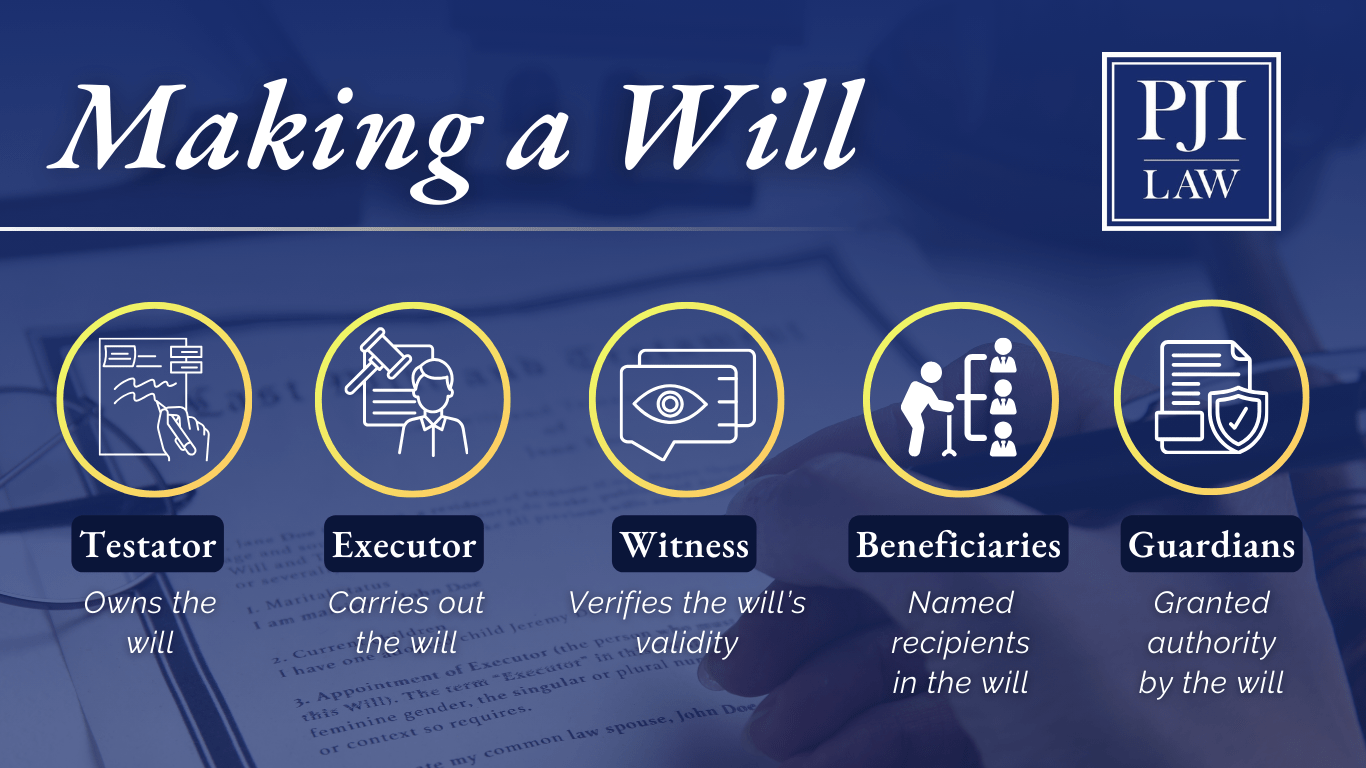
    • Designate a personal representative to handle the probate process and asset distribution according to the terms of the will
    • Name guardians to care for minor children in your absence.
    • Support charitable causes by directing a portion of your assets to organizations you care about.

    Living Will vs. Will in Richmond, Virginia: What Is the Difference?

    A Living Trust and a Pour-Over Will

    If you have established a living trust at the recommendation of Richmond estate planning attorneys, they will advise you of the importance of a trust-based estate plan that includes a pour-over will. This type of will transfers any assets you might have accidentally left out of your living trust into the trust.

    For more detailed information on this aspect of estate planning, we invite you to read our blog, What Is a Pour-Over Will in Richmond, Virginia?

    Why is a Will So Important for Estate Planning?

    Although a will does not avoid probate like a revocable living trust, your estate may fall under intestate laws without a comprehensive will, which could lead to outcomes that don’t align with your wishes.

    When creating your will with the guidance of attorneys that do wills, you will designate a trustworthy individual to act as your personal representative. It should be someone who can manage the complexities of the probate process, comply with probate law, facilitate your estate administration effectively, and communicate well with your surviving family members and other loved ones named as beneficiaries.

    If you have minor children, your Richmond estate planning attorney will assist you in determining the right individual or individuals to assume guardianship for them if you should pass away. While this person does not have to be a family member, it should be someone committed to protecting your children and raising them according to your values.

    For more information, we invite you to read our blog, The Disadvantages of Dying With No Will in Virginia.

    What Makes a Will Legally Valid in Richmond, Virginia?

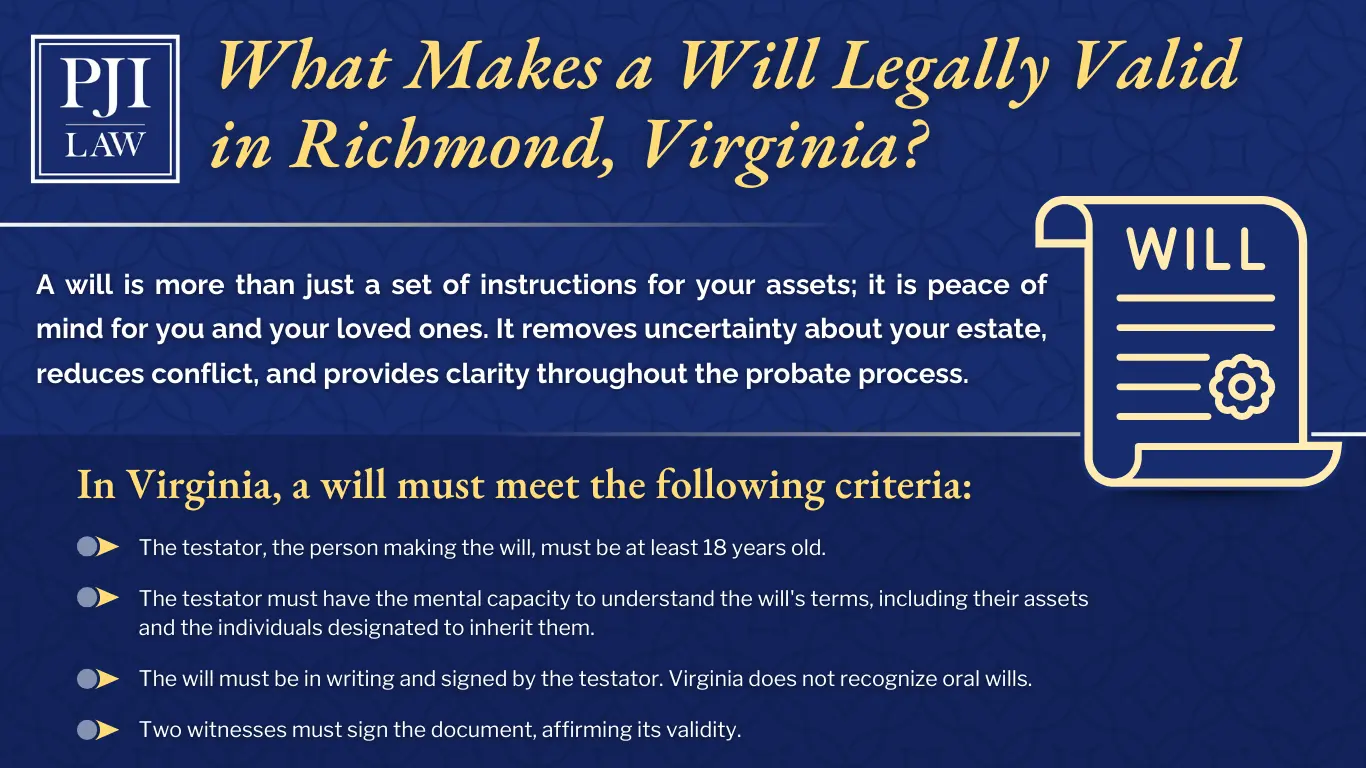
    A will is more than just a set of instructions for your assets; it is peace of mind for you and your loved ones. It removes uncertainty about your estate, reduces conflict, and provides clarity throughout the probate process during a time when your family and other loved ones grieve your death. As such, Virginia estate planning lawyers know that to fulfill all legal requirements in Virginia, a will must meet the following criteria:

    • The testator, the person making the will, must be at least 18.
    • The testator must have the mental capacity to understand the will’s terms, including their assets and those designated to inherit them.
    • The will must be in writing and signed by the testator. Virginia does not recognize oral wills.
    • Two witnesses must sign the document, affirming its validity.

    Living Will vs. Will in Richmond, Virginia: What Is the Difference?

    The Estate Administration & Probate  Process in Richmond, Virginia

    When a person passes away, their will undergoes probate. Probate is the legal procedure for transferring assets from the deceased individual to their heirs or beneficiaries. Probate involves:

    • Proving the will’s validity in court.
    • Identifying and inventorying assets.
    • Settling any outstanding debts or taxes owed by the estate.
    • Distributing remaining assets to beneficiaries according to the terms of the will.

    While this process can be lengthy and complex, a comprehensive and legally valid will can streamline probate and reduce potential conflicts among family members.

    Making Changes to Your Will

    As circumstances change throughout your life, you may need to change your will. Common reasons for updating a will may include second marriages, divorce, death, birth of children or grandchildren, and changes in assets, finances, or beneficiaries.

    Discuss these changes to your will with a knowledgeable estate planning attorney in Richmond to maintain your will’s legal validity and accuracy.

    Living Will vs. Will in Richmond, Virginia: What Is the Difference?

    What is a Living Will?

    Unlike a last will and testament, a living will is a directive that applies while you are still alive but cannot make decisions due to incapacity. It outlines your preferences for medical care, such as whether you wish to receive life support or other life-sustaining treatments in specific scenarios.

    While living wills involve planning for unexpected medical emergencies, Virginia laws provide other options, such as advance medical directives, for those preference details. At PJI Law, our estate planning services focus specifically on matters like wills, trusts, probate administration, general powers of attorney and advance medical directives.

    Advance Medical Directive/Healthcare Power of Attorney

    As you embark on estate planning for your future, our law firm recommends creating a healthcare power of attorney or advance medical directive. In this legal document, you can designate a person you trust to make medical decisions for you if you cannot communicate them to others yourself.

    This individual, known as your healthcare agent or proxy, can make decisions ranging from minor medical procedures to life-saving measures on your behalf, depending on the authority you grant them in the healthcare power of attorney or advance medical directive.

    Because your healthcare agent or proxy coordinates with your medical team to respect and implement your treatment preferences, your estate planning attorney will recommend someone trustworthy who is willing to fulfill these responsibilities if and when the time comes. Knowledgeable lawyers in Richmond will establish a legally compliant document that accurately states your desires.

    Other Available Power of Attorney (POA) Options

    Besides healthcare power of attorney, Virginia offers the following options:

    • Durable power of attorney – a durable power of attorney allows you to designate an individual or individuals to manage your finances if you become incapacitated.
    • General power of attorney – a general power of attorney grants broad authority to a person you designate.
    • Limited power of attorney – a limited power of attorney allows you to appoint someone to act on your behalf for specific tasks or transactions.
    • Springing power of attorney – a springing power of attorney only takes effect if you become incapacitated.

    For more information, we invite you to read our blog, What Type of Virginia POA Do I Need?

    Is Business Succession Planning Part of Estate Planning in Richmond, Virginia?

    If you own a business, you know it’s much more than just an enterprise; it is an integral part of your legacy and identity. For these reasons, business planning must be part of your overall estate planning.

    Whether you want your business to succeed after you pass away or plan to keep running it for the foreseeable future, creating a plan with the assistance of a skilled attorney will facilitate a seamless transition. Early planning also allows you to protect your company if you become incapacitated and unable to manage daily operations.

    Our law firm can guide you through the following aspects of business planning:

    • Choosing an exit strategy
    • Establishing a plan for a seamless transition
    • Selecting a successor
    • Connecting with the right advisors for your finances and insurance
    • Limiting taxes

    Contact PJI Law for Personalized Service & Attention to Your Estate Planning Needs, Including Wills

    At PJI Law, we understand the uniqueness of every family’s circumstances; that’s why we take a tailored approach to estate planning based on our clients’ needs and desires. We provide personalized service and attention if you need to create or update your will, establish a durable power of attorney, engage in business succession planning, or manage a probate estate.

    Have you been searching online for “will and estate planning lawyers near me?”

    With clear communication, prompt service, and a comprehensive understanding of your personal story, our Richmond law firm wants to discuss your goals, answer your questions, and protect what’s important to you.

    Contact us at (804) 653-3550 or complete our online form to schedule a consultation. 

    Copyright © 2025. PJI Law, PLC. All rights reserved.

    The information in this blog post (“post”) is provided for general informational purposes only and may not reflect the current law in your jurisdiction. No information in this post should be construed as legal advice from the individual author or the law firm, nor is it intended to be a substitute for legal counsel on any subject matter. No reader of this post should act or refrain from acting based on any information included in or accessible through this post without seeking the appropriate legal or other professional advice on the particular facts and circumstances at issue from a lawyer licensed in the recipient’s state, country, or other appropriate licensing jurisdiction.

    PJI Law, PLC
    4108 E Parham Rd, 
    Richmond, VA 23228
    (804) 653-3450
    https://pjibe.webteam.ai/

  • Who Inherits if a Beneficiary Dies Before the Testator in Richmond, VA?

    Who Inherits if a Beneficiary Dies Before the Testator in Richmond, VA?

    Mary, a Richmond resident, established her estate plan five years ago, believing everything was in order. Her will outlined her wishes, with her brother, Thomas, set to inherit a significant portion of her estate. No one could have anticipated that Thomas would pass away unexpectedly before Mary in a tragic accident. When Mary died a few years later, her family faced surprising and avoidable legal issues. “Who inherits if a beneficiary dies?” they wondered.

    Thoughts about what would happen to the share of Mary’s estate she originally intended for Thomas swirled through their minds. Would it go to his children? Would the entire estate be redistributed among other heirs? Or would Virginia state law dictate a completely different outcome?

    This real-world challenge illustrates why estate planning is much more than creating a document and tucking it into a drawer. As a skilled attorney knows, it requires foresight, adaptability, and professional guidance. At PJI Law, we understand the nuances of Virginia’s estate laws and provide individual attention and personalized legal services to protect your wishes and shield your family from confusion during difficult times.

    This blog, from a wills and probate lawyer, explores how the Commonwealth of Virginia determines the outcome in cases like Mary’s — situations where a named beneficiary predeceases the testator (the person who made the will).

    Continue reading to learn more, then contact our estate planning law firm at (804) 653-3450 for personalized service and attention.

    Who inherits if a beneficiary?

    What Constitutes a Legally Valid Will in Virginia?

    As a reputable estate planning and estate administration law firm in Richmond, we cannot overemphasize the importance of establishing a legally enforceable will. It honors your final wishes and simplifies and expedites the estate administration process for your family members and other loved ones.

    Before we address the issue of beneficiaries dying before testators, let’s review the requirements that make a will a valid legal document in Virginia.

    The Code of Virginia specifies the following criteria:

    1. Age and Capacity: The testator must be at least 18 years old and of sound mind, meaning they understand the aspects and consequences of making a will.
    2. Written: A will must be written in either ink or typewritten. Virginia does not recognize oral wills.
    3. Signature: The testator must sign the document at the end of its contents. If the testator cannot sign the will, another person can sign it on their behalf. However, they must sign it in the presence of the testator and at their direction.
    4. Personal Representative/Executor: In the will, the testator can designate a personal representative, also known as an executor, to handle the estate administration and probate process upon their death. A probate lawyer can recommend the right individual for this role.
    5. Witnesses: Two disinterested and competent witnesses must attest to the testator’s signature by signing the will in their presence.
    6. Intent: The testator must intend that this legal document serve as their last will and testament.
    7. Voluntary: The testator must create the will voluntarily without undue influence, coercion, or duress.

    Benefits of creating a will

    Keep in mind that a will must undergo a public probate process as part of the deceased’s estate administration. During this time, the personal representative/executor designated in the will is responsible for paying debts and any tax obligations owed by the deceased before they can distribute assets to the primary beneficiary and other named heirs.

    For more information, we invite you to read our blog, What Does It Mean to Be an Executor of Estate in Richmond, Virginia?

    Who inherits if a beneficiary dies?

    What Happens When a Beneficiary Dies Before the Testator?

    Under state law, if a beneficiary dies before the testator, several possibilities determine what happens to the intended inheritance. These outcomes depend on critical factors, including how the will is written, whether it names alternate beneficiaries, and how the specific provisions of Virginia’s law concerning an estate apply.

    Understanding the “Lapse” Rule in Virginia

    If Mary’s will simply named Thomas as a primary beneficiary without additional instructions about what to do if Thomas predeceased her, the legal principle of “lapse” would apply. The term “lapse” simply means the gift intended for the deceased beneficiary fails, or “lapses.” When this occurs, the intended gift typically becomes part of the residuary estate, which is then distributed according to the terms of the will or, in some cases, according to Virginia’s intestacy laws.

    To learn more, we invite you to read our blog, The Disadvantages of Dying with No Will in Virginia.

    However, Virginia has a layer of protection for certain beneficiaries in the form of its anti-lapse statute.

    Virginia’s Anti-Lapse Statute

    Virginia Code § 64.2-418 states that if a deceased beneficiary was a relative of the testator — specifically, a descendant, ancestor, sibling, or descendant of a sibling — the gift will pass to the deceased beneficiary’s descendants unless a will clearly states otherwise. For example, if Mary named Thomas as her primary beneficiary and he had children, his share would automatically pass to his kids unless Mary explicitly wrote a clause dictating otherwise.

    This statute keeps family assets within the family circle unless the testator’s will expresses a desire for a different arrangement. It’s a thoughtful approach, but it also highlights the importance of updating your will to account for changes in family dynamics over time.

    Search for Estate Law Firms Near Me

    Real-World Implications

    Returning to Mary’s story, if Thomas had two children, Virginia’s anti-lapse statute could direct an equal division of Thomas’s share between his children. However, Mary’s family could still face complications if her will included ambiguous language or failed to anticipate this possibility.

    For example:

    1. No Alternate Beneficiary Named – If Mary made no mention of an alternate beneficiary, the outcome could rely entirely on the anti-lapse statute or result in the lapsed gift being distributed to other residuary beneficiaries (if any exist).
    2. Conflicting Terms in the Will – If Mary had contradicting clauses in her will or used vague terms like “all my relatives” without listing names, the case could end up in probate court, requiring judicial interpretation.
    3. Intestate Succession Risks – If the residuary estate’s beneficiary had also predeceased Mary, portions of her estate might be distributed according to Virginia’s rules for intestate succession — a result Mary likely tried to avoid.

    Consulting legal counsel in Richmond, Virginia to establish a comprehensive will and updating your will regularly as life circumstances change will help you avoid these unwanted outcomes.

    Virginia Estate Planning

    Virginia Estate Planning is an Ongoing Process, Not a Once in a Lifetime Activity

    At PJI Law, we often meet clients who created their wills ten or twenty years ago when their lives looked very different. Their families grew, relationships evolved, and loved ones passed away. Yet, their estate plans remained frozen in time. Mary’s situation could have been avoided with a quick, proactive update to her planning documents.

    Periodic reviews and revisions to your Virginia estate plan are essential for many reasons:

    • Family Changes: Births, deaths, marriages, and divorces can significantly change how you want to allocate your assets.
    • Life Stage Milestones: If your children are now adults or your grandchildren are born post-document creation, your priorities may shift.
    • State Law Updates: Virginia’s estate planning laws evolve. Staying in compliance with current law keeps your will enforceable and efficient.
    • Avoid Family Disputes: Ambiguities in a will often lead to rifts between family members. Clear, updated plans eliminate confusion and reduce tension.

    When you consult an estate planning attorney from our law firm, we will handle these updates with professionalism and care, always focused on your specific situation and what serves your best interest.

    Proactive Solutions to Avoid Lapse Issues

    To align your estate plan with your true intentions — even in unforeseen circumstances — consider implementing the following:

    Naming Contingent Beneficiaries

    Always include contingent beneficiaries in your will. If Mary’s will had stated, “If Thomas predeceases me, his share shall pass to his children equally,” her family might have avoided confusion altogether. Naming backup beneficiaries provides clarity and reduces reliance on Virginia’s intestate succession law.

    Including Residuary Clauses

    A residuary clause specifies who should inherit the remaining portions of your estate after the distribution of all specific bequests. For example, “I leave the residue of my estate to my niece, Hannah, if Thomas predeceases me” directs unallocated assets as intended.

    Drafting Testamentary Trusts

    For clients with multiple beneficiaries or minor children, establishing a testamentary trust can facilitate the smooth management of assets after their passing. Created through wills, testamentary trusts take effect after the grantor’s (the person creating the trust) death, allowing them to designate the allocation of funds, provide for minors, and avoid leaving potentially large inheritances directly to those who may be unprepared for financial responsibility.

    For example, the grantor can stipulate that their beneficiaries can only receive assets under a specific situation, such as turning 21 years of age. Testamentary trusts offer many benefits, such as giving the grantor control of when and how their heirs receive assets and enabling the grantor to name a trustee to handle trust administration and manage assets until their beneficiaries can claim their inheritance.

    However, unlike other types of trusts, a testamentary trust must undergo the public probate process where the contents of the trust and the decedent’s assets become a matter of public record. There may also be significant court costs to administer a testamentary trust.

    Leveraging Professional Legal Assistance

    Every family’s needs and financial goals are unique. That’s why PJI Law focuses on personalized, detail-oriented estate planning that upholds your desires, protects your legacy, and accounts for future uncertainties. Our estate planning and probate law firm has helped Richmond families prevent the very issues we discuss here.

    Special Considerations in Complex Situations

    Estate planning is not one-size-fits-all. Our law firm recognizes that some circumstances require advanced solutions:

    • Blended Families: Estate planning for blended families requires clarification of your inheritance intentions in situations involving stepchildren, half-siblings, or second marriages.
    • Small Business Owners: For small business owners, business succession planning must be part of their estate planning. Our attorneys help business owners design plans for who will inherit or manage their business if they become incapacitated or pass away.
    • Heirlooms and Personal Property: We assist clients in deciding who will receive sentimental items to prevent disputes among surviving family members.

    Our legal services anticipate and address these intricate scenarios with tailored advice and strategies.

    Building a Legacy with PJI Law

    The attorneys and staff at PJI Law understand that estate planning is not merely transactional — it’s relational. We pride ourselves on forming lifelong partnerships with our clients, serving as a trusted part of their family’s estate planning team. Our legal services prioritize clear and timely communication, so you never have to wonder about the progress of your estate plan or worry that your loved ones will be left with unanswered questions.

    Consider the peace of mind you’ll feel knowing your wishes are crystal clear, your family’s future is secure, and someone is there to guide your loved ones through the probate process when the time comes.

    Contact PJI Law in Richmond, Virginia to Discover How Our Attorneys and Staff Can Help with All Aspects of Estate Planning

    Have you been searching for “estate law firms near me?”

    With the guidance of our Virginia estate planning attorneys, estate planning doesn’t have to be overwhelming. Whether you’re creating your will for the first time or revisiting years-old documents, we’re here to help. By working together, we’ll establish a plan that reflects your values, protects your family, and addresses uncertainties like the possibility of a beneficiary dying before you.

    Contact PJI Law at (804) 653-3450 or complete our online form to schedule a consultation for personalized service and attention.

    Copyright © 2025. PJI Law, PLC. All rights reserved.

    The information in this blog post (“post”) is provided for general informational purposes only and may not reflect the current law in your jurisdiction. No information in this post should be construed as legal advice from the individual author or the law firm, nor is it intended to be a substitute for legal counsel on any subject matter. No reader of this post should act or refrain from acting based on any information included in or accessible through this post without seeking the appropriate legal or other professional advice on the particular facts and circumstances at issue from a lawyer licensed in the recipient’s state, country, or other appropriate licensing jurisdiction.

    PJI Law, PLC
    4108 E Parham Rd,
    Richmond, VA 23228
    (804) 653-3450
    https://pjibe.webteam.ai/

  • Is Your Will Up to Date for the New Year? How to Change Your Will in VA

    Is Your Will Up to Date for the New Year? How to Change Your Will in VA

    As one year ends and a new one begins, it’s natural to think about fresh starts and future goals. Many people make New Year’s resolutions to exercise more, spend less, or finally tackle that cluttered garage. But have you ever thought about whether your will reflects your current wishes and circumstances?

    Life changes quickly—marriages, divorces, new additions to the family, or shifts in your financial situation can all leave your current will out of sync with your intentions. An outdated will can create unnecessary confusion and stress for your loved ones. That’s why the start of a new year is the perfect time to review your will and make any changes to align with your current wishes.

    In this blog, an estate planning attorney from PJI Law, PLC explains when to change your will, how to change your will, and common mistakes to avoid. 

    When Should You Change Your Will?  

    Major life changes often signal the need to update your last will and testament (“will”). Keeping your will current ensures that your estate is distributed according to your wishes and can prevent potential disputes among your heirs. Common triggers for updating your will include:

    • Marriage, Divorce, or Remarriage: Entering into or ending a marriage significantly alters your personal and financial circumstances. After getting married, you may want to include your spouse as a beneficiary or appoint them as an executor. In the event of a divorce or remarriage, it’s important to revise your will to reflect these changes, which might involve removing a former spouse or adding new family members such as stepchildren.
    • Birth or Adoption of Children or Grandchildren: Welcoming a new child or grandchild into your family is a joyful event that also necessitates updating your will. Adding them as beneficiaries ensures they are provided for in your estate plan. You may also wish to appoint a guardian for minor children to care for them if something happens to you.
    • Death of Beneficiaries or Executors: If someone named in your will—whether a beneficiary, executor, or guardian—passes away, you’ll need to update your will accordingly. This ensures your assets are distributed as you intend and that capable individuals are in place to manage your estate.
    • Significant Financial Changes: Major shifts in your financial situation, such as acquiring or selling substantial assets, receiving an inheritance, or starting a new business, can affect how you want your estate distributed. Updating your will allows you to account for these changes and manage any potential tax implications.
    • Changes in Relationships: Relationships evolve over time. If you’ve become estranged from or reconciled with someone named in your will, you may want to adjust your estate plan to reflect your current feelings and intentions.
    • Relocation to a New State: Moving to a different state can impact your estate plan because estate laws vary by state. If you’ve relocated to Virginia from elsewhere, it’s important to review your will to ensure it complies with Virginia’s legal requirements and addresses any state-specific considerations.
    • Desire to Add or Change Charitable Contributions: If you wish to add, remove, or modify charitable donations in your will, updating your estate plan ensures your philanthropic goals are accurately reflected.

    Even if no major changes occur, reviewing your will every three to five years helps confirm it aligns with your current circumstances and wishes. Regular updates provide peace of mind that your estate plan accurately reflects your intentions and can prevent unintended consequences down the road.

    Options for Changing Your Will

    Codicil

    A codicil functions as an amendment to your existing will. This legal document must meet the same requirements as the original will, including witness signatures. Codicils work well for minor changes, such as updating an executor or adding a beneficiary. However, if you need to make multiple changes, drafting a new will is often more efficient.

    Create a New Will

    For substantial changes, writing a new will often proves more effective than using multiple codicils. Your new will should explicitly state that it revokes all previous wills and codicils to prevent any confusion or conflicts. The new document needs to meet all Virginia legal requirements and should comprehensively address your current circumstances.

    Steps to Create a New Will

    The process begins with a thorough inventory of your assets and property. This includes both tangible and intangible assets, such as real estate, vehicles, bank accounts, investments, and digital assets.

    • Determine Beneficiaries: Decide who should receive your assets and in what proportions. Include alternate beneficiaries in case your primary choices are unable to inherit.
    • Choose an Executor: Select someone trustworthy and capable of handling estate administration. Consider naming a backup executor as well.
    • Draft the Will: Work with an attorney to ensure the will complies with Virginia law. This includes having two witnesses present for the signing.
    • Store the Will Safely: Place the will in a secure location, such as a fireproof safe or safety deposit box, and inform your executor where to find it.

    Common Mistakes to Avoid

    • Failing to Revoke Old Wills: Without a clear revocation clause, old wills may cause confusion.
    • Not Updating Beneficiary Designations: Ensure life insurance policies and retirement accounts align with your will. These designations typically override your will’s provisions.
    • Ignoring Digital Assets: Include instructions for managing cryptocurrency, online accounts, and digital photos.
    • Overlooking Tax Implications: While Virginia doesn’t impose an estate tax, federal taxes may apply to larger estates.

    Should You DIY or Consult with an Attorney?  

    Creating or updating a will might seem like a task you can handle on your own with a DIY template or online service. However, even small errors—such as improper witnessing or vague language—can lead to significant issues that delay estate administration or invite disputes.

    Working with an estate planning attorney offers a personalized approach that makes your will legally sound and tailored to your situation. Whether your estate is straightforward or complex, professional guidance can help you make informed decisions and avoid pitfalls. While it may involve an initial investment, consulting with an attorney helps protect your wishes and safeguard your loved ones.

    Is It Time to Change or Create a New Will?  

    As life changes, your will should keep pace. Whether you need to make updates to reflect recent events or start fresh with a new will, PJI Law can help you determine the best path forward. Our estate planning attorneys will review your current will and overall estate plan, providing personalized guidance to make certain that your wishes are clearly documented and legally enforceable.  

    Updating or creating a will is about more than just following Virginia law—it’s about protecting your loved ones and making thoughtful decisions for the future. If you’ve been searching online for “last will and testament attorneys” or “attorney for wills near me,” contact PJI Law instead. Call us at (703) 865-6100 or use our confidential online form to schedule your consultation. Together, we’ll create an estate plan that gives you peace of mind for the new year and beyond. 

    At PJI Law, you’ll receive personalized service and attention!

    Copyright © 2024. PJI Law, PLC. All rights reserved.

    The information in this blog post (“post”) is provided for general informational purposes only and may not reflect the current law in your jurisdiction. No information in this post should be construed as legal advice from the individual author or the law firm, nor is it intended to be a substitute for legal counsel on any subject matter. No reader of this post should act or refrain from acting based on any information included in or accessible through this post without seeking the appropriate legal or other professional advice on the particular facts and circumstances at issue from a lawyer licensed in the recipient’s state, country, or other appropriate licensing jurisdiction.

    PJI Law, PLC
    3900 Jermantown Rd, 2nd Floor
    Fairfax, Virginia 22030
    (703) 865-6100
    https://pjibe.webteam.ai/
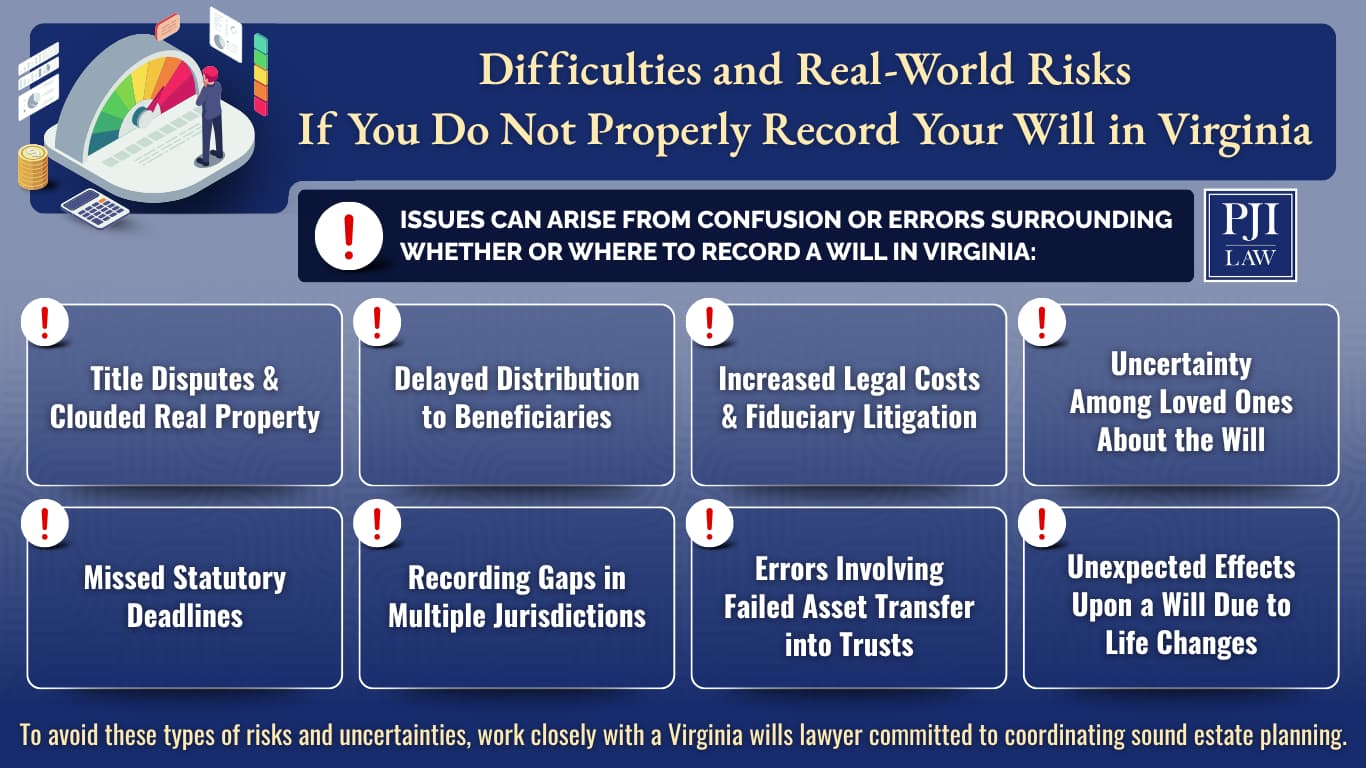
  • The Disadvantages of Dying with No Will in Virginia

    The Disadvantages of Dying with No Will in Virginia

    Whether you’ve spent years building a life, raising a family, and accumulating assets, or you’re just starting your adult journey, have you thought about what would happen if you unexpectedly died due to a natural disaster, accident, or illness? Maybe you think you’re too young to worry about a will or that you don’t have enough to justify one. The truth is, now is the perfect time to start planning for the future, no matter your age or financial status.

    A will isn’t just about distributing your possessions – it’s about protecting your loved ones, expressing your wishes for medical care, naming guardians for your children, and even managing your digital legacy. While it might feel like a topic you’d rather avoid, understanding the consequences of dying intestate (without a will) in Virginia is crucial to safeguarding your family, your values, and your legacy.

    Without a will, these important decisions are left up to the state’s intestacy laws, which might not align with your personal wishes or your family’s needs. So, what happens if you die with no will in Virginia? An estate planning attorney from PJI Law, PLC answers this question and shares what else you need to know.

    What Happens When You Die Without a Will in Virginia?

    When you die without a will in Virginia, you don’t get to decide how your assets are distributed. Instead, the state’s intestacy laws take over, determining who inherits your property based on a predetermined formula. Depending on your situation, this process might not align with your wishes or your family’s needs.

    Your Family May Face Unnecessary Stress and Conflict

    Unintended Beneficiaries

    Without a will, you can’t control who receives your assets. In some cases, Virginia’s intestacy laws might distribute your property to relatives you barely know or didn’t get along with, potentially causing tension within your family.

    Increased Family Disputes

    The absence of clear instructions can lead to disagreements among your loved ones about who should receive what. These disputes can strain relationships and even lead to costly legal battles, depleting the assets you intended to leave behind.

    Your Estate May Incur Higher Costs and Delays

    Lengthy Probate Process

    Dying without a will often results in a more complex and time-consuming probate process. The court must appoint an administrator (can be a family member or even a creditor) to manage your estate, which can take weeks or even months. However, the probate length can vary depending on the complexity of your estate.

    Increased Administrative Expenses

    The extended probate process typically leads to higher legal and administrative fees, reducing the overall value of your estate. These additional costs can include bond requirements for the administrator, which are typically waived if a will names an executor. These additional costs could have been minimized or avoided with a properly drafted will.

    Your Children’s Future May Be Uncertain

    Guardianship Issues

    If you have minor children, dying without a will means you haven’t legally designated a guardian for them. The court will decide who raises your children, potentially choosing someone you wouldn’t have selected yourself. The court will choose based on the best interest of your child, but this decision may not reflect your personal preferences. Contesting a guardianship decision can also lead to family conflict.

    Inheritance Complications

    Without a will, Virginia law determines how your assets are split among your spouse and children. This distribution might not provide adequate support for your children’s specific needs or future education.

    Your Business Interests May Be at Risk

    Lack of Succession Planning

    If you own a business, dying without a will can leave your company in limbo. There’s no clear plan for who will take over or how the business will be managed, potentially jeopardizing its future and the livelihoods of your employees. A comprehensive estate plan, including a will and potentially a trust, can help ensure a smoother transition and protect your business.

    Unintended Partners

    Your business interests might be divided among family members who have no experience or interest in running the company, potentially leading to disputes or forced sales.

    Your Charitable Intentions May Go Unfulfilled

    Missed Opportunities for Giving

    If you’ve always wanted to leave a portion of your estate to a favorite charity or cause, dying without a will means this wish won’t be carried out. Virginia’s intestacy laws don’t make provisions for charitable giving.

    Loss of Tax Benefits

    Charitable bequests in a will can provide tax benefits for your estate. While Virginia does not have an estate tax, your estate could still be subject to federal estate taxes. Without a will, you miss out on these potential advantages, possibly leaving your heirs to deal with the consequences of a larger tax burden.

    Your Digital Assets May Be Lost or Mishandled

    Inaccessible Accounts

    In today’s digital age, many of us have valuable or sentimental assets stored online. These can include everything from social media accounts to cryptocurrency or cloud-stored photos. Without instructions in a will, your family might struggle to access or manage your digital accounts, potentially losing important information or memories.

    Privacy Concerns

    Without clear directions, your digital legacy could be mishandled, potentially exposing private information or leaving your online presence in a state you wouldn’t have wanted. Having a plan in place for your digital assets can help prevent this.

    You Miss the Chance to Leave a Personal Legacy

    No Final Messages

    A will provides an opportunity to leave personal messages or explanations to your loved ones. Without one, you miss the chance to provide closure or express your final thoughts and wishes.

    Loss of Family Heirlooms

    Without specific instructions, family heirlooms or items of sentimental value might not reach the intended recipients, potentially losing their significance or causing family discord.

    The Importance of Creating a Will

    Now that you understand the disadvantages of dying without a will in Virginia, it’s clear that creating one is a crucial step in protecting your assets and loved ones. A well-crafted will gives you the power to make important decisions that align with your values and wishes, providing peace of mind for you and your family.

    With a will, you gain control over vital aspects of your legacy. You can designate who will care for your minor children, ensuring they’re raised by someone you trust. Your property and possessions will be distributed according to your wishes, not state law. If you own a business, you can outline your succession plan, protecting your life’s work. You can even leave a lasting impact by designating gifts to causes you care about. In our increasingly digital world, a will also allows you to provide instructions for handling your online accounts and assets.

    While Virginia’s Small Estate Act can simplify probate for limited assets in certain situations, having a will can make the process smoother for estates of any size. Remember, estate planning is not just for the wealthy or the elderly. No matter your age or financial status, having a will is a fundamental part of responsible adult life. It’s about taking control of your legacy and showing your love for your family through careful planning. By taking the time to create a will, you’re not just putting your affairs in order – you’re providing clarity and direction for your loved ones during a difficult time, ensuring that your life’s work and values continue to have an impact, even after you’re gone.

    Take Control of Your Legacy Today

    Don’t let the state decide what happens to your assets, your children, or your digital presence. At PJI Law, we understand the complexities of Virginia estate planning. As your local attorneys for wills, we can guide you through the process of creating a comprehensive will that truly reflects your wishes and protects what matters most to you.

    Whether you’re just starting out in life or you’ve accumulated significant assets over the years, now is the time to secure your legacy. Our experienced legal team will work closely with you to craft a will that addresses all aspects of your estate, from asset distribution to guardianship arrangements and even your digital footprint.

    Don’t leave your family’s future to chance. Take the first step towards peace of mind by contacting PJI Law today. Our knowledgeable Virginia wills attorneys are ready to help you create a will that safeguards your legacy and your loved ones’ well-being.

    Call us at (703) 865-6100 or reach out through our confidential online form to schedule a consultation. Let’s work together to ensure your wishes are respected and your family is protected, no matter what the future holds.

    At PJI Law, you’ll receive personalized service and attention!

    Copyright © 2024. PJI Law, PLC. All rights reserved.

    The information in this blog post (“post”) is provided for general informational purposes only and may not reflect the current law in your jurisdiction. No information in this post should be construed as legal advice from the individual author or the law firm, nor is it intended to be a substitute for legal counsel on any subject matter. No reader of this post should act or refrain from acting based on any information included in or accessible through this post without seeking the appropriate legal or other professional advice on the particular facts and circumstances at issue from a lawyer licensed in the recipient’s state, country, or other appropriate licensing jurisdiction.

    PJI Law, PLC
    3900 Jermantown Rd, 2nd Floor
    Fairfax, Virginia 22030
    (703) 865-6100
    https://pjibe.webteam.ai/

  • An Experienced Virginia Estate and Will Attorney Answers Common Questions About Wills

    An Experienced Virginia Estate and Will Attorney Answers Common Questions About Wills

    John, a vibrant 42-year-old with a promising career, always brushed aside the topic of wills. “I’m young and healthy,” he’d reason, “there’s plenty of time for that later.” Sadly, John’s life was tragically cut short in a car accident. The absence of a will threw his family into a whirlwind of confusion and emotional turmoil. 

    John wasn’t alone. Many people mistakenly believe they don’t need a will, often due to misconceptions about wealth or age. But as John’s story illustrates, the consequences of intestacy (dying without a will) can be significant, impacting even those with seemingly modest estates.

    In this blog, an experienced estate and will attorney dispels these myths by answering common questions about wills. Remember, a will isn’t just about wealth; it’s about ensuring your wishes are respected and your loved ones are protected during a difficult time after your passing.

    Continue reading to learn more, then contact us at (703) 865-6100 for personalized service and attention.

    What Is a Will?

    A will is a legal document that outlines your wishes for how your assets should be distributed after your death. It can also name a guardian for your minor children and an executor to handle the administration of your estate.

    Do I Need a Will?

    Every adult should have a will, regardless of age or the size of their estate. If you die without a will, your assets will be distributed according to the state’s “intestate succession” law, which may not reflect your wishes. Creating a will also minimizes conflict among your family members, and expedites the probate process.

    How Do I Create a Will?

    You can create a will by yourself, but it is recommended you consult with an attorney to ensure that your will is valid and enforceable. An attorney can also help you understand the legal implications of your decisions and draft a will that meets your specific needs. We invite you to read our blog, How to Create a Will in Virginia, for detailed information about creating a will.

    What Can I Include in My Will?

    Your will can include instructions for the distribution of your real estate, personal property, financial accounts, and other assets. You can also name a guardian for your minor children and an executor to handle the administration of your estate.

    Who Should I Name as Executor of My Will?

    The executor of your will is responsible for carrying out your wishes as outlined in the document and in accordance with the law. This person should be someone you trust to handle your affairs responsibly and efficiently.

    What If I Don’t Have Any Close Family Members?

    Even if you don’t have immediate family, creating a will is still highly recommended. Through your will, you can designate beneficiaries of your choosing, such as friends, charities, or even educational institutions. This ensures your assets are distributed according to your wishes and don’t default to the state through intestacy laws. 

    Can I Change My Will After I Create It?

    Yes. Your will is not a permanent document and can be modified throughout your life to reflect changes in your circumstances. This flexibility allows you to adapt your wishes as your family grows, relationships evolve, or your financial situation changes. It’s crucial to update your will after significant life events such as marriage, divorce, the birth or adoption of a child, or the death of a beneficiary.

    What Is the Difference Between a Will and a Living Trust?

    A will is a legal document that takes effect after your death. A living trust (also called a revocable trust or revocable living trust) is a legal arrangement that allows you to transfer ownership of your assets to a trustee who manages them for your benefit during your lifetime and then distributes them according to your wishes after your death.

    Is a Handwritten Will Valid in Virginia?

    In Virginia, while a handwritten will (holographic will) is technically legal, it’s strongly discouraged. Holographic wills can be easily challenged in court due to concerns about authenticity, proper execution, and potential ambiguities. This can lead to delays, additional costs, and even unintended distribution of your assets. To ensure your will is legally sound and enforceable, it’s highly recommended to consult with an experienced Virginia estate planning attorney who can draft a formal, witnessed will that adheres to state regulations.

    What Happens to My Debts If I Have a Will?

    Generally, any unpaid debts are covered by your estate – the assets owned at your death. Your executor will be responsible for paying your outstanding bills prior to distributing money to your named beneficiaries. If the value of your estate is insufficient to cover all of your enforceable debts, any remaining debt may become the responsibility of co-signers or be discharged by creditors. 

    Is a Will Expensive to Create If I Hire an Attorney?

    The cost of creating a will can vary depending on several factors, such as the complexity of your estate, your location, and the experience level of the attorney you choose. However, compared to the potential costs and complications associated with intestacy, creating a will is generally considered a cost-effective way to protect your loved ones and ensure your wishes are carried out.

    Empowering Your Future: An Estate Planning Checklist

    Here’s a helpful Estate Planning Checklist to guide you through the initial stages of planning your legacy:

    • Gather important documents: Birth certificates, marriage licenses, social security numbers, titles, insurance policies, etc. 
    • Inventory your assets: List all your possessions, including real estate, vehicles, bank accounts, investments, etc. 
    • Consider your beneficiaries: Decide who you want to inherit your assets and in what proportions. 
    • Choose an executor: Select a trusted individual to manage your estate after your passing. 
    • Schedule a consultation with an estate planning attorney: Discuss your specific needs and create a personalized plan. 
    • Review and update your will regularly: Revisit your will periodically to reflect changes in your life or circumstances.

    Don’t Leave Your Legacy to Chance

    Understanding the intricacies of wills in Virginia and estate planning can empower you to make informed decisions about your future and ensure your wishes are carried out with clarity and respect. While this blog has addressed common questions, navigating the legal nuances and creating a personalized plan often requires the guidance of experienced local attorneys for wills.

    If you’d like to learn more about creating a will tailored to your specific circumstances, the legal team at PJI Law is here to assist you. We understand the unique challenges and considerations our clients face when planning their estates. Our Fairfax, Virginia estate and will attorneys have extensive experience in crafting wills, trusts, advance medical directives, powers of attorney, and other essential estate planning documents, ensuring your legacy is protected with comprehensive strategies.

    Don’t leave your future and the well-being of your loved ones to chance. Call us today at (703) 865-6100 to schedule a consultation and receive personalized attention from our dedicated team. Alternatively, you can conveniently schedule your consultation online through our secure online form.

    By taking proactive steps today, you can gain peace of mind knowing your wishes are documented, your loved ones are protected, and your legacy is secured for generations to come.

    Copyright © 2024. PJI Law, PLC. All rights reserved.

    The information in this blog post (“post”) is provided for general informational purposes only and may not reflect the current law in your jurisdiction. No information in this post should be construed as legal advice from the individual author or the law firm, nor is it intended to be a substitute for legal counsel on any subject matter. No reader of this post should act or refrain from acting based on any information included in or accessible through this post without seeking the appropriate legal or other professional advice on the particular facts and circumstances at issue from a lawyer licensed in the recipient’s state, country, or other appropriate licensing jurisdiction.

    PJI Law, PLC
    3900 Jermantown Rd, 2nd Floor
    Fairfax, Virginia 22030
    (703) 865-6100
    https://pjibe.webteam.ai/

  • How to Create a Will in Virginia

    How to Create a Will in Virginia

    A Last Will and Testament (will) is a crucial step in safeguarding your legacy and ensuring your loved ones are cared for according to your wishes. In Virginia, this vital document sits at the heart of estate planning—not only as a tool for distributing assets but also as a way to prevent potential family disputes and embody your life’s values and desires.

    Creating a will is the foundation for any comprehensive estate plan, which may also include other important documents for various needs and concerns. So, are you ready to take the first step towards securing your family’s future by learning how to create a will in Virginia?

    This blog post will guide you through the process of creating a will in Virginia, covering everything from understanding the legal requirements and types of wills accepted to the essential components of a Virginia will. We’ll also discuss additional estate planning documents to consider and the pros and cons of DIY wills versus hiring local attorneys for wills.

    If you’re ready to create a will or would like us to review an existing one, contact us at (703) 865-6100 to schedule your consultation. At PJI Law, you’ll receive personalized service and attention.

    Key Takeaways

    • Understanding Virginia wills is essential for a comprehensive estate plan.
    • Legal requirements and types of accepted wills must be adhered to in order to ensure assets are distributed as desired.
    • Consulting with local attorneys for wills is crucial to get accurate legal advice and ensure your will meets all necessary legal standards and effectively captures your wishes.

    Understanding Virginia Wills: An Overview

    Understanding Virginia Wills: An Overview

    In the Commonwealth of Virginia, having a complete estate plan is the most effective way to ensure that your assets are distributed according to your wishes upon your passing. A will is one of the key legal documents in your estate plan that outlines your desires for the distribution of your property and the care of any minor children. 

    Understanding the various types of wills that Virginia law recognizes is crucial in crafting a well-rounded estate plan. The most common will in the state is the witnessed will, while holographic (handwritten) wills are also accepted.  Electronic wills are not yet legally accepted.

    Legal Requirements for a Will in Virginia

    Legal Requirements for a Will in Virginia

    Certain legal conditions must be fulfilled for crafting a valid will in Virginia. These conditions include:

    1. The testator must be of legal age (18 years or older) and of sound mind.
    2. The will must be in writing and signed by the testator in their own handwriting.
    3. Two disinterested witnesses must be present during the signing to ensure the testator’s intent is properly executed.

    Types of Wills Accepted in Virginia

    Virginia accepts various types of wills including the following:

    • Written Wills: These are the most common type of will and must be in writing and signed by the testator and two witnesses.
    • Holographic Wills: In Virginia, holographic wills are also recognized. These are wills entirely written, dated, and signed by the hand of the testator. While this type of will can be legally valid, it’s more prone to challenges and issues in probate, especially regarding its authenticity and compliance with state law requirements.
    • Self-Proving Wills: These are also known as self-proving affidavits and are written wills that have been signed and sworn to by the testator and two witnesses in the presence of a notary public. This type of will speeds up the probate process because the court can accept the will without needing to contact the witnesses who signed it.

    Pour-over wills are another type of will that is commonly used in Virginia. A pour-over will is a will that is used to transfer any remaining assets that are not already in a revocable living trust into the trust after the testator’s death.

    Essential Components of a Virginia Will

    Creating a valid and effective will is a crucial part of estate planning. In Virginia, certain key elements are necessary to ensure that your will is legally binding and clearly communicates your final wishes. Understanding these essential components can help in drafting a will that accurately reflects your intentions and stands up to legal scrutiny.

    If you leave out these important parts, your family might end up arguing over your assets, the probate process could get held up, or the court might have to decide how to split your assets, possibly in ways you wouldn’t have chosen. Now, let’s take a closer look at each of these components.

    • Testator’s Details

    Your will must clearly identify you, the testator, including your full legal name and residence. This helps in affirming the will’s ownership and validity.

    • Declaration of Intent

    Your will should start with a declaration stating that the document is your will and that you are creating it willingly, free of undue influence or duress.

    • Capacity and Sound Mind

    The will must state that you are of legal age (at least 18 years old in Virginia) and of sound mind. This assertion confirms your legal and mental capacity to make informed decisions about your estate.

    • Appointment of an Executor

    The appointment of an executor is a critical step in crafting a will in Virginia. The executor is responsible for ensuring that the provisions in your will are fulfilled upon your death, making them an essential player in your estate planning process. In order to appoint an executor, you must choose an individual who is of legal age and mentally competent. This person can be a family member, a friend, or even a professional, such as an attorney or financial advisor.

    If an executor is not specified in your will, the probate court will assign someone to oversee the settlement of your estate. While it’s not a requirement, you may consider having your attorney serve as the executor of your will, depending on the relevant state or local laws. This can provide peace of mind, knowing that your estate is in capable and experienced hands.

    • Naming Beneficiaries

    Beneficiaries refer to the individuals or organizations nominated to inherit assets from your estate. To name beneficiaries in your Virginia will, you must provide the relevant information, such as the name, address, and relationship of each beneficiary. This ensures that your assets are distributed according to your wishes, providing financial support and security for your loved ones after your passing.

    You should be aware that in Virginia, you also have the option to disinherit your children by explicitly indicating in your will whom you are denying an inheritance and the rationale for doing so. Though making such a decision could be challenging, addressing these issues in your will is vital for clarity of your intentions, minimizing the potential for family disputes and legal challenges.

    • Guardianship Designations (if applicable)

    If you have minor children or dependents, it’s vital to appoint a guardian. This person will be responsible for their care if you’re unable to do so.

    • Property Distribution

    Property Distribution

    Property distribution refers to the act of assigning your assets to your designated beneficiaries as per your will. In Virginia, the probate court oversees this process, ensuring that all assets are appropriately distributed. Properly outlining how you wish to distribute your property can prevent misunderstandings and disputes among your beneficiaries, allowing for a smoother probate process.

    • Signatures

    For a will to be valid in Virginia, it must be signed by you and witnessed by at least two independent witnesses in your presence. These witnesses should also sign the will, affirming they observed your signature and that you were of sound mind and under no duress when signing.

    • Specific Bequests or Legacies

    If you have specific items or fixed sums of money that you want to leave to particular individuals or organizations, these should be clearly mentioned.

    • Revocation Clause

    Including a statement that explicitly revokes any previous wills or codicils prevents confusion and potential legal challenges.

    Additional Estate Planning Documents in Virginia

    Additional Estate Planning Documents in Virginia

    While a will is a fundamental part of your estate planning, there are additional documents to consider in Virginia. These documents can provide further protection and guidance for your family and loved ones in the event of your incapacitation or death. Incorporating these documents into your comprehensive estate plan allows you to tackle numerous concerns and guarantees the fulfillment of your desires.

    Some of the additional estate planning documents to consider in Virginia include living trusts, advance medical directive, durable power of attorney, and guardianship and conservatorship arrangements. Each of these documents serves a unique purpose, allowing you to address specific aspects of your personal, medical, and financial affairs.

    Living Trust

    A living trust is a legal document that allows you to transfer ownership of your assets to a trustee, who will manage and distribute the assets according to your instructions. Living trusts can be either revocable or irrevocable.

    Revocable living trusts can be changed or revoked at any time during the grantor’s lifetime. This means that you can add or remove assets from the trust, change the trustee, or even terminate the trust altogether.

    Irrevocable living trusts, on the other hand, cannot be changed or revoked once they are created. This means that the assets that you transfer to the trust are no longer yours, and you have no control over how they are managed or distributed.

    Advance Medical Directive

    Advance Medical Directive

    An Advance Medical Directive is a legal tool that empowers you to outline your wishes regarding medical treatment and care in case you become unable to communicate those decisions yourself. This directive serves not only as a guide for healthcare providers but also provides peace of mind for you and your loved ones. You can read about Advance Medical Directives in more detail here.

    Durable Power of Attorney

    A durable power of attorney (POA), a legal document, empowers you to appoint another person to manage your financial matters if you become incapacitated or pass away. The chosen individual, known as your agent, will have the authority to make financial decisions on your behalf, such as managing your bank accounts, paying bills, and handling property transactions.

    Incorporating a durable power of attorney into your estate plan can provide added protection and assistance when you’re unable to manage your financial affairs. This document ensures that your financial matters are handled appropriately and in accordance with your wishes, providing security and peace of mind for you and your family.

    Guardianship and Conservatorship

    Guardianship and Conservatorship

    Legal documents known as guardianship and conservatorship arrangements allow you to appoint another individual to supervise your personal, medical, and financial affairs in the event of your incapacity or passing. In Virginia, a guardian is responsible for the personal affairs of an incapacitated individual, whereas a conservator is tasked with managing their financial affairs.

    These arrangements can be especially important if you have minor children or adult dependents with special needs. By establishing guardianship and conservatorship, you can ensure that your loved ones receive the care and support they need when you’re no longer able to provide it yourself. Consulting with an estate planning attorney can help you determine the best approach for your family’s unique circumstances.

    Updating and Revoking a Will in Virginia

    In Virginia, as in other states, life’s inevitable changes often necessitate updates to your legal documents, including your will. Regularly reviewing and, if needed, revising your will ensures that it accurately reflects your current wishes and circumstances. Understanding when and why to update or revoke your will is crucial for effective estate planning.

    Key Reasons to Update Your Will

    Marital Changes: Changes in your marital status, whether through marriage, divorce, or the death of a spouse, significantly impact your estate planning. It’s wise to review and update your will to reflect these changes clearly.

    Birth or Adoption of Children or Grandchildren: The arrival of new family members is a common reason to update your will. You may want to include provisions for their guardianship, care, and inheritance, ensuring they are cared for according to your wishes.

    Birth or Adoption of Children or Grandchildren

    Change in Assets: Significant changes in your financial situation — such as acquiring or disposing of major assets like real estate, stocks, or valuable personal property — should prompt a will review. This ensures your will accurately reflects your current asset portfolio and distribution wishes.

    Relocation: Moving to a different state can affect your will, as estate laws vary by state. If you’ve moved to or from Virginia, it’s important to ensure your will adheres to the local laws and taxation regulations.

    Beneficiary Changes: Changes in relationships or circumstances may lead you to reconsider who you have named as beneficiaries. This includes adding new beneficiaries or removing existing ones due to changed relationships, death, or other reasons.

    Changes in Tax Laws: Tax laws can significantly impact estate planning. Staying informed about changes in both federal and Virginia state tax laws, and updating your will accordingly, can ensure maximum benefit for your beneficiaries.

    Choice of Executor or Guardians: If your chosen executor or guardian is no longer able to fulfill their role due to death, incapacity, or a change in relationship, updating your will is necessary to appoint someone suitable.

    Methods for Updating a Will

    Methods for Updating a Will

    In Virginia, updating a will can be accomplished by creating a codicil or drafting a new will altogether. A codicil is a written amendment to your will that must be signed by you and two witnesses. It should include the date of the codicil, a reference to the original will, and the changes you wish to make. This method can be useful for making minor updates or adjustments to your existing will.

    Alternatively, you can draft a new will to replace your previous one. This requires creating a document that meets the legal requirements, such as including your name, the date of the will, and the names of two witnesses. In addition, you must outline your wishes for the distribution of your property and the appointment of an executor. Drafting a new will can be a more comprehensive approach, particularly if your estate plan has undergone significant changes or if you wish to revoke a previous will.

    Revoking a Will

    Revoking a will in Virginia can be accomplished by either physically destroying the document, such as tearing, ripping, or burning it, or by having another person destroy it at your direction and in your presence. Demonstrating the intent to cancel the will is essential for the revocation to be legally valid.

    Another way to revoke a will is by creating a new will that explicitly states it revokes all previous wills. This method allows you to start with a clean slate and develop a new estate plan that better reflects your current wishes and circumstances. Regardless of the method, consulting a Virginia estate planning attorney to ensure proper revocation of your will and legal validity of your new estate plan is crucial.

    Revoking a Will

    Failure to update your documents can result in unintended consequences and distributions upon your passing. Consulting with experienced Virginia estate planning attorneys can provide professional guidance and ensure your estate plan remains valid, comprehensive, and aligned with your intentions.

    DIY vs. Hiring an Estate Planning Attorney

    The appeal of saving time and money may tempt you to opt for a DIY approach when crafting a will in Northern Virginia. However, this approach may not always be the best choice. While DIY wills can appear to be more cost-effective and convenient, they may also be more prone to errors and legal challenges.

    Conversely, retaining lawyers for wills ensures the legal validity of your will and provides professional guidance throughout the process.

    Benefits of Hiring Local Attorneys for Wills

    Benefits of Hiring

    • Local Legal Knowledge: Understands specific Virginia laws and regulations affecting wills and estate planning. 
    • Convenience: Easy access for meetings, document signings, and personal consultations. 
    • Community Insight: Familiar with local judges, courts, and administrative processes, which can be advantageous in estate planning and execution. 
    • Personalized Service: Offers more individual attention and tailored advice based on local trends and practices. 
    • Networking Resources: Access to a network of local professionals (like financial planners and accountants) who can assist in comprehensive estate planning. 
    • Responsive Communication: Quicker and more direct communication, providing prompt updates and answers to queries. 
    • Support Local Business: Contributing to the local economy and fostering community relationships. 
    • Familiarity with Local Real Estate: Knowledge of Virginia property laws, essential for estate plans involving local real estate holdings.

    Your attorney can provide the following services:

    • Ensuring that your will is legally valid
    • Accurately and properly documenting all of your wishes
    • Assisting you in updating and revoking your will as needed
    • Ensuring that your estate plan remains current and reflective of your desires

    By utilizing the services of lawyers for wills, you can have peace of mind knowing that your will and estate plan are in order. Ultimately, working with a law firm can help protect your assets and family members, giving you the confidence that your estate plan is in good hands, and addressing any potential legal issues.

    Frequently Asked Questions

    Frequently Asked Questions

    Q: What happens if I die without a will in Virginia?
    A: If you die without a will (intestate), your assets will be distributed according to Virginia’s intestacy laws, typically to your closest relatives, which might not align with your personal wishes.

    Q: How do I include my pets in my will in Virginia?
    A: In Virginia, you can include provisions for pet care in your will, such as designating a caregiver and setting aside funds for your pet’s care. However, pets are legally considered property, so you can’t leave money or assets directly to them.

    Q: Can my will in Virginia dictate funeral arrangements?
    A: While you can include funeral wishes in your will, it’s often better to convey these preferences in a separate document or discussion, as wills are sometimes not reviewed until after the funeral.

    Q: Can I leave a conditional gift in my will in Virginia (e.g., money to a grandchild only if they graduate college)?
    A: Yes, you can include conditional gifts in your will, such as bequests contingent on the beneficiary meeting certain criteria like graduating college. However, these conditions should be clear and legally enforceable.

    Q: If I have a living trust, do I still need a will in Virginia?
    A: Yes, even if you have a living trust, a will is important to cover any assets not included in the trust. A will can also designate guardians for minor children, something a trust cannot do.

    Q: Can a will in Virginia include instructions for my digital assets?
    A: Yes, a will in Virginia can include instructions for digital assets. It’s essential to provide clear directions and access information for handling your digital assets, like social media accounts, digital currencies, or online banking.

    Protect Your Loved Ones and Ensure Your Final Wishes with a Well-Drafted Will

    Crafting a detailed and legally sound will is crucial for ensuring your final wishes are respected and fulfilled. If you’re looking online for “local lawyers for wills,” consider the seasoned team at PJI Law for dependable and knowledgeable estate planning guidance.

    At PJI Law, we place immense value on our client relationships, dedicating ourselves to delivering personalized service and superior legal experience. We understand the nuances of Virginia estate law and are committed to helping you draft a will that not only captures your wishes accurately but also safeguards your family’s future and legacy.

    Ready to establish or revise a will that truly represents your intentions and benefits those you care about most? Reach out to PJI Law at (703) 865-6100 or use our online form to book your consultation in Fairfax, Virginia. Let us assist you in creating an estate plan that stands the test of time.

    Copyright © 2023. PJI Law, PLC. All rights reserved.

    The information in this blog post (“post”) is provided for general informational purposes only and may not reflect the current law in your jurisdiction. No information in this post should be construed as legal advice from the individual author or the law firm, nor is it intended to be a substitute for legal counsel on any subject matter. No reader of this post should act or refrain from acting based on any information included in or accessible through this post without seeking the appropriate legal or other professional advice on the particular facts and circumstances at issue from a lawyer licensed in the recipient’s state, country, or other appropriate licensing jurisdiction.

    PJI Law, PLC
    3900 Jermantown Rd, 2nd Floor
    Fairfax, Virginia 22030
    (703) 865-6100
    https://pjibe.webteam.ai/

  • 5 Biggest Mistakes People Make with Their Wills in Virginia

    5 Biggest Mistakes People Make with Their Wills in Virginia

    Whether you’re in your 30s or advancing into your senior years, planning for the future is essential. Estate planning is more than just deciding where your assets go after you’re gone; it’s about ensuring your loved ones are cared for and preventing potential disputes.

    A critical component of this planning is creating a will—a legal document that articulates your final wishes. However, having a will is not enough; you need to avoid certain mistakes that can compromise your wishes.

    In this blog post, we’ll share the five biggest mistakes people make with their wills in Virginia and how to avoid them. We’ll also share other estate planning documents you may want to add to your estate plan.

    If you’d like to create a will or have us review an existing one, contact us at (703) 865-6100 to schedule a consultation with a Virginia estate planning attorney. At PJI Law, you’ll receive personalized service and attention.

    The Importance of Wills

    A will is more than just a legal document; it’s a reflection of your wishes and intentions for your assets and loved ones after you’re gone. By creating a will, you retain control over how your assets are distributed, rather than leaving such decisions to state laws.

    It serves as a clear roadmap, reducing potential conflicts among heirs and ensuring your legacy is preserved as you envisioned.

    Additionally, for those with minor children, a will is the designated space to appoint a trusted guardian, ensuring they are cared for in the manner you deem best. Given its pivotal role in estate planning, it’s paramount to ensure you avoid the five biggest mistakes people make with their wills.

    Mistake 1: Not Seeking Legal Help

    Many people make the mistake of trying to draft their will without professional help. While a “do-it-yourself” (DIY) will might save money in the short term, it can lead to costly legal battles in the future.

    For example, Virginia has specific requirements for a will to be valid, such as being in writing, being signed in the presence of two competent witnesses, and being signed by the testator.

    A surprising number of people either aren’t aware of these stipulations or overlook them, leading to wills being contested or deemed invalid. It’s crucial to seek help from lawyers for wills when drafting your will to avoid any potential legal issues.

    Mistake 2: Ignoring the Need for Regular Updates

    Your will isn’t a static document; it’s a reflection of your life’s ever-changing circumstances. Major life events, such as marriages, divorces, the birth of children or grandchildren, the passing of loved ones, or substantial shifts in your financial situation, all necessitate a re-evaluation and potential revision of your will.

    Additionally, changes in state or federal laws might impact provisions within your will or the distribution of your assets. Neglecting to periodically review and update your will can result in a document that no longer aligns with your intentions or the well-being of your heirs.

    An outdated will can cause confusion, lead to disputes among beneficiaries, and might even be contested in court. It’s imperative to ensure your will is an accurate representation of your current wishes and circumstances, reducing potential legal complications and family strife in the future.

    Mistake 3: Overlooking Potential Estate Tax

    While Virginia no longer has an estate tax, the federal government does. Many individuals mistakenly believe they won’t be affected by estate taxes or fail to understand the thresholds and exemptions.

    As estates grow in value, especially with rising property prices and investment growth, more individuals may find their estates approaching or surpassing the federal exemption limit. By not planning for these taxes, beneficiaries could face unexpected and significant tax bills, which might necessitate the sale of assets or properties to cover the tax liability.

    Proper estate planning with an informed attorney can help mitigate these potential federal estate tax burdens, ensuring that beneficiaries receive the maximum benefit of the inheritance.

    Mistake 4: Not Properly Planning for Minor Children

    Having minor children adds an essential layer of complexity to estate planning. One of the most critical decisions parents must make is designating a trustworthy guardian in their will. This individual or couple will assume responsibility for your children’s well-being if you’re no longer there to care for them.

    Overlooking this crucial step can result in a court deciding who will raise your children, potentially leading to contentious legal battles among family members and causing unnecessary emotional distress for the children.

    Beyond guardianship, it’s equally vital to think about your children’s financial future. Setting up a trust is a proactive way to manage and protect assets intended for your children until they reach an age or milestone you’ve determined appropriate for inheritance.

    A well-structured trust can provide for their education, healthcare, and other essential needs in your absence, ensuring they are well taken care of, both physically and financially.

    By thoroughly addressing the needs of minor children in your will, you’ll offer them a shield of protection, comfort, and stability in an uncertain world.

    Mistake 5: Failure to Clearly Identify Beneficiaries and Appoint an Executor

    When creating a will, two critical decisions involve naming your beneficiaries and appointing an executor. Clearly identifying your beneficiaries means specifying who will receive particular assets, which prevents confusion or disputes later on. General terms or ambiguous descriptions can lead to potential conflicts among loved ones.

    The role of the executor is equally crucial. This person will manage your estate’s affairs after your passing, ensuring debts are settled and assets are distributed as per your will’s instructions. If you don’t appoint an executor, the court will assign someone, which might not align with your preferred choice and could complicate the estate administration process.

    To safeguard the smooth execution of your will, always be clear in your designations and give due thought to your executor’s appointment.

    Additional Estate Planning Documents to Consider

    While a will is certainly a critical part of your estate plan, there are several other documents you should consider signing when you make your will. Each provides additional layers of security and peace of mind for you and your loved ones.

    • Trusts*: Safeguard assets with mechanisms like the revocable living trust, allowing you to control assets during your life and ensure smooth transfers after death. For families with minor children, consider a testamentary trust to manage your children’s inheritances responsibly.
    • Durable Power of Attorney: Appoint someone to handle your finances if you can’t.
    • Advance Medical Directive: Choose a representative for your healthcare decisions if incapacitated.
    • Transfer-on-Death Deed: Bypass probate by letting a beneficiary directly inherit your home after you pass.

    *For more information about trusts, we invite you to read our blog, “Understanding the Different Types of Trusts in Virginia.”

    By avoiding these five biggest will mistakes and setting up additional estate documents tailored to your unique circumstances, you’re taking a proactive step to secure your future and ease concerns for both yourself and your loved ones.

    Safeguard Your Legacy: Comprehensive Wills and Estate Planning in Virginia

    Creating a precise and effective will is paramount to ensuring your wishes are carried out as intended when you pass. As you search online for “local lawyers for wills,” trust the experienced estate planning attorney team at PJI Law to guide you every step of the way.

    At PJI Law, our clients are our top priority, and we’re committed to providing personal attention and premium service.

    If you want to create or update a will that accurately reflects your wishes and benefits your specific circumstances, contact us at (703) 865-6100 or complete our online form to schedule a consultation in Fairfax, Virginia.

    Copyright © 2023. PJI Law, PLC. All rights reserved.

    The information in this blog post (“post”) is provided for general informational purposes only and may not reflect the current law in your jurisdiction. No information in this post should be construed as legal advice from the individual author or the law firm, nor is it intended to be a substitute for legal counsel on any subject matter. No reader of this post should act or refrain from acting based on any information included in or accessible through this post without seeking the appropriate legal or other professional advice on the particular facts and circumstances at issue from a lawyer licensed in the recipient’s state, country, or other appropriate licensing jurisdiction.

    PJI Law, PLC
    3900 Jermantown Rd, 2nd Floor
    Fairfax, Virginia 22030
    (703) 865-6100
    https://pjibe.webteam.ai/