Tag: Will Contests

  • 5 Warning Signs a Will Was Signed Under Undue Influence in Richmond, VA

    5 Warning Signs a Will Was Signed Under Undue Influence in Richmond, VA

    When a loved one dies, the last thing you expect is to hear that their will says something completely different from what they told you for years. Maybe you’re told that a new will replaced the one your parent kept for most of their life, or that most of the estate now goes to someone who managed their care near the end. When the terms feel out of character for the person you knew, it’s natural to wonder whether someone stepped in during a vulnerable period and influenced decisions your loved one wouldn’t have made on their own.

    Situations like this arise more often than families expect. Even though will contests make up a small share of probate cases, the disputes that do appear often involve late-life dependence, health challenges, caregiver involvement, or sudden changes to long-standing estate plans. DIY wills or rushed updates made during periods of isolation may also create opportunities for undue influence by individuals who had access when others did not.

    When doubt exists about a will’s validity, Virginia law allows you to challenge a legal document that may not reflect the testator’s true intentions. Below are 5 of the most common warning signs our contested will lawyers at PJI Law see when families come to us, and how those signs can help you assess whether a will may have been affected by undue influence.

    At a Glance: Signs a Will May Have Been Affected by Undue Influence

    If a loved one’s will looks inconsistent with their long-term plans, several indicators may point toward undue influence. Families often notice:

    • Sudden changes in the estate plan
    • A beneficiary taking control of the will’s creation
    • Isolation from trusted contacts
    • Concerns about the testator’s capacity
    • Unusual circumstances surrounding the signing

    Virginia law permits interested parties to contest a will when doubt exists about whether it reflects the testator’s true intentions.

    Searching for a lawyer to prove undue influence upon a loved one’s will

    How Virginia Law Evaluates Undue Influence in a Will Contest

    Before you look at warning signs, it helps to understand how Virginia treats undue influence in a will contest. State law does not offer a single definition, but Virginia courts view undue influence as conduct that overpowers the testator’s independent judgment and causes them to sign a will that does not reflect their own wishes. It goes beyond ordinary persuasion and often involves someone taking advantage of a vulnerable person during the will’s creation.

    Virginia also recognizes situations where a presumption of undue influence applies. Under Va. Code § 64.2-454.1, if certain conditions are present during a will contest, the court must begin with the presumption that undue influence occurred unless evidence shows the testator intended the will as written. This presumption often arises when the testator was vulnerable, relied on someone in a confidential or fiduciary relationship, and the will’s terms differ significantly from prior intent.

    When a will contest moves forward, the court then examines whether the document reflects the testator’s true intentions. If the court determines that circumstances suggest coercion, manipulation, or self-dealing (meaning someone acted in their own interest rather than the testator’s), the will may be invalid. In some situations, the court may revert to a previous will or apply Virginia’s intestacy laws.

    Virginia’s Requirements for a Valid Will

    To determine whether improper execution or undue influence occurred, it helps to understand what makes a valid will under state law. A Virginia will must meet a few requirements:

    • It must be in writing.
    • The testator must have testamentary capacity.
    • It must be signed by the testator or by someone at the testator’s direction.
    • It must be signed by two witnesses who observed the signing.

    If the current will wasn’t properly witnessed or doesn’t appear to follow state law, that alone may open the door to a will contest. However, most undue influence claims center on patterns, relationships, and behavior rather than technical execution errors. The red flags that most families recognize first often involve surprising changes to the estate plan.
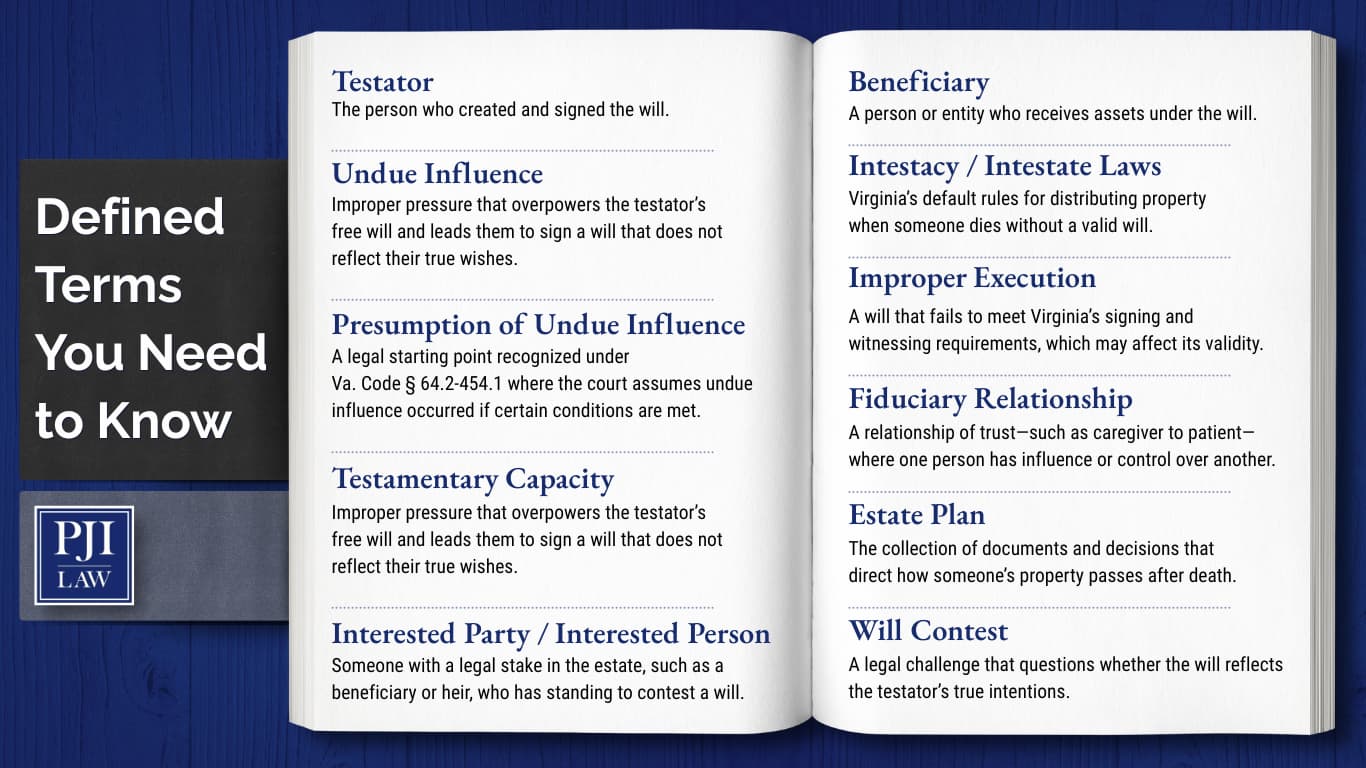
    Defined Terms You Need to Know

    1. Sudden and Unexplained Changes to the Estate Plan

    A dramatic change in a loved one’s will often signals that something influenced their thinking near the end of their life. When someone revises their estate plan in a way that departs sharply from long-standing intentions, it may indicate undue influence.

    Signs this may apply to your situation:

    • A previous will provided for family members, but the current will leaves the bulk of the decedent’s estate to one individual with unusual access or power.
    • Estranged family members suddenly become beneficiaries without explanation.
    • The will was previously revoked, yet a new version appears under suspicious circumstances.
    • The current will was signed when the testator had declining mental capacity or longstanding medical conditions.

    An interested party may file a will contest when the new terms don’t make sense based on the testator’s history. Will contest lawyers often examine earlier versions to compare consistent intent with the changes. A document admitted to probate that contradicts decades of stable planning is something courts take seriously.

    2. A Beneficiary Played a Direct Role in the Will’s Creation

    Another warning sign appears when the primary beneficiary arranges the legal process from start to finish. If the person who gains the most from the will contacted the law firm, scheduled the meetings, or gave instructions to the estate attorney, a dispute exists over whether their influence shaped the document.

    Red flags that raise concern:

    • The beneficiary selected the attorney who drafted the last will and testament.
    • The testator’s communication with the attorney appears limited, filtered, or controlled by someone else.
    • The beneficiary was present for discussions about the estate matters, but discouraged other interested parties from being involved.
    • The will’s execution occurred in a location chosen by the beneficiary rather than the testator.

    No single sign proves that undue influence occurred, but this pattern frequently appears in contest cases. Courts look at whether the beneficiary had an opportunity to control the flow of information or guide decisions that affected the remaining assets.

    3. Isolation of the Testator From Family Members and Friends

    Isolation of the Testator From Family Members and Friends

    One of the most common grounds for contesting a will involves isolation. When someone cuts the testator off from long-trusted family members, long-term friends, or other interested persons, doubt exists about whether the current will reflects independent decision-making.

    What isolation may look like:

    • The testator stopped communicating with people who played a consistent role in their life.
    • A caregiver or close contact monitored or restricted phone calls.
    • The testator lived with someone who controlled who could visit.
    • Estranged family members suddenly gained control over the testator’s daily life.

    Undue influence thrives when the testator relies entirely on one individual for transportation, meal preparation, medical appointments, or emotional support. If isolation coincides with changes to the will, it strengthens a contestant’s claims during estate litigation.

     

    Looking for a will contest attorney in Richmond, Virginia

    4. Signs the Testator Lacked Testamentary Capacity

    Undue influence often occurs when the testator had declining mental capacity. Capacity issues don’t require a formal diagnosis. Courts examine whether the testator understood the nature of their assets, the purpose of a will, and the natural objects of their affection at the time they signed it.

    Indicators of diminished capacity:

    • Medical records show confusion, memory loss, or cognitive decline.
    • The testator couldn’t identify family members, minor children, or previously named beneficiaries.
    • Witness testimony describes unusual behavior or disorientation.
    • A pattern of dependency on one individual increased near the time of signing.

    If someone lacked testamentary capacity at the time the will was executed, the document may be invalid. Even when capacity existed, a weakened mental state can make it easier for someone to exert influence that overpowered the testator’s free will.

    5. Suspicious Circumstances Surrounding the Signing

    The signing process itself can reveal irregularities that suggest undue influence. The law requires that a will be properly executed and properly witnessed. When the circumstances surrounding the signing appear unusual or inconsistent with standard estate-planning practices, those details matter.

    Examples of suspicious circumstances:

    • Witnesses appeared to be associates of the primary beneficiary rather than neutral observers.
    • The testator signed the will in a hurry or under stress.
    • Someone other than the testator communicated instructions to the attorney.
    • The will wasn’t read to the testator, even though their vision or literacy skills were impaired.
    • A no-contest clause appears in a document that strongly favors one beneficiary, raising questions about whether the testator intended to deter valid challenges.

    When improper execution combines with unexpected terms and questionable involvement from a beneficiary, the will’s validity becomes harder to defend.

    How to Contest Someone’s Will in Richmond, VA

    When you believe undue influence affected your loved one’s will, the next question involves the legal action required to challenge its validity. Contesting wills follows specific rules under state law, and the filing period is limited.

    Key steps in the legal process:

    • Verify your standing as an interested party. Virginia law permits an interested party or interested person to contest a will. This may include beneficiaries named in a previous will, intestate heirs, and others with a legitimate stake in the decedent’s estate.
    • Identify the grounds for contesting. Common grounds include lack of testamentary capacity, improper execution, and undue influence. Contest lawyers evaluate whether doubt exists about the will’s creation and whether suspicious circumstances support your claims.
    • File the challenge in the proper court. A will contest must be filed in the circuit court after the will has been admitted to probate.
    • Gather supporting evidence. Evidence may involve medical records, witness testimony, financial documents, caregiver logs, prior estate-planning records, and communication patterns showing that someone exerted undue influence.
    • Follow the time limit. Virginia imposes a filing period, and state law requires that you act quickly once the document is admitted to probate. In most cases, a will contest must be filed within one year after the will is admitted. If the deadline passes, you may lose your ability to challenge the will.

    Because Virginia requires clear and convincing evidence in undue influence challenges, will contest lawyers focus on patterns, relationships, and circumstances that collectively show the will did not reflect the testator’s true wishes.

    What Happens if the Court Finds Undue Influence Occurred

    If the court agrees that undue influence affected the will’s validity, several potential decisions may follow:

    • The court may invalidate the current will.
    • A previous will may be restored if it was properly executed and not previously revoked.
    • If no earlier will exists, Virginia’s intestacy laws determine how the decedent’s estate passes to heirs.
    • A fiduciary relationship involving self-dealing may lead the court to review additional estate matters.

    The probate court may also consider whether the person who exerted undue influence has breached a fiduciary duty owed to the decedent. In some legal complexities, other interested parties may negotiate terms that produce a favorable settlement in a timely manner, particularly when the dispute involves multiple families or large estates.

    How Contest Will Lawyers Evaluate Your Case

    How Contest Will Lawyers Evaluate Your Case

    Contest will lawyers analyze the facts, the relationships, and the timeline of events to determine whether a dispute exists. They examine:

    • The current will, and previous will versions
    • The testator’s medical records
    • Witness involvement
    • Communication patterns
    • Financial transactions
    • Caregiver arrangements
    • Record-keeping by the person who stood to benefit

    They also look for patterns found in contest cases involving undue influence, lack of testamentary capacity, or improper execution. Because state law requires that a will be properly witnessed and executed, any break in the chain of legal compliance may strengthen your position.

    A contested will is a legal proceeding that requires careful review of document creation, the testator’s state of mind, and the circumstances surrounding the signing. When doubt exists, your attorney may challenge whether the will reflects the testator’s true intentions under Virginia law.

    Searching online for a “will contest lawyer near me”

    Frequently Asked Questions

    Q: What qualifies as undue influence in a Virginia will contest?

    A: Virginia courts look at whether someone overpowered the testator’s independent judgment during the will’s creation. This often involves late-life dependence, isolation, control over communication, or a beneficiary directing the estate-planning process. The court may apply a presumption of undue influence when certain conditions are present.

    Q: Can a will be contested if the testator had cognitive decline but no diagnosis?

    A: Yes. A formal diagnosis is not required. Courts examine whether the testator understood the nature of their assets, the purpose of a will, and the natural objects of their affection at the time of signing. Medical records, witness observations, and evidence of memory issues often play a role in capacity evaluations.

    Q: How long do I have to contest a will in Virginia?

    A: A will contest must be filed in the circuit court after the document is admitted to probate. In the majority of cases, you must file within one year after the will is admitted to probate. If the deadline passes, you may lose the ability to challenge the will, even if strong concerns exist about undue influence or improper execution.

    Q: What evidence helps prove undue influence?

    A: Useful evidence often includes medical records, prior versions of the will, caregiver logs, financial transactions, communication patterns, and witness testimony. Contest lawyers also review whether a beneficiary arranged the planning process or controlled access to the testator.

    Q:  What happens if the court decides undue influence occurred?

    A: The court may invalidate the current will. If a previous will was properly executed and not previously revoked, that version may be restored. If no earlier will exists, the estate passes under Virginia’s intestacy laws. The court may also examine whether the person who benefited violated a fiduciary duty.

    Consult With a Contest Will Lawyer About Possible Undue Influence

    When a loved one’s will raises questions, it can leave you unsure where to turn or how to move forward. At PJI Law, our team understands the weight these estate disputes carry and the impact they have on families across Richmond, Virginia. If you believe undue influence affected your loved one’s will, you can speak with a contest will lawyer who handles these sensitive estate matters with careful attention and professionalism.

    Call (804) 653-3450 to request a confidential consultation. You can also complete our confidential online form if it is more convenient for you. Our firm provides thoughtful legal representation to interested parties who need guidance with the probate process, will contests, and concerns about a will’s validity.

    At PJI Law, you’ll receive white glove service and personal attention from a team that treats you like family.

    Copyright © 2026. PJI Law, PLC. All rights reserved.

    The information in this blog post (“post”) is provided for general informational purposes only and may not reflect the current law in your jurisdiction. No information in this post should be construed as legal advice from the individual author or the law firm, nor is it intended to be a substitute for legal counsel on any subject matter. No reader of this post should act or refrain from acting based on any information included in or accessible through this post without seeking the appropriate legal or other professional advice on the particular facts and circumstances at issue from a lawyer licensed in the recipient’s state, country, or other appropriate licensing jurisdiction.

    PJI Law, PLC
    4108 E Parham Rd,
    Richmond, VA 23228
    (804) 653-3450
    https://pjibe.webteam.ai/

  • What Happens When You Contest a Will in Richmond, Virginia?

    What Happens When You Contest a Will in Richmond, Virginia?

    As Alexa sat across the polished mahogany desk from her mother’s attorney, a sense of unease settled in the room. The heavy silence hung between them, punctuated only by the scratch of pen on paper as the estate administrator flipped through the pages of her late mother’s will. This meeting was meant to bring closure, a final farewell to a beloved matriarch and a smooth transition of assets. However, what unfolded before Alexa shattered her expectations and left her reeling with disbelief.

    Alexa had always been close to her mother, Lisa, sharing secrets, dreams, and even discussions about inheritance. During countless evenings spent in the cozy living room, where they sipped tea and talked about life, her mother reassured Alexa that she would be well taken care of and that her two estranged siblings would not benefit from their family’s wealth. Yet, as the attorney outlined the asset distribution stated in the will, it became painfully clear that the reality painted on those legal pages bore no resemblance to the promises her mother had made to her.

    The shock of seeing her siblings listed as primary beneficiaries, with generous portions of the estate assigned to them, left Alexa struggling with a mix of confusion and disbelief. How could this be? Had her mother’s intentions changed so dramatically at the end of her life? The discrepancy between the previous version and the version before her was jarring, raising questions about the validity of her mother’s last will and testament.

    As Alexa’s mind raced with uncertainty and a growing sense of injustice, she wondered, “What happens when you contest a will?”

    This blog, from an experienced Richmond will contest attorney, explains the process for contesting a will, exploring the legal grounds, heir challenges, and potential outcomes the person challenging the will can expect from will contest cases.

    Continue reading to learn more, then contact us at (804) 653-3450 for personalized service and attention.

    What is a Will?

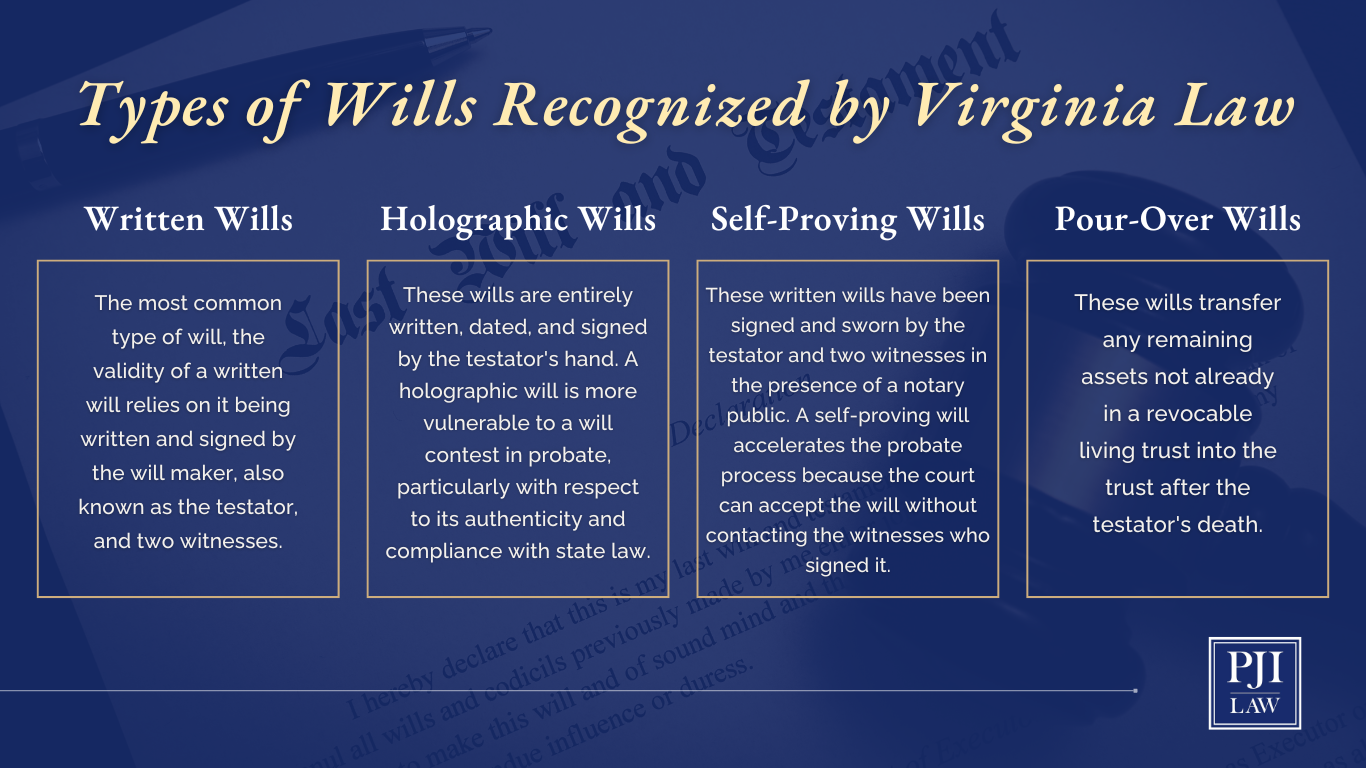
    Before we delve into will contests, let’s first define a will. A will is a legal document that stipulates the wishes of the person making the will for the distribution of their estate assets and care of their minor children, if applicable, upon their death. Virginia law recognizes several types of wills, including:

    • Written Wills: These remain the most common type of will. The validity of a written will wholly relies on it being written and signed by the will maker, also known as the testator, and two witnesses.
    • Holographic Wills: Virginia also accepts holographic wills, which are entirely written, dated, and signed by the testator’s hand. Although a holographic will can have legal validity, it’s more vulnerable to a will contest in probate, particularly relating to its authenticity and compliance with state law.
    • Self-Proving Wills: Also called self-proving affidavits, these written wills have been signed and sworn to by the testator and two witnesses in the presence of a notary public. A self-proving will accelerates the probate process because the court can accept the will without contacting the witnesses who signed it.

    In Virginia, people also like to create pour-over wills, which transfer any remaining assets not already in a revocable living trust into the trust after the death of the person.

    What Makes a Will Valid in Virginia?

    As a knowledgeable and experienced Richmond estate planning attorney knows, Virginia requires specific elements to render a will legally valid and binding and a clear representation of the final wishes of the person creating it. If the person died and neglected to include these vital components in their will, interested parties could pursue a will contest.

    Requirements 

    1. Testamentary Capacity: The testator must be of sound mind and legal age (18 years or older) at the time of executing the will. They should understand the nature of the document they are creating and its implications.
    2. Voluntariness: The creation of the will must be voluntary, without any undue influence or coercion from others.
    3. Proper Execution: The will must be in writing and signed by the testator or by someone else in their presence and at their direction. Additionally, the signing must be witnessed by at least two competent individuals who also sign the will in the presence of the testator.
    4. Attestation Clause: Including an attestation clause, where the witnesses confirm that they observed the testator signing the will and that they signed it in the testator’s presence, can strengthen the will’s validity.
    5. Revocation: If the person wishes to revoke or amend the will, they must do so in accordance with Virginia law. Simply destroying the original will may not be sufficient to revoke it legally.
    6. No Contest Clause: While not required, including a no-contest clause in the will can discourage challenges to its validity after the testator’s death. No contest clauses deter beneficiaries from engaging in a will contest by threatening the forfeiture of their inheritance if they unsuccessfully challenge the document.
    7. Legal Compliance: The will must comply with all relevant Virginia laws and regulations regarding estate planning and will execution.

    Who Can Contest a Will in Virginia?

    Virginia law dictates who has the legal standing to contest a will. If you’re the person bringing the matter to a contest, you must meet one of the following requirements:

    • You are a beneficiary named in the current will or a previous will: If you were a beneficiary in a previous will but were removed or had your inheritance reduced in the current will, you may have grounds to contest someone’s will. 
    • You are an heir at law: If you would have been a beneficiary under Virginia’s intestacy laws if no will had existed, you have the right to contest the will.
    • You are an interested party: If you have a legal interest in the estate, such as a creditor or a child born after the deceased person executed the will, you may have standing to contest the will.

    What are the Common Grounds for Contesting a Will?

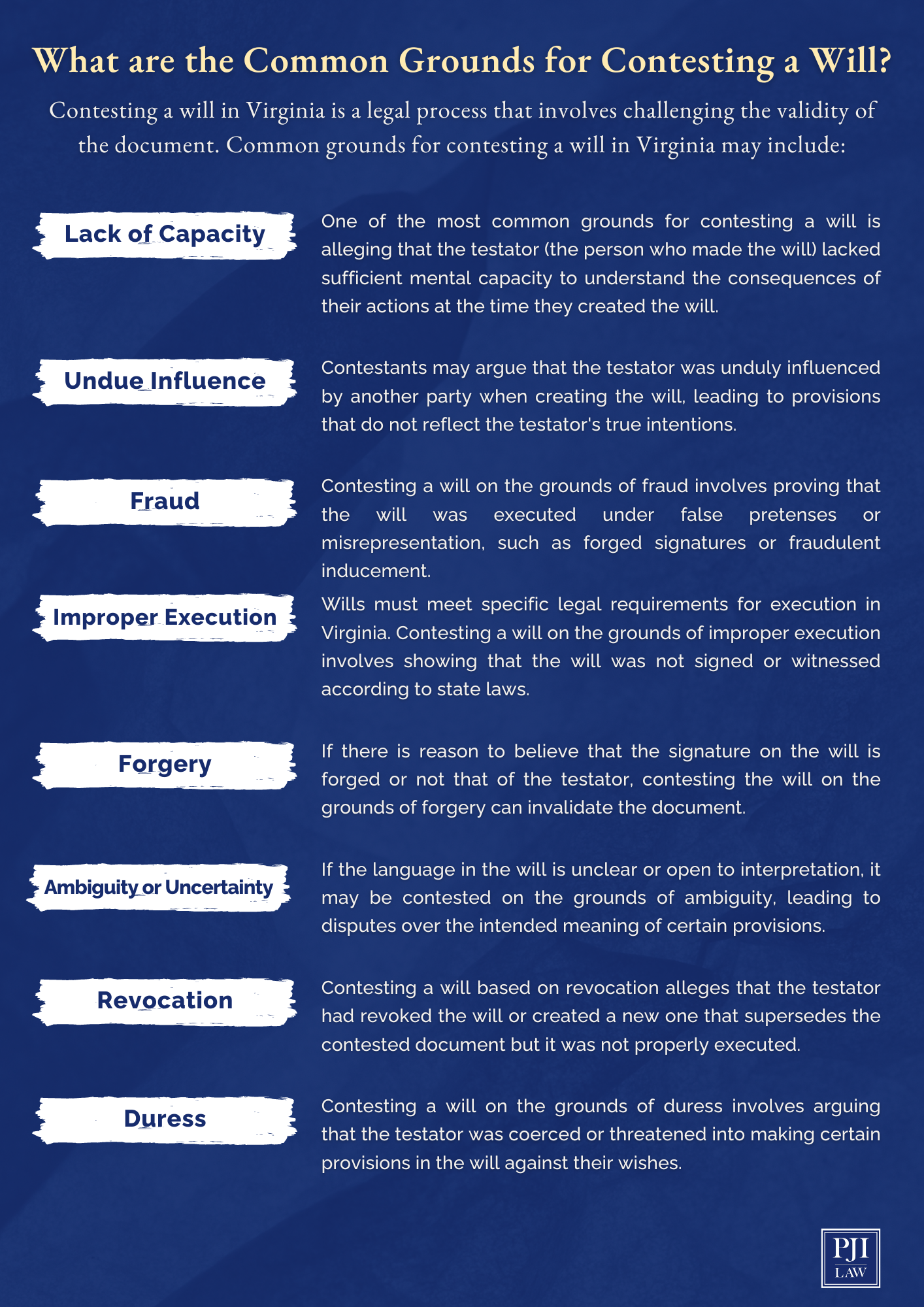
    Contesting a will in Virginia is a legal process that involves challenging the validity of the document. Common grounds for contesting a will in Virginia may include:

    1. Lack of Capacity: One of the most common grounds for contesting a will is alleging that the testator (the person who made the will) lacked sufficient mental capacity to understand the consequences of their actions at the time they created the will.
    2. Undue Influence: Contestants may argue that the testator was unduly influenced by another party when creating the will, leading to provisions that do not reflect the testator’s true intentions.
    3. Fraud: Contesting a will on the grounds of fraud involves proving that the will was executed under false pretenses or misrepresentation, such as forged signatures or fraudulent inducement.
    4. Improper Execution: Wills must meet specific legal requirements for execution in Virginia. Contesting a will on the grounds of improper execution involves showing that the will was not signed or witnessed according to state laws.
    5. Forgery: If there is reason to believe that the signature on the will is forged or not that of the testator, contesting the will on the grounds of forgery can invalidate the document.
    6. Ambiguity or Uncertainty: If the language in the will is unclear or open to interpretation, it may be contested on the grounds of ambiguity, leading to disputes over the intended meaning of certain provisions.
    7. Revocation: Contesting a will based on revocation alleges that the testator had revoked the will or created a new one that supersedes the contested document but it was not properly executed.
    8. Duress: Contesting a will on the grounds of duress involves arguing that the testator was coerced or threatened into making certain provisions in the will against their wishes.

    If you are wondering whether a will contest is worth pursuing, consult a knowledgeable and experienced will contest lawyer. A contest lawyer can provide personalized guidance based on your specific circumstances and help navigate the legal process of challenging a will in compliance with Virginia laws.

    Virginia Will Contests Begin with Filing a Complaint

    If you think you have the legal standing for a will contest you have to file a complaint with the Circuit Court in the county where the testator lived. In most cases, you must file this complaint within one year from the date that the circuit court clerk admits the will into probate court.

    However, exceptions to this rule include:

    • Minors – If the person bringing the contest is a minor, the time limit starts when they reach 18
    • Incapacitated Individuals – For individuals incapacitated at the time of probate, the probate court extends the time limit
    • Individuals Not Served Personally – Individuals who were not served personally and did not join when the will was presented to probate court receive an extended time limit
    • The Person Bringing the Contest was Proceeded Against by Publication – The time limit extends to two years if the person bringing the contest was proceeding against by publication, which refers to a method of providing notice to parties involved in a legal proceeding when their whereabouts are unknown or they cannot be personally served with legal documents.

    In the complaint, clearly explain your reasons for initiating a will contest and provide evidence to support your claim. As a will contest lawyer knows, acting promptly to challenge your loved one’s will is urgent; exceeding the time limits can result in forfeiting your right to contest the will.

    Due to the nuances of time limits and the legal complexities of contesting a will in Virginia, if you’re considering challenging the validity of a will, consult an experienced attorney. An estate planning attorney can provide legal advice and clarity on the specific rules and procedures involved in a will contest within the state’s legal framework. Furthermore, your attorney can let you know if it’s worth contesting the will and initiating a legal battle with a family member or multiple family members, depending on your unique circumstances.

    Collecting Evidence

    Successful will contests demand supporting evidence. This evidence may include medical records indicating that the person was mentally incompetent, witness statements suggesting undue influence, or handwriting analysis to prove fraud. An experienced will contest attorney can help you collect and present this evidence to the court. Your estate attorney may also recommend hiring experts, such as medical professionals or handwriting analysts, to strengthen your case.

    The Role of an Executor in a Will Contest

    As a probate attorney will tell you, if you are the executor (also known as the personal representative) of the will undergoing a contest, you have a legal duty to defend the will’s validity. This effort involves gathering evidence supporting the will’s validity and defending against the contestant’s claims. As an executor, you may find yourself in a difficult position especially if you are also a named beneficiary or have a personal relationship with the contestant. Seek legal guidance from an experienced probate attorney to help you fulfill your duties and protect your best interest.

    Resolving a Will Contest

    The cost of a will contest will vary depending on the specific circumstances. In some cases, mediation or settlement negotiations can resolve the contest, either of which can be less costly and less stressful than going to trial. Mediation involves a neutral third party who helps the contestants and the executor arrive at a mutually agreeable resolution. If they reach a settlement, the terms must be put in writing and submitted to the probate court for approval. However, if they cannot come to a favorable settlement, the case will proceed to trial, where a judge will hear evidence and render a decision.

    Is a Will Contest Worth the Emotional Cost?

    Contesting a will extracts a significant emotional toll on you and your family. Before initiating the process, consider the potential impact on your relationships with your siblings and other family members. As the person bringing the contest, you may feel justified that your decision will protect your interests and honor the testator’s true wishes; however, your loved ones may have an entirely different outlook. Be aware of the emotional challenges that may accompany the process, and consider seeking support from friends, family, or a mental health professional.

    Seeking Professional Legal Guidance and Support

    If you’re considering a will contest in and around Richmond, Virginia, seek the guidance of an experienced contest attorney. They can listen to the details of your case, collect evidence, and guide you through the legal complexities. The decision to initiate a will contest demands thoughtful consideration for legal, practical, and emotional reasons. However, if you believe that the decedent’s assets are not being distributed according to their true wishes or that the will is invalid, a will contest may be a suitable choice for you. A contest lawyer can help you weigh your options and make an informed decision.

    Considering a Will Contest in and around Richmond, Virginia? Let the Contest Attorneys at PJI Law Offer Personalized Service and Attention

    Initiating a will contest wreaks havoc on your mind and emotions during a time of mourning and family turmoil. At PJI Law, our will contest attorneys understand the delicate nature of these situations. Let us provide you with compassionate, personalized attention and guidance to help you through this harrowing process.

    Whether you’re a named beneficiary, heir, or interested party who wants to contest a will on the grounds of lack of testamentary capacity, undue influence, fraud, or improper execution, our will contest attorneys will fight with you for fairness and justice.

    If you’re considering a will contest in and around Richmond, Virginia, you don’t have to go it alone. The contest attorneys at PJI Law will be your guide and advocate. Call PJI Law, PLC at (804) 653-3450 or complete our online form to schedule your consultation.

    Copyright © 2024. PJI Law, PLC. All rights reserved.

    The information in this blog post (“post”) is provided for general informational purposes only and may not reflect the current law in your jurisdiction. No information in this post should be construed as legal advice from the individual author or the law firm, nor is it intended to be a substitute for legal counsel on any subject matter. No reader of this post should act or refrain from acting based on any information included in or accessible through this post without seeking the appropriate legal or other professional advice on the particular facts and circumstances at issue from a lawyer licensed in the recipient’s state, country, or other appropriate licensing jurisdiction.

    PJI Law, PLC
    4108 E Parham Rd,
    Richmond, VA 23228
    (804) 653-3450
    https://pjibe.webteam.ai/

  • How Do You Contest a Will in Virginia?

    How Do You Contest a Will in Virginia?

    Imagine receiving a copy of your late father’s will from his attorney. Your father, a successful businessman with a sizable estate, passed away a few weeks ago. As you read through the will, you’re shocked to discover that the distribution of assets is vastly different from what you expected. You can’t help but feel that something is seriously wrong. 

    Could your father have been unduly influenced? Was he mentally capable of making such decisions towards the end of his life? If you find yourself in a situation like this, you may be questioning the validity of the will and wondering about your rights. You might be asking yourself, “How do you contest a will in Virginia?” and “Do I have the grounds to do so?”

    Who Can Contest a Will in Virginia?

    In Virginia, not everyone has the legal standing to contest a will. You can challenge a will if you are:

    • A beneficiary named in the current will or a previous will: If you were a beneficiary in a previous will but were removed or had your inheritance reduced in the current will, you may have grounds to contest. 
    • An heir at law: If you would have been entitled to inherit under Virginia’s intestate succession laws had there been no will, you have the right to contest the will. 
    • An interested party: If you have a legal interest in the estate, such as a creditor or a child who was born after the will was executed, you may have standing to contest the will.

    Understanding the Grounds for Contesting a Will

    To contest a will in Virginia, you must have valid grounds. These grounds include:

    • Lack of Testamentary Capacity: You must prove that the testator (the person making the will) lacked the mental capacity to understand the will’s contents and the consequences of their decisions. This includes understanding the extent of their assets and who would inherit them. The lack of capacity may have been due to conditions such as dementia, Alzheimer’s disease, or other cognitive impairments. 
    • Undue Influence: If you suspect that someone exerted undue influence on the testator, causing them to make changes to their will that they would not have otherwise made, you may have grounds to contest the will. This often involves a person in a position of trust, such as a caregiver or family member, who uses their influence to manipulate the testator’s decisions. 
    • Fraud: If the testator was tricked into signing the will or if the will was forged, you can contest it on the grounds of fraud. This may involve someone presenting a false document to the testator or misleading them about the contents of the will. 
    • Improper Execution: If the will was not signed, witnessed, or executed according to Virginia law, you may be able to contest it. In Virginia, a will must be signed by the testator and two witnesses who are present at the same time and who also sign the will in the presence of the testator and each other.

    Filing a Complaint to Contest the Will

    If you believe you have grounds to contest the will, you’ll need to file a complaint with the Circuit Court in the county where the testator resided. You must file this complaint within one year of the will being admitted to probate. In your complaint, clearly state the grounds for contesting the will and provide any evidence you have to support your claim. It’s essential to act quickly, as missing the deadline can result in losing your right to contest the will.

    Gathering Evidence

    To successfully contest a will, you’ll need to gather evidence that supports your grounds for contesting. This evidence may include medical records indicating a lack of testamentary capacity, witness statements suggesting undue influence, or handwriting analysis to prove fraud. An experienced will contest attorney can help you gather and present this evidence effectively. They may also recommend hiring experts, such as medical professionals or handwriting analysts, to strengthen your case.

    The Role of an Executor in a Will Contest

    If you are the executor of the will being contested, you have a legal duty to defend the will’s validity. This means that you’ll need to gather evidence supporting the will’s validity and argue against the contestant’s claims. As an executor, you may find yourself in a difficult position, especially if you are also a beneficiary or have a personal relationship with the contestant. It’s crucial to seek legal guidance to ensure that you fulfill your duties as an executor while protecting your own interests.

    Resolving the Dispute

    In some cases, it may be possible to resolve the dispute through mediation or settlement negotiations. This can be less expensive and less stressful than going to trial. Mediation involves a neutral third party who helps the contestants and the executor reach a mutually agreeable resolution. If a settlement is reached, the terms will be put in writing and submitted to the court for approval. However, if a resolution cannot be reached, the case will proceed to trial, where a judge will hear evidence and make a decision.

    The Emotional Toll of Contesting a Will

    Contesting a will can take a significant emotional toll on you and your family. It’s essential to consider the potential impact on your relationships with your siblings and other family members. While you may feel that contesting the will is necessary to protect your interests and honor the testator’s true wishes, others may view it differently. Be prepared for the emotional challenges that may come with the process, and consider seeking support from friends, family, or a mental health professional.

    Seeking Professional Guidance

    If you’re considering contesting a will in Virginia, it’s crucial to seek the guidance of an experienced will contest attorney. They can help you evaluate your case, gather evidence, and guide you through the complex legal process. Remember, contesting a will is not a decision to be made lightly. It can be a long, expensive, and emotionally draining process. However, if you believe that the testator’s true wishes are not being honored or that the will is invalid, contesting it may be the right choice for you. An attorney can help you weigh your options and make an informed decision.

    Guiding You Through the Process of Contesting a Will in Virginia

    Contesting a will can be an emotionally challenging and legally intricate process, especially during a time of grief and family turmoil. At PJI Law, our will contest attorneys understand the sensitivity of these situations and are committed to providing compassionate, personalized attention and guidance to help you through this difficult journey.

    Whether you’re a beneficiary, heir, or interested party seeking to contest a will on the grounds of lack of testamentary capacity, undue influence, fraud, or improper execution, our will contest attorneys are here to stand by your side and fight for what’s fair and just. We’re committed to using our skills and resources to help you achieve the best possible outcome in your case.

    If you’re considering contesting a will in Virginia, don’t face this challenging process alone. Let the dedicated team of lawyers that contest wills at PJI Law be your guide and advocate. To schedule a consultation, call us today at (703) 865-6100 or through our secure online form. Together, we can work towards ensuring that your loved one’s true wishes are honored and that your interests are protected.

    Copyright © 2024. PJI Law, PLC. All rights reserved.

    The information in this blog post (“post”) is provided for general informational purposes only and may not reflect the current law in your jurisdiction. No information in this post should be construed as legal advice from the individual author or the law firm, nor is it intended to be a substitute for legal counsel on any subject matter. No reader of this post should act or refrain from acting based on any information included in or accessible through this post without seeking the appropriate legal or other professional advice on the particular facts and circumstances at issue from a lawyer licensed in the recipient’s state, country, or other appropriate licensing jurisdiction.

    PJI Law, PLC
    3900 Jermantown Rd, 2nd Floor
    Fairfax, Virginia 22030
    (703) 865-6100
    https://pjibe.webteam.ai/