Tag: Trusts

  • What is a Virginia Special Needs Trust?

    What is a Virginia Special Needs Trust?

    Estate planning helps preserve your assets and protects your loved ones after you pass away. However, when aging loved ones or other family members have special needs, designing the right plan for their future well-being becomes even more urgent.

    One of the most effective tools for individuals for this purpose is a Virginia special needs trust (SNT), which protects a disabled individual’s financial future without jeopardizing their eligibility for public benefits, like Supplemental Security Income (SSI) and Medicaid.

    This comprehensive blog explains the essentials of a Special Needs Trust, its unique benefits, and how it operates in Virginia. Whether you’re a parent of a child with a disability or a family member planning for a loved one’s care, we’ll clarify the purpose of these trusts and answer common questions about other trusts in Virginia.

    What is an SNT?

    An SNT, or Special Needs Trust, specifically supports individuals with disabilities. Its main purpose is to hold and manage assets for the person’s benefit while keeping them eligible for federal and state assistance programs. Without proper planning, inheriting assets could inadvertently disqualify your loved one from accessing the public benefits they rely on for medical care and living expenses.

    This type of trust prevents this problem by separating the assets from the person’s direct ownership. A trustee manages the funds in the trust and uses them to cover expenses that improve the beneficiary’s quality of life, which could include costs for caregivers, education, therapies, or even recreational activities—expenses that public benefits don’t cover.

    An Estate Planning Attorney Explains the Benefits of an SNT

    1. Maintains Eligibility for Public Benefits
      Public assistance programs, such as Medicaid and SSI, have strict income and asset limits. An SNT prevents funds meant for the beneficiary from counting toward these limits, allowing continued access to such benefits.
    2. Enhanced Quality of Life
      The assets held in an SNT can be used for services or items that improve the beneficiary’s living conditions. For example, funds can cover educational programs, healthcare not provided by Medicaid, transportation, or technology such as assistive devices.
    3. Protection from Creditors
      Because the assets belong to the trust rather than the individual, they’re protected from claims made by creditors or liability settlements.
    4. Long-Term Estate Planning
      These trusts provide continuity and financial security beyond the lifetime of a caregiver or parent, relieving families’ concerns about the future.
    5. Tailored Support
      You can customize SNTs to meet your unique needs and specifically outline the use and distribution of funds. 
    6. Privacy
      Assets held in an SNT do not go through probate, keeping financial and personal matters private.
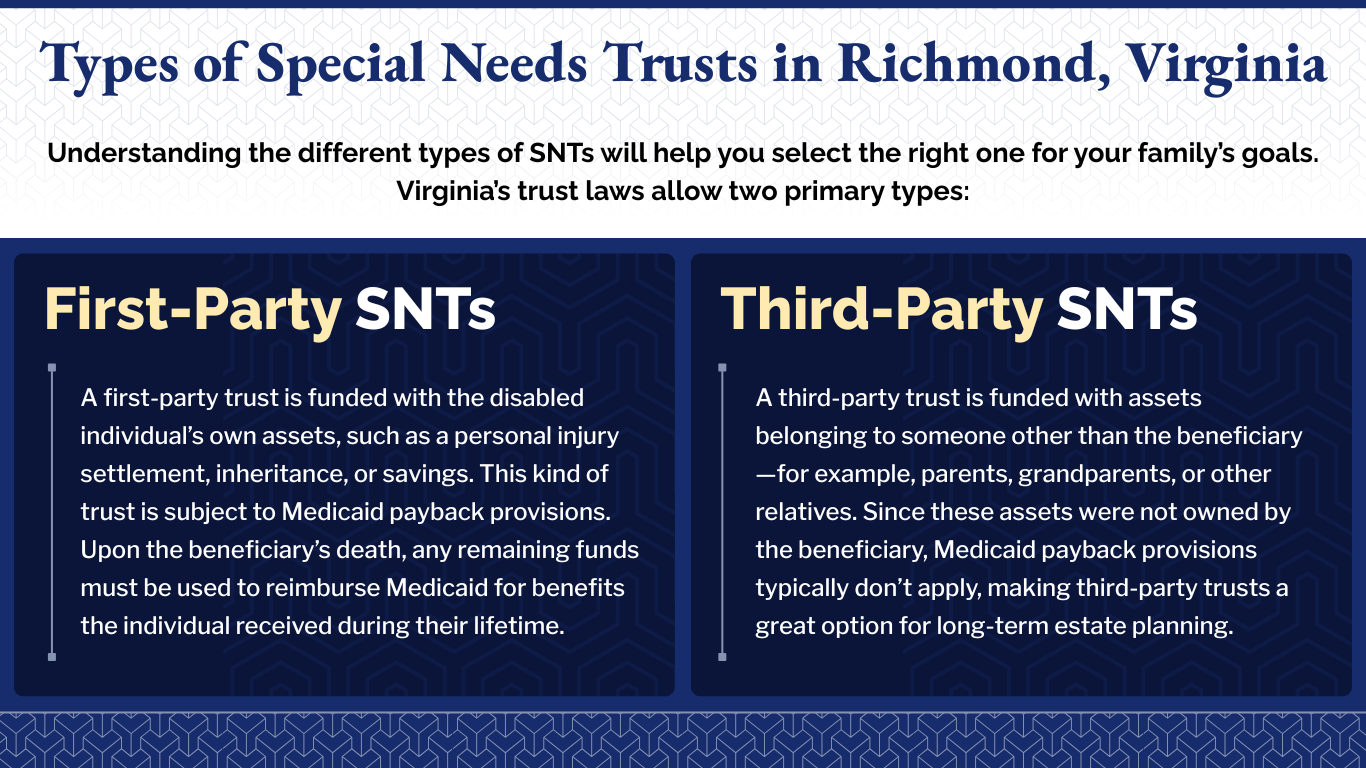
    Creating an SNT in Richmond, Virginia

    Establishing a Special Needs Trust involves careful planning and legal guidance from knowledgeable and experienced attorneys.

    1. Determine Trust Goals

    Start by evaluating your intentions. Are you trying to safeguard eligibility for public benefits, protect assets, or create a reserve fund for specific needs? Clear goals will help your attorneys structure the trust appropriately.

    2. Choose a Trustee

    The trustee holds significant responsibility, as they’ll manage the funds and distribute the funds properly, according to the trust’s terms. Trustees can be family members, independent professionals, or financial institutions with extensive knowledge in trust administration.

    3. Draft the Trust Document

    A trust document outlines the terms of the trust, including how to distribute funds and what expenses the trust allows. This legal document should comply with state and federal regulations, especially concerning public benefits programs.

    4. Fund the Trust

    Once established, the trust creator must transfer assets into it, such as cash, investments, property, or life insurance policies.

    5. Maintain Compliance and Oversight

    Trustees must align distributions with the trust’s terms and prevent funds from inadvertently disqualifying the beneficiary from receiving public benefits. Detailed record-keeping and regular reviews assist in this process.

    6. Work with an Experienced Attorney

    Guidance from a Virginia estate planning attorney serves to make sure the SNT complies with state and federal laws. An attorney can also offer advice tailored to your family’s unique needs.

    Frequently Asked Questions About SNTs and Other Trusts in Virginia

    What expenses can an SNT cover?

    The funds in an SNT can cover a variety of expenses that enhance the beneficiary’s quality of life, including medical care, therapy, educational programs, transportation, and recreational activities. However, as a lawyer will advise, the trustee must obey the rules associated with public benefits.

    Can an SNT own property on behalf of the beneficiary?

    An SNT can own property such as a home or a vehicle. However, properties owned by the trust should be for the beneficiary’s use and aligned with the trust’s goals.

    How does an SNT differ from other types of trusts?

    While many trusts focus on minimizing taxes, protecting assets, or avoiding probate, an SNT specifically preserves eligibility for public assistance programs while providing supplemental support.

    What is the role of a trustee in managing an SNT?

    The trustee manages the trust assets and distributes funds according to the trust’s terms. It requires a strong understanding of financial management and public benefits regulations. Trustees must act in the beneficiary’s best interests and keep accurate records.

    Can an SNT be altered or revoked?

    The ability to revoke or modify an SNT depends on the type of trust. Generally, third-party special needs trusts can be more flexible, while first-party trusts may have stricter rules. Consulting an attorney can clarify the options available.

    Are there tax implications for an SNT?

    Taxation depends on the trust type and distribution methods. Typically, the trust’s income is taxed at trust rates unless specifically distributed to the beneficiary. Consulting a lawyer is advisable for proper planning.

    Secure Your Loved One’s Future with PJI Law in Richmond, Virginia

    SNTs provide peace of mind and procure the ongoing care of loved ones with disabilities. However, creating one involves thoughtful consideration of multiple legal, financial, and personal factors. Collaborating with an experienced Virginia estate planning attorney, like the team at PJI Law, structures the SNT correctly so it can serve its intended purpose.

    At PJI Law, we help our clients create tailored estate planning solutions, including SNTs, to meet the unique needs of their families. Our practice areas include wills, trusts, trust administration, probate administration for an executor/personal representative tasked with estate administration, and much more.

    Contact us at (804) 653-3450 or complete our online form to schedule a consultation. Together, we’ll protect your loved one’s future and provide the support they need to thrive.

    Copyright © 2025. PJI Law, PLC. All rights reserved.

    The information in this blog post (“post”) is provided for general informational purposes only and may not reflect the current law in your jurisdiction. No information in this post should be construed as legal advice from the individual author or the law firm, nor is it intended to be a substitute for legal counsel on any subject matter. No reader of this post should act or refrain from acting based on any information included in or accessible through this post without seeking the appropriate legal or other professional advice on the particular facts and circumstances at issue from a lawyer licensed in the recipient’s state, country, or other appropriate licensing jurisdiction.

    PJI Law, PLC
    4108 E Parham Rd, 
    Richmond, VA 23228
    (804) 653-3450
    https://www.pjilaw.com/

  • What Are the Steps to Placing Your House in a Trust in Virginia?

    What Are the Steps to Placing Your House in a Trust in Virginia?

    Placing your house in a trust can be one of the most meaningful decisions you make for your family. It’s not just about asset protection or avoiding probate—it’s about peace of mind. You want to know your home will go to the right people, at the right time, without unnecessary court involvement or confusion. At PJI Law, we understand how personal this process is. Many of our clients have built their lives in the same home for decades. For them, placing a house in a trust isn’t just a financial move; it’s an act of love.

    Whether you’re planning for long-term goals, protecting a vulnerable family member, or simply preparing for the future, it helps to know what the process involves. Below, we explain the legal steps to place your house in a trust in Virginia, what decisions you’ll need to make, and how to avoid common pitfalls. 

    Before you commit to the process, it’s worth understanding what you’ll gain and what challenges may come with it.

    Benefits of Putting Your House in a Trust

    Placing your house in a trust can do more than just simplify what happens after you’re gone. It can also reduce stress for your family and give you greater peace about the future.

    Here are a few specific benefits:

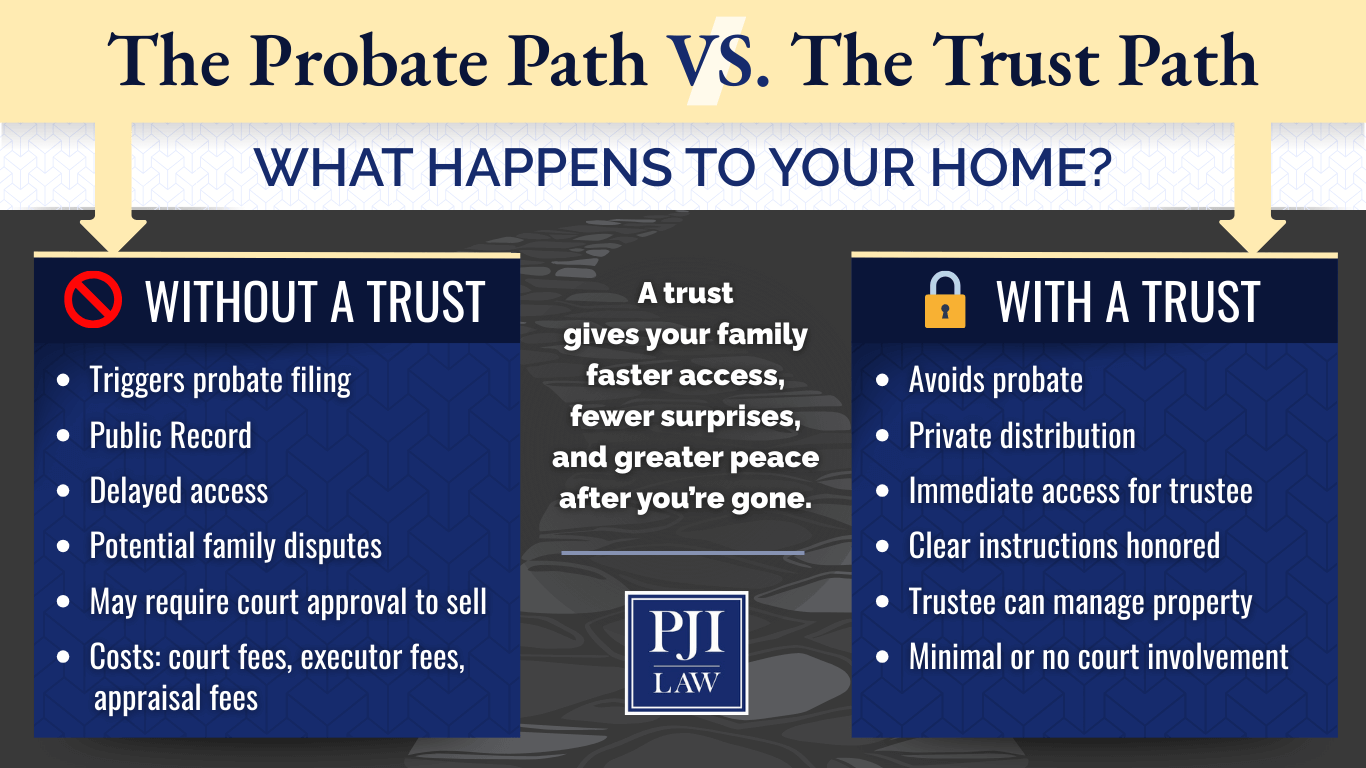
    • Fewer delays for your loved ones. A properly funded trust lets your successor trustee take control without going through the probate court, which means no waiting for a judge to authorize basic tasks like paying the mortgage or selling the home.
    • Clear direction for blended or complex families. If you’ve remarried, have stepchildren, or want to keep inherited property in the bloodline, a trust makes your wishes legally enforceable without relying on someone else’s memory or promises.
    • Private handling of family matters. Unlike a will, which becomes public once filed, a trust remains confidential. That means no one outside the family needs to know who inherits the home or under what conditions.
    • Continuity during incapacity. If you become unable to manage your affairs, your trustee can step in immediately to handle household needs, sell the property if necessary, or manage rental income without delay.
    • Flexibility in how and when assets are passed down. You can keep the house in trust for a minor child, delay distribution until a certain age, or use the home for a surviving spouse with other terms in place after they pass.

    Even with these benefits, a trust may not be the right solution for every homeowner. Here are a few trade-offs to consider before moving forward.

    Considerations and What a Trust Does Not Provide

    While a trust can offer many long-term advantages, it’s not always the right move for everyone. It’s important to consider the trade-offs to understand what you’re taking on.

    Here are some potential items to consider:

    • Upfront effort and cost. You’ll need to create a trust document, prepare a new deed, and file it with the county. This often involves attorney fees and some administrative legwork.
    • Ongoing responsibility. You will want to keep the trust updated if you refinance your move or make changes to your estate plan. If you forget to title inherited or newly purchased property into the trust, it won’t be protected.
    • Not a shield from creditors. With a revocable trust, your assets, including your home, are still considered legally yours. That means they remain vulnerable to legitimate lawsuits, liens, or collections during your lifetime.
    • Title complications if poorly drafted. Mistakes in the deed or trust language can create issues with title companies when it’s time to refinance or sell. This is why DIY documents are strongly discouraged. They often cause more problems than they solve.
    • No direct tax savings. A revocable trust doesn’t change how your property is taxed while you’re alive. It still appears under your Social Security number, and you’re responsible for any property or income taxes just as before.

    If you’ve weighed the benefits and considered the trade-offs and decided a trust makes sense for your situation, the next step is to understand how the process works in Virginia.

    Step 1: Choose the Right Type of Trust for Your Goals

    Before transferring your home into a trust, you’ll need to decide what kind of trust fits your needs. In Virginia, the most common types include:

    • Revocable living trusts. These are flexible and can be changed or revoked during your lifetime. You typically serve as your own trustee and retain full control over the property.
    • Irrevocable trusts. Once you place your house in this type of trust, you give up control over it. These trusts may offer greater protection from creditors and certain tax advantages.
    • Testamentary trusts. Created by your will and go into effect after your death. Your house remains in your name until then.
    • Special needs trusts. Used to leave property for a loved one with a disability without affecting their eligibility for benefits.
    • Charitable trusts. Allow you to leave your home or its value to a nonprofit organization.

    The type of trust you choose will affect how your property is treated for tax, control, and probate purposes. A revocable trust is often the most practical choice for Virginia homeowners who want to keep managing their home while simplifying what happens after death.

    Step 2: Select the Right Trustee


    The trustee is the person or entity responsible for managing the trust. If you’re creating a revocable trust, you can serve as your own trustee while naming a successor trustee to take over when you pass away or become incapacitated. This gives you full control during your lifetime.

    When choosing a trustee, think about:

    • Who is trustworthy, organized, and willing to follow your instructions?
    • Who understands your family dynamics?
    • If your trust will continue after your death (such as for minor children or loved ones with special needs), who is equipped to manage long-term property decisions?

    Your trustee should be someone you would trust to carry out your wishes with care and attention.

    Step 3: Create the Trust Document

    Once you’ve selected the trust type and trustee, your next step is drafting the actual trust document. This legal document names:

    • The trust creator (you)
    • The trustee (who is responsible for managing the trust assets)
    • The beneficiaries (who will inherit the home or live in it)
    • The terms and conditions of the trust

    Your trust document must comply with Virginia law to be valid. Inaccuracies, vague language, or missing provisions can cause confusion, delay access to trust property, or lead to disputes. This is why working with a knowledgeable Virginia trusts attorney matters. A DIY template might not cover everything, especially when you’re dealing with valuable real estate, complex family dynamics, or blended families.

    At PJI Law, we tailor each trust to reflect your values, your property, and your long-term goals.

    Step 4: Sign and Notarize the Trust

    Once your trust is drafted, you’ll sign it in front of a notary public. This step makes the trust legally valid. While notarization is not strictly required for all revocable trusts in Virginia, it is strongly recommended to help prove authenticity and avoid challenges later on.

    Step 5: Transfer or Fund the House into the Trust

    Creating the trust isn’t enough. You must formally move the house into the trust by filing a new deed. This is called funding the trust.

    Here’s how it works:

    1. Prepare a new deed transferring ownership from your name to the trust, either immediately or upon your death.
      • For example: “John A. Smith hereby conveys to John A. Smith, Trustee of the Smith Family Trust dated July 1, 2025…”
    2. Sign the deed in front of a notary.
    3. File the deed with the land records office in the circuit court of the county where the property is located. For example, if your home is in Fairfax County, you’ll file with the Fairfax Circuit Court.

    Until this step is complete, your house is not legally part of the trust. That means it would still require involvement by the probate court unless properly transferred.

    Once your home is legally transferred into the trust, there are a few important housekeeping tasks to complete so nothing falls through the cracks.

    Step 6: Update Homeowners Insurance

    Once the trust owns your home, you’ll need to notify your homeowners insurance provider to add your trust as an additional insured party.

    If your home has a mortgage, placing a home in a revocable trust will not trigger the due-on-sale clause, thanks to protections under the federal Garn-St. Germain Act (12 U.S.C. § 1701j-3(d)(8)).

    Step 7: Keep the Trust Document Safe and Up to Date

    Once your home is in the trust, keep a copy of the trust document in a secure but accessible location. Let your successor trustee know where to find it. If you move, refinance, or make major changes to your estate plan, revisit the trust to make sure it still reflects your wishes.

    Creating a trust is not a set it and forget it task. It’s part of a larger estate plan that may include your will, powers of attorney, health care directives, and other important documents. Over time, your goals, relationships, or property may change. When they do, your trust should be reviewed and updated accordingly.

    Many Virginia homeowners also ask what kind of flexibility they’ll have after the trust is created, especially when it comes to refinancing or selling.

    Can You Still Sell or Refinance a House in a Revocable Trust?

    Yes. If you’ve placed your home in a revocable living trust and named yourself as trustee, you can still sell, rent, or refinance the property. You retain full control during your lifetime.

    That said, your title company or lender may request a certification of trust or a copy of the trust showing your authority. In some cases, you may need to temporarily deed the home back into your individual name before completing a sale or refinance. 

    Your home may also play a role in broader planning goals beyond your immediate heirs.

    What About a Pet Trust or Family Business?

    If you plan to pass on a family business or leave money for the care of a pet, your home might still play a role in that plan. You could:

    • Include provisions in your trust to allow the property to be sold and the proceeds distributed to support a charitable trust or special needs trust.
    • Leave the house to a designated caretaker to continue caring for pets who remain in the home.
    • Use rental income from a second property to fund long-term goals for your children or grandchildren.

    Note: In Virginia, pet trusts end when no covered pets remain, and any leftover funds are distributed according to the trust or default rules. 

    Still have questions about how this all works in practice? Below are answers to some of the most common questions we hear from families across Northern Virginia.

    Frequently Asked Questions

    Q: Can I name different beneficiaries for my home and my other assets?

    A: Yes. Your trust can designate one beneficiary to receive your home and others to receive different property, like bank accounts or investments. Each asset can be handled individually, giving you full control over how your estate is distributed.

    Q: Does placing my home in a trust protect it from creditors?

    A: Not if it’s a revocable trust. During your lifetime, assets in a revocable trust are still considered your property and remain accessible to creditors. If protection from creditors is your goal, you would need to speak with your attorney about an irrevocable trust and how that might impact access, control, and Medicaid planning.

    Q: Can I remove my house from the trust later if I change my mind?

    A: Yes, if the trust is revocable. You can amend or revoke the trust at any time, including transferring the home back into your name. This flexibility is one of the reasons revocable living trusts are so common in Virginia estate planning.

    Q: Will my property taxes change if I transfer my house to a trust?

    A: In most cases, no. Virginia law does not impose additional property tax just because a home is placed in a revocable trust. The property remains eligible for standard tax rates and exemptions, including senior or disability-related property tax relief, as long as the trust is structured properly.

    Q: Can I name someone out of state as my trustee?

    Yes, you can. Virginia does not require your trustee to live in the Commonwealth. However, naming an out-of-state trustee can complicate real estate transactions or communications with local institutions. It’s worth considering whether a local trustee or at least a co-trustee in Virginia might make things easier for your family.

    Talk with a Trusts Attorney in Northern Virginia Who Treats Your Family Like Their Own

    At PJI Law, our team works with families throughout Fairfax County and Northern Virginia who want more than just documents. We take time to understand your needs, answer your questions, and build legally sound trusts that reflect what matters most—your family, your home, and your future.

    Your online search for “attorney for estate planning near me” or “attorney for trust” brought you here. Now it’s time to protect what matters.

    Call PJI Law at (703) 865-6100 or contact us online to schedule your confidential estate planning consultation. We’ll guide you through the process of placing your house in a trust and give you the support you need to create peace for those you love most.

    At PJI Law, you’ll receive white glove service and personal attention from a team that treats you like family.

    Copyright © 2025. PJI Law, PLC. All rights reserved.

    The information in this blog post (“post”) is provided for general informational purposes only and may not reflect the current law in your jurisdiction. No information in this post should be construed as legal advice from the individual author or the law firm, nor is it intended to be a substitute for legal counsel on any subject matter. No reader of this post should act or refrain from acting based on any information included in or accessible through this post without seeking the appropriate legal or other professional advice on the particular facts and circumstances at issue from a lawyer licensed in the recipient’s state, country, or other appropriate licensing jurisdiction.

    PJI Law, PLC
    3900 Jermantown Rd, 2nd Floor
    Fairfax, Virginia 22030
    (703) 865-6100
    https://www.pjilaw.com

  • Can a Revocable Trust Be Changed in Northern Virginia?

    Can a Revocable Trust Be Changed in Northern Virginia?

    As life evolves, so do our needs and circumstances, making flexibility a critical aspect of estate planning. As an experienced estate planning attorney knows, a revocable trust, also known as a revocable living trust, offers adaptability, among many other benefits, for individuals seeking to care for future generations.

    Can a revocable trust be changed in Fairfax County and Northern Virginia? 

    Yes, this estate planning tool offers the flexibility our clients in Northern Virginia seek. This blog, from a knowledgeable trusts attorney, explains how these trusts work, why they’re beneficial, and how to change them when needed.

    What Is a Revocable Living Trust?

    A revocable living trust is a legal arrangement that allows the trust creator, known as the settlor or grantor, to transfer assets like money and property into the trust during their lifetime. The settlor designates a trustee to manage these assets according to the settlor’s wishes and distribute the assets based on the settlor’s instructions in the trust upon the settlor’s death.

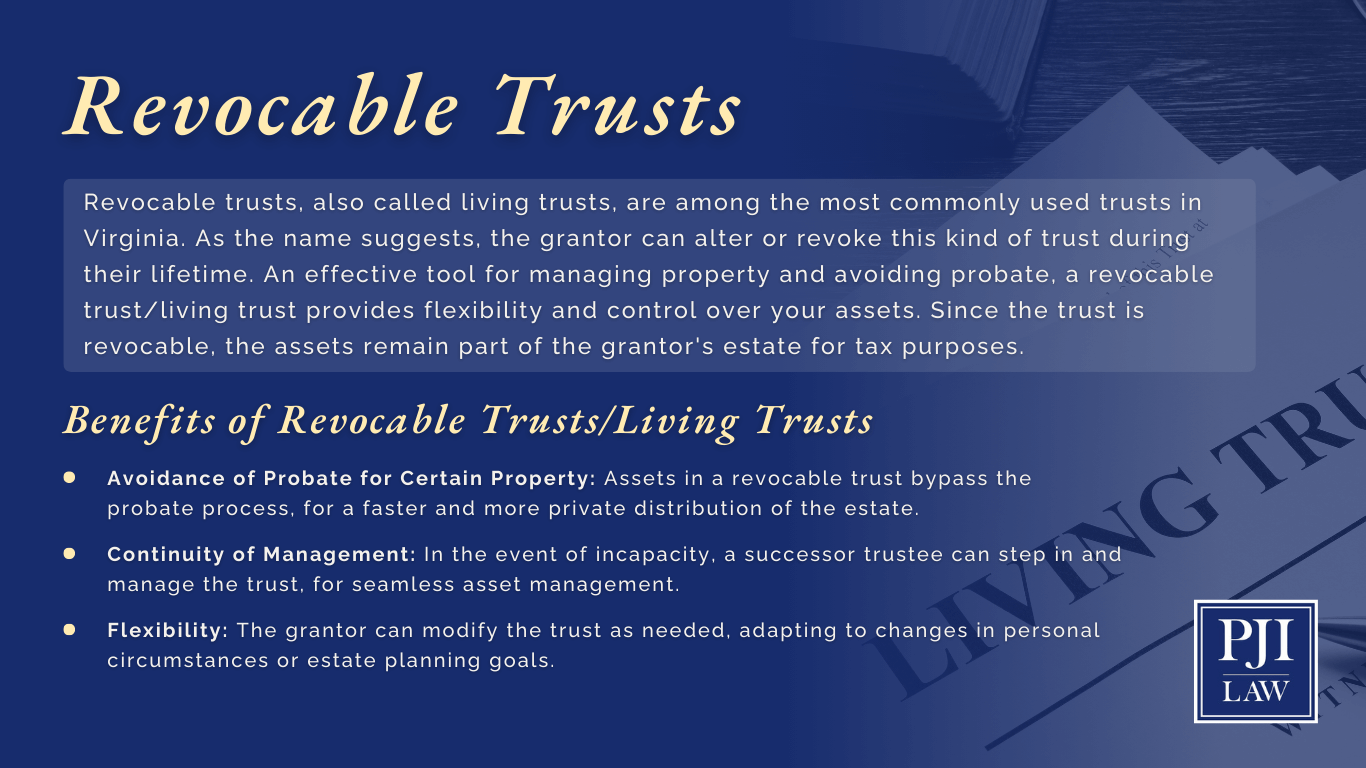
    As we mentioned, one of the defining features of a revocable living trust is its flexibility. Unlike irrevocable trusts — which settlors cannot change or revoke once they establish them— revocable trusts give you the flexibility to make adjustments as your circumstances dictate.

    Benefits of a Revocable Trust

    An estate planning attorney may recommend a revocable trust for several reasons, depending on a client’s circumstances, wishes, and best interests:

    1. Avoid Probate: Assets in a revocable trust bypass probate court and the probate process, passing assets privately and more efficiently to your beneficiaries.
    2. Asset Management & Control: You can serve as the trustee, or choose the right individual to assume the responsibility. Either way, you have authority over the assets during your lifetime, according to the terms you include in the trust.
    3. Flexibility: The ability to modify or revoke the trust adapts to life’s changes, such as marriages, births, or financial circumstances, protecting your family’s future.
    4. Privacy: Unlike wills, which become public record during probate, trusts remain private.
    5. Peace of Mind for You & Your Family: Knowing you have placed instructions for asset management according to your wishes in a legally binding document offers significant reassurance.

    Common Reasons for Amending a Revocable Trust

    Life’s changes often necessitate adjustments to your estate plan. At our law firm in Fairfax County, clients often choose to modify their revocable trusts for the following reasons:

    • New Beneficiaries: Perhaps you’ve welcomed a new child or grandchild, and you’d like to update your trust to include them.
    • Removed Beneficiaries: Changes in relationships may mean certain individuals should no longer be beneficiaries.
    • Trustee Updates: You may want to appoint a new trustee or successor trustee if your initial choice is no longer appropriate.
    • Asset Adjustments: If you acquire or sell significant assets, you’ll want the trust to reflect these changes.
    • Estate Taxes, State Law & Law Changes: Changes in estate taxes and federal or state tax laws might necessitate updates to your trust to maximize its financial benefits.

    A revocable trust allows you to respond to these life changes and align your estate plan with your current goals.

    How to Change a Revocable Trust in Northern Virginia

    At PJI Law, our estate planning services include helping our clients modify a revocable trust. With the right legal assistance, it’s a straightforward process.

    1. Review the Trust Document

    Carefully review the terms of your existing trust as the foundation for identifying what changes you would like to make.

    2. Consult an Estate Planning Attorney

    These important decisions require collaboration with an experienced Northern Virginia estate planning attorney, due to the complexity of trust laws. To avoid future legal issues, all changes must comply with state and federal law.

    At PJI Law, we offer personalized guidance to help you determine the best course of action, whether it involves minor tweaks or more significant revisions.

    3. Draft an Amendment or Restatement

    • Amendment: If you’re making small changes to your trust, such as adjusting beneficiaries or updating the trustee, we often use an amendment, a document that outlines the specific changes without altering the rest of the trust.
    • Restatement: For more comprehensive updates, you may want to create a restatement of trust. This process involves rewriting the trust document in its entirety while retaining the original trust name and date. This approach creates clarity and eliminates confusion caused by multiple amendments over time.

    4. Sign and Notarize

    Once you and your attorney have prepared the changes, you’ll need to sign the amendment or restatement before a notary public to formalize and legally bind the updates.

    5. Notify Relevant Parties

    Depending on the changes, you may need to inform your trustees, financial institutions, and other involved parties. For example, if you’ve updated the trustee, the successor trustee will need to be aware of their new role.

    6. Revisit Funding

    If the changes involve adding or removing assets, you must properly fund the trust. Any assets not transferred to the trust may still need to go through probate, defeating one of the benefits of the trust.

    7. Store the Updated Trust Safely

    Keep your updated trust documents in a secure location, such as a fireproof safe, and inform your trustee and significant family members of their whereabouts so that they can find them in case of an emergency or death.

    The Importance of Professional Estate Planning Guidance

    While a revocable trust offers convenience and flexibility among estate planning documents, you must handle modifications correctly. Working with a skilled estate planning attorney offers many benefits:

    • Legal Compliance: Your attorney will make every change to your trust in compliance with Virginia laws and regulations.
    • Clarity: Your attorney will help you avoid ambiguity that could lead to disputes among beneficiaries.
    • Efficiency: An estate planning law firm makes the process smoother, saving you time and reducing stress.

    At PJI Law, we take pride in helping our clients preserve their legacies and protect their loved ones. Our thorough, customized approach to every detail of your trust meets your needs and passes legal scrutiny.

    Why Choose PJI Law for Your Estate Planning Needs?

    Changing a revocable trust is a significant decision requiring precision and knowledge. At PJI Law in Fairfax, VA, we deliver white-glove service designed to make this process and the overall estate planning process as seamless as possible.

    • Personalized Attention: We understand the uniqueness of every client’s situation and invest the time to understand your goals and recommend solutions tailored to your needs.
    • Experienced Guidance: Our team has extensive experience in estate planning and a commitment to helping Northern Virginia families.
    • High-Touch Service: We guarantee prompt communication and inform you every step of the way.
    • Commitment to Excellence: Our detail-oriented team executes estate planning documents flawlessly and fully aligned with your wishes.

    Whether you need to modify your existing trust or begin your estate planning from scratch, an estate planning lawyer from PJI Law will guide you through this complex process.

    Schedule an Initial Consultation at PJI Law

    A revocable trust is an indispensable estate planning tool for anyone seeking flexibility and control over their assets. If it no longer matches your current circumstances or goals, you can update it with relative ease.

    Have you been typing “trust attorneys,” “trust attorney near me,” or “estate planning attorneys” into your search bar? 

    At PJI Law, we help families across Northern Virginia protect their assets and secure their legacies. Our practice areas include Fairfax wills, power of attorney (POA) documents, irrevocable trusts, and revocable trusts. Depending on your circumstances, we may also discuss options like charitable trusts, a special needs trust, a pet trust, and other estate planning tools.

    Contact us today at (703) 865-6100 or complete our online form to schedule a free initial consultation to discuss your estate planning needs.

    At PJI Law, you’ll receive personalized service and attention! 

    Copyright © 2025. PJI Law, PLC. All rights reserved.

    The information in this blog post (“post”) is provided for general informational purposes only and may not reflect the current law in your jurisdiction. No information in this post should be construed as legal advice from the individual author or the law firm, nor is it intended to be a substitute for legal counsel on any subject matter. No reader of this post should act or refrain from acting based on any information included in or accessible through this post without seeking the appropriate legal or other professional advice on the particular facts and circumstances at issue from a lawyer licensed in the recipient’s state, country, or other appropriate licensing jurisdiction.

    PJI Law, PLC
    3900 Jermantown Rd, 2nd Floor
    Fairfax, Virginia 22030
    (703) 865-6100
    https://pjibe.webteam.ai/

  • Can You Put Retirement Accounts in a Trust in Virginia?

    Can You Put Retirement Accounts in a Trust in Virginia?

    Planning your estate is personal. It isn’t just about money or documents. It’s about the people you care about and what will happen to them after you’re gone. One of the common questions people ask is, “Can you put retirement accounts in a trust?” The answer isn’t simple, and doing it the wrong way could have serious consequences for your family.

    In this blog, you’ll learn how Virginia treats retirement accounts in estate planning, whether you can name a trust as a beneficiary, and what to watch out for when making these decisions.

    Can You Put a Retirement Account Into a Trust?

    Transferring a retirement account like an IRA or 401(k) into a trust during your lifetime is usually not recommended. Doing so would trigger a taxable event, since these accounts are tied to you as an individual and offer tax-deferred or tax-free growth. Transferring ownership to a trust is considered a distribution by the IRS. That could mean:

    • Immediate income tax liability
    • A 10% early withdrawal penalty if you’re under age 59½

    However, you can name a trust as the beneficiary of your retirement account. When you pass away, the account will transfer to the trust, not directly to a person. This allows the trust to control how and when the money is distributed.

    When Naming a Trust as Beneficiary Makes Sense

    There are several reasons you might choose to name a trust as the beneficiary of your retirement accounts:

    • You have minor children or young adult beneficiaries
    • You’re providing for someone with special needs
    • You’re in a blended family
    • You want to protect assets from creditors or poor spending habits
    • You want to avoid probate and keep the terms of the trust private

    For example, suppose you leave your IRA directly to your 19-year-old child; they could take the full amount immediately and spend it however they like. But if your trust is the beneficiary, the trustee controls the timing and purpose of the distributions.

    In the case of a special needs beneficiary, a properly drafted special needs trust can receive retirement account distributions without affecting the person’s eligibility for benefits like Medicaid or SSI. For example, suppose you name a special needs trust as the beneficiary of your $500,000 IRA, the trustee can distribute funds for your disabled child’s medical expenses without affecting their Medicaid or SSI eligibility, unlike a direct inheritance.

    can you put retirement accounts in a trust

    How the SECURE Act Changed Inherited Retirement Accounts

    Congress passed the SECURE Act in 2019, and it was supplemented by the SECURE Act 2.0 in 2022. The SECURE Act introduced the 10-year withdrawal rule for most non-spouse beneficiaries, while SECURE 2.0 raised the required minimum distribution (RMD) age to 73 (or 75 for those born after 1960), impacting trust planning. These laws changed how inherited retirement accounts work for most non-spouse beneficiaries.

    Before the SECURE Act, beneficiaries could stretch distributions over their lifetime. Now, most must withdraw the full amount within 10 years. That can lead to a hefty tax bill, especially if the distributions push the beneficiary into a higher income bracket.

    Exceptions to the 10-Year Rule

    Certain individuals still qualify for lifetime “stretch” treatment:

    • Your surviving spouse
    • Your minor child (until they reach age 21, applicable only to your own children, not grandchildren or stepchildren)
    • A disabled or chronically ill beneficiary
    • A beneficiary less than 10 years younger than you

    What About Trusts?

    To get favorable tax treatment, a trust must meet the IRS definition of a “see-through” trust:

    • It must be valid under state law
    • It must become irrevocable upon your death
    • Its beneficiaries must be identifiable
    • A copy must be given to the plan administrator by October 31 of the year following your death

    If your trust doesn’t meet these requirements, the retirement account could be taxed in as little as five years if you died before your required beginning date for RMDs (age 73), or immediately if you die after that date.

    Steps to Protect Your Retirement Accounts

      • Review retirement account beneficiary designations.
      • Consult an attorney to select the appropriate trust type.
      • Draft the trust to meet IRS “see-through” requirements.
      • Coordinate the trust with your will and other estate documents.
      • Submit trust documentation to the plan administrator by October 31 of the year following death.

    Can You Put Retirement Accounts in a Trust in Virginia?

    Choosing the Right Type of Trust for Retirement Assets

    Different types of trusts offer different benefits, and each must be carefully drafted if you want to name it as a beneficiary of a retirement account.

    Revocable Living Trust

    A revocable living trust is popular for avoiding probate and keeping your estate private. You retain control during your lifetime, and it becomes irrevocable after your death.

    Irrevocable Trust

    An irrevocable trust can protect assets from creditors and may reduce estate taxes, but it’s more complex. These trusts are subject to higher tax rates and strict distribution rules. They may also involve trustee fees and tax preparation costs, which should be weighed against their benefits.

    Conduit Trust

    A conduit trust requires the trustee to pass required distributions directly to beneficiaries. This can help the trust qualify for favorable tax treatment, but it limits your control over the timing or use of the funds. Conduit trusts ensure tax compliance but may not suit complex family needs.

    Accumulation Trust

    An accumulation trust allows the trustee to hold the retirement distributions within the trust and manage them. This provides more control and asset protection but may result in higher taxes. Accumulation trusts face compressed tax brackets (e.g., 37% at $14,450 of income in 2025), unlike individual beneficiaries. 

    Special Needs Trust

    A Special Needs Trust is used to provide for a disabled beneficiary without disrupting their access to government benefits. A retirement account can fund a special needs trust—but it must be structured properly.

    Charitable Remainder Trust (CRT)

    This is a complex tool for higher-net-worth individuals. It pays income to your chosen beneficiary for life or a set period and donates the remainder to charity. This structure can offer tax advantages and support charitable goals. CRTs typically require significant assets (e.g., $100,000+) to justify setup costs and provide a partial charitable deduction.

    Can You Put Retirement Accounts in a Trust in Virginia?

    Retirement Accounts and the Probate Process in Virginia

    When you name an individual or a trust as your retirement account beneficiary, those assets pass outside of probate under Virginia law. (See Va. Code § 64.2-100).

    That said, if your estate plan isn’t coordinated, things can still go wrong. Your IRA beneficiary form controls who inherits the account, even if your trust or will names different heirs. For example, if your trust stipulates that your children each get 50%, but your IRA beneficiary form only names one of them, the trust language doesn’t apply. The IRA will go entirely to the beneficiary named on the form.

    Common Mistakes to Avoid

    can you put retirement accounts in a trust

    Here are some of the most common and costly mistakes people make:

    • Naming the wrong type of trust as a beneficiary
    • Failing to update your beneficiary forms after a life event
    • Using a boilerplate trust that doesn’t address retirement accounts
    • Overlooking the tax hit of accelerated distributions
    • Not submitting trust documentation to the plan administrator
    • Assuming a trust is always better than leaving the account directly to a spouse

    If you name your spouse directly as the IRA beneficiary, they can roll the account into their own IRA and delay RMDs until age 73 (or 75 if born after 1960), reducing tax liability and allowing continued tax-deferred growth. That option isn’t available to a trust.

    Coordinating Your Estate Plan in Fairfax and Northern Virginia

    Whether you’re in Fairfax County or another part of Northern Virginia, you want to make sure all your estate planning documents work together. That means:

    • Reviewing your will, trust, and beneficiary forms regularly
    • Coordinating with your powers of attorney and advance directives
    • Checking whether your estate will be subject to federal estate tax
    • Talking with an attorney about family dynamics, tax planning, and long-term goals

    Virginia does not have a state estate tax. But federal rules still apply, and the exemption is $13.99 million per individual in 2025 but is scheduled to drop significantly after 2025 unless Congress acts.

    How a Trusts Attorney Can Support Your Goals

    A Virginia trusts attorney can help you:

    • Review your accounts and determine whether a trust is the right beneficiary
    • Draft trust provisions that meet IRS see-through rules and Virginia’s Uniform Trust Code (Va. Code § 64.2-700), which requires clear intent and identifiable beneficiaries
    • Coordinate your trust, will, and retirement accounts
    • Avoid triggering unnecessary taxes or legal disputes

    In Virginia, trusts must follow the Uniform Trust Code. That means they must be properly drafted and valid under state law to be effective.

     Can You Put Retirement Accounts in a Trust in Virginia?

    Not Sure How to Handle Your IRA or 401(k) in a Trust? We Can Help

    Your retirement accounts are a significant part of your legacy. Whether you’re building your first estate plan or updating it to reflect life changes, it’s worth taking a closer look at how those accounts will pass to your family.

    At PJI Law, we work with individuals and families across Fairfax and Northern Virginia to develop customized estate plans that protect what matters most. If you’re considering naming a trust as the beneficiary of your IRA or 401(k), our legal team can review your documents and help you avoid costly mistakes.

    Your online search for “attorney for trust” or “estate planning lawyers near me” brought you here. Now take the next step. Call (703) 865-6100 or fill out our confidential online form to schedule a consultation.

    From your first conversation with us, you’ll receive responsive communication, clear explanations, and solutions built around your goals. At PJI Law, we don’t offer one-size-fits-all estate planning services. We create estate plans that reflect your life, your family, and your future.

    At PJI Law, you’ll receive white glove service and personalized attention!

    Copyright © 2025. PJI Law, PLC. All rights reserved.

    The information in this blog post (“post”) is provided for general informational purposes only and may not reflect the current law in your jurisdiction. No information in this post should be construed as legal advice from the individual author or the law firm, nor is it intended to be a substitute for legal counsel on any subject matter. No reader of this post should act or refrain from acting based on any information included in or accessible through this post without seeking the appropriate legal or other professional advice on the particular facts and circumstances at issue from a lawyer licensed in the recipient’s state, country, or other appropriate licensing jurisdiction.

    PJI Law, PLC
    3900 Jermantown Rd, 2nd Floor
    Fairfax, Virginia 22030
    (703) 865-6100
    https://pjibe.webteam.ai/

  • What Are the Advantages and Disadvantages of a Revocable Trust in Richmond, VA?

    What Are the Advantages and Disadvantages of a Revocable Trust in Richmond, VA?

    Estate planning is critical for anyone who wants to safeguard their assets, provide for loved ones, and establish financial security for future generations. Among estate planning documents, proficient estate planning attorneys often recommend revocable trusts to their clients as a method of reaching their financial goals. Unlike an irrevocable trust, a revocable trust (also called a revocable living trust or a living trust) offers flexibility and control.

    But what are the advantages and disadvantages of a revocable trust?

    At PJI Law, our law office focuses on personalized estate planning to fulfill your goals and protect your family’s future. This blog, from a knowledgeable lawyer, explains the basic elements of revocable trusts and their benefits and limitations to help you evaluate whether this estate planning tool suits your unique needs and circumstances.

    What Are the Advantages and Disadvantages of a Revocable Trust in Richmond, VA?

    What Is a Revocable Living Trust?

    A revocable living trust is a legal entity created to hold and manage assets during your lifetime. It takes its name from the grantor’s (the person establishing the trust) ability to modify, amend, or completely dissolve the trust during the grantor’s lifetime. Individuals who want full control over their estate plan as their needs and circumstances evolve can enjoy many benefits from a revocable living trust.

    How a revocable living trust works:

    • The grantor establishes the trust and transfers ownership of assets into it.
    • The grantor names a trustee to manage the trust’s assets. Often, the grantor serves as their trustee during their lifetime. The grantor can also specify a successor trustee to manage the trust assets if the original trustee dies or can no longer handle this fiduciary responsibility.
    • The grantor designates beneficiaries to receive the trust’s assets after the grantor’s death.
    • The trust document includes the terms and distribution schedule for the assets.

    A revocable living trust offers a straightforward and private way to manage your estate during your lifetime and after your passing.

    Advantages of a Revocable Living Trust in Richmond, VA

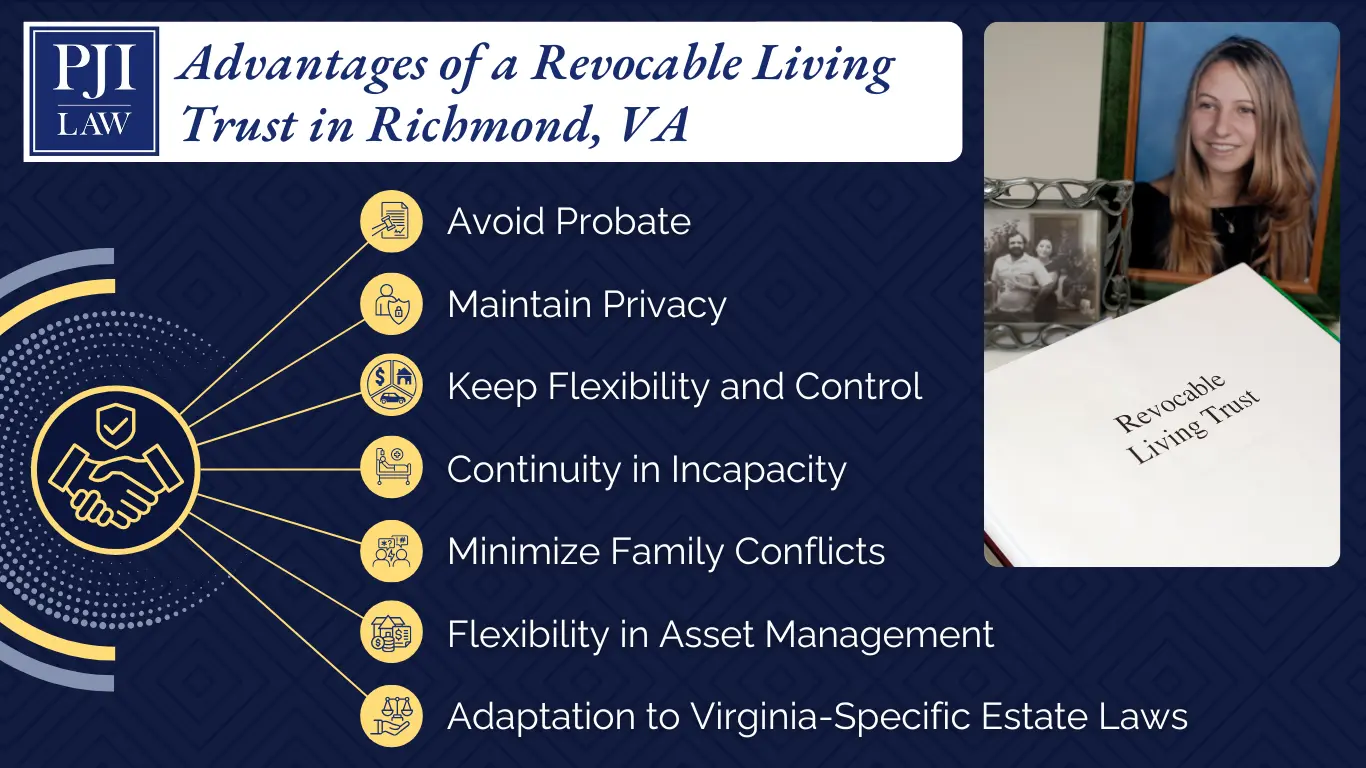
    What Are the Advantages and Disadvantages of a Revocable Trust in Richmond, VA?

    A revocable living trust has various benefits that make it an appealing choice for many individuals and families in and around Richmond.

    1. Avoid Probate

    One of the most significant benefits of a revocable trust is its ability to avoid probate, a time-consuming, public, and costly process for your loved ones. Assets held in a revocable living trust skip the probate process and transfer directly to beneficiaries without court supervision, significantly reducing delays and expenses.

    When Richmond families can avoid probate setbacks, it saves time and allows beneficiaries to access assets efficiently during a time of grief. The function of a living trust is particularly helpful when dealing with real estate, property, business interests, or financial accounts.

    2. Maintain Privacy

    Unlike a will, which becomes a public record during the probate process, a revocable trust remains private, preventing sensitive financial details and distribution plans from being publicly disclosed. For individuals and families who value discretion, the privacy of a living trust is a highly attractive feature.

    3. Keep Flexibility and Control

    A living trust allows the grantor to retain full control over the assets. Whether you need to add new assets, remove them, or change beneficiaries, you can make adjustments as your life circumstances evolve. The flexibility a living trust offers is perfect for situations such as:

    • Changes in financial status
    • New family dynamics, like divorce and second marriages
    • Revisions to beneficiary designations
    • Adjustments for tax planning purposes

    4. Continuity in Incapacity

    Should the grantor become incapacitated, the successor trustee named in the trust can step in to manage the assets seamlessly, preventing the need for court-appointed guardianship or conservatorship, and offering peace of mind for families managing difficult medical situations.

    5. Minimize Family Conflicts

    By outlining clear terms for asset distribution and naming a trustee to oversee the process, revocable trusts can minimize misunderstandings or disputes among family members. This is especially important in cases where assets are complex or when blended families are involved.

    6. Flexibility in Asset Management

    Assets transferred into a revocable trust are managed according to your instructions and can include real estate, bank accounts, investments, and more. For example, you can transfer Richmond properties into your trust for proper management and swift transfer to beneficiaries after your death.

    7. Adaptation to Virginia-Specific Estate Laws

    Virginia’s trust laws, governed by the Virginia Uniform Trust Code, provide a user-friendly framework for creating and administering trusts. Working with an experienced law firm well-versed in VA law helps your living trust adhere to all applicable guidelines, so you gain maximum benefit without unintended pitfalls.

    What Are the Advantages and Disadvantages of a Revocable Trust in Richmond, VA?

    Disadvantages of Revocable Trusts in Richmond, VA

    While revocable trusts offer many advantages, they are not without downsides. Here are some factors to consider before deciding to create one.

    1. Higher Initial Costs

    Setting up a revocable trust generally requires more time and attorney fees compared to drafting a simple will. While the upfront expense may be substantial, the savings achieved by avoiding probate proceedings and legal fees later often outweigh the cost.

    2. Funding the Trust

    Once you create a trust, you must formally transfer assets into it. This process, known as funding the trust, can be time-consuming and requires careful attention to detail. Failing to fully fund the trust may result in certain assets still being subject to probate.

    3. No Asset Protection

    While an irrevocable trust offers protection from creditors, a revocable trust does not shelter assets in the same way. Because the grantor retains control of the assets during their lifetime, creditors can still make claims against them. If you want to safeguard assets during your lifetime, keep this in mind.

    4. Does Not Save Estate Taxes

    Revocable trusts do not provide relief from estate or inheritance taxes. If you have a substantial estate and concerns about federal estate taxes, you may need to incorporate other estate planning strategies alongside a revocable trust.

    5. Ongoing Maintenance from the Trust Maker

    A revocable trust is not a “set-it-and-forget-it” kind of tool for the trust maker. Life changes, new relationships, or shifting financial priorities require periodic updates. Additionally, you should monitor your beneficiaries over time to align the trust terms with your wishes as they evolve. Remain actively engaged with your trust so that it serves your objectives.

    Is a Revocable Trust Right for You?

    Whether or not a revocable trust is the best choice depends on your specific needs, family goals, and estate size. Individuals who will benefit most from this type of trust typically:

    • Value flexibility and control over their assets
    • Want to streamline the transfer of property after death
    • Are concerned about maintaining privacy
    • Need a plan for managing their estate in the event of incapacity

    However, individuals with smaller estates or those that do not involve complex assets may achieve their objectives with a simpler plan, such as a will, which becomes a matter of public record, or a transfer-on-death deed.

    Frequently Asked Questions About Revocable Trusts and Estate Planning

    What is a revocable trust, and how does it work?

    A revocable trust is a legal document that allows you to manage and distribute your assets during your lifetime and after your death. You, as the grantor, can modify or revoke it at any time. The trust, managed by a trustee, holds your assets, such as property or investments.

    How does a revocable trust help with estate planning?

    A revocable trust simplifies estate planning by organizing the handling and distribution of your assets. It helps avoid court involvement for probate, provides privacy, and carries out your wishes efficiently, especially if you have minor children or complex finances.

    Will I still owe estate taxes with a revocable trust?

    A revocable trust doesn’t protect your estate from taxes because the assets are still considered part of your taxable estate. However, if your estate is under the current estate tax exemption limits, there will be no estate tax imposed.

    What is a Successor Trustee?

    A successor trustee steps in to manage the trust’s assets if you become incapacitated or pass away. They must follow your wishes, pay debts, and distribute assets to beneficiaries

    How do trust assets differ from personal assets?

    Trust assets are those transferred into your trust’s name, such as bank accounts, real estate, or investments. Personal assets remain in your name and can be funded to your trust upon your death if proper beneficiary designations have been filed. To maximize the benefits of a revocable trust, you must transfer all appropriate assets properly.

    What happens if I don’t have a Durable Power of Attorney?

    Without a Durable Power of Attorney, your financial and legal decisions may require court involvement if you become incapacitated. Including this document in your estate plan allows your chosen representative to act on your behalf for important matters.

    Do revocable trusts protect assets from creditors?

    No, a revocable trust does not shield assets from creditors or lawsuits during your lifetime. For asset protection, you may need additional strategies, such as irrevocable trusts, tailored to your needs.

    Can a revocable trust benefit minor children?

    Yes, the trustee of a revocable trust manages assets intended for children until they reach a specified age. It prevents a court from appointing a guardian for financial matters and avoids direct inheritance issues.

    Why is a Pour-Over Will important in estate planning?

    A pour-over will works alongside a revocable trust to catch any assets not titled in the trust’s name at the time of your death. It transfers these assets into the trust, where they are distributed according to its terms.

    Do financial institutions recognize revocable trusts?

    Yes, most financial institutions recognize and work with revocable trusts. However, they may require specific documentation, like a copy of the trust or a trustee’s certification, before granting access to trust accounts.

    How do I create and manage a revocable trust?

    Creating and managing a revocable trust requires careful planning and legal guidance. It’s best to consult a qualified law firm that can draft the trust, assist with funding it, and guide you on succession planning to meet your goals.

    What Are the Advantages and Disadvantages of a Revocable Trust in Richmond, VA?

    PJI Law: Your Local Richmond Estate Planning Attorneys

    Estate planning becomes manageable when you have knowledgeable advisors on your side. PJI Law’s staff of legal professionals understands the intricacies of Virginia law and offers white-glove service to tailor your estate plan to your needs. We serve clients at all stages of life, from young families to older individuals. In addition to revocable living trusts, our practice areas include irrevocable trusts, special needs trusts, power of attorney documents, and estate administration.

    Have you been searching online for a “trust attorney near me,” “trust attorneys,” or “Virginia estate planning attorneys?” 

    Whether you’re exploring a revocable trust, seeking to establish a last will and testament, or considering options for asset protection, durable power of attorney, and other components of a comprehensive estate plan, contact us to discover how we can help you preserve your legacy and protect your family’s long-term financial future.

    With our personalized, high-touch approach, your estate planning will reflect your values and provide peace of mind for you and your loved ones.

    Contact us at (804) 653-3450 or complete our online form to schedule a consultation.

    Copyright © 2025. PJI Law, PLC. All rights reserved.

    The information in this blog post (“post”) is provided for general informational purposes only and may not reflect the current law in your jurisdiction. No information in this post should be construed as legal advice from the individual author or the law firm, nor is it intended to be a substitute for legal counsel on any subject matter. No reader of this post should act or refrain from acting based on any information included in or accessible through this post without seeking the appropriate legal or other professional advice on the particular facts and circumstances at issue from a lawyer licensed in the recipient’s state, country, or other appropriate licensing jurisdiction.

    PJI Law, PLC
    4108 E Parham Rd, 
    Richmond, VA 23228
    (804) 653-3450
    https://pjibe.webteam.ai/

  • Richmond Trust Attorneys Explain How to Create a Trust in Virginia

    Richmond Trust Attorneys Explain How to Create a Trust in Virginia

    In a previous blog, we explained the types of trusts in Virginia, illustrating the importance of trusts through the story of John and Mary Thompson, a Richmond couple who realized that their estate planning documents were not complete without the inclusion of a trust.

    The trust attorneys at PJI Law in Richmond understand that planning for your future and protecting the interests of your loved ones can feel overwhelming. We also recognize that each individual and family should have a plan tailored to their unique estate planning needs and goals.

    Have you been searching online for “how to create a trust?”

    This blog, from skilled estate planning attorneys in Virginia, delves into creating a trust and why it is often a viable solution for individuals who want to distribute assets smoothly and help their heirs avoid the unpredictability of probate.

    What Is a Trust?

    A trust is a legal arrangement where a person, known as the grantor, transfers their assets to a named trustee to manage for the benefit of their designated beneficiaries. While this might sound complex, a trust allows for flexibility, control, and protection of your assets while offering you and your family numerous benefits. Assets can include money and property and once the grantor transfers these assets into the trust, the trust becomes the owner of these assets. The trustee’s role is to manage the assets and distribute them to the heirs indicated in the trust according to its terms.

    Benefits of Creating a Virginia Trust

    Creating a trust and transferring assets into it offers several benefits.

    1. Bypass Probate

    As we shared in our blog, What You Need to Know About Probate in Virginia, the public probate process can be lengthy and complex. A trust allows you to bypass probate so that your loved ones receive their inheritance faster and with less hassle.

    2. Privacy

    While most people have will-based estate plans, wills become public records during the probate process, meaning anyone can access the details. Trusts, on the other hand, are private legal documents.

    3. Control and Flexibility

    Trusts allow you to set conditions for how and when to distribute your assets. For example, you can leave instructions that minor children or grandchildren only receive their inheritance when they reach a certain age.

    4. Protection from Creditors

    Assets in certain types of trusts, like irrevocable trusts, often enjoy protection from creditors, helping to secure your family’s finances for the next generation.

    5. Minimizing Family Disputes

    Clearly outlining asset management and distribution via a trust can help reduce misunderstandings and disputes among family members.

    Virginia Laws Governing Trusts

    The Virginia Uniform Trust Code (UTC) primarily governs trusts in the state. These laws provide a clear framework for creating, administrating, and enforcing trusts.

    Key Sections of the Virginia Code to Know:

    • § 64.2-700 to § 64.2-808 of the Virginia Uniform Trust Code outlines the basic requirements and duties related to trusts.
    • § 64.2-763 addresses the fiduciary duties of trustees, emphasizing their legal obligation to act in the best interest of the beneficiaries.

    To comply with these laws, consult knowledgeable Richmond estate planning lawyers.

    Types of Trusts Available in Virginia

    Virginia offers various types of trusts to meet different needs, including:

    1. Revocable Living Trusts

      • The grantor maintains control and can modify or revoke the trust during their lifetime.
      • Ideal for avoiding probate while retaining flexibility.

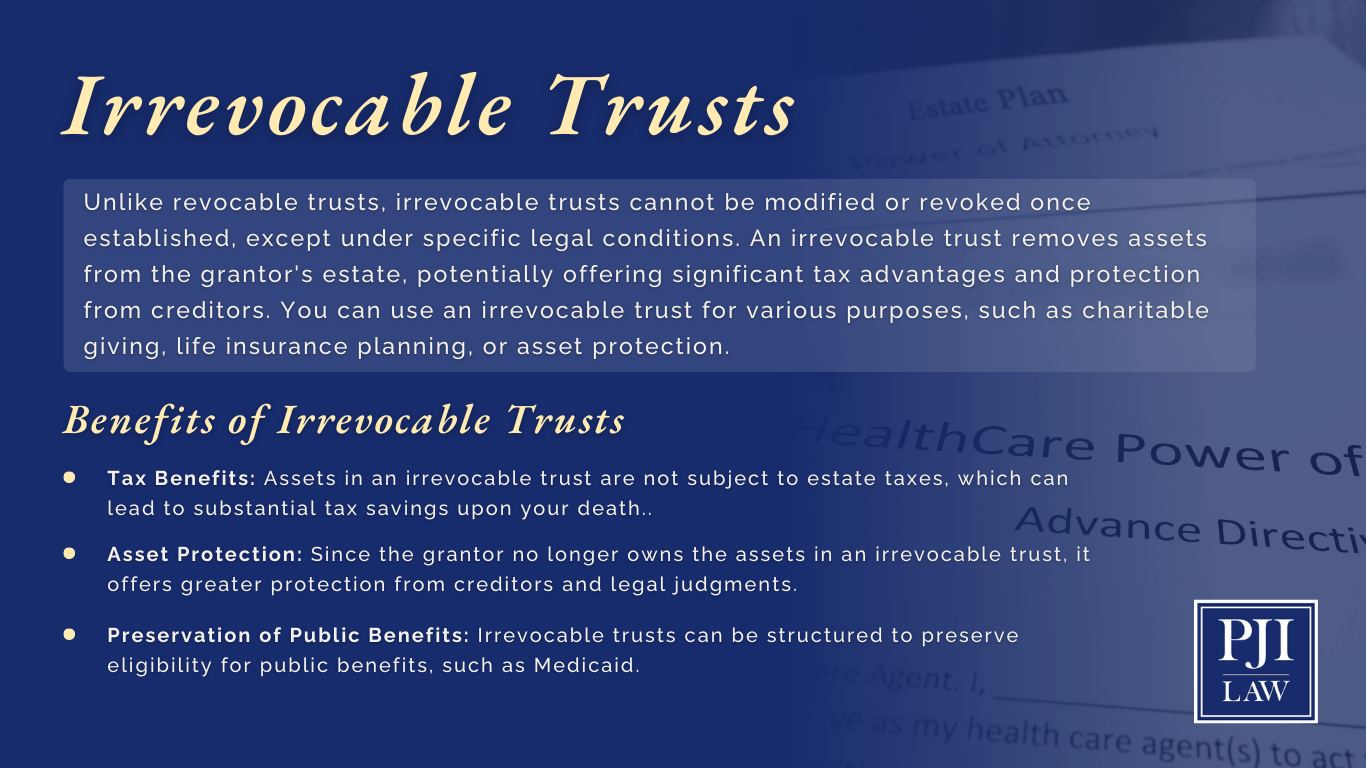
    2. Irrevocable Trusts

      • These trusts cannot be modified or revoked once established.
      • Offer significant tax benefits and enhanced creditor protection.

    3. Special Needs Trusts

      • Designed to provide for a beneficiary with a disability without affecting their eligibility for public benefits like Medicaid or Supplemental Security Income (SSI).

    4. Charitable Trusts

      • Intended to benefit a specific charitable organization or cause.

    5. Testamentary Trusts

      • Created through a will and only activated upon the grantor’s death.
      • These trusts do not bypass probate but are useful for passing down assets under defined conditions.

    Click here for a complete list. As experienced attorneys know, each trust has unique advantages, and the correct choice will depend on your goals and circumstances.

    Steps to Creating a Trust in Virginia

    Creating a trust requires careful planning to protect and distribute your assets as you wish.

    1. Determine Your Goals

    Before you begin, think about what you want to achieve. Are you trying to avoid probate? Minimize taxes? Protect assets for future generations? This clarity will guide the process and help with decision-making.

    2. Draft Your Trust Document

    Your trust must comply with the Virginia Uniform Trust Code.

    • Name the Grantor

    The person who creates the trust and transfers the assets.

    • Name the Trustee

    Appoint someone you trust to manage the assets and confirm that they understand their responsibilities.

    • Identify Beneficiaries

    Designate the individuals or organizations that will benefit from the trust.

    • Define Conditions

    Specify how and when to distribute assets and any restrictions based on your goals.

    • Name a Successor Trustee

    As the saying goes, death and taxes are the two things we can count on in life. You want to name a successor trustee who can handle trust administration if your original trustee passes away or can no longer fulfill their duties.

    3. Execute the Trust Agreement

    Virginia requires that the trust document be signed and notarized in most cases. This process formalizes the legal creation of your trust and ensures its enforceability.

    4. Fund the Trust

    A trust can only achieve its purpose if you fund it. Funding a trust involves transferring ownership of your assets (such as property, bank accounts, and investments) to the name of the trust or listing the trust as the beneficiary of your assets upon your death. If you want to spare your family the hassles of the probate process and facilitate a smoother estate administration, you must take the time to transfer funds into the trust.

    5. Maintain and Manage the Trust

    Once the trust is established, it requires ongoing attention. Responsibilities include updating the trust if circumstances change, managing trust assets, and ensuring timely distributions. Virginia laws require that trustees act in the best interests of the beneficiaries, maintaining transparency and avoiding self-dealing.

    Common Mistakes to Avoid When Establishing a Trust as Part of Your Estate Plan

    Creating a trust can provide immense peace of mind, but as our attorneys know, common mistakes in the process can undermine your intent.

    1. Failing to Define Beneficiaries and Conditions Clearly

    State your wishes explicitly to prevent ambiguity.

    2. Neglecting to Fund the Trust Properly

    Transfer funds into the trust. Without funding, it is just a document.

    3. Overcomplicating Trust Terms

    Keep it simple to achieve better outcomes and avoid overly restrictive conditions.

    4. Overlooking Updates

    When life events such as second marriages, death, divorce, or the arrival of a new family member occur, keep your trust up to date to align with these changes.

    Frequently Asked Questions About Virginia Trusts

    How does a pour-over will work with a trust?

    A pour-over will is a special type of will that works alongside a revocable living trust. It transfers any remaining funds that were not transferred into a trust during your lifetime or automatically upon your death, to be managed in accordance with the trust’s terms.

    Can I place retirement accounts into a trust?

    You can place certain retirement accounts into a trust, but it requires careful planning due to tax implications and legal considerations. Accounts like IRAs, 401(k)s, and other tax-advantaged accounts are typically not directly transferred into a trust during your lifetime to avoid triggering immediate taxation. Instead, you can name the trust as the beneficiary of the retirement account. This approach allows the funds to flow into the trust upon your passing, enabling you to control the distribution of assets to your beneficiaries. However, you must structure the trust properly to avoid unintended tax consequences such as accelerated distributions or higher tax rates for beneficiaries.

    For these reasons, consult a knowledgeable estate planning attorney.

    How does trust administration work?

    Trust administration involves managing and distributing the assets of a trust according to its terms and in compliance with state laws.

    1. Acceptance of Trustee Role: The trustee, named in the trust document, formally accepts their role and responsibilities.
    2. Understanding the Trust Terms: The trustee reviews the trust document to understand their duties, the beneficiaries, and the distribution instructions.
    3. Inventory of Assets: The trustee identifies and gathers all trust assets, such as real estate, bank accounts, investments, and personal property.
    4. Notification of Beneficiaries: Virginia law requires the trustee to notify beneficiaries of the trust’s existence and their rights.
    5. Management of Assets: The trustee manages the trust assets prudently, preserving and investing them appropriately, following the “prudent investor rule.”
    6. Payment of Debts and Taxes: The trustee settles any outstanding debts, expenses, and taxes the trust owes.
    7. Distribution of Assets: The trustee distributes the trust assets to the beneficiaries according to the terms of the trust.
    8. Record-Keeping and Reporting: The trustee maintains detailed records of all transactions and may need to provide beneficiaries with periodic accountings.

    What does my financial institution require from a trust?

    Each institution may have its own policies and procedures but generally requires you to provide a copy of the trust document or a certification of trust, a summary document confirming the trust’s existence without revealing all its terms. The institution will verify that the trustee has the authority to manage the account or transfer assets into the trust and retitle any accounts you transfer into the name of the trust, e.g., “Julianna Rose, Trustee of the Julianna Rose Living Trust.” If you’re naming the trust as a retirement or life insurance account beneficiary, your institution may require specific forms to update the designation.

    Contact PJI Law to Discover How Our Trust Attorneys Can Assist You

    At PJI Law, we know that establishing an estate plan is not a one-time transaction. We build lasting relationships with our clients because we want their plans to grow and adapt with them through every significant life event. Our experienced estate planning lawyers and legal staff will guide you every step of the way, from selecting the correct type of trust to structuring it properly and ensuring it serves your family’s needs in years to come.

    Whether you need a living trust, a special needs trust, or any other type of trust, our personalized services will give you and your loved ones peace of mind. Contact PJI Law at (804) 653-3450 or complete our online form to schedule a consultation for personalized service and attention.

    Copyright © 2025. PJI Law, PLC. All rights reserved.

    The information in this blog post (“post”) is provided for general informational purposes only and may not reflect the current law in your jurisdiction. No information in this post should be construed as legal advice from the individual author or the law firm, nor is it intended to be a substitute for legal counsel on any subject matter. No reader of this post should act or refrain from acting based on any information included in or accessible through this post without seeking the appropriate legal or other professional advice on the particular facts and circumstances at issue from a lawyer licensed in the recipient’s state, country, or other appropriate licensing jurisdiction.

    PJI Law, PLC
    4108 E Parham Rd,
    Richmond, VA 23228
    (804) 653-3450
    https://pjibe.webteam.ai/

  • Can I Put My Life Insurance in a Trust in Virginia?

    Can I Put My Life Insurance in a Trust in Virginia?

    Life insurance is often a key component of estate planning, offering financial security to loved ones in the event of your passing. However, simply naming a beneficiary may not provide the level of control or protection you want. A trust can help you bridge that gap. Using a trust to hold your life insurance policy can offer several advantages, such as avoiding probate, reducing estate taxes, and protecting your beneficiaries from creditors. 

    Given these benefits, you may be asking, “Can I put my life insurance in a trust in Virginia?” The answer is yes—in many cases, it can be a strategic choice. Let’s explore what this process involves and whether it’s right for you.

    Why Consider Putting Life Insurance in a Trust?

    Placing your life insurance in a trust can offer several advantages, depending on your financial goals and family situation. Here are some reasons people consider this option:

    • Avoiding Probate: In Virginia, assets held in a trust typically bypass the probate process, distributing your life insurance benefits more quickly and privately.
    • Estate Tax Planning: Although Virginia does not have a state estate tax, the federal estate tax applies to estates exceeding a certain threshold ($13.61 million in 2024 and $13.99 million in 2025). By placing your life insurance in an Irrevocable Life Insurance Trust (ILIT), you may reduce the taxable portion of your estate.
    • Controlled Distribution: A trust allows you to specify when and how your beneficiaries receive the life insurance proceeds. This can be particularly beneficial if your beneficiaries are minors or if you want to stagger distributions over time.
    • Protecting Beneficiaries: A trust can shield life insurance proceeds from creditors and ensure that funds are used according to your wishes.

    Types of Trusts for Life Insurance in Virginia

    When placing life insurance in a trust, it’s essential to choose the right type of trust for your specific needs. Here are the most common options:

    Irrevocable Life Insurance Trust (ILIT)

    An ILIT is a popular option for holding life insurance policies. Once you create an ILIT and transfer ownership of your policy to the trust, you relinquish control of the policy. While this may seem restrictive, it comes with significant benefits:

    • Estate Tax Exclusion: Since the policy is no longer part of your estate, the death benefit will not be subject to federal estate taxes.
    • Creditor Protection: The funds in an ILIT are generally protected from creditors.
    • Structured Payouts: You can dictate how and when your beneficiaries receive the proceeds.

    However, if you transfer an existing life insurance policy into an ILIT, the IRS applies a “three-year rule” under Internal Revenue Code § 2035(a). If you pass away within three years of transferring the policy, the IRS will include the policy’s proceeds in your estate for tax purposes, negating the intended estate tax benefits. To avoid this issue, many individuals choose to have the ILIT purchase a new policy instead of transferring an existing one. This strategy allows the policy to be excluded from your estate immediately.

    Despite these benefits, ILITs also have drawbacks:

    • Loss of Control: Once the policy is placed in an ILIT, you cannot change its terms or beneficiaries or revoke the trust.
    • Gift Tax Considerations: Transferring an existing life insurance policy to an ILIT may be considered a taxable gift, though this can often be mitigated through annual exclusions.
    • Complex Administration: ILITs require careful management, particularly when making premium payments, to ensure contributions qualify for gift tax exclusions and maintain the trust’s intended benefits.

    Revocable Living Trust

    A Revocable Living Trust is another option for holding a life insurance policy. Unlike an ILIT, this type of trust allows you to retain control and make changes to the trust during your lifetime. However, there are some significant differences to be aware of:

    • Flexibility: You can modify or revoke the trust as your circumstances change.
    • Probate Avoidance: Like an ILIT, a Revocable Living Trust can help your beneficiaries avoid probate.
    • Control Over Distribution: You can dictate how the proceeds are distributed, ensuring beneficiaries receive funds in a structured manner.

    Despite its advantages, a Revocable Living Trust has some limitations:

    • No Estate Tax Benefits: Since you maintain control of the policy, the death benefit will still be included in your taxable estate. However, if your estate is under the federal estate tax exemption limit at the time of your death, no estate tax will be assessed. 
    • Limited Asset Protection: Unlike an ILIT, assets in a Revocable Living Trust are not shielded from creditors during your lifetime.

    How to Transfer a Life Insurance Policy to a Trust

    If you decide to place your life insurance in a trust, you’ll need to follow a few steps to make the transfer legally effective:

    1. Create the Trust: Work with Virginia estate planning attorneys to draft the trust document. This step is critical for creating a trust that complies with Virginia law and reflects your intentions.
    2. Transfer Ownership: For ILITs, you must purchase a new policy or transfer ownership of the life insurance policy to the trust. This involves completing the necessary forms with your insurance company.
    3. Change the Beneficiary: For both ILITs and Revocable Living Trusts, the trust should be named as the beneficiary of the life insurance policy. This allows the proceeds to flow directly into the trust upon your passing.
    4. Pay Premiums: If you transfer an existing policy to an ILIT, you’ll need to make premium payments through the trust. This is often done using annual gifts to the trust, which are then used to pay the premiums.

    Potential Drawbacks to Consider

    While placing life insurance in a trust can offer significant benefits, it’s not without its challenges. Here are some potential drawbacks to be aware of:

    • Irrevocability: With an ILIT, once you transfer ownership of the policy, you cannot make changes or revoke the trust.
    • Gift Tax Implications: Transferring an existing life insurance policy to an ILIT may be considered a taxable gift. However, this can often be mitigated by using your annual gift tax exclusion ($19,000 per recipient in 2025).
    • Cost and Complexity: Creating and maintaining a trust can involve legal fees and administrative responsibilities.

    Is a Life Insurance Trust Right for You?

    The decision to place your life insurance in a trust depends on your individual circumstances, including your estate size, financial goals, and family dynamics. Here are some scenarios where a trust may be beneficial:

    • You have a large estate that may be subject to federal estate taxes.
    • You want to control how and when your beneficiaries receive life insurance proceeds.
    • You have minor children and want to provide financial protection until they reach adulthood.

    Working with Local Trust Attorneys in Virginia

    Placing life insurance in a trust involves legal and financial complexities. Consulting local trust attorneys in Virginia can clarify your options, draft the appropriate trust documents, and guide you through the process of transferring your life insurance policy.

    Putting your life insurance in a trust can be a powerful way to protect your beneficiaries, reduce estate taxes, and maintain control over your legacy. By weighing the pros and cons of ILITs and Revocable Living Trusts, you can make a decision that aligns with your estate planning goals.

    Does Your Life Insurance Support Your Loved Ones the Way You Intend?

    Planning for the future means making decisions that protect your loved ones and preserve your assets. At PJI Law, we help Virginians structure their estate plans effectively, including setting up life insurance trusts to avoid probate, minimize estate taxes, and ensure controlled distributions.

    Our trust attorneys provide personalized guidance on whether a Revocable Living Trust or an Irrevocable Life Insurance Trust (ILIT) is right for your situation. We handle the legal details so you can focus on what matters most—your family’s financial security.

    If you’re ready to explore life insurance trust options in Virginia, call PJI Law at (703) 865-6100 or use our confidential online form to schedule your consultation today.

    At PJI Law, you’ll receive personalized service and attention!

    Copyright © 2025. PJI Law, PLC. All rights reserved.

    The information in this blog post (“post”) is provided for general informational purposes only and may not reflect the current law in your jurisdiction. No information in this post should be construed as legal advice from the individual author or the law firm, nor is it intended to be a substitute for legal counsel on any subject matter. No reader of this post should act or refrain from acting based on any information included in or accessible through this post without seeking the appropriate legal or other professional advice on the particular facts and circumstances at issue from a lawyer licensed in the recipient’s state, country, or other appropriate licensing jurisdiction.

    PJI Law, PLC
    3900 Jermantown Rd, 2nd Floor
    Fairfax, Virginia 22030
    (703) 865-6100
    https://pjibe.webteam.ai/

  • Richmond Estate Planning Attorneys Explain the Types of Trusts in Virginia

    Richmond Estate Planning Attorneys Explain the Types of Trusts in Virginia

    Richmond natives John and Mary Thompson spent their lives working hard, with dreams of leaving a lasting legacy for their children and grandchildren. They took pride in their small business, modest home, a vacation property in Virginia Beach, a few cherished family heirlooms, and a nest egg that they hoped would support their family for generations. Confident that their assets would naturally transfer to their loved ones, the Thompsons never imagined that after their death, their children would have to deal with the complexities of the probate process and estate taxes in the absence of a proper estate plan.

    Unknown to John and Mary, Virginia offers many types of trusts that could have safeguarded their intentions. Among their three children, their youngest son, David, who has Down syndrome, would have greatly benefited from a special needs trust, which would have secured his lifelong care and financial security without jeopardizing his eligibility for government assistance.

    As John and Mary faced the inevitable challenges of aging, they began to realize that their well-intentioned legacy might not unfold as planned. Hoping it wasn’t too late, they started the estate planning process with a focus on trusts and how they might serve their unique circumstances.

    As the local trust attorneys at PJI Law in Richmond know, trusts are a vital aspect of estate planning. Contrary to a popular myth, anyone who wishes to secure their legacy and provide for their loved ones can benefit from a trust, regardless of the amount of money they have in the bank or their annual salary.

    When established with the help of an experienced estate attorney, trusts can help you manage and protect assets, avoid probate, and minimize taxes. This blog explores the various trust options in Virginia and how certain types can work for you, depending on your specific concerns.

    Have you been searching online for a “trust attorney near me?”

    Contact us at (804) 653-3450 to schedule a consultation. With personalized service and attention, we will listen to your goals, gather the details, and recommend the right trusts for you as part of a comprehensive estate plan.

    Understanding Trusts in Virginia

    A trust is a legal arrangement established by an individual known as the grantor (settlor), that designates an individual, known as the trustee, to hold and manage money and property for any person or persons — the beneficiary or beneficiaries named by the grantor. Once the grantor transfers ownership of an asset into the trust, it belongs to the trust itself, not to the trustee. The grantor can tailor the trust to address their specific goals.

    Revocable Trusts

    Revocable trusts, also called living trusts, are among the most commonly used trusts in Virginia. As the name suggests, the grantor can alter or revoke this kind of trust during their lifetime. An effective tool for managing property and avoiding probate, a revocable trust/living trust provides flexibility and control over your assets. Since the trust is revocable, the assets remain part of the grantor’s estate for tax purposes.

    Benefits of Revocable Trusts/Living Trusts

    • Avoidance of Probate for Certain Property: Assets in a revocable trust bypass the probate process, for a faster and more private distribution of the estate.
    • Continuity of Management: In the event of incapacity, a successor trustee can step in and manage the trust, for seamless asset management.
    • Flexibility: The grantor can modify the trust as needed, adapting to changes in personal circumstances or estate planning goals.

    Richmond, Virginia estate planning attorneys explain the types of trusts available. Call (804) 653-3450 to schedule a consultation.

    Irrevocable Trusts

    Unlike revocable trusts, irrevocable trusts cannot be modified or revoked once established, except under specific legal conditions. An irrevocable trust removes assets from the grantor’s estate, potentially offering significant tax advantages and protection from creditors. You can use an irrevocable trust for various purposes, such as charitable giving, life insurance planning, or asset protection.

    For example, many Virginians choose irrevocable life insurance trusts (ILIT) to set aside funds for estate taxes. An ILIT removes the life insurance policy from the insured person’s estate, reducing potential taxes. The policy’s death benefit is not considered part of the estate and is not subject to estate tax, potentially saving thousands of dollars.

    Benefits of Irrevocable Trusts

    • Tax Benefits: Assets in an irrevocable trust are not subject to estate taxes, which can lead to substantial tax savings upon your death.
    • Asset Protection: Since the grantor no longer owns the assets in an irrevocable trust, it offers greater protection from creditors and legal judgments.
    • Preservation of Public Benefits: Irrevocable trusts can be structured to preserve eligibility for public benefits, such as Medicaid.

    Richmond, Virginia estate planning attorneys explain the types of trusts available. Call (804) 653-3450 to schedule a consultation.

    Testamentary Trusts

    Created through wills, testamentary trusts take effect after the grantor’s death. This trust helps individuals who wish to provide for a minor child or children or allow beneficiaries to receive assets under certain conditions, such as reaching a specific age.

    Benefits of Testamentary Trusts

    • Control Over Inheritance: The grantor can dictate how and when beneficiaries receive their inheritance.
    • Protection for Minors: Assets can be managed by a trustee until the beneficiary reaches maturity.

    Drawbacks of Testamentary Trusts

    • Do Not Avoid Probate: These types of trusts are overseen by the probate court and local commissioner of accounts. The trustee of a testamentary trust is required to file an Inventory and annual Accountings until the trust is fully distributed.
    • Privacy Concerns: As part of probate, both the contents of the testamentary trust and the decedent’s assets become a matter of public record.

    Special Needs Trusts

    A special needs trust provides for individuals with disabilities without jeopardizing their eligibility for government benefits. When you designate a special needs child or individual as the beneficiary, this trust enables them to maintain their quality of life while still qualifying for public assistance.

    Benefits of Special Needs Trusts

    • Preservation of Benefits: Trust assets do not count towards eligibility for Supplemental Security Income (SSI) or Medicaid.
    • Quality of Life Enhancements: Funds can be used for medical care, education, and other personal needs not covered by public benefits.

    Charitable Trusts

    Charitable trusts allow individuals to support charitable organizations while enjoying tax benefits. There are two primary types of charitable trusts: charitable remainder trusts and charitable lead trusts.

    Charitable Remainder Trust

    A charitable remainder trust (CRT) lets you achieve your personal and philanthropic goals. You simply transfer assets into the trust, providing a steady income to yourself or other beneficiaries for a designated period – or even for their entire lifetime. Once that period ends, the trust distributes the remaining assets to your chosen charitable organization.

    Charitable Lead Trust

    A charitable lead trust (CLT) first gives a portion of the trust income to a charity for a specified amount of time. After that period ends, the trust pays the remaining funds to you or your heirs.

    Benefits of Charitable Trusts

    • Tax Deductions: Donors may receive income tax deductions for contributions to the trust.
    • Support for Causes: These trusts enable donors to support causes they care about while potentially reducing estate taxes.

    Richmond, Virginia estate planning attorneys explain the types of trusts available. Call (804) 653-3450 to schedule a consultation.

    Spendthrift Trusts

    Spendthrift trusts protect beneficiaries from creditors and their own potentially imprudent spending habits. The trustee controls the distribution of trust funds so that the assets serve the beneficiary’s best interest.

    Benefits of Spendthrift Trusts

    • Creditor Protection: Beneficiaries cannot sell or pledge their interest in the trust to creditors.
    • Financial Management: Trustees can manage funds prudently, preventing misuse by the beneficiary.

    Qualified Personal Residence Trusts (QPRTs)

    QPRTs are specialized irrevocable trusts that allow individuals to transfer their residences to beneficiaries at a reduced gift tax value. The grantor retains the right to live in the home for a specified period, after which the property passes to the beneficiaries.

    Benefits of QPRTs

    • Gift Tax Reduction: The value of the gift is reduced, potentially minimizing gift taxes.
    • Estate Tax Savings: By removing the home from the estate, QPRTs can lead to estate tax savings.

    Qualified Terminable Interest Property Trusts (QTIP)

    These trusts provide income for a surviving spouse and ensure that the remaining assets go to each beneficiary designated by the grantor after the spouse passes away.

    Benefits of QTIPs

    • Surviving Spouse Protection: The surviving spouse receives income from the trust for life, giving them financial security.
    • Control over Asset Distribution: The grantor can specify how and when assets will pass to other beneficiaries after the surviving spouse’s death.

    Pet Trusts

    With a pet trust, you can care for your cherished pets after you pass away by designating a trustworthy individual or individuals to take responsibility for them.

    Benefits of Pet Trusts

    • Peace of Mind: Knowing that your pets will be cared for after your passing can bring peace of mind.
    • Pet’s Best Interest: You can specify how you want your pet to be taken care of and prioritize their best interests.
    • Avoid Family Disputes: Pet trusts can prevent potential disagreements among family members about who should take responsibility for the pet.

    Richmond, Virginia estate planning attorneys explain the types of trusts available. Call (804) 653-3450 to schedule a consultation.

    Generation-Skipping Trusts

    A generation-skipping trust (GST) is a strategic estate planning tool designed to minimize estate taxes across multiple generations. These trusts transfer assets to the grantor’s grandchildren and bypass their children to reduce any inheritance complications and preserve long-term wealth. The primary benefit of a GST is the ability to leverage its federal tax exemption. Each individual can allocate a certain amount, indexed for inflation, to a GST without incurring the federal generation-skipping transfer tax. This exemption allows substantial amounts of wealth to be passed down without being eroded by taxes at each generational transfer.

    Benefits of Generation-Skipping Trusts

    • Wealth Preservation: By skipping a generation, these trusts protect assets from estate taxes twice.
    • Avoidance of Probate: Trust assets pass directly to the grandchildren, avoiding the costly and time-consuming probate process.

    Which Type of Trust is Best for Me – Living Trusts or Irrevocable Trusts?

    Experienced Richmond estate planning lawyers know that choosing the right type of trust depends on your individual goals and circumstances. When you consult a knowledgeable lawyer, they will guide you through the process and help you make informed decisions. At PJI Law, we have extensive experience in creating customized trusts that meet our clients’ unique needs.

    Contact PJI Law, Your Estate Planning Lawyers in Richmond, for Help Creating a Trust

    Whether you’re considering a living trust or an irrevocable trust, work with an experienced estate planning attorney. Because trusts are complex legal documents, consulting a Richmond attorney with profound knowledge of state and federal laws will help you structure your trust properly so that it serves its intended purpose. An attorney can also help you navigate any potential tax implications.

    PJI Law understands that every client’s situation is unique. Our team of experienced estate planning lawyers is dedicated to creating trusts and other legal tools tailored for you. Whether you want to protect your money, property, and other assets, provide for loved ones, or support charitable causes, we will take the time to listen and design a trust that meets your specific needs and goals.

    Schedule a consultation today at (804) 653-3450 or complete our online form. With personalized service and attention, we will help you preserve your future and legacy.

    Copyright © 2024. PJI Law, PLC. All rights reserved.

    The information in this blog post (“post”) is provided for general informational purposes only and may not reflect the current law in your jurisdiction. No information in this post should be construed as legal advice from the individual author or the law firm, nor is it intended to be a substitute for legal counsel on any subject matter. No reader of this post should act or refrain from acting based on any information included in or accessible through this post without seeking the appropriate legal or other professional advice on the particular facts and circumstances at issue from a lawyer licensed in the recipient’s state, country, or other appropriate licensing jurisdiction.

    PJI Law, PLC
    4108 E Parham Rd,
    Richmond, VA 23228
    (804) 653-3450
    https://pjibe.webteam.ai/

  • Things to Keep in Mind When Naming a Trust in Virginia

    Things to Keep in Mind When Naming a Trust in Virginia

    When you’re setting up a trust in Virginia, choosing the right name might seem like a minor detail. However, the name you select can have significant implications for your estate planning goals, privacy, and the trust’s administration. In this blog, an estate planning lawyer from PJI Law, PLC shares key considerations to keep in mind in naming a trust.  But before we delve into the naming process, let’s start with the fundamentals of a trust.

    What is a Trust?

    A trust is a legal arrangement in which you (the settlor) transfer assets to a trustee, who manages those assets for the benefit of your chosen beneficiaries. Think of it as a container that holds and protects your assets, governed by specific rules you set.

    Key points to understand about trusts include:

    • Types of trusts: Trusts can be revocable (modifiable during your lifetime) or irrevocable (generally unchangeable once established).
    • Benefits: Trusts can help avoid probate, reduce estate taxes, streamline the transfer of assets to your beneficiaries, and provide for loved ones with special needs.
    • Components: Every trust has a settlor (you), trustee(s) (who manage the trust), beneficiaries (who receive benefits), and trust property (the assets placed in the trust).
    • Legal status: In Virginia, a trust is a distinct legal entity, separate from you as an individual.

    Understanding these basics will help you appreciate why naming your trust carefully is so important. The name you choose will be used in legal documents, financial transactions, and potentially public records.

    Understand the Purpose of Your Trust

    Before discussing naming conventions, reflect on why you’re creating the trust in the first place. Are you primarily concerned with:

    • Avoiding probate?
    • Minimizing estate taxes?
    • Simplify the transfer of assets after your death?
    • Providing for a loved one with special needs?
    • Managing property for minor children?

    Your trust’s purpose should inform its name. For example, if privacy is a top priority, you’ll want to choose a name that doesn’t immediately reveal the trust’s purpose or beneficiaries.

    Consider Privacy vs. Transparency

    In Virginia, as in most states, trusts are generally private documents. However, the name of your trust may become public record in certain situations, such as when the trust purchases real estate. You need to balance your desire for privacy with practical considerations:

    • Imagine you create a trust named “The Johnson Family Special Needs Trust” to provide for a relative with disabilities. While this name clearly communicates the trust’s purpose, it might also inadvertently disclose personal and sensitive information about the beneficiary’s situation. This could be a concern if privacy is a top priority for you.
    • A more generic name like “The Oak Trust” offers greater privacy but may be less intuitive for beneficiaries and trustees.

    Weigh these factors carefully based on your specific circumstances and goals.

    Incorporate Key Identifying Information

    While maintaining privacy, your trust’s name should still include enough information to distinguish it from other trusts. Consider including:

    • Your initials or last name
    • The year of creation
    • A unique identifier or number

    For example, “JDS 2024 Trust” or “Fairfax Family Trust #1” provide some identifying details without revealing too much.

    Avoid Potentially Problematic Terms

    When naming your trust, be mindful of terms that might cause confusion or legal issues. Here are a few to avoid:

    • Business Terms: Don’t use terms like “Inc.,” “LLC,” or “Corp.” unless your trust is actually set up as a business entity, which is rare. These terms might make it look like your trust is a company, which could lead to misunderstandings or legal complications.
    • Financial Institution Terms: Avoid using words like “Bank” or “Insurance.” These terms might suggest that your trust is a financial institution, which could be misleading and might lead to legal issues.
    • Trademarked Names: Be careful not to use names that are trademarked or associated with well-known brands. This could lead to conflicts or legal disputes with those brands.

    Keeping the name simple and straightforward will help avoid confusion and make it easier for everyone involved.

    Keep It Simple and Clear

    While creativity can be fun, remember that your trust’s name will be used in legal documents and financial transactions. Aim for a name that is:

    • Easy to spell and pronounce
    • Not overly long or complex
    • Clear and unambiguous

    This will make life easier for you, your trustees, and any institutions dealing with the trust.

    Consider Multiple Trusts

    If you’re setting up multiple trusts, develop a naming convention that clearly distinguishes between them. You might use:

    • Sequential numbers (Smith Family Trust #1, Smith Family Trust #2)
    • Different family members’ names (John Smith Trust, Jane Smith Trust)
    • Specific purposes (Smith Charitable Trust, Smith Grandchildren’s Education Trust)

    Consistency in naming will help you and your advisors keep track of multiple trusts more easily.

    Be Mindful of Virginia-Specific Considerations

    While Virginia doesn’t have unique laws governing trust names, keep in mind:

    • If your trust will own real estate in Virginia, the trust’s name will appear in public property records.
    • Virginia recognizes both revocable and irrevocable trusts. You might consider including “Revocable” or “Irrevocable” in the name if you want to make the trust’s nature clear.
    • If you’re creating a special needs trust, be cautious about using terms that might impact the beneficiary’s eligibility for government benefits.

    Think About Future Changes

    Remember that your circumstances may change over time. Choose a name that allows for some flexibility:

    • Avoid using specific dates or ages that might become outdated.
    • If you think you might move out of state, consider whether the name would still be appropriate elsewhere.
    • If you’re creating a revocable trust, keep in mind that you may want to modify it in the future.

    Consult with Legal and Financial Advisors

    While these guidelines provide a good starting point, it’s always wise to consult with your local trust lawyers and financial advisor before finalizing your trust’s name. They can offer insights based on your specific situation and ensure that the name aligns with your overall estate plan.

    Naming your trust in Virginia requires thoughtful consideration of various factors, from privacy concerns to practical administration issues. By keeping these points in mind, you can choose a name that serves your trust’s purpose effectively while avoiding potential pitfalls. Remember, the right name is an important step in creating a trust that will protect your assets and provide for your beneficiaries as intended.

    Ready to Create a Well-Named Trust in Virginia? 

    Setting up a trust and choosing the right name are important steps in your estate planning journey. These decisions can have a lasting impact on how your assets are managed and protected. At PJI Law, we’re committed to helping you create a trust that meets your unique needs and goals.

    Our experienced estate planning lawyers will work closely with you throughout the trust creation process. We’ll ensure your trust is properly structured and thoughtfully named, taking into account Virginia trust law, your privacy concerns, and practical considerations.

    Take the first step towards securing your legacy and safeguarding your assets. Contact PJI Law today for a consultation with our knowledgeable trust attorneys. Call us at (703) 865-6100 or reach out through our confidential online form. Let us help you create a trust that serves your purposes effectively, starting with a name that sets the right foundation for your future.

    Copyright © 2024. PJI Law, PLC. All rights reserved.

    The information in this blog post (“post”) is provided for general informational purposes only and may not reflect the current law in your jurisdiction. No information in this post should be construed as legal advice from the individual author or the law firm, nor is it intended to be a substitute for legal counsel on any subject matter. No reader of this post should act or refrain from acting based on any information included in or accessible through this post without seeking the appropriate legal or other professional advice on the particular facts and circumstances at issue from a lawyer licensed in the recipient’s state, country, or other appropriate licensing jurisdiction.

    PJI Law, PLC
    3900 Jermantown Rd, 2nd Floor
    Fairfax, Virginia 22030
    (703) 865-6100
    https://pjibe.webteam.ai/

  • What Are the Benefits of a Trust in Virginia?

    What Are the Benefits of a Trust in Virginia?

    James is a devoted husband, caring father, and doting grandfather, who spent his entire life working hard to provide for his loved ones. He had always believed that his family would be protected and secure, assuming that his assets would naturally pass on to his heirs without complications or the need for estate planning. However, a series of unforeseen events left James’s estate entangled in legal complexities, causing distress and uncertainty for his loved ones.

    James’s story serves as a cautionary tale, highlighting the vital importance of estate planning. Estate planning goes beyond mere paperwork and checking boxes. It is a proactive strategy to protect your legacy and ensure a smooth transfer of your assets, such as property and money, to your beneficiaries. One vital element of an estate plan is a trust. 

    What are the benefits of a trust in Virginia?

    In this blog, a knowledgeable and experienced Virginia estate planning attorney explains the critical role of a trust in your estate plan. Discover how implementing a trust can help you safeguard your assets, streamline the distribution of your wealth, minimize tax burdens, and ensure a smooth transition for future generations.

    Continue reading to learn more, then contact us at (703) 865-6100 for personalized service and attention.

    What Is the Main Purpose of a Trust?

    The main purpose of a trust is to protect and preserve your assets while allowing for efficient distribution according to your wishes. Contrary to a persistent misconception, a trust is not just for the wealthy, but for people of all income levels.

    As an experienced trust lawyer knows, this comprehensive legal tool offers the following benefits:

    1. Probate Avoidance: Probate, the court-supervised process of distributing assets after someone passes away, can be lengthy and costly. Establishing a trust in a proper manner helps you bypass probate because assets held in the trust can be distributed directly to beneficiaries without court intervention, saving time and reducing administrative expenses.
    2. Privacy: Unlike a will, which becomes a matter of public record during probate, a trust provides privacy. The terms and conditions of a trust remain confidential, safeguarding sensitive family and financial information from public scrutiny.
    3. Control and Flexibility: With a trust, you can maintain control over the management and distribution of your assets, even after your passing. You can appoint a trustee to carry out your wishes and ensure that your beneficiaries receive their intended inheritance according to your instructions.
    4. Asset Protection: A trust allows you to transfer ownership of your assets into the trust, which creates a separate legal entity that holds your assets. Depending on the type of trust, this transfer keeps them safe from potential creditors or legal disputes.
    5. Tax Benefits: Certain types of trusts, such as irrevocable trusts, can offer tax advantages. Irrevocable trust assets may be excluded from the taxable estate, potentially reducing estate taxes. Consulting an experienced trust lawyer estate can help you determine the best trust structure for your specific tax planning needs.

    Understanding the Difference Between Revocable Trusts and Irrevocable Trusts

    A knowledgeable and experienced estate planning lawyer will listen to your legal needs to determine whether a revocable trust or an irrevocable trust upholds your best interests. As the name suggests, you can modify or terminate a revocable trust at any time; however, you cannot make any changes to an irrevocable trust once it’s established.

    While a revocable trust offers more flexibility, it does not protect your assets from taxes or creditors. Although these assets are in the trust, they remain part of your estate. By contrast, creditors cannot seize assets held in an irrevocable trust, which also enables you to reduce your tax burden. Experienced Northern Virginia trust lawyers can discuss your unique goals and circumstances, offer insights, and guide you through the process of setting up the right kinds of trusts for you.

    Types of Trusts in Virginia

    Are you considering creating trusts in Virginia? The state offers a myriad of options, including:

    Revocable Living Trusts

    With a revocable living trust, you maintain control over your assets, ensure their proper management if you become incapacitated, and effortlessly transfer them to your loved ones upon your death. As the trust’s creator, you can serve as the trustee and the beneficiary, with the ability to revise or revoke the terms at any time. However, a revocable trust does not protect you from taxes or creditors.

    Irrevocable Trusts

    As noted above, you cannot change an irrevocable trust once established. This type of trust becomes permanent once you transfer assets into it and designate a beneficiary. In return, an irrevocable trust protects your beneficiaries from probate and estate taxes. With an irrevocable trust, you can also meet Medicaid eligibility requirements. Before setting up an irrevocable trust, discuss its management with your estate planning lawyer.

    Testamentary Trusts

    Incorporated seamlessly into wills, testamentary trusts protect the financial interests of your beneficiaries, particularly minor children. By holding assets until certain criteria are met, such as reaching a designated age or accomplishing important milestones like college graduation, this trust structure prevents heirs from wasting their inheritance.

    With the guidance of a trusted trustee, appointed to oversee and effectively manage assets, you can rest assured that your beneficiaries will benefit from their inheritance most responsibly and advantageously.

    Charitable Trusts

    If you’re passionate about philanthropy, consider charitable trusts. By placing assets in these trusts, you can directly support a charitable organization—either fully or for a specific timeframe.

    But the benefits of charitable trusts extend far beyond helping others. They also offer considerable tax advantages, making them an attractive choice for individuals with substantial estates who want to optimize their tax situation and make a meaningful contribution.

    A charitable remainder trust (CRT) allows you to achieve personal and philanthropic objectives. You simply transfer assets into the trust, providing a steady income to yourself or other beneficiaries for a designated period – or even for their entire lifetime. Once that period ends, the remaining assets are then distributed to your chosen charitable organization.

    With a charitable lead trust (CLT), a portion of the trust income is first given to a charity for a specified duration. After that period is over, the remaining assets are returned to you or your heirs.

    Both trust structures offer flexibility and customization to align with your personal estate planning goals, ensuring a win-win for your loved ones and the causes you care about.

    Special Needs Trusts

    These trusts provide for individuals with special needs without disqualifying them from government assistance. You can establish a special needs trust to pay for medical and dental costs, housing, and other basic needs.

    Qualified Terminable Interest Property Trusts (QTIP)

    These trusts provide income for a surviving spouse and ensure that the remaining assets go to the settlor’s selected beneficiaries after the spouse passes away.

    Pet Trusts

    Care for your beloved pets after your death by creating pet trusts in which you designate a trustworthy individual or individuals to assume responsibility for them upon your passing.

    Spendthrift Trusts

    These trusts protect your beneficiaries from creditors and their potentially misguided financial decisions by limiting access to trust funds.

    Generation-Skipping Trusts

    These trusts transfer assets to the settlor’s grandchildren and bypass their children to reduce any inheritance complications and preserve long-term wealth.

    PJI Law, PLC: Knowledgeable and Experienced Trust Lawyers in Northern Virginia

    Have you been entering “trust lawyers near me” in your search bar to find a local estate planning attorney with extensive knowledge of Virginia estate law and proven experience? One you’ll feel comfortable telling your desires for your property, money, and other assets? Look no further than PJI Law, where each client receives our complete dedication, personal attention, and courteous, white-glove service. To provide the best experience possible, our skilled team responds quickly to each client and employs cutting-edge technology.

    If you’d like to learn more about establishing a trust, the legal team at PJI Law is here to answer any questions you may have. Our Fairfax, Virginia trust lawyers have helped clients create trusts and wills, advance medical directives, powers of attorney, and much more as part of a comprehensive estate plan. Call us at (703) 865-6100 or complete our online form to schedule your consultation.

    Copyright © 2024. PJI Law, PLC. All rights reserved.

    The information in this blog post (“post”) is provided for general informational purposes only and may not reflect the current law in your jurisdiction. No information in this post should be construed as legal advice from the individual author or the law firm, nor is it intended to be a substitute for legal counsel on any subject matter. No reader of this post should act or refrain from acting based on any information included in or accessible through this post without seeking the appropriate legal or other professional advice on the particular facts and circumstances at issue from a lawyer licensed in the recipient’s state, country, or other appropriate licensing jurisdiction.

    PJI Law, PLC
    3900 Jermantown Rd, 2nd Floor
    Fairfax, Virginia 22030
    (703) 865-6100
    https://pjibe.webteam.ai/