Tag: Trust Administration

  • Can a Trust Beneficiary Be a Trustee in Virginia?

    Can a Trust Beneficiary Be a Trustee in Virginia?

    You may rely on one of your children to handle financial matters more than anyone else in your family. That can make the person seem like a natural choice to serve as trustee. But what if that child will also inherit from the trust? Can a trust beneficiary be a trustee?

    Yes. A trust beneficiary can be a trustee in Virginia. However, Virginia law does not allow the same person to be both the sole trustee and sole beneficiary of a trust. A beneficiary who serves as trustee must also follow the trust document and comply with the fiduciary duties Virginia law imposes on trustees.

    The more important estate planning question may not be whether you can name a beneficiary as trustee, but whether that person is the right trustee for your family situation.

    At a Glance

    • Virginia law allows a beneficiary to serve as trustee, but the same person cannot be both the sole trustee and sole beneficiary.
    • A beneficiary-trustee must follow the trust document and comply with the fiduciary duties imposed on trustees.
    • Conflicts can arise when a trustee’s decisions affect their own financial interest and the interests of other beneficiaries.
    • Virginia law limits certain discretionary distributions a beneficiary-trustee can make for their own benefit.
    • Choosing the right trustee requires considering the person’s judgment, financial abilities, relationship with other beneficiaries, and the complexity of the trust assets.

    What Does Virginia Law Say About a Beneficiary Serving as Trustee?

    Virginia law does not prohibit a trust beneficiary from also serving as trustee. Family members can play more than one role in an estate plan. A parent might create a trust for three adult children, for example, while naming one of those children as successor trustee.

    However, there is an important limitation. Under Virginia Code § 64.2-720, when a trust is created, the same person cannot be both the sole trustee and sole beneficiary. However, the sole beneficiary can serve as successor trustee. The statute also requires a trust to have a definite beneficiary, subject to specified exceptions.

    The restriction reflects a basic feature of a trust: the trustee manages property subject to duties involving the beneficiary’s interest. When other beneficiaries or trustees are involved, one person may occupy both roles without eliminating that relationship.

    Whether combining the roles is advisable is a separate question. A trustee who is also a beneficiary may have to make decisions affecting their own interest and the interests of other beneficiaries.

    What Is the Difference Between a Trustee and a Trust Beneficiary?

    A trustee and beneficiary have different roles even when the same person fills both. The settlor creates the trust and establishes how its property should be managed and distributed. A trustee administers the trust. Depending on the trust document, those responsibilities can include managing and investing trust assets, maintaining records, paying appropriate expenses, making distributions, providing information to beneficiaries, and handling other administrative duties.

    A trust beneficiary is someone who has a beneficial interest in the trust. Virginia Code § 64.2-701 defines a beneficiary to include a person with a present or future, vested or contingent beneficial interest in a trust, among others.

    A beneficiary’s right to receive income or property depends on the trust’s terms and the nature of that person’s interest. Being a beneficiary does not necessarily create an immediate right to receive all trust assets.

    When a beneficiary also serves as trustee, the roles remain legally distinct. The trustee cannot disregard their administrative and fiduciary responsibilities simply because they also stand to benefit from the trust.

    What Fiduciary Duties Does a Beneficiary-Trustee Have?

    Serving as both trustee and beneficiary does not eliminate trustee fiduciary duties. Under Virginia Code § 64.2-763, a trustee must administer the trust and invest its assets in good faith, according to its terms and purposes, the interests of its beneficiaries, and applicable law.

    Other important duties include:

    • Loyalty: Virginia Code § 64.2-764 requires a trustee to administer the trust solely in the interests of the beneficiaries.
    • Impartiality: When a trust has two or more beneficiaries, § 64.2-765 requires the trustee to act impartially in investing, managing, and distributing trust property while giving due regard to their respective interests.
    • Prudent administration: A trustee must exercise reasonable care, skill, and caution while considering the trust’s purposes, terms, distribution requirements, and circumstances.
    • Protecting trust property: Trustees have responsibilities involving control and protection of trust property.
    • Recordkeeping: Trustees must maintain adequate records and keep trust property separate from their own property.

    These duties are especially important when a trustee is also a beneficiary. For example, if three siblings are beneficiaries and one serves as trustee, that sibling cannot manage the trust solely to increase their own inheritance or disregard the interests created for the others.

    However, acting impartially does not necessarily require identical distributions. The trust document may create different rights among beneficiaries. The trustee must follow those terms while giving appropriate regard to each beneficiary’s interest.

    Can a Trustee Make Trust Distributions to Themselves?

    A beneficiary serving as trustee does not automatically lose the ability to receive distributions. The trustee’s authority depends on the trust document and Virginia law. Virginia Code § 64.2-776 specifically addresses a person other than the settlor who is both beneficiary and trustee and has discretionary authority to make distributions for their own personal benefit. 

    Subject to the exceptions in the statute and the trust’s terms, that authority is limited to an ascertainable standard. Virginia law defines an ascertainable standard by reference to an individual’s health, education, support, or maintenance under applicable federal tax law.

    This restriction is important when drafting a trust. Giving a beneficiary-trustee overly broad discretion to distribute trust funds to themselves can create fiduciary and tax issues. Clear distribution provisions can define the trustee’s authority and reduce uncertainty about when distributions are permitted.

    What Problems Can Arise When a Beneficiary Is Also Trustee?

    Naming a beneficiary as trustee can work well when the person is responsible, understands your wishes, and has a good relationship with other beneficiaries. The dual role can also create conflicts that should be considered during estate planning.

    Conflicts of interest and self dealing

    A beneficiary-trustee may have to make decisions that affect their own financial interest. For example, the trustee may need to approve expenses, make investments, or decide whether a discretionary distribution is appropriate.

    Virginia’s duty of loyalty addresses transactions affected by conflicts between a trustee’s fiduciary and personal interests. A trustee also cannot treat trust property as personal property simply because they are a beneficiary. Trust funds and personal funds should remain separate, and transactions involving trust property should be properly documented.

    Disputes among family members

    Family dynamics can make trust administration more difficult. A sibling may question why the sibling serving as trustee made a particular investment, incurred an expense, delayed a distribution, or interpreted the trust document in a particular way.

    Disagreement does not necessarily mean the trustee breached a duty. However, recordkeeping and communication become especially important when the trustee also has a financial interest in the trust.

    Discretion over distributions

    Broad discretion can also lead to disputes. Other beneficiaries may question whether a trustee-beneficiary is using that discretion according to the trust or favoring their own interests. Clear, objective distribution provisions can give trustees more direction and reduce uncertainty.

    What Information Must a Trustee Provide to Beneficiaries?

    Virginia Code § 64.2-775 requires trustees to keep qualified beneficiaries reasonably informed about trust administration and material facts necessary to protect their interests. Unless unreasonable under the circumstances, a trustee must also promptly respond to a beneficiary’s request for information related to administration.

    The statute creates additional reporting requirements for applicable trusts. Beneficiaries may have rights to request a copy of the trust instrument, and trustees may be required to provide reports describing trust property, liabilities, receipts, disbursements, trustee compensation, and assets. Section 64.2-775(C) requires at least annual reports for specified beneficiaries, subject to the statute’s applicability provisions and certain waiver rights.

    Complete records can protect beneficiaries while also helping trustees show that they administered the trust according to its terms and Virginia law.

    What Are the Benefits of Naming a Beneficiary as Trustee?

    Potential conflicts do not mean a beneficiary is necessarily a poor trustee choice. A family member may already understand your property, wishes, and beneficiaries’ circumstances. When considering how to choose a trustee, look beyond the person’s relationship to you. The right trustee should be able and willing to:

    • Exercise sound financial judgment
    • Maintain careful records
    • Follow the trust document
    • Communicate with beneficiaries
    • Devote sufficient time to administrative responsibilities
    • Obtain professional guidance when necessary
    • Separate personal interests from fiduciary responsibilities

    The decision should focus on the responsibilities the trustee will actually face rather than simply choosing the oldest child, closest family member, or person who lives nearby.

    How Do You Choose the Right Trustee?

    The trustee may eventually manage substantial assets and make decisions affecting your family for years. Consider what your particular trust will require. For example, a trust holding financial accounts for adult beneficiaries may require different skills than a long-term irrevocable trust containing real estate, business interests, or complicated investments. A trust giving the trustee significant discretion over distributions can also require considerable judgment.

    Family relationships also deserve attention. If siblings have a history of serious disputes, placing one in control of another’s inheritance may create unnecessary conflict even if that person is financially capable.

    Depending on your estate planning needs, you might name one family member, co-trustees, another trusted person who is not a beneficiary, or a qualified institution. Co-trustees can provide additional oversight, but disagreement between them can also interfere with administration.

    A Virginia trust attorney can help you evaluate the duties created by your proposed trust and whether the person you have in mind is suited to carry them out.

    What Can Beneficiaries Do If a Trustee Misuses Their Position?

    Trust beneficiary rights include legal protections when a trustee fails to perform required duties. Under Virginia Code § 64.2-759, a beneficiary may petition the court to remove a trustee. Grounds can include a serious breach of trust, persistent failure to administer the trust effectively, and other circumstances specified by law.

    Virginia law also provides remedies for breach of trust. Under § 64.2-792, a court may, depending on the circumstances, compel performance or an accounting, suspend or remove a trustee, require restoration of property or payment of money, reduce or deny compensation, or provide other appropriate relief.

    A disagreement with a trustee does not by itself establish a breach. The trust document, trustee’s conduct, beneficiaries’ rights, and applicable law determine what legal options may be available.

    Frequently Asked Questions

    Can the sole beneficiary of a trust also be the sole trustee in Virginia?

    A trust cannot be created with the same person serving as both the sole trustee and sole beneficiary. However, the sole beneficiary can serve as successor trustee. Virginia Code § 64.2-720 establishes the requirements for creating a valid trust.

    Can my child be both trustee and beneficiary of my trust?

    Yes. Virginia law allows a child or other family member to serve as trustee while also being a beneficiary, provided the trust satisfies Virginia’s requirements. Whether the arrangement makes sense depends on the person’s abilities, trust terms, other beneficiaries, and potential conflicts.

    Can siblings be trustees and beneficiaries of the same trust?

    Yes. A trust may have multiple trustees and beneficiaries. Before naming siblings as co-trustees, consider whether they can make decisions together and effectively manage the trust.

    Can a trustee distribute trust money to themselves?

    A trustee who is also a beneficiary may receive distributions when authorized by the trust and applicable law. Virginia Code § 64.2-776 places specific limits on certain discretionary distributions a beneficiary-trustee can make for their own benefit.

    Does a beneficiary-trustee have to treat all beneficiaries equally?

    Virginia law requires a trustee of a trust with two or more beneficiaries to act impartially while giving due regard to their respective interests. The trustee must also follow the rights and distribution provisions created by the trust document.

    Can a beneficiary-trustee be paid for serving as trustee?

    Virginia law permits trustees to receive compensation. The amount may be governed by the trust terms or, when the trust does not specify compensation, applicable Virginia law. Being a beneficiary does not necessarily prevent the person from receiving trustee compensation.

    Can a beneficiary have a trustee removed?

    A beneficiary may petition a Virginia court for removal under § 64.2-759. The court may remove a trustee on statutory grounds, including a serious breach of trust or persistent failure to administer the trust effectively.

    Can a beneficiary be the successor trustee of a revocable trust?

    Yes. A settlor can name a beneficiary as successor trustee, subject to the trust’s terms and Virginia law. The proposed successor should be capable of handling the administrative and fiduciary responsibilities involved.

    Is it better to name a family member or an independent trustee?

    Neither choice is appropriate for every trust. A family member may know your wishes and beneficiaries well, while an independent trustee may be useful when family conflict, complicated assets, or impartiality concerns could make administration more difficult.

    Should I name more than one trustee?

    Co-trustees can provide shared decision-making and oversight, but they can also complicate administration. Consider whether the proposed trustees can work together and how the trust document addresses decision-making and disagreements.

    Planning Who Will Manage Your Trust? PJI Law Can Help

    Choosing a trustee involves more than naming someone you trust personally. That person may eventually manage investments and other property, make distributions, maintain records, communicate with beneficiaries, and carry out instructions affecting your family for years. When a trustee will also be a beneficiary, careful planning can define that person’s authority and address potential conflicts before administration begins.

    At PJI Law, PLC, our Virginia trust attorneys help individuals and families create trusts based on their assets, beneficiaries, family circumstances, and estate planning needs. We can help you consider who should serve as trustee and establish distribution provisions that reflect your wishes.

    If you have questions about creating or updating a trust, schedule your complimentary consultation by calling (703) 865-6100 or completing our confidential online form.

    At PJI Law, you’ll receive white-glove service and personal attention from a team that treats you like family.

    Copyright © 2026. PJI Law, PLC. All rights reserved.

    The information in this blog post (“post”) is provided for general informational purposes only and may not reflect the current law in your jurisdiction. No information in this post should be construed as legal advice from the individual author or the law firm, nor is it intended to be a substitute for legal counsel on any subject matter. No reader of this post should act or refrain from acting based on any information included in or accessible through this post without seeking the appropriate legal or other professional advice on the particular facts and circumstances at issue from a lawyer licensed in the recipient’s state, country, or other appropriate licensing jurisdiction.

    PJI Law, PLC
    3900 Jermantown Rd, 2nd Floor
    Fairfax, VA 22030
    (703) 865-6100
    https://www.pjilaw.com

  • What is the Difference Between a Trust and Estate Administration in Richmond, VA?

    What is the Difference Between a Trust and Estate Administration in Richmond, VA?

    You’re sitting at your kitchen table in Richmond’s West End, going through your father’s papers. There’s a will, but is there a trust? Do you need to go to the Circuit Court? Your siblings are calling with questions, and you’re not sure where to start.

    When someone you love passes away, you’re not thinking about legal terminology. You’re thinking about taking care of your family, protecting financial affairs, and honoring a legacy. Then questions start to surface. Is there a trust? Is there a last will? Do you need to open probate in Richmond, VA? What is the difference between a trust and estate administration, and why does it matter?

    If you’re planning ahead, the question feels just as important. You want a plan that protects minor children, supports adult children, accounts for second marriages, and addresses business succession planning. You want clarity about how your estate will be handled in Virginia and whether probate will become part of the process.

    Understanding the difference between a trust and estate administration helps you make informed decisions about your future and respond confidently if you’re serving as a personal representative, trustee, or court-appointed administrator.

    At a Glance

    • A trust is a legal arrangement created during your lifetime that allows trustees to manage and distribute assets according to written instructions, generally avoiding probate entirely for properly funded trusts.
    • Estate administration is the court-supervised probate process that takes place after death to gather assets, pay creditors, and distribute property under a will or Virginia intestacy law.
    • Trust administration typically occurs privately.
    • Estate administration usually requires involvement with the Circuit Court of the county where the person lived.
    • Both processes carry fiduciary responsibilities and potential probate issues if not handled properly.
    • Trust administration typically proceeds more efficiently than probate, though timelines vary depending on complexity, while probate often takes 9-18+ months or longer.

    If You’re Dealing With an Estate Right Now

    If you recently experienced a death and are trying to determine whether you must open probate or whether a trust controls the assets, timing matters. The steps you take in the first few weeks can affect creditor notices, tax filings, and how quickly beneficiaries may receive distributions.

    Here’s what you need to do immediately:

    1. Locate all estate planning documents (trust, will, beneficiary designations).
    2. Determine which assets are in the trust vs. outside it.
    3. Understand your legal responsibilities under Virginia law.
    4. Contact an estate administration attorney before taking action.

    Before you proceed with estate administration or trust administration, you need to understand the legal requirements. Early legal guidance can help you avoid probate issues, reduce the risk of litigation, and protect your family’s interests from the start.

    Call (804) 653-3450 to speak with our trust administration law firm team today.

    Looking for a law firm to guide you through trust and estate administration in Richmond, Virginia

    Why Richmond Families Choose Trusts for Estate Planning

    A trust is a legal structure created during your lifetime through a written document, often as part of a comprehensive estate plan. You transfer assets into the trust, and trustees manage those assets for the benefit of beneficiaries.

    Under the Virginia Uniform Trust Code, found at Virginia Code § 64.2-700 et seq., a trust can be revocable or irrevocable. A revocable living trust allows you to maintain control during your lifetime and provides structured trust administration after death.

    How Trust Administration Works

    When you create a trust:

    • You sign the trust document.
    • You fund the trust by transferring property and financial accounts.
    • You name trustees to serve if you cannot.
    • Upon death, trustees follow the instructions for distribution.

    Trust administration generally avoids probate entirely for assets properly titled in the trust name. Trustees carry out their job under the powers granted in the trust document and Virginia law.

    Under the Virginia Uniform Trust Code, trustees owe fiduciary duties to beneficiaries, including the duty of loyalty and the duty to act in good faith. See Virginia Code §§ 64.2-763 through 64.2-779.

    Example: Richmond Family With a Revocable Trust

    If you create a revocable trust as part of your estate planning and properly fund it, your trustees can begin trust administration immediately after your death. Your family members may not need to attend court proceedings, and the distribution of assets can proceed according to the trust document without waiting for the probate process to unfold. This structure often reduces delays and limits public exposure of financial details.

    Estate Administration and the Probate Process

    Estate administration refers to the probate process that occurs after death when a person passes with a will or without one.

    If there is a valid last will, the person named as executor must qualify before the appropriate Circuit Court and will serve as the estate’s personal representative under Virginia law. If there is no will, the court appoints an administrator under Virginia Code § 64.2-502.

    Personal representatives, whether serving as an executor under a will or as a court-appointed administrator, must follow detailed court procedures. This includes filing inventories with the appropriate courts in Virginia and fulfilling fiduciary responsibilities throughout the administration process.

    The Probate Process in Richmond, VA

    Estate administration typically involves:

    • Qualifying as the estate’s personal representative (as executor under a will or administrator if no will exists)
    • Posting bond if required
    • Collecting estate assets
    • Notifying creditors
    • Paying valid debts and taxes
    • Filing required inventories and accountings
    • Distributing remaining property to heirs or beneficiaries

    This process takes place under court supervision and follows Virginia law. If you’re unsure how to proceed after qualifying as the executor, consulting a probate attorney can help you comply with statutory deadlines and avoid unnecessary court delays.

    Example: Estate With Only a Will

    If you pass with only a last will, your executor must qualify before the Circuit Court. The probate process begins, creditors receive notice, and estate administration follows statutory procedures. Even when family members cooperate, the executor must attend to court filings, deadlines, and formal requirements before distribution can occur.

    Probate provides structure, but it can also increase costs, extend timelines, and expose financial information to public record.

    Searching online for an attorney for trust or estate administration

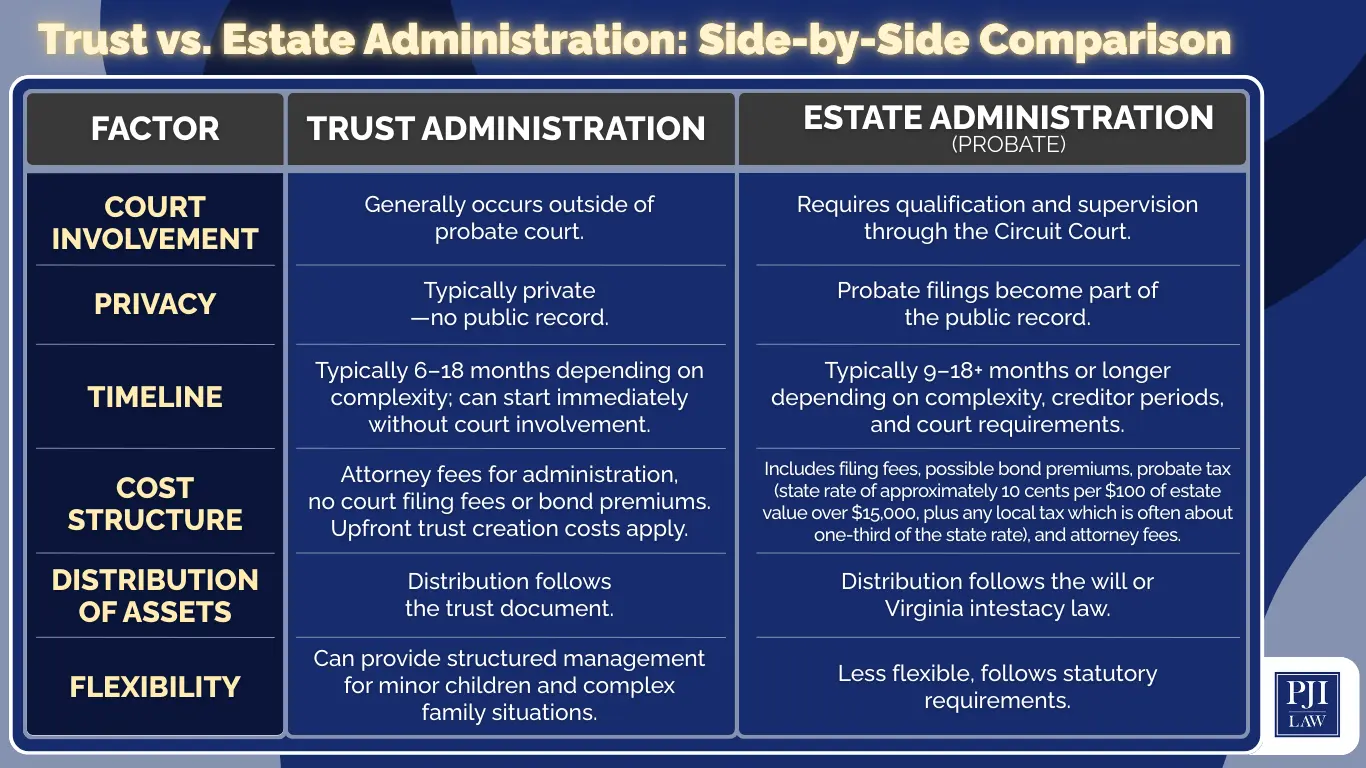
    Trust vs. Estate Administration: Side-by-Side Comparison

    Understanding the differences between a trust and estate administration requires comparing how each process functions in Virginia. To clearly see the differences, let’s compare how each process works in Virginia: Trust administration is the private, trustee-led process where a trustee manages and distributes assets held in a trust according to the trust document’s instructions, typically without court supervision.

    Estate administration is the court-supervised probate process where a personal representative gathers a deceased person’s assets, pays debts and taxes, and distributes property according to a will or state intestacy laws.

    The infographic below illustrates the key differences.

    Trust vs. Estate Administration Side-by-Side Comparison

    Handling Minor Children and Blended Families

    Both structures allow you to name a guardian for minor children. However, a trust often provides more structured management of assets for children and flexibility in second marriages.

    Example: Blended Family 

    In second marriages, tension sometimes arises between a surviving spouse and adult children from a prior relationship. If your estate plan relies only on estate administration through probate, disputes over distribution can lead to probate issues or litigation. A carefully drafted trust can clarify distribution terms and reduce the risk of trust and estate disputes among family members.

    When Does Probate Become Necessary?

    Even if you create a trust, probate may still become necessary if:

    • You fail to fund the trust.
    • Certain assets remain outside the trust.
    • There is no beneficiary designation.
    • Disputes arise among heirs or beneficiaries.
    • The estate qualifies as a small estate under Virginia law but still requires some court involvement.

    For very small estates (generally personal property under $75,000 total), Virginia allows simplified affidavit procedures that often avoid full court probate.

    If someone passes without a trust or with only a will in place, estate administration through probate becomes the required legal path.

    Important Note: Even with a well-funded trust, a “pour-over will” may still go through probate to capture any assets inadvertently left outside the trust. However, if the trust is properly funded, this probate process is typically brief and involves minimal assets.

    Business Succession Planning: Protecting Your Richmond Business

    If you own a business in Richmond, VA, your estate planning strategy must address continuity.

    How a Trust Protects Your Business

    A trust can:

    • Provide a structured transition of ownership without court delays.
    • Protect business assets from probate complications.
    • Clarify management powers during succession.
    • Reduce disruption to operations and employees.
    • Maintain business value during the transition period.

    Example: Richmond Business Owner

    If you rely solely on estate administration and probate, your executor may need court authority before transferring ownership of your business. During that time, operations can stall, employees worry about their jobs, and business value can decline. A properly structured trust can allow trustees to proceed under the terms of the estate plan without waiting for probate approval.

    Integrating business succession planning into your overall estate plan helps protect your legacy and support your family’s future.

    How Trust and Estate Disputes Arise

    How Trust and Estate Disputes Arise

    Whether you’re dealing with trust administration or estate administration, disputes can develop.

    Common scenarios include:

    • Allegations of undue influence
    • Claims of improper execution
    • Executor or trustee mismanagement
    • Conflicts between adult children
    • Business valuation disagreements
    • Disputes over powers granted to fiduciaries

    Example: Executor Conflict

    If an executor delays distribution, fails to communicate with beneficiaries, or mishandles estate assets, family members may raise probate issues or pursue fiduciary litigation. Courts in Virginia may review whether the executor fulfilled their responsibilities under estate administration law and complied with fiduciary duties.

    Fiduciary litigation proceeds in Circuit Court and requires careful attention to statutory requirements.

    Common Mistakes That Create Probate Issues

    Even well-intentioned families encounter probate issues when estate planning details are overlooked. Common mistakes include:

    • Failing to fund a trust. Creating a trust without transferring assets into it often forces those assets through estate administration and probate.
    • Relying only on a will for complex estates. Estates involving business interests, second marriages, or minor children may require more structured planning than a simple last will provides.
    • Delaying probate qualification. Executors who wait too long to qualify before the Circuit Court can create complications with creditor notices and estate administration deadlines.
    • Ignoring fiduciary responsibilities. Trustees and administrators must follow Virginia law carefully. Missteps can lead to litigation, disputes among family members, and court involvement.
    • Failing to update beneficiary designations. Life insurance, retirement accounts, and bank accounts with beneficiary designations pass outside both trusts and wills. Outdated designations can undermine your entire estate plan.
    • Not coordinating estate planning documents. Your trust, will, powers of attorney, and beneficiary designations should all work together as part of a cohesive strategy.

    Addressing these factors early helps protect your estate plan and reduce unnecessary conflict. Understanding these common pitfalls helps, but you likely still have specific questions about your situation. Here are answers to the questions we hear most often:

    Are you searching for an “estate administration attorney near me”

    Frequently Asked Questions

    Q: Does a trust avoid probate in Virginia?

    A: A properly funded trust can avoid probate for assets titled in the trust. Assets outside the trust may still require estate administration.

    Q: How much does probate cost in Virginia?

    A: Probate costs in Virginia typically include court filing fees ($100-$200), probate tax (approximately 10 cents per $100 of value for estates over $15,000), potential bond premiums (if required), and attorney fees. Total costs vary depending on complexity, attorney involvement, bond requirements, and disputes.

    Q: Can I be both executor and trustee?

    A: Yes. It’s common for the same person to serve as personal representative (executor for probate assets) and trustee (for trust assets). However, each role carries distinct responsibilities under Virginia law.

    Q: What happens if I die without a will or trust in Virginia?

    A: Your estate will be distributed according to Virginia’s intestacy laws (Virginia Code § 64.2-200). This means the court determines who inherits based on statutory formulas, which may not reflect your wishes. A spouse and children would receive specific shares, but the distribution may not align with your intentions.

    Q: Who qualifies as an executor?

    A: The named executor in a will qualifies before the Circuit Court and serves as the estate’s personal representative. If there is no will, the court appoints an administrator, who also serves as the personal representative under Virginia law.

    Q: Can trust administration lead to litigation?

    A: Yes. Trustees owe fiduciary duties under Virginia law. Beneficiaries may pursue fiduciary litigation if those duties are breached.

    Q: How long does estate administration take in Virginia?

    A: The probate process often lasts 9-18 months and may extend longer depending on creditors, taxes, disputes, and court requirements.

    Work With Richmond’s Trusted Estate Planning and Administration Attorneys

    Planning for the future or handling responsibilities after a death requires careful attention to Virginia law. Whether you’re serving as executor, acting as a trustee, or creating an estate planning strategy for your family, clear legal direction helps you proceed with confidence.

    At PJI Law, our estate administration attorneys serve clients in Richmond, VA, and throughout Northern Virginia who need experienced representation with estate planning and probate matters. Our law firm works closely with clients who require assistance with trust administration, estate administration, probate issues, and fiduciary litigation.

    Call (804) 653-3450 to request a consultation. You can also complete our confidential online form if that is more convenient. Our estate administration law firm is prepared to assist you with estate planning, trust and estate disputes, and probate matters across Virginia.

    At PJI Law, you’ll receive white-glove service and personal attention from a team that treats you like family.

    Copyright © 2026. PJI Law, PLC. All rights reserved.

    The information in this blog post (“post”) is provided for general informational purposes only and may not reflect the current law in your jurisdiction. No information in this post should be construed as legal advice from the individual author or the law firm, nor is it intended to be a substitute for legal counsel on any subject matter. No reader of this post should act or refrain from acting based on any information included in or accessible through this post without seeking the appropriate legal or other professional advice on the particular facts and circumstances at issue from a lawyer licensed in the recipient’s state, country, or other appropriate licensing jurisdiction.


  • What Does It Mean to be an Executor of Estate in Richmond, Virginia?

    What Does It Mean to be an Executor of Estate in Richmond, Virginia?

    When AJ agreed to be the executor (also known as the personal representative) in his widowed father’s estate, he’d been busy raising a young family, providing for his wife and children, and climbing the corporate ladder. To put his father’s mind at ease, he accompanied him to the office of the estate attorney, where he didn’t ask many questions or pay too close attention to the responsibilities he would take on as the named executor.

    Now, nearly 20 years later, AJ is grieving the loss of his father and wondering what to do with his last will and testament. How can he be sure he complies with estate law in Virginia? Is he personally liable if he makes a mistake? Should he look for an estate administration attorney near his home in Richmond to help him understand Virginia state law, an executor’s job, and how to do right by each beneficiary?

    Like AJ, are you a designated executor in someone’s will and uncertain about your responsibilities? You’re not alone. Many family members and others who have accepted this responsibility do not know what an executor of estate does or how to serve in this capacity. Furthermore, some complex estates require full administration, while others are relatively simple to administer.

    This blog, from an experienced estate administration lawyer from PJI Law, PLC, in Richmond, Virginia, explains an executor’s responsibilities and how an attorney can guide you through this complicated legal process. Continue reading to learn more, then contact us at (804) 653-3450 for personalized service and attention.

    Who Can Serve as an Executor/Personal Representative of a Virginia Estate?

    Any competent adult over 18 can serve as an executor. During the estate planning process, many people designate a spouse or a family member as their executor. However, they can also choose to appoint a professional executor or a lawyer to handle their estate administration after their death.

    Executors must be responsible, trustworthy, and willing to fulfill the duties of an estate representative. Anyone who takes on the executor role is legally obligated to promote the best interest of the decedent’s (deceased individual) estate according to their will. Violating the law could lead to the executor’s removal and dire legal consequences, including lawsuits, fines, and even jail time.

    In some cases, the appointed executor may be required to obtain a bond to fulfill their duties, as they have been entrusted with the person’s estate and all property contained within it. A bond guarantees that executors will obey the law and fulfill their responsibility to distribute the estate’s assets.

    executor of estate

    Initiating Probate According to Virginia Probate Law

    Probate is the legal process of distributing the estate of a deceased person. After their death, the executor of the deceased person’s estate can start the probate process by scheduling an appointment with the Clerk of the Circuit Court in the proper jurisdiction. In addition to other information, the will’s designated executor must take the original will and a certified copy of the death certificate to the probate appointment.

    After keeping the appointment and qualifying before the Clerk, the executor has the authority to administer the decedent’s estate. Once the Clerk determines that they are indeed qualified, they will issue Certificates of Qualification, also known as letters testamentary – a written document with the Court’s seal authorizing the executor to act on the estate’s behalf.

    Duties of An Executor

    probate attorneys near me

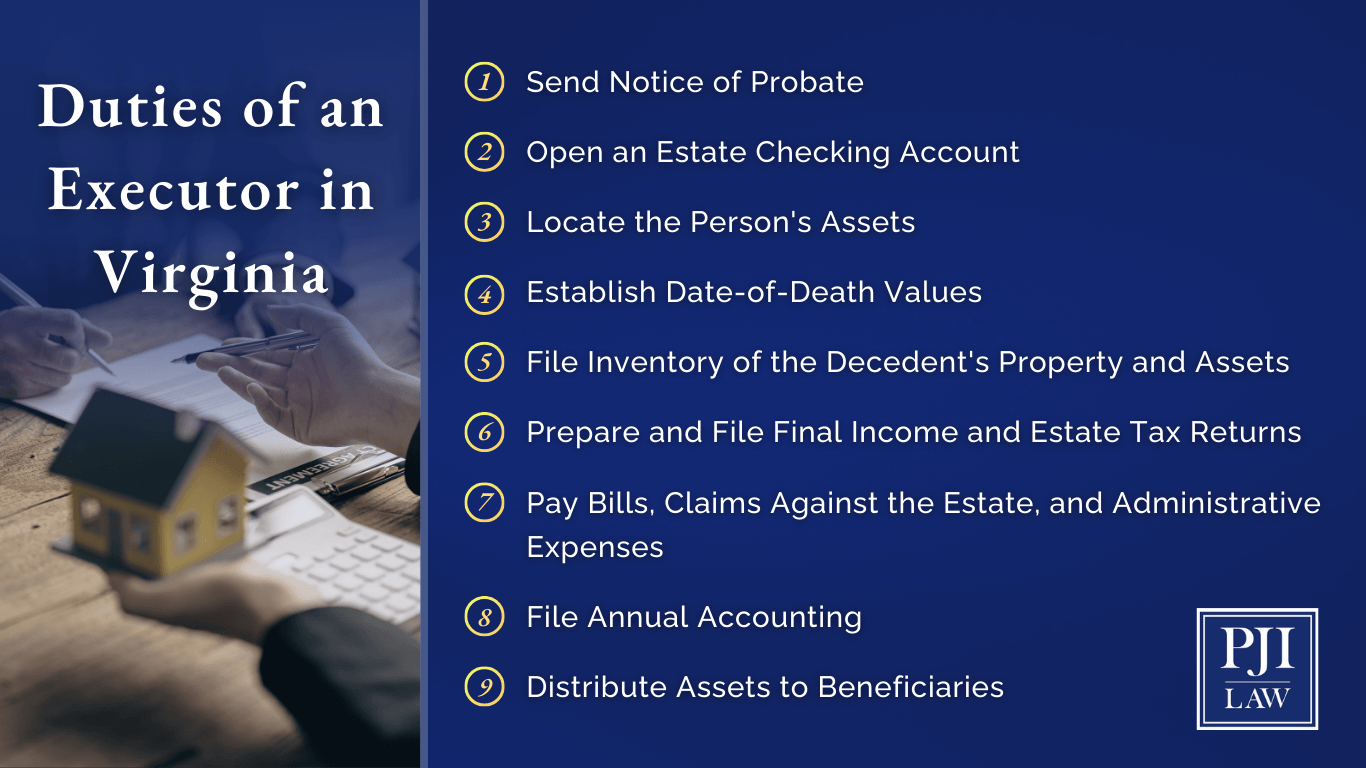
    Among other duties, a qualified estate executor must:

    Send Notice of Probate

    The executor must send a Notice of Probate to all beneficiaries and heirs within 30 days of qualifying before the Clerk of the Court. The notice informs each beneficiary about the opening of probate. The appointed executor must also file an affidavit with the Clerk within four months, proving they gave notice.

    Open an Estate Checking Account

    When opening a checking account for the estate, the executor must give the bank a death certificate, certificate of qualification, and provide the tax identification number for the estate that they have obtained from the Internal Revenue Service.

    Next, the executor must transfer the contents of the decedent’s personal bank accounts to the estate checking account, keeping thorough records of each bank account transaction. When the probate process ends, any funds remaining after paying estate taxes, valid debts, or other fees, will be distributed to the beneficiaries.

    Locate the Person’s Assets

    An executor must locate and protect any estate assets passing through probate. This effort generally excludes accounts that pass directly to beneficiaries, property the decedent previously co-owned with a surviving spouse, and property in revocable living trusts.

    Establish Date-of-Death Values

    The executor must determine the value of all assets belonging to the estate. Ordering appraisals of any real property or business assets of disputable value is often recommended. Accurately valuing probate assets is indispensable; however, even non-probate assets could potentially require valuation if the estate owes estate taxes. Why? A taxable estate includes probate and non-probate assets.

    File Inventory of the Decedent’s Property and Assets

    The executor must take inventory of the decedent’s probate estate and file it with the Commissioner of Accounts within four months. For small estates, this requirement can sometimes be waived.

    Prepare and File Final Income and Estate Tax Returns

    The executor must prepare any federal and state tax documentation on the decedent’s behalf, including personal income tax returns and estate tax returns.

    Pay Bills, Claims Against Estate, and Administrative Expenses

    The executor must pay the estate administration expenses, including appraisal, court, and estate attorney fees, using funds in the estate checking account. If necessary, the executor may also be tasked with selling property or other estate assets to fulfill these financial obligations. Aside from satisfying any tax obligations, the executor must pay the deceased’s final bills and debts and any claims against the estate.

    File Annual Accounting 

    These accountings inform the Probate Court of the executor’s actions on behalf of the estate. The executor must submit the first accounting within 16 months, which covers the first year of probate. If subsequent accountings are required, they are due within four months of the end of the accounting period of the executor’s preference — but no later than 12 months after the last accounting was due. It requires filing all the necessary documentation, such as a list of all probate assets with their values at the beginning of the account period and proof of any receipts, disbursements, or distributions the representative received or made.

    Distribute Assets to Beneficiaries

    After discharging all debts, fees, and taxes, the executor will distribute the estate balance to the beneficiaries. Asset distribution to beneficiaries usually takes place at the end of the probate process.

    How a Richmond Estate Administration Attorney Can Help Estate Executors

    A Richmond, Virginia estate administration attorney can help estate executors with:

    • Identifying, securing, and obtaining appraisals for estate assets
    • Collecting life insurance policy proceeds
    • Discharging debts and bills
    • Preparing and filing all probate court documents
    • Managing the estate account
    • Handling all of the steps in the probate process

    probate attorneys near me

    What About Guardians for Minor Children Named in the Will?

    When a will contains guardian designations for minor children, a Richmond VA estate administration lawyer can assist the executor with making a smooth transition.

    1. Legal Guidance: An estate attorney can provide legal guidance on interpreting the guardian designations outlined in the will, explain the responsibilities and legal implications, and ensure the executor fully understands their role in the process.
    2. Court Procedures: If the designated guardians need to be officially appointed by the court, estate administration attorneys can navigate the necessary legal procedures, including preparing and filing the required documentation with the court.
    3. Communication: An estate attorney can facilitate communication between the executor, the designated guardians, and any other relevant parties involved in the guardianship process. Clear communication ensures that everyone knows what their roles and responsibilities entail.
    4. Conflict Resolution: In cases where there may be disagreements or disputes regarding the guardian designations or the care of the children, the estate administration lawyer can help mediate and resolve conflicts to protect the best interests of the children.
    5. Compliance with Laws: The lawyer ensures that all actions taken concerning the guardianship of children are in compliance with Virginia laws and regulations. They help the executor uphold the wishes expressed in the will while adhering to legal requirements.
    6. Documentation and Record-Keeping: Keeping accurate records of all communications, decisions, and actions taken regarding the guardian designations is crucial. The lawyer can assist the executor in maintaining detailed documentation to ensure transparency and accountability throughout the process.

    Should I Begin Estate Planning Now?

    Individuals 18 and over of all income levels should create an estate plan with the help of an experienced estate planning attorney. As a qualified attorney can attest, the estate planning process involves more than just a will, although it is the foundation of a comprehensive estate plan.

    The documents required will vary depending on the individual, but with the guidance of trust and estate counsel, who will ask the right questions, listen to your answers, consider your unique circumstances, then make recommendations, your estate plan could potentially include:

    • A last will and testament
    • Revocable Living Trust
    • Advance medical directives
    • Powers of attorney
    • Business succession planning
    • Transfer-on-death deeds

    Many attorneys claim to be estate planners. When choosing an estate planning attorney, read online reviews, ask for references from other clients, inquire as to whether they offer a flat fee or a simple hourly rate, and listen to their answers to your questions during a consultation. Your estate planning attorney should demonstrate their willingness to listen and customize an estate plan that meets your needs and fulfills your wishes, recommend that you update your estate plan regularly to keep pace with life’s inevitable changes, and treat you as a valued client for life.

    PJI Law, PLC: Your Estate Administration Attorneys in Richmond Virginia

    At PJI Law, PLC, each client receives our complete dedication, personal attention, and courteous, white-glove service. To provide the best experience possible, our skilled team responds quickly to each client and employs cutting-edge technology. 

    Have you been typing “probate attorneys near me” into your search bar? If you’ve been named an executor of someone’s estate and are seeking the services of a knowledgeable and experienced estate administration lawyer in Richmond, Virginia, our team is here to guide you through the complexities of probate law and help you fulfill your responsibilities with peace of mind.

    And if this blog has inspired you to establish an estate plan, our estate planning attorneys are ready to listen to your goals, consider your unique circumstances, and guide you through your estate planning with care and precision. 

    Call PJI Law, PLC at (804) 653-3450 or complete our online form to schedule your consultation.

    Copyright © 2024. PJI Law, PLC. All rights reserved.

    The information in this blog post (“post”) is provided for general informational purposes only and may not reflect the current law in your jurisdiction. No information in this post should be construed as legal advice from the individual author or the law firm, nor is it intended to be a substitute for legal counsel on any subject matter. No reader of this post should act or refrain from acting based on any information included in or accessible through this post without seeking the appropriate legal or other professional advice on the particular facts and circumstances at issue from a lawyer licensed in the recipient’s state, country, or other appropriate licensing jurisdiction.

    PJI Law, PLC
    4108 E Parham Rd, 
    Richmond, VA 23228
    (804) 653-3450
    https://pjibe.webteam.ai/