Tag: Probate & Estate Administration

  • How Fiduciary Services Can Simplify Estate Administration in Richmond, VA for Churches, Nonprofits, & Long-Distance Heirs

    How Fiduciary Services Can Simplify Estate Administration in Richmond, VA for Churches, Nonprofits, & Long-Distance Heirs

    A Richmond resident leaves a house and its contents to a local church. Although the gift is meaningful, the church’s leaders and volunteers may not have the time, personnel, or knowledge to secure the property, review decades of belongings, hire an appraiser, or oversee a sale. In another estate, a nonprofit beneficiary or the deceased person’s heirs live outside Virginia and cannot repeatedly travel to Richmond to maintain the home, meet vendors, and supervise the administration.

    Fiduciary services provide a local point of responsibility for this legal, financial, and practical work. Services may include securing property, coordinating cleanouts and appraisals, hiring vendors, overseeing sales, maintaining financial records, and completing the final distribution.

    For churches, nonprofits, and long-distance heirs facing these circumstances, PJI Law provides comprehensive fiduciary services for managing a Richmond estate. The firm can coordinate the legal administration and property-related responsibilities from start to finish. Knowing how these services work, what they include, and how they fit within the Virginia probate process can help an organization or heir determine what support the estate requires.

    At a Glance

    • Fiduciary services may cover legal administration, financial recordkeeping, property management, vendor coordination, sales, and distributions.
    • A personal representative must have proper authority before controlling, selling, or distributing probate property.
    • Virginia requires personal representatives to complete specific notices, inventories, accountings, and other filings.
    • Churches and nonprofits should evaluate inherited property before accepting responsibility for its expenses, condition, or sale.
    • Long-distance heirs can use local professional fiduciary support to manage many responsibilities without making repeated trips to Richmond.
    • The personal representative’s authority comes from court qualification, the will, and Virginia law, while the professional engagement defines which fiduciary services the law firm will handle.

    What Are Fiduciary Services in Estate Administration?

    Fiduciary services provide professional help with managing an estate after someone dies. These services may include protecting property, locating and valuing assets, maintaining financial records, coordinating cleanouts and appraisals, hiring vendors, preparing property for sale, addressing expenses and taxes, and completing distributions.

    During estate administration, the personal representative has legal authority to act for the estate. A qualified professional providing fiduciary services may be appointed to serve as the personal representative or may assist someone else who serves in that role. If the professional is not the personal representative, the appointed executor or administrator retains the authority to approve decisions, sign documents, and distribute estate property.

    Fiduciary services can be especially helpful when a church, nonprofit, or long-distance heir lacks the time, personnel, or proximity to manage the work. Rather than coordinating each legal filing, property visit, vendor, and financial record independently, the organization or family can obtain local assistance with the responsibilities included in the professional engagement.

    Why Can Estate Administration Be Difficult for Churches, Nonprofits, and Long-Distance Heirs?

    Estate administration often involves far more than preparing legal documents and completing court filings. Someone must protect the deceased person’s assets, maintain accurate records, and manage the property while the probate process is pending.

    A vacant home may require new locks, continued insurance, utility service, lawn care, repairs, mail collection, security monitoring, and protection from weather damage. Contents may need to be inventoried, appraised, stored, sold, donated, or distributed. Each expense and transaction must also be documented for the estate’s accounting.

    Distance adds another layer of difficulty. An heir may review documents electronically, but they cannot inspect a house after a storm or admit an appraiser from another state. A charitable organization may have capable directors but no local staff member available to supervise vendors in Richmond.

    Professional fiduciary services connect the legal administration with the work taking place at the property. The scope of assistance can be tailored to the estate’s assets, condition, beneficiaries, and location.

    What Do Full-Service Fiduciary Services Include?

     

    The services required depend on the estate’s assets, debts, governing documents, beneficiaries, and condition. An estate holding liquid, well-documented assets may require less hands-on administration than one containing multiple properties, private investments, closely held business interests, vehicles, valuable collections, or years of personal belongings.

    Full-service fiduciary services go beyond preparing probate paperwork. Depending on the scope of the engagement and the authority granted, a law firm can oversee the practical, financial, and administrative work from securing estate property through final distribution. The personal representative retains authority over decisions reserved to that role unless a qualified professional has been appointed to serve as the personal representative.

    Complete fiduciary services may include the following responsibilities:

    Securing and maintaining estate property

    Vacant property can deteriorate quickly. A fiduciary may need to:

    • Confirm who has keys or access codes
    • Change locks when appropriate
    • Locate and protect cash, jewelry, legal documents, and financial records
    • Confirm that property and vehicle insurance remain in place
    • Notify the insurer when a home becomes vacant
    • Maintain necessary utilities and security systems
    • Arrange lawn care, cleaning, pest control, or repairs
    • Forward mail and monitor notices sent to the deceased
    • Document the property’s initial condition

    Family members, heirs, and beneficiaries should not remove property before the personal representative confirms who owns it and how it must be handled. Premature removal can cause disputes and make an accurate inventory more difficult.

    Identifying and valuing assets

    The personal representative must determine what the decedent owned and which assets belong to the probate estate. The review may include financial accounts, multiple real estate holdings, closely held business interests, private investments, vehicles, artwork, jewelry, valuable collections, storage units, safe-deposit boxes, and money owed to the deceased.

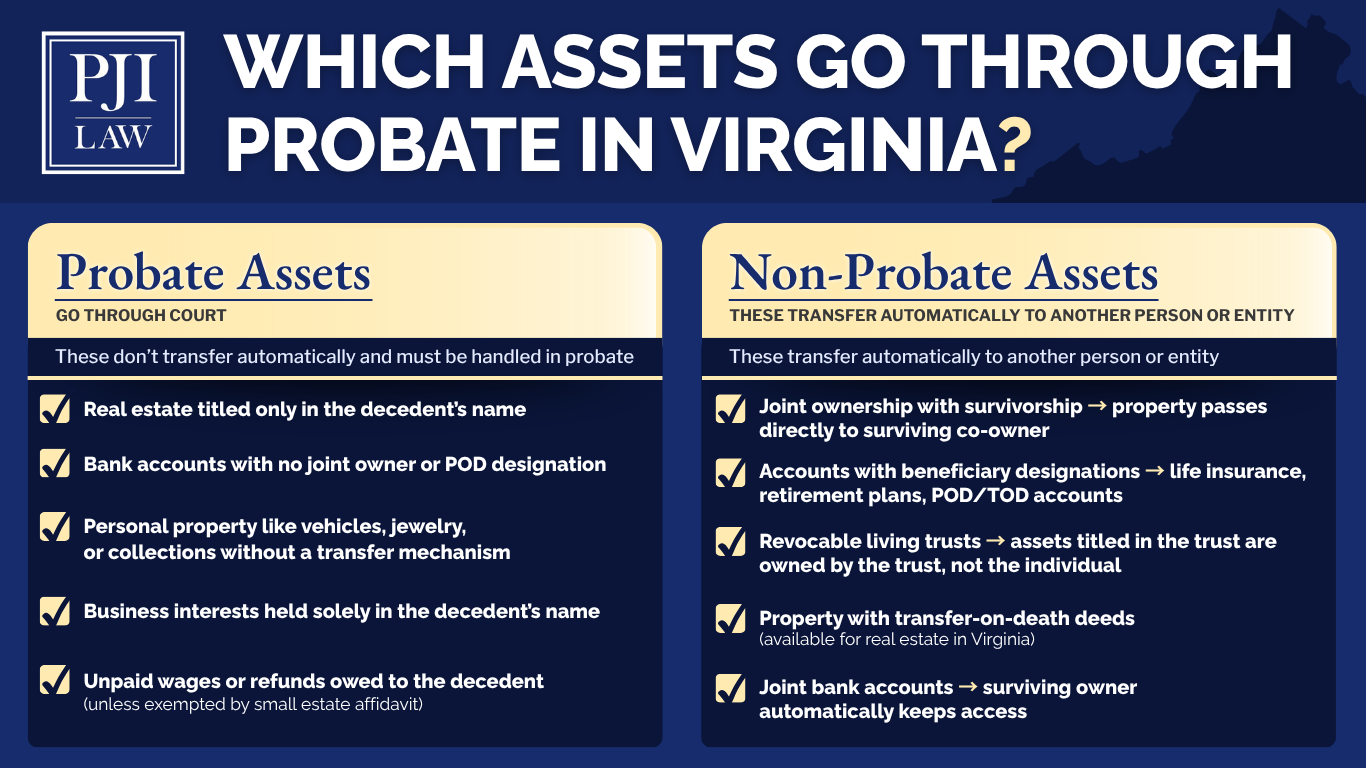
    However, not every asset passes through probate. A joint account, payable-on-death account, life insurance policy, retirement account, or property held in a living trust may pass under a separate legal arrangement. Correctly classifying the assets affects the inventory, accounting, taxes, and distribution.

    Unless an exception or waiver applies, Virginia law requires a personal representative to file an inventory within four months after qualification. The inventory includes covered property under the personal representative’s control and its market value as of the date of death. Reasonable valuation expenses may be treated as an administration cost.

    Coordinating cleanouts, storage, and appraisals

    Preparing a residence and its contents for transfer, storage, sale, donation, or disposal requires a documented process. Among the belongings may be specifically gifted property, valuable items, family photographs, sensitive records, or documents identifying additional assets.

    A structured cleanout may involve:

    1. Photographing and documenting the contents
    2. Separating legal and financial records
    3. Identifying items addressed in the will
    4. Setting aside property requiring appraisal
    5. Consulting beneficiaries about sentimental items when appropriate
    6. Arranging secure storage
    7. Selecting property for sale, donation, transfer, or disposal
    8. Retaining records of the decisions and expenses

    A local fiduciary can meet vendors, answer questions, and document how the contents were handled without requiring beneficiaries or organizational representatives to attend each appointment.

    Hiring and supervising vendors

    An estate may require assistance from specialized appraisers, auction houses, estate-sale professionals, real estate brokers, property managers, contractors, cleaners, movers, locksmiths, landscapers, storage companies, accountants, and tax preparers.

    The fiduciary should review each vendor’s role, fees, insurance, and proposed scope of work. Contracts, invoices, receipts, and sale records must be retained. Centralized coordination can also reduce missed appointments, duplicated services, and uncertainty about who approved an expense.

    Preparing property for sale

    Real estate may require cleaning, repairs, removal of personal property, valuation, or title work before it can be listed. The personal representative must also confirm the authority to sell.

    That authority can depend on how title was held, the language of the will, whether the property belongs to the probate estate, outstanding liens, and the purpose of the proposed sale. The rights of a surviving spouse or other interested person may also affect the decision.

    Sale proceeds must be deposited and documented as estate assets. They should not be distributed until the personal representative has accounted for debts, taxes, filing requirements, and other obligations.

    Addressing debts, expenses, and taxes

    A personal representative identifies and addresses proper estate obligations before distributing the remaining assets. These obligations may include funeral expenses, property costs, administration fees, valid creditor claims, and taxes.

    The personal representative may need to obtain an employer identification number and open an estate account. Estate money should remain separate from the personal representative’s personal funds or a beneficiary organization’s operating accounts.

    Tax responsibilities may include:

    • The deceased person’s final individual income tax return
    • A federal estate income tax return on Form 1041
    • A Virginia fiduciary income tax return
    • A federal estate tax return on Form 706 when required

    The IRS requires an estate income tax return for a domestic decedent’s estate with gross income of $600 or more during the tax year, among other filing circumstances. For 2026, the federal basic exclusion amount is $15 million, although prior taxable gifts and portability can affect the filing analysis.

    An estate that owes no federal estate tax may still file Form 706 to elect portability of a deceased spouse’s unused exclusion. Virginia does not impose an inheritance tax merely because a beneficiary receives an inheritance, but other tax consequences may depend on the property and income earned during administration.

    Maintaining records and completing fiduciary accounts

    Virginia’s Commissioner of Accounts reviews inventories and accounts filed by personal representatives. Under Virginia Code § 64.2-1304, the first account is due within 16 months after qualification and reports the money and property received or disbursed during the first 12 months.

    Bank statements, invoices, canceled checks, sale documents, appraisals, tax records, and distribution receipts may be needed to support the accounting. Complete records help beneficiaries understand how the estate was managed and allow the personal representative to respond to questions or objections.

    Completing the final distribution

    The personal representative can complete the final distribution after identifying the beneficiaries or heirs, addressing appropriate obligations, completing required filings, and determining what remains. A valid will controls the distribution when one exists. If the person died intestate, Virginia’s intestacy laws determine who inherits.

    A church or nonprofit might receive a specific amount, a percentage of the remaining estate, identified property, real estate, trust distributions, or sale proceeds. Before the gift is distributed, the organization’s legal name, tax identification information, authorized recipient, and delivery instructions should be confirmed.

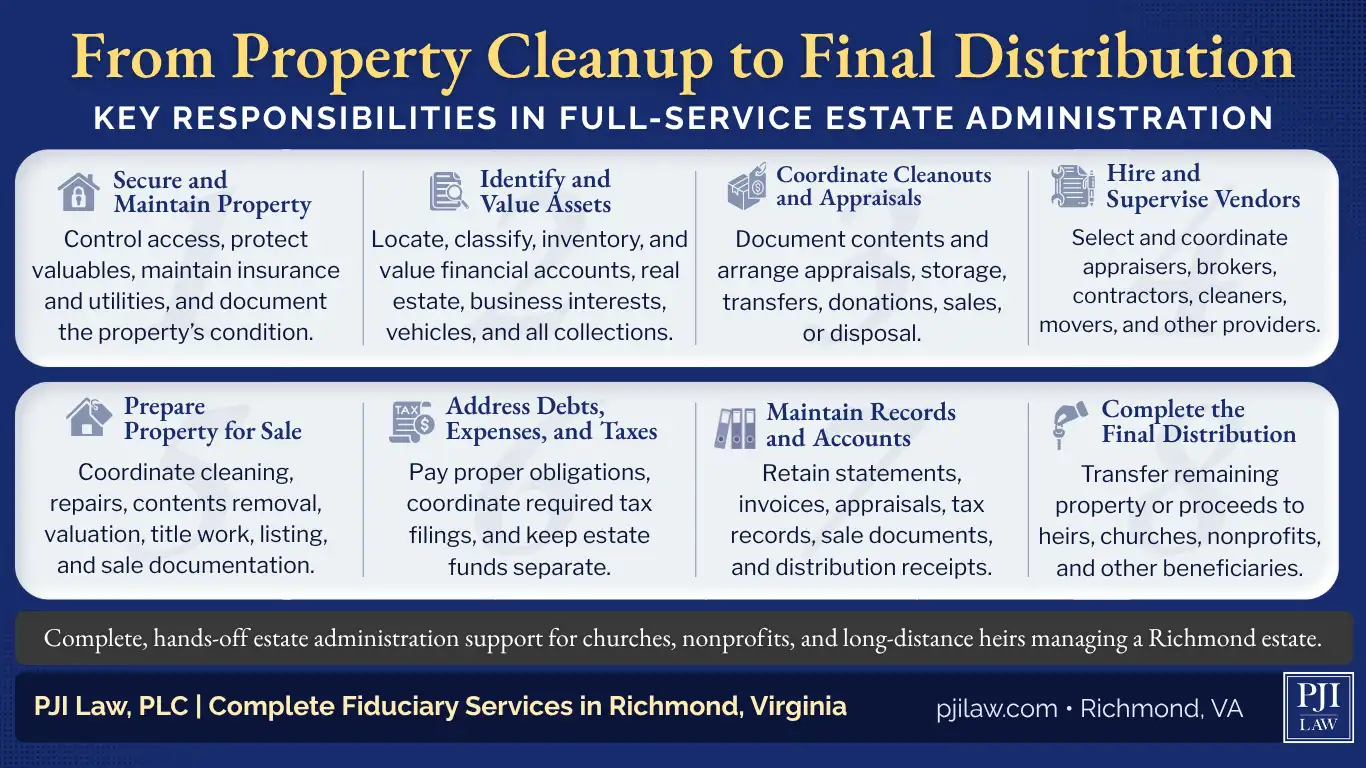
    The infographic below summarizes how these responsibilities fit together, from securing and maintaining estate property through final distribution.
    How Do Fiduciary Services Fit Into the Virginia Probate Process?

    Probate is the legal process for admitting a will, qualifying a personal representative, administering probate assets, and transferring the remaining property to beneficiaries or heirs. In Virginia, the circuit court clerk and Commissioner of Accounts oversee different parts of the administration.

    Fiduciary services can support the administration at each stage of the Virginia probate process. The scope of the engagement determines whether a qualified professional serves as the personal representative or assists a separately appointed executor or administrator with the estate’s legal, financial, and property-related responsibilities.

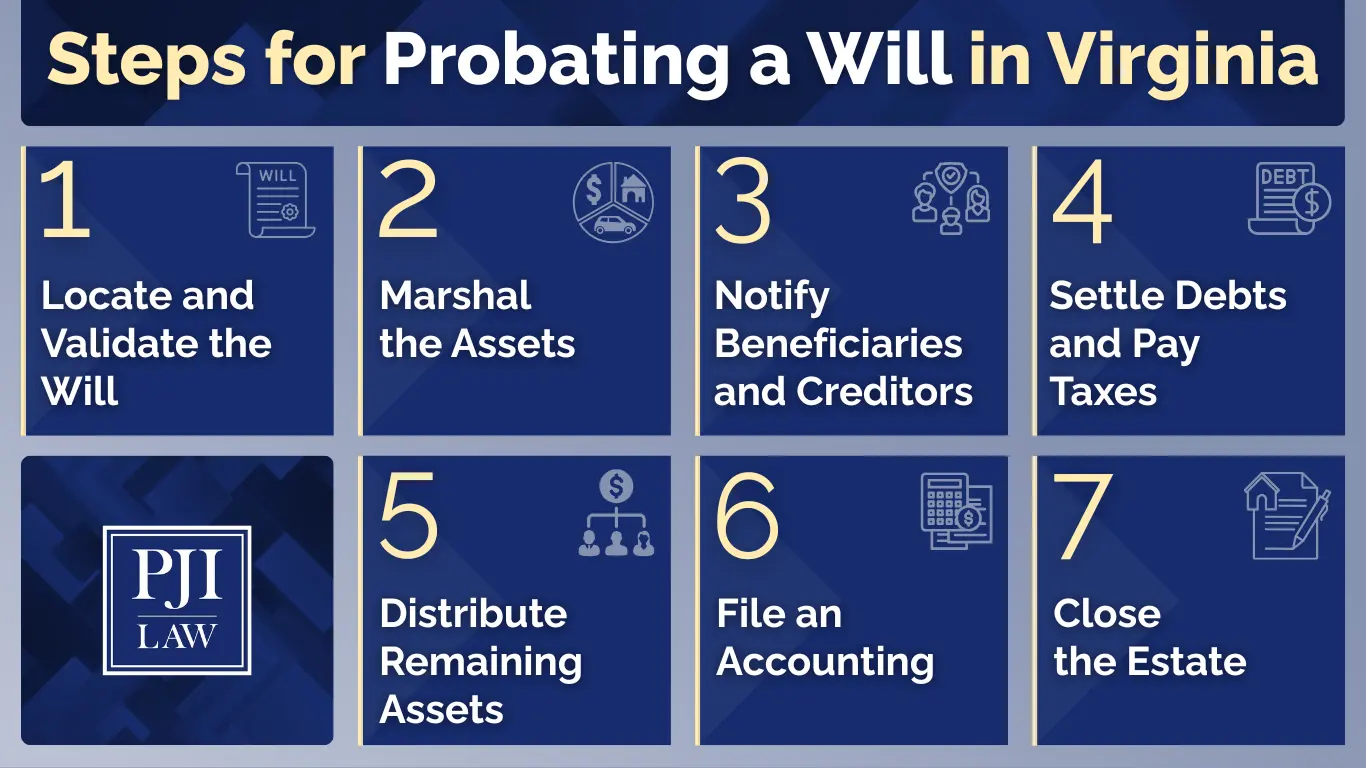
    A Virginia probate proceeding may include the following steps:

    1. Determine the proper jurisdiction. A will is offered for probate in the circuit court for the city or county where the decedent had a known place of residence.
    2. Locate and present the will. If the decedent left a valid will, it is presented for probate. If the decedent died intestate, an eligible person may seek appointment as administrator.
    3. Qualify the personal representative. An executor named in a will does not receive full authority merely from being named. The person must qualify, take the required oath, and provide any required bond or surety.
    4. Provide required notice. Virginia law requires the personal representative or proponent of the will to send notice to specified parties within 30 days after qualification or admission of the will to probate.
    5. Identify and secure estate assets. The personal representative identifies, collects, and protects probate assets within the scope of the appointment and determines their date-of-death values. Fiduciary services may include securing a residence, locating records, confirming insurance coverage, arranging appraisals, and coordinating the inventory of personal property.
    6. File the inventory. The inventory is ordinarily due within four months after qualification. Property documentation, account records, and appraisals provide the information needed to prepare the inventory.
    7. Address expenses, claims, and taxes. The personal representative evaluates and pays proper obligations in the legally applicable order. Fiduciary services may include maintaining financial records, organizing invoices and creditor information, coordinating tax filings, and documenting payments.
    8. File the accounting. The accounting documents receipts, expenses, sales, distributions, and property still held. Complete records of maintenance, vendors, appraisals, sales, and other transactions support the required fiduciary accounts.
    9. Distribute the remaining property. Once the estate is ready, the personal representative transfers the remaining assets to the beneficiaries or heirs. Fiduciary services can help coordinate property transfers, confirm beneficiary information, collect distribution receipts, and complete the remaining administrative work.

    Fiduciary services connect the court-supervised requirements of probate with the financial and property-related work required to complete the administration. This support can be particularly valuable when an estate contains multiple properties, closely held businesses, private investments, valuable collections, deferred maintenance, or beneficiaries who cannot manage the work locally.

    How Can Fiduciary Services Help Churches and Nonprofits?


    A gift of real estate can be valuable to a church or nonprofit while also creating immediate responsibilities. The property may have a mortgage, deferred maintenance, unpaid taxes, tenants, valuable contents, environmental concerns, or insurance issues. The organization may operate outside Virginia or lack staff familiar with Virginia probate administration.

    A vacant or deteriorating property may also present safety and insurance risks, making prompt inspection, appropriate coverage, controlled access, and necessary maintenance important while the estate is being administered.

    Before accepting or directing the handling of a gift, organizational leaders should determine:

    • What the will or trust gives the organization
    • Whether it will receive the property or the sale proceeds
    • Who has legal authority over the property
    • Whether the organization has a gift-acceptance policy
    • Who can approve the gift and sign documents
    • What debts and ongoing expenses accompany the property
    • Whether restrictions affect the property’s use or sale
    • Whether accepting the gift is consistent with the organization’s mission and internal policies

    Being named as a beneficiary does not make the church or nonprofit the personal representative. Its leaders, employees, or volunteers should not enter the property, remove belongings, hire vendors, or agree to a sale without confirming who has authority to act.

    Instead, a law firm providing fiduciary services can collect information for the organization’s decision-makers, maintain the property, coordinate appraisals and vendors, document expenses, and oversee a sale when authorized. This arrangement allows the organization to receive and evaluate the gift without assigning staff members or volunteers to manage each task in Richmond.

    How Can Long-Distance Heirs Manage a Virginia Estate?

    Living outside Virginia does not automatically prevent you from participating in estate administration or serving as a personal representative. A remote appointment can still create legal and logistical complications.

    You may be able to review documents, attend meetings, approve work, and communicate with beneficiaries electronically. Local tasks still require someone to inspect the property, meet appraisers and contractors, locate records, supervise a cleanout, monitor repairs, and coordinate a sale.

    Professional fiduciary services can reduce repeated travel while keeping you informed. A communication plan may include scheduled updates, photographs, vendor proposals, expense reports, and copies of important filings.

    Remote administration does not mean you give up every decision. The engagement should explain which decisions remain with the appointed personal representative, which responsibilities PJI Law would manage, and when additional approval is required.

    What Should You Ask Before Hiring Fiduciary Services?

    Before engaging a law firm for fiduciary services, determine whether its assistance extends beyond probate paperwork. Confirm who has legal authority to act for the estate, which decisions require the personal representative’s approval, and which responsibilities the law firm will manage.

    Churches, nonprofits, and long-distance heirs may benefit from complete, hands-off estate administration support when they lack the time, proximity, or resources to manage an estate themselves. Ask whether the services include protecting and maintaining property, coordinating cleanouts and appraisals, supervising vendors, preparing property for sale, maintaining financial records, and assisting with final distribution. If the estate includes a home, determine whether the law firm will coordinate the property and its contents or whether those responsibilities will remain with the beneficiaries or organization.

    You should also ask how vendors will be selected, how legal fees and outside expenses will be calculated, how you will receive updates, and what will happen if a dispute develops. A written scope of services establishes who will handle each responsibility and which decisions require additional approval.

    Frequently Asked Questions About Fiduciary Services

    What are professional fiduciary services for an estate?

    Professional fiduciary services provide assistance with the legal, financial, and practical responsibilities of estate administration. A qualified professional may serve as the personal representative or support a separately appointed executor or administrator. Services may include protecting property, maintaining financial records, coordinating vendors, preparing filings, overseeing sales, and completing distributions.

    Can an attorney serve as an executor or administrator in Virginia?

    An attorney may serve if properly nominated or appointed and qualified under Virginia law. Hiring an attorney to represent the estate does not automatically make that attorney the personal representative.

    Can I administer a Virginia estate if I live in another state?

    A nonresident may be able to serve, but additional qualification, bond, resident-agent, or procedural requirements may apply. The estate’s location and complexity also affect whether remote administration is practical.

    Must an out-of-state heir travel to Richmond for probate?

    Not every task requires an in-person visit. Many communications and document reviews can occur remotely. Whether you must travel depends on your role, qualification requirements, court procedures, and the condition of the estate property.

    What happens when a church or nonprofit inherits a house?

    The organization should confirm the terms of the gift, who controls the property during administration, the building’s condition, ongoing expenses, title issues, and its own gift-acceptance procedures. It can then decide whether accepting the property or receiving sale proceeds is appropriate.

    Who pays for cleanouts, appraisals, maintenance, and estate sales?

    Authorized and reasonable expenses may be paid from estate assets when they are proper administration costs. The personal representative should retain contracts, invoices, receipts, and proof of payment for the accounting.

    Can a professional fiduciary sell estate property?

    A fiduciary may sell estate property when the fiduciary has the required authority. That authority can depend on title, the will, court qualification, Virginia law, and the nature of the proposed sale.

    How long does estate administration take in Virginia?

    The timeline for estate administration depends on the property, creditor issues, taxes, required filings, disputes, and whether assets must be sold. An estate containing a house and substantial personal property can take longer than an estate holding only accessible financial accounts.

     

    Trusted Fiduciary Services for Churches, Nonprofits, and Long-Distance Heirs

    Complete Fiduciary Services from Property Cleanup to Final Distribution

    A gift left through an estate can carry deep personal meaning. A longtime member may leave a home to the church that supported them. A donor may remember a nonprofit whose work shaped their life. A relative may leave you property in Richmond while you live hundreds or thousands of miles away.

    Honoring that gift can require someone to protect the property, sort and value its contents, supervise vendors, maintain financial records, complete the probate filings, and prepare the remaining assets for distribution. Those responsibilities can quickly exceed the time and resources available to a family member or charitable organization.

    PJI Law, PLC provides complete, hands-off estate administration support for churches, nonprofits, and long-distance heirs. Our Richmond estate administration attorneys can manage the legal and practical details, including property protection, cleanouts, appraisals, sales, vendor coordination, financial records, and final distribution. Our goal is to provide peace of mind by managing the details efficiently, professionally, and respectfully while helping make sure the estate is properly administered from start to finish.

    Call (804) 653-3450 to schedule your complimentary consultation. You can also complete our confidential online form if that is more convenient.

    At PJI Law, you’ll receive white-glove service and personal attention from a team that treats you like family.

    Copyright © 2026. PJI Law, PLC. All rights reserved.

    The information in this blog post (“post”) is provided for general informational purposes only and may not reflect the current law in your jurisdiction. No information in this post should be construed as legal advice from the individual author or the law firm, nor is it intended to be a substitute for legal counsel on any subject matter. No reader of this post should act or refrain from acting based on any information included in or accessible through this post without seeking the appropriate legal or other professional advice on the particular facts and circumstances at issue from a lawyer licensed in the recipient’s state, country, or other appropriate licensing jurisdiction.

    PJI Law, PLC
    4108 E Parham Road
    Richmond, VA 23228
    (804) 653-3450
    https://www.pjilaw.com/
  • Your Parent Died and You’re Appointed as the Executor. What’s Next as an Executor of a Will in Richmond, VA?

    Your Parent Died and You’re Appointed as the Executor. What’s Next as an Executor of a Will in Richmond, VA?

    Losing a parent is one of life’s most difficult experiences. While you’re trying to process your loss, family members may already be asking questions, bills still need attention, and legal responsibilities can begin piling up. If you’ve been named the executor of your parent’s will, you’re now responsible for guiding your parent’s estate through Virginia’s probate process. If you’ve never served in this role before, it’s normal to wonder where to begin.

    Fortunately, you don’t have to figure everything out at once. The probate process in Virginia follows a structured path, and understanding what comes first can help you avoid common mistakes while moving the estate forward. Taking one step at a time often makes the responsibilities ahead feel much more manageable.

    Knowing what to expect can make a difficult time a little less overwhelming. From qualifying with the probate court to paying debts, communicating with beneficiaries, and distributing estate assets, understanding your responsibilities as the executor of a will can help you administer your parent’s estate with confidence during this difficult time.
     
    At a Glance

    At a Glance

    • Before you have legal authority to administer the estate, you’ll generally need to qualify with the Clerk of the Circuit Court where your parent lived.
    • You’ll need to gather important documents, protect estate assets, provide required notice to heirs and beneficiaries, and address creditor claims as part of the probate process.
    • As executor, you’ll have a fiduciary duty to protect the estate, follow the terms of the will and Virginia law, and keep careful financial records.
    • Before you can distribute estate assets, you must pay valid estate debts, taxes, and administration expenses.
    • Many estates can be settled in less than a year, although more complex estates may take longer.
    • An experienced estate administration attorney can help if questions arise during estate administration or if disputes develop.

    First, Take a Breath: You Don’t Have to Make Every Decision Today

    When a parent dies, it’s natural to feel pressure to start handling paperwork immediately. Family members may ask questions about inheritances, creditors may begin contacting the family, and financial institutions may request documentation before discussing accounts. While there are important deadlines, very few decisions need to be made within the first few hours or even the first few days.

    One of the biggest mistakes a named executor can make is rushing to distribute property or close accounts before understanding the legal process. Until you’ve officially qualified through the court, your authority to act on behalf of the deceased person’s estate is limited.

    Instead of trying to solve every issue at once, focus on taking the next appropriate step. The probate process in Virginia is designed to move through each stage in order, giving you time to gather information before making major decisions.

    Have you been named the Executor of a will in Richmond, Virginia_

    Your Decisions During the First Week

    The days immediately following your parent’s death often involve practical matters that have little to do with formal executor authority. These are things you can start on right away, before you’ve gone through the court process that gives you legal authority over the estate, covered in the next section.

    Obtain Multiple Certified Copies of the Death Certificate

    Nearly every organization you’ll work with, including banks, life insurance companies, government agencies, investment firms, and financial institutions, will request a certified death certificate before releasing information or transferring ownership.

    Make sure the copies you order have the official raised or embossed seal, since some institutions won’t accept plain photocopies or uncertified printouts. Ordering multiple certified copies upfront can save time later.

    Locate the Original Will and Other Important Documents

    If your parent left a valid will, locate the original signed document rather than relying on copies whenever possible. You’ll also want to gather documents related to:

    • Bank accounts
    • Brokerage accounts
    • Retirement plans
    • Investment accounts
    • Real estate
    • Vehicle titles
    • Insurance policies
    • Business records
    • Recent tax returns
    • Outstanding bills

    Having these records available early can make the probate process much smoother.

    Secure Your Parent’s Home and Belongings

    If your parent owned a home, vehicle, or other valuable personal property, take reasonable steps to secure it. That may include changing locks if necessary, forwarding mail, maintaining insurance coverage, or arranging for ongoing maintenance until ownership is transferred. You don’t need to begin distributing belongings right away. Instead, focus on preserving the property’s value for everyone with an interest in the estate.

    Under Virginia Code § 64.2-511, Virginia law also allows a named executor to take a narrow set of actions even before qualifying with the court: arranging burial, paying reasonable funeral expenses, and taking steps to preserve the estate from waste. Beyond that, most of what you handle in the first week falls to you as a family member helping out, not as the legally authorized executor. That authority comes next.

    Qualifying as the Executor

    You might assume you’re automatically authorized to act as soon as your parent passes away, but that’s not the case. Virginia requires most executors to complete a court process before receiving official authority over the estate.

    One note on terminology: Virginia law and many court forms use the broader term “personal representative.” An executor is a personal representative named in a will, so you’ll often see both terms used throughout the probate process. Since your parent left a will naming you for this role, you’re serving as the executor while also acting as the estate’s personal representative.

    Acting on behalf of the estate covers things like opening an estate bank account, accessing your parent’s financial accounts, paying bills from estate funds, selling or transferring property, and dealing with creditors and financial institutions on the estate’s behalf. Until you’ve qualified, you generally can’t do any of this. That authority only takes effect once the court confirms you as executor.

    How to Qualify in Richmond

    In Richmond, probate and qualification are generally handled before the Clerk of the Circuit Court serving the locality where the deceased person lived at the time of death. To qualify, you’ll generally present the original will, a certified death certificate, required probate forms, and any additional documentation requested by the Clerk of Court.

    Once you’ve qualified, the Clerk of the Circuit Court issues a Certificate of Qualification (also referred to as a letter of administration) that serves as official proof of your authority to act on behalf of the decedent’s estate. Financial institutions and others often request this certificate before allowing you to access estate accounts, transfer assets, or conduct other business on the estate’s behalf.

    What to Know About the Bond Requirement

    A bond is a financial guarantee that helps protect the estate and its beneficiaries if an executor fails to carry out their legal responsibilities properly.

    As part of qualifying, Virginia law requires an executor to provide a bond. The Clerk of the Circuit Court determines the amount of the bond and whether additional security is required under Virginia law. In some instances, the bond may be waived. 

    Can You Decline to Serve as Executor?

    Being named as the executor in your parent’s will doesn’t require you to accept the role. If you don’t wish to serve, you may decline the appointment before qualifying with the Clerk of the Circuit Court. If the will names an alternate executor, that person may qualify instead. Otherwise, the court may appoint another qualified personal representative to administer the estate.

    After You Qualify: What Comes Next?

    After qualification, the probate process officially begins, and several important deadlines start running. One of your first responsibilities is notifying the appropriate people that probate has been opened.

    Under Virginia Code § 64.2-508, the executor must provide written notice to heirs and beneficiaries within 30 days after qualification. You may also need to notify creditors so they have an opportunity to present valid claims against the estate.

    At this stage, you’re acting on behalf of the estate, not yourself or any individual beneficiary. That means decisions should be based on your legal responsibilities rather than family expectations or personal preferences.

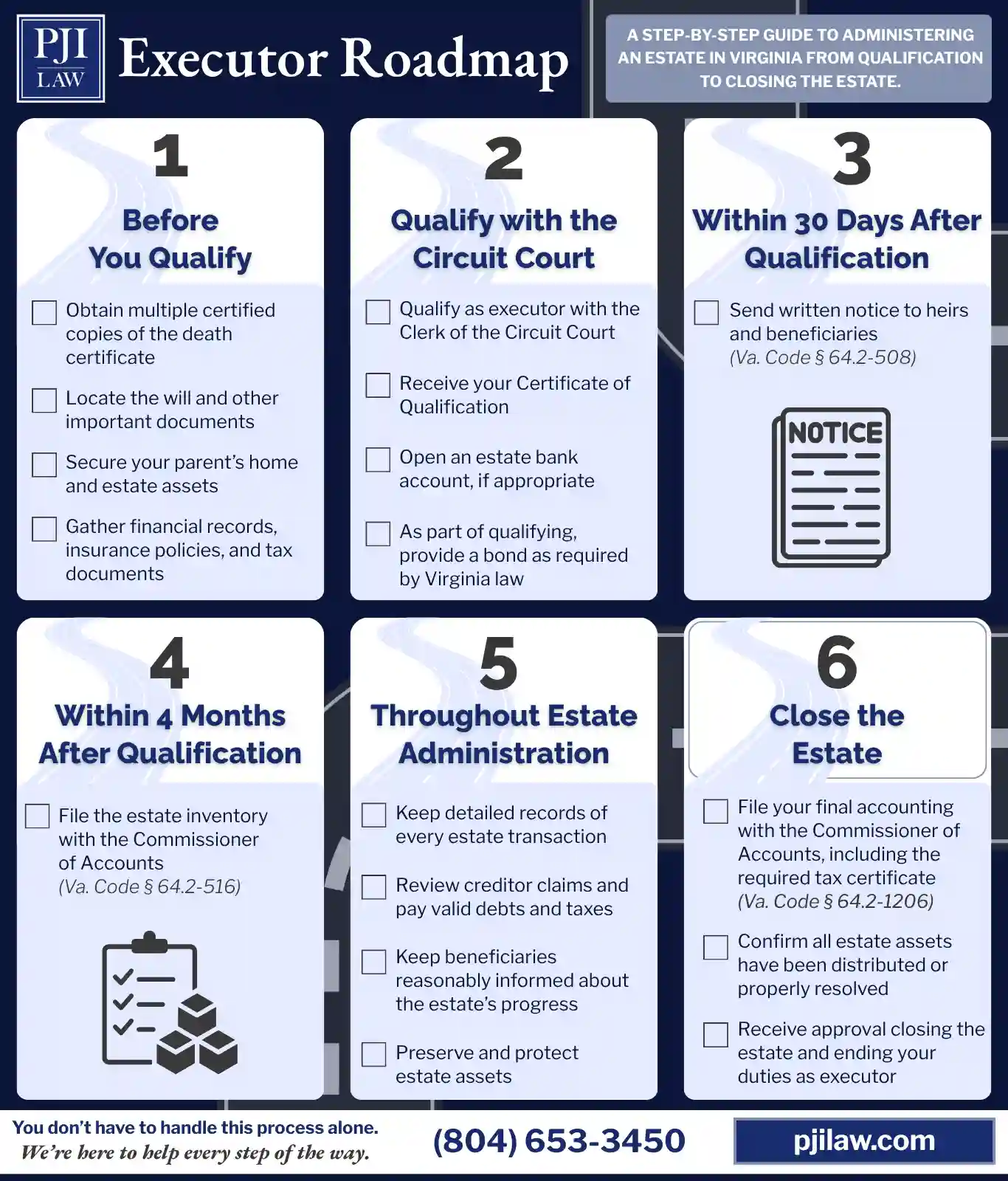
    Executor Roadmap

    Protecting the Estate

    One misconception is that an estate executor simply distributes inheritances. In reality, your first responsibility is protecting the estate until it can be properly administered. Once you’re qualified, protecting the estate becomes a formal legal responsibility, not just the practical steps you may have already taken to secure your parent’s home and belongings.

    Virginia law imposes a fiduciary duty on every executor. A fiduciary duty means you must act honestly, carefully, and in the interests of the beneficiaries while following the terms of the will and applicable state law.

    As the executor, you’re responsible for protecting the decedent’s assets, maintaining accurate financial records, and making decisions that benefit the estate rather than yourself. That duty continues throughout the entire probate process, and two habits will carry you through most of it: keeping estate money separate from your own, and keeping a clear record of everything you do.

    Separate Estate Funds From Your Own

    One of the simplest ways to avoid problems is keeping estate funds completely separate from your personal finances. Many executors open an estate checking account after receiving a federal tax identification number for the estate. Using that account to pay bills and deposit estate income creates a clear record of every transaction.

    Mixing personal and estate money, even temporarily, can create unnecessary complications and, in some situations, expose an executor to personal liability.

    Keep Detailed Records

    Good recordkeeping protects both the estate and you. Maintain documentation of every deposit, every payment, receipts, bank statements, property sales, communications with beneficiaries, professional invoices, and court filings. Keeping careful records makes preparing required reports much easier if questions arise later.

    Identifying Estate Assets

     
    Identifying Estate Assets

    Before property can be transferred to beneficiaries, you’ll need to determine exactly what your parent owned and whether those assets pass through probate. This process often takes longer than many families expect.

    You may need to locate:

    • Checking and savings accounts
    • Financial accounts
    • Retirement accounts
    • Investment accounts
    • Brokerage accounts
    • Real estate
    • Vehicles
    • Business interests
    • Valuable collectibles
    • Jewelry
    • Household items
    • Digital assets

    Not every asset becomes part of the probate estate. For example, many jointly owned assets, payable-on-death accounts, retirement accounts with designated beneficiaries, and certain trust assets may pass directly to the intended recipient without going through probate.

    Identifying which assets are probate assets and which transfer outside probate is an important part of estate administration.

    Preparing an Estate Inventory

    Virginia requires executors to prepare an estate inventory identifying probate property and its value. For many assets, you’ll need to determine the fair market value as of the date of death. Depending on the type of property involved, that may require bank statements, investment statements, tax assessments, vehicle valuation guides, or a professional appraiser for real estate, antiques, artwork, or other unique property.

    Under Virginia Code § 64.2-1300, this inventory must be filed with the local Commissioner of Accounts within four months after qualification. Preparing a thorough inventory helps establish transparency throughout the probate process and creates a clear record of the assets under your responsibility.

    Paying Bills Doesn’t Mean Paying Every Bill Immediately

    One of the most common questions executors ask is whether they should begin paying bills as soon as they arrive. As the person responsible for administering the deceased person’s estate, you’re expected to identify valid claims, determine available estate resources, and follow Virginia law regarding the payment of creditors. Paying bills too quickly, or in the wrong order, can create unnecessary complications if the estate doesn’t have enough assets to satisfy every obligation.

    Before making payments, you’ll typically need to identify:

    • Outstanding debts
    • Mortgage payments
    • Credit card balances
    • Medical bills
    • Funeral expenses
    • Utility bills
    • Insurance premiums
    • Other ongoing expenses

    Some expenses should continue during estate administration, particularly if they’re necessary to preserve estate assets, such as homeowners insurance, utilities for an occupied home, or property maintenance.

    At the same time, you’ll also need to review creditor claims carefully. Not every debt presented to the estate is necessarily valid or enforceable. Because every estate is different, it’s often wise to understand your responsibilities before making large payments from estate funds.

    Taxes Are Still Part of Your Responsibilities

    Serving as an executor also means handling several tax-related obligations before you can distribute assets. Depending on the circumstances, you may need to file the decedent’s final income tax return, fiduciary income tax return(s) for the estate, any remaining federal or state tax returns, and an estate tax return, if required under applicable tax laws.

    Not every estate will owe estate tax, but determining whether any filing requirements apply is still part of the administration process. If the estate earns income after your parent passes away, for example through rental property, dividends, or investment earnings, you may also need to report that income appropriately.

    Because tax matters can become complicated, many executors work with a tax accountant or other qualified professional, particularly when an estate includes rental property, a business interest, or a sizable investment portfolio.

    Keep Beneficiaries Informed Throughout the Probate Process

     
    Keep Beneficiaries Informed Throughout the Probate Process

    Grief and uncertainty make people anxious for answers, and many probate disputes begin simply because someone feels left in the dark. Even when you’re following the law, a lack of communication can create unnecessary tension among beneficiaries and other interested parties.

    As executor, you’re generally expected to keep beneficiaries reasonably informed about the progress of estate administration. That doesn’t mean providing daily updates. Instead, clear communication about major developments, such as property sales, creditor claims, court filings, or expected distribution timelines, can help reduce misunderstandings.

    If more than one sibling is involved, maintaining transparency also helps demonstrate that you’re fulfilling your fiduciary duty fairly and consistently.

    Avoid These Common Mistakes While Administering an Estate

    Even conscientious executors, doing their best during an already hard time, can run into trouble if they’re unfamiliar with the probate process. Some of the most common mistakes include the following.

    Distributing Property Too Soon

    It can be tempting to begin dividing family heirlooms or transferring remaining property shortly after the funeral. However, you generally shouldn’t distribute estate assets until the estate’s debts, taxes, expenses, and legal obligations have been addressed.

    Mixing Estate and Personal Funds

    Never deposit estate money into your personal bank account or use personal funds without maintaining complete documentation. Keeping separate financial records protects both the estate and you.

    Failing to Document Transactions

    Whether you’re selling a vehicle, paying a contractor, or reimbursing an expense, maintain supporting documentation. Detailed records help explain each financial decision if questions arise later.

    Ignoring Court Deadlines

    Virginia’s probate system includes deadlines for notices, inventories, accountings, and other required filings. Missing those deadlines can delay administration and create additional work.

    Self-Dealing

    An executor cannot use estate property for personal benefit simply because they’re administering the estate.

    For example, purchasing estate property below fair market value, borrowing estate funds, or giving yourself preferential treatment over other beneficiaries may constitute self dealing and expose you to legal challenges.

    Are you seeking guidance after you were appointed as the Executor of your parent’s estate in Richmond, Virginia_

    Can You Be Held Personally Liable?

    Although serving as an executor doesn’t automatically create personal financial responsibility for your parent’s debts, you can be held personally liable if you violate your legal obligations while administering the estate.

    Acting honestly, keeping accurate records, and following Virginia’s probate requirements are what keep most executors free of personal liability. None of that happens automatically, though, and the responsibility to get it right rests with you throughout the process.

    Closing the Estate

    Once all debts, taxes, and expenses have been paid and the remaining assets have been distributed to beneficiaries, the final step is closing the estate with the court.

    Under Virginia Code § 64.2-1206, the executor must account for the estate before the Commissioner of Accounts. The final accounting should show that debts, expenses, and distributions have been accounted for and that the remaining estate assets have been properly distributed or resolved.

    Once the Commissioner of Accounts reviews and approves that final accounting, you’re formally released from your duties as executor, and your legal responsibility for the estate comes to an end.

    How Long Does the Probate Process Usually Take?

    Every estate is different. For relatively simple estates with cooperative beneficiaries, few creditors, and straightforward assets, estate administration may be completed in less than a year.

    More complicated estates often require additional time, particularly when they involve real estate sales, closely held businesses, multiple beneficiaries, will contests, tax issues, difficult creditor claims, or property located in multiple states.

    Virginia also requires executors to comply with statutory timelines for inventories and periodic accountings reviewed by the local Commissioner of Accounts, so the overall timeline depends on both the estate’s complexity and compliance with those requirements. Patience is often one of the most valuable qualities an executor can bring to the process.

    When Should You Consider Working With an Estate Administration or Probate Attorney?

    Virginia doesn’t require every executor to hire an attorney, and many smaller estates proceed smoothly without extensive legal assistance.

    Professional advice tends to matter most when:

    • Family members disagree about the will
    • Someone challenges the estate
    • The estate includes a sizable real estate or business interest
    • Complicated tax issues arise
    • Creditors dispute claims
    • The estate owns a substantial investment portfolio
    • You’re serving as sole executor for a large or complex estate
    • More than one executor is involved and disagreements develop over administration

    Having legal guidance can help you understand your responsibilities while reducing the likelihood of mistakes that delay the probate process or create unnecessary disputes.

    Looking for guidance from an attorney for wills in Richmond, Virginia_

    Frequently Asked Questions

    Can an executor also be a beneficiary?

    It’s common for a named executor to also be an intended beneficiary under the will. Even so, the executor must continue fulfilling their fiduciary duty and treat all beneficiaries fairly.

    Does every estate have to go through the full probate process?

    Under Virginia Code § 64.2-601, Virginia offers a simplified affidavit process for smaller estates where the decedent’s personal probate estate doesn’t exceed $75,000, not counting real estate. If the estate qualifies, some assets may be collected without going through formal probate at all. An attorney can help you determine whether your parent’s estate meets the requirements.

    Can I refuse to serve as executor?

    If you don’t wish to serve, you may generally decline the appointment. If the will names an alternate executor, that person may serve instead. Otherwise, the court can appoint another qualified personal representative.

    Can an executor change the terms of the will?

    An executor must administer the estate according to the will and applicable state law. They cannot rewrite or modify the deceased person’s wishes.

    What happens if my other parent is still alive?

    A surviving spouse has independent rights under Virginia law, regardless of what the will says. These include a family allowance, an exempt property allowance, and a homestead allowance, along with the option to claim an elective share of the estate instead of what the will provides. These claims are paid before most creditors and before other heirs, and the surviving spouse generally has up to a year after the death to make them. If your other parent is still living, part of your role as executor is understanding how these rights may affect what’s ultimately available to distribute to everyone else.

    Do all assets go through probate?

    Certain trust assets, jointly owned property, and accounts with beneficiary designations may transfer outside the probate process.

    Can I sell my parent’s house?

    Whether you have authority to sell real estate depends on the terms of the will, Virginia law, and, in some situations, whether court approval is required.

    Will I need to open an estate bank account?

    Often, yes. Opening a separate account helps manage estate funds, pay expenses, and maintain accurate financial records throughout administration.

    Can family members demand their inheritance immediately?

    Before you can distribute assets, you must complete required probate procedures, resolve creditor claims, pay taxes and expenses, and determine what remaining assets are available for distribution.

    What if I have questions during the probate process?

    Every estate presents different challenges. If questions arise about your responsibilities, deadlines, taxes, or potential liability, speaking with an experienced estate administration attorney early in the process may help prevent larger issues later.

    Move Forward With Confidence as You Administer Your Parent’s Estate

    Serving as an executor often comes at one of the most difficult times in your life. While you’re coping with the loss of a parent, you’re also expected to manage court filings, financial matters, communication with beneficiaries, and the legal responsibilities that come with being an executor of a will. You don’t have to handle every challenge on your own.

    At PJI Law, PLC, our Richmond, Virginia, estate administration and probate attorneys help clients understand executor responsibilities, comply with Virginia probate requirements, and move through estate administration with confidence. Whether you’re administering a straightforward estate or facing family disagreements, tax questions, or complex assets, we’re here to provide practical guidance tailored to your situation.

    Call (804) 653-3450 to schedule your complimentary consultation. You can also complete our confidential online form if that’s more convenient.

    At PJI Law, you’ll receive white-glove service and personal attention from a team that treats you like family.

    Copyright © 2026. PJI Law, PLC. All rights reserved.

    The information in this blog post (“post”) is provided for general informational purposes only and may not reflect the current law in your jurisdiction. No information in this post should be construed as legal advice from the individual author or the law firm, nor is it intended to be a substitute for legal counsel on any subject matter. No reader of this post should act or refrain from acting based on any information included in or accessible through this post without seeking the appropriate legal or other professional advice on the particular facts and circumstances at issue from a lawyer licensed in the recipient’s state, country, or other appropriate licensing jurisdiction.

    PJI Law, PLC
    4108 E Parham Road
    Richmond, VA 23228
    (804) 653-3450
    https://www.pjilaw.com/

  • What is the Difference Between a Trust and Estate Administration in Richmond, VA?

    What is the Difference Between a Trust and Estate Administration in Richmond, VA?

    You’re sitting at your kitchen table in Richmond’s West End, going through your father’s papers. There’s a will, but is there a trust? Do you need to go to the Circuit Court? Your siblings are calling with questions, and you’re not sure where to start.

    When someone you love passes away, you’re not thinking about legal terminology. You’re thinking about taking care of your family, protecting financial affairs, and honoring a legacy. Then questions start to surface. Is there a trust? Is there a last will? Do you need to open probate in Richmond, VA? What is the difference between a trust and estate administration, and why does it matter?

    If you’re planning ahead, the question feels just as important. You want a plan that protects minor children, supports adult children, accounts for second marriages, and addresses business succession planning. You want clarity about how your estate will be handled in Virginia and whether probate will become part of the process.

    Understanding the difference between a trust and estate administration helps you make informed decisions about your future and respond confidently if you’re serving as a personal representative, trustee, or court-appointed administrator.

    At a Glance

    • A trust is a legal arrangement created during your lifetime that allows trustees to manage and distribute assets according to written instructions, generally avoiding probate entirely for properly funded trusts.
    • Estate administration is the court-supervised probate process that takes place after death to gather assets, pay creditors, and distribute property under a will or Virginia intestacy law.
    • Trust administration typically occurs privately.
    • Estate administration usually requires involvement with the Circuit Court of the county where the person lived.
    • Both processes carry fiduciary responsibilities and potential probate issues if not handled properly.
    • Trust administration typically proceeds more efficiently than probate, though timelines vary depending on complexity, while probate often takes 9-18+ months or longer.

    If You’re Dealing With an Estate Right Now

    If you recently experienced a death and are trying to determine whether you must open probate or whether a trust controls the assets, timing matters. The steps you take in the first few weeks can affect creditor notices, tax filings, and how quickly beneficiaries may receive distributions.

    Here’s what you need to do immediately:

    1. Locate all estate planning documents (trust, will, beneficiary designations).
    2. Determine which assets are in the trust vs. outside it.
    3. Understand your legal responsibilities under Virginia law.
    4. Contact an estate administration attorney before taking action.

    Before you proceed with estate administration or trust administration, you need to understand the legal requirements. Early legal guidance can help you avoid probate issues, reduce the risk of litigation, and protect your family’s interests from the start.

    Call (804) 653-3450 to speak with our trust administration law firm team today.

    Looking for a law firm to guide you through trust and estate administration in Richmond, Virginia

    Why Richmond Families Choose Trusts for Estate Planning

    A trust is a legal structure created during your lifetime through a written document, often as part of a comprehensive estate plan. You transfer assets into the trust, and trustees manage those assets for the benefit of beneficiaries.

    Under the Virginia Uniform Trust Code, found at Virginia Code § 64.2-700 et seq., a trust can be revocable or irrevocable. A revocable living trust allows you to maintain control during your lifetime and provides structured trust administration after death.

    How Trust Administration Works

    When you create a trust:

    • You sign the trust document.
    • You fund the trust by transferring property and financial accounts.
    • You name trustees to serve if you cannot.
    • Upon death, trustees follow the instructions for distribution.

    Trust administration generally avoids probate entirely for assets properly titled in the trust name. Trustees carry out their job under the powers granted in the trust document and Virginia law.

    Under the Virginia Uniform Trust Code, trustees owe fiduciary duties to beneficiaries, including the duty of loyalty and the duty to act in good faith. See Virginia Code §§ 64.2-763 through 64.2-779.

    Example: Richmond Family With a Revocable Trust

    If you create a revocable trust as part of your estate planning and properly fund it, your trustees can begin trust administration immediately after your death. Your family members may not need to attend court proceedings, and the distribution of assets can proceed according to the trust document without waiting for the probate process to unfold. This structure often reduces delays and limits public exposure of financial details.

    Estate Administration and the Probate Process

    Estate administration refers to the probate process that occurs after death when a person passes with a will or without one.

    If there is a valid last will, the person named as executor must qualify before the appropriate Circuit Court and will serve as the estate’s personal representative under Virginia law. If there is no will, the court appoints an administrator under Virginia Code § 64.2-502.

    Personal representatives, whether serving as an executor under a will or as a court-appointed administrator, must follow detailed court procedures. This includes filing inventories with the appropriate courts in Virginia and fulfilling fiduciary responsibilities throughout the administration process.

    The Probate Process in Richmond, VA

    Estate administration typically involves:

    • Qualifying as the estate’s personal representative (as executor under a will or administrator if no will exists)
    • Posting bond if required
    • Collecting estate assets
    • Notifying creditors
    • Paying valid debts and taxes
    • Filing required inventories and accountings
    • Distributing remaining property to heirs or beneficiaries

    This process takes place under court supervision and follows Virginia law. If you’re unsure how to proceed after qualifying as the executor, consulting a probate attorney can help you comply with statutory deadlines and avoid unnecessary court delays.

    Example: Estate With Only a Will

    If you pass with only a last will, your executor must qualify before the Circuit Court. The probate process begins, creditors receive notice, and estate administration follows statutory procedures. Even when family members cooperate, the executor must attend to court filings, deadlines, and formal requirements before distribution can occur.

    Probate provides structure, but it can also increase costs, extend timelines, and expose financial information to public record.

    Searching online for an attorney for trust or estate administration

    Trust vs. Estate Administration: Side-by-Side Comparison

    Understanding the differences between a trust and estate administration requires comparing how each process functions in Virginia. To clearly see the differences, let’s compare how each process works in Virginia: Trust administration is the private, trustee-led process where a trustee manages and distributes assets held in a trust according to the trust document’s instructions, typically without court supervision.

    Estate administration is the court-supervised probate process where a personal representative gathers a deceased person’s assets, pays debts and taxes, and distributes property according to a will or state intestacy laws.

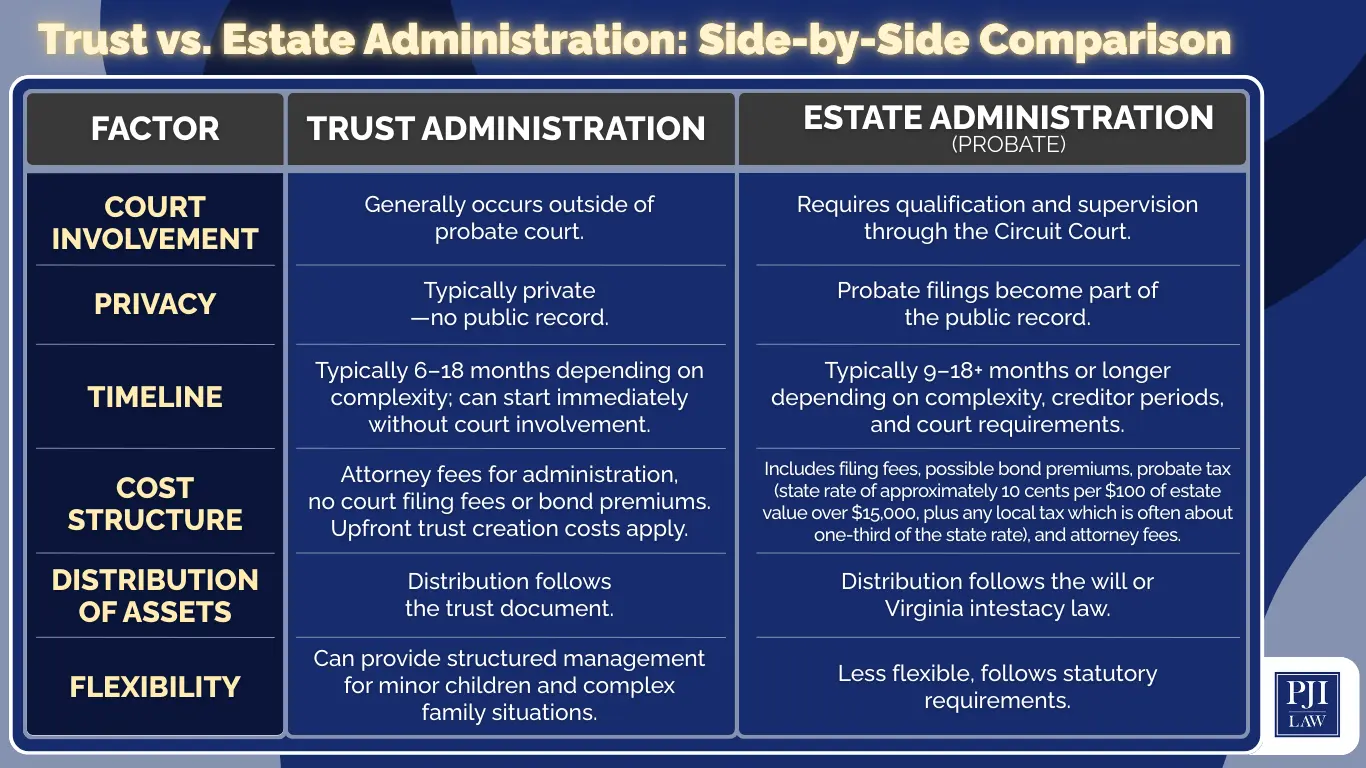
    The infographic below illustrates the key differences.

    Trust vs. Estate Administration Side-by-Side Comparison

    Handling Minor Children and Blended Families

    Both structures allow you to name a guardian for minor children. However, a trust often provides more structured management of assets for children and flexibility in second marriages.

    Example: Blended Family 

    In second marriages, tension sometimes arises between a surviving spouse and adult children from a prior relationship. If your estate plan relies only on estate administration through probate, disputes over distribution can lead to probate issues or litigation. A carefully drafted trust can clarify distribution terms and reduce the risk of trust and estate disputes among family members.

    When Does Probate Become Necessary?

    Even if you create a trust, probate may still become necessary if:

    • You fail to fund the trust.
    • Certain assets remain outside the trust.
    • There is no beneficiary designation.
    • Disputes arise among heirs or beneficiaries.
    • The estate qualifies as a small estate under Virginia law but still requires some court involvement.

    For very small estates (generally personal property under $75,000 total), Virginia allows simplified affidavit procedures that often avoid full court probate.

    If someone passes without a trust or with only a will in place, estate administration through probate becomes the required legal path.

    Important Note: Even with a well-funded trust, a “pour-over will” may still go through probate to capture any assets inadvertently left outside the trust. However, if the trust is properly funded, this probate process is typically brief and involves minimal assets.

    Business Succession Planning: Protecting Your Richmond Business

    If you own a business in Richmond, VA, your estate planning strategy must address continuity.

    How a Trust Protects Your Business

    A trust can:

    • Provide a structured transition of ownership without court delays.
    • Protect business assets from probate complications.
    • Clarify management powers during succession.
    • Reduce disruption to operations and employees.
    • Maintain business value during the transition period.

    Example: Richmond Business Owner

    If you rely solely on estate administration and probate, your executor may need court authority before transferring ownership of your business. During that time, operations can stall, employees worry about their jobs, and business value can decline. A properly structured trust can allow trustees to proceed under the terms of the estate plan without waiting for probate approval.

    Integrating business succession planning into your overall estate plan helps protect your legacy and support your family’s future.

    How Trust and Estate Disputes Arise

    How Trust and Estate Disputes Arise

    Whether you’re dealing with trust administration or estate administration, disputes can develop.

    Common scenarios include:

    • Allegations of undue influence
    • Claims of improper execution
    • Executor or trustee mismanagement
    • Conflicts between adult children
    • Business valuation disagreements
    • Disputes over powers granted to fiduciaries

    Example: Executor Conflict

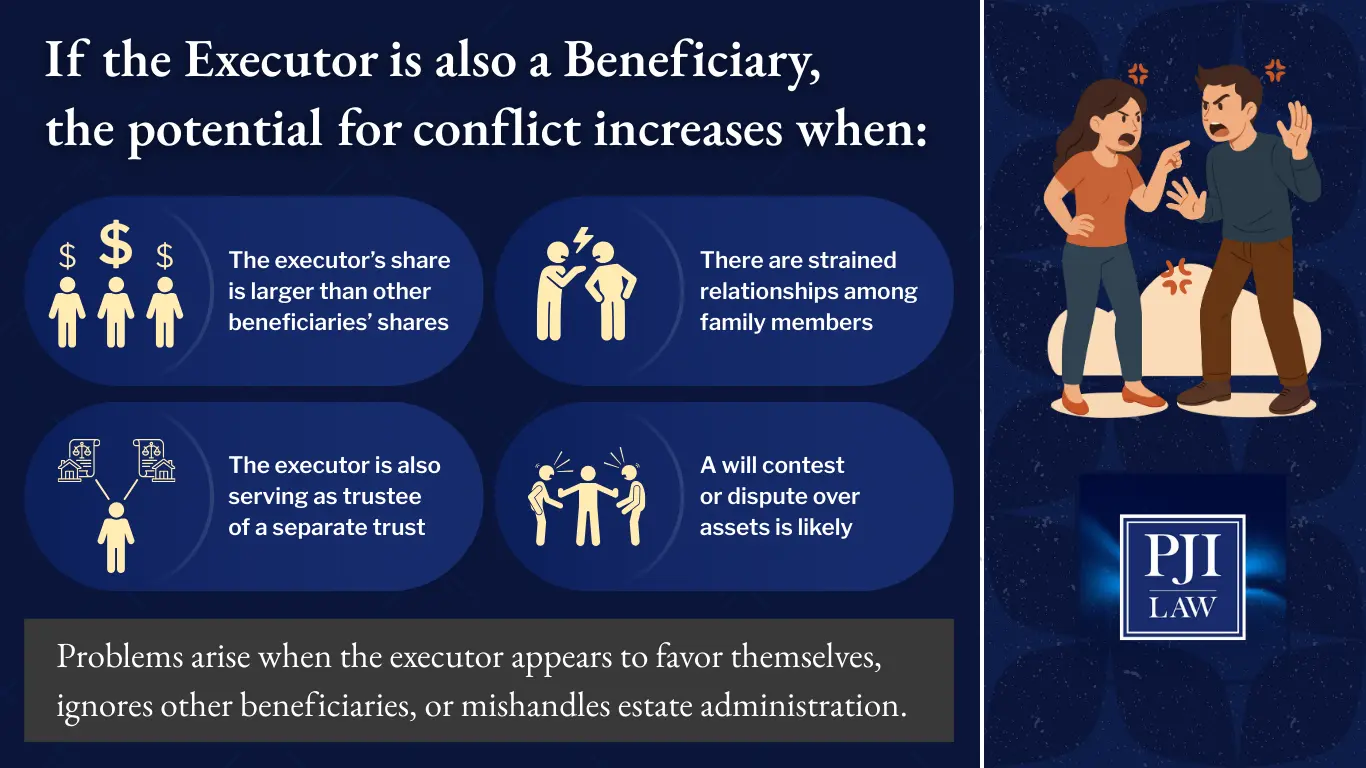
    If an executor delays distribution, fails to communicate with beneficiaries, or mishandles estate assets, family members may raise probate issues or pursue fiduciary litigation. Courts in Virginia may review whether the executor fulfilled their responsibilities under estate administration law and complied with fiduciary duties.

    Fiduciary litigation proceeds in Circuit Court and requires careful attention to statutory requirements.

    Common Mistakes That Create Probate Issues

    Even well-intentioned families encounter probate issues when estate planning details are overlooked. Common mistakes include:

    • Failing to fund a trust. Creating a trust without transferring assets into it often forces those assets through estate administration and probate.
    • Relying only on a will for complex estates. Estates involving business interests, second marriages, or minor children may require more structured planning than a simple last will provides.
    • Delaying probate qualification. Executors who wait too long to qualify before the Circuit Court can create complications with creditor notices and estate administration deadlines.
    • Ignoring fiduciary responsibilities. Trustees and administrators must follow Virginia law carefully. Missteps can lead to litigation, disputes among family members, and court involvement.
    • Failing to update beneficiary designations. Life insurance, retirement accounts, and bank accounts with beneficiary designations pass outside both trusts and wills. Outdated designations can undermine your entire estate plan.
    • Not coordinating estate planning documents. Your trust, will, powers of attorney, and beneficiary designations should all work together as part of a cohesive strategy.

    Addressing these factors early helps protect your estate plan and reduce unnecessary conflict. Understanding these common pitfalls helps, but you likely still have specific questions about your situation. Here are answers to the questions we hear most often:

    Are you searching for an “estate administration attorney near me”

    Frequently Asked Questions

    Q: Does a trust avoid probate in Virginia?

    A: A properly funded trust can avoid probate for assets titled in the trust. Assets outside the trust may still require estate administration.

    Q: How much does probate cost in Virginia?

    A: Probate costs in Virginia typically include court filing fees ($100-$200), probate tax (approximately 10 cents per $100 of value for estates over $15,000), potential bond premiums (if required), and attorney fees. Total costs vary depending on complexity, attorney involvement, bond requirements, and disputes.

    Q: Can I be both executor and trustee?

    A: Yes. It’s common for the same person to serve as personal representative (executor for probate assets) and trustee (for trust assets). However, each role carries distinct responsibilities under Virginia law.

    Q: What happens if I die without a will or trust in Virginia?

    A: Your estate will be distributed according to Virginia’s intestacy laws (Virginia Code § 64.2-200). This means the court determines who inherits based on statutory formulas, which may not reflect your wishes. A spouse and children would receive specific shares, but the distribution may not align with your intentions.

    Q: Who qualifies as an executor?

    A: The named executor in a will qualifies before the Circuit Court and serves as the estate’s personal representative. If there is no will, the court appoints an administrator, who also serves as the personal representative under Virginia law.

    Q: Can trust administration lead to litigation?

    A: Yes. Trustees owe fiduciary duties under Virginia law. Beneficiaries may pursue fiduciary litigation if those duties are breached.

    Q: How long does estate administration take in Virginia?

    A: The probate process often lasts 9-18 months and may extend longer depending on creditors, taxes, disputes, and court requirements.

    Work With Richmond’s Trusted Estate Planning and Administration Attorneys

    Planning for the future or handling responsibilities after a death requires careful attention to Virginia law. Whether you’re serving as executor, acting as a trustee, or creating an estate planning strategy for your family, clear legal direction helps you proceed with confidence.

    At PJI Law, our estate administration attorneys serve clients in Richmond, VA, and throughout Northern Virginia who need experienced representation with estate planning and probate matters. Our law firm works closely with clients who require assistance with trust administration, estate administration, probate issues, and fiduciary litigation.

    Call (804) 653-3450 to request a consultation. You can also complete our confidential online form if that is more convenient. Our estate administration law firm is prepared to assist you with estate planning, trust and estate disputes, and probate matters across Virginia.

    At PJI Law, you’ll receive white-glove service and personal attention from a team that treats you like family.

    Copyright © 2026. PJI Law, PLC. All rights reserved.

    The information in this blog post (“post”) is provided for general informational purposes only and may not reflect the current law in your jurisdiction. No information in this post should be construed as legal advice from the individual author or the law firm, nor is it intended to be a substitute for legal counsel on any subject matter. No reader of this post should act or refrain from acting based on any information included in or accessible through this post without seeking the appropriate legal or other professional advice on the particular facts and circumstances at issue from a lawyer licensed in the recipient’s state, country, or other appropriate licensing jurisdiction.


  • 5 Warning Signs a Will Was Signed Under Undue Influence in Richmond, VA

    5 Warning Signs a Will Was Signed Under Undue Influence in Richmond, VA

    When a loved one dies, the last thing you expect is to hear that their will says something completely different from what they told you for years. Maybe you’re told that a new will replaced the one your parent kept for most of their life, or that most of the estate now goes to someone who managed their care near the end. When the terms feel out of character for the person you knew, it’s natural to wonder whether someone stepped in during a vulnerable period and influenced decisions your loved one wouldn’t have made on their own.

    Situations like this arise more often than families expect. Even though will contests make up a small share of probate cases, the disputes that do appear often involve late-life dependence, health challenges, caregiver involvement, or sudden changes to long-standing estate plans. DIY wills or rushed updates made during periods of isolation may also create opportunities for undue influence by individuals who had access when others did not.

    When doubt exists about a will’s validity, Virginia law allows you to challenge a legal document that may not reflect the testator’s true intentions. Below are 5 of the most common warning signs our contested will lawyers at PJI Law see when families come to us, and how those signs can help you assess whether a will may have been affected by undue influence.

    At a Glance: Signs a Will May Have Been Affected by Undue Influence

    If a loved one’s will looks inconsistent with their long-term plans, several indicators may point toward undue influence. Families often notice:

    • Sudden changes in the estate plan
    • A beneficiary taking control of the will’s creation
    • Isolation from trusted contacts
    • Concerns about the testator’s capacity
    • Unusual circumstances surrounding the signing

    Virginia law permits interested parties to contest a will when doubt exists about whether it reflects the testator’s true intentions.

    Searching for a lawyer to prove undue influence upon a loved one’s will

    How Virginia Law Evaluates Undue Influence in a Will Contest

    Before you look at warning signs, it helps to understand how Virginia treats undue influence in a will contest. State law does not offer a single definition, but Virginia courts view undue influence as conduct that overpowers the testator’s independent judgment and causes them to sign a will that does not reflect their own wishes. It goes beyond ordinary persuasion and often involves someone taking advantage of a vulnerable person during the will’s creation.

    Virginia also recognizes situations where a presumption of undue influence applies. Under Va. Code § 64.2-454.1, if certain conditions are present during a will contest, the court must begin with the presumption that undue influence occurred unless evidence shows the testator intended the will as written. This presumption often arises when the testator was vulnerable, relied on someone in a confidential or fiduciary relationship, and the will’s terms differ significantly from prior intent.

    When a will contest moves forward, the court then examines whether the document reflects the testator’s true intentions. If the court determines that circumstances suggest coercion, manipulation, or self-dealing (meaning someone acted in their own interest rather than the testator’s), the will may be invalid. In some situations, the court may revert to a previous will or apply Virginia’s intestacy laws.

    Virginia’s Requirements for a Valid Will

    To determine whether improper execution or undue influence occurred, it helps to understand what makes a valid will under state law. A Virginia will must meet a few requirements:

    • It must be in writing.
    • The testator must have testamentary capacity.
    • It must be signed by the testator or by someone at the testator’s direction.
    • It must be signed by two witnesses who observed the signing.

    If the current will wasn’t properly witnessed or doesn’t appear to follow state law, that alone may open the door to a will contest. However, most undue influence claims center on patterns, relationships, and behavior rather than technical execution errors. The red flags that most families recognize first often involve surprising changes to the estate plan.

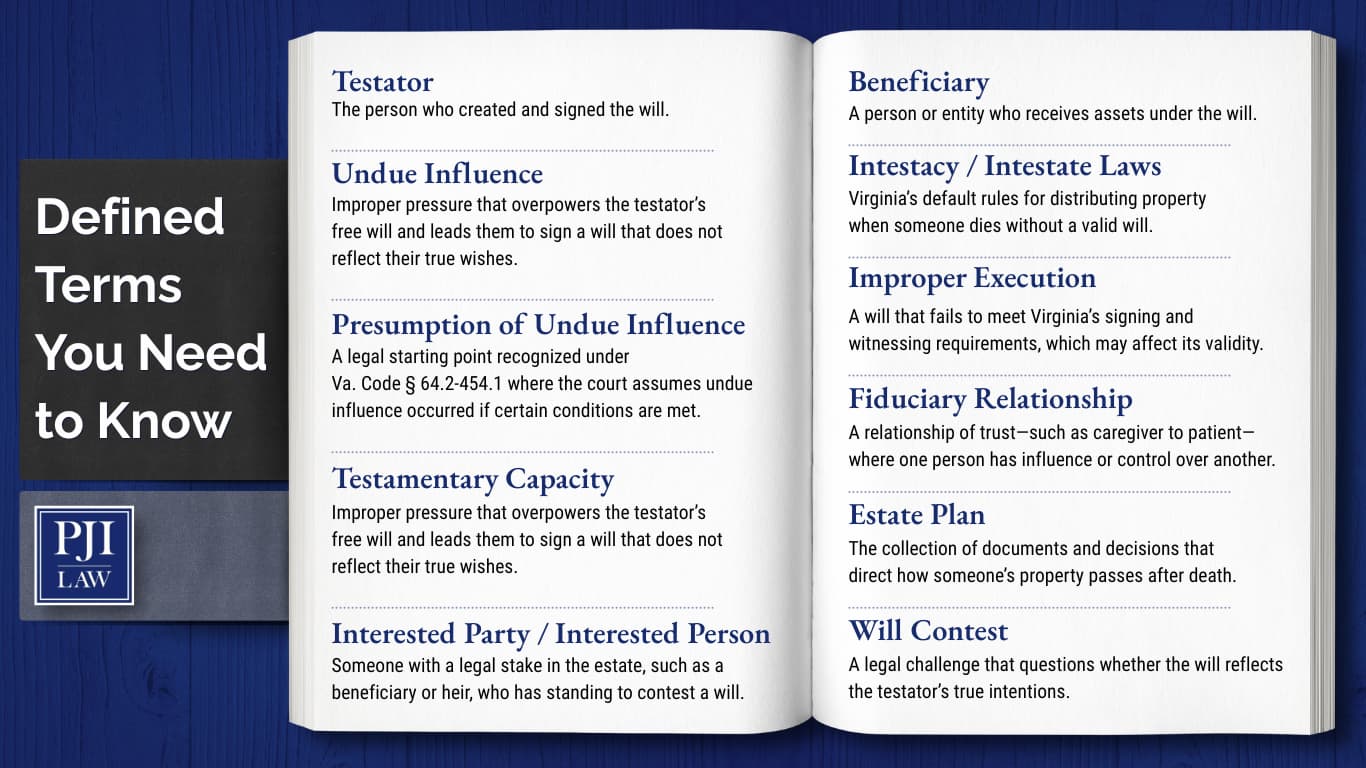
    Defined Terms You Need to Know

    1. Sudden and Unexplained Changes to the Estate Plan

    A dramatic change in a loved one’s will often signals that something influenced their thinking near the end of their life. When someone revises their estate plan in a way that departs sharply from long-standing intentions, it may indicate undue influence.

    Signs this may apply to your situation:

    • A previous will provided for family members, but the current will leaves the bulk of the decedent’s estate to one individual with unusual access or power.
    • Estranged family members suddenly become beneficiaries without explanation.
    • The will was previously revoked, yet a new version appears under suspicious circumstances.
    • The current will was signed when the testator had declining mental capacity or longstanding medical conditions.

    An interested party may file a will contest when the new terms don’t make sense based on the testator’s history. Will contest lawyers often examine earlier versions to compare consistent intent with the changes. A document admitted to probate that contradicts decades of stable planning is something courts take seriously.

    2. A Beneficiary Played a Direct Role in the Will’s Creation

    Another warning sign appears when the primary beneficiary arranges the legal process from start to finish. If the person who gains the most from the will contacted the law firm, scheduled the meetings, or gave instructions to the estate attorney, a dispute exists over whether their influence shaped the document.

    Red flags that raise concern:

    • The beneficiary selected the attorney who drafted the last will and testament.
    • The testator’s communication with the attorney appears limited, filtered, or controlled by someone else.
    • The beneficiary was present for discussions about the estate matters, but discouraged other interested parties from being involved.
    • The will’s execution occurred in a location chosen by the beneficiary rather than the testator.

    No single sign proves that undue influence occurred, but this pattern frequently appears in contest cases. Courts look at whether the beneficiary had an opportunity to control the flow of information or guide decisions that affected the remaining assets.

    3. Isolation of the Testator From Family Members and Friends

    Isolation of the Testator From Family Members and Friends

    One of the most common grounds for contesting a will involves isolation. When someone cuts the testator off from long-trusted family members, long-term friends, or other interested persons, doubt exists about whether the current will reflects independent decision-making.

    What isolation may look like:

    • The testator stopped communicating with people who played a consistent role in their life.
    • A caregiver or close contact monitored or restricted phone calls.
    • The testator lived with someone who controlled who could visit.
    • Estranged family members suddenly gained control over the testator’s daily life.

    Undue influence thrives when the testator relies entirely on one individual for transportation, meal preparation, medical appointments, or emotional support. If isolation coincides with changes to the will, it strengthens a contestant’s claims during estate litigation.


    Looking for a will contest attorney in Richmond, Virginia

    4. Signs the Testator Lacked Testamentary Capacity

    Undue influence often occurs when the testator had declining mental capacity. Capacity issues don’t require a formal diagnosis. Courts examine whether the testator understood the nature of their assets, the purpose of a will, and the natural objects of their affection at the time they signed it.

    Indicators of diminished capacity:

    • Medical records show confusion, memory loss, or cognitive decline.
    • The testator couldn’t identify family members, minor children, or previously named beneficiaries.
    • Witness testimony describes unusual behavior or disorientation.
    • A pattern of dependency on one individual increased near the time of signing.

    If someone lacked testamentary capacity at the time the will was executed, the document may be invalid. Even when capacity existed, a weakened mental state can make it easier for someone to exert influence that overpowered the testator’s free will.

    5. Suspicious Circumstances Surrounding the Signing

    The signing process itself can reveal irregularities that suggest undue influence. The law requires that a will be properly executed and properly witnessed. When the circumstances surrounding the signing appear unusual or inconsistent with standard estate-planning practices, those details matter.

    Examples of suspicious circumstances:

    • Witnesses appeared to be associates of the primary beneficiary rather than neutral observers.
    • The testator signed the will in a hurry or under stress.
    • Someone other than the testator communicated instructions to the attorney.
    • The will wasn’t read to the testator, even though their vision or literacy skills were impaired.
    • A no-contest clause appears in a document that strongly favors one beneficiary, raising questions about whether the testator intended to deter valid challenges.

    When improper execution combines with unexpected terms and questionable involvement from a beneficiary, the will’s validity becomes harder to defend.

    How to Contest Someone’s Will in Richmond, VA

    When you believe undue influence affected your loved one’s will, the next question involves the legal action required to challenge its validity. Contesting wills follows specific rules under state law, and the filing period is limited.

    Key steps in the legal process:

    • Verify your standing as an interested party. Virginia law permits an interested party or interested person to contest a will. This may include beneficiaries named in a previous will, intestate heirs, and others with a legitimate stake in the decedent’s estate.
    • Identify the grounds for contesting. Common grounds include lack of testamentary capacity, improper execution, and undue influence. Contest lawyers evaluate whether doubt exists about the will’s creation and whether suspicious circumstances support your claims.
    • File the challenge in the proper court. A will contest must be filed in the circuit court after the will has been admitted to probate.
    • Gather supporting evidence. Evidence may involve medical records, witness testimony, financial documents, caregiver logs, prior estate-planning records, and communication patterns showing that someone exerted undue influence.
    • Follow the time limit. Virginia imposes a filing period, and state law requires that you act quickly once the document is admitted to probate. In most cases, a will contest must be filed within one year after the will is admitted. If the deadline passes, you may lose your ability to challenge the will.

    Because Virginia requires clear and convincing evidence in undue influence challenges, will contest lawyers focus on patterns, relationships, and circumstances that collectively show the will did not reflect the testator’s true wishes.

    What Happens if the Court Finds Undue Influence Occurred

    If the court agrees that undue influence affected the will’s validity, several potential decisions may follow:

    • The court may invalidate the current will.
    • A previous will may be restored if it was properly executed and not previously revoked.
    • If no earlier will exists, Virginia’s intestacy laws determine how the decedent’s estate passes to heirs.
    • A fiduciary relationship involving self-dealing may lead the court to review additional estate matters.

    The probate court may also consider whether the person who exerted undue influence has breached a fiduciary duty owed to the decedent. In some legal complexities, other interested parties may negotiate terms that produce a favorable settlement in a timely manner, particularly when the dispute involves multiple families or large estates.

    How Contest Will Lawyers Evaluate Your Case

    How Contest Will Lawyers Evaluate Your Case

    Contest will lawyers analyze the facts, the relationships, and the timeline of events to determine whether a dispute exists. They examine:

    • The current will, and previous will versions
    • The testator’s medical records
    • Witness involvement
    • Communication patterns
    • Financial transactions
    • Caregiver arrangements
    • Record-keeping by the person who stood to benefit

    They also look for patterns found in contest cases involving undue influence, lack of testamentary capacity, or improper execution. Because state law requires that a will be properly witnessed and executed, any break in the chain of legal compliance may strengthen your position.

    A contested will is a legal proceeding that requires careful review of document creation, the testator’s state of mind, and the circumstances surrounding the signing. When doubt exists, your attorney may challenge whether the will reflects the testator’s true intentions under Virginia law.

    Searching online for a “will contest lawyer near me”

    Frequently Asked Questions

    Q: What qualifies as undue influence in a Virginia will contest?

    A: Virginia courts look at whether someone overpowered the testator’s independent judgment during the will’s creation. This often involves late-life dependence, isolation, control over communication, or a beneficiary directing the estate-planning process. The court may apply a presumption of undue influence when certain conditions are present.

    Q: Can a will be contested if the testator had cognitive decline but no diagnosis?

    A: Yes. A formal diagnosis is not required. Courts examine whether the testator understood the nature of their assets, the purpose of a will, and the natural objects of their affection at the time of signing. Medical records, witness observations, and evidence of memory issues often play a role in capacity evaluations.

    Q: How long do I have to contest a will in Virginia?

    A: A will contest must be filed in the circuit court after the document is admitted to probate. In the majority of cases, you must file within one year after the will is admitted to probate. If the deadline passes, you may lose the ability to challenge the will, even if strong concerns exist about undue influence or improper execution.

    Q: What evidence helps prove undue influence?

    A: Useful evidence often includes medical records, prior versions of the will, caregiver logs, financial transactions, communication patterns, and witness testimony. Contest lawyers also review whether a beneficiary arranged the planning process or controlled access to the testator.

    Q:  What happens if the court decides undue influence occurred?

    A: The court may invalidate the current will. If a previous will was properly executed and not previously revoked, that version may be restored. If no earlier will exists, the estate passes under Virginia’s intestacy laws. The court may also examine whether the person who benefited violated a fiduciary duty.

    Consult With a Contest Will Lawyer About Possible Undue Influence

    When a loved one’s will raises questions, it can leave you unsure where to turn or how to move forward. At PJI Law, our team understands the weight these estate disputes carry and the impact they have on families across Richmond, Virginia. If you believe undue influence affected your loved one’s will, you can speak with a contest will lawyer who handles these sensitive estate matters with careful attention and professionalism.

    Call (804) 653-3450 to request a confidential consultation. You can also complete our confidential online form if it is more convenient for you. Our firm provides thoughtful legal representation to interested parties who need guidance with the probate process, will contests, and concerns about a will’s validity.

    At PJI Law, you’ll receive white glove service and personal attention from a team that treats you like family.

    Copyright © 2026. PJI Law, PLC. All rights reserved.

    The information in this blog post (“post”) is provided for general informational purposes only and may not reflect the current law in your jurisdiction. No information in this post should be construed as legal advice from the individual author or the law firm, nor is it intended to be a substitute for legal counsel on any subject matter. No reader of this post should act or refrain from acting based on any information included in or accessible through this post without seeking the appropriate legal or other professional advice on the particular facts and circumstances at issue from a lawyer licensed in the recipient’s state, country, or other appropriate licensing jurisdiction.

    PJI Law, PLC
    4108 E Parham Rd,
    Richmond, VA 23228
    (804) 653-3450
    https://pjibe.webteam.ai/

  • What To Do When a Parent Dies Without a Will in Richmond, Virginia

    What To Do When a Parent Dies Without a Will in Richmond, Virginia

    Losing a parent is emotionally exhausting, and when that loss is followed by the realization that there is no will, the stress often multiplies. Many families in Richmond find themselves asking the same urgent questions: Who is in charge now? What happens to the house, bank accounts, and other property? Will debts and taxes consume the estate? How long will probate take?

    If you’re searching for “what to do when a parent dies without a will,” you’re not alone. This situation can create confusion, tension among family members, and fear of making a mistake that could delay the probate process or increase costs. Understanding how Virginia law addresses intestate estates is the first step toward restoring order and moving forward with clarity. At PJI Law, we are here to guide you.

    At-a-Glance Summary

    • Virginia law provides a clear framework for intestate estates, in which the decedent died without a will.
    • Early legal guidance often reduces probate issues and family conflict.
    • When a parent dies without a will in Richmond, Virginia law controls how the estate is handled.
    • The probate process usually begins in the local circuit court.
    • The court appoints a personal representative to manage administration.
    • Probate applies to many assets, but some transfers may avoid probate.
    • Debts, taxes, and creditor concerns must be addressed before distribution.
    • Assets are distributed to heirs according to Virginia’s intestacy statutes.
    • A Richmond probate lawyer can assist with probate and estate administration from start to finish

    Understanding What It Means to Die Without a Will in Virginia

    When a parent passes away without a valid will, they are considered to have died “intestate” under Virginia law. In these situations, the estate does not pass according to personal wishes or informal family agreements. Instead, the General Assembly of Virginia has established intestacy statutes that control asset distribution.

    These laws determine:

    • Who inherits the estate.
    • The order of priority among heirs.
    • How much is to be allocated to each beneficiary.

    This framework applies regardless of family dynamics, second marriages, divorce history, or verbal promises made during life. While these rules provide structure, they may not reflect what the deceased person intended, which is why estate planning is so important for the future..

    Step One: Secure Immediate Matters After Death

    Before the probate process begins, families should focus on immediate and practical concerns. These steps are not about probate court filings yet, but about protecting the estate and complying with basic requirements.

    Common early actions include:

    • Collecting multiple certified copies of the death certificate.
    • Securing the parent’s residence and personal property.
    • Locating attorney documents, financial statements, and insurance policies.
    • Notifying close family members and interested parties.

    At this stage, many clients worry about accessing accounts or selling property. Until a personal representative is appointed, no one has authority to act on behalf of the estate, even if they are close family.

    Step Two: Determine Whether Probate Is Required

    Not every asset passes through probate. Part of estate administration involves identifying which assets require court involvement and which transfer automatically.

    Assets that often avoid probate include:

    • Jointly owned property with survivorship rights
    • Accounts with named beneficiaries
    • Life insurance proceeds
    • Certain retirement accounts
    • Assets held in trust

    However, assets titled solely in the deceased person’s name usually require probate. A Richmond probate attorney can review the estate’s assets to clarify what falls under the probate process and what does not.

    Step Three: Open the Probate Case in Richmond Circuit Court

    Probate cases are handled by the circuit court for the city or county where the parent lived at death. The circuit court clerk plays a central role in opening the estate.

    To begin probate:

    • An application for probate is filed
    • The court appoints a personal representative
    • Qualification paperwork is completed with the court clerk

    Unlike probate situations with wills, there is no named executor. Virginia law establishes who has priority to serve as personal representative, often starting with the surviving spouse or adult children.

    The Role of the Personal Representative

    The personal representative is legally responsible for managing the estate administration process. This role carries fiduciary duties, meaning the representative must act in the estate’s and beneficiaries’ interests, not personal preferences.

    Responsibilities of the personal representative typically include:

    • Collecting and inventorying the deceased’s assets.
    • Notifying creditors and addressing outstanding debts.
    • Filing required tax returns.
    • Managing property during administration.
    • Distributing property according to Virginia law.

    Reasonable compensation may be allowed, subject to court oversight.

    How Virginia Law Determines Heirs When There Is No Will

    Virginia law sets out a strict order of inheritance. The identity of heirs depends heavily on family structure.

    Common scenarios include:

    • Surviving spouse and children: Assets typically pass to the spouse, unless there are children from the decedent’s prior marriage, in which case assets are divided between them according to statute.
    • No surviving spouse: Children inherit equally.
    • No spouse or children: Assets pass to parents, siblings, or more distant relatives.

    Second marriages often complicate intestate estates, especially when children from prior relationships are involved. Divorce history also matters, as former spouses are excluded under Virginia law.

    Handling Minor Children and Guardianship Concerns

    When minor children inherit under intestacy, the situation becomes more complex. Virginia courts do not permit minors to directly manage inherited assets.

    Possible resolutions for minors inheriting assets in Virginia include:

    • Appointment of a guardian or conservator.
    • Court-supervised management of funds.
    • Restrictions on access until adulthood.

    These court processes can increase administration time and costs. Many estate planning attorneys highlight this risk when discussing guardianship planning for the future.

    Addressing Debts, Taxes, and Creditor Concerns

    Before any asset distribution occurs, the estate must address debts and taxes. This step often causes anxiety for family members worried about personal liability.

    Under Virginia law:

    • Valid debts are paid from estate assets.
    • Creditors must be properly notified.
    • Certain deadlines apply to claims.
    • Taxes, including final income taxes and possible estate taxes, must be filed.

    Family members generally are not personally responsible for the deceased person’s debts unless they co-signed or guaranteed them.

    The Probate Timeline in Richmond

    The probate timeline varies based on estate size, asset complexity, and disputes. Many estates remain open for at least several months, with some extending beyond a year.

    Factors that affect timing include:

    • Real estate sales
    • Business interests
    • Disputes among heirs
    • Fiduciary litigation involving the personal representative

    Working with probate administration lawyers often helps reduce delays caused by procedural errors.

    Common Probate Issues in Intestate Estates

    Dying without a will (dying intestate) increases the likelihood of probate issues. Without written guidance, misunderstandings are often more likely to arise.

    Frequent challenges during probate if the decedent died without a will include:

    • Disagreements among family members.
    • Confusion over asset ownership.
    • Disputes involving second marriages.
    • Questions about reasonable compensation.
    • Creditor concerns and late claims.

    A Richmond probate lawyer can assist in addressing these concerns within the court process.

    The Relationship Between Probate and Trust Administration

    Some parents may have created trusts but never completed funding them. In those cases, both probate and trust administration may be required.

    Trust administration focuses on:

    • Managing trust-held assets.
    • Following trust terms.
    • Distributing property outside probate.

    When assets remain outside the trust, probate becomes necessary to transfer them. This overlap often surprises families.

    Can Probate Be Avoided After Death?

    Once a parent has passed without a will, options to avoid probate are limited. Some small estates may qualify for simplified procedures under Virginia law, but many require full administration.

    For surviving family, this experience often motivates future planning to avoid probate for themselves through updated estate planning strategies.

    Why Legal Guidance Matters in Intestate Estates

    Probate law involves deadlines, filings, and fiduciary standards. Mistakes can lead to delays, disputes, or personal liability for the personal representative.

    A Richmond probate attorney provides legal guidance by:

    • Explaining rights and obligations.
    • Preparing court filings.
    • Communicating with the circuit court clerk.
    • Guiding clients regarding asset protection concerns.
    • Addressing fiduciary litigation if disputes arise.

    Legal counsel often provides reassurance during an emotionally difficult period.

    How PJI Law Assists Families in Richmond

    As a Richmond-based law firm serving central Virginia, PJI Law works with clients facing probate and estate administration after the death of a loved one. Many clients come to us feeling overwhelmed by the combination of grief and legal responsibility.

    Our attorneys assist with:

    • Probate administration
    • Trust administration
    • Addressing probate issues
    • Supporting informed decisions during administration
    • Planning for the future to protect family and assets

    We understand that each family situation is unique, and we work closely with our clients to develop practical plans moving forward.

    Where Are Probate Matters Handled in Richmond Courts?

    Richmond probate matters are handled through the local circuit court, and procedures can vary slightly by county and city. Familiarity with Richmond probate practices, court clerks, and filing expectations helps keep administration moving efficiently.

    Working with a Richmond probate attorney who regularly appears before local courts often streamlines communication and scheduling.

    Frequently Asked Questions

    1. Who can serve as personal representative if there is no will?

    Virginia law prioritizes the surviving spouse, followed by adult children and other heirs. The circuit court makes the final appointment.

    2. How long does probate take in Richmond, Virginia?

    Many estates take several months, though more complex estates may take longer depending on assets, debts, and disputes.

    3. Are all assets subject to probate?

    No. Certain assets transfer outside probate, such as beneficiary-designated accounts and trust assets.

    4. What happens if family members disagree during probate?

    Disputes may lead to fiduciary litigation or court intervention to resolve disagreements.

    5. Do minor children receive their inheritance directly?

    No. Guardianship or conservatorship may be required until the child reaches adulthood. Minors inheriting in Virginia generally are not allowed direct access to their inheritances.

    6. Should I work with a lawyer if the estate seems simple?

    Even smaller estates can present probate issues. Consulting with a probate attorney often helps prevent costly mistakes.

    Schedule a Consultation With a Richmond Probate Attorney

    If you are facing the difficult situation in which you need to figure out what to do when a parent dies without a will in Richmond VA, you do not have to handle probate alone. The attorneys at PJI Law assist families through every stage of probate and estate administration with clarity and care.

    Call (703) 865-6100 today to schedule a consultation, or complete our online form to speak with a Richmond probate lawyer about your situation.

    At PJI Law, you’ll receive white glove service and personal attention from a team that treats you like family.

    Copyright © 2026. PJI Law, PLC. All rights reserved.

    The information in this blog post (“post”) is provided for general informational purposes only and may not reflect the current law in your jurisdiction. No information in this post should be construed as legal advice from the individual author or the law firm, nor is it intended to be a substitute for legal counsel on any subject matter. No reader of this post should act or refrain from acting based on any information included in or accessible through this post without seeking the appropriate legal or other professional advice on the particular facts and circumstances at issue from a lawyer licensed in the recipient’s state, country, or other appropriate licensing jurisdiction.

    PJI Law, PLC
    4108 E Parham Rd, 
    Richmond, VA 23228
    (703) 865-6100
    https://pjibe.webteam.ai/ 

  • Can an Executor of a Will Be a Beneficiary in Richmond, Virginia?

    Can an Executor of a Will Be a Beneficiary in Richmond, Virginia?

    When a loved one dies, it is common for one person, often an adult child or trusted friend, to suddenly hold two roles at once: beneficiary and executor. If you are asking yourself, “Can an executor of a will be a beneficiary?” you may be worried that other family members will think you are taking advantage, that the courts might remove you, or that you could be personally responsible if something goes wrong with the probate process.

    At PJI Law, our estate planning attorneys and probate administration lawyers regularly speak with clients in Richmond VA who feel overwhelmed by these exact concerns and want practical, Virginia-specific answers so they can honor their loved one’s wishes and move forward.

    Can an Executor of a Will Be a Beneficiary in Richmond, Virginia?

    Under Virginia law, an executor may also be a beneficiary of the same estate. There is no statute that prohibits a beneficiary from serving as executor, and in practice, Virginia wills frequently name a beneficiary, such as a surviving spouse, adult child, or close relative, as executor. However, having a beneficiary as the executor of a will can lead to some complicated implications that we will address below. Virginia courts focus not on the simple fact that the executor is a beneficiary, but on whether that executor is properly carrying out fiduciary duties in accordance with the will and the Virginia Code.

    In other words, your role as beneficiary does not disqualify you from serving. What matters is how you act in that role: whether you follow the law, treat beneficiaries fairly, and handle estate administration properly.

    Why So Many Executors Are Also Beneficiaries

    In Virginia estate planning, testators (the people who sign wills) usually choose someone they trust deeply to serve as executor. Often, that is the same person who may become a recipient of a substantial share of the estate:

    • A surviving spouse who needs to access joint and individual accounts
    • An adult child who has been helping aging parents for years
    • A sibling or close friend with financial experience

    This is entirely consistent with Virginia estate planning practice and probate law. The executor is responsible for managing assets, paying debts and taxes, and distributing property to heirs and beneficiaries. It makes sense that a testator wants a trusted beneficiary to oversee these steps.

    However, because the executor is also a beneficiary, emotions can run high. Other heirs may worry that the executor-beneficiary is “helping themselves first” or that the estate plan is being changed informally along the way. Those concerns can often be reduced, or avoided altogether, when the executor understands the legal responsibilities and follows a clear, documented process.

    Key Legal Duties of an Executor in Virginia

    In Virginia, an executor (also called a personal representative) has a fiduciary duty to the estate and to all beneficiaries, regardless of personal relationships or their own interests as a beneficiary. Several provisions in Title 64.2 of the Code of Virginia and local guidance from Commissioners of Accounts lay out these responsibilities.

    Core responsibilities

    An executor must:

    • Qualify before the court: The executor typically qualifies at the Circuit Court for the city or county where the decedent resided, such as the Richmond Circuit Court. At qualification, the executor takes an oath to faithfully perform the duties of the office and may have to post a bond.
    • Collect and manage estate assets: This includes bank accounts, investment accounts, real property, vehicles, business interests, and other assets. The executor must safeguard these assets, open an estate account, and avoid mixing estate funds with personal accounts.
    • Give notice to heirs and beneficiaries: Within 30 days after qualification, the executor generally must give written notice of probate or qualification to heirs at law and beneficiaries, then file the required affidavit with the clerk and Commissioner of Accounts.
    • Prepare inventories and accountings: Virginia requires a detailed inventory of estate assets within a specified timeframe (often four months) and periodic accountings showing receipts, disbursements, and distributions, which are reviewed by the local Commissioner of Accounts.
    • Pay valid debts and taxes: The executor must identify and pay lawful debts of the estate and handle tax filings, including final income tax returns and any applicable estate or inheritance taxes. Paying a time-barred or invalid claim can expose the executor to personal liability.
    • Distribute the remaining estate: Only after debts, costs, and taxes are handled does the executor distribute the remaining property according to the will. If the decedent died without a will, Virginia intestacy law controls who inherits.

    Emphasizing High Fidelity and Good Faith as a Beneficiary-Excutor in Virginia

    Virginia courts hold executors to a high fiduciary standard, requiring them to act with loyalty and impartiality toward all beneficiaries, not just themselves. Fiduciary duties require acting in good faith, fairly, and according to Virginia law when managing assets, evaluating debts, and dealing with beneficiaries.

    As a beneficiary-executor, this means you cannot prioritize your own share, delay distributions to others without legal cause, or use estate assets for personal benefit outside of your role.

    Is it a Conflict of Interest if the Executor is Also a Beneficiary?

    Simply being both executor and beneficiary is not, by itself, a legal conflict of interest under Virginia law. In fact, it is expected in many estates. However, the potential for conflict increases when:

    • The executor’s share is larger than other beneficiaries’ shares
    • There are strained relationships among family members
    • The executor is also serving as trustee of a separate trust
    • A will contest or dispute over assets is likely

    Virginia ethics opinions recognize that when an attorney represents an executor who is also a beneficiary, the attorney’s client is the executor in the fiduciary role, not all beneficiaries. A conflict of interest may arise if the attorney tries to represent multiple beneficiaries with differing interests at the same time.

    What matters practically is whether the executor is:

    • Following the will and Virginia law
    • Keeping accurate records
    • Providing information when appropriate
    • Seeking legal guidance when uncertain

    If the executor is transparent and diligent, Virginia courts and Commissioners of Accounts typically accept the arrangement. Problems arise when the executor appears to favor themselves, ignores other beneficiaries, or mishandles estate administration.

    Common Pain Points for Executor-Beneficiaries in Richmond, VA

    If you are serving as both executor and beneficiary in Richmond, you may recognize some of these concerns:

    • “My brother thinks I’m trying to control everything.”
    • “The will leaves me the house, but I’m also in charge of the entire estate. Is that unfair?”
    • “I work full-time and do not understand probate. What if I make a mistake?”
    • “Our family is spread between Richmond, Newport News, and Virginia Beach, and everyone has an opinion.”

    These are realistic worries. Probate issues in Virginia involve strict deadlines, court oversight, and detailed accounting requirements. A misstep can delay distribution, increase fees and costs, or lead to disputes among heirs. Working with an estate administration law firm gives you a place to ask questions and access guidance tailored to your situation.

    At PJI Law, our estate planning attorneys and probate lawyers provide support in Richmond, VA and throughout Northern Virginia for clients facing this type of dual role as beneficiary and executor.

    How Virginia Courts Oversee Executors and Estates

    While Virginia law allows executor-beneficiaries, the system is built with checks and balances:

    1. Circuit Court and qualification: The Circuit Court oversees qualification and may consider objections if someone claims the named executor is not suitable.
    2. Commissioner of Accounts review: After qualification, the Commissioner of Accounts in each locality reviews inventories and accountings to help protect beneficiaries, heirs, and creditors. The Commissioner can issue show cause orders if required filings are late or incomplete.
    3. Beneficiary rights: Beneficiaries can request information, raise objections if they believe the executor is mismanaging assets, and, in some cases, petition the court to address concerns.
    4. Removal of an executor: In serious situations, Virginia law allows for removal of an executor who fails to perform duties, misuses estate property, or engages in misconduct.

    Because of this oversight, an executor-beneficiary who takes their responsibilities seriously and works with experienced probate lawyers is often able to complete estate administration smoothly, even when emotions are high.

    Executor Compensation vs. Beneficiary Distributions

    Another frequent question is whether an executor-beneficiary may accept both a share of the estate and compensation for their services as executor.

    Compensation

    Virginia law allows reasonable compensation for executors, subject to review and approval by the Commissioner of Accounts. The fee is typically based on the size and complexity of the estate and the effort required. Local norms and guidelines often influence what is considered reasonable. We can address your specific questions during your consultation.

    Beneficiary share

    Separately, the executor accepts whatever share the will grants them as a beneficiary. This is distinct from compensation and reflects the decedent’s wishes about distributing property and assets among beneficiaries.

    As long as the compensation is reasonable and approved, it is generally permissible for an executor to accept both compensation and their inheritance. Still, because other family members may not understand how fees work, it can be wise for executors to discuss anticipated fees with the probate attorney and, when appropriate, explain the structure to beneficiaries. Clear communication can prevent misunderstanding later.

    Special Concerns When the Executor Is Also a Major Beneficiary

    Being both executor and major beneficiary can create sensitive situations:

    • Selling estate property that you want to keep: If you want to purchase a house or other property from the estate, you must handle the transaction at fair market value and often with court or Commissioner oversight. Any appearance of a “sweetheart deal” can trigger objections from other heirs.
    • Loans and advances to beneficiaries: An executor-beneficiary might be tempted to “advance” money to themselves or other heirs. Doing so without proper documentation and legal guidance may cause accounting problems or claims of unequal treatment.
    • Family businesses and real estate: When the estate includes major assets like a small business in Richmond, a rental property in Glen Allen, or investment real estate in Newport News or Virginia Beach, questions about valuation and ongoing management can impact distributions to all beneficiaries.

    If you are facing these scenarios, working with an estate planning lawyer or probate attorney at PJI Law can help you carefully evaluate options, document the process, and protect both yourself and the estate.

    What If the Executor Is Also the Trustee of a Trust?

    Many Virginia estate plans use both wills and trusts. A revocable living trust might hold substantial assets during the decedent’s lifetime, while the will addresses remaining property and appoints an executor. Sometimes the same person serves as both executor and trustee.

    As a trustee, you would owe fiduciary duties to trust beneficiaries, which may include yourself. As the executor, you owe duties to the estate and its beneficiaries and creditors. Trustees and executors must keep careful records, keep trust and estate accounts separate, and follow the terms of the trust and will, as well as Virginia law.

    Having the same individual in both roles can simplify administration, but it also increases responsibility. Professional legal guidance can help trustees and executors understand how these roles interact and how to protect beneficiaries and families.

    Q&A: Practical Questions About Executor-Beneficiaries in Virginia

    Can an executor change what the will says if they think the distribution is unfair?

    No. An executor must carry out the will as written and follow Virginia law. The executor does not have the authority to change gifts or percentages simply because they believe the distribution is unfair. However, in some families, beneficiaries may agree among themselves to a different distribution, and those agreements should be documented with the help of an attorney.

    What if the executor-beneficiary is not communicating with other family members?

    Executors should keep beneficiaries reasonably informed about the status of the probate process, debts, and anticipated distribution timelines. If you are a beneficiary and feel in the dark, you may have options to request information or ask the Commissioner of Accounts or the court to review the situation. Estate planning lawyers can guide you on appropriate next steps.

    Can a beneficiary force the executor to step down?

    There is no automatic right for a beneficiary to remove an executor simply because they are dissatisfied. However, if an executor fails to file required reports, misuses assets, ignores court orders, or otherwise breaches fiduciary duties, the court can consider removal. A probate lawyer can review the facts and explain whether a petition to the court is appropriate.

    Is it safer to choose a non-family executor?

    Some people prefer to name a corporate fiduciary or professional in their estate plan, especially when family relationships are strained or assets are complex. Others value the personal knowledge and lower costs of having a family member serve.

    The “right” choice depends on factors such as:

    • Size and complexity of the estate
    • Nature of the assets (real estate, business interests, retirement accounts)
    • Relationships among family members
    • Location of beneficiaries (for example, spread across Richmond, Newport News, and beyond)

    Estate planning attorneys at PJI Law can discuss these factors and help clients choose executors and trustees who fit their goals.

    Do I really need a probate attorney if I am both executor and beneficiary?

    While Virginia law does not require every executor to hire counsel, the process can be demanding, especially in estates with real property, out-of-state assets, business interests, or disputes. Probate administration lawyers can:

    • Explain deadlines, forms, and court requirements
    • Assist with inventories and accountings
    • Help evaluate debts and taxes
    • Provide guidance when beneficiaries disagree
    • Reduce the likelihood of costly errors

    If you are searching for a “probate attorney near me” in Richmond VA, our firm is available to discuss your situation and help you decide how much assistance you need.

    How Good Planning Can Reduce Stress for Future Executors and Families

    Thoughtful Virginia estate planning can make life much easier for the person who eventually serves as executor and beneficiary. When working on your own estate plan, consider:

    • Clear, detailed wills: Clear instructions about distributing property, especially highly valued items like the family home or business, can reduce misunderstandings later.
    • Use of revocable trusts: In some cases, placing assets into a revocable trust may help avoid probate for those assets and streamline administration after death. While no plan can avoid probate in every situation, using trusts and beneficiary designations wisely can reduce court involvement.
    • Guardianship provisions for minor children: Parents of minor children can use wills to nominate guardians and address financial support, so the executor and trustee have a clearer roadmap when the unthinkable happens.
    • Planning for blended families and divorce history: Prior divorce, remarriage, and blended family situations often increase the possibility of conflict. Crafting a comprehensive estate plan with help from estate planning lawyers can help protect all children, both from current and prior relationships, and provide clarity for a surviving spouse.
    • Coordination with other planning: Many clients also have life insurance, retirement accounts, and business arrangements, all of which should be coordinated with their estate planning documents.

    PJI Law has served Virginia families for more than a decade with estate planning, probate, and estate administration services, offering tailored plans that reflect each client’s values and goals.

    How an Estate Administration Law Firm Can Help an Executor-Beneficiary

    When you serve as both executor and beneficiary, you carry considerable responsibility. Our estate administration law firm in Richmond can:

    • Review the will and related documents: An attorney at PJI Law can explain your duties as executor, your rights as a beneficiary, and how Virginia law applies to your specific estate.
    • Guide you through the probate process: From qualification at the Richmond Circuit Court to final distribution of assets, our probate lawyers can help you understand the process, deadlines, and local procedures, including interactions with the Commissioner of Accounts.
    • Assist with inventories, accountings, and taxes: Accurate inventories and accountings protect you and the estate. A probate lawyer at our firm can help structure estate accounts, categorize assets, and prepare documents for review.
    • Address disputes among heirs or beneficiaries: If another beneficiary questions your decisions as executor, having a law firm involved can provide a neutral explanation of the law and, when necessary, represent you in court proceedings.
    • Coordinate with other legal matters: Sometimes estate administration intersects with other issues, such as personal injury claims, business succession, divorce history, or guardianship concerns. Working with attorneys familiar with these aspects of Virginia law can be especially helpful.

    Considering Your Options: Should You Accept the Role of Executor if You Are a Beneficiary?

    If a loved one’s will names you executor and you are also a beneficiary, you have choices. You may:

    • Accept the appointment and work with a probate attorney to fulfill your duties
    • Decline to serve and allow an alternate executor or administrator to be appointed
    • Serve with support, by hiring an estate administration law firm to assist with day-to-day tasks

    When deciding, consider:

    • Your time and availability
    • The size and complexity of the estate
    • The condition of relationships among family members
    • Whether there are significant assets that need oversight
    • Your own comfort level with financial and legal responsibilities

    Discussing these factors with an attorney can help you make informed decisions about accepting or declining the role.

    Schedule a Consultation with a Richmond Probate Lawyer at PJI Law

    If you are asking whether an executor of a will can be a beneficiary in Richmond, Virginia, you are likely facing the recent death of a loved one and trying to honor their wishes while also protecting your own rights and your family. You do not need to manage this process alone.

    PJI Law provides Virginia estate planning, probate, and estate administration services in Richmond, Virginia. Our attorneys help clients understand the responsibilities of executors, trustees, and beneficiaries. We guide our clients in an approach to estate administration that respects both the law and family relationships.

    Whether your loved one owned a home, had retirement accounts, or left real property in Richmond, working with local probate counsel can offer peace of mind during a difficult time. Our firm can assist with:

    • Reviewing the will and overall estate plan
    • Guiding executors and trustees
    • Preparing inventories and accountings
    • Working through complex probate issues
    • Coordinating with tax professionals and financial advisors
    • Protecting the interests of beneficiaries and estates under Virginia law

    If you are serving as both executor and beneficiary, or if you have questions about a Virginia estate plan, we invite you to discuss your situation with our team. Call PJI Law at (804) 653-3450 or contact us through our online form to schedule a free consultation with our probate and estate planning attorneys serving Richmond, VA.

    We are here to provide clear legal guidance so you can focus on taking care of your family and honoring your loved one’s wishes.

    Copyright © 2025. PJI Law, PLC. All rights reserved.

    The information in this blog post (“post”) is provided for general informational purposes only and may not reflect the current law in your jurisdiction. No information in this post should be construed as legal advice from the individual author or the law firm, nor is it intended to be a substitute for legal counsel on any subject matter. No reader of this post should act or refrain from acting based on any information included in or accessible through this post without seeking the appropriate legal or other professional advice on the particular facts and circumstances at issue from a lawyer licensed in the recipient’s state, country, or other appropriate licensing jurisdiction.

    PJI Law, PLC
    4108 E Parham Rd, 
    Richmond, VA 23228
    (804) 653-3450
    https://pjibe.webteam.ai/

  • Do All Wills Go Through Probate in Virginia?

    Do All Wills Go Through Probate in Virginia?

    When a loved one passes away, you’re often left facing more than grief. Alongside funeral arrangements and family responsibilities, you may suddenly find yourself sorting through their financial papers, locating important documents, and wondering what to do next. For many families in Northern Virginia, one of the first questions that arises is: Do all wills go through probate in Virginia?

    It’s not unusual to feel uncertain about the probate process, especially if this is the first time you’ve dealt with a loved one’s estate. Some people assume that having a will automatically means a simple transfer of property, while others fear that probate always means a lengthy court battle. The truth lies somewhere in between. Whether probate is required depends on the type of estate assets left behind, how they were titled, and what planning steps were taken before death.

    To answer the question of whether all wills go through probate in Virginia, this blog explains when probate is required, when it can be avoided, and how those differences can affect families already coping with loss.

    Defining Probate in Virginia

    Probate is the legal process through which a court oversees the administration of a deceased person’s (decedent) estate. In Virginia, this takes place in the circuit court of the city or county where the person lived. During probate, the court validates the will (if one exists), appoints a personal representative, and gives that representative the authority to manage estate assets. The representative’s duties include paying legitimate debts and taxes before distributing the remaining property to heirs or beneficiaries.

    A will by itself can often transfer property, specifically real estate. You do not have to go through probate to transfer real estate in the vast majority of situations.

    Situations That Require Probate

    Probate becomes necessary when a person dies owning property that cannot be transferred automatically under Virginia law. Common examples include:

    • Real estate titled solely in the decedent’s name
    • Bank accounts without joint ownership or payable-on-death beneficiaries
    • Personal property such as vehicles, jewelry, or valuable collections without a transfer mechanism

    In these cases, the circuit court must open a probate estate so the personal representative can legally retitle or distribute the property. Just as some estates require probate, others do not. Virginia law provides several ways property can pass outside the probate process.

    When Probate Is Not Required

    Some estates do not need to go through probate because assets already have a built-in way to transfer ownership. In Virginia, this can happen in several common situations:

    • Joint ownership with survivorship. Property such as homes or bank accounts held in joint names usually pass automatically to the surviving owner.
    • Accounts with beneficiary designations. Life insurance, retirement accounts, and payable-on-death accounts transfer directly to the named beneficiaries.
    • Revocable living trusts. Property placed in a trust during life generally avoids probate because the trust, not the individual, is considered the owner.

    Virginia law also provides a simplified process for small estates. If the total probate estate is valued at $75,000 or less, heirs may use a small estate affidavit under Va. Code § 64.2-601 instead of opening probate. The affidavit must state that at least 60 days have passed since the decedent’s death and confirm that the estate qualifies under the $75,000 limit. It also must include the decedent’s information, the names and addresses of the heirs or beneficiaries, and signatures from the successors, and it must be notarized. Once complete, the affidavit can be presented to banks or other institutions to release funds.

    This option applies only to personal property, not real estate, but it can make the process easier for families dealing with modest estates. For example, if a loved one left behind only a checking account or vehicle in their own name, you may be able to transfer it with an affidavit rather than a full probate proceeding.

    Because the distinction between probate and non-probate assets is so important, here’s a visual summary you can use as a quick reference:

    The Estate Administration Process in Virginia

    When probate is required, estate administration follows a series of steps under Virginia law. It begins when the death certificate and the will are filed with the circuit court. The court then appoints a personal representative, who is called an executor if named in the will or an administrator if not.

    Once appointed, the personal representative must complete several key tasks:

    • Collect and inventory estate assets. This includes real property, bank accounts, personal property, and other financial holdings. The inventory must be filed with the Commissioner of Accounts.
    • Identify and pay debts and taxes. This may involve reviewing outstanding bills, paying legitimate creditor claims, and filing tax returns. In some cases, federal estate tax obligations also apply.
    • Distribute assets. Only after debts and taxes are paid can assets be distributed to beneficiaries. If there is no valid will, property is distributed under Virginia’s intestacy laws, which determine heirs by family relationship.

    The process also comes with court-imposed deadlines. Most Virginia estates take 18 to 24 months to close, but the timing depends on complexity. By law:

    • The inventory is due within four months of qualification.
    • The first accounting is due within 16 months.

    Filing probate promptly, ideally within about 30 days after death, helps keep the process on schedule, though disputes, tax filings, or creditor issues can extend the timeline.

    Probate in Complex Estates

    While some estates are straightforward, others raise complicated issues that make probate more challenging. Disputes are common when there is no valid will and family members disagree over who should inherit. Large estates with multiple beneficiaries may require careful accounting, especially if estate assets include business interests or property in joint names across more than one state.

    Creditors can also make administration more difficult. Nursing home claims or unpaid medical bills may lead to contested hearings, and estates with significant debts can leave the personal representative in a difficult position. In some cases, the Commissioner of Accounts or the probate court may require more detailed reporting and oversight, extending the timeframe of administration.

    Complex estates highlight why probate is not simply paperwork but a legal process that can vary depending on the facts of each case.

    How Probate Affects Families

    Probate is not only a legal process; it has real effects on families already dealing with loss. The process can influence emotions, finances, and even the privacy of the estate.

    Timing often feels difficult. Probate occurs during a painful period and adds deadlines, filings, and court oversight that can feel overwhelming. Many estates in Virginia take 18 to 24 months to settle, and beneficiaries may need to wait before they may be able to receive their inheritance.

    Costs also play a role. Virginia does not impose an estate tax, but there is a probate tax of $0.10 per $100 on estates valued above $15,000 (Va. Code § 58.1-1712). Local governments may add another one-third of the state tax. Clerk’s fees for filing and recording wills add to the total. While each fee may appear small, together they reduce what ultimately passes to heirs.

    Privacy is another concern. Once a will is admitted to probate, it becomes a public record. That means details about assets and beneficiaries are available to anyone who requests them, something many families find uncomfortable.

    Because of these challenges, many families choose to work with a probate lawyer who can manage the process and ease the burden.

    How a Probate Lawyer Can Support You

    Probate involves more than filing forms with the court. For families already coping with loss, it can mean sorting through financial records, handling creditor claims, and making sure every filing meets Virginia’s legal deadlines. Even a small mistake can slow the process or leave the personal representative personally liable for unpaid debts or taxes.

    A probate lawyer in Northern Virginia can step in to manage these responsibilities and protect you from unnecessary risk. Their support often includes:

    • Preparing and filing court documents. The court requires timely inventories and accountings, and errors can lead to delays or penalties. An attorney makes sure filings are accurate and on schedule.
    • Advising the personal representative. Executors and administrators carry a fiduciary duty to act in the best interests of beneficiaries. Legal guidance helps them meet that standard and avoid being held personally liable.
    • Handling creditor claims. Medical providers, nursing homes, and credit card companies often file claims against estates. An attorney can review and dispute questionable claims while making sure legitimate debts are paid.
    • Overseeing asset distribution. From real estate sales to transferring bank accounts, an attorney oversees asset distribution so it complies with the will or, if there is no will, Virginia’s intestacy laws.
    • Managing disputes. Probate often stirs conflict between heirs or with creditors. Having counsel in place can prevent disagreements from escalating into full legal battles.

    With an attorney guiding the process, families can move forward knowing the estate is handled properly, deadlines are met, and risks are minimized.

    Questions About Probate in Virginia? Contact PJI Law

    Questions about whether a will must go through probate can feel overwhelming, especially when you are already balancing family responsibilities and grief. At PJI Law, our probate lawyers in Virginia provide guidance at every stage of the probate process. From determining whether probate is required to managing court filings, creditor claims, and asset distribution, we take on the legal details so you can focus on your family.

    When you search online for “probate law firms near me,” you want more than a list of names. You want a law firm that understands the challenges of probate and can give you clear direction. Each probate lawyer at PJI Law is committed to providing families throughout Fairfax County and Northern Virginia with white glove service and personal attention.

    Call PJI Law at (703) 865-6100 or contact us online to schedule your complimentary consultation. Whether you’re facing probate now or need clarity on whether it applies to your loved one’s estate, we are here to guide you through the process.

    At PJI Law, you’ll receive white glove service and personal attention from a team that treats you like family.

    Copyright © 2025. PJI Law, PLC. All rights reserved.

    The information in this blog post (“post”) is provided for general informational purposes only and may not reflect the current law in your jurisdiction. No information in this post should be construed as legal advice from the individual author or the law firm, nor is it intended to be a substitute for legal counsel on any subject matter. No reader of this post should act or refrain from acting based on any information included in or accessible through this post without seeking the appropriate legal or other professional advice on the particular facts and circumstances at issue from a lawyer licensed in the recipient’s state, country, or other appropriate licensing jurisdiction.

    PJI Law, PLC
    3900 Jermantown Rd, 2nd Floor
    Fairfax, Virginia 22030
    (703) 865-6100
    https://www.pjilaw.com

  • Steps for Probating a Will in Virginia

    Steps for Probating a Will in Virginia

    Probating a will in Richmond, VA, can be an intimidating process when you’re grieving the loss of a loved one. The legal and financial responsibilities involved require careful attention to detail because every aspect must comply with Virginia laws. If you have been named the executor of an estate, understanding the probate and estate administration process will help you fulfill your duties effectively.

    This blog, from a probate and estate administration law firm, explains probating a will in Virginia and simplifies probate for personal representatives. Whether you are managing probate or estate administration for the first time or encountering complexities along the way, this blog offers clarity and support to help you execute your responsibilities with confidence.

    Probate Law Explained 

    Probate is a court process through which a personal representative, also known as an executor or administrator, settles a deceased person’s estate. During probate, the court validates the will and oversees the payment of debts and the distribution of assets to beneficiaries according to the deceased’s wishes or, if there is no will, in accordance with Virginia’s intestate succession laws. This legal process occurs in the Circuit Court for the county or city where the deceased resided.

    By understanding the steps involved in probate administration, you can reduce delays while fulfilling your fiduciary obligations with diligence.

    Step 1: Locate and Validate the Will

    As knowledgeable probate lawyers will tell you, the first job in probate is locating the deceased’s will and taking it to the Circuit Court in the appropriate jurisdiction for validation.

    Actions to Take

    • Locate the Will: Search for the original will and other estate planning documents, which may be stored in a safe deposit box, with a lawyer, or among the deceased’s personal papers.
    • File the Will with the Clerk of the Circuit Court: Take the original will and file it with the Clerk’s Office in the jurisdiction where the decedent resided.
    • Obtain the Certificate of Qualification: This document officially appoints you as the executor and grants you the legal authority to act on behalf of the estate.

    If there is no will, probate proceeds under Virginia’s intestate succession laws, which determine the distribution of assets among surviving family members.

    Step 2: Marshal the Assets

    Marshalling the assets refers to the process of identifying, securing, and documenting every asset the deceased owned to account for all estate property before paying debts and distributing assets.

    Responsibilities of the Personal Representative

    1. Identify All Assets: Take inventory of the deceased’s belongings, including real estate, bank accounts, investment accounts, vehicles, valuables, and digital assets.
    2. Secure the Property: Protect the assets by notifying financial institutions of the decedent’s passing, safeguarding valuables, and securing real estate by changing locks if necessary.
    3. Conduct Appraisals: Obtain appraisals for items like real estate, art, or jewelry to determine their fair market value.
    4. File an Inventory with the Commissioner of Accounts: Virginia law requires the personal representative to submit a detailed inventory of the estate’s assets to the Commissioner of Accounts within four months of qualification.

    Proper marshalling upholds transparency and accountability while creating a thorough record of the estate’s financial position.

    Step 3: Notify Beneficiaries and Creditors

    To maintain transparency and comply with legal obligations, the personal representative must notify beneficiaries and creditors of the decedent’s passing.

    Required Notifications

    • Beneficiaries: Send written notice to all of the decedent’s heirs-at-law and all individuals named in the will. Inform them of their entitlements and keep them updated throughout the probate process.
    • Creditors: Publish a notice of death in a local newspaper to inform creditors and provide them the opportunity to file claims against the estate.

    Under Virginia law, creditors must file claims within a specified window, typically six months. Failure to notify beneficiaries or creditors can result in legal disputes or delays.

    Step 4: Settle Debts and Pay Taxes

    Before distributing assets, the personal representative must resolve outstanding debts and taxes associated with the estate.

    Steps to Settle Financial Obligations

    1. Address Final Expenses: Cover administrative costs for settling the estate and pay final expenses, which may include funeral expenses and medical bills related to the decedent’s last illness.
    2. Review and Verify Claims: Assess claims submitted by creditors for validity, and pay only legitimate claims in order of their priority. Paying claims out of order can expose you to personal liability. 
    3. File Final Taxes: Work with a tax professional to file the deceased’s personal income tax returns, as well as estate income tax or federal estate tax filings, if applicable.
    4. Pay Taxes: Use the estate’s funds to pay any outstanding taxes at both the state and federal levels.

    Virginia does not impose an estate tax, but federal estate taxes may apply to high-value estates. Settling financial obligations puts the estate in good standing before moving forward with asset distribution.

    Step 5: Distribute Remaining Assets

    Once the personal representative pays debts and taxes, they can distribute the remaining assets to the beneficiaries according to the terms of the will.

    Asset Distribution Process

    1. Follow the Will’s Instructions: Review the specific bequests and give each beneficiary the correct share or item.
    2. Provide Receipts of Distribution: Request beneficiaries to sign acknowledgment receipts upon receiving their inheritance.
    3. Handle Intestacy If Necessary: If no will exists, distribute assets according to Virginia’s intestacy laws, which prioritize the surviving spouse, children, and other close relatives.

    Distributing assets accurately and systematically helps avoid disputes and fulfills your legal obligation to the estate.

    Step 6: File an Accounting

    Virginia law requires a personal representative to file periodic accountings with the Commissioner of Accounts during the probate process to document all income, expenditures, and distributions related to the estate.

    Key Actions

    • Maintain detailed records of financial transactions associated with the estate.
    • Submit copies of receipts, paid bills, and distribution summaries with the accounting report.
    • Respond to any inquiries from the Commissioner of Accounts.

    Working with an experienced probate attorney will help you stay organized, meet filing deadlines, and handle probate smoothly with reduced complications.

    Step 7: Close the Estate

    The final step in probate is to close the estate and obtain court approval for completing your responsibilities as a personal representative.

    Closing Actions

    1. File the Final Accounting: Submit a complete summary of all estate activities to the Commissioner of Accounts.
    2. Pay Remaining Fees: Cover any outstanding court fees, bond premiums, or administrative costs.
    3. Distribute Remaining Funds: Allocate any funds left in the estate account after closing to beneficiaries.

    Once the court reviews and approves your final accounting, it officially closes the estate and absolves you of your duties as a personal representative.

    Why Do I Need Legal Representation?

    Due to the complexities of probate, it’s easy to make mistakes that can result in delays, legal disputes, or personal liability. Partnering with an experienced probate attorney can help you avoid pitfalls and facilitate an efficient process.

    How PJI Law Simplifies Probate

    At PJI Law in Richmond, VA, our experienced probate lawyers provide comprehensive guidance for personal representatives managing estates. From marshaling assets to settling debts and filing court documents, we meet every legal requirement.

    By working with PJI Law, you gain access to legal knowledge and personalized support tailored to your estate’s unique circumstances. Our compassionate legal team eases your burden, allowing you to focus on honoring your loved one’s legacy.

    A Probate Attorney in Richmond, VA, Answers Frequently Asked Questions About Estate Administration

    What does an estate administration attorney in Richmond, VA do?

    An estate administration attorney in Richmond, VA, guides clients through the legal process of managing and settling an estate after someone passes away. This effort can include filing documents in probate court, addressing fiduciary litigation, and allocating the estate’s assets according to the deceased’s wishes. An attorney also provides individualized service to help clients understand and manage any probate issues that arise, particularly in complex cases involving numerous heirs or disputes.

    What is probate, and can you avoid it?

    Probate is the legal process of verifying a deceased person’s will and distributing their assets to the appropriate heirs. While probate legally enforces the decedent’s wishes, it can be a lengthy and sometimes costly process. Fortunately, there are ways to avoid probate in certain situations. A knowledgeable Virginia estate planning attorney develops legal strategies, such as establishing trusts, naming beneficiaries directly on accounts, or holding property jointly. For clients in the Richmond area, working with a Virginia estate planning law firm can help safeguard their hard-earned assets from unnecessary legal hurdles.

    How does estate planning help prevent probate issues?

    Estate planning minimizes complications that might arise during probate. By clearly outlining your wishes in legally sound documents, such as wills and trusts, you reduce the chances of disputes among heirs. Estate planning attorneys draft and review these documents periodically to keep them current with changes in your life or the law. This proactive approach protects your assets and eases the burden on your loved ones.

    What are common challenges in estate administration?

    Estate administration often involves resolving disputes, particularly when multiple heirs have differing opinions. Fiduciary litigation might occur if one party believes the personal representative or trustee (in the case of trust administration) has mishandled the estate. Other common issues include locating all assets, settling outstanding debts, and understanding complex tax obligations. An experienced estate administration attorney can streamline this process by addressing these challenges efficiently and advocating for their clients.

    Why is individualized service important in estate administration?

    Every estate is unique, and so are the needs of the heirs and personal representatives involved. A Virginia attorney who offers individualized service can tailor their approach to the specific concerns of their clients. For example, moving through the probate system in and around Richmond, VA, requires an understanding of Virginia’s unique estate and probate laws. By offering personalized guidance, an estate administration attorney supports their clients through the conclusion of probate.

    Can an attorney help resolve disputes among heirs?

    A probate attorney helps resolve inheritance disputes. Whether conflicts arise over asset distribution, the validity of a will, or the conduct of a personal representative, these issues can often escalate into fiduciary litigation. A skilled estate administration attorney acts as a legal advisor and a negotiator to help lessen tensions and work toward equitable solutions. This approach protects family relationships while securing the client’s interests.

    Who should consider hiring an estate administration attorney?

    Anyone tasked with managing a loved one’s estate should consider working with an attorney. Retaining a legal team in Virginia is particularly important if the estate contains significant assets, if someone contests the will, or if multiple heirs exist. Additionally, individuals seeking to organize their own affairs can benefit from consulting a Virginia estate planning law firm to avoid probate and honor their wishes. Whether you’re in the Richmond area or elsewhere in Virginia, hiring a knowledgeable attorney is an investment in protecting your legacy and giving your family peace of mind.

    Contact PJI Law in Richmond, Virginia for Personalized Service & Attention

    Probating a will may feel like an overwhelming responsibility, but by breaking the process into clear steps, you can manage your executor duties effectively. Remember to locate and validate the will, marshal assets, notify all parties, settle debts, distribute assets, and file accountings before closing the estate.

    Have you been searching online for an “estate administration law firm,” “probate administration lawyers,” or “probate law firms near me?”

    Reach out to PJI Law in Richmond, Virginia, for personalized service and attention. Our practice areas include estate planning, probate, business succession planning, and trust administration. Our extensive experience in contested matters and all aspects of probate in Virginia allows us to shoulder the burden of estate administration and ease your mind during a difficult time. And if you’re ready to start estate planning, you can trust our legal experience and personal service to establish a comprehensive plan based on your unique circumstances and goals.

    Call us at (804) 653-3450 or complete our online form to schedule a consultation today. With PJI Law in Richmond, Virginia, by your side, you can confidently fulfill your responsibilities and complete the probate process with care and precision.

    Copyright © 2025. PJI Law, PLC. All rights reserved.

    The information in this blog post (“post”) is provided for general informational purposes only and may not reflect the current law in your jurisdiction. No information in this post should be construed as legal advice from the individual author or the law firm, nor is it intended to be a substitute for legal counsel on any subject matter. No reader of this post should act or refrain from acting based on any information included in or accessible through this post without seeking the appropriate legal or other professional advice on the particular facts and circumstances at issue from a lawyer licensed in the recipient’s state, country, or other appropriate licensing jurisdiction.

    PJI Law, PLC
    4108 E Parham Rd, 
    Richmond, VA 23228
    (804) 653-3450
    https://pjibe.webteam.ai/

  • How to Know If an Estate Is Closed in Virginia

    How to Know If an Estate Is Closed in Virginia

    As a VA probate attorney knows, managing the probate process can be a complex and emotional experience, particularly for designated personal representatives tasked with all the legal matters involved in a probate estate. 

    After the death of a loved one, the court process of probate validates the decedent’s will and appoints a personal representative. The personal representative is called an executor if specifically named in the will, or an administrator if the will does not name one. The personal representative must file any necessary tax returns, provide formal notice to heirs and creditors, pay off qualified debts, and distribute real property, personal property, and any other assets to the appropriate beneficiaries, as instructed by the decedent in their will.  

    Clients seeking the probate services of our law firm in Fairfax, VA often ask how to know if an estate is closed. 

    It’s an excellent question, given Virginia’s probate laws, the multiple responsibilities of estate administration, and the fact that the closing of an estate signifies the completion of all legal, financial, and administrative obligations.

    This guide, from a VA probate attorney, explains how to confirm an estate’s closure and how PJI Law can assist you in this process with professionalism and care.

    The Probate Process in Virginia

    As mentioned, probate is the legal process of validating a will (if one exists), settling debts, and distributing a decedent’s assets according to the will or state law. Although most estates in Virginia must go through probate, some assets, such as life insurance payouts, retirement accounts with named beneficiaries, and jointly owned property, bypass it.

    When an estate enters probate, the personal representative must fulfill several critical tasks:

    1. Validating the Will
      If the deceased left a will, the personal representative must submit it to the Circuit Court in the jurisdiction where the person resided. The court will verify whether it is valid before proceeding.
    2. Inventorying the Estate
      The personal representative must prepare a comprehensive list of the deceased’s assets, including real property, bank accounts, and personal belongings. Afterward, they must file this list with the Commissioner of Accounts.
    3. Settling Debts and Taxes
      The personal representative formally notifies creditors, pays debts, and files all necessary tax returns, including income and estate tax.
    4. Handling Disputes
      If issues such as challenges to the will, creditor disputes, or other legal claims arise, the personal representative must resolve them during probate.
    5. Distributing Assets
      Once they fulfill all obligations, the personal representative distributes the remaining assets to the beneficiaries as outlined in the decedent’s will.

    Although these steps appear to be straightforward, challenges to the validity of the will or claims from creditors can create significant delays. Consulting a knowledgeable Virginia probate attorney from PJI Law can simplify these tasks and protect the estate from unnecessary legal complications.

    How to Close an Estate in Virginia

    Once the personal representative completes the steps outlined above, it’s time to close the estate.

    1. Filing Final Accounting

    The personal representative must submit a final accounting to the Commissioner of Accounts, detailing all the financial transactions they made during probate, including income earned, debts paid, administrative expenses, and distributions to beneficiaries. As a probate lawyer knows, this stage demands clear and accurate documentation. Beneficiaries have the legal right to review this accounting and may challenge its accuracy if they believe the personal representative made errors or mismanaged the estate administration.

    2. Closing an Estate: Informal vs. Formal Distribution Processes

    Closing an estate involves distributing the remaining assets to the rightful beneficiaries, a process that may be either informal or formal depending on the complexity of the estate. It usually does not require petitioning the court. However, in specific cases where court involvement is necessary, the court issues an Order of Distribution.

    • Informal Distribution Process

    Under informal distribution, the personal representative handles the distribution of assets during the probate process.

    While informal distribution allows the Personal Representative to avoid court proceedings for most actions, waiting until the creditor claims period has passed before disbursing assets minimizes the risk of complications arising from unpaid debts. After completing asset distributions, the personal representative must submit a detailed report showing the allocation of the assets. The Commissioner of Accounts, an independent authority overseeing estate administration under Virginia law, reviews the report.

    • Formal Distribution Process

    A formal distribution involves a more structured court-supervised approach, where the personal representative proposes a distribution plan and presents it to the court for approval. The court confirms if the plan complies with the terms of the will or Virginia state laws if no will is present. After the court reviews and approves the plan, it issues an Order of Distribution.

    Signs a Virginia Estate Is Officially Closed

    If you are a personal representative or beneficiary, the following indicators confirm the official closing of an estate in Virginia.

    1. Distribution of Assets
      As mentioned, most estates will follow informal distribution, with the personal representative completing asset distributions (preferably after settling unpaid debts), then submitting a report to the Commissioner of Accounts, the independent authority that oversees Virginia estate administration. Beneficiaries should have received their designated shares of the estate as outlined in the will or according to Virginia’s intestacy laws.
    2. No Outstanding Debts or Claims
      All creditor claims, including administrative and tax obligations, should have been settled. Generally speaking, creditors cannot file claims against the estate after its closure.
    3. Release from Personal Representative Duties
      The personal representative’s job formally ends, releasing them from their responsibility for managing the estate.

    Challenges That May Arise After Closure

    While the closure of an estate offers a sense of resolution, certain situations can create complications:

    • Late Discoveries
      If the personal representative finds or becomes aware of additional assets post-closure, they may need to notify the court. Depending on the circumstances, the court may allow the existing executor to manage the new assets or reopen the probate process.
    • Beneficiary or Creditor Complaints
      Even after an estate is closed, beneficiaries and creditors have a limited timeframe, usually one year in Virginia, to raise complaints about the estate management. Executors may face allegations of mishandling assets or failing to fulfill fiduciary responsibilities.
    • Disputes Over Asset Distribution
      If beneficiaries believe the executor acted improperly, they can contest the final accounting or request further legal review.

    Working with a competent probate attorney in Northern Virginia from the beginning of the estate administration process can prevent errors and meet all legal requirements.

    Why Choose PJI Law for Your Probate Needs?

    At PJI Law, we understand that estate administration is a legal and emotional process. Executors and beneficiaries alike need a partner who provides guidance, support, and knowledge to ease the burden and facilitate a smooth outcome.

    Our Northern Virginia law firm stands out because we:

    • Prioritize Clear Communication
      You’ll never wonder about the status of your case. We keep you informed every step of the way.
    • Deliver High-Touch Service
      From greeting you by name during your first visit to going above and beyond during the entire process, we make each client feel valued and supported.
    • Offer Profound Experience
      Our Fairfax, VA team is well-versed in Virginia’s probate and estate laws. Whether it’s negotiating with creditors or handling complex tax matters, we provide knowledgeable representation tailored to your case.

    Closing an estate can be an overwhelming task, with high stakes and numerous details to manage. By trusting PJI Law, you gain peace of mind knowing we’re handling your probate needs with personalized service and attention.

    Contact PJI Law in Fairfax, VA

    A probate attorney recognizes that confirming an estate’s closure is a critical part of the probate process in Virginia. From establishing proper documentation to addressing disputes, managing this complex process effectively requires strict attention to detail and a comprehensive understanding of probate.

    If you’re an executor, beneficiary, or someone handling the rules of probate after the death of a loved one, a probate attorney from PJI Law is ready to help. Contact us today at (703) 865-6100 or complete our online form to schedule a consultation.

    At PJI Law, you’ll receive personalized service and attention!

    Copyright © 2025. PJI Law, PLC. All rights reserved.

    The information in this blog post (“post”) is provided for general informational purposes only and may not reflect the current law in your jurisdiction. No information in this post should be construed as legal advice from the individual author or the law firm, nor is it intended to be a substitute for legal counsel on any subject matter. No reader of this post should act or refrain from acting based on any information included in or accessible through this post without seeking the appropriate legal or other professional advice on the particular facts and circumstances at issue from a lawyer licensed in the recipient’s state, country, or other appropriate licensing jurisdiction.

    PJI Law, PLC
    3900 Jermantown Rd, 2nd Floor
    Fairfax, Virginia 22030
    (703) 865-6100
    https://pjibe.webteam.ai/

  • Checklist for an Executor of a Will from a Richmond, Virginia Law Firm

    Checklist for an Executor of a Will from a Richmond, Virginia Law Firm

    Serving as the executor (also known as a personal representative) of a will is an honor that reflects the confidence and trust the deceased placed in your ability to manage their last wishes for their heirs and legacy. However, this role encompasses significant responsibility, demanding executors handle urgent financial, legal, and administrative tasks while coping with grief.

    Are you a personal representative embarking on estate administration in Richmond, Virginia?

    This checklist for an executor of a will from our Virginia law firm explains the probate process and every law governing estate administration to help you fulfill your responsibilities with clarity and confidence. 

    At PJI Law, our estate planning practice is a trusted authority in estate and probate matters for clients in Richmond, Central Virginia, and throughout the state.

    Understanding Your Role as an Executor/Personal Representative

    An executor/personal representative has fiduciary duties, meaning the person has a legal responsibility to act in the best interests of the beneficiaries and the estate. From validating the will to distributing assets, the actions of the personal representative must comply with Virginia laws and adhere to deadlines. Failure to meet your obligations can lead to legal complications or disputes.

    Below is a detailed checklist to help you manage your responsibilities as an executor in Richmond, Virginia. However, we highly recommend seeking legal counsel from a reputable probate law firm to make informed decisions, satisfy heirs, and comply with every law on probate issues and estate administration.

    Checklist for an Executor of a Will from a Richmond, Virginia Law Firm

    1. Locate and Validate the Will

    Your first duty as executor is to locate the deceased’s will and any related estate planning documents. These documents will guide the probate process, outlining the deceased’s wishes regarding asset distribution.

    Once you have the will, you must take it to the Court clerk in the Circuit Court in the county or city where the deceased resided, typically the Henrico or Richmond Circuit Courts. The Clerk of the Circuit Court will determine the validity of the document. This process, known as probate qualification, establishes the legal authority of the executor.

    Required Actions:

    • Locate the original will.
    • File the will with the Clerk of the Circuit Court.
    • Obtain a certificate of qualification, which legally grants you the authority to act as executor.

    Under some circumstances, Virginia law requires interested parties to validate the will promptly after the person’s passing. Acting quickly to begin addressing estate matters can help you meet certain deadlines.

    2. Marshal the Assets

    Marshaling assets involves identifying, securing, and documenting all the property that belonged to the deceased. This step accounts for all estate assets before distributing them to beneficiaries or creditors.

    Steps to Marshalling Assets:

    • Identify Assets: List all assets, including real estate, bank accounts, investment accounts, business interests, personal property (vehicles, jewelry, art), retirement accounts, and life insurance policies.
    • Secure Assets: Take steps to protect the estate’s property, such as notifying banks, securing real estate, and safeguarding valuables.
    • Appraise Property: Rely on public records or use a professional appraiser to determine the fair market value of certain assets, such as real estate or collectibles.
    • Compile an Inventory: Prepare a detailed inventory for all the assets and file it with the Commissioner of Accounts, as Virginia law requires.

    This process clearly shows the estate’s financial position in order to distribute assets fairly, according to the will’s terms.

    3. Notify Beneficiaries and Creditors

    Virginia law requires executors to notify all interested parties, including beneficiaries and creditors, about the probate process for transparency and compliance with legal obligations.

    Required Actions:

    • Notify Beneficiaries: Inform all named beneficiaries in the will of the estate proceedings. Provide details about their entitlements.
    • Notify Creditors: Place a notice in a local newspaper to alert creditors of the deceased’s passing to give them an opportunity to come forward and file claims against the estate within a specified time frame.

    Failure to notify beneficiaries and creditors can lead to delays and potential legal challenges, so prioritize this step.

    4. Settle Debts and Pay Taxes

    The executor must address the deceased’s outstanding debts and taxes before distributing the deceased’s assets. Debts may include mortgages, medical bills, credit card balances, and other obligations.

    Virginia does not impose an estate tax, but federal estate taxes may apply to larger estates exceeding the federal exemption limit. Executors must also file final income tax returns for the deceased and possibly an estate income tax return.

    Steps to Take:

    • Verify Debt: Review creditor concerns and claims, and pay only valid debts.
    • Settle Final Expenses: Pay for funeral costs and administrative fees.
    • File Tax Returns: Work with a tax professional to file personal and estate-related tax returns.
    • Pay Taxes: Pay all federal and state taxes from the estate.

    Virginia law mandates the resolution of these debts and taxes before distributing the estate’s assets to beneficiaries. 

    5. Distribute the Assets

    Once you settle debts and taxes, you can distribute the remaining assets to the beneficiaries listed in the will. If no will exists, Virginia intestacy laws dictate asset distribution and outline how to divide property among surviving family members.

    Important Steps:

    • Review the terms of the will to understand each beneficiary’s entitlements.
    • Distribute assets in an orderly manner and document all actions well.
    • Retain proof of distribution, such as receipts signed by beneficiaries.

    Distributions should align with the will’s instructions to avoid disputes. Work carefully to meet all legal requirements during this phase.

    6. File an Accounting with the Commissioner of Accounts

    Virginia law requires executors to submit periodic accounting to the Commissioner of Accounts. These filings detail all estate-related transactions, including income, expenses, disbursements, and distributions.

    The first accounting is typically due four months after qualification, although specific deadlines may vary depending on the estate’s complexity.

    Key Actions:

    • Maintain detailed records of all financial transactions during the probate process.
    • File periodic accountings with the Commissioner of Accounts as mandated.
    • Respond promptly to any inquiries or requests for additional information.

    Failure to file periodic accountings can result in penalties and possibly your removal as the personal representative, so be diligent in meeting these requirements.

    7. Close the Estate

    The final step is to close the estate once all responsibilities have been completed. This process involves obtaining final approval from the Commissioner of Accounts and properly notifying all parties about the estate’s closure.

    Required Steps:

    • File a final accounting with the Commissioner of Accounts.
    • Pay all taxes, debts, and administrative fees.
    • Distribute any remaining funds to beneficiaries.

    The estate is officially closed once the court approves the final accounting and validates the executor’s actions.

    Checklist for an Executor of a Will from a Richmond, Virginia Law Firm

    Frequently Asked Questions About Probate & Estate Planning

    What is an estate plan, and how does it help avoid probate?

    An estate plan is a comprehensive set of legal documents, such as wills, trusts, and power of attorney documents, designed to manage your assets during life and distribute them according to your wishes after death. Our clients avoid probate for certain assets by incorporating tools like revocable living trusts for a faster and more cost-effective property transfer to heirs and beneficiaries. Comprehensive estate planning reduces the administrative burden on an executor/personal representative and minimizes court involvement.

    What are the primary responsibilities of an executor/personal representative in estate administration?

    In Virginia, a personal representative has the fiduciary duty to manage the probate estate. Their responsibilities include validating the will, locating and securing assets, settling debts, paying taxes, addressing creditor claims, and distributing assets to beneficiaries. A personal representative must also file accountings with the Commissioner of Accounts to comply with state laws. A skilled probate attorney with extensive experience can help manage the process on your behalf, taking care of every detail and offering peace of mind.

    Checklist for an Executor of a Will from a Richmond, Virginia Law Firm

    What should I do if I suspect undue influence in a probate estate?

    Undue influence occurs when someone manipulates the deceased into altering their will or estate plan for personal gain, often creating disputes during estate administration. If you believe undue influence has impacted the validity of a will, you should consult a probate attorney immediately. An attorney can help investigate your claim, determine sufficient evidence, and guide you through potential litigation to protect the estate’s integrity.

    What steps can I take to avoid probate for my future beneficiaries?

    Several estate planning strategies are available to help you and your beneficiaries avoid probate, including setting up revocable living trusts, adding transfer-on-death (TOD) or payable-on-death (POD) designations to accounts, and establishing joint tenancy with rights of survivorship for properties. However, sometimes setting up these probate avoidance designations without guidance from a skilled estate planning attorney can cause unintended tax or distribution issues for heirs. Avoiding probate saves time and costs and offers privacy for your loved ones, but only when done correctly and with your entire estate in i. Our Richmond law firm focuses on these practice areas and can provide tailored guidance to create a plan that meets your goals.

    How can PJI Law assist with estate administration and disputes?

    PJI Law’s practice areas include estate planning, business succession planning, deed preparation, medical powers of attorney documents, estate administration, and probate to assist personal representatives and families in and around Richmond, Virginia, and throughout the state. Whether you’re managing the probate process, addressing creditor claims, resolving disputes among beneficiaries, or ready to begin your estate planning, our estate planning and probate attorneys provide compassionate, informed guidance every step of the way. We help clients develop comprehensive estate plans and guide them through sensitive estate matters and probate issues.

    Checklist for an Executor of a Will from a Richmond, Virginia Law Firm

    Contact PJI Law, Probate & Estate Planning Lawyers in Richmond, Virginia

    Regardless of the size of the estate, probate can present significant challenges for personal representatives. Disputes among beneficiaries, challenges to the will, or estates with substantial assets require informed legal counsel to prevent fiduciary litigation and accusations of financial exploitation, and fulfill all responsibilities legally.

    Have you been searching for an “estate administration lawyer,” “probate attorney near me,” or “probate lawyers in Richmond, VA?”

    A knowledgeable probate lawyer from PJI Law can guide you through the process, complying with Virginia law and minimizing the risk of legal conflicts. Our law firm provides personalized service and attention for Virginia personal representatives, guiding them through every stage of probate, from marshaling assets to filing accountings and handling disputes.

    Whether you need help preparing court filings, managing creditor concerns, or resolving disputes with heirs, our law firm is ready to protect your interests and honor your loved one’s legacy.

    Contact us at (804) 653-3450 or complete our online form to schedule a consultation to discover how we can help you handle your duties confidently and carefully.

    Copyright © 2025. PJI Law, PLC. All rights reserved.

    The information in this blog post (“post”) is provided for general informational purposes only and may not reflect the current law in your jurisdiction. No information in this post should be construed as legal advice from the individual author or the law firm, nor is it intended to be a substitute for legal counsel on any subject matter. No reader of this post should act or refrain from acting based on any information included in or accessible through this post without seeking the appropriate legal or other professional advice on the particular facts and circumstances at issue from a lawyer licensed in the recipient’s state, country, or other appropriate licensing jurisdiction.

    PJI Law, PLC
    4108 E Parham Rd,
    Richmond, VA 23228
    (804) 653-3450
    https://pjibe.webteam.ai/