Tag: Power of Attorney

  • Why a Power of Attorney for a College Student is Needed Before Move-In Day in Richmond, VA

    Why a Power of Attorney for a College Student is Needed Before Move-In Day in Richmond, VA

    Most families spend months getting ready for college move-in day. You research the school, coordinate housing, handle tuition payments, and make sure your child has everything they need. What most Richmond families don’t think about until it’s too late is the legal gap that opens the moment your child turns 18.

    If you’re wondering why a power of attorney for a college student matters, the answer is this: Once your child becomes a legal adult, you lose the authority to act on their behalf. That loss is immediate under Virginia law, regardless of whether you’re paying tuition, you’re carrying them on your insurance, or they’re listed as an emergency contact.

    If your child is already in college and these documents aren’t in place, it’s not too late. Any college student over 18 can execute these documents at any time, and there’s no reason to wait until the next move-in day to get them in order.

    At a Glance

    At a Glance

    • What this is: Legal documents that authorize you to act for your child after they turn 18
    • Why it matters: Without them, you may be legally unable to make medical or financial decisions in a crisis
    • What you need: A Financial Power of Attorney, an Advance Medical Directive, and a HIPAA Authorization
    • Who is involved: Your child as the principal (the one granting authority) and you as the authorized representative
    • When to act: Before move-in day in Richmond, Virginia

    What Changes the Moment Your Child Turns 18

    Under Virginia law, your child becomes a legal adult at 18. That single change has real consequences, and most families don’t discover them until they’re facing a medical crisis or financial emergency.

    Before your child turned 18, you had the legal authority to access their medical records, speak with their doctors, manage their finances, and make decisions on their behalf. After they turn 18, that authority is gone. It doesn’t matter that you’re their parent. Hospitals, banks, and universities are bound by federal and state privacy laws that treat your child as an independent adult.

    Specifically, you may find yourself unable to:

    • Access your child’s medical records under federal privacy law
    • Speak with doctors or healthcare providers about their condition
    • Make health care decisions if your child is unconscious or incapacitated
    • Access or manage their bank account
    • Handle financial transactions on their behalf
    • View grades, financial aid details, or disciplinary records, which are protected under FERPA, the federal privacy law that governs academic records at colleges and universities

    Most parents are surprised to learn that paying tuition doesn’t give them any automatic right to see their child’s grades or speak with the financial aid office. Once your child turns 18, those records belong to them under federal law, regardless of who is footing the bill.

    This isn’t a theoretical concern. Families across Richmond face these barriers each year when something unexpected occurs. The legal system isn’t designed to make exceptions for well-meaning parents without the proper paperwork in place.

    Seeking a lawyer for Power of Attorney and Advance Medical Directives for your college student in Richmond_

    Why This Matters More Than Most Families Realize

    Why This Matters More Than Most Families Realize

    Consider what happens if your child is injured in an accident and taken to a Richmond hospital. You receive a call and drive to the emergency room. When you arrive, you ask about their condition. The hospital can’t tell you. You ask to speak with the treating physician. You’re told they can’t discuss the case without authorization. 

    You try to give direction on treatment. You’re informed you don’t have legal authority to do so. This isn’t the hospital being difficult. It’s the hospital following the law.

    Without a properly executed medical directive and federal privacy authorization, you’re legally a stranger to your child’s healthcare team. The only way to gain authority at that point may be through a court guardianship proceeding, which takes time, costs money, and creates delays at the worst possible moment.

    Families are surprised to learn how quickly this situation develops. The good news is that it’s entirely preventable. Three legal instruments, prepared before move-in day, give you the authority you need to act when it counts. Getting these authorizations in place is one of the easiest things you can do to protect your child before they leave home.

    Three Vital Legal Documents Each College Student Needs Before Move-In Day

    Many families make the mistake of thinking one document is enough. It isn’t. Each covers a different area of your child’s life, and all three need to be in place before move-in day.

    1. Financial Power of Attorney

    A financial power of attorney allows your child to appoint you as their authorized representative to handle financial matters. Under Virginia’s Uniform Power of Attorney Act (Va. Code § 64.2-1600 et seq.), this paperwork can cover a broad range of financial decisions or be limited to specific transactions.

    As the named representative under a financial power of attorney, you may be authorized to:

    • Access and manage their bank account and other funds.
    • Pay tuition, housing costs, and other college expenses.
    • Handle unexpected financial transactions.
    • Manage assets held in their name.
    • File tax returns on their behalf if needed.
    • Communicate with the university registrar, financial aid office, and billing department on your child’s behalf, although schools may still require separate FERPA authorization for access to certain academic records.
    • Sign housing contracts, enrollment forms, or other university paperwork remotely if your child is unable to do so.

    In practical terms, this means you can step in to handle the kinds of administrative tasks that come up during a college career, from resolving a billing dispute to signing a housing renewal when your child is studying abroad or dealing with a health issue. A power of attorney gives you the legal standing to make those requests. Whether a specific university portal or digital system grants you direct access will depend on that institution’s own policies, but having the paperwork in place puts you in a far stronger position to work with the school.

    A durable power of attorney is particularly important for college students because it remains in effect even if your child becomes incapacitated. Without the durable designation, a standard power of attorney terminates the moment your child loses capacity, which is exactly when you need it most.

    2. Advance Medical Directive

    Virginia law allows your child to execute an advance medical directive that names you as their healthcare representative and outlines their wishes for medical treatment. Under Va. Code § 54.1-2983, this paperwork gives you the legal authority to communicate with healthcare providers and make health care decisions if your child is unable to do so.

    As your child’s healthcare representative, you may be authorized to:

    • Speak directly with doctors and specialists.
    • Access medical records and test results.
    • Approve or decline recommended treatments.
    • Make decisions during a medical emergency when your child can’t communicate.
    • Coordinate care across multiple providers.

    Without this paperwork, healthcare providers are legally prohibited from sharing information or accepting your direction, even in a life-threatening situation. Virginia hospitals follow these rules strictly, and Richmond area medical centers are no exception.

    3. HIPAA Authorization

    The Health Insurance Portability and Accountability Act (HIPAA) restricts who can access a patient’s medical information. Even with an advance medical directive in place, a separate HIPAA authorization form is recommended to give providers clear written permission to communicate with you.

    A HIPAA authorization allows providers to:

    • Release medical records directly to you.
    • Discuss your child’s diagnosis, treatment, and progress.
    • Respond to your questions and requests for information.
    • Coordinate with your child’s insurance company on their behalf.

    Without a HIPAA authorization, providers may decline to share even basic information about your child’s condition, including whether they’re being treated at all. This paperwork works alongside the advance medical directive rather than replacing it.

    What These Documents Actually Give You

    Together, these three documents give you something no emergency contact designation or parental instinct can provide: legal authority. When something happens, you won’t be waiting for someone to make an exception. You’ll have paperwork that clearly establishes your right to act.

    With all three documents properly executed under Virginia law, you may be able to:

    • Make time-sensitive medical decisions without court involvement
    • Access and share medical records with specialists or insurance providers
    • Manage your child’s finances while they recover
    • Pay bills, handle accounts, and protect against financial disruption
    • Communicate directly with your child’s healthcare team
    • Act on your child’s behalf across a wide range of situations

    The peace of mind that comes with having these legal documents in place is real. You’re not hoping someone will work with you. You have the legal standing to step in.

    What Happens Without These Documents

    What Happens Without These Documents

    If your child turns 18 and leaves for college without these authorizations, you’re operating without a safety net. Most of the time, nothing will go wrong, and you’ll never need them. But if something does happen, the barriers you’ll face are significant.

    Without proper authorization, you may encounter:

    • Hospitals that can’t legally discuss your child’s condition or share records
    • Financial institutions that won’t grant you access to accounts
    • Doctors who can’t accept your direction on treatment decisions
    • University administrators who can’t discuss your child’s academic or financial standing
    • Court proceedings to establish guardianship or conservatorship, which can take weeks and cost thousands of dollars

    The guardianship process in Virginia requires filing a petition with the circuit court, obtaining a guardian ad litem for your child, scheduling a hearing, and waiting for a judge’s order. During that time, critical decisions may be delayed. It’s a process designed for situations where no planning was done in advance, and it’s far more burdensome than preparing the right paperwork before move-in day.

    Do you need a Financial Power of Attorney, Advance Medical Directive, & HIPAA Authorization to handle decisions for your college student in Richmond, Virginia_

    Choosing the Right Representative

    Your child gets to decide who serves as their representative. Most college students name one or both parents. Some also name a backup in case the primary representative is unavailable.

    When your child is deciding who to name, consider:

    • Availability. Can this person drop everything and respond quickly if something happens?
    • Location. Are they close enough to Richmond to act in person if needed? If both parents travel frequently or live far from Richmond, consider naming a trusted local family member or close friend as a backup representative who can respond in person quickly if needed.
    • Judgment. Will they make decisions that reflect your child’s values and wishes?
    • Communication. Can they work with medical providers, financial institutions, and other parties under pressure?

    It’s worth having an honest conversation with your child about who they trust to act on their behalf and under what circumstances. These documents reflect your child’s choices, and they should feel comfortable with whoever is named.

    Virginia Legal Requirements

    Virginia has specific requirements for these documents to be legally valid. Working with a Richmond, VA estate planning attorney helps make sure each one is properly executed and enforceable.

    For a financial power of attorney to be valid under Virginia law, it must generally be signed by your child and acknowledged before a notary public. The Virginia Uniform Power of Attorney Act governs financial powers of attorney and sets out your rights and limitations as the named representative.

    For an advance medical directive to be valid under Va. Code § 54.1-2983, your child must sign it in the presence of two witnesses, who must also sign the directive. The witnesses can’t be the person named as healthcare representative, a relative, an heir, or anyone who would benefit financially from your child’s death.

    Virginia also maintains an Advance Health Care Directive Registry where your child can file the document after signing it. Filing with the registry makes the directive accessible to healthcare providers across the state, which is particularly valuable if something happens while your child is away from home and their providers in Richmond don’t have a copy on file.

    Generic online templates may not meet these requirements. A document that doesn’t comply with Virginia law may be rejected by a hospital, bank, or other institution at exactly the moment you need it accepted.

    College Student Move-In Checklist

    Common Mistakes to Avoid

    Even parents who know these documents exist often make mistakes in how they handle them.

    • Completing only one document. Each covers a distinct area. A financial power of attorney doesn’t give you access to medical records. A HIPAA authorization doesn’t authorize you to manage your child’s bank account. And even if you have both, without an advance medical directive naming you as healthcare representative, you may not have clear legal authority to make or enforce medical decisions on your child’s behalf if they are unconscious in a Richmond emergency room. All three serve different purposes and all three are needed. 
    • Waiting until something happens. Once your child is incapacitated or in a medical crisis, it’s too late to execute these documents. Your child must have legal capacity to sign, which means the paperwork must be prepared while everything is fine. 
    • Using generic templates. Virginia has specific execution requirements. A document that doesn’t meet those requirements may be unenforceable. 
    • Not keeping paperwork accessible. These documents are only useful if you can produce them when needed. Keep originals in a secure but accessible location, provide copies to your child’s healthcare providers if appropriate, and make sure your child knows where everything is stored. 
    • Forgetting to update them. Your child’s circumstances will change over the years of college and beyond. If they move to a different state after graduation, enter a serious relationship, or their financial situation changes significantly, the documents should be reviewed and updated accordingly.

    How This Fits Into a Broader Virginia Estate Planning Strategy

    Most parents don’t think of a college student’s power of attorney as part of estate planning. But under Virginia law, these documents are part of the same framework that governs wills, trusts, and advance directives for adults of any age.

    For Richmond families, creating these documents before move-in day is often the first step in helping your child build their own estate plan. It introduces them to concepts like granting legal authority, naming trusted representatives, and putting their own wishes in writing. It also gives you the opportunity to coordinate your child’s paperwork with your own estate plan, making sure wills, trusts, beneficiary designations, and powers of attorney work together as a unified whole.

    Richmond, Virginia estate planning attorneys who work with families on college preparation can also help you review your own documents at the same time. If your own powers of attorney or advance directives haven’t been updated recently, your child’s move-in day is a natural moment to address that, as well.

    Searching online for a “Power of Attorney lawyer near me

    Frequently Asked Questions

    Q: Do I need an attorney to create these documents in Virginia?

    A: You’re not legally required to use an attorney, but Virginia’s execution requirements are specific, and a document that doesn’t meet them may be rejected when you need it most. Working with a Richmond estate planning attorney helps make sure each document is properly drafted, witnessed, notarized, and enforceable under state law.

    Q: Can I access my child’s bank account without a power of attorney?

    A: No. Financial institutions require written legal authorization. Without a valid financial power of attorney, you won’t be granted access to your child’s account regardless of your relationship to them.

    Q: What happens if my child becomes incapacitated and has no documents in place?

    A: You’d need to petition the Virginia circuit court for guardianship and conservatorship. That process involves legal filings, court hearings, and a waiting period during which you may be unable to act. It’s significantly more time-consuming and costly than preparing paperwork in advance.

    Q: Can my child revoke these documents?

    A: Yes. Your child remains in full control and can revoke or update the paperwork at any time as long as they have legal capacity to do so. Executing these documents doesn’t limit your child’s independence in any way during their day-to-day life.

    Q: Do these documents expire?

    A: They don’t expire automatically, but they should be reviewed periodically. If your child attends college out of state or moves to another state after graduation, it’s worth confirming that the Virginia documents will be recognized there. Virginia documents are often accepted in other states when properly drafted, but an attorney can build in language that strengthens out-of-state recognition and gives your child’s documents a much broader reach.

    Protect Your Child Before Move-In Day

    Between housing assignments, orientation schedules, and everything else on your list, college move-in day arrives faster than most families expect. Legal paperwork is one of the easiest things to overlook, and one of the hardest to fix once something goes wrong. Whether your child is heading to campus for the first time or is already enrolled, the time to act is now.

    At PJI Law, PLC, our Richmond, VA estate planning attorneys have years of experience working with clients and families to protect their loved ones with powers of attorney, medical directives, and HIPAA authorizations for college students heading into their next chapter. We take the time to understand your family’s situation, answer your questions, and prepare paperwork that’ll hold up when it’s needed most.

    Our clients consistently tell us that getting these documents in place before move-in day gave them real peace of mind throughout their child’s college years. We have the experience to handle that process efficiently for your family, as well.

    Call (804) 653-3450 to schedule a complimentary consultation before move-in day. You can also complete our confidential online form on our website if that’s more convenient.

    At PJI Law, you’ll receive white-glove service and personal attention from a team that treats you like family.

    Copyright © 2026. PJI Law, PLC. All rights reserved.

    The information in this blog post (“post”) is provided for general informational purposes only and may not reflect the current law in your jurisdiction. No information in this post should be construed as legal advice from the individual author or the law firm, nor is it intended to be a substitute for legal counsel on any subject matter. No reader of this post should act or refrain from acting based on any information included in or accessible through this post without seeking the appropriate legal or other professional advice on the particular facts and circumstances at issue from a lawyer licensed in the recipient’s state, country, or other appropriate licensing jurisdiction.

    PJI Law, PLC
    4108 E Parham Rd, 
    Richmond, VA 23228
    (804) 653-3450
    https://www.pjilaw.com/

  • What Is the Role of a Power of Attorney in Virginia?

    What Is the Role of a Power of Attorney in Virginia?

    You don’t usually think about who would step in to handle your life if something suddenly went wrong. That is, until something actually happens.

    A hospital stay. A serious diagnosis. Even a temporary situation where you’re unable to sign documents or make decisions. Bills still need to be paid. Accounts still need attention. Decisions don’t pause just because you’re unable to act.

    This is where a power of attorney becomes more than just another legal document. It creates a structure for someone to step in and handle things when you cannot.

    So, what is the role of a power of attorney? It comes down to control — who has it, when they can use it, and how much authority is actually granted under Virginia law. Here’s how it works and what it means for your estate planning decisions.

    At a Glance

    • A power of attorney is a legal document that grants authority to another person to act on your behalf. 
    • The person you choose is called an agent or attorney in fact. 
    • The authority can cover financial and legal matters, and sometimes healthcare decisions. 
    • Virginia law governs how a valid power is created and used. 
    • A durable power of attorney stays in effect if you become incapacitated. 
    • You can name a successor agent if your original agent cannot serve. 
    • Documents must be acknowledged before a notary public to be valid and accepted.

    What Is a Power of Attorney Under Virginia Law?

    A power of attorney is a legal document that allows you to appoint a trusted person to act on your behalf. This appointed agent is sometimes referred to as an attorney in fact, even though they’re not required to be a lawyer.

    Under Virginia law, these documents are governed by the Virginia Uniform Power of Attorney Act (Va. Code § 64.2-1600 et seq.), which sets out the Virginia power of attorney requirements and defines how authority is granted and exercised.

    In practice, if you’re unable to manage your own financial affairs or legal matters, someone you trust can step in without the need for court intervention.

    What Is the Role of a Power of Attorney?

    The role of a power of attorney is to allow another person to act on your behalf in a legally recognized way. That authority may apply to financial matters, legal matters, or healthcare decision-making, depending on how the document is written.

    In practical terms, your agent’s role often includes managing accounts, handling financial transactions, communicating with financial institutions, and completing real estate transactions. If healthcare authority is included, the agent may also participate in medical decisions and follow your treatment preferences.

    The scope of your agent’s authority is not automatic. It depends entirely on what is written in the document. Some powers are limited to specific actions, while others provide broad authority over many aspects of your affairs.

    What Can a Power of Attorney Do in Virginia?

    What your agent can do depends on the authority granted in your document. A well-prepared power of attorney clearly outlines whether the agent has limited power or broader control over your affairs.

    In many estate planning situations, the agent is authorized to manage financial affairs, including paying bills, handling investments, and working with financial institutions. They may also conduct financial transactions or oversee business matters if needed.

    Some documents go further and include authority for real estate transactions, allowing the agent to buy, sell, or manage property on your behalf. Others include healthcare authority or are coordinated with advance medical directives, so the agent can assist with healthcare decision-making if you’re unable to communicate your wishes.

    Careful planning is what makes the difference. The document should reflect exactly how much authority you want to grant and under what circumstances that authority can be used.

    What a Power of Attorney Cannot Do

    Even when a power of attorney grants broad authority, there are limits under state law. An agent cannot act outside the authority granted in the document. They also cannot override your will, make decisions after the power of attorney terminates, or act in a way that goes against your best interests.

    These limitations are part of what makes the document legally enforceable. The agent’s role is defined, not unlimited.

    Types of Power of Attorney in Virginia

    Virginia recognizes several types of power of attorney, and each serves a different purpose depending on your situation.

    • Durable power of attorney. A durable power of attorney in Virginia is a common choice in estate planning because it remains effective even if you become permanently incapacitated. Your agent can continue managing your affairs without interruption. 
    • General power of attorney. This provides broad authority but may not remain valid if you become unable to act — unless the document is specifically made durable. 
    • Limited power of attorney. This restricts the agent’s authority to specific powers or a single transaction. It’s often used for short-term or narrowly defined situations. 
    • Springing power of attorney. This only becomes effective after a triggering event, such as a determination that you’re unable to manage your own affairs. Some people prefer this structure to maintain control until it’s absolutely necessary.

    Virginia Power of Attorney Requirements

    Creating a valid power of attorney in Virginia means meeting specific legal requirements under state statutes. To be enforceable, the document must:

    • Be signed by a person with legal capacity 
    • Clearly identify the appointed agent and any successor agent 
    • Describe the authority granted 
    • Be acknowledged before a notary public under Va. Code § 64.2-1603

    Notarization isn’t just a formality. It creates a legal presumption of genuineness and is required for acceptance by banks, financial institutions, and in real estate transactions. A document that omits this step may be questioned or rejected outright.

    For healthcare powers or advance medical directives, different rules apply. Virginia law requires two witnesses for those documents, but does not require a notary, so the execution requirements depend on the type of document you’re creating.

    When Does a Power of Attorney Take Effect?

    A power of attorney can take effect immediately or at a later time, depending on how it’s structured.

    • Immediate power allows the agent to act as soon as the document is signed. This can be helpful if you need assistance right away or want to avoid delays. 
    • A springing power delays the agent’s authority until a specific condition is met, such as a medical determination that you’re unable to act. This often requires clear documentation of incapacity, such as certification by a physician, which can slow down time-sensitive financial or legal decisions.

    Fiduciary Duties of an Agent

    An agent is not simply given authority and left unchecked. Under Virginia law, they’re bound by fiduciary duties that require them to act responsibly and in good faith.

    This means the agent must act in your best interests, handle your financial affairs carefully, and avoid conflicts of interest. They must also keep records and avoid mixing their personal finances with yours.

    The agent’s role carries legal responsibility. If those duties are violated, it can lead to disputes, financial harm, and even court intervention.

    Can a Power of Attorney Be Abused?

    A power of attorney is a valuable planning tool, but it must be used carefully. Abuse can occur when an agent exceeds the authority granted, uses funds for personal benefit, or fails to act in the principal’s best interests. These situations are more likely when the document is vague or when the wrong person is chosen.

    You can reduce risk by:

    • Choosing a trusted person 
    • Naming a successor agent 
    • Considering whether more than one agent should serve 
    • Working with a power of attorney lawyer in Virginia to create a well-prepared document

    In more serious situations, misuse of a power of attorney can lead to legal claims or court intervention to protect the principal’s interests.

    When Does a Power of Attorney End?

    A power of attorney does not last forever. It terminates under specific conditions, including when:

    • You revoke it 
    • You pass away 
    • The purpose of a limited power is completed 
    • A court invalidates it 
    • The document states an end date

    Once the power of attorney terminates, the agent no longer has authority to act on your behalf.

    Why a Power of Attorney Belongs in Your Estate Plan

    A power of attorney allows you to plan ahead and maintain control over your affairs, even if you’re temporarily unable to act or become permanently incapacitated.

    Without one, your family members may need to seek court intervention to manage your financial matters or medical decisions. That process can be time-consuming and stressful during an already difficult situation.

    Key benefits:

    • Allows someone to manage your affairs temporarily or long-term 
    • Helps avoid delays and court involvement 
    • Supports healthcare decision-making through advance medical directives 
    • Provides continuity for financial and legal matters 
    • Keeps decisions in the hands of a trusted person

    Frequently Asked Questions About Power of Attorney in Virginia

    Can a power of attorney access bank accounts?

    Yes, if the authority granted includes financial matters, the agent can work with financial institutions to manage accounts and complete transactions.

    Can a power of attorney sell property in Virginia?

    Yes, but only if the document includes specific powers related to real estate transactions.

    Does a power of attorney include healthcare decisions?

    Only if healthcare authority is included or if it’s paired with advance medical directives.

    Can more than one agent be appointed?

    Yes, you can appoint more than one agent or name a successor agent to step in if the original agent cannot serve.

    Can a bank refuse a power of attorney?

    In some situations, financial institutions may question older or unclear documents. However, under the Virginia Uniform Power of Attorney Act, third parties are generally required to accept a properly executed and valid power of attorney. Working with an attorney in Virginia to create a clear, well-prepared document can reduce the risk of delays or rejection.

    Put the Right Power of Attorney in Place Before You Need It

    A power of attorney isn’t just paperwork. It’s about making sure the right person has the right authority at the right time, so your affairs stay in trusted hands when it matters most.

    At PJI Law, our power of attorney lawyers in Virginia assist clients throughout Northern Virginia and surrounding regions in the state with power of attorney planning, advance medical directives, trust planning, and long-term estate strategies. Whether you need a durable power of attorney, a springing structure, or a limited document for a specific purpose, we work with you to draft something that functions the way you intend it to.

    If you’re ready to put a well-prepared power of attorney in place or want to discuss your broader estate planning strategy, PJI Law is here to assist you.

    Schedule a consultation today by calling (703) 865-6100 or completing our confidential online form. Our team is ready to provide the guidance and assistance you need.

    At PJI Law, you’ll receive white-glove service and personal attention from a team that treats you like family.

    Copyright © 2026. PJI Law, PLC. All rights reserved.

    The information in this blog post (“post”) is provided for general informational purposes only and may not reflect the current law in your jurisdiction. No information in this post should be construed as legal advice from the individual author or the law firm, nor is it intended to be a substitute for legal counsel on any subject matter. No reader of this post should act or refrain from acting based on any information included in or accessible through this post without seeking the appropriate legal or other professional advice on the particular facts and circumstances at issue from a lawyer licensed in the recipient’s state, country, or other appropriate licensing jurisdiction.

    PJI Law, PLC
    3900 Jermantown Rd, 2nd Floor
    Fairfax, VA 22030
    (703) 865-6100
    https://pjibe.webteam.ai/

  • The Differences Between a General Power of Attorney and Durable Power of Attorney in Richmond, Virginia

    The Differences Between a General Power of Attorney and Durable Power of Attorney in Richmond, Virginia

    Faced with life’s uncertainties, many people in Richmond, Virginia, wisely seek the services of a lawyer to prepare the appropriate legal documents to protect themselves and their loved ones. A power of attorney (POA), a legal arrangement that grants someone you trust the authority to act on your behalf in specific circumstances or when you cannot make your own decisions, remains one of the most critical tools for planning.

    Virginia residents can create a general power of attorney and durable power of attorney. But what does each one do?

    This blog, from a knowledgeable Richmond lawyer, explores the fundamental differences between these POAs, their uses, and when they might be suitable, based on each person’s unique circumstances and goals. We’ll also highlight the importance of consulting an experienced lawyer to tailor these documents to fulfill your goals and comply with Virginia law.

    The Differences Between a General Power of Attorney and Durable Power of Attorney in Richmond, Virginia

    What Is a Power of Attorney?

    A power of attorney is a legal document that allows an individual (the principal) to appoint someone else (the agent or attorney-in-fact) to make decisions or act on their behalf. The scope and duration of the agent’s or attorney-in-fact’s authority depends on the type of POA and the instructions it contains.

    For residents in and around Richmond, Virginia, a POA can simplify handling personal, financial, and even legal matters during times when the principal cannot handle them. However, the terms of POA documents can vary.

    General Power of Attorney

    A general power of attorney (GPOA) grants broad authority to the agent to handle various tasks on behalf of the principal, which can include managing financial matters, conducting business operations, signing agreements, or purchasing property.

    Features of a General Power of Attorney

    • Scope of Authority: The agent can perform numerous actions as outlined in the document, from paying bills and managing investments to conducting real estate transactions.
    • Timeframe: Typically, a general power of attorney remains valid only as long as the principal retains the mental capacity to make decisions. If the principal becomes incapacitated, whether due to illness, injury, or other reasons, a GPOA automatically terminates.
    • Purpose: Virginia residents often use this arrangement for short-term needs, such as when the principal is traveling or temporarily unable to handle their affairs due to circumstances like military deployment.

    Example Scenario for a General Power of Attorney

    Imagine Ben, a Richmond resident, is leaving for an extended work assignment overseas. Worried he’ll be unable to manage his financial transactions while abroad, he executes a GPOA that allows his trusted friend to oversee his banking and pay his bills. However, if Ben were to become incapacitated, it would render the document invalid, leaving his affairs unmanageable without further legal action.

    The Differences Between a General Power of Attorney and Durable Power of Attorney in Richmond, Virginia

    Durable Power of Attorney

    By contrast, a durable power of attorney (DPOA) remains effective even if the principal becomes incapacitated, making it a critical tool in estate planning and long-term personal care planning.

    Features of a Durable Power of Attorney

    • Lasting Authority: A DPOA remains in effect if the principal becomes unable to manage their own affairs due to mental or physical incapacity.
    • Broad Applications: Much like a GPOA, a DPOA can authorize the agent to undertake an array of financial, legal, and personal tasks.
    • Health Care Provisions: Durable POAs often manage medical decisions when used in conjunction with a health care POA or advance medical directive.
    • Customizable Options: With the help of an attorney, a Virginia resident can tailor the document to include specific instructions, such as which powers the agent can exercise and under what conditions.

    Example Scenario for a Durable Power of Attorney

    Consider Sarah, a retired Richmond teacher, concerned about future health issues that could make it impossible for her to manage her finances. With the help of her attorney, she sets up a DPOA granting her daughter authority to pay bills, manage investments, and even make healthcare-related decisions. If Sarah develops dementia or another incapacitating condition, the DPOA keeps her daughter’s authority to act on her behalf intact, avoiding costly legal delays.

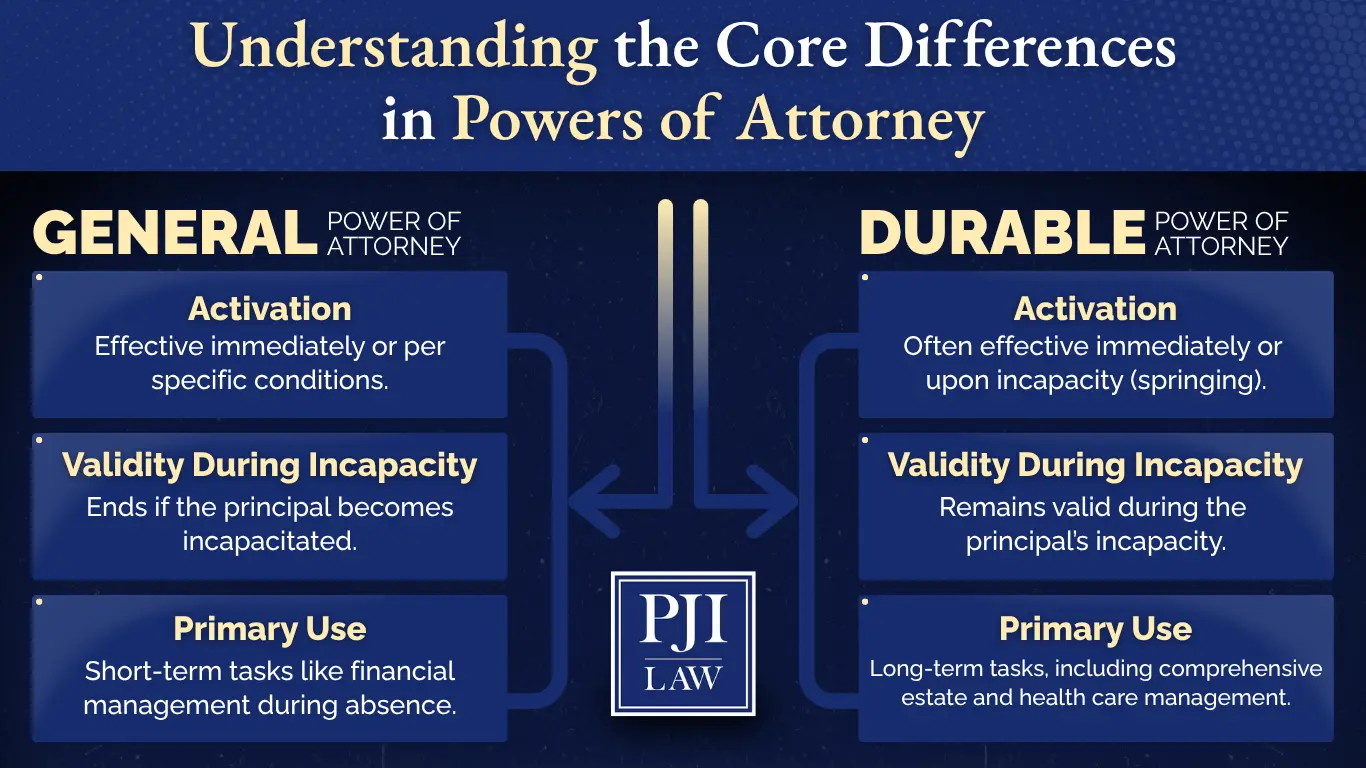
    Understanding the Core Differences

    Although the General POA and Durable POA authorize an agent to handle certain duties for the principal, their most significant difference lies in when the authority ends.

    Feature General Power of Attorney Durable Power of Attorney
    Activation Effective immediately or per specific conditions. Often effective immediately or upon incapacity (springing).
    Validity During Incapacity Ends if the principal becomes incapacitated. Remains valid during the principal’s incapacity.
    Primary Use Short-term tasks like financial management during absence. Long-term tasks including comprehensive estate and health care management.

    When Should You Use Each Type of POA?

    Deciding which POA suits you depends on your individual circumstances and goals.

    Choose a General POA When:

    • You need short-term help with financial or legal matters due to travel, military deployment, or other temporary unavailability.
    • You’re entirely confident in your ability to actively oversee the tasks being handled by your agent.
    • Incapacity concerns are not an issue, or you plan to revoke the POA before they arise.

    Create a Durable POA When:

    • You want a comprehensive, long-term solution to meet your legal, financial, and personal needs.
    • You’re planning for the possibility of incapacitation due to aging, medical issues, or unexpected accidents.
    • Your estate plan prioritizes continuity and seeks to avoid court intervention through guardianship or conservatorship.

    The Differences Between a General Power of Attorney and Durable Power of Attorney in Richmond, Virginia

    Tailoring a POA for Your Needs

    Because POA documents grant significant authority over your affairs, you want to tailor them specifically to your circumstances.

    How PJI Law Can Help

    At PJI Law, our team focuses on establishing legally sound and personalized POA documents by:

    1. Listening to Your Needs: We take the time to understand your unique goals, family dynamics, and concerns.
    2. Offering Tailored Guidance: Based on your situation, we help determine whether a General POA, Durable POA, or both are right for you.
    3. Complying with Virginia Laws: Your documents will fulfill every necessary standard, due to our in-depth knowledge of Virginia’s legal requirements.
    4. Providing Ongoing Support: Life is unpredictable, and circumstances change. We’re here to update or adjust your POA documents as your needs evolve.

    Frequently Asked Questions About Virginia POAs

    What is the main difference between a General and Durable Power of Attorney?

    The main difference is how the two documents operate if the principal becomes incapacitated. A general power of attorney ends if the principal is no longer mentally competent, while a durable power of attorney remains in effect, allowing the agent to continue managing the principal’s financial affairs or healthcare decisions.

    What does a Durable Power of Attorney typically handle?

    A durable power of attorney can include financial powers such as managing bank accounts, handling bills, or overseeing investments. When coupled with an Advanced Medical Directive, your agent can be vested with medical powers, enabling them to make healthcare decisions on behalf of the principal if they cannot communicate their wishes.

    When does a Power of Attorney document take effect?

    Virginia residents can structure a POA to take effect immediately upon signing or to become active upon a future event, such as the principal’s incapacitation. For instance, a “springing” POA takes effect only when the principal is deemed incapacitated, as specified in the document.

    Can I customize the powers granted in the POA?

    You can assign specific powers to your agent, whether for financial matters, healthcare decisions, or both. Working with an estate planning attorney aligns these powers with your wishes and complies with Virginia law.

    What is a successor agent?

    A successor agent is an individual designated in a POA document to step in if the primary agent is unable or unwilling to perform their duties to maintain continuity in your financial affairs, healthcare decisions, or other matters according to your wishes. Assigning a successor agent adds an extra layer of security and continuity, preventing disruptions if the original agent cannot serve.

    How do I get financial institutions to honor my POA?

    You should keep the original POA document in a safe place and provide certified copies to the relevant parties. Because banks or other institutions may require specific verifications, it’s wise to consult an estate planning attorney for assistance.

    What should I consider when choosing an agent for my POA?

    Choose a trustworthy individual who understands your goals and wishes. For financial powers, the agent should have strong organizational skills and financial knowledge. For medical powers, select someone capable of advocating for your healthcare preferences during stressful situations.

    Can I revoke or amend my Power of Attorney?

    Yes, as long as you are mentally competent, you can revoke or amend your POA at any time. It’s important to notify all relevant parties, including financial institutions, of the change and establish proper documentation.

    Should everyone have both types of POA?

    Not necessarily. Whether you need a general, durable, or both types of POA depends on your specific circumstances. Consulting an estate planning attorney can help you determine the right options based on your financial affairs, health concerns, and overall goals.

    Why is it important to work with an estate planning attorney for a POA?

    An estate planning attorney will create a POA that complies with Virginia law, protects your interests, and clearly outlines specific powers for your agent, reducing the risk of disputes, mismanagement, or invalidation of the document.

    The Differences Between a General Power of Attorney and Durable Power of Attorney in Richmond, Virginia

    Contact PJI Law in Richmond to Create Your Virginia Power of Attorney 

    Life is full of surprises. Preparing for a future date when you could become incapacitated or otherwise unable to handle your business, healthcare, or personal affairs protects you and your loved ones. 

    Have you been typing “estate planning lawyer near me,” “POA in Virginia,” or “Virginia power of attorney” into your search bar? 

    Whether you need a general power of attorney for short-term matters or a durable power of attorney for comprehensive and long-term security, a knowledgeable lawyer from PJI Law will explain your options, prepare the proper power of attorney form in compliance with Virginia law, and give you peace of mind.

    Contact PJI Law today at (804) 653-3450 or complete our online form to schedule a free consultation and receive personalized service and attention.

    Copyright © 2025. PJI Law, PLC. All rights reserved.

    The information in this blog post (“post”) is provided for general informational purposes only and may not reflect the current law in your jurisdiction. No information in this post should be construed as legal advice from the individual author or the law firm, nor is it intended to be a substitute for legal counsel on any subject matter. No reader of this post should act or refrain from acting based on any information included in or accessible through this post without seeking the appropriate legal or other professional advice on the particular facts and circumstances at issue from a lawyer licensed in the recipient’s state, country, or other appropriate licensing jurisdiction.

    PJI Law, PLC
    4108 E Parham Rd, 
    Richmond, VA 23228
    (804) 653-3450
    https://pjibe.webteam.ai/

  • What Is a Limited Power of Attorney in Virginia?

    What Is a Limited Power of Attorney in Virginia?

    Have you ever wondered what would happen if you became temporarily unable to handle specific financial or legal matters? Life can sometimes throw unexpected challenges our way. Perhaps you’re planning an extended trip abroad and need someone to manage your property transactions in your absence.

    Or maybe you’re facing a scheduled surgery and want to make sure your business or investments are taken care of while you recover. Even if you’re simply looking to prepare for life’s uncertainties, having a limited power of attorney in Virginia might be the solution you’re looking for. This document allows you to appoint someone to manage specific tasks on your behalf, ensuring your affairs stay in order, even when you can’t handle them yourself.

    What is a limited power of attorney? Continue reading to learn more about how it works and why it could be essential for your peace of mind.

    What is a Limited Power of Attorney?

    A limited power of attorney in Virginia is a legal document that allows you to appoint someone (called an “agent” or “attorney-in-fact”) to act on your behalf for specific tasks or transactions. Unlike a general power of attorney, which grants broad authority, a limited power of attorney restricts your agent’s powers to particular matters you specify in the document. This specificity gives you greater control over what actions your agent can take, making it a popular choice for those who want careful oversight of their affairs without a broad delegation of power.

    When to Consider a Limited Power of Attorney

    You might find a limited power of attorney useful in various situations, such as:

    • Selling or purchasing property while you’re out of state
    • Managing specific investments during your temporary incapacity
    • Handling tax matters when you’re unavailable
    • Overseeing a business transaction during your absence
    • Dealing with insurance claims while you’re recovering from illness
    • Managing rental properties during extended travel
    • Handling specific legal proceedings
    • Operating a business account for designated purposes

    Having a limited power of attorney in these cases can ensure your affairs stay on track, even if you’re temporarily unavailable.

    Key Requirements for Virginia Limited Power of Attorney

    To create a valid limited power of attorney, the following requirements must be met:

    • You must be at least 18 years old
    • You must have the mental capacity to understand the document at the time of signing
    • Sign the document in front of a notary (Virginia does not require witnesses for a limited power of attorney, though having witnesses can add a layer of authenticity)
    • Clearly specify the powers you’re granting in detail, especially for high-risk actions

    Virginia law requires that certain powers, like those related to real estate transactions or making gifts, be explicitly stated in the document to be legally binding. The document should be clear, specific, and written in a way that financial institutions and courts can easily understand. Consulting a lawyer for power of attorney can also help ensure all requirements are met according to Virginia’s Uniform Power of Attorney Act.

    Powers You Can Grant

    Your limited power of attorney can authorize your agent to handle specific tasks such as:

    • Real estate transactions, including sales, purchases, and lease agreements
    • Banking operations, like deposits, withdrawals, and check writing
    • Investment decisions for specific accounts or assets
    • Contract negotiations and signings
    • Tax document preparation and filing
    • Insurance matters, including filing claims and changing policies
    • Vehicle registration and sales
    • Stock and bond transactions
    • Safe deposit box access
    • Social Security, Medicare, or other government benefits management

    Clearly defining these powers ensures your agent knows exactly what they are authorized to do, reducing the risk of misunderstandings or unauthorized actions.

    Limitations and Restrictions

    Understanding what a limited power of attorney cannot do is just as important as knowing what it can do. Your agent cannot:

    • Make decisions beyond the scope specified in the document
    • Transfer their powers to another person
    • Act after the limited power of attorney expires
    • Make medical decisions (unless specifically authorized)
    • Change or create your will
    • Vote on your behalf
    • Make gifts of your property unless explicitly authorized
    • Change beneficiary designations on life insurance or retirement accounts
    • Access your personal email or social media accounts without specific authorization

    Knowing these restrictions helps ensure that your limited power of attorney is used solely for the purposes you intended.

    Choosing Your Agent

    When selecting an agent for your limited power of attorney, consider someone who:

    • Is trustworthy and reliable
    • Understands what is required to fulfill their specified financial or legal duty
    • Is willing to seek professional guidance if something unexpected arises
    • Lives close enough to handle the tasks
    • Has the time to fulfill the responsibilities
    • Will follow your wishes and act in your best interest
    • Can maintain accurate records of all transactions
    • Will communicate regularly about actions taken
    • Has no conflicts of interest with the assigned tasks

    Choosing an agent with these qualities can help you feel confident that your affairs are in good hands.

    How to Revoke a Limited Power of Attorney

    You can revoke your limited power of attorney at any time as long as you’re mentally competent. To do so:

    • Create a written revocation document
    • Sign it in front of a notary
    • Provide copies to your agent and any institutions that received the original limited power of attorney
    • Keep records of when and how you notified all parties
    • File the revocation with the county clerk if the original was recorded
    • Send the revocation via certified mail to ensure proof of receipt

    Taking these steps ensures that your revocation is documented and legally recognized, ending your agent’s authority.

    Protecting Yourself

    To safeguard your interests when creating a limited power of attorney:

    • Be specific about the powers you’re granting
    • Include an expiration date or a durability clause if you want it to remain effective in case of incapacitation
    • Maintain copies of all documents
    • Inform relevant financial institutions
    • Consider requiring your agent to provide regular updates
    • Include backup agents in case your primary agent becomes unavailable
    • Review and update the document periodically
    • Keep a log of all institutions that have received copies
    • Consider requiring two agents to act jointly for significant transactions

    These precautions can help you create a limited power of attorney that serves your needs while providing additional protections for your interests.

    A limited power of attorney can provide peace of mind knowing specific matters will be handled according to your wishes when you can’t manage them yourself. By understanding the requirements, carefully selecting your agent, and clearly defining the granted powers, you can create an effective limited power of attorney that serves your needs while protecting your interests.

    Virginia’s Uniform Power of Attorney Act includes specific provisions. Consulting estate planning attorneys can help you align your limited power of attorney with state laws and protect your interests so that your limited power of attorney meets all Virginia requirements and addresses your unique situation.

    Protect Your Interests with a Limited Power of Attorney

    When unexpected situations arise, you’ll want the confidence of knowing your specific financial and legal matters are in capable hands. PJI Law can help you establish a limited power of attorney that meets your unique needs while protecting your interests under Virginia law.

    Your life doesn’t pause when you’re unavailable or temporarily unable to handle important transactions. By working with PJI Law’s estate planning attorneys, you can create a carefully crafted limited power of attorney that gives you control over exactly what powers you grant and to whom.

    Take the first step toward securing your peace of mind. Contact PJI Law today to create a limited power of attorney that fits your specific situation. Our attorneys will guide you through each decision, ensuring your document provides the protection you need while maintaining the control you want.

    If you’ve been searching online for a “power of attorney near me,” call us at (703) 865-6100 or connect through our confidential online form to schedule your consultation. Let’s work together to put proper legal safeguards in place for your financial and legal matters.

    At PJI Law, you’ll receive personalized service and attention!

    Copyright © 2024. PJI Law, PLC. All rights reserved.

    The information in this blog post (“post”) is provided for general informational purposes only and may not reflect the current law in your jurisdiction. No information in this post should be construed as legal advice from the individual author or the law firm, nor is it intended to be a substitute for legal counsel on any subject matter. No reader of this post should act or refrain from acting based on any information included in or accessible through this post without seeking the appropriate legal or other professional advice on the particular facts and circumstances at issue from a lawyer licensed in the recipient’s state, country, or other appropriate licensing jurisdiction.

    PJI Law, PLC
    3900 Jermantown Rd, 2nd Floor
    Fairfax, Virginia 22030
    (703) 865-6100
    https://pjibe.webteam.ai/

  • What Type of Virginia POA Do I Need?

    What Type of Virginia POA Do I Need?

    Consider these two different scenarios: a Richmond business owner is attending an important conference in another state when he receives a call from his assistant about an urgent matter that requires his attention back home. Meanwhile, in a Richmond hospital, a grieving family faces the prospect of making critical medical decisions for their beloved grandfather, but because he cannot communicate with them and leaves no instructions behind, they don’t know what to do. They would honor his preferences if only they knew what they were.

    Whether in business matters or matters of life and death, knowing a trusted representative could legally act on your behalf can help you avoid these difficult situations and provide peace of mind for you, your business associates, and your loved ones. That’s where a Virginia  POA — power of attorney — steps in.

    Virginia offers several types of power of attorney, each with its rules and requirements. This blog explains the different types of power of attorney in Virginia, how to obtain a POA, and what’s involved in the process.

    How does a POA fit into a comprehensive estate plan? Contact PJI Law, PLC at (804) 653-3450 to schedule a consultation. Our knowledgeable and experienced power of attorney lawyers will assist you with personalized service and attention.

    What is a Power of Attorney in Virginia? 

    A power of attorney is a legal instrument that confers authority to an individual, known as the “agent” or “attorney-in-fact”, to act on another person’s behalf, known as  the “principal.” Depending on the specific type of power of attorney, this granted authority can be broad or limited.

    Powers of attorney typically come into play when the principal is unavailable to tend to financial matters or other affairs like real estate transactions, or cannot verbalize their health care choices due to incapacity.

    As attorneys experienced in estate planning know, a power of attorney is a crucial component of a comprehensive estate plan. It gives the principal the ability to handle their affairs through an authorized individual they trust in accordance with their preferences and best interests.

    virginia power of attorney

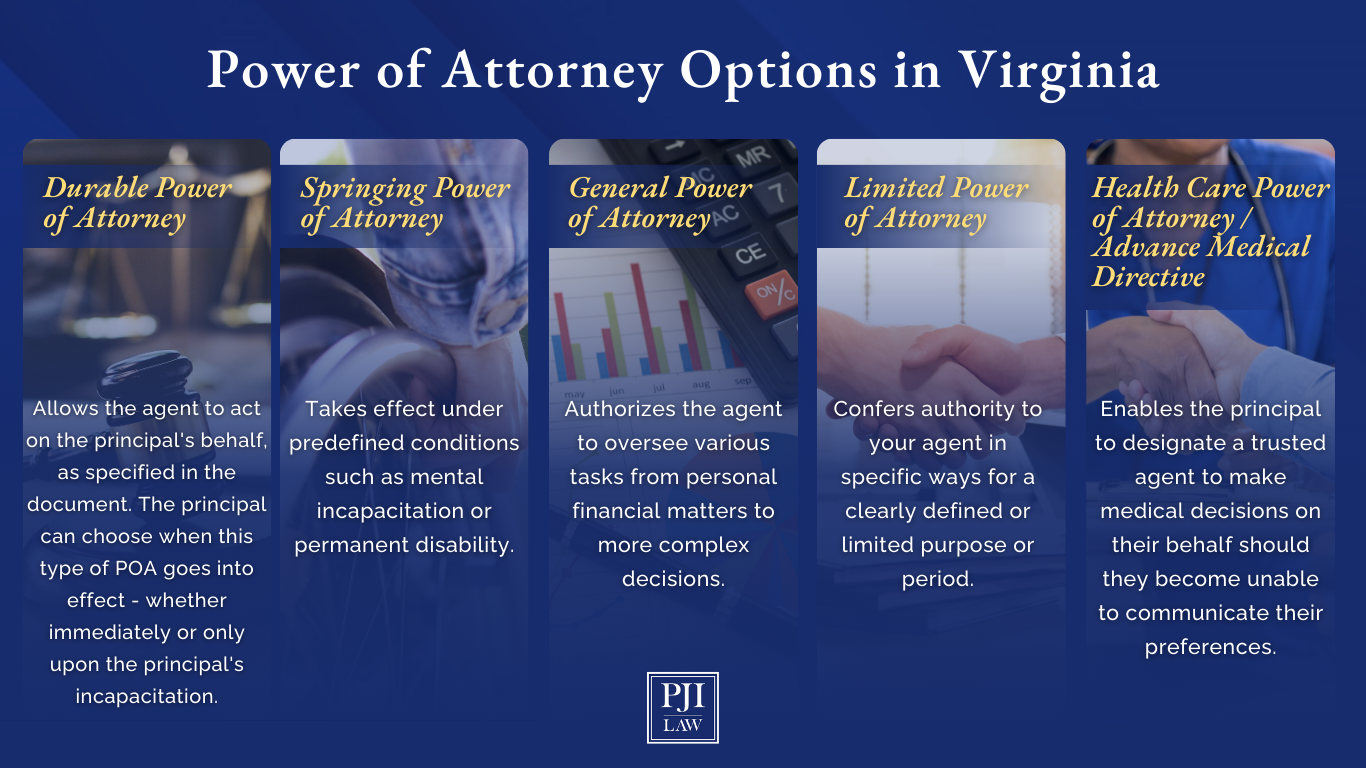
    What are the Different Types of Power of Attorney in Virginia?

    Virginia offers several options for power of attorney.

    virginia power of attorney

    Durable Power of Attorney

    A durable power of attorney offers the principal the peace of mind of knowing that even if they become unable to manage their affairs due to incapacitation or permanent disability, their attorney-in-fact will act on their behalf as specified in the document.

    Most of us manage our personal finances but consider situations where you might also manage properties or business matters. With a durable power of attorney, your trusted agent can oversee the management of these affairs, making decisions that align with your desires and interests as outlined in the document.

    Springing Power of Attorney

    As the name suggests, a springing power of attorney takes effect under predefined conditions such as mental incapacitation or permanent disability.

    For example, if you have been diagnosed with a health condition, you could establish a springing power of attorney that activates when your condition reaches a certain level, as documented by a healthcare professional.

    The powers stated in this document ensure the prompt handling of your personal and financial matters by your attorney-in-fact during health adversities.

    General Power of Attorney

    With a general power of attorney, your appointed agent can oversee various tasks, from personal financial matters to more complex decisions, so that your affairs run smoothly in your absence.

    The authority granted in a general power of attorney could span from managing everyday banking transactions to endorsing significant contracts on your behalf.

    Limited Power of Attorney

    In contrast, a limited power of attorney confers authority to your agent in specific ways for a clearly defined or limited purpose or period. For example, with a limited power of attorney, your agent could complete a real estate transaction on your behalf if you cannot be physically present.

    A limited power of attorney assures the principal that the agent or attorney-in-fact will accomplish specific tasks according to their instructions, regardless of their availability.

    Thus far, these powers of attorney have primarily pertained to financial and specific transactions. However, as an experienced attorney can attest, when creating an estate plan there is another critical subject to consider – your health care decisions. To address these vital considerations, Virginia law offers a health care power of attorney – more commonly known as an advance medical directive.

    Health Care Power of Attorney / Advance Medical Directive

    As you and your attorney plan for your future, a health care power of attorney or advance medical directive should become part of your estate plan. This legal document enables you to designate a trusted individual to make medical decisions on your behalf if you become unable to communicate your preferences.

    Often referred to as your health care agent or proxy, you could choose to entrust this person with decisions ranging from minor medical procedures to life-saving measures, depending on the scope of authority you stipulate in the health care power of attorney or advance medical directive.

    Your health care agent or proxy coordinates with your medical team to respect and implement your treatment preferences. A skilled attorney can guide you through this process and create a legally sound document that complies with the law and accurately states your desires.

    Would you like to learn more about a health care power of attorney/advance medical directive? We invite you to read our blog, “The Importance of Having a Virginia Advance Medical Directive in Place.”

    virginia power of attorney

    Obtaining a Power of Attorney

    When going through the process of creating a power of attorney, you first want to carefully consider the individual who will serve as your agent. This person should be a competent adult who has earned your trust because a power of attorney will give them the authority to act on your behalf as your agent.

    Next, determine the type and extent of the authority you want to confer to your agent. As we noted above, this authority can be limited, e.g. handling real estate property transactions, or much broader in scope to include your financial matters and health care decisions.

    Working with a knowledgeable and experienced attorney, you can discuss your unique circumstances and establish a legal document or multiple legal documents that meet your needs. Your attorney will make sure the document stipulates your authorized agent and the scope of their authority because financial institutions and other institutions will also review it. 

    Notarizing Your Power of Attorney

    Once completed, the principal’s signature on a power of attorney must be notarized, per Virginia law, to be considered genuine. A notary public will confirm your identity and the fact that you consent to sign the power of attorney willingly and not under duress.

    If you have notarized a durable power of attorney that could potentially be used for real estate property transactions, it should be recorded in the circuit court of the county in which the property is located.

     virginia poa

    Another scenario in which a power of attorney could terminate is if a court appoints a guardian or conservator for you unless the court order specifies otherwise.

    How Powerful Is a Power of Attorney in Time of Need?

    A power of attorney carries significant implications in business matters and medical emergencies where an individual cannot verbalize their wishes, giving others the benefit of knowing exactly what the principal desires even if they are unavailable or incapacitated.

    Business-Related Scenario

    Imagine a scenario where a business owner becomes incapacitated due to illness or injury. With a valid power of attorney, the appointed agent or attorney-in-fact can step in to manage the day-to-day operations of the business, make critical decisions, sign contracts, access financial accounts, and represent the owner in legal matters. With the agent fulfilling these duties, it ensures continuity in business operations and prevents disruptions that could adversely affect the company’s performance, employees, and reputation.

    Medical Emergency Scenario

    Consider a situation where an individual experiences a serious accident, leaving them unable to communicate their medical preferences or decisions. If this person has designated a health care power of attorney, the appointed agent can make medical decisions on their behalf based on the written authority and instructions outlined in the power of attorney document. These instructions include choices about medical treatments, surgeries, medications, and end-of-life care.

    With a health care power of attorney, the appointed agent can ensure that all involved parties respect the individual’s wishes, alleviating the burden on family members who may otherwise struggle to make difficult decisions during such critical times.

    A Virginia power of attorney empowers individuals to plan for unforeseen circumstances and provides clarity and assurance to business and health care decision-making processes, ultimately reducing stress and uncertainty in stressful situations.

    Successor Agents and Powers of Attorney

     virginia poa

    When drafting powers of attorney with the assistance of an experienced attorney, you can secure greater peace of mind for your family and business associates by appointing a successor agent. The individual designated as the successor agent assumes authority when the original agent cannot fulfill their duties due to illness, incapacity, or other reasons. Designating a successor trustee provides greater security because if your initially appointed agent cannot act on your behalf, someone you trust can still manage your affairs and assets.

    As your attorney will counsel, when granting another person the authority to act on your behalf, making an informed decision is in your best interest. Whether authorized with a broad range of acts or given specific authority confined to a single transaction, your designated agent should have earned your trust, have your best interests in mind, and be willing to act according to your wishes.

    Frequently Asked Questions about Power of Attorney in Virginia

    What is a power of attorney (POA) in Virginia?

    A power of attorney is a legal document granting written authority to an agent or attorney-in-fact to make decisions on behalf of the principal (the person creating the power of attorney) in financial matters, business matters, or health care matters when the principal cannot act.

    How can I create a power of attorney in Virginia?

    The best way to create a power of attorney is by consulting a Virginia estate planning lawyer who can help you determine your choice of agent and draft a document that complies with state laws and requirements.

    What types of decisions can an agent make under a power of attorney in Virginia?

    An appointed agent can make decisions related to financial matters, health care choices, real estate property transactions, taxes and tax matters, and legal affairs as specified in the power of attorney document.

    Is it necessary to notarize a power of attorney in Virginia?

    Yes, to comply with Virginia law, you must sign the power of attorney document in the presence of a notary public to validate the authenticity of the signature and the fact that you are establishing the document freely and not under duress.

    Should I include a power of attorney in my Virginia estate plan?

    Depending on the circumstances of each person, a power of attorney can be a crucial component of estate planning, allowing designated individuals to manage assets, make financial decisions, and handle legal matters on behalf of the principal. Because we don’t know what the future will bring, a health care power of attorney, also known as an advance directive, is something everyone should include in their estate plan for their benefit and the benefit of their loved ones. It makes dealing with a medical emergency easier when you can provide prior written instructions for your agent, family, and medical team.  

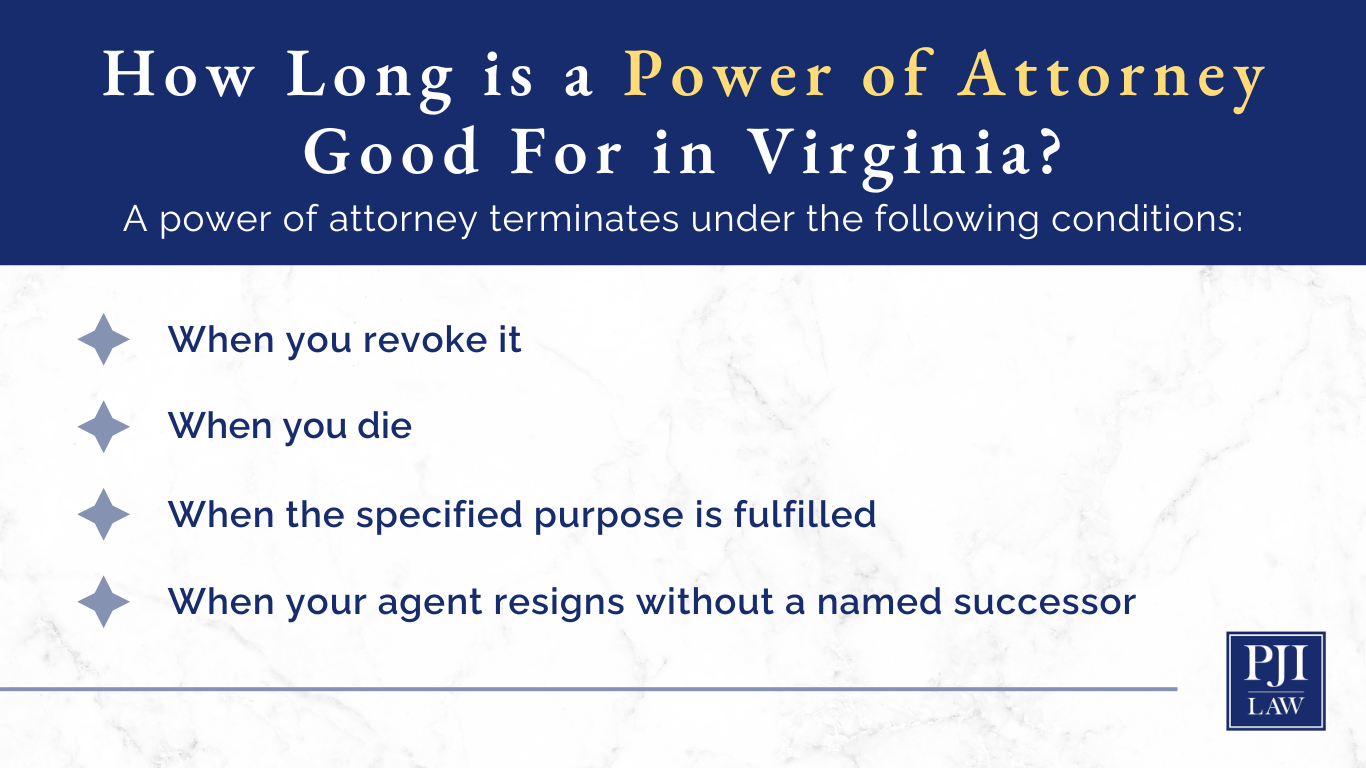
    How long does a power of attorney remain valid in Virginia?

    In Virginia, a power of attorney remains in effect until the principal dies, revokes the document, until the specific purpose outlined in the power of attorney is fulfilled, or if the agent resigns without a named successor.

    What is the Uniform Power of Attorney Act in Virginia?

    The Uniform Power of Attorney Act in Virginia is a legislative framework that establishes guidelines for the creation, execution, and enforcement of power of attorney documents within the state. This act seeks to promote consistency and clarity in the language used in the power of attorney documents, delineating the powers granted to agents and specifying obligations and responsibilities.

    Under this act, key provisions may include definitions of terms related to powers of attorney, rules governing the execution and signing of power of attorney documents, guidelines for the agent’s conduct, protection for third parties who act in good faith based on the power of attorney, and mechanisms for addressing disputes or abuse of power.

    By adopting the Uniform Power of Attorney Act, Virginia aligns its practices with standardized principles and regulations, enhancing transparency, safeguarding against exploitation, and facilitating smoother transactions involving power of attorney arrangements.

    How can a Virginia power of attorney prevent financial exploitation of the principal?

    A Virginia power of attorney can serve as a crucial tool in protecting the principal by establishing clear guidelines, oversight mechanisms, and legal protections. By granting written authority to a trusted agent, the power of attorney document outlines the specific powers and limitations of the agent, reducing the risk of unauthorized actions or abuse.

    Furthermore, the Virginia Uniform Power of Attorney Act and relevant statutes, such as 18.2-178.2, provide legal frameworks to deter and penalize agents who engage in this type of exploitation of vulnerable adults. Agents under a power of attorney are subject to scrutiny by organizations like Virginia Adult Protective Services (APS), which receive and investigate reports of suspected elder abuse, neglect, or exploitation. Reporting suspected abuse can help prevent further financial harm.

    Consult attorneys who focus on estate law for more information.

    Does a Virginia power of attorney allow the agent to view the principal’s tax information?

    A Virginia power of attorney can authorize an agent to discuss designated tax issues with the Virginia Department of Taxation. This authorization is typically granted through a Power of Attorney and Declaration of Representative (Form PAR 101) form. The agent may be empowered to access tax information, represent the grantor in tax-related interactions, and handle specific tax issues on behalf of the grantor.

    How can power of attorney lawyers in Virginia help me?

    Experienced attorneys can guide you through the process of creating a power of attorney as a vital part of your overall estate plan, discussing important issues like financial planning, medical directives, and your choice of agent.

    Do I need power of attorney lawyers to create a power of attorney in Virginia?

    While it is not mandatory to have a lawyer, consulting knowledgeable and experienced power of attorney lawyers can provide valuable insights, ensure legal compliance, and tailor the power of attorney to meet your specific needs and circumstances.

    Let the Power of Attorney Lawyers at PJI Law, PLC Assist You with Personalized Service and Attention 

    With the right power of attorney, you can secure your future, knowing your affairs are in trusted and capable hands. Have you been typing “power of attorney lawyer near me,” into your search bar? 

    Whether preparing for a future outcome or dealing with an urgent situation, the power of attorney lawyers at PJI Law can help you determine the type of power of attorney that best serves you and your individual situation.

    At PJI Law, our valued clients receive our complete dedication, personal attention, and courteous, white-glove service. Contact us at (804) 653-3450 or complete our online form to schedule a consultation. Let us establish a Virginia POA that aligns with your personal goals and meets your family’s needs.

    Copyright © 2024. PJI Law, PLC. All rights reserved.

    The information in this blog post (“post”) is provided for general informational purposes only and may not reflect the current law in your jurisdiction. No information in this post should be construed as legal advice from the individual author or the law firm, nor is it intended to be a substitute for legal counsel on any subject matter. No reader of this post should act or refrain from acting based on any information included in or accessible through this post without seeking the appropriate legal or other professional advice on the particular facts and circumstances at issue from a lawyer licensed in the recipient’s state, country, or other appropriate licensing jurisdiction.

    PJI Law, PLC
    4108 E Parham Rd, 
    Richmond, VA 23228
    (804) 653-3450
    https://pjibe.webteam.ai/

  • What Rights Does a VA Durable Power of Attorney Have?

    What Rights Does a VA Durable Power of Attorney Have?

    Imagine a situation where you’re suddenly unable to make decisions for yourself due to an unexpected illness or accident. Who would you trust to manage your financial affairs, make healthcare decisions, and ensure your wishes are carried out? That’s where a VA durable power of attorney (DPOA) comes in – a powerful legal tool that grants someone you trust the authority to act on your behalf, even if you become incapacitated.

    As a Virginia resident, understanding the rights and responsibilities of a DPOA is crucial to protecting your interests and ensuring your loved ones are prepared for any eventuality. Navigating the complexities of legal documents can be daunting, but this blog will help you understand the role of a DPOA in your life, giving you peace of mind and the confidence to plan for the future.

    If you have any questions about creating a DPOA, don’t hesitate to contact the PJI Law VA estate planning team at (703) 865-6100 for personalized service and attention.

    Understanding Powers of Attorney

    A power of attorney (POA) is a legal document that allows you to appoint someone else, known as an agent or attorney-in-fact, to make decisions on your behalf. As the person creating the POA, you are referred to as the principal. While a POA is a useful tool for granting authority to someone else, it’s important to consider what happens if you become incapacitated and unable to manage your affairs. This is where a DPOA comes into play.

    A DPOA allows your chosen agent to quickly step in and handle your matters without the need for expensive and time-consuming legal processes to establish guardianship or conservatorship.

    These legal proceedings can be financially and emotionally taxing, and they take away your power to choose who manages your affairs. By establishing a DPOA, you maintain control over who is entrusted to handle your affairs and ensure that your wishes are carried out even if you become incapacitated.

    When and Why You Might Need a DPOA

    Consider the unforeseen scenarios: a sudden illness or an accident that leaves you unable to communicate or manage your affairs. Without a DPOA, your loved ones would face the daunting task of seeking court intervention to make decisions for you. This process is not only time-consuming and costly but also stressful. A DPOA acts as a safeguard, granting your trusted agent the authority to manage your affairs seamlessly, without the need for court approval.

    Types of POAs

    General Power of Attorney

    This gives your agent the broad authority to handle almost all aspects of your life and decisions on your behalf. However, decisions about medical care typically fall under a separate document known as an Advance Medical Directive or Healthcare POA.

    Limited Power of Attorney

    Contrary to the general POA, a limited one restricts your agent’s authority to certain actions you’ve specifically outlined in the document.

    Springing Power of Attorney

    A springing POA is designed to become effective only under predetermined conditions, such as your incapacitation. This type can complicate matters since it often requires proof of your condition every time your agent needs to act, which could delay decision-making.

    Rights and Powers Granted by a VA Durable Power of Attorney

    A DPOA in Virginia can grant your agent various rights and powers, depending on the type and the specific provisions included in the document. Some of the main areas covered by a DPOA include:

    Financial Powers

    Your agent can handle various financial tasks on your behalf, such as managing banking transactions, investments, real estate matters, tax filings, insurance policies, and retirement benefits. This authority helps ensure that your financial affairs continue to be managed efficiently in case you’re unable to do so yourself.

    Legal Powers

    A DPOA can grant your agent the authority to sign legal documents on your behalf, represent you in legal matters, and handle claims and disputes. This ensures that your legal affairs can be managed without your direct involvement, necessary for your ongoing legal protection.

    Personal Powers

    Managing your personal affairs, including your property, living arrangements, and general welfare, can also be part of the agent’s responsibilities. This ensures that your personal needs and preferences are considered and acted upon, even if you’re unable to communicate them yourself.

    It’s important to note that the specific powers granted by a DPOA should be clearly outlined in the document itself. Virginia law requires clear and specific language to ensure that the DPOA is effective and that the agent’s powers are clearly defined.

    Limitations on the Rights of a VA Durable Power of Attorney

    While a DPOA grants significant powers to your agent, there are some limitations to keep in mind. Your agent has a fiduciary duty to act in your best interest and cannot make or change your will, transfer the DPOA to another person, or exceed the powers specified in the document. You can also limit your agent’s powers by explicitly stating the restrictions in the DPOA.

    When Does a Durable Power of Attorney Become Effective?

    A DPOA can be structured to take effect immediately upon signing or to become active upon the principal’s incapacitation. It’s critical that any DPOA, especially a springing DPOA that activates based on the principal’s incapacitation, includes a clear definition of what constitutes “incapacitation.”

    Under Virginia law, incapacitation is generally understood to mean the principal’s inability to make informed decisions due to physical or mental conditions. This condition should be specifically defined in the DPOA document, often requiring a formal assessment by one or more licensed healthcare professionals. For a springing DPOA, this definition ensures that there is a clear and actionable standard for determining when the agent’s authority begins, thereby eliminating ambiguity and potential delays in critical situations.

    When Does a Durable Power of Attorney End? Revoking or Modifying a VA Durable Power of Attorney

    As the principal, you have the right to revoke or modify your DPOA at any time, as long as you are mentally competent. Wondering how to revoke a durable power of attorney? Consulting a VA estate planning attorney to ensure legal compliance with the process is crucial, as is keeping your DPOA up to date to reflect your current wishes. Your DPOA is automatically revoked upon your death.

    Choosing an Agent for a VA Durable Power of Attorney

    When selecting an agent for your DPOA, choose someone you trust and who is capable of handling the responsibilities. Discuss your wishes and expectations with your chosen agent to ensure they understand their role. Consider naming a successor agent in case your primary agent is unable or unwilling to serve.

    As you can see, a VA durable power of attorney is a powerful tool that grants significant rights and powers to your chosen agent. By understanding the types of DPOAs available in Virginia and the rights they confer, you can make informed decisions about your future. Remember to choose your agent carefully, communicate your wishes clearly, and keep your DPOA up to date.

    Protect Your Future with a Durable Power of Attorney

    Now that you understand the importance of having a DPOA and the rights it grants to your chosen agent, it’s time to take action to protect your future and ensure your wishes are carried out, even if you become incapacitated.  If you’ve been searching online for “power of attorney lawyers near me” or a “POA attorney near me,” reach out to the experienced team at PJI Law instead.

    At PJI Law, our experienced Fairfax, VA estate planning attorneys are dedicated to helping clients like you navigate the complexities of creating a comprehensive DPOA tailored to your unique needs and circumstances. We understand that each client’s situation is different, and we take the time to listen to your concerns, answer your questions, and provide personalized guidance every step of the way.

    Our experienced team can help you create a legally sound document that grants your chosen agent the necessary powers to manage your affairs, while also incorporating safeguards to protect your interests. We’ll work with you to identify the right person to serve as your agent, ensure your DPOA is properly executed, and provide guidance on keeping your DPOA up to date as your life circumstances change.

    Don’t wait until it’s too late to protect your future and ensure your loved ones are prepared to act on your behalf. Call PJI Law today at (703) 865-6100 to schedule a consultation with one of our compassionate and knowledgeable estate planning attorneys. If you prefer, you can also request your consultation through our secure online form.

    Copyright © 2024. PJI Law, PLC. All rights reserved.

    The information in this blog post (“post”) is provided for general informational purposes only and may not reflect the current law in your jurisdiction. No information in this post should be construed as legal advice from the individual author or the law firm, nor is it intended to be a substitute for legal counsel on any subject matter. No reader of this post should act or refrain from acting based on any information included in or accessible through this post without seeking the appropriate legal or other professional advice on the particular facts and circumstances at issue from a lawyer licensed in the recipient’s state, country, or other appropriate licensing jurisdiction.

    PJI Law, PLC
    3900 Jermantown Rd, 2nd Floor
    Fairfax, Virginia 22030
    (703) 865-6100
    https://pjibe.webteam.ai/

  • How to Get Power of Attorney in VA

    How to Get Power of Attorney in VA

    Imagine this scenario: You’re away on an extended business trip, and an urgent matter requires your immediate attention back home. Or perhaps you’re envisioning a future where you might not be able to handle your affairs personally due to health reasons.

    In such situations, wouldn’t it be comforting to know that a trusted person can legally act on your behalf? This is where power of attorney comes into play.

    In Virginia, you can choose from several types of powers of attorney, each with its own set of rules and requirements. In this blog post, we’ll share how to get power of attorney in VA and what else you need to know about the process.

    If you have questions about including a power of attorney in your estate plan, contact a PJI Law, PLC team member at (703) 865-6100 for personalized service and attention.

    What is a Power of Attorney?

    A power of attorney is a legal document that provides an individual, referred to as the “agent” or “attorney-in-fact,” the authority to act on behalf of another person, known as the “principal.” The authority granted can be broad or specific, depending on the type of power of attorney established.

    This legal mechanism is typically used when the principal is unable or unavailable to make decisions or manage their affairs, such as financial transactions, real estate dealings, or healthcare decisions.

    It’s a crucial tool in estate planning, ensuring that the principal’s affairs are handled according to their preferences and best interests. Now let’s talk about the different types of powers of attorney.

    Durable Power of Attorney

    In Virginia, a durable power of attorney offers peace of mind knowing that even in case of an unfortunate event such as sudden mental incapacitation or permanent disability, your affairs will be taken care of.

    Consider a situation where you manage personal finances, properties, or even business matters. A durable power of attorney will allow the person you trust, your agent, to handle these affairs, ensuring that decisions made are aligned with your desires and best interests.

    Springing Power of Attorney

    A springing power of attorney becomes effective under predefined conditions such as mental incapacitation or permanent disability.

    For instance, if you have a known health condition, you might set up a springing power of attorney that activates when your condition reaches a certain level, as documented by a healthcare professional.

    This measure ensures that your personal and financial matters will be handled promptly and effectively, even during health adversities.

    General Power of Attorney

    A general power of attorney allows your appointed agent to oversee various tasks, from personal financial matters to more complex decisions, ensuring that your affairs run smoothly in your absence.

    This could span from managing everyday banking transactions to endorsing significant contracts on your behalf.

    Limited Power of Attorney

    In contrast, a limited power of attorney gives your agent specific powers for a defined purpose or period. For example, a limited power of attorney would empower your agent to complete the transaction on your behalf if you cannot be physically present for a property transaction.

    Using a limited power of attorney is a secure way to ensure specific tasks are accomplished in line with your instructions, regardless of your availability.

    While powers of attorney we’ve discussed so far primarily pertain to financial and specific transactions, it’s worth considering another crucial aspect – your healthcare decisions. For this, Virginia law provides the option of an Advance Medical Directive.

    Advance Medical Directive

    As you plan for your future, preparing for potential health concerns is equally important as part of your advance care planning. A Healthcare Power of Attorney, better known in Virginia as an Advance Medical Directive, allows you to nominate a trusted person to make medical decisions on your behalf should you become unable to communicate your preferences.

    This individual, often referred to as your healthcare agent or proxy, could be entrusted with decisions ranging from minor medical procedures to life-saving measures, depending on the permissions you stipulate.

    They would collaborate with your healthcare team to ensure your treatment preferences are respected and implemented. A skilled attorney can guide you through this process, ensuring your document meets legal standards and reflects your desires accurately.

    For more information about Advance Medical Directives, we invite you to read our blog, “The Importance of Having a Virginia Advance Medical Directive in Place.”

    The Process of Getting Power of Attorney

    The first step in acquiring power of attorney in Virginia is identifying the individual you want to serve as your agent. This person should be a competent adult you trust, as they will have the authority to make decisions on your behalf.

    Next, you must decide on the type and extent of authority you wish to grant your agent. As mentioned, this can range from limited authority, such as handling a real estate transaction, to broad authority over your financial affairs or healthcare decisions.

    Consult an experienced power of attorney lawyer to create a custom document that meets your needs. Your attorney will ensure the document details the authority granted to the agent, as financial institutions and other organizations will need to review the document.

    Notarization

    After the power of attorney document is completed, Virginia law calls for the principal’s signature to be notarized for the signature to be presumed genuine. A notary public will verify your identity to ensure you are signing willingly and under no duress.

    If the power of attorney is durable and might be used to handle real estate transactions, it should also be recorded with the circuit court in the county where the property is located.

    When Power of Attorney Terminates

    It’s important to understand when and how a power of attorney terminates. In Virginia, a power of attorney terminates when you revoke it, when you die, when the specified purpose is accomplished (in case of a limited power of attorney), or when your agent resigns without a named successor.

    Also, if a court appoints a guardian or conservator for you, that could also lead to termination of the power of attorney unless the court order specifies otherwise.

    Successor Agents and Their Role

    You may also name a successor agent in your power of attorney document. This person steps in when the original agent cannot carry out their duties due to illness, incapacity, or other reasons.

    This ensures that even if your initially appointed agent can’t act, there is still someone you trust to take care of your affairs.

    The successor agent has the same authority as the original agent, but their power kicks in only after the original agent can no longer act. It’s essential that the successor agent is aware of their role and is willing to take up the responsibility if required.

    Remember, making informed decisions is crucial when granting power of attorney. Whether you’re granting broad authority over your financial affairs or limited authority over a single transaction, the agent you select should always have your best interests in mind and act in accordance with your wishes.

    Frequently Asked Questions

    Q: What happens if I don’t have a power of attorney and I become incapacitated?
    A: If you become mentally incompetent or permanently incapacitated without a power of attorney, a court may appoint a guardian or conservator to manage your affairs.
    Q: Can I revoke a power of attorney?
    A: Yes, as long as you’re mentally competent, you can revoke a power of attorney at any time by notifying your agent in writing.
    Q: Can the agent use my assets for their own benefit?
    A: No, the agent is legally obligated to act in your best interests and manage your assets for your benefit. Any misuse can be legally prosecuted.
    Q: Does a power of attorney allow the agent to make decisions after my death?
    A: No, a power of attorney terminates upon the death of the principal. After your death, the executor of your will or a court-appointed administrator would manage your estate.

    PJI Law: Your Local Lawyers for Power of Attorney

    With the right power of attorney, you can rest assured that your affairs are in capable hands. Whether you’re preparing for a future need or dealing with an urgent situation, the team of power of attorney lawyers at PJI Law can help you decide on which type of power of attorney is best suited for you and your individual situation.

    At PJI Law, each client receives our complete dedication, personal attention, and courteous, white-glove service, ensuring that your VA power of attorney aligns with your personal goals and family’s needs.

    End your search for “local lawyers for power of attorney” and place your trust in PJI Law. We invite you to contact us at (703) 865-6100 or complete our online form to schedule your consultation with our power of attorney legal team in Fairfax, Virginia.

    Copyright © 2023. PJI Law, PLC. All rights reserved.

    The information in this blog post (“post”) is provided for general informational purposes only and may not reflect the current law in your jurisdiction. No information in this post should be construed as legal advice from the individual author or the law firm, nor is it intended to be a substitute for legal counsel on any subject matter. No reader of this post should act or refrain from acting based on any information included in or accessible through this post without seeking the appropriate legal or other professional advice on the particular facts and circumstances at issue from a lawyer licensed in the recipient’s state, country, or other appropriate licensing jurisdiction.

    PJI Law, PLC
    3900 Jermantown Rd, 2nd Floor
    Fairfax, Virginia 22030
    (703) 865-6100
    https://pjibe.webteam.ai/

  • 3 Reasons Why Adding Your Children as Co-Owners on Your Financial Accounts Is an Awful Idea

    3 Reasons Why Adding Your Children as Co-Owners on Your Financial Accounts Is an Awful Idea

    It has become common practice in Virginia for a surviving parent, after their spouse has passed away, to name one of their children as a co-owner of some or all of their financial accounts. There are a few reasons parents do this, but oftentimes it is to make sure that the child can access the parent’s account for the parent’s benefit if the parent becomes mentally or physically incapacitated. It is sometimes perceived as a shortcut to creating a proper estate plan with a portfolio of legal documents drafted by an attorney.

    However, adding a child as a joint owner of your financial accounts is fraught with peril. Here are three of the main reasons:

    1. By adding your child as a joint owner, you are exposing your financial accounts to your child’s creditors. If your child ever goes through financial hardship (perhaps even due to a tragic accident), their creditors may try to collect by garnishing your child’s financial accounts, including ones where you established your child as a joint owner.
    2. Second, you are exposing your finances to your child’s control before you need to cede control. You hope that your child will continue to act in your best interests once you add them as a joint owner to your accounts. Most children will. But some do not, sometimes due to pressure from a spouse. And when they do not, you cannot simply remove the child from your accounts. You must have the child’s written permission to have them removed as a co-owner. Or you can close the account and withdraw all of the funds; of course, you have given your wayward child the ability to do the same thing.
    3. Finally, you may unintentionally disinherit your other children. For example, you have three children, two of whom live in another state, and one lives locally. It is not rare in such a case for a parent to add the child who lives locally as the joint owner on the financial accounts. However, if that is done, joint accounts usually have a survivorship clause in the contract. Which means when the one co-owner dies, the account is now solely the property of the surviving co-owner. Which means the local child inherits all of your financial assets at your death while your other children receive nothing.

    There are more problems, of course, but no need to pile on.

    So, what do you do? How do you properly allow a child to help you with your finances without adding the child as a co-owner on your accounts? One method is to make your child an “authorized signer” on your financial accounts. That way, the child can sign checks and engage in transactions on your behalf while exposing your finances to only some, but not all, of the perils of co-ownership.

    A far stronger solution is that you can, as part of your estate plan, name a child your financial agent in a General Durable Power of Attorney document. Under such a document, your child has the power to engage in financial transactions of your behalf, but they are not considered a co-owner of the accounts. The child has obligations to meet under the law to act in your best interests as your agent and you can revoke the Power of Attorney documents at any time, unless you lack mental capacity.

    There are additional aspects of an estate plan that can even make it easier on your child to help you, while simultaneously protect you and your family even more. If you would like more information, please call our team at PJI law at (703) 865-6100, or email us at poa@pjilaw.com.