Tag: Contracts

  • What Is a Purchase Agreement Contract in Virginia?

    What Is a Purchase Agreement Contract in Virginia?

    You’ve spent months searching, and now you’ve finally found the perfect home in Virginia. After negotiating with the seller, you agree on a price and start thinking about the next steps. Before the sale is official, you’ll need to sign a purchase agreement contract—but what exactly does that mean?

    A purchase agreement contract is a legally binding document that sets the terms of a sale. These agreements exist for many types of transactions, including business deals and vehicle purchases. However, when it comes to real estate, which is the focus of this blog, this contract is a critical step in finalizing a home purchase because it helps the buyer and seller understand their rights, responsibilities, and any conditions that must be met before closing.

    If you’re preparing to buy a home, knowing what’s included in a real estate purchase agreement contract can help you make informed decisions. This blog breaks down what to expect, what key terms to look for, and how this contract shapes your home-buying process.

    Seeking a contract lawyer in Virginia

    What Is a Purchase Agreement Contract?

    A purchase agreement is a legally binding document that sets the terms of a property sale in Virginia. It outlines the rights and obligations of the buyer and seller and clearly defines all aspects of the transaction, including details such as the purchase price, property description, contingencies, and closing terms.

    Although some may refer to it as a “purchase agreement contract,” the term “contract” is implied since a signed purchase agreement is legally binding. In Virginia real estate transactions, “purchase agreement” is the more commonly used term.

    Key Elements of a Virginia Purchase Agreement

    Key Elements of a Virginia Purchase Agreement
    When drafting or reviewing a purchase agreement in Virginia, several components must be considered to create a comprehensive and enforceable contract.

    Identification of Parties and Property

    The contract must clearly state the full legal names and contact information of the buyer and the seller. Accurate identification prevents potential disputes arising from misidentification. Additionally, a precise description of the property is essential.

    This description includes the property’s legal address, parcel number, and any other pertinent identifiers that distinguish it from other properties, such as the lot number, subdivision, or metes and bounds description to prevent ambiguity regarding the exact parcel being transferred. If there is any uncertainty, buyers may request a property survey to confirm the boundaries before closing.

    Seeking a contract lawyer in Virginia

    Purchase Price and Payment Terms

    The agreed-upon purchase price should be explicitly stated in the contract. Beyond the total amount, the contract should detail the structure of payments, including:

    • Earnest Money Deposit: A sum paid by the buyer to demonstrate serious intent. The contract should specify the amount, the entity holding the deposit (often an escrow agent), and conditions under which the deposit may be forfeited or returned. Virginia law requires earnest money to be held in an escrow account managed by a licensed real estate broker or settlement agent. Mismanagement of these funds could result in legal consequences for the escrow holder.
    • Financing Details: If the buyer is obtaining a mortgage, the contract should outline the financing terms, including loan type, interest rate, and the timeline for securing financing.
    • Payment Schedule: Some transactions may involve structured payments beyond the initial deposit and final closing amount. If any portion of the purchase price will be paid in installments, the contract should specify these terms.

    Property Inclusions and Exclusions

    A well-drafted purchase agreement in Virginia should clearly define what items are included in the sale. Some items, such as built-in appliances, window treatments, and light fixtures, are often assumed to be part of the home purchase. However, if the buyer or seller intends to include or exclude certain items—such as a refrigerator, washer, dryer, or outdoor fixtures—these should be explicitly listed in the contract to prevent disputes.
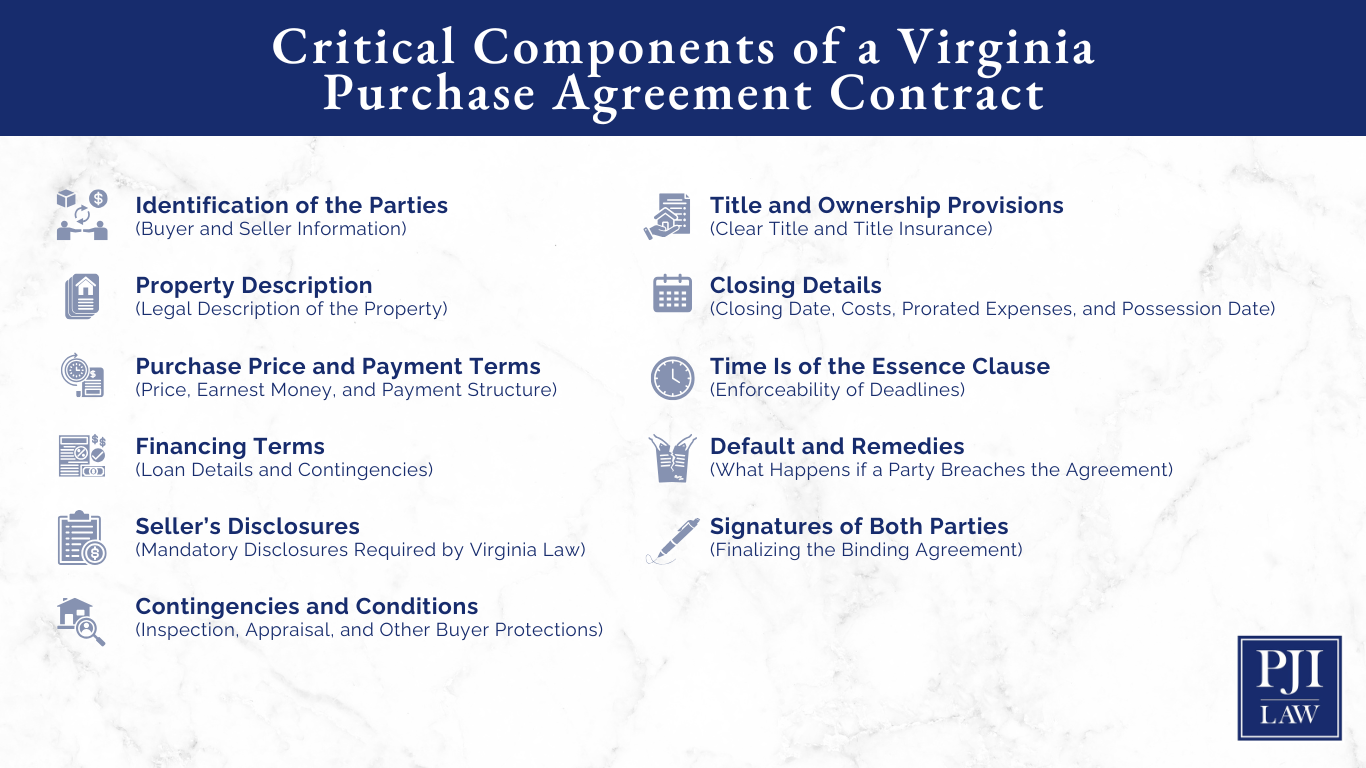
    Critical Components of a Virginia Purchase Agreement Contract

    Contingencies That Protect Buyers and Sellers

    Contingencies are conditions that must be met for the contract to move forward. These clauses allow either party to withdraw from the agreement without penalty under certain circumstances. Common contingencies in a Virginia purchase agreement include:

    • Financing Contingency: Protects the buyer by allowing contract cancellation if they cannot secure a mortgage within a specified timeframe.
    • Home Inspection Contingency: Allows the buyer to hire a home inspector and negotiate repairs or a price adjustment based on the findings. If the home inspection reveals significant defects, the buyer may have the right to walk away.
    • Appraisal Contingency: Seeks to value the property at or above the purchase price. If the home appraises for less than the agreed price, the buyer can renegotiate or withdraw.
    • Sale of Current Home Contingency: This contingency gives the buyer time to sell their existing home before purchasing a new one.
    • Title Contingency: Confirms that the property’s title is clear of liens or ownership disputes before the sale is finalized.
    • Insurance Contingency: Allows the buyer to cancel the contract if they cannot obtain homeowners insurance, which is often required for financing, especially in areas prone to flooding, hurricanes, or wildfires.
    • Final Walkthrough Contingency: This gives the buyer the right to complete a final walkthrough before closing to confirm that the property is in the agreed-upon condition and that any required repairs have been completed. If issues arise, the buyer may delay closing or renegotiate.
    • Well and Septic System Inspection Contingency: While Virginia law requires sellers to disclose septic system information, this contingency allows the buyer to conduct independent well and septic inspections to confirm they are in working order. If deficiencies are found, the buyer may request repairs or withdraw from the contract.

    Clearly defining contingencies with specific deadlines and conditions is crucial for a smooth transaction.

    Seller’s Disclosures in Virginia

    Sellers Disclosures in Virginia

    Unlike some states that require comprehensive seller disclosures, Virginia follows the buyer beware principle, which means the seller is generally not obligated to disclose property defects. However, Virginia law does require certain disclosures. These include:

    • Lead-Based Paint Disclosure: If the home was built before 1978, federal law requires sellers to inform buyers of any known presence of lead-based paint and provide related documentation.
    • Septic System Disclosure: If the property has a septic system, the seller must disclose its condition and provide any available inspection records. However, this does not guarantee the system is functional, which is why buyers may include a septic inspection contingency in their contract.
    • Military Air Installation Disclosure: If the property is near a military airbase, the seller must inform the buyer due to potential noise and environmental concerns.
    • Homeowners Association (HOA) Disclosure: If the property is located in an HOA community, the seller must provide information about HOA fees, rules, and any pending assessments. The buyer has the right to review these documents and may be able to withdraw from the contract within a set timeframe if they find the terms unacceptable.

    Because Virginia follows a buyer-beware approach, buyers are encouraged to conduct independent inspections to uncover potential property issues. Disclosures only provide required information—they do not replace inspections or eliminate the need for buyer contingencies

    Closing Details

    Once both parties sign the purchase agreement contract, the transaction moves toward closing—the final step where ownership officially transfers. The contract should specify:

    • Closing Date: The agreed-upon date when the transaction will be finalized. In Virginia, simply setting a closing date does not make it enforceable unless the contract includes a “time is of the essence” clause (Sims v. Nidiffer). This clause ensures that deadlines must be strictly met and that failure to close on time could be considered a breach of contract.
    • Location of Closing: Typically conducted at a title company, real estate attorney’s office, or escrow agent’s office. In Virginia, the settlement agent—who may be a title company, escrow officer, or attorney—oversees the closing process, ensuring all legal requirements are met.
    • Closing Costs: Specifies who is responsible for various costs, including title fees, escrow fees, and transfer taxes. In Virginia, these costs are negotiable, but buyers and sellers should agree on their responsibilities in the contract.
    • Title Insurance: While not required by law, title insurance is strongly recommended to protect against title defects or claims. The contract should state whether the buyer or seller is responsible for purchasing the policy.
    • Prorated Expenses: Details how property taxes, homeowners association (HOA) dues (if applicable), and utility bills will be split between the buyer and seller based on the closing date. These costs are often prorated to ensure each party pays their fair share for the time they own the property.
    • Recording Fees and Transfer Taxes: Clarifies who will pay the costs associated with recording the deed and any applicable transfer taxes. Virginia imposes deed transfer taxes, but the responsibility for payment can be negotiated in the contract.
    • Possession Date: Specifies when the buyer will take physical possession of the property. In most cases, possession transfers at closing, but in some agreements, the seller may remain in the home for a set period after closing under a separate agreement.
    • Home Warranty: If a home warranty is included as part of the sale, the contract should specify who is responsible for purchasing it and what it covers.
    • Surveys and Inspections: If the buyer requests a property survey to confirm boundary lines or additional inspections beyond the standard home inspection, the contract should specify who will pay for them and whether the results could impact the sale.

    Including these details in the purchase agreement contract can help avoid last-minute disputes and create a clear, structured path to closing day.

    Common Pitfalls to Avoid

    Common Pitfalls to Avoid

    Real estate transactions can be complex, and certain pitfalls may arise during the contract process. Here are some common mistakes and ways to prevent them in Virginia real estate contracts:

    • Ambiguous Language: Any vague or unclear terms in the contract can lead to disputes. All terms, including deadlines, responsibilities, and conditions, should be clearly defined to prevent misunderstandings.
    • Failure to Include Contingencies: Omitting important contingencies—such as financing, inspections, or appraisal clauses—can leave buyers unprotected if issues arise before closing.
    • Missed Deadlines: Real estate contracts contain strict timelines for financing approval, inspections, repairs, and closing. Failing to meet these deadlines can delay the transaction or result in contract termination.
    • Improper Identification of Parties: The contract should accurately identify all parties involved. If the buyer or seller is an LLC, trust, or other legal entity, the contract must include the full legal name of that entity to avoid enforceability issues.
    • Unclear Terms Regarding Personal Property: To avoid disputes after closing, the contract should explicitly state which items—such as appliances, light fixtures, and window treatments—convey with the home.
    • Inadequate Earnest Money Deposit: The earnest money deposit serves as a good faith payment to secure the property. In a competitive market, an insufficient deposit may make the buyer’s offer less appealing. However, buyers should also be cautious about committing too much without proper contingencies in place.
    • Overlooking Homeowners Association (HOA) Rules and Fees: If the property is located in an HOA community, buyers must review the HOA disclosure packet before proceeding. This includes rules, restrictions, financial obligations, and potential assessments that could impact the buyer’s decision.
    • Neglecting Title Insurance: While not legally required in Virginia, title insurance protects buyers from undiscovered liens, ownership disputes, and title defects that could arise after the purchase. Without it, buyers risk financial loss if an issue surfaces.
    • Failure to Address Termite and Moisture Inspections: Termite and moisture-related damage is a common issue in Virginia, particularly in older homes. The contract should specify who is responsible for inspections and any necessary treatments or repairs before closing.
    • Ignoring the “Time is of the Essence” Clause: Including this clause ensures that deadlines must be strictly followed. Without it, missed deadlines may not automatically result in a breach of contract, potentially delaying closing or causing the deal to fall apart.

    Avoiding these common mistakes helps prevent legal disputes, unexpected costs, and transaction delays, making the home-buying process in Virginia smoother for both buyers and sellers.

    Dealing with a purchase agreement

    When Can a Purchase Agreement Be Canceled?

    There are specific scenarios in which a purchase agreement can be canceled legally without penalty:

    • Failure to Meet Contingencies: If a contingency, such as financing approval or a satisfactory inspection, is not met, the buyer can withdraw without consequences.
    • Mutual Agreement: Both parties can agree to cancel the contract in writing.
    • Breach of Contract: If one party fails to meet their contractual obligations, the other party may have grounds for termination.
    • Legal Issues: Unresolved title defects, zoning violations, or undisclosed property conditions may justify contract termination.

    If a contract is canceled, the terms of earnest money refunds or forfeitures should be clearly outlined in the agreement.

    The Role of Real Estate Professionals

    The Role of Real Estate Professionals

    Although a purchase agreement is a binding legal document, buyers and sellers may not always fully understand its implications. Real estate professionals—such as agents, brokers, and attorneys—play a key role in ensuring the contract reflects both parties’ intentions and complies with Virginia laws.

    • Real Estate Agents: Agents assist in drafting, negotiating, and finalizing purchase agreements while ensuring that buyers and sellers understand the terms.
    • Attorneys: A legal contract lawyer can review the contract, explain potential risks, and handle legal complexities such as title issues or disputes.
    • Title Companies: A title company ensures the property’s title is clear of liens and facilitates the closing process.

    While not legally required, involving professionals can provide valuable guidance throughout the transaction.

    A purchase agreement contract in Virginia is the backbone of any real estate transaction, ensuring both buyers and sellers are legally protected. By understanding its key elements, legal requirements, and potential pitfalls, you can approach a property purchase with confidence. Whether you’re buying your first home or selling an investment property, a well-drafted contract helps create a clear path to a successful closing.

    Need a Contract Lawyer? Consult PJI Law in Fairfax, Virginia

    A purchase agreement contract is more than just paperwork—it defines your rights and obligations in a high-stakes transaction. Whether you’re buying or selling property, having a contract lawyer review or draft your agreement can help you avoid costly mistakes and legal disputes. At PJI Law, we review your contract for clarity, enforceability, and alignment with Virginia law. We assist with negotiations, identify potential risks, and address contingencies to protect your investment.

    Though this blog focuses on real estate purchase contracts, our legal team also assists with various business and financial agreements. Whether you’re entering a partnership agreement, drafting a promissory note, or reviewing a property lease, we provide tailored legal solutions to safeguard your interests.

    If you’re searching for a “real estate attorney near me” who can help with your contract needs, PJI Law is ready to assist. Call (703) 865-6100 or fill out our confidential online form to schedule your consultation today.

    At PJI Law, you’ll receive white glove service and personalized attention!

    Copyright © 2025. PJI Law, PLC. All rights reserved.

    The information in this blog post (“post”) is provided for general informational purposes only and may not reflect the current law in your jurisdiction. No information in this post should be construed as legal advice from the individual author or the law firm, nor is it intended to be a substitute for legal counsel on any subject matter. No reader of this post should act or refrain from acting based on any information included in or accessible through this post without seeking the appropriate legal or other professional advice on the particular facts and circumstances at issue from a lawyer licensed in the recipient’s state, country, or other appropriate licensing jurisdiction.

    PJI Law, PLC
    3900 Jermantown Rd, 2nd Floor
    Fairfax, Virginia 22030
    (703) 865-6100
    https://pjibe.webteam.ai/
  • What Is a SOW (Statement of Work) in Virginia?

    What Is a SOW (Statement of Work) in Virginia?

    What is a SOW? A Statement of Work (SOW) is a foundational document used to define the terms, responsibilities, and deliverables of a specific project. In Virginia, SOWs are critical for ensuring alignment between parties, mitigating risks, and maintaining compliance with legal and contractual obligations. Whether you’re working on a government project, managing a private sector initiative, or negotiating supplier contracts, an effective SOW provides the framework for a successful collaboration.

    In this blog, a legal contract lawyer from PJI Law, PLC explains what a SOW is, key considerations before drafting one, essential components, and practical drafting tips to help you avoid common pitfalls.

    What is a SOW and why is it important

    What is a Statement of Work?

    A SOW is a detailed agreement that outlines the specifics of a project or task, such as the scope of work, deliverables, timelines, and payment terms. Typically, it complements a master agreement, which governs the broader legal relationship between parties. SOWs may cover projects that are defined:

    • At the inception of the master agreement, or
    • During the agreement’s term, as new projects arise.

    Why SOWs Are Important

    SOWs eliminate uncertainty by providing clarity on:

    • Total work effort required: Prevents misunderstandings about the scale of the project.
    • Impact of changes: Clearly defines how alterations to scope affect timelines, costs, and deliverables.
    • Avoiding disputes: Reduces the risk of disagreements that could lead to financial losses or litigation.

    Issues to Consider Before Drafting a SOW

    Drafting a SOW requires forethought and planning to avoid unintended consequences. Below are key factors to address:

    Choosing the Right SOW Format

    The SOW format should align with the type of contract:

    • Fixed-Price Contracts: Require highly detailed SOWs to ensure all tasks and costs are accounted for.
    • Time-and-Materials Contracts: Allow for more flexibility and may require less precision.
    • Cost Reimbursement Contracts: Focus on project parameters rather than technical details.

    Avoiding Pre-Execution Pitfalls

    Avoiding Pre-Execution Pitfalls

    Before finalizing a SOW, take these steps to protect your interests:

    • Verify Authority: Confirm that the other party’s representatives have the authority to negotiate.
    • Use Non-Disclosure Agreements: Secure Non-Disclosure Agreements if sensitive information is shared during negotiations.
    • Avoid Verbal Commitments: Ensure that all agreements are documented in writing and marked as “non-binding” until the final SOW is signed.

    Defining Contracting Parties

    Clearly identify the parties involved in the project:

    • Specify which entity (buyer or supplier) is responsible for key deliverables.
    • Include any third parties, such as subcontractors, in the agreement, or ensure they are covered under a participation or delegation agreement.

    Key Components of a SOW in Virginia

    To draft an effective SOW, you need to include several critical components. These elements serve as the foundation for your contract and project success.

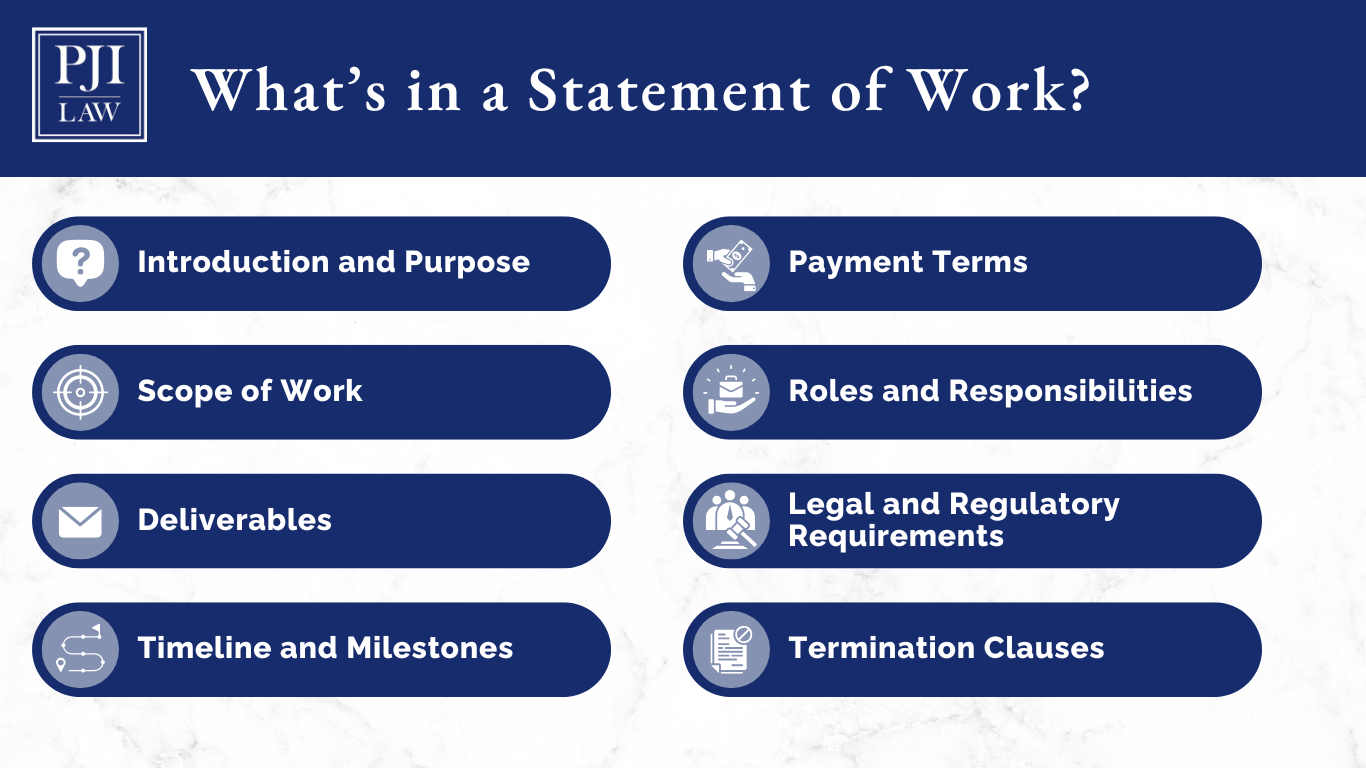
    1. Introduction and Purpose

    The Introduction and Purpose section defines the project’s intent and goals, ensuring all parties are aligned from the start. It answers two key questions:

    • What is the project intended to achieve?
    • Why is it necessary?

    Example:

    For a SOW providing IT services to a Virginia municipality:

    • Objective: “Upgrade the municipality’s cybersecurity systems to protect sensitive data and comply with state mandates.”
    • Rationale: “This project addresses increasing cybersecurity threats and supports compliance with Virginia’s public sector requirements.”

    A concise purpose statement establishes the project’s relevance and lays the foundation for the rest of the SOW.

    2. Scope of Work

    The Scope of Work section establishes the boundaries of the project. It clarifies what tasks and services are included—and equally important, what is excluded. A well-defined scope prevents misunderstandings and reduces the risk of “scope creep,” where additional work is added without renegotiating the agreement.

    Key Details to Include:

    • Tasks to Be Completed: List specific activities the supplier or contractor will perform.
      Example: “Perform a full cybersecurity audit, install firewall systems, and provide staff training.”
    • Services to Be Provided: Outline the deliverables or services the project entails.
      Example: “Continuous network monitoring during the contract period.”
    • Exclusions (if applicable): Specify what is not part of the agreement to avoid disputes later.
      Example: “This project does not include the procurement of hardware or software licenses.”

    A precise Scope of Work sets clear expectations for all parties and ensures that the project stays within agreed-upon parameters.

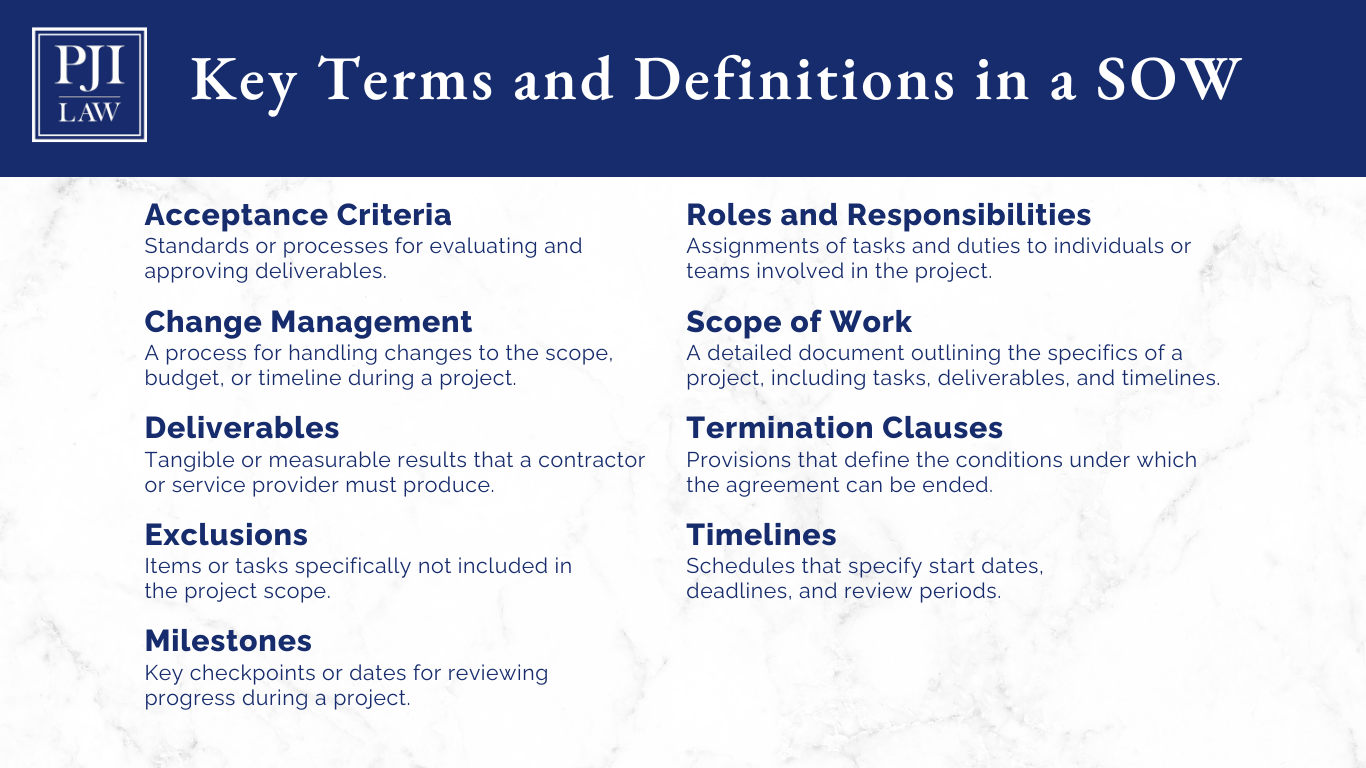
    Key Terms and Definitions in a SOW

    3. Deliverables

    Deliverables

    Deliverables are the tangible or measurable outcomes that the contractor or service provider is required to produce. These define the end results of the project, ensuring both parties understand what constitutes success.

    Key Elements to Include:

    • Description of Each Deliverable: Clearly outline what will be produced.
      Example: “Completed architectural drawings that meet zoning requirements.”
    • Deadlines: Specify the due dates for each deliverable.
      Example: “Final site survey to be submitted by March 1, 2026.”
    • Acceptance Criteria: Define the standards or processes for evaluating each deliverable.
      Example: “Drawings must receive approval from the Virginia State Planning Commission.”

    By clearly specifying deliverables, along with deadlines and acceptance criteria, you eliminate ambiguity and create a framework for accountability.

    4. Timelines and Milestones

    Timelines establish when tasks and deliverables should be completed. For larger projects, breaking the timeline into milestones can make progress easier to track. A milestone might include phases such as “Design Approval” or “Initial Testing,” with specific deadlines attached.

    Virginia businesses often use this section to highlight key deadlines tied to state or local regulations, particularly for government projects.

    5. Payment Terms

    The payment section outlines how and when payments will be made. Include:

    • Payment schedules
    • Milestone-based payments (if applicable)
    • Penalties for late payments or missed deadlines

    For projects in Virginia, this section should comply with any state-specific payment regulations, such as those outlined in the Virginia Prompt Payment Act.

    Seeking a legal contract lawyer for SOW

    6. Roles and Responsibilities

    Roles and Responsibilities

    The Roles and Responsibilities section establishes accountability by defining who is responsible for specific aspects of the project. Clear assignments ensure smooth collaboration and prevent confusion during execution.

    Key Elements to Include:

    • Primary Points of Contact: Identify the main contacts for each party, responsible for communication and decision-making.
      Example: “The project manager for [Company Name] will serve as the primary contact for progress updates and approvals.”
    • Responsibilities: Outline the duties assigned to each team or individual.
      Example:Client Responsibilities: Provide timely feedback on deliverables and grant necessary site access.
      Contractor Responsibilities: Submit progress reports, complete tasks on schedule, and adhere to project specifications.
    • Escalation Processes: Detail steps for resolving disputes or delays.
      Example: “In case of unresolved issues, disputes will be escalated to senior management within five business days.”

    Clearly defined roles and responsibilities foster efficient collaboration, minimize misunderstandings, and provide a clear path for addressing challenges.

    7. Legal and Regulatory Requirements

    Virginia has distinct legal and regulatory requirements that must be addressed in any project, especially for government or public-sector work. Including these ensures that the project complies with state laws and avoids potential penalties or disputes.

    Key Considerations:

      • Compliance with the Virginia Public Procurement Act: Required for contracts involving public funds, this act sets standards for procurement fairness and accountability.
        Example: “All procurement activities must adhere to the Virginia Public Procurement Act (Va. Code § 2.2-4300 et seq.).”
      • Licensing Requirements for Contractors: Verify and document that all contractors hold the appropriate licenses for the work being performed.
        Example: “General contractors must maintain an active Class A license as required by the Virginia Department of Professional and Occupational Regulation (DPOR).”
      • Environmental or Safety Standards: Ensure compliance with state-specific regulations, such as:
        • Virginia Building Code: Relevant for construction projects.
        • OSHA Standards: Critical for ensuring workplace safety.

    By referencing applicable state laws and regulations, this section protects both parties and ensures a legally sound project framework.

    8. Termination Clauses

    Termination Clauses

    While the goal of any project is successful completion, termination clauses provide a safety net by defining the conditions under which the agreement can be ended. Including these clauses ensures that all parties understand their rights and obligations in the event of unforeseen issues.

    Common Grounds for Termination:

    • Failure to Meet Deliverables: If critical milestones or deliverables are not met within the agreed timeline.
      Example: “The agreement may be terminated if the contractor fails to deliver the approved designs within 60 days of the agreed deadline.”
    • Breach of Contract Terms: When one party fails to fulfill essential obligations outlined in the SOW.
      Example: “A material breach of any term of this agreement allows the non-breaching party to terminate the contract after providing written notice.”
    • Mutual Agreement to Discontinue: If both parties decide to end the project due to changing circumstances or priorities.
      Example: “Termination by mutual consent must be documented in writing and signed by both parties.”

    By outlining clear conditions for termination, this section protects both parties from prolonged disputes and provides a structured exit strategy if the project cannot proceed as planned.

    What's in a Statement of Work

    Best Practices for Drafting a SOW in Virginia

    Creating an effective SOW requires more than just filling out a form. Following best practices ensures that your document is clear, comprehensive, and legally sound, reducing the risk of disputes and delays.

    Be Specific

    Avoid ambiguous terms like “reasonable” or “as needed,” which can lead to differing interpretations. Instead, use precise and measurable language.

    Example: Replace “complete the project quickly” with “deliver the final report within 10 business days.”

    Use Plain Language

    Clear, concise language helps all parties understand their obligations without needing a legal background.

    Example: Instead of writing, “The supplier shall endeavor to perform to the best of its abilities,” use “The supplier will complete the installation as outlined in Section 3.”

    Consult State Laws

    Virginia has unique legal requirements, especially for public contracts. For instance:

    • Virginia Public Procurement Act: Establishes rules for procurement processes in government projects.
    • Virginia Building Code: Applicable for construction-related SOWs.

    Consult a contract lawyer or reference specific statutes when drafting SOWs that may be subject to state laws.

    Involve Stakeholders Early

    Engage all key stakeholders, including contractors, clients, and legal teams, during the drafting process. Early input ensures the SOW reflects the needs and expectations of all parties.

    Review and Revise

    A SOW should not be finalized without a thorough review. Check for consistency, completeness, and alignment with the master agreement. Ensure all stakeholders sign off on the SOW after revisions to confirm mutual understanding.

    Plan for Changes

    Include provisions for managing changes to scope, budget, or timelines. This avoids disputes when adjustments are necessary.

    Example: Add a “Change Management” section detailing how additional tasks or modifications will be approved.

    By adhering to these best practices, you can create a well-structured SOW that fosters collaboration and ensures project success, whether you’re working on private contracts or public-sector initiatives in Virginia.

    Common Mistakes and How to Avoid Them

    Common Mistakes and How To Avoid Them

    Even with careful preparation, some common mistakes can undermine the effectiveness of a SOW. Here’s what to watch out for and how to avoid these pitfalls:

    Overlooking Local Regulations

    Virginia’s legal framework includes specific requirements for contracts, particularly in government or public-sector projects. Neglecting these can render a SOW unenforceable or non-compliant. To avoid this, reference applicable laws, such as the Virginia Public Procurement Act, and consult an attorney if the project involves complex regulatory obligations.

    Failing to Define Scope Clearly

    Unclear scope descriptions can lead to disagreements about what the project includes or excludes. For example, vague language like “perform required maintenance” can create confusion. Instead, be specific by detailing the tasks, deliverables, and exclusions in a way that all parties can easily understand.

    Not Specifying Acceptance Criteria

    Without clear acceptance criteria, disagreements can arise about whether deliverables meet the agreed-upon standards. For instance, phrases like “provide a quality report” leave room for interpretation. Clearly define what “quality” means by specifying measurable criteria, such as format, content, and deadlines.

    Ignoring Termination Provisions

    A SOW without termination clauses leaves you without a clear exit strategy if the project encounters significant issues. Include conditions for termination, such as failure to meet deadlines or breach of contract, and specify notice periods to ensure all parties know the process for ending the agreement if necessary.

    Using Vague Language

    Vague terms like “as needed” or “reasonable efforts” often lead to differing expectations between parties. Use specific, actionable language instead, such as “complete Task Y within 10 business days of receiving approval for Task X,” to minimize misunderstandings.

    By addressing these common issues, you can draft a SOW that is clear, enforceable, and designed to support the success of your project.

    In closing, a Statement of Work is a vital document that sets the stage for project success. Whether you’re a contractor, business owner, or government agency in Virginia, a well-crafted SOW helps define expectations, allocate responsibilities, and minimize the risk of disputes. By tailoring your SOW to meet Virginia’s legal and regulatory requirements, you create a solid foundation for achieving your project goals.


    Seeking contract attorneys to protect your interests with a properly drafted SOW

    Protect Your Interests with a Professionally Drafted SOW

    A well-prepared Statement of Work is key to defining expectations, avoiding disputes, and protecting your interests. At PJI Law, our contract attorneys help clients create and review SOWs that are clear, thorough, and tailored to their needs, balancing strong protections with language that fosters collaborative business relationships.

    Whether you need to draft a SOW from the ground up or refine one prepared by another party, we’ll focus on addressing the specifics—like scope, deliverables, and legal requirements—so your project starts on the right path.

    Take the next step in protecting your rights and strengthening your business agreements. Contact PJI Law at (703) 865-6100 or fill out our confidential online form to schedule a consultation. Let us help you create a strong foundation for success.

    At PJI Law, you’ll receive white glove service and personalized attention!

    Copyright © 2024. PJI Law, PLC. All rights reserved.

    The information in this blog post (“post”) is provided for general informational purposes only and may not reflect the current law in your jurisdiction. No information in this post should be construed as legal advice from the individual author or the law firm, nor is it intended to be a substitute for legal counsel on any subject matter. No reader of this post should act or refrain from acting based on any information included in or accessible through this post without seeking the appropriate legal or other professional advice on the particular facts and circumstances at issue from a lawyer licensed in the recipient’s state, country, or other appropriate licensing jurisdiction.

    PJI Law, PLC
    3900 Jermantown Rd, 2nd Floor
    Fairfax, Virginia 22030
    (703) 865-6100
    https://pjibe.webteam.ai/

  • What Is an Independent Contractor Agreement in Virginia?

    What Is an Independent Contractor Agreement in Virginia?

    As the business landscape continues to evolve, many companies in Virginia are increasingly turning to independent contractors to supplement their workforce on an as-needed basis. This flexible model offers numerous advantages, from cost savings to enhanced agility. However, formalizing these working relationships through an independent contractor agreement is crucial for protecting both parties and ensuring a successful partnership.

    An independent contractor agreement is a legally binding document that outlines the terms, responsibilities, and expectations of the contractor-client relationship. Whether you’re a small business owner, a freelancer, or an enterprise-level organization, understanding the purpose and key components of these agreements is essential in today’s ever-evolving business world.

    In this comprehensive guide, we’ll explore the defining characteristics of independent contractor agreements, discuss the essential elements of a well-crafted agreement, and highlight the legal requirements and potential pitfalls to avoid. By the end, you’ll have a clear roadmap for leveraging this useful tool to support your business goals and empower your workforce.

    Fairfax, VA attorney explains an independent contractor agreement, and who needs one in Virginia. Call (703) 865-6100 to schedule a consultation.

    What Exactly Is an Independent Contractor Agreement?

    An independent contractor agreement is a legal contract that defines the working relationship between a company (the “hiring party”) and an individual or business (the “independent contractor”). Unlike an employment agreement, which governs the terms of a traditional employer-employee dynamic, an independent contractor agreement outlines the specific services the contractor will provide, the compensation they will receive, and the parameters under which they will operate.

    In simple terms, an independent contractor agreement is a way to formally document an arrangement where an individual or business is hired to perform a defined scope of work, rather than being an employee of the company. This type of agreement provides clarity for both parties and helps ensure a mutually beneficial relationship.

    If you’re considering engaging an independent contractor or have been asked to sign such an agreement, it’s highly recommended to consult an independent contractor attorney in Virginia. They can review the contract terms, ensure compliance with state laws, and help you understand your rights and obligations as either the hiring party or the independent contractor.

    Fairfax, VA attorney explains an independent contractor agreement, and who needs one in Virginia. Call (703) 865-6100 to schedule a consultation.

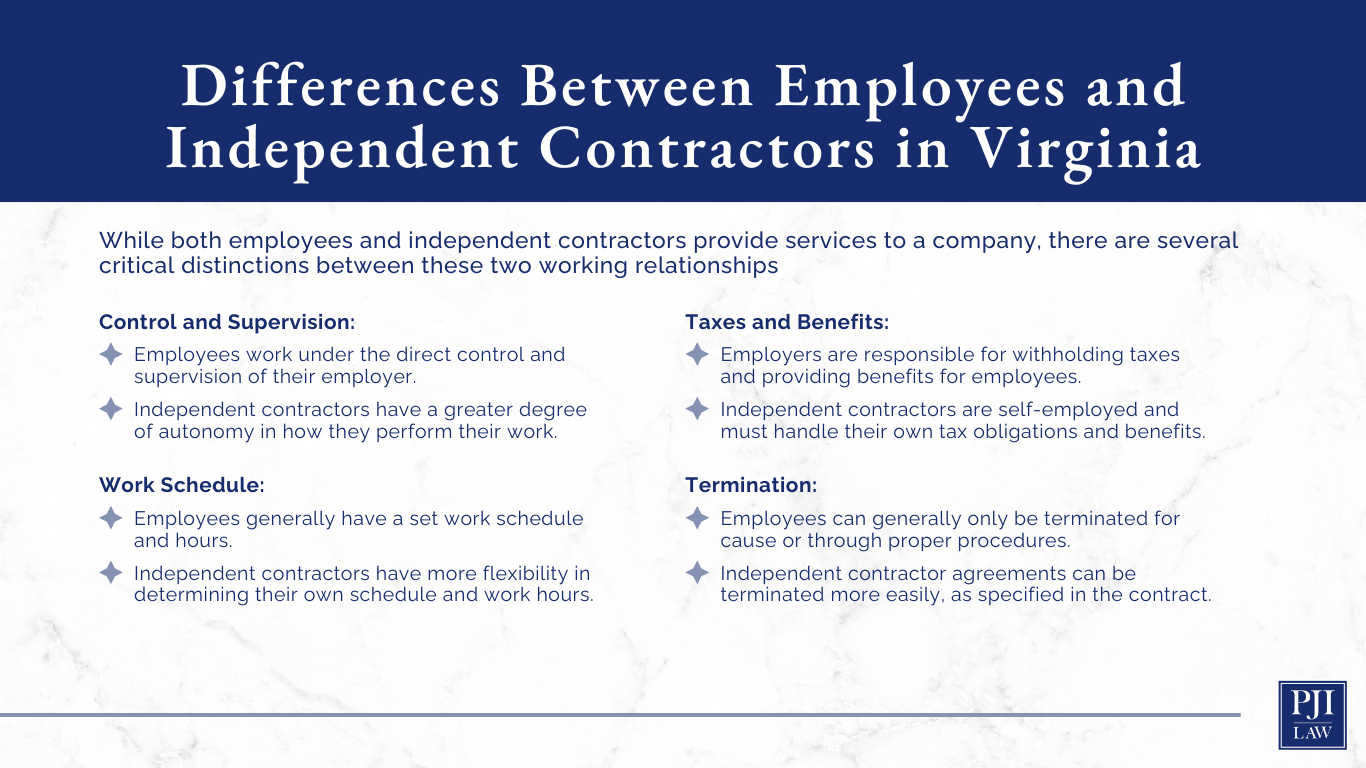
    Key Differences Between Employees and Independent Contractors

    While both employees and independent contractors provide services to a company, there are several critical distinctions between these two working relationships:

    Control and Supervision:

    • Employees work under the direct control and supervision of their employer.
    • Independent contractors have a greater degree of autonomy in how they perform their work.

    Taxes and Benefits:

    • Employers are responsible for withholding taxes and providing benefits for employees.
    • Independent contractors are self-employed and must handle their own tax obligations and benefits.

    Work Schedule:

    • Employees generally have a set work schedule and hours.
    • Independent contractors have more flexibility in determining their own schedule and work hours.

    Termination:

    • Employees can generally only be terminated for cause or through proper procedures.
    • Independent contractor agreements can be terminated more easily, as specified in the contract.

    Ensuring you properly classify the nature of your working relationships is essential. Misclassifying an employee as an independent contractor can have serious legal and financial consequences. Consulting a legal contract lawyer in Virginia can help you navigate these nuances and structure the appropriate agreements.

    Determining if Your Relationship Qualifies as an Independent Contractor Arrangement

    Distinguishing between an employee and an independent contractor relationship is not always straightforward. There are a number of factors that courts and government agencies use to evaluate the true nature of a working arrangement. Some of the key considerations include:

    Control and Independence:

    • The degree of control the hiring party has over the worker’s performance and schedule
    • The worker’s ability to exercise independent judgment and discretion

    Financial Relationship:

    • Who provides the necessary tools, equipment, and supplies
    • How the worker is compensated (e.g., by the project, hourly, or salaried)

    Permanence of the Relationship:

    • Whether the work is temporary or ongoing
    • If the worker has other clients or is exclusively working for the hiring party

    If you’re unsure whether your situation qualifies as an independent contractor arrangement, it’s highly recommended to consult a contract lawyer. They can review the specific details of your working relationship and provide guidance on the appropriate classification and contractual terms.

    Navigating the Legal Requirements for Independent Contractors in Virginia

    In addition to the general considerations around employee classification, companies engaging independent contractors in Virginia must also be mindful of the specific legal requirements governing these working relationships. From business licensing to tax obligations, there are a number of compliance factors to keep in mind.

    For example, Virginia requires independent contractors to obtain a business license and register for state and federal tax IDs. There are also regulations around worker’s compensation coverage and unemployment insurance that may apply, depending on the nature of the contract. Failure to properly adhere to these legal obligations can expose the hiring company to penalties and liabilities.

    A legal contract lawyer well-versed in Virginia’s independent contractor laws can help you navigate these complexities. They can ensure the agreement is structured to comply with all relevant statutes and regulations, protecting both the company and the contractor. This level of legal experience is invaluable in establishing a robust, compliant independent contractor relationship.

    Protecting Your Business Interests with a Well-Crafted Agreement

    Engaging an independent contractor without a formal, written agreement in place can leave your business vulnerable. From undefined scopes of work to unclear ownership of intellectual property, operating without a proper contract opens the door to potential disputes and legal complications down the line.

    A well-crafted independent contractor agreement is essential for safeguarding your company’s interests. By outlining the specific terms, responsibilities, and parameters of the working relationship, you can ensure both parties have a clear understanding of their obligations and protect critical business assets.

    Investing the time upfront to develop a comprehensive agreement is a small price to pay compared to the headaches and costs that can arise from a poorly structured or nonexistent contract. Don’t leave your business exposed.

    Fairfax, VA attorney explains an independent contractor agreement, and who needs one in Virginia. Call (703) 865-6100 to schedule a consultation.

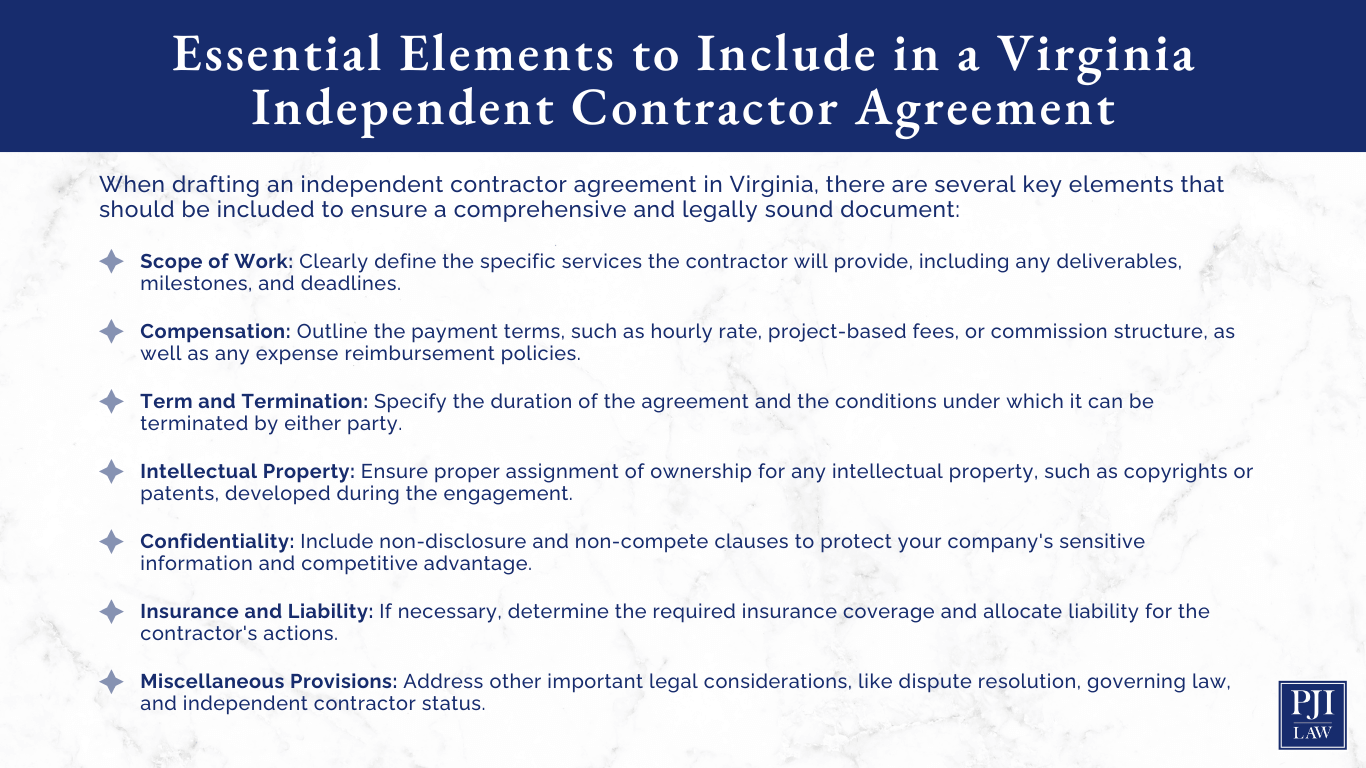
    Essential Elements to Include in a Virginia Independent Contractor Agreement

    When drafting an independent contractor agreement in Virginia, there are several key elements that should be included to ensure a comprehensive and legally sound document:

    • Scope of Work: Clearly define the specific services the contractor will provide, including any deliverables, milestones, and deadlines.
    • Compensation: Outline the payment terms, such as hourly rate, project-based fees, or commission structure, as well as any expense reimbursement policies.
    • Term and Termination: Specify the duration of the agreement and the conditions under which it can be terminated by either party.
    • Intellectual Property: Ensure proper assignment of ownership for any intellectual property, such as copyrights or patents, developed during the engagement.
    • Confidentiality: Include non-disclosure and non-compete clauses to protect your company’s sensitive information and competitive advantage.
    • Insurance and Liability: If necessary, determine the required insurance coverage and allocate liability for the contractor’s actions.
    • Miscellaneous Provisions: Address other important legal considerations, like dispute resolution, governing law, and independent contractor status.

    Working closely with an independent contractor attorney in Virginia can help ensure your agreement addresses all the necessary elements and aligns with state-specific regulations, and give you the peace of mind that your business interests are properly safeguarded.

    Common Mistakes to Avoid When Drafting Independent Contractor Contracts

    Entering into an independent contractor relationship without a properly structured agreement can expose your business to a variety of legal and financial risks. To ensure your independent contractor contracts are bulletproof, it’s important to be aware of the common pitfalls to avoid:

    Failing to Clearly Define the Scope of Work

    A vague or overly broad scope of work can lead to misunderstandings and disputes over the contractor’s deliverables and responsibilities. Be sure to spell out the specific services, project milestones, and expected outcomes in clear, unambiguous language.

    Neglecting to Address Intellectual Property Rights

    Independent contractors may create valuable intellectual property, such as designs, software code, or proprietary information, during the course of their work. Failing to properly assign ownership rights can result in costly legal battles down the line.

    Omitting Confidentiality and Non-Compete Clauses

    Protecting your company’s confidential information and guarding against unfair competition are critical considerations. Comprehensive non-disclosure and non-compete provisions should be included to safeguard your business interests.

    Improper Classification of the Worker’s Status

    Misclassifying an employee as an independent contractor can carry significant legal and financial penalties. Ensure your agreement accurately reflects the nature of the working relationship based on factors like control, autonomy, and financial arrangements.

    Neglecting to Address Liability and Insurance

    Depending on the industry in which they operate, some independent contractors must carry their own liability insurance to protect against potential claims or lawsuits arising from their work. Your contract should clearly outline these requirements and delineate the allocation of risk.

    Relying on a One-Size-Fits-All Template

    Every independent contractor engagement is unique, with its own set of nuances and requirements. Attempting to use a generic contract template without tailoring it to your specific situation is a recipe for trouble.

    To avoid these pitfalls and draft truly robust independent contractor agreements, it’s highly recommended to work with an experienced contract lawyer.

    Fairfax, VA attorney explains an independent contractor agreement, and who needs one in Virginia. Call (703) 865-6100 to schedule a consultation.

    When Is It Time to Seek Legal Assistance for Your Independent Contractor Needs?

    Navigating the complexities of independent contractor agreements can be challenging, even for seasoned business owners. If you’re unsure about any aspect of the contracting process or have concerns about protecting your company’s interests, it’s always better to err on the side of caution and consult a legal professional. An experienced independent contractor attorney can provide invaluable guidance to ensure your independent contractor relationships are properly structured and compliant with Virginia laws and regulations.

    PJI Law: Your Virginia Independent Contractor Attorney

    Navigating the complexities of an independent contractor agreement can be a daunting task, but you don’t have to go it alone. At PJI Law, our experienced contract lawyer is here to provide the guidance you need.

    As your trusted legal partner, we’ll work closely with you to carefully review any independent contractor agreement language, ensuring it aligns with your best interests and the applicable laws in your state. Our team is well-versed in the nuances of contractor relationships, and we’ll leverage that experience to identify potential pitfalls, negotiate favorable terms, and give you the peace of mind that your business interests are properly protected.

    Whether you’re a company seeking to implement a comprehensive independent contractor agreement or an individual presented with such an agreement, PJI Law can help you make informed decisions that safeguard your rights and responsibilities. We understand the complexities involved in these contractual relationships, and can provide you with the necessary guidance to ensure a fair and mutually beneficial arrangement.

    Call us at (703) 865-6100 or complete our online form to schedule your consultation. 

    Copyright © 2024. PJI Law, PLC. All rights reserved.

    The information in this blog post (“post”) is provided for general informational purposes only and may not reflect the current law in your jurisdiction. No information in this post should be construed as legal advice from the individual author or the law firm, nor is it intended to be a substitute for legal counsel on any subject matter. No reader of this post should act or refrain from acting based on any information included in or accessible through this post without seeking the appropriate legal or other professional advice on the particular facts and circumstances at issue from a lawyer licensed in the recipient’s state, country, or other appropriate licensing jurisdiction.

    PJI Law, PLC
    3900 Jermantown Rd, 2nd Floor
    Fairfax, Virginia 22030
    (703) 865-6100
    https://pjibe.webteam.ai/
  • What is a Non-Disclosure Agreement in Virginia?

    What is a Non-Disclosure Agreement in Virginia?

    Protecting a company’s confidential information is essential for maintaining a competitive edge and ensuring the success of sensitive projects. In this regard, a non-disclosure agreement (NDA) serves as a powerful legal tool. But what is a non-disclosure agreement in Virginia, and how can businesses and professionals leverage its protective powers?

    In this comprehensive guide, we’ll explore the ins and outs of NDAs in the Old Dominion State, providing you with the essential knowledge needed to make critical decisions about these agreements in your organization. Whether you’re an entrepreneur safeguarding your startup’s trade secrets or a seasoned professional looking to keep your next big project under wraps, you’ll discover the key considerations and best practices for using non-disclosure agreements to your advantage. By the end of this guide, you’ll have a thorough understanding of the role NDAs play in Virginia and be equipped with the insights to ensure your confidential information remains secure.

    Continue reading to learn more, then contact us at (703) 865-6100 for personalized service and attention. 

    What is a Non-Disclosure Agreement?

    Fairfax, VA employment contract attorney answers, “What is a non-disclosure agreement?” Call (703) 865-6100 to schedule a consultation.

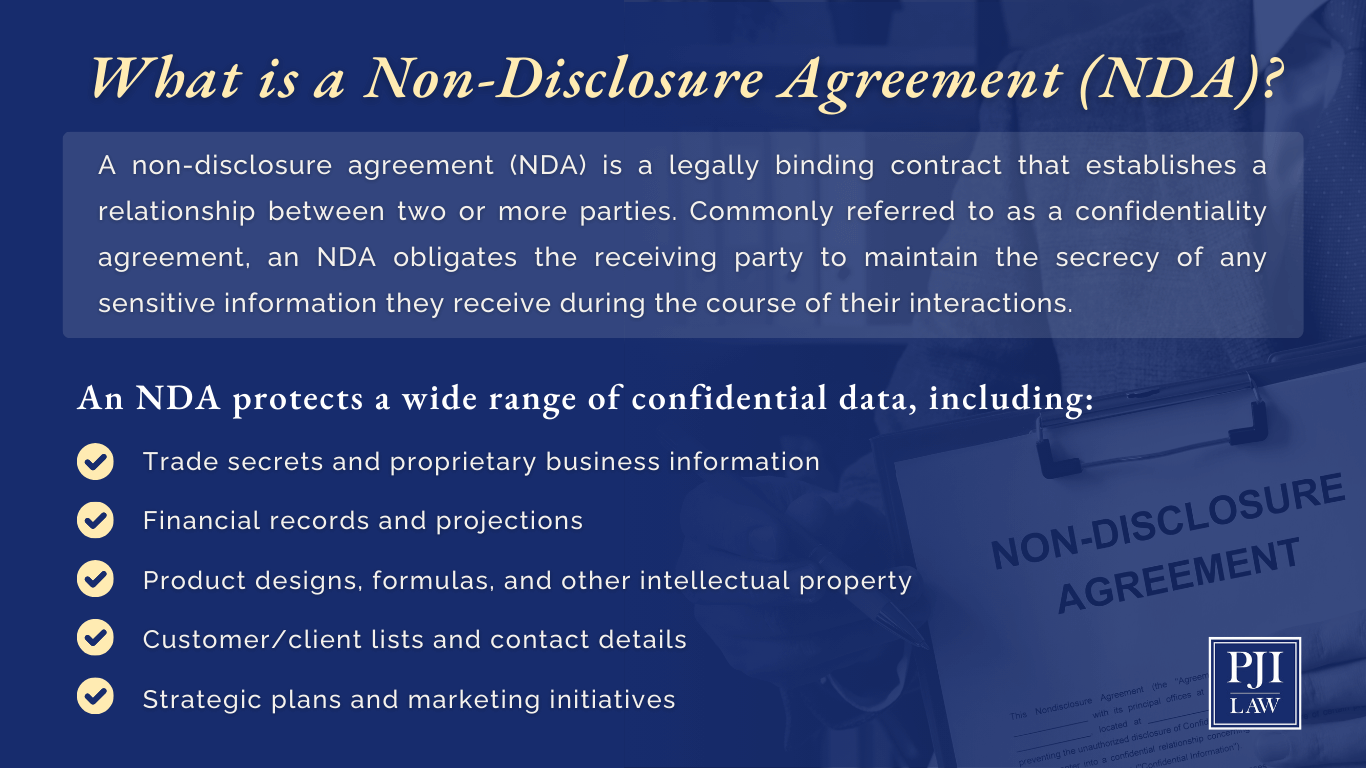
    At its core, a non-disclosure agreement (NDA) is a legally binding contract that establishes a confidential relationship between two or more parties. Also commonly referred to as a confidentiality agreement, an NDA obligates the receiving party to maintain the secrecy of any sensitive information they receive during the course of their interactions.

    In practical terms, an NDA serves to protect a wide range of confidential data, including:

    • Trade secrets and proprietary business information
    • Financial records and projections
    • Product designs, formulas, and other intellectual property
    • Customer/client lists and contact details
    • Strategic plans and marketing initiatives

    By signing an NDA, the recipient agrees not to share, use, or disclose this information without the express permission of the disclosing party. Violation of an NDA can result in significant legal consequences, such as financial penalties or even litigation.

    NDAs are also commonly used in a variety of business contexts, including:

    • Partnerships and joint ventures
    • Mergers, acquisitions, and other corporate transactions
    • Employment relationships and consulting agreements
    • Product development and research collaborations

    Crafting an effective NDA requires a thorough understanding of state laws, industry best practices, and the unique needs of your organization. That’s why it’s often advisable to work with experienced contract lawyers who can ensure your confidentiality agreement is tailored to your specific requirements and provides the robust legal protection you need.

    Fairfax, VA employment contract attorney answers, “What is a non-disclosure agreement?” Call (703) 865-6100 to schedule a consultation.

    Non-Disclosure Agreement Considerations for Virginia Residents

    While non-disclosure agreements are widely used across the United States, the specific laws and regulations governing these contracts can vary from state to state. As a Virginia resident, it’s important to understand how NDAs are viewed and enforced within the Commonwealth.

    Unlike some other states, Virginia does not have any overarching statutes that explicitly address the requirements or limitations of non-disclosure agreements. However, the courts in Virginia have established certain common law principles and precedents that shape how these contracts are interpreted and applied.

    For example, Virginia’s courts generally take a fairly broad and permissive view when it comes to the scope of information that can be protected under an NDA. As long as the confidential data in question provides a genuine competitive advantage and the agreement’s terms are deemed reasonable, Virginia courts have shown a willingness to uphold NDAs and enforce their provisions.

    At the same time, there are still important nuances and potential pitfalls that Virginia residents must consider when drafting or signing a non-disclosure agreement. Issues like the duration of the agreement, the types of activities that are restricted, and the remedies available for breach can all have significant implications.

    Working with an experienced non-disclosure lawyer who is well-versed in Virginia’s legal landscape can help ensure your NDA aligns with state-specific requirements and provides the airtight safeguards you need to keep your sensitive information secure. With the right legal counsel, you can have confidence that your confidentiality agreement will stand up in court if challenged.

    Fairfax, VA employment contract attorney answers, “What is a non-disclosure agreement?” Call (703) 865-6100 to schedule a consultation.

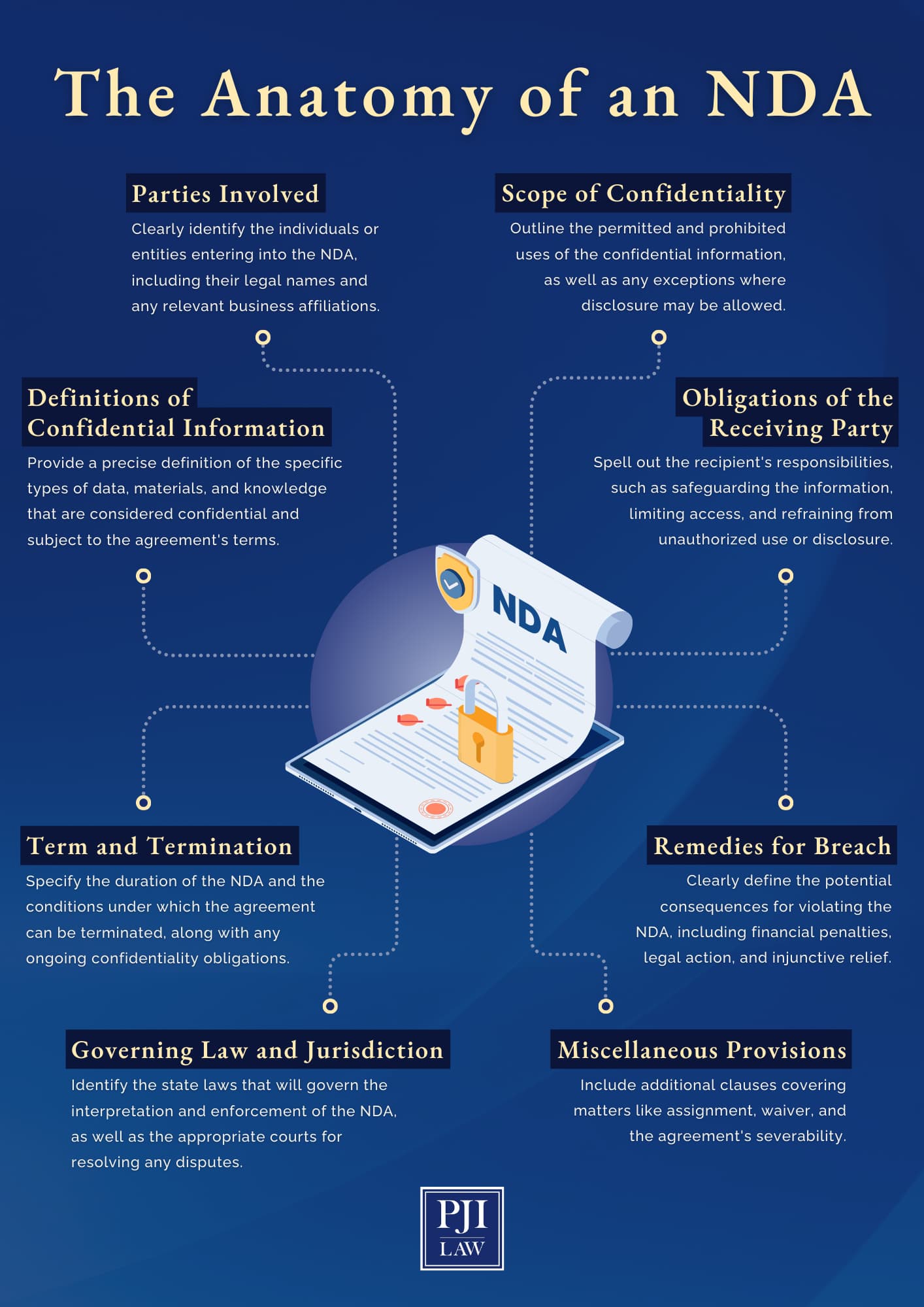
    The Anatomy of an NDA

    When drafting a comprehensive non-disclosure agreement, several key components should be included for its effectiveness. An experienced employment contract attorney can help you ensure your NDA covers all the necessary elements:

    Parties Involved

    Clearly identify the individuals or entities entering into the NDA, including their legal names and any relevant business affiliations.

    Definitions of Confidential Information

    Provide a precise definition of the specific types of data, materials, and knowledge that are considered confidential and subject to the agreement’s terms.

    Scope of Confidentiality

    Outline the permitted and prohibited uses of the confidential information, as well as any exceptions where disclosure may be allowed.

    Obligations of the Receiving Party

    Spell out the recipient’s responsibilities, such as safeguarding the information, limiting access, and refraining from unauthorized use or disclosure.

    Term and Termination

    Specify the duration of the NDA and the conditions under which the agreement can be terminated, along with any ongoing confidentiality obligations.

    Remedies for Breach

    Clearly define the potential consequences for violating the NDA, including financial penalties, legal action, and injunctive relief.

    Governing Law and Jurisdiction

    Identify the state laws that will govern the interpretation and enforcement of the NDA, as well as the appropriate courts for resolving any disputes.

    Miscellaneous Provisions

    Include additional clauses covering matters like assignment, waiver, and the agreement’s severability.

    By ensuring your NDA comprehensively addresses these key elements, you can create a robust and legally-sound agreement that effectively protects your confidential information.

    What Happens if I Break an NDA?

    Violating the terms of a non-disclosure agreement can have serious consequences, both for the individual who breaches the contract and for the company or individual whose confidential information is compromised.

    Under Virginia law, the primary recourse for a party whose NDA has been breached is to pursue legal action against the offending individual or entity. This can take the form of:

    Civil Litigation

    The disclosing party may file a civil lawsuit alleging breach of contract, misappropriation of trade secrets, or other related claims. If successful, they may be awarded monetary damages to compensate for any financial harm caused by the disclosure.

    Injunctive Relief

    In addition to or instead of monetary damages, the court may issue an injunction to prevent further dissemination of the confidential information and compel the return or destruction of any materials containing the data.

    Criminal Charges

    In some cases, the unauthorized use or disclosure of certain types of highly sensitive information protected by an NDA may also rise to the level of criminal activity, such as theft of trade secrets. This could result in fines or even jail time for the offending party.

    The specific consequences will depend on the details of the NDA, the nature and extent of the breach, and the extent of the harm caused. That’s why it’s crucial to work with experienced contract lawyers who can ensure your NDA is structured to provide the maximum legal protections and enforceability.

    Fairfax, VA employment contract attorney answers, “What is a non-disclosure agreement?” Call (703) 865-6100 to schedule a consultation.

    How Binding Is a Non-Disclosure Agreement?

    The binding nature of a non-disclosure agreement (NDA) is a critical consideration for anyone asked to sign one, whether you’re an employee, a business partner, or a vendor. Ultimately, the enforceability and strength of an NDA depends on a variety of factors, making it essential to work with a skilled non-disclosure lawyer.

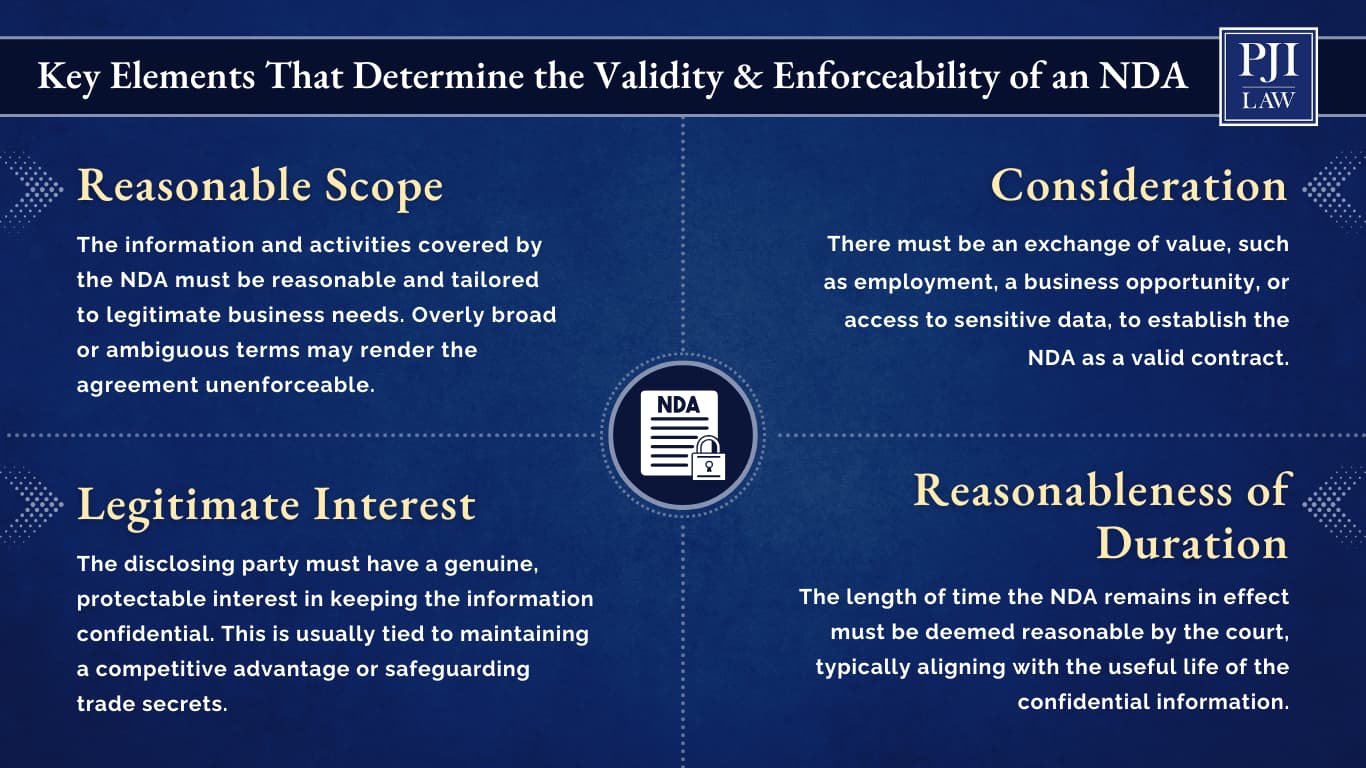
    In Virginia, NDAs are generally viewed as legally binding contracts, meaning that violating the agreement’s terms can expose the offending party to significant consequences. However, the courts will scrutinize several key elements when determining the validity and enforceability of a particular NDA:

    Fairfax, VA employment contract attorney answers, “What is a non-disclosure agreement?” Call (703) 865-6100 to schedule a consultation.

    • Reasonable Scope: The information and activities covered by the NDA must be reasonable and tailored to legitimate business needs. Overly broad or ambiguous terms may render the agreement unenforceable.
    • Legitimate Interest: The disclosing party must have a genuine, protectable interest in keeping the information confidential. This is usually tied to maintaining a competitive advantage or safeguarding trade secrets.
    • Consideration: There must be an exchange of value, such as employment, a business opportunity, or access to sensitive data, to establish the NDA as a valid contract.
    • Reasonableness of Duration: The length of time the NDA remains in effect must be deemed reasonable by the court, typically aligning with the useful life of the confidential information.

    If an NDA meets these criteria, Virginia courts have generally shown a willingness to uphold the agreement and grant appropriate legal remedies, such as monetary damages or injunctions, in the event of a breach. However, the specific enforceability can vary based on the unique circumstances of each case.

    How Long Does a Non-Disclosure Agreement Last?

    In many cases, NDAs will remain in effect for a set number of years, often ranging from 1 to 5 years. However, some agreements may also contain “perpetual” confidentiality clauses, rendering the NDA binding for an indefinite period. The enforceability of such provisions can depend on the nature of the information and the circumstances of the case.

    Consulting experienced contract lawyers is crucial when determining the appropriate length for your NDA. They can help ensure the duration aligns with industry standards, adequately safeguards your confidential data, and stands up to potential legal challenges down the road.

    Can I Work for a Competitor if I Signed an NDA?

    The question of whether an employee can work for a competitor after signing a non-disclosure agreement (NDA) is a complex one that often requires the guidance of an experienced employment contract attorney.

    In Virginia, the courts typically recognize the enforceability of non-compete clauses and other restrictive covenants contained within NDAs, as long as the terms are deemed reasonable. This means that even after the termination of employment, an individual may be legally prohibited from taking a job with a direct competitor if doing so would inevitably lead to the disclosure of the former employer’s trade secrets or confidential information.

    However, the specific restrictions will depend on the language and scope of the NDA. For example, an NDA may only prohibit the employee from directly competing or from soliciting clients, but allow them to work in a non-competing role. Additionally, Virginia courts have shown a tendency to balance the employer’s legitimate business interests with the employee’s right to pursue their career.

    An employment contract attorney can review the terms of your NDA, assess the potential risks, and advise you on your options. They may be able to negotiate modifications to the agreement or seek a “carve-out” that permits you to accept a position with a competitor without violating the NDA. Ultimately, the enforceability of post-employment restrictions in an NDA is highly situational.

    PJI Law: Your Virginia Employment Contract Attorney

    Navigating the complexities of non-disclosure agreements can be a daunting task, but you don’t have to go it alone. At PJI Law, our experienced employment contract attorney is here to provide the guidance you need.

    As your trusted legal partner, we’ll work closely with you to carefully review any NDA language, ensuring it aligns with your best interests and the applicable laws in your state. Our team is well-versed in the nuances of employment contracts, and we’ll leverage that experience to identify potential pitfalls, negotiate favorable terms, and give you the peace of mind that your confidential information is properly protected.

    Whether you’re an employer seeking to implement robust NDAs or an employee presented with an agreement, PJI Law can help you make informed decisions that safeguard your rights. Call us at (703) 865-6100 or complete our online form to schedule your consultation. 

    Copyright © 2024. PJI Law, PLC. All rights reserved.

    The information in this blog post (“post”) is provided for general informational purposes only and may not reflect the current law in your jurisdiction. No information in this post should be construed as legal advice from the individual author or the law firm, nor is it intended to be a substitute for legal counsel on any subject matter. No reader of this post should act or refrain from acting based on any information included in or accessible through this post without seeking the appropriate legal or other professional advice on the particular facts and circumstances at issue from a lawyer licensed in the recipient’s state, country, or other appropriate licensing jurisdiction.

    PJI Law, PLC
    3900 Jermantown Rd, 2nd Floor
    Fairfax, Virginia 22030
    (703) 865-6100
    https://pjibe.webteam.ai/
  • Planning on Buying a Business in Virginia? Tips on How to Write a Business Purchase Agreement

    Planning on Buying a Business in Virginia? Tips on How to Write a Business Purchase Agreement

    Whether you’re a seasoned entrepreneur looking to expand your portfolio or someone transitioning into business ownership for the first time, navigating the legal intricacies of transferring ownership can feel overwhelming.

    However, having the right documents in place upfront will help make negotiations clearer and set both parties up for long-term success. One of these crucial documents — perhaps the most crucial — is a business purchase agreement.

    This blog aims to help any would-be business owners in Virginia feel informed and confident as they craft their own business purchase agreement.

    For those who want to leave nothing up to chance, the best thing you can do is hire an experienced business transaction lawyer. A knowledgeable and experienced Fairfax business lawyer can ensure that all legal bases are covered, and help navigate any unforeseen issues that could derail the purchase process.

    At PJI Law, PLC, our clients are our top priority. We’re committed to providing personal attention and premium service. If you want to create a legally sound business purchase agreement that protects your interests, contact us at (703) 865-6100.

    What is a Business Purchase Agreement?

    A business purchase agreement, sometimes also referred to as a buy-sell agreement in Virginia, is the central legal document that governs the terms of the transaction between a buyer and seller of a business.

    This contract outlines vital components of the deal, including:

    • Purchase price 
    • Timeline for closing
    • Specific assets and liabilities being transferred
    • Conditions of sale
    • Representations and warranties 
    • Consequences of default

    The agreement protects both parties by formally establishing their respective obligations and rights in writing. Essentially, it is a roadmap for facilitating an orderly transition of business ownership that clearly defines expectations. With a comprehensive business purchase agreement, the buyer and seller can enter the deal with confidence, knowing their interests and rights are protected.

    What’s Included in a Business Purchase Agreement?

    While business purchase agreements can be complex, they generally contain several standard components. Crafting a comprehensive agreement requires the help of an experienced attorney; however, familiarizing yourself with the basic structure and key provisions is certainly worthwhile. Entering negotiations with a working knowledge of standard terms can help facilitate crucial discussions.

    Party Identification

    The first provision in a business purchase agreement establishes the identities of the buyer and seller transacting the deal. It provides their full legal names, entity types (if relevant), and contact details. Misidentifying parties in the contract has legal implications, so ensure names, signatures and all details are accurate.

    Business Description

    This section paints a full picture of the business being sold, including an overview of its operations. It also confirms the seller’s capacity to legally authorize the transaction. Representations and warranties about the company’s good standing, compliance with relevant laws, and absence of pending or threatened litigation provide both reassurance and recourse for buyers. A factual yet comprehensive business synopsis at this stage establishes full transparency about what the buyer is purchasing.

    Financial Terms

    Key transactional details are outlined here, beginning with the agreed-upon purchase price. Provisions indicate any deposits payable, how and when funds will change hands, including details about the closing date and transfer of ownership. By clearly spelling out payment expectations and the financial mechanics of the deal, this section sets the stage for a smooth exchange.

    Terms of Sale

    This section unambiguously defines the type of sale, as well as the assets that are included or excluded from the deal. Additionally, it provides important information abound the transfer of tangible property, with details on the condition and value of equipment, tools, facilities and other resources that are critical to operations.

    Covenants

    This part of the agreement delineates responsibilities for both parties as ownership changes hands. It spells out obligations the seller must fulfill regarding matters like tax commitments, loan repayments, transferring employment benefits and wages, etc. Post-closing, ongoing protections are listed here, as well.

    Transition

    To facilitate a seamless leadership change, this section establishes expectations for responsibilities like outlining the seller’s ongoing advisory or support role (if any). It also determines who will manage the training of new hires to ensure business continuity, and how customers, vendors and other stakeholders will be informed of the sale to maintain key relationships.

    Third Parties

    When third parties aid the transaction, this part of the business purchase agreement records their formal details. It lists their full names and contact information, and clearly assigns responsibility for paying commission fees or other forms of compensation.

    Closing Details

    To smoothly wrap up the purchase, this straightforward section lays out the logistical plan. It establishes the definitive closing date, timeframe, location where title transfers will occur, and the monetary sum to be paid at closing.

    Dispute Resolution Clause

    This section outlines procedures for resolving any transaction-related conflicts via mediation or litigation, providing clarity upfront on addressing issues that could arise after closing.

    These standard provisions cover common bases, but business purchase agreements can vary in complexity depending on factors like business type and the assets/liabilities involved. Additional terms may require negotiation. To ensure a smooth purchase, consult an experienced Virginia business transaction lawyer.

    Can You Write Your Own Business Purchase Agreement?

    Yes, you can. However, while it is legal for a buyer and seller to write their own business purchase agreement, it is not always advisable. Drawing up a legally binding contract on your own carries certain risks. Critical terms and disclosures could be overlooked or clauses can be written in a way that leaves potential loopholes.

    How Can a Business Transaction Attorney Help?

    A business transaction lawyer can provide valuable assistance to buyers and sellers involved in a business purchase agreement. They understand the legal intricacies and can identify issues that an individual may miss. Attorneys will make sure all regulatory disclosure requirements are satisfied. They can review financials, contracts, and other documentation to catch any problems.

    Additionally, an attorney can draft ancillary documents like non-compete agreements, and ensure a smooth closing process. Their expertise helps minimize risks so both parties are properly protected through every phase of the transaction.

    Ensure Your Business Purchase Agreement Protects Your Interests with the Transaction Attorneys at PJI Law, PLC

    Purchasing a business isn’t something you do every day. Given the high stakes involved, enlisting the help of an experienced business transaction lawyer is wise.

    With personalized service and attention, our dedicated team at PJI Law, PLC will leave no stone unturned to ensure that your business purchase agreement reflects your best interests and protects your rights. Take the first step today and call our office at (703) 865-6100 or complete our online form to schedule your consultation.

    Copyright © 2023. PJI Law, PLC. All rights reserved.

    The information in this blog post (“post”) is provided for general informational purposes only and may not reflect the current law in your jurisdiction. No information in this post should be construed as legal advice from the individual author or the law firm, nor is it intended to be a substitute for legal counsel on any subject matter. No reader of this post should act or refrain from acting based on any information included in or accessible through this post without seeking the appropriate legal or other professional advice on the particular facts and circumstances at issue from a lawyer licensed in the recipient’s state, country, or other appropriate licensing jurisdiction.

    PJI Law, PLC
    3900 Jermantown Rd, 2nd Floor
    Fairfax, Virginia 22030
    (703) 865-6100
    https://pjibe.webteam.ai/

  • 7 Types of Business Contracts in Northern Virginia

    7 Types of Business Contracts in Northern Virginia

    As a business owner, you likely handle a multitude of contracts. These documents are required to hire employees, rent equipment, and conduct general business. Contracts protect your professional relationship with the other party as well as your own business interests. Without a legally binding contract that’s properly written, you could leave yourself open to legal issues and other inconveniences that could hurt your business.

    When drafting a contract, language plays an important role. Writing a contract can begin as a simple process, but you need to include legal language to protect yourself and the other party. For that, you need a professional, especially one who knows the laws in your state.

    When searching for a lawyer, it’s not advisable to simply search online for “business lawyer near me.” Instead, work with an experienced law firm like our team at PJI Law, LLC, in Northern Virginia. You can count on us to help you create well-written, enforceable business contracts.

    What Are Some Different Types of Contracts?

    Most business contracts will generally fall into one of three categories:

    • Employment
    • Sales
    • General business

    Within these categories, you can typically expect to see the following:

    1. Non-disclosure Agreements
    Non-disclosure agreements protect your company’s proprietary information. When working with vendors, contractors, and employees, these agreements prevent them from sharing your internal information with outside sources.

    2. Property or Equipment Leases
    When you lease a building, warehouse space, or special equipment, the contract should include pricing, deposits, duration, maintenance requirements, and the agreement terms.

    3. Purchase Orders
    When purchasing items for your business, you’ll likely encounter a purchase order. This legal document specifies the price, payment terms, delivery specifics, and whether the purchase is a recurring order. As a business owner, this protects your purchase by preventing last-minute price and delivery changes.

    4. Bills of Sale
    A bill of sale helps you transfer a property title to another party. Essentially, it reflects that both parties agreed to the sale. These documents play an essential role in business transactions.

    5. Employment Contracts
    An employment contract outlines the compensation, grounds for termination, employment duration, benefits, and other employment terms. When hiring new employees, this contract protects you from potential lawsuits that may arise during employment or after termination.

    6. Non-compete Agreements
    Non-compete agreements protect your company from losing valuable employees to competitors. Typically, these will outline a location radius, identify competitors, and provide a time period during which the agreement is in effect.

    7. Independent Contractor Agreements
    Separate from regular employment contracts, an independent contractor agreement establishes the terms for an independent contractor’s services.

    How Does a Contract Protect Your Business?

    Business contracts outline the terms and agreements surrounding transactions involving another party. These contracts both minimize risk and help you understand your rights as a business owner. Additionally, they set expectations for both parties. Typically, you’ll want to use a business lawyer to help draft this legal documentation. Business contract lawyers exist to help companies navigate business law and protect themselves during transactions.

    What Is the Purpose of a Contract? Why Are They Important?

    Business contracts serve the purpose of outlining expectations between the involved parties. For example, when hiring a new employee, you need a contract to establish the terms of employment. The contract typically includes the salary and benefits your company is providing. This signed document could prevent an employee from suing you if they later dispute their compensation or other aspects of their employment.

    On the other side, your employees also receive protection from this contract. When an employer breaches an employee’s contracted rights, workers can take legal action. From the business owner’s perspective, employment contracts make you stand out as an employer. This contract shows potential employees your professionalism in the employment process.

    What Is the Process of Making a Contract?

    When first drafting a business contract, you should consider the following in the process:

    • Use language you can understand
    • Use as much detail as possible
    • Include all payment details
    • Include termination details
    • Consider attorney fees and potential mediation

    When it comes to the bottom line, you want to include all necessary information while also preparing for potential future disputes. No matter who the parties are, a business contract keeps everyone safe. You’ll both know what to expect from the agreement and can conduct business accordingly. Problems can arise at any time, and a well-written contract will protect you.

    PJI Law, PLC: Your Business Contract Lawyers in Northern Virginia

    Whether you need help drafting a business contract or you’ve already written one, an experienced business attorney can help ensure that these documents contain the necessary items. Business law can quickly turn complicated, and you don’t want to risk your business’s future due to an improperly written contract.

    With offices in Fairfax and Leesburg, our knowledgeable team at PJI Law, PLC, can guide you through the drafting process. With white-glove service, we’ll take away the headaches of navigating the law on your own. Call us today at (703) 865-6100 or fill out our online form to schedule a consultation.

    Copyright © 2022. PJI Law, PLC. All rights reserved.

    The information in this blog post (“post”) is provided for general informational purposes only and may not reflect the current law in your jurisdiction. No information in this post should be construed as legal advice from the individual author or the law firm, nor is it intended to be a substitute for legal counsel on any subject matter. No reader of this post should act or refrain from acting based on any information included in or accessible through this post without seeking the appropriate legal or other professional advice on the particular facts and circumstances at issue from a lawyer licensed in the recipient’s state, country or other appropriate licensing jurisdiction.

    PJI Law, PLC
    3900 Jermantown Rd, 2nd Floor
    Fairfax, Virginia 22030
    (703) 865-6100
    https://pjibe.webteam.ai/

  • Shortcuts in Business Contracts: Penny Wise and Pound Foolish

    Shortcuts in Business Contracts: Penny Wise and Pound Foolish

    In today’s uncertain economy, marginal increases in revenue or minor reductions in expenses can noticeably improve the bottom line of a small business. However, many small business owners in Northern Virginia attempt to cut costs by managing their commercial contract drafting or negotiations without an attorney, an ill-advised attempt at cost-cutting which often backfires.

    Whether negotiating a commercial lease, a promissory note, a distribution agreement, an asset purchase agreement, or a joint venture agreement, consulting with an attorney early in the process will likely save you money and help avoid headaches both during the negotiation process and during the term of the agreement.

    Many small business owners or entrepreneurs are tempted by the thousands of easily obtainable agreements online, and in fact, many of these agreements are indeed professionally and expertly drafted—but for different parties dealing with different and unique circumstances, often in a different state or legal jurisdiction. Since the addition or omission of a single word or sentence can often radically change the meaning or enforceability of an agreement, attempting to modify and utilize these agreements without professional assistance can end badly.

    When it comes to business agreements, business owners without legal training don’t know what they don’t know.

    The attorneys at PJI Law have seen countless commercial agreements that omit critical provisions which should always be included, as well as agreements made by individuals when the parties should be corporate entities, or agreements made by corporate entities which have been dissolved or have never existed to begin with. We often find ourselves helping clients who had poorly drafted agreement resolve contract disputes at a far higher cost than the small upfront investment in legal guidance that would have likely prevented such problems from arising.

    When both parties are represented by counsel and the attorneys drafting the agreement have a clear understanding of their clients’ desires and concerns, the process can become streamlined and efficient. An effective commercial contract can save even a very small business tens – or even hundreds – of thousands of dollars by helping to reduce the likelihood of problems arising and minimizing the damage in the event that problems do arise – whether from breaches, negligence, liability, or indemnification issues.

    Finding ways to cut costs in your small business is absolutely critical for success and survival, but business owners should think twice before trying to save money by taking shortcuts with their commercial contracts. No one wants to reach a point where they realize they were penny wise and pound foolish.