Tag: Contract Disputes

  • What Are the Legal Implications of Terminating a Contract Due to Breach in Virginia?

    What Are the Legal Implications of Terminating a Contract Due to Breach in Virginia?

    A vendor has repeatedly failed to deliver what your agreement requires. A customer has stopped making payments. A service provider has missed an important deadline and put your own business commitments at risk. At some point, you may decide you’ve had enough and want to end the relationship.

    But terminating a contract because the other party breached it isn’t always as simple as sending a notice that you’re done. Whether you have the right to terminate can depend on the seriousness of the breach, the contract’s terms, which party failed to perform first, and whether notice or an opportunity to correct the problem is required.

    Before ending the agreement, it’s important to know whether the breach gives you a legal basis to stop your own performance and what obligations or claims could remain afterward.

    At a Glance

    • Not every breach necessarily gives the other party the right to terminate a contract.
    • Under Virginia law, a material breach may excuse the non-breaching party from further performance.
    • Your contract may establish specific grounds for termination and require notice or an opportunity to cure a breach.
    • Terminating without sufficient contractual or legal grounds could expose you to a breach of contract claim.
    • Ending the contract doesn’t necessarily eliminate claims arising from an earlier breach or obligations intended to survive termination.

    When Can You Terminate a Contract Due to Breach in Virginia?

    A breach of contract occurs when a party fails to perform an obligation required by a valid contract without a legal excuse. However, the existence of a breach doesn’t necessarily mean the aggrieved party can immediately end the agreement.

    The first place to look is the contract itself. Well-drafted written contracts often include provisions identifying events that constitute default, circumstances allowing termination, notice requirements, and whether the party that breached must receive a reasonable time to correct the problem.

    Virginia common law can also affect whether a party’s own performance remains required following a breach. Virginia courts apply the first material breach doctrine, which can prevent a party that materially breached an agreement first from enforcing the contract against the other party. A 2026 Virginia Court of Appeals decision examining the doctrine explained that a breach must go to the “root of the contract” rather than involve only a minor part of the agreement to qualify as a first material breach.

    That distinction is important because ending a contract over a minor problem may have very different legal implications from terminating after the other party has failed to perform a central obligation.

    How Do You Know Whether a Breach Is Material?

    A material breach goes to the heart of what the parties agreed to do. Rather than focusing only on whether a contract term was violated, the analysis considers the significance of that failure to the agreement as a whole.

    Suppose a business hires a vendor to provide an essential component by a specific date so the business can fulfill a major customer order. The vendor’s complete failure to deliver may affect the central purpose of the contract. A brief delay involving something that has little effect on the value of the promised performance could present a different situation.

    Whether a breach is material depends on the contract and circumstances. The size of the financial loss isn’t necessarily the only issue. Courts can examine the nature of the obligation, the extent of the failure to perform, and how that failure affected what the parties expected to receive from the agreement.

    This is one reason businesses should be cautious about assuming that any violation of a contract’s terms permits termination.

    Why Does the First Material Breach Affect Your Right to Stop Performing?

    When contract disputes develop, both parties sometimes accuse the other of failing to comply with the agreement. Virginia’s first material breach rule can make the sequence of events significant. A party that committed the first material breach may not be able to rely on a later failure by the other party to perform its contractual obligations.

    Consider a company that stops making required payments because it believes a service provider has breached the agreement. If the provider’s earlier failure was material, the company may have grounds for refusing further performance. But if that earlier problem wasn’t a material breach, stopping payment could create a new breach by the company.

    The question therefore isn’t simply whether the other party breached the contract. It may also be necessary to determine:

    • What obligation did each party have?
    • Which failure occurred first?
    • Was that failure material?
    • Had the other party substantially performed?
    • Did later conduct affect either party’s rights?

    Those questions can become especially important before a business takes an irreversible step based on its interpretation of the agreement.

    What Should You Review Before Terminating a Contract?

    Even when the other party’s failure appears significant, review the agreement carefully before sending a termination notice or stopping your own performance.

    Grounds for Termination

    A termination clause may identify specific circumstances that allow one party to end the agreement. Some contracts permit termination for a defined breach, while others contain broader termination-for-convenience provisions that allow a party to exit without alleging wrongdoing if specified conditions are satisfied.

    The contract may also end automatically after a stated period or event. Don’t assume that a contract permits termination simply because a dispute has developed. Identify the provision you intend to rely upon and determine whether the circumstances satisfy it.

    Notice Requirements

    The agreement may require written notice before termination becomes effective. It may specify what the notice must contain, how it must be delivered, who must receive it, and how much advance notice is required.

    An informal email or telephone conversation may not comply with a provision requiring notice in writing to a particular person or address.

    An Opportunity to Cure

    Some agreements give the party that breached a specific period to correct the problem before the other party can terminate.

    For example, a contract might require written notice of non-performance followed by 10 or 30 days to cure. Attempting contract termination before that period expires could create a dispute about whether the termination complied with the agreement.

    Your Own Performance

    Before accusing the other party of breach, examine whether you have satisfied your own contractual obligations.

    Payment records, invoices, delivery documentation, correspondence, project records, and other evidence can help establish what each party was required to do and what actually occurred.

    Waiver and Acceptance of Performance

    Your conduct after learning about a breach can also become relevant. For example, repeatedly accepting performance that doesn’t comply with the agreement without objecting may lead to arguments about whether you waived strict compliance with a particular requirement. Because waiver is highly dependent on the facts and the parties’ conduct, businesses should be deliberate about how they respond when potential breaches occur.

    What If the Other Party Says It Won’t Perform?

    You don’t necessarily have to wait until a future deadline passes to address every potential breach. Anticipatory repudiation can arise when a party clearly indicates that it won’t perform future contractual obligations. The Supreme Court of Virginia has recognized that repudiation of future duties may constitute an anticipatory breach, including in some circumstances after performance under a continuing contract has already begun.

    A disagreement, concern about future performance, or ambiguous statement isn’t necessarily enough. Whether conduct amounts to repudiation depends on what was communicated and the circumstances surrounding it.

    If the other party tells you it will no longer perform, preserve that communication and obtain legal guidance before deciding whether to stop your own performance or terminate the agreement.

    What Can Happen If You Terminate a Contract Without Sufficient Grounds?

    Wrongful termination can turn the party claiming a breach into a party defending against one. If your contract doesn’t permit termination under the circumstances and the other party’s conduct wasn’t sufficient to excuse your continued performance, ending the agreement could expose you to claims for damages caused by your failure to perform.

    Depending on the agreement and circumstances, a dispute could involve:

    • Lost payments or other compensatory damages
    • Enforceable liquidated damages provisions
    • Costs associated with replacing promised goods or services
    • Attorney fees when recoverable under the contract or applicable law
    • Claims concerning property, confidential information, or unfinished work
    • Arbitration or litigation over which party breached first

    The legal consequences of a breach of contract depend heavily on the agreement and the losses that can be proven. Reviewing your legal options before terminating can help you compare the risks of ending the relationship with other potential ways to address the dispute.

    What Happens to Your Obligations After the Contract Ends?

    Terminating a contract doesn’t always mean every contractual obligation immediately disappears. The agreement may expressly provide that certain clauses survive termination. Depending on the contract, these could include confidentiality requirements, indemnification provisions, payment obligations that have already accrued, intellectual property restrictions, dispute-resolution procedures, or other continuing duties. Rights arising from an earlier breach may also survive.

    Contracts for the sale of goods are subject to additional rules under Virginia’s Uniform Commercial Code (UCC). The UCC distinguishes between “termination,” which ends a contract other than for breach, and “cancellation” based on the other party’s breach. It also provides that cancellation or rescission ordinarily doesn’t eliminate a damages claim for an earlier breach unless the parties clearly intended otherwise.

    The rules governing your agreement therefore depend partly on the type of contract involved. A contract for the sale of goods may be governed by different statutory provisions than an agreement primarily involving services.

    What Should You Do Before Sending a Termination Notice?

    If you believe the other party has breached your agreement, acting quickly may be necessary, but that doesn’t mean acting without first evaluating your position.

    Before terminating the contract:

    1. Review the complete agreement. Include amendments, addenda, statements of work, and other documents that may modify the original terms.
    2. Identify the specific breach. Determine exactly which contractual obligation the other party failed to perform.
    3. Document the timeline. Preserve correspondence, invoices, payment records, delivery information, and other evidence showing what occurred and when.
    4. Check termination procedures. Identify any notice requirements, cure periods, deadlines, or required methods of delivery.
    5. Evaluate your own performance. Determine whether you complied with your obligations and whether the other party could claim that you breached first.
    6. Assess the financial impact. Document losses associated with the breach and expenses you may incur if the agreement ends.
    7. Identify continuing obligations. Determine which provisions remain effective after termination.
    8. Evaluate your legal options. Termination may be appropriate, but negotiation, a demand for performance, damages, or another remedy may better serve your business objectives.

    A contract dispute attorney can review both the language of the agreement and the parties’ conduct before you take action that may be difficult to reverse.

    Frequently Asked Questions

    Does every breach of contract allow termination in Virginia?

    A breach may violate a legally binding contract without being serious enough to excuse the other party from further performance. The contract’s termination provisions and whether the breach is material can affect your rights.

    What is considered a material breach of contract in Virginia?

    A material breach of contract involves a failure to perform an obligation that is central to the agreement rather than a minor or technical failure. Whether a particular breach is material depends on the contract and the circumstances.

    Do I have to give the other party a chance to fix a breach before terminating?

    It depends on the contract and the law governing the agreement. Some contracts contain cure provisions requiring notice and a specified opportunity to correct a breach before termination. Review the contract’s terms before proceeding.

    Can I recover damages after terminating a contract?

    Potentially. Ending the contractual relationship doesn’t necessarily eliminate claims for damages caused by a breach that occurred before termination. The available breach of contract remedies depend on the agreement, applicable law, and losses involved.

    What happens if I terminate a contract and the other party’s breach wasn’t material?

    If you lacked a contractual or legal basis for terminating, the other party may claim that your refusal to continue performing was itself a breach. That can lead to a dispute over which party failed to comply with the agreement and whether either party suffered damages.

    Can I terminate a contract if the other party says it won’t perform?

    Under Virginia law, anticipatory repudiation may occur when a party clearly indicates that it won’t perform its future contractual obligations. However, not every disagreement or statement about future performance amounts to repudiation. Before terminating the contract or stopping your own performance, consider whether the other party’s words or conduct provide a sufficient legal basis for doing so.

    Does a contract termination notice have to be in writing in Virginia?

    Not in every situation, but many written contracts specify how notice must be provided. Your agreement may require written notice, delivery to a particular person or address, or a specific method of delivery. Following the contract’s notice provisions can help avoid a later dispute over whether termination was effective.

    Can a contract be terminated if both parties agree?

    Parties can agree to end a contract early even when the original agreement doesn’t otherwise provide grounds for termination at that time. A written termination agreement can document the effective date, remaining payment obligations, treatment of pending work, releases, and any provisions that will continue after the relationship ends.

    What is the difference between terminating a contract for cause and for convenience?

    Termination for cause is based on a reason recognized by the contract, such as a specified default or breach. A termination-for-convenience clause allows a party to end the agreement without proving that the other party breached it, provided the requirements of the clause are satisfied. Not every contract permits termination for convenience.

    Should I have an attorney review a contract before sending a termination notice?

    While an attorney isn’t required to send every termination notice, legal review can be particularly helpful when significant money, disputed performance, or continuing obligations are involved. A contract dispute attorney can evaluate the grounds for termination, notice and cure requirements, each party’s performance, and potential liability before you take action that could lead to additional claims or litigation.

    Before Ending a Contract, Know What the Agreement and Virginia Law Allow

    When another party’s failure is costing your business money or interfering with operations, terminating the relationship may seem like the most practical response. But the decision can carry significant legal and financial consequences. The language of the agreement, materiality of the breach, sequence of the parties’ performance, notice requirements, and potential damages can all affect what you should do next.

    The Northern Virginia contract dispute attorneys at PJI Law, PLC help individuals and businesses evaluate contract disputes before and after a business relationship breaks down. Our attorneys can review the agreement and surrounding communications, assess the alleged breach and termination provisions, and help you determine whether termination, negotiation, litigation, or another approach aligns with your legal and business objectives.

    PJI Law provides personalized attention and strategic counsel based on the circumstances of each dispute. If you’re considering terminating a contract because the other party failed to perform, call (703) 865-6100 or contact us online to schedule your complimentary consultation.

    At PJI Law, you’ll receive white-glove service and personal attention from a team that treats you like family.

    Copyright © 2026. PJI Law, PLC. All rights reserved.

    The information in this blog post (“post”) is provided for general informational purposes only and may not reflect the current law in your jurisdiction. No information in this post should be construed as legal advice from the individual author or the law firm, nor is it intended to be a substitute for legal counsel on any subject matter. No reader of this post should act or refrain from acting based on any information included in or accessible through this post without seeking the appropriate legal or other professional advice on the particular facts and circumstances at issue from a lawyer licensed in the recipient’s state, country, or other appropriate licensing jurisdiction.

    PJI Law, PLC
    3900 Jermantown Road, 2nd Floor
    Fairfax, VA 22030
    (703) 865-6100
    https://www.pjilaw.com
  • Breach of Contract in Virginia: What Counts and What Doesn’t

    Breach of Contract in Virginia: What Counts and What Doesn’t

    When someone fails to honor an agreement, it’s easy to assume they’ve breached the contract. Maybe a contractor walked off the job before finishing the work, a vendor never delivered the products your business paid for, or a client refused to pay after receiving your services. Situations like these can disrupt your finances, strain business relationships, and leave you wondering what legal options you have.

    Not every disagreement, missed deadline, or broken promise qualifies as a breach of contract in Virginia. Whether a contract breach has occurred depends on the specific terms of the agreement, each party’s contractual obligations, the extent of the alleged failure to perform, and whether that failure caused measurable harm.

    In the sections below, you’ll learn what counts as a breach of contract in Virginia, what may not qualify as a legal breach, the difference between a material and minor breach, the remedies that may be available, and the steps you can take to protect your interests if a contract dispute arises.

    At a Glance

    At a Glance

    • A breach of contract occurs when one party fails to fulfill contractual obligations without a valid legal excuse.
    • Virginia courts evaluate whether the breach is material or minor when determining the available remedies.
    • Not every contract dispute results in a successful breach of contract claim.
    • Depending on the circumstances, available remedies may include contract damages, specific performance, rescission, or other forms of monetary compensation.
    • Preserving contracts, emails, invoices, payment records, and other evidence can strengthen your position if legal proceedings become necessary.

    Do you need a contract attorney to pursue a civil action for breach of contract in Virginia_

    What Is a Breach of Contract in Virginia?

    A breach of contract in Virginia occurs when one party fails to perform a legal obligation required by an enforceable agreement without a valid legal excuse. The breach may involve failing to complete promised work, refusing to make payment, delivering goods or services that do not comply with the contract terms, or otherwise failing to perform as the agreement requires.

    Not every contract breach looks the same. Some breaches involve a complete refusal to perform, while others involve delayed performance, incomplete work, or failure to satisfy specific provisions within the agreement. Whether a breach has occurred depends on the language of the contract and the circumstances surrounding the parties’ performance.

    Virginia law also recognizes that some failures are more significant than others. A substantial failure that defeats the primary purpose of the agreement may qualify as a material breach, while a relatively minor issue may not excuse the other party from continuing to perform under the contract. That distinction often affects whether the contract remains enforceable and which remedies may be available.

    Although Virginia’s breach of contract principles are largely derived from common law rather than a single statute, contracts involving the sale of goods may also be governed by Virginia’s Uniform Commercial Code, including Article 2 of the Virginia Code when applicable.

    Before Assuming You Have a Breach of Contract, Ask Yourself These Four Questions

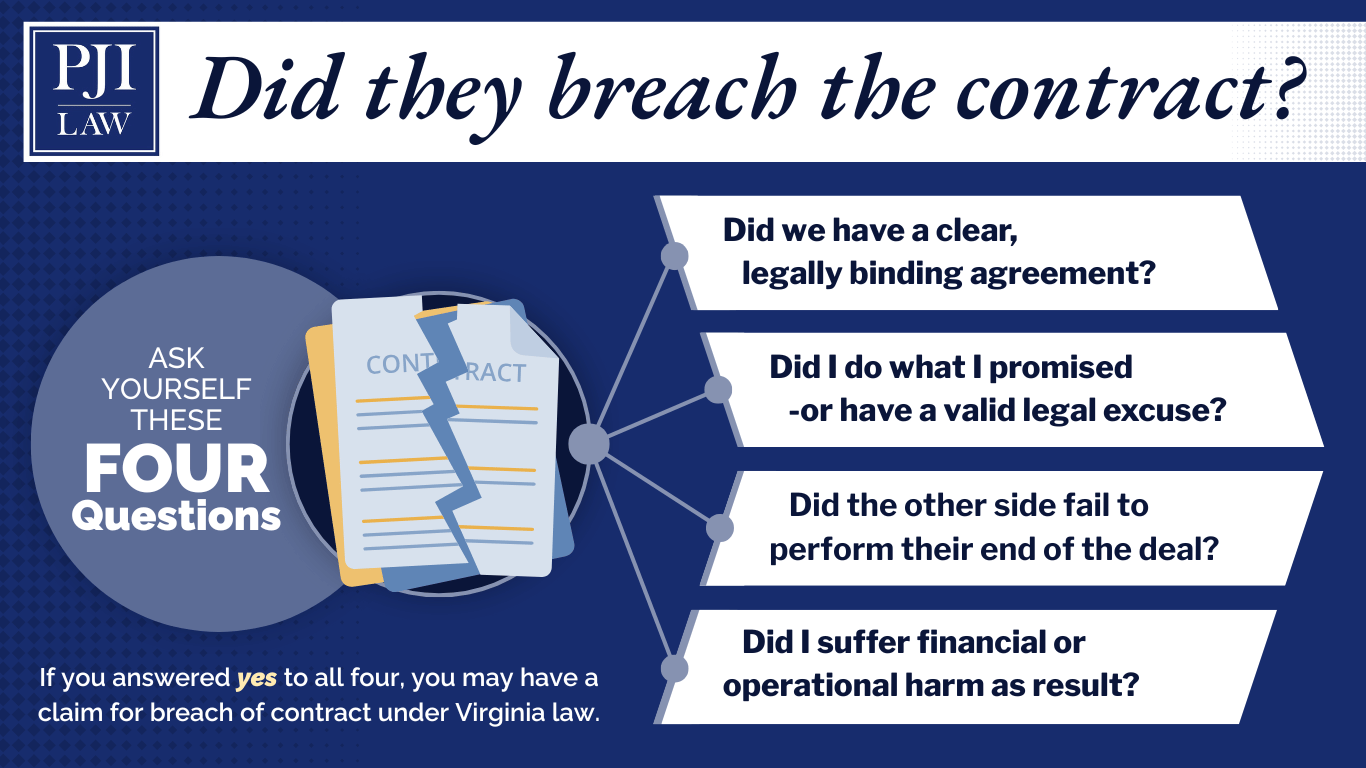
    Before deciding how to respond, consider four questions that can help distinguish an actionable breach from an ordinary contract disagreement. These questions reflect the issues Virginia courts examine when evaluating a breach of contract claim.

    1. Is There a Valid Contract?

    The first question is whether a legally enforceable contract exists. Depending on the circumstances, this may involve written contracts, oral agreements, or a combination of written communications and conduct demonstrating mutual agreement. The contract should clearly identify each party’s obligations.

    If you’re unsure whether an oral agreement may be enforceable, our blog discussing verbal contracts in Virginia explains when those agreements may be legally recognized.

    2. Did the Other Party Actually Fail to Perform?

    Not every disagreement constitutes a breach. Ask yourself whether the other party failed to fulfill a specific obligation required by the agreement. This might include failing to deliver products, refusing to complete agreed-upon services, missing contractual deadlines, or violating another important provision.

    The answer depends on what the contract actually required, not what either party assumed should have happened.

    3. Was the Failure Legally Excused?

    Sometimes a party’s performance is excused by the contract itself or by applicable law. In other situations, the other party may argue that you materially breached the agreement first, both parties agreed to modify the contract, or certain contractual duties were waived.

    Determining whether a legal excuse applies often requires a careful review of the contract language, the parties’ communications, and the events leading to the dispute.

    4. Did the Breach Cause Financial Harm?

    Finally, ask whether the alleged breach caused measurable losses. A successful breach of contract claim typically requires more than showing someone failed to perform. You must also demonstrate that the breach resulted in recognizable losses, such as unpaid amounts, additional completion costs, lost business opportunities in appropriate circumstances, or other damages recognized under Virginia law.

    Once these four questions have been considered, real-world examples can help show how the same principles apply to different types of contract disputes.

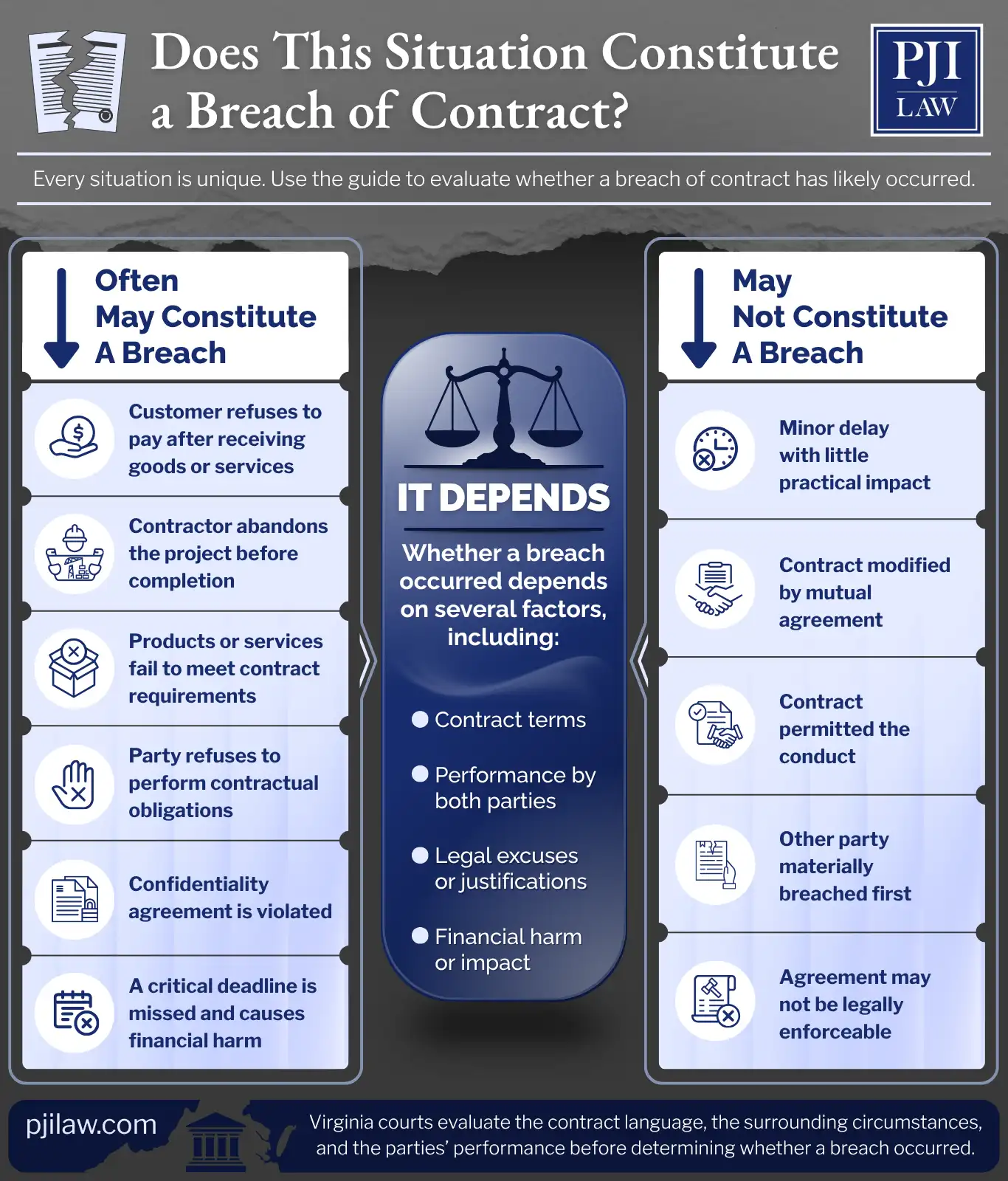
    Situations That Often Count as a Breach of Contract

     
    Situations That Often Count as a Breach of Contract

    The following examples show how a failure to perform may appear in common business and service agreements. Whether any particular event constitutes a breach ultimately depends on the contract terms, the parties’ conduct, and whether a legal excuse applies.

    A Customer or Client Refuses to Pay

    One of the most common contract disputes arises when a customer or business fails to pay after receiving the agreed-upon goods or services. If payment was required under the agreement and no legal excuse applies, failing to pay may constitute a breach of contract.

    A Contractor or Service Provider Walks Away from the Job

    A contractor, consultant, or service provider who abandons a project before completing the required work may be in breach if the agreement required completion and no legal excuse exists. Whether the breach is material often depends on how much work remains and how the unfinished performance affects the other party.

    Products or Services Do Not Meet the Contract Requirements

    A breach may occur when delivered goods or completed work fail to comply with the quality standards, specifications, quantities, or other provisions outlined in the agreement. For example, a supplier who delivers substantially fewer products than required or a contractor who performs work that fails to satisfy the contract specifications may have breached the agreement.

    A Party Refuses to Perform Its Contractual Duties

    Sometimes a party simply refuses to fulfill its obligations despite being capable of doing so. A vendor may decline to deliver products after accepting payment, or a business may refuse to provide services it agreed to perform. Depending on the circumstances, this type of refusal may constitute a material breach.

    A Confidentiality or Non-Disclosure Obligation Is Violated

    Many business contracts include confidentiality or non-disclosure provisions designed to protect sensitive information. If one party improperly discloses confidential information in violation of the agreement, that conduct may support a breach of contract claim, particularly if it causes financial harm.

    A Time-Sensitive Obligation Is Not Completed

    A missed deadline may support a breach of contract claim when timely performance was a significant part of the agreement and the delay caused measurable losses. For example, failing to deliver materials needed for a scheduled construction project or business event may have more serious consequences than a short delay that causes no disruption.

    Situations That May Not Count as a Breach of Contract

    Even when another party fails to do what you expected, the law does not always treat that conduct as a breach of contract. The contract terms, the parties’ actions, and the surrounding circumstances may show that no actionable breach occurred.

    A Minor Delay That Does Not Affect the Agreement’s Purpose

    Missing a deadline does not automatically constitute a material breach. If a supplier delivers products one day late but the delay causes no meaningful disruption or financial loss, the court may determine that the agreement was substantially performed.

    Whether a delay constitutes a breach often depends on the contract terms, the reason for the delay, and whether timely performance was an essential part of the agreement.

    The Parties Agreed to Change the Contract

    Business relationships often evolve after a contract is signed. The parties may agree to extend deadlines, modify pricing, change the scope of work, or revise other provisions.

    If both parties agreed to those changes, conduct that would otherwise appear to violate the original agreement may no longer constitute a breach.

    The Contract Allowed the Conduct

    Some agreements provide flexibility by allowing delays, substitutions, extensions, or alternative methods of performance under certain circumstances.

    Before concluding that a breach occurred, it’s important to review the entire agreement rather than relying on a single provision.

    The Other Party Breached First

    Virginia recognizes circumstances where one party’s prior material breach may affect the other party’s obligation to continue performing under the contract.

    For example, if a customer refuses to make required payments, the contractor may argue that continuing performance was no longer required because the other party materially breached the agreement first.

    The Agreement May Not Be Legally Enforceable

    Not every agreement creates a legally enforceable contract. If the parties never reached a binding agreement or an essential contract requirement is missing, a breach of contract claim may not succeed.

    Determining whether a valid contract exists often requires examining the specific facts, communications between the parties, and applicable Virginia law.

    Wondering whether your situation counts as a breach of contract in Virginia_Wondering whether your situation counts as a breach of contract in Virginia_

    When Does a Breach Become Material?

    Whether a breach is material can affect both parties’ remaining duties under the agreement. A material breach of contract is a substantial failure to perform that defeats the primary purpose of the agreement. Because the breach significantly affects what the other party expected to receive, Virginia courts may conclude that the non-breaching party is no longer required to continue performing its own contractual obligations.

    By contrast, a minor breach involves a less significant failure that does not substantially undermine the overall agreement. While the injured party may still have a claim for damages, the contract itself often remains enforceable, and both parties may still have continuing duties.

    Compare these examples:

    • A contractor abandons a commercial construction project after completing only 25% of the work. This is more likely to constitute a material breach because the unfinished work defeats the primary purpose of the agreement.
    • A software developer delivers a completed project one day late without causing any measurable business interruption. This is less likely to constitute a material breach because the delay did not substantially deprive the other party of the benefit of the bargain.
    • A supplier refuses to deliver products after accepting payment. This often constitutes a material breach because the supplier failed to perform a fundamental contractual obligation.
    • A consultant submits a required report one day after the agreed deadline without affecting the project. This is less likely to constitute a material breach because the agreement was still substantially performed.

    Every situation depends on the specific facts, the contract terms, and the extent to which the breach deprived the non-breaching party of the benefit of the bargain.

    Can Several Small Problems Become a Material Breach?

     
    Can Several Small Problems Become a Material Breach

    Sometimes no single issue appears serious enough to justify terminating the agreement. However, the cumulative effect of repeated failures may tell a different story.

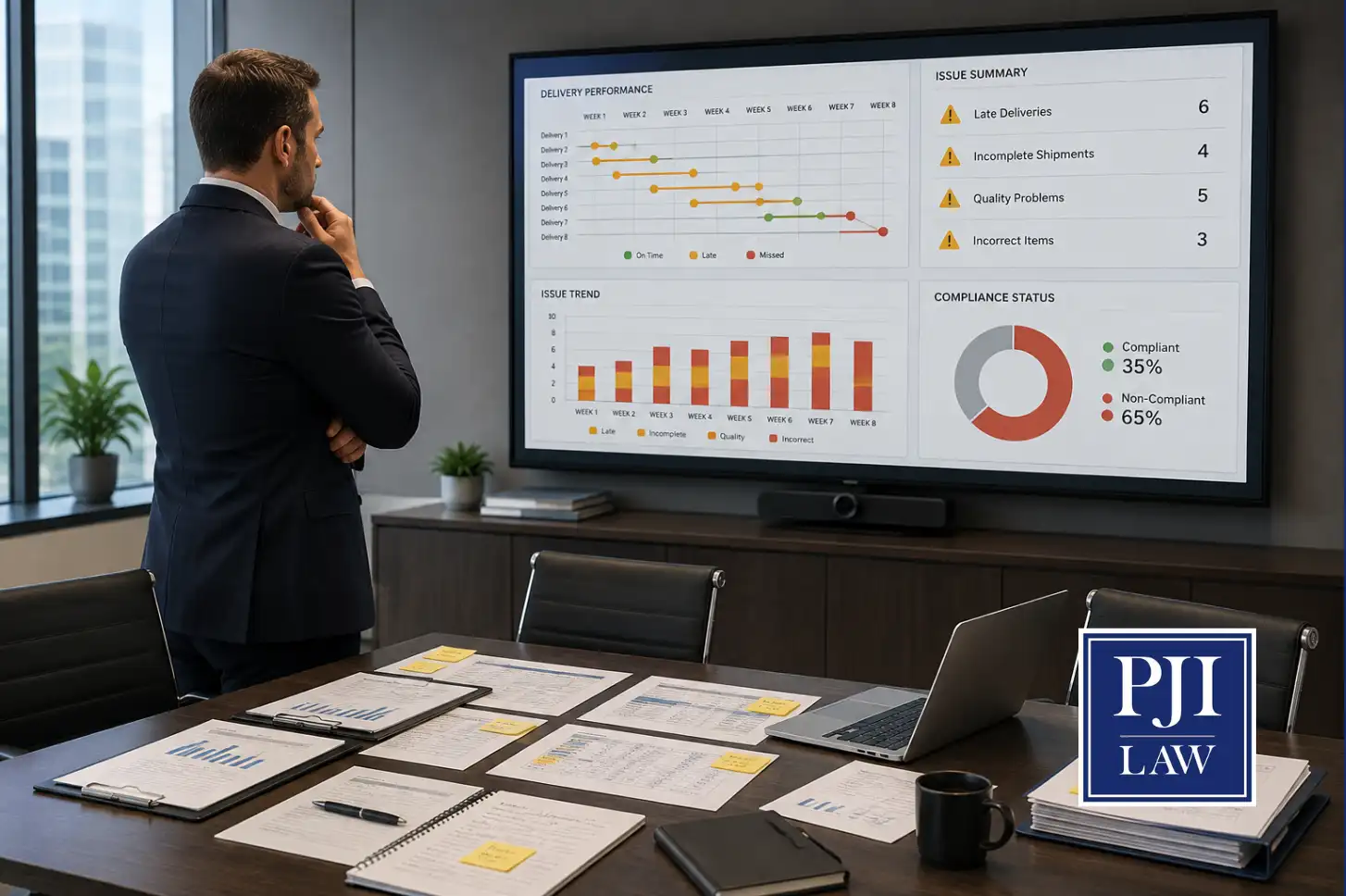
    For example, a vendor who repeatedly misses delivery deadlines, ships incomplete orders, ignores quality requirements, and fails to correct ongoing problems may create a pattern of noncompliance that substantially interferes with the agreement’s purpose.

    Rather than viewing each incident in isolation, a court may evaluate whether the cumulative effect of multiple breaches demonstrates a substantial failure to perform contractual obligations.

    This is one reason it’s important to document ongoing performance issues instead of focusing only on the most recent event.

    What Remedies May Be Available for a Breach of Contract?

    If a breach of contract claim is successful, Virginia law recognizes several remedies depending on the nature of the agreement and the harm suffered. The appropriate remedy depends on the contract, the circumstances of the breach, and the losses experienced by the injured party.

    Compensatory Damages

    Compensatory damages are the most common remedy in breach of contract actions. Their purpose is to place the non-breaching party as close as reasonably possible to the financial position they would have occupied had the contract been performed as agreed.

    Examples may include unpaid contract amounts, additional completion costs, or other proven financial losses resulting from the breach.

    Liquidated Damages

    Some contracts contain liquidated damages provisions that establish in advance the amount one party must pay if certain types of breaches occur.

    Virginia courts may enforce these provisions when they represent a reasonable estimate of anticipated damages rather than an unenforceable penalty. For contracts involving the sale of goods, liquidated damages provisions are specifically addressed under Virginia Code § 8.2-718.

    Specific Performance

    In some situations, monetary compensation alone may not adequately address the harm caused by a contract breach. A court may order specific performance, requiring the breaching party to fulfill contractual obligations.

    This remedy is more commonly considered when the contract involves unique goods or real property that cannot easily be replaced. For contracts involving unique goods, Virginia Code § 8.2-716 expressly authorizes specific performance in appropriate circumstances.

    Rescission

    Rescission cancels the agreement and seeks to restore the parties to substantially the same position they occupied before entering into the contract.

    This remedy may be appropriate in certain circumstances where continuing the contractual relationship is no longer practical.

    Restitution and Unjust Enrichment

    A court may also award restitution to prevent unjust enrichment when one party received a benefit under circumstances where retaining that benefit would be inequitable.

    Nominal Damages

    In limited situations, nominal damages may be awarded when a breach occurred but the plaintiff cannot demonstrate significant financial loss.

    Are Punitive Damages Available?

    Punitive damages are not typically available in ordinary breach of contract cases. However, they may become relevant when the dispute also involves an independent tort, such as fraud, and Virginia law otherwise permits their recovery.

    Does This Situation Constitute a Breach of Contract_

    What Should You Do if You Believe a Contract Was Breached?

    If you believe another party violated a contract, the actions you take immediately afterward may affect your legal options.

    Consider taking the following steps:

    • Review the contract carefully before concluding that a breach occurred.
    • Preserve the signed agreement, amendments, emails, text messages, invoices, payment records, and other relevant evidence.
    • Document how the alleged breach affected your business or finances.
    • Continue complying with your own contractual duties unless the agreement or applicable law allows otherwise.
    • Avoid making assumptions about your legal rights without first evaluating the specific circumstances.
    • Consult experienced Virginia contract attorneys if significant financial interests are involved or you’re uncertain how to respond.

    Early legal guidance may help identify available remedies, preserve important evidence, and evaluate whether negotiation, mediation, or legal proceedings provide the most appropriate path toward resolving the dispute.

    Frequently Asked Questions

    What is considered a breach of contract in Virginia?

    A breach of contract occurs when one party fails to fulfill contractual obligations required by a valid agreement without a legal excuse, and the breach leads to legally recognized harm.

    Does every broken promise qualify as a breach of contract?

    Not every disagreement, missed deadline, or disappointing outcome constitutes a breach of contract. The answer depends on the agreement’s language, the surrounding circumstances, and whether the failure materially affected the contract.

    What is a material breach?

    A material breach is a substantial failure to perform that defeats the primary purpose of the agreement. A material breach may excuse the non-breaching party from continuing to perform under the contract.

    Can several minor breaches become a material breach?

    In some situations, Virginia courts may consider the cumulative effect of repeated failures when determining whether the overall performance amounts to a material breach.

    How long do I have to file a breach of contract lawsuit in Virginia?

    The statute of limitations is generally five years for written contracts and three years for oral contracts under Virginia Code § 8.01-246. The applicable deadline depends on the type of agreement and the specific facts of your case.

    What damages are available in a breach of contract case?

    Depending on the circumstances, breach of contract damages may include compensatory damages, liquidated damages, specific performance, rescission, restitution, or nominal damages. The appropriate remedy depends on the contract, the nature of the breach, and the losses suffered by the non-breaching party.

    Can I recover attorney’s fees?

    Attorney’s fees are not automatically awarded in Virginia breach of contract cases. Whether they are recoverable often depends on the language of the contract or another applicable legal basis.

    Can a verbal agreement be enforced?

    In some situations, yes. Virginia recognizes certain oral agreements, although proving their terms may present additional challenges. The specific facts determine whether an oral agreement is legally enforceable.

    Do I have to file a lawsuit immediately?

    Depending on the circumstances, negotiation, mediation, or other dispute resolution methods may resolve contract disputes without litigation.

    When should I contact a Virginia contract attorney?

    You should consider speaking with a contract attorney if the dispute involves significant financial losses, complex contract terms, uncertainty about your legal rights, or questions about the remedies that may be available.

    Are you searching for “contract attorney near me” to pursue a breach of contract claim in Virginia_

    Find Out Where You Stand Before a Contract Dispute Escalates

    A contract dispute can interrupt your business, affect important relationships, and create uncertainty about your next steps. Whether you’re evaluating a potential breach, responding to allegations that you’ve violated an agreement, or trying to resolve a dispute before litigation becomes necessary, evaluating your legal options early can help you avoid decisions that may affect your claim or your ability to enforce the agreement.

    At PJI Law, PLC, our Virginia contract dispute lawyers represent businesses and individuals throughout Northern Virginia in a wide range of contract matters, including drafting agreements, resolving contract disputes, and pursuing or defending breach of contract claims. We provide white-glove service and personal attention while developing legal strategies tailored to your specific circumstances.

    If you have questions about a potential breach of contract in Virginia, call (703) 865-6100 or contact us online to schedule your complimentary consultation.

    At PJI Law, you’ll receive white-glove service and personal attention from a team that treats you like family.

    Copyright © 2026. PJI Law, PLC. All rights reserved.

    The information in this blog post (“post”) is provided for general informational purposes only and may not reflect the current law in your jurisdiction. No information in this post should be construed as legal advice from the individual author or the law firm, nor is it intended to be a substitute for legal counsel on any subject matter. No reader of this post should act or refrain from acting based on any information included in or accessible through this post without seeking the appropriate legal or other professional advice on the particular facts and circumstances at issue from a lawyer licensed in the recipient’s state, country, or other appropriate licensing jurisdiction.

    PJI Law, PLC
    3900 Jermantown Road, 2nd Floor
    Fairfax, VA 22030
    (703) 865-6100
    https://www.pjilaw.com

  • What Are the 4 Elements of Fraudulent Misrepresentation in Contract Law in Virginia?

    What Are the 4 Elements of Fraudulent Misrepresentation in Contract Law in Virginia?

    Signing a contract often requires trust. Whether you’re entering into a business transaction, purchasing property, or negotiating another agreement, you expect the information you’re given to be accurate. When someone intentionally provides false information to persuade you to act, the consequences can be significant.

    Although a fraudulent misrepresentation claim is a separate legal claim from a breach of contract claim, it typically grows out of a contract negotiation or transaction, which is why it carries real weight in contract law. In some circumstances, Virginia law allows an injured party to pursue fraud claims based on fraudulent misrepresentation.
    However, not every inaccurate statement will constitute fraud. Courts require proof of specific elements before a plaintiff can recover damages. Understanding those elements can help you determine whether your situation may involve fraudulent misrepresentation in contract law and whether it may be time to speak with Northern Virginia fraud attorneys about your legal options.

    At a Glance

    • Fraudulent misrepresentation occurs when a party relies on a false statement and suffers harm as a consequence.
    • Virginia courts require proof of several key elements before allowing fraud claims to proceed.
    • The statement must involve a material fact rather than an opinion or prediction about future events.
    • Fraudulent inducement may occur when a person is persuaded to enter a contract based on false information.
    • Actual fraud and constructive fraud involve different legal standards.
    • Available remedies may include compensatory damages, punitive damages, rescission of the contract, or other relief.

    What Is Fraudulent Misrepresentation in Contract Law?

    Fraudulent misrepresentation in contract law occurs when one party makes a false representation of an important fact, intending for another party to rely on it, and that reliance leads to harm.

    For example, a business owner may knowingly provide inaccurate financial information to convince someone to purchase a company. A seller may fail to disclose significant defects in a property while making statements suggesting no problems exist. In these circumstances, the issue may go beyond a simple breach of contract and rise to the level of fraud.

    Virginia courts carefully examine the facts of each case because fraud allegations can have serious legal and financial consequences. A plaintiff must present proof that the defendant’s conduct meets the required legal elements.

    The 4 Elements of Fraudulent Misrepresentation in Virginia

    Fraudulent misrepresentation is often explained through four core elements. While Virginia case law may describe fraud using five or six elements depending on how the courts separate each concept, these four concepts provide a practical framework for understanding what courts generally look for when evaluating fraud claims.

    1. A False Representation of a Material Fact

    The first element requires a false statement involving a material fact. A material fact is information that would influence a reasonable person’s decision-making process. In other words, the information is important enough that it could affect whether someone enters into a contract or business transaction.

    Not every inaccurate statement qualifies. Virginia courts distinguish between statements of fact and statements of opinion.

    For example:

    • “This company generated $2 million in revenue last year” may be a statement of fact.
    • “I think this business will double in value next year” is generally an opinion.

    Similarly, unfulfilled promises about future events do not automatically constitute fraud. Courts often focus on whether the statement concerned a present or existing fact rather than a prediction about what may happen later.

    2. Knowledge That the Statement Was False

    The second element involves knowledge. To establish actual fraud, a plaintiff must show that the defendant knew the statement was false when it was made or acted with reckless disregard for the truth.

    This requirement helps separate fraud from honest mistakes. People can make inaccurate statements without committing fraud. Fraud generally involves conduct that is intentional or knowingly deceptive.

    Evidence showing that a person had access to accurate information but chose to provide false information may help support this element.

    3. Intent to Induce Reliance

    A false statement alone is not enough. The plaintiff must also show that the defendant made the statement with the intent to influence another party’s decision. This concept is often associated with fraudulent inducement. Fraudulent inducement occurs when a person is persuaded to enter a contract because of false information provided during negotiations.

    For example, if a defendant intentionally misrepresents a business’s financial condition to convince a buyer to sign an agreement, a court may determine that the statement was intended to induce reliance. Intent can be difficult to prove directly. For this reason, courts frequently examine surrounding circumstances, communications, and conduct when evaluating allegations of fraud.

    4. Reasonable Reliance That Causes Harm

    The fourth element requires proof that the plaintiff reasonably relied on the false representation and suffered harm because of it. Reasonable reliance means the plaintiff actually relied on the statement and that such reliance was justified under the circumstances.

    Courts may examine factors such as:

    • The relationship between the parties
    • The information available at the time
    • Whether the plaintiff had an opportunity to investigate
    • The sophistication of the parties involved

    If the plaintiff relied on the misrepresentation and suffered financial losses, the court may find that this element has been satisfied. Without reliance and the harm it causes, a fraud claim may fail even if a false statement was made.

    How Fraudulent Misrepresentation Differs From a Breach of Contract

    Many people assume that every broken promise amounts to fraud. That is not necessarily true. The difference between fraud vs. breach of contract comes down to timing and intent. A breach of contract generally occurs when one party fails to perform obligations outlined in an agreement. Fraud, on the other hand, typically involves deception that occurs before or during the formation of the contract.

    The distinction can be important because fraud litigation may allow recovery under legal theories that extend beyond ordinary contract remedies. For example, if a business simply fails to perform under a contract, the dispute may involve breach of contract. However, if the business intentionally misled the other party to secure the agreement in the first place, the facts may support fraud claims in addition to contract-based claims.

    Because these distinctions can be complex, courts frequently analyze whether the alleged misconduct is truly separate from the contractual obligations themselves.

    Actual Fraud vs. Constructive Fraud Under Virginia Law

    Virginia law recognizes both actual fraud and constructive fraud. Actual fraud involves intentional deception. The plaintiff must show that the defendant knowingly made false statements with the intent to mislead another person.

    Constructive fraud differs because it may arise even when there is no intent to deceive. In certain circumstances, a false statement made negligently can create liability if another party reasonably relied on the information and suffered harm.

    The distinction can significantly affect how a case proceeds and the type of proof required. When evaluating allegations of actual fraud or constructive fraud, courts often conduct a detailed investigation of the facts, communications, documents, and circumstances surrounding the transaction.

    What Evidence May Help Support a Fraud Claim?

    Successfully pursuing fraud litigation often requires substantial evidence. Depending on the circumstances, relevant proof may include:

    • Contracts and written agreements
    • Emails and text messages
    • Financial records
    • Marketing materials
    • Internal business documents
    • Witness testimony
    • Corporate records
    • Communications between the parties

    Fraud cases can be challenging because defendants rarely admit they intended to mislead someone. For that reason, attorneys often build cases using documents, timelines, inconsistencies, and other evidence that helps establish intent.

    In many cases, plaintiffs must satisfy a heightened burden of proof by presenting clear and convincing evidence rather than merely showing that their version of events is slightly more likely than not.

    What Remedies May Be Available in a Virginia Fraud Case?

    The remedies available in a fraud case depend on the facts and circumstances involved. Potential remedies may include:

    • Compensatory damages for financial losses
    • Rescission of the contract
    • Recovery of out-of-pocket expenses
    • Punitive damages in appropriate cases, capped at $350,000 under Virginia Code § 8.01-38.1, available only upon clear and convincing evidence of egregious conduct
    • Other relief authorized by Virginia law

    The court will evaluate the evidence, the extent of the losses, and the nature of the defendant’s conduct when determining what remedies may be appropriate.

    Because each case is different, the availability of damages often depends on the specific allegations and supporting proof presented to the court.

    Frequently Asked Questions

    What is fraudulent misrepresentation in contract law?

    Fraudulent misrepresentation occurs when a person makes a false statement about a material fact, another party relies on that statement, and the reliance causes harm.

    What is the difference between actual fraud and constructive fraud?

    Actual fraud involves intentional deception, while constructive fraud may arise from negligent misrepresentations even when there was no intent to deceive.

    What is fraudulent inducement?

    Fraudulent inducement occurs when a person is persuaded to enter into a contract based on false information or misrepresentations.

    What evidence is commonly used to prove fraud?

    Evidence may include contracts, emails, financial records, witness testimony, corporate documents, and other materials showing what was said, what was known, and how the parties acted.

    Can a fraud claim exist alongside a breach of contract claim?

    In some circumstances, yes. Courts may allow both claims when the alleged fraud involves conduct that is separate from the contractual obligations themselves.

    Can a false opinion be considered fraud in Virginia?

    Generally, opinions are not treated the same as statements of fact. However, there may be exceptions when a person presents an opinion as fact or possesses information that makes the statement misleading under the circumstances.

    How long do I have to file a fraud lawsuit in Virginia?

    In Virginia, you have two years from the date you discovered or reasonably should have discovered the fraud to file a lawsuit, under Virginia Code § 8.01-243. Virginia Code § 8.01-249(1) establishes that the discovery rule controls when that two-year clock starts, so the deadline can vary based on when the fraud came to light. Given how much weight the discovery date carries, it’s worth speaking with an attorney as soon as you suspect fraud.

    What does reasonable reliance mean in a fraud case?

    Reasonable reliance means that a person relied on a false statement and that such reliance was justified under the circumstances. Courts often examine the relationship between the parties, the information available, and whether additional investigation would have been expected.

    Can a business be liable for fraudulent misrepresentation?

    Yes. Businesses, corporations, and other entities may be held liable when their representatives make fraudulent statements or engage in conduct that supports a valid fraud claim.

    Can I recover punitive damages in a Virginia fraud case?

    Virginia law caps total punitive damages at $350,000 regardless of how serious the misconduct was, under Virginia Code § 8.01-38.1. Courts require clear and convincing evidence of intentional or egregious conduct before awarding punitive damages, which is a higher bar than the standard used for compensatory damages.

    When Suspected Fraud Puts Your Financial Interests at Risk, Speak With Northern Virginia Fraud Attorneys

    Discovering that you may have entered into a contract based on false information can raise difficult questions. Was it simply a failed business deal, or did someone’s conduct cross the line into fraud? The answer often depends on the specific facts, the available evidence, and how Virginia law applies to your situation.

    The Northern Virginia fraud attorneys at PJI Law, PLC represent individuals and businesses involved in complex fraud litigation, contract disputes, and claims involving fraudulent inducement, actual fraud, and constructive fraud. Our attorneys carefully investigate the circumstances surrounding each matter, evaluate potential claims and defenses, and develop legal strategies tailored to our clients’ goals.

    If you believe misrepresentations played a role in a contract or business transaction, call (703) 865-6100 or contact us online to schedule your consultation today.

    At PJI Law, you’ll receive white-glove service and personal attention from a team that treats you like family.

    Copyright © 2026. PJI Law, PLC. All rights reserved.

    The information in this blog post (“post”) is provided for general informational purposes only and may not reflect the current law in your jurisdiction. No information in this post should be construed as legal advice from the individual author or the law firm, nor is it intended to be a substitute for legal counsel on any subject matter. No reader of this post should act or refrain from acting based on any information included in or accessible through this post without seeking the appropriate legal or other professional advice on the particular facts and circumstances at issue from a lawyer licensed in the recipient’s state, country, or other appropriate licensing jurisdiction.

    PJI Law, PLC
    3900 Jermantown Road, 2nd Floor
    Fairfax, VA 22030
    (703) 865-6100
    https://pjibe.webteam.ai/

  • Do Verbal Contracts Hold Up in Court in Virginia?

    Do Verbal Contracts Hold Up in Court in Virginia?

    You make a deal. No paperwork. No signatures. Just a conversation over coffee and an understanding.

    Then something changes. The other party backs out, refuses to pay, or claims the agreement never existed. Now you’re left wondering what your legal rights actually are. Do verbal contracts hold up in court, or mean anything at all?

    The answer is yes, sometimes. Under Virginia law, verbal contracts can be legally binding and legally enforceable, but only if specific requirements are met. And even when a valid contract exists, proving it is where many contract disputes fall apart.

    At a Glance

    • Verbal agreements can be legally binding agreements under Virginia contract law.
    • A valid contract requires six elements.
    • Certain contracts must be in writing under the Virginia statute of frauds.
    • The biggest challenge with oral contracts is proving the agreement in court.
    • A breach of contract claim depends on evidence and performance.
    • Virginia courts evaluate conduct, communications, and credibility.
    • Written contracts remain the safest way to protect your business interests.

    Are Verbal Agreements Legally Binding Under Virginia Law?

    In many situations, yes. Oral contracts can create a binding agreement between two or more parties if the required elements are present.

    When those elements are met, an enforceable contract exists even without a written agreement. A verbal agreement can carry the same legal weight as many written contracts, and the conduct of the parties after the fact often becomes part of how Virginia courts assess whether a deal was genuinely struck. The issue is rarely whether a contract exists. The issue is whether it can be proven.

    What Makes a Contract Valid in Virginia?

    Courts focus on the substance of the agreement rather than whether it was written down. To determine if a contract is enforceable, Virginia courts look for core elements that show a real agreement was formed.

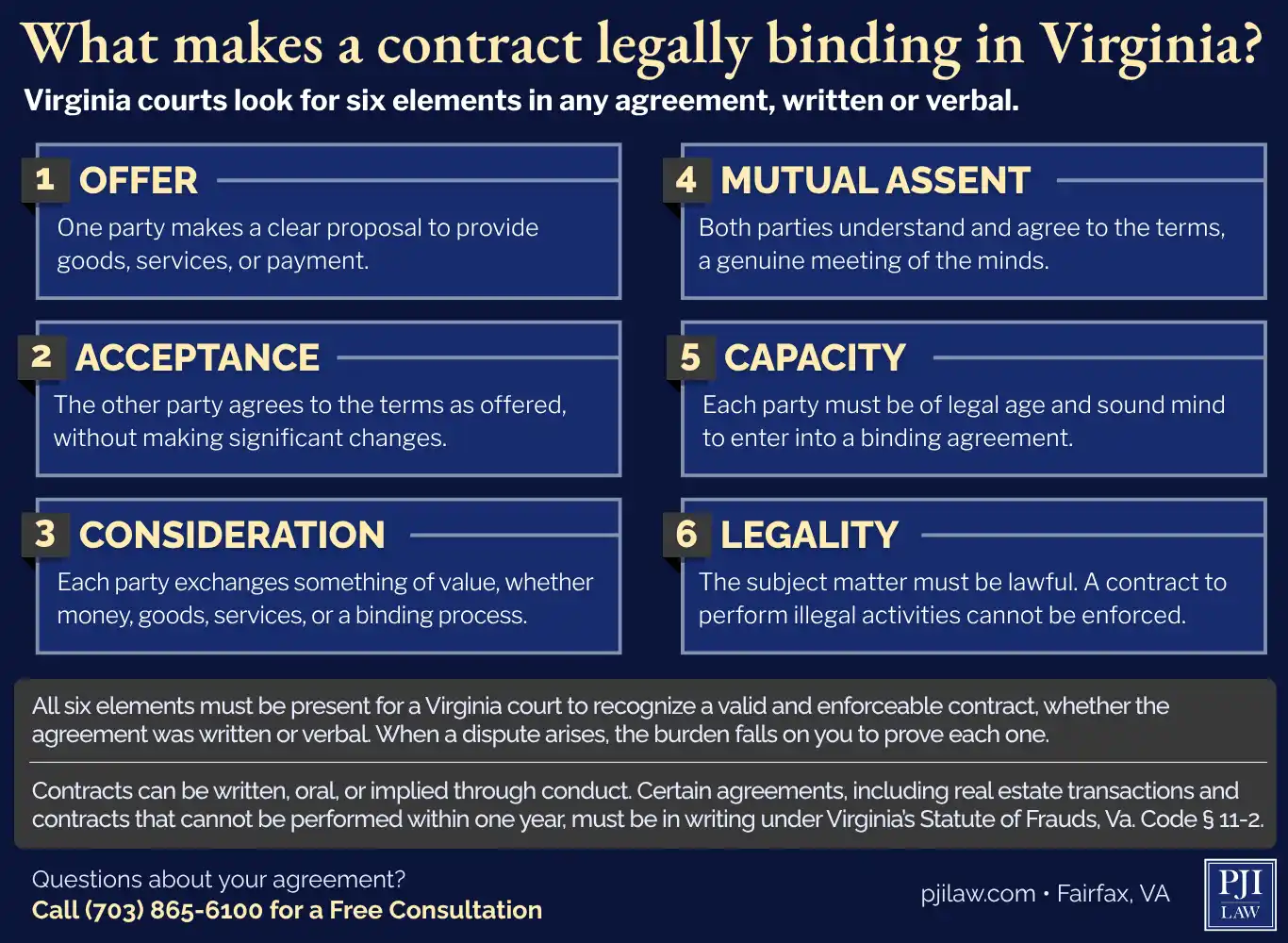
    A valid contract typically includes the following:

    • Offer: One party presents a clear proposal, whether that’s agreeing to perform work, deliver goods, or make a payment.
    • Acceptance: The other party agrees to those terms without materially changing what was proposed.
    • Consideration: Both sides exchange something of value, which can be money, services, goods, or a binding promise to act.
    • Mutual Assent: Both parties reach a genuine meeting of the minds, meaning they understand and agree to the same terms.
    • Capacity: Each party must have the legal ability and sound mind to enter into a binding agreement.
    • Legality: The purpose of the contract must be lawful. Courts will not enforce agreements built around illegal activity.

    These are the elements of a valid contract in Virginia and form the foundation of Virginia contract law. Without them, a contract claim will not succeed. In many contract cases, the dispute centers on whether these elements were clearly established, and that challenge becomes even more pronounced when dealing with oral contracts and no documentation to fall back on.

    When a Verbal Contract Will Not Hold Up in Court


    Virginia law places limits on when verbal agreements are enforceable, particularly under the statute of frauds.

    Even though many contracts can be verbal, Virginia law requires certain agreements to be in writing under the Virginia statute of frauds (Va. Code § 11-2), which limits when oral contracts are legally enforceable.

    Contracts That Must Be in Writing

    • Real estate sales or leases exceeding one year
    • Contracts that cannot be completed within a reasonable time, typically more than one year.
    • Promises to lend money or extend credit in an aggregate amount of $25,000 or more (Va. Code § 11-2(9))
    • Promises to pay another party’s debt
    • Non-disclosure agreements and certain specialized arrangements

    If a contract falls into one of these categories and is not documented in a written agreement, it may not be enforceable in court even if both parties believed they had a deal. This is where case law in Virginia draws a firm line, and where having a contract attorney review your arrangement early can prevent costly surprises.

    How Virginia Courts Evaluate Verbal Agreements

    When a dispute reaches Virginia courts, the focus shifts to evidence. Without written contracts, the court must determine what the parties actually agreed to based on their actions and communications.

    Courts often examine emails, text messages, invoices, payment history, and witness testimony. They may also look at whether one party began performing under the agreement or whether the other party accepted benefits from the arrangement. Good faith conduct matters, and Virginia courts pay close attention to consistency between what was said and what was done.

    Even when a valid contract exists, the lack of documentation creates uncertainty. Many contract claims involving oral agreements come down to credibility and consistency rather than clear proof, which is why building a record of your communications and own performance from the start is always worth the effort.

    The Biggest Risk With Verbal Contracts in Business Deals

    In a business contract setting, verbal agreements create risk that often does not become obvious until a problem arises. When expectations are not clearly documented, disputes can develop over what each party agreed to do, when performance was expected, and how payment should be handled.

    One party may believe the agreement included certain contract terms, while the other party remembers it differently. This is where many Virginia breach of contract claims become difficult. Without a written agreement, the non-breaching party may struggle to show exactly what contractual obligations were agreed to and how the breaching party failed to meet them.

    Potential breaches can also arise from ambiguity rather than bad faith. When contract terms are vague, one party may not even realize they have fallen short of what was expected. That kind of dispute is far harder to resolve than one with clear documentation behind it.

    Can You Sue for Breach of a Verbal Contract in Virginia?

    Yes, you can pursue a breach of contract claim based on a verbal agreement. However, success depends on your ability to prove the agreement and the breach.

    To seek damages, you must show that a valid contract exists, that you performed your contractual obligations or were ready to perform, and that the other party failed to do so. You must also show that the breach caused measurable harm. If a party breached the agreement without a legal excuse, the aggrieved party may seek compensation through the court system.

    It is also worth understanding anticipatory breach, which occurs when one party makes clear before performance is due that they will not fulfill their obligations. In Virginia, that repudiation must be clear, absolute, and unequivocal. Virginia courts recognize this as a contract breach before the performance date arrives, and it can give the aggrieved party the right to act without waiting for the breach to fully materialize.

    What Happens When a Breach Occurs

    When a breach occurs, Virginia law can allow several possible resolutions, depending on the nature of the agreement and the harm involved.

    Legal Remedies Available

    • Compensatory damages for direct financial losses
    • Consequential damages for related losses caused by the breach
    • Specific performance in limited situations where monetary damages are not sufficient

    In some cases, legal disputes may also involve contract termination, whether there was substantial performance, or whether the conduct of the parties met the standard of good faith. Virginia courts generally will not rewrite a contract term that is found to be overbroad or unenforceable. If a specific provision cannot stand on its own, courts will typically strike it entirely rather than modify it to make it work.

    How Virginia’s Commercial Sales Law Affects Verbal Business Contracts

    Most verbal contract disputes fall under general contract law, but business deals involving the sale of goods operate under a separate framework. Under Va. Code § 8.2-201, a verbal agreement for goods valued at $500 or more is generally not enforceable without a written record.

    When a contract mixes goods and services, Virginia courts apply the predominant purpose test to determine which framework governs. If the primary purpose of the agreement is the sale of goods, Va. Code § 8.2-201 applies even if services are also involved.

    There are two limited exceptions worth knowing. If both parties are merchants and one sends a written confirmation the other does not object to within a reasonable time, that confirmation may satisfy the writing requirement. If one party has already accepted goods or made partial payment, courts may recognize the contract to the extent of what was accepted or paid.

    If your verbal business contract involves goods, speaking with a contract attorney early gives you the best chance to assess whether Va. Code § 8.2-201 applies, what exceptions may be available, and how to negotiate a resolution or build a legal strategy for court.

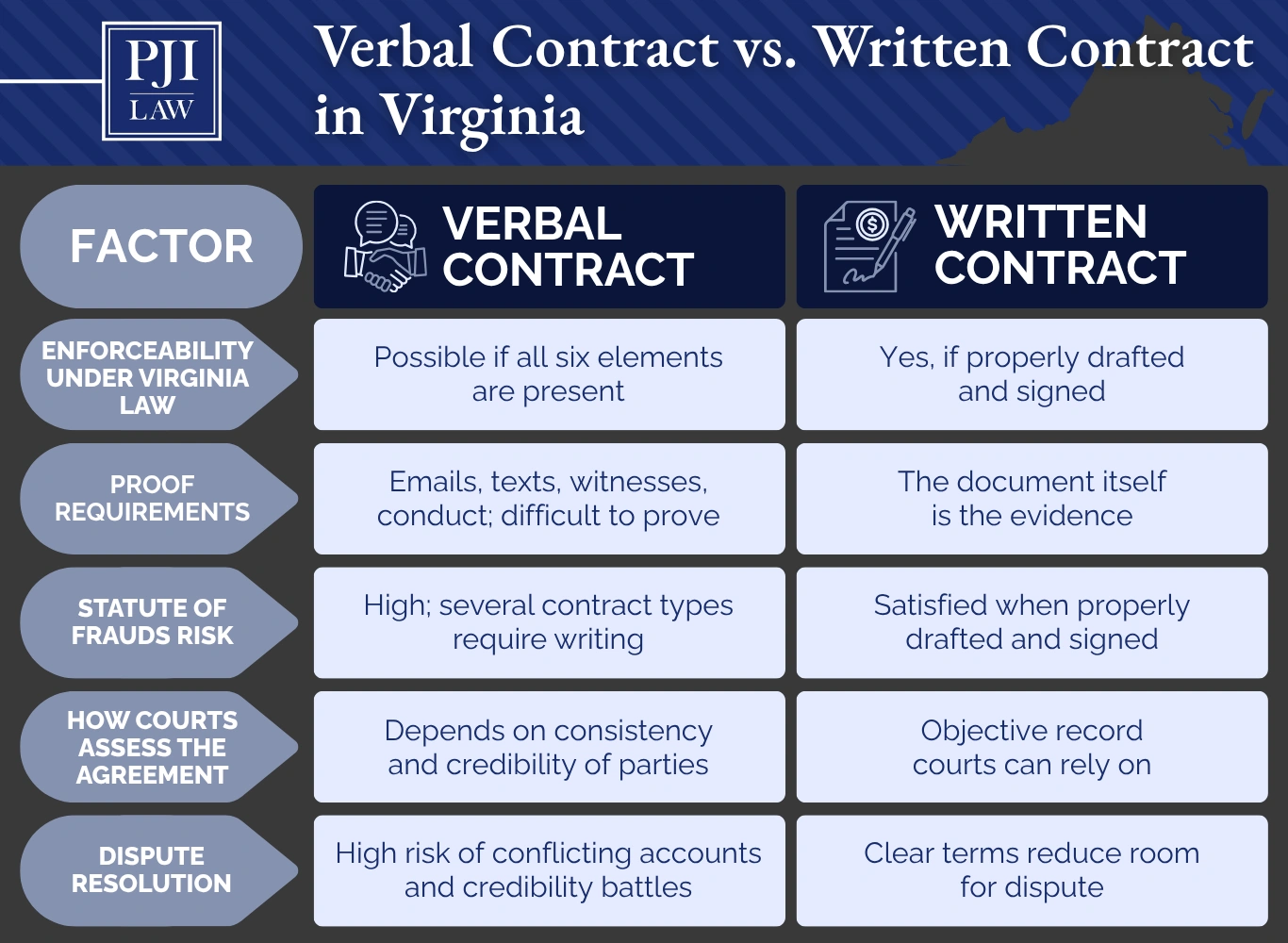
    Here’s how verbal and written contracts compare under Virginia law:

    A Practical Example of a Verbal Contract Dispute

    You enter into a verbal agreement with another business for services. You complete the work, expecting payment based on what was discussed. The other party refuses to pay, claiming the agreement was different.

    If you have supporting evidence such as emails, invoices, or proof of your own performance, you may be able to pursue a breach of contract claim. If you experienced a breach but have little documentation, the case becomes significantly harder to prove, and the other party’s version of events may carry more weight in court.

    This is a common scenario in contract disputes, and it highlights why documentation matters even when a contract is legally valid. A contract lawyer reviewing your position early can help you assess what evidence you have and what legal strategy makes the most sense.

    When You Should Put a Contract in Writing

    While verbal agreements can be enforceable, relying on them creates unnecessary risk. You should strongly consider a written contract when:

    • The agreement involves a large amount of money
    • Performance extends over time
    • Multiple parties are involved
    • Your business interests or contractual obligations could be affected by a dispute

    A written agreement provides clarity, reduces misunderstandings, and gives you stronger protection if a contract breach or contract dispute arises. It also gives both parties a shared reference point, which can prevent the kind of credibility battles that make oral contract claims so difficult.

    Steps to Take If a Verbal Contract Is Broken

    If you believe a contract breach has occurred, taking early action can help protect your position.

    • Gather any communications or documentation that supports your claim, including messages, invoices, or proof of performance. 
    • Consider sending a demand letter to the other party, outlining what was agreed to and how the breach occurred. 
    • Speak with a contract attorney early to assess your legal rights, evaluate your options, and build a clear legal strategy.

    Acting quickly matters. Evidence fades, witnesses forget details, and delay can weaken an otherwise strong breach of contract claim. Note that Virginia law under Va. Code § 8.01-246 generally provides five years to bring a claim on a written contract and three years on an oral contract, and the clock typically starts on the date of the breach, not the date of the agreement. The sooner you document what happened and seek legal representation, the better your position.

    Frequently Asked Questions

    Q: Do verbal contracts hold up in court in Virginia?

    A: Yes, verbal agreements can be legally binding and legally enforceable under Virginia law if they meet the requirements of a valid contract and are not barred by the statute of frauds.

    Q: What is the biggest issue with oral contracts?

    A: Proof. Without written contracts, contract disputes often come down to conflicting accounts between the parties, and Virginia courts must weigh credibility rather than documentation.

    Q: Can you sue for breach of a verbal agreement?

    A: Yes. You can pursue a breach of contract claim if you can prove a valid contract existed, show what contractual obligations were agreed to, and demonstrate that the other party failed to perform.

    Q: What types of contracts must be in writing?

    A: Certain contracts, including real estate agreements, agreements that cannot be performed within a reasonable time, and promises to pay another’s debt, must be in a written agreement under the Virginia statute of frauds.

    Q: What is anticipatory breach?

    A: Anticipatory breach occurs when one party makes it clear, through words or actions, that they will not fulfill their obligations before their performance is actually due. In Virginia, this repudiation must be clear, absolute, and unequivocal. This allows the non-breaching party to pursue a legal claim immediately, rather than waiting for the actual date of performance to pass.

    Q: Is a written contract always better?

    A: From a documentation standpoint, yes. A written contract establishes clear contract terms, documents each party’s contractual obligations, and makes enforcement significantly easier if a dispute arises.

    When a Verbal Agreement Is on the Line, Have a Legal Team in Your Corner

    You shouldn’t have to argue over what was said. Whether you’re trying to enforce an oral agreement, defend against a breach of contract claim, or put stronger written contracts in place going forward, PJI Law, PLC is ready to help you take the right next step.

    Our legal team works with clients across Northern Virginia on contract disputes of all kinds, from proving the terms of a verbal agreement in court to drafting written contracts that hold up when the pressure is on. We examine the facts of your situation, identify your legal options, and work alongside you at each stage of the process.

    Our Virginia business contract attorneys know how courts weigh oral contracts, what evidence matters most, and how to build a legal strategy tailored to your specific circumstances.

    Call (703) 865-6100 or contact us online to schedule your complimentary consultation today. From your first call to your final resolution, you’ll have a dedicated legal team standing behind you every step of the way.

    At PJI Law, you’ll receive white-glove service and personal attention from a team that treats you like family.

    Copyright © 2026. PJI Law, PLC. All rights reserved.

    The information in this blog post (“post”) is provided for general informational purposes only and may not reflect the current law in your jurisdiction. No information in this post should be construed as legal advice from the individual author or the law firm, nor is it intended to be a substitute for legal counsel on any subject matter. No reader of this post should act or refrain from acting based on any information included in or accessible through this post without seeking the appropriate legal or other professional advice on the particular facts and circumstances at issue from a lawyer licensed in the recipient’s state, country, or other appropriate licensing jurisdiction.

    PJI Law, PLC
    3900 Jermantown Road, 2nd Floor
    Fairfax, VA 22030
    (703) 865-6100
    https://pjibe.webteam.ai/

  • Handshake Deal vs. Written Contract: What Virginia Law Actually Cares About

    Handshake Deal vs. Written Contract: What Virginia Law Actually Cares About

    You make a deal. Maybe it’s a quick conversation, a handshake, or a promise between you and another party. At the time, it felt clear. You both agree on what needs to happen. Then something changes. The other party doesn’t follow through, and now you’re left asking what that agreement actually means under Virginia law.

    You may be wondering whether verbal agreements hold any weight or if you needed a written contract from the start. The answer isn’t always as simple as people think. In many situations, a handshake deal can form a legally binding agreement, but when a dispute arises, the details and the proof start to matter a great deal.

    At a Glance

     
    At a Glance

    • Why written contracts are far easier to enforce than handshake deals
    • When a verbal agreement is still legally binding in Virginia
    • How contract disputes are evaluated without a written record
    • When Virginia law requires a contract to be in writing
    • Why putting it in writing is the smarter choice, even when not required
    • What happens when one party fails to perform
    • How PJI Law, PLC can help protect your interests

    Handshake Deal vs. Written Contract: Key Differences

    The biggest practical difference between a handshake deal and a written contract isn’t whether it can be enforced. It’s how hard you’ll have to work to prove what you agreed to.

    A written contract gives you a clear record of the terms from day one. Payment amounts, deadlines, and obligations are documented and signed. When a dispute arises, a written contract provides an objective baseline. With an oral contract, you are often left with a story, and the other party may have a different one.

    That gap is where most handshake deals fall apart. Not because the agreement wasn’t real, but because two people who shook hands in good faith often walk away with different memories of what was said. A written agreement closes that gap before it has a chance to open.

    Looking for a contract disputes attorney in Virginia

    Are Verbal Agreements Legally Binding in Virginia?

    Yes, verbal agreements are legally binding in Virginia, provided the required elements of a contract are present. A handshake deal is simply an informal way of describing an oral contract: an agreement made through spoken words rather than a signed document. These agreements may be enforceable if the parties involved reach a clear understanding and intend to be bound by it.

    However, when a contract dispute arises, the first question is whether a valid agreement exists that can be enforced. Regardless of the form, the strength of your position depends on whether you can show that you have met all Virginia contract law requirements. These requirements consist of six fundamental elements that form the foundation of a binding agreement:

    • Offer: One party makes a clear proposal to provide goods, services, or payment.
    • Acceptance: The other party agrees to the terms as offered, without making significant changes.
    • Consideration: Each party exchanges something of value, whether money, goods, services, or a binding promise.
    • Mutual Assent: Both parties understand and agree to the terms, a genuine meeting of the minds.
    • Capacity: Each party must be of legal age and sound mind to enter into a binding agreement.
    • Legality: The subject matter must be lawful. A contract to perform illegal activities cannot be enforced.

    These elements come from established Virginia case law and general contract principles. Virginia law uses an objective standard to decide if a contract exists, meaning the focus is on outward actions such as emails, text messages, or payment records, rather than what a party might have been thinking privately at the time.

    How Contract Disputes Are Evaluated

    Whether a contract dispute is resolved through negotiation or a formal claim, the focus remains on the available evidence to determine whether a valid agreement existed and whether a breach occurred. This includes reviewing written communications, payment records, and witness testimony. The process evaluates whether the parties acted in good faith and whether the agreement’s terms can be proven.

    Without a written record, the resolution often depends on conflicting accounts from the parties involved. That makes it more difficult to determine what each party promised, which is exactly why the form of your agreement can become the deciding factor in reaching a resolution.

    It doesn’t matter whether you shook hands or signed a document. Virginia law applies the same six-part test to any agreement.

    What makes a contract legally binding in Virgini

    When Virginia Law Requires a Written Contract

    Even though some verbal agreements are enforceable, Virginia law requires certain contracts to be in writing under the Statute of Frauds (Va. Code § 11-2).

    Under Va. Code § 11-2, agreements must be in writing in situations such as contracts for the sale of real estate, agreements that cannot be performed within one year, promises to pay the debt of another party, and certain business transactions involving significant obligations.

    For the sale of goods, Virginia has adopted the Uniform Commercial Code. Under Va. Code § 8.2-201, a contract for the sale of goods valued at $500 or more generally must be in writing to be enforceable. In these circumstances, relying on verbal agreements can create serious legal issues if one party fails to perform.

    Seeking a contracts lawyer to uphold or prepare a legally-binding agreement in Virginia

    Why a Written Contract Is Almost Always the Smarter Choice

    If you’re entering into a business agreement, putting the terms in writing protects your interests and reduces the risk of future disputes. This is particularly true for service contracts, purchase agreements, agreements involving ongoing obligations, and business relationships involving money or performance over time. A written agreement allows both parties to clearly understand their responsibilities from day one. It also gives you a reliable path to resolve disputes if something goes wrong down the road.

    Even when Virginia law doesn’t require it, a written agreement is almost always the wiser choice. If you’re unsure whether your agreement protects you, speaking with a contract lawyer in Virginia can help you identify gaps before they turn into disputes.

    What Happens When a Deal Falls Apart

    When one party fails to perform, it may constitute a breach of contract. Common examples include a party failing to pay for services, a party not delivering promised goods, or a party refusing to complete agreed-upon work. When a breaching party fails to perform, the other party may file a claim to recover damages.

    If you’re dealing with a breach, you may be able to file a lawsuit in a Virginia court, seek compensation for lost money, or request enforcement of the agreement. Virginia law generally provides a five-year statute of limitations for written contracts under Va. Code § 8.01-246(2) and a three-year period for certain oral agreements under Va. Code § 8.01-246(4). Because these time limits typically begin to run from the date the breach occurs rather than the date you formed the agreement, acting promptly is critical to protecting your rights.

    What to Expect When You Work with PJI Law, PLC

    Whether you need a contract drafted, an existing agreement reviewed, or legal representation in a dispute, PJI Law, PLC works with clients across Northern Virginia to protect what they’ve built.

    When drafting agreements, our contract lawyers in Virginia can prepare contracts that reflect your goals, define obligations clearly, and include provisions such as confidentiality clauses and liquidated damages where appropriate. If you already have an agreement in place, a lawyer can review the terms and identify potential risks before they become real problems. And if a dispute has already arisen, PJI Law can evaluate your claim, gather evidence, negotiate a resolution, and represent you in litigation or arbitration if it comes to that.

    Searching online for a contract disputes lawyer in Virginia

    Frequently Asked Questions

    Q: Are verbal agreements legally binding in Virginia?

    A: Yes, verbal agreements can be legally binding if the required elements of a contract are present. However, without a written record, proving exactly what was agreed to becomes much harder.

    Q: What makes a contract legally binding? 

    A: A contract becomes legally binding in Virginia when it includes an offer, acceptance, consideration, mutual assent, capacity, and legality.

    Q: When is a written contract required in Virginia? 

    A: Virginia law requires certain agreements to be in writing under the Statute of Frauds, including real estate transactions and contracts that cannot be performed within one year.

    Q: Can you sue over a handshake deal? 

    A: Yes, you can file a lawsuit based on a verbal agreement, but you must prove the agreement’s terms and show that a breach occurred.

    Q: What evidence can support a contract claim? 

    A: Evidence may include emails, text messages, payment records, witness testimony, and actions taken by the parties.

    Get Clear, Enforceable Contracts That Protect Your Interests

    A handshake deal might feel like enough at the start of a business relationship, but a clearly drafted written contract is the most effective way to protect your interests. Whether you’re entering a new deal or facing a dispute over an existing verbal or written agreement, the right legal strategy can protect your assets and your reputation.

    At PJI Law, PLC, our legal team helps clients across Northern Virginia with each stage of the contract process. We create agreements that reflect your specific goals and define obligations clearly while also analyzing existing agreements to identify risks before they become legal problems. If a party fails to perform, we represent our clients in negotiations and litigation to reach a resolution.

    Our contract lawyers in Virginia understand the local courts and how Virginia contract law applies to both oral and written agreements. We’ll work closely with you to explain your options and represent you with professionalism at each stage of the process.

    If you want to move forward with confidence and protect your interests, call (703) 865-6100 or contact us online to schedule your complimentary consultation today.

    At PJI Law, you’ll receive white-glove service and personal attention from a team that treats you like family.

    Copyright © 2026. PJI Law, PLC. All rights reserved.

    The information in this blog post (“post”) is provided for general informational purposes only and may not reflect the current law in your jurisdiction. No information in this post should be construed as legal advice from the individual author or the law firm, nor is it intended to be a substitute for legal counsel on any subject matter. No reader of this post should act or refrain from acting based on any information included in or accessible through this post without seeking the appropriate legal or other professional advice on the particular facts and circumstances at issue from a lawyer licensed in the recipient’s state, country, or other appropriate licensing jurisdiction.

    PJI Law, PLC
    3900 Jermantown Road, 2nd Floor
    Fairfax, VA 22030
    (703) 865-6100
    https://pjibe.webteam.ai/

  • Should You Hire a Virginia Civil Dispute Lawyer Before a Dispute Turns Into a Lawsuit?

    Should You Hire a Virginia Civil Dispute Lawyer Before a Dispute Turns Into a Lawsuit?

    A disagreement rarely starts as a lawsuit. It usually begins with a contract that fell apart, a business relationship that broke down, a landlord-tenant conflict that escalated, or one party believing the other failed to honor an agreement. What starts as a dispute can quickly turn into a civil lawsuit if no one steps in early.

    If you’re facing a serious legal dispute in the Northern Virginia area, you may be wondering whether you need a civil dispute lawyer now or whether you should wait until someone files in court. The answer can shape the resolution of your legal matter before a complaint is ever filed.

    In many civil matters, early involvement by a civil litigation attorney changes the direction of the case entirely. It can protect your interests, reduce risk, and position you advantageously before the litigation process becomes time-consuming and expensive.

    At a Glance

    • A civil dispute involves legal conflicts between private parties, not criminal charges brought by the government.
    • A dispute becomes a civil lawsuit once a complaint is filed in court and formal litigation begins.
    • Early involvement of a civil litigation attorney can help resolve legal disputes before trial.
    • Many civil matters in Fairfax County involve breach of contract, business disputes, landlord-tenant issues, and fraud claims.
    • Waiting to hire a lawyer can increase costs, limit negotiation leverage, and expose you to stricter court deadlines.
    • Virginia law sets clear rules and deadlines for how civil cases proceed.
    • Strategic early counsel may lead to settlement, mediation, or arbitration without a prolonged trial.
    • An experienced legal team can protect your interests and position you for a favorable resolution.

    What Is a Civil Dispute Under Virginia Law?

    Under Virginia law, a civil dispute arises when one party seeks relief from another party for harm, financial loss, or failure to meet obligations. These are civil matters, not criminal matters.

    In a criminal matter, the government prosecutes a defendant and may seek fines or criminal penalties. In contrast, civil litigation involves private parties resolving legal disputes in civil court. One party may seek compensation, enforcement of an agreement, or other remedies allowed by law.

    Civil cases can involve:

    • Breach of contract
    • Business disputes
    • Fraud or misrepresentation
    • Landlord-tenant disputes
    • Property disagreements
    • Insurance coverage claims

    Virginia Code Title 8.01 governs much of the procedure for civil action in the Commonwealth. It sets deadlines, defines substantive and procedural law, and outlines how civil lawsuits proceed through the court system.

    Many civil cases begin informally. A party finds that the other side has failed to perform under a contract. A business partner believes there has been a breach. A landlord-tenant relationship deteriorates. If not addressed in a timely manner, these disputes can escalate into formal litigation.

    Searching for a civil dispute lawyer in Fairfax, Virginia

    Civil Matters That Often Require Early Legal Strategy

    Civil litigation in Fairfax County covers a wide range of legal disputes. Knowing the warning signs for your specific situation can help you determine when it’s time to consult an attorney before matters escalate.

    Breach of Contract

    If the other party has stopped communicating, missed payment deadlines, failed to deliver agreed services, or is disputing the terms of a written agreement, these are early signals that a breach of contract claim may be developing. Acting before the other side retains counsel can preserve leverage and create room for strategic negotiation.

    Business Litigation

    If a business partner is making unauthorized decisions, a vendor has failed to perform, or you suspect fraud or misrepresentation within a business relationship, waiting to consult an attorney can cost you leverage and increase exposure. Business disputes can escalate and become public quickly.

    Landlord-Tenant Disputes

    If rent has gone unpaid for multiple months, a tenant has caused significant property damage, or a landlord has failed to address serious habitability issues, the dispute may be approaching the point where court intervention becomes likely. Early counsel can help resolve landlord-tenant disputes before a formal filing.

    Fraud and Misrepresentation

    If you suspect you were deliberately misled during a business transaction, contract negotiation, or property sale, and you have communications or documents that suggest intentional deception, time is critical. Evidence can disappear, and statutes of limitations apply. Consulting an attorney early is essential.

    Is Your Dispute Heading Toward a Lawsuit


    When Does a Dispute Become a Lawsuit in Virginia?

    A dispute becomes a lawsuit when a plaintiff files a complaint in court. At that point, the defendant must be formally served, and the litigation process begins.

    In Fairfax County, civil cases may be filed in:

    Once filed, the court sets deadlines. Hearings may be scheduled. Discovery begins. The matter moves toward trial unless resolved.

    The difference between a dispute and a lawsuit is procedural but significant. Before filing, the parties still have flexibility. After filing, the rules of court strictly control the process.

    Early involvement by attorneys for civil matters can influence whether the matter proceeds to trial or is resolved through settlement, mediation, or arbitration.

    Why Waiting Can Be Risky

    Many people assume they should wait until the other side files a lawsuit. In reality, delay can increase exposure. Civil litigation can become time-consuming and expensive once filed. Risks of waiting include:

    • Loss of leverage in negotiation
    • Missed deadlines under the Virginia statute of limitations
    • Informal communications that harm your position
    • Destruction or loss of evidence
    • Escalation that makes settlement more difficult
    • Increased legal fees once trial preparation begins

    If opposing counsel becomes involved before you consult an attorney, you may already be reacting rather than planning.

    An experienced civil litigation attorney can step in early to protect your interests, evaluate claims, and determine whether the dispute can be resolved without court intervention.

    Do you need a lawyer for a civil dispute that might lead to a lawsuit in Fairfax, Virginia

    What a Civil Litigation Attorney Does Before a Lawsuit Is Filed

    Hiring a civil litigation attorney before filing a civil lawsuit is about strategy. An attorney evaluates:

    • The strength of your legal claims
    • Defenses available if you must defend
    • Damages and potential compensation
    • Contract language and breach issues
    • Risk under substantive and procedural law
    • The cost-benefit of filing in court

    Your legal team may draft a formal demand letter, structure negotiations, or recommend mediation or arbitration. Many civil litigation lawyers resolve disputes without trial when the facts and law support a strong position.

    Early counsel can also help you:

    • Preserve documents and communications
    • Avoid statements that could later harm your case
    • Frame issues in a way that positions you for a favorable resolution
    • Prepare for possible hearings if litigation becomes necessary

    Skilled attorneys with extensive experience understand how civil litigation unfolds in Fairfax County courts. That knowledge allows them to advocate effectively while also pursuing practical solutions.

    Can a Dispute Be Resolved Without Going to Court?

    Yes. Many civil matters are resolved without trial.

    Settlement discussions, mediation, and arbitration often occur before a lawsuit is filed or during litigation. A structured negotiation process can often produce a preferred resolution without the expense of extended court proceedings.

    A civil litigation attorney evaluates whether:

    • Settlement is feasible
    • Mediation is appropriate
    • Arbitration is required under the contract
    • Filing a civil lawsuit strengthens leverage

    The goal is not always trial. The goal is to achieve the most favorable outcome under the circumstances for clients while minimizing unnecessary cost and disruption.

    Early Counsel vs. Waiting Until a Lawsuit Is Filed

    Consider the difference:

    Hiring Early

    • Strategic case evaluation
    • Preservation of evidence
    • Negotiation leverage
    • Controlled communication
    • Potential early resolution

    Waiting

    • Reactive defense
    • Court deadlines imposed
    • Increased litigation expenses
    • Greater trial risk
    • Limited flexibility

    Civil litigation can become significantly more complex once a complaint is filed. In many civil cases, early involvement contributes to disputes being resolved in a timely manner.

    What to Expect When You Hire a Civil Litigation Attorney in Fairfax County

    When you retain a civil litigation attorney in Fairfax County, your legal team will:

    • Review facts and documentation
    • Assess applicable Virginia law
    • Identify claims or defenses
    • Develop a litigation strategy
    • Represent you in negotiations
    • Prepare for hearings or trial if necessary

    Civil litigation may involve state or federal court, depending on jurisdiction. Your attorneys will evaluate venue, procedural requirements, and risks. Their role is to represent you, defend against claims where necessary, and advocate for a favorable resolution through negotiation or trial.

    Experienced lawyers understand that litigation is as much about positioning and risk management as it is about courtroom appearances. It’s about protecting business interests, minimizing exposure, and pursuing success through careful planning.

    What to Expect If Your Civil Dispute Proceeds to Trial in Virginia

    While many civil disputes are resolved through negotiation, mediation, or settlement, some do proceed to trial. Understanding what that process involves underscores why early legal strategy matters.

    In Virginia, civil trials are held in either the General District Court or the Circuit Court, depending on the amount in controversy and the complexity of the dispute. In Fairfax County and throughout Northern Virginia, civil litigation is governed by the Virginia Supreme Court Rules and local court procedures. Once a case is filed, deadlines become firm, discovery obligations expand, and the structure of the court controls the pace of the matter.

    If a dispute advances to trial, the process generally includes:

    • Pre-trial preparation, including discovery, depositions, and motion practice
    • Presentation of evidence, where each side introduces documents, witness testimony, and legal arguments
    • Closing arguments, followed by a decision from the judge or jury

    Civil trials are methodical and evidence-driven. They are not the dramatic courtroom scenes often portrayed on television. However, they are formal, procedural, and demanding.

    The advantage of hiring a civil litigation attorney early is not simply preparation for trial. Strategic early involvement increases the likelihood that a dispute can be resolved before court becomes necessary. And if a trial cannot be avoided, it allows you to enter the courtroom prepared, protected, and in a strong position.

    Searching online for a “civil dispute lawyer near me”

    Frequently Asked Questions

    Q: Do I need a civil dispute lawyer before filing a lawsuit in Virginia?

    A: In many civil matters, yes. Early counsel allows you to evaluate claims, protect evidence, and determine whether filing is necessary.

    Q: What is the difference between civil litigation and a criminal matter?

    A: Civil litigation involves private disputes between parties seeking compensation or relief. A criminal matter involves the government pursuing criminal penalties or fines.

    Q: How long does a civil litigation case take in Fairfax County?

    A: The timeline depends on complexity, court schedules, and whether the case proceeds to trial. Many civil cases are resolved before trial.

    Q: Can landlord-tenant disputes be resolved without court?

    A: Yes. Some landlord-tenant disputes are resolved through negotiation before formal civil action.

    Q: What happens if the other party refuses settlement?

    A: If settlement fails, filing a lawsuit may become necessary. Your attorneys will prepare for hearings and trial while continuing to evaluate resolution opportunities.

    Strategic Civil Litigation Guidance Before a Dispute Becomes a Lawsuit

    Legal disputes rarely begin in a courtroom. They begin with uncertainty, strained business relationships, unanswered demands, or a disagreement that grows more complicated by the day. Acting early can change the direction of a dispute long before it turns into a civil lawsuit.

    At PJI Law, PLC, our legal team works with individuals and business owners across Fairfax and the Northern Virginia area who want to address civil matters strategically and in a timely manner. Whether you’re facing a breach of contract, a business dispute, landlord-tenant concerns, fraud allegations, or another civil litigation issue, our attorneys evaluate your position carefully and develop a plan designed to protect your interests and pursue your preferred resolution.

    Clients searching online for a “civil law lawyer near me” often want practical guidance before the situation escalates. Others looking for experienced “civil lawyers in Virginia” need representation in negotiations, mediation, arbitration, or court when litigation becomes necessary. Our firm provides both thoughtful early intervention and skilled courtroom advocacy when required.

    With extensive experience in civil litigation throughout Fairfax County, our attorneys understand how local courts operate and how opposing counsel approaches pre-suit negotiations. We work closely with our clients, explain risks clearly, and represent them with professionalism and preparation at each stage of the process.

    If you’re facing a serious dispute and want to evaluate your options before it becomes a lawsuit, call (703) 865-6100 or contact us online to schedule a confidential consultation today. Early legal strategy can materially influence the direction and outcome of your civil matter.

    At PJI Law, you’ll receive white-glove service and personal attention from a team that treats you like family.

    Copyright © 2026. PJI Law, PLC. All rights reserved.

    The information in this blog post (“post”) is provided for general informational purposes only and may not reflect the current law in your jurisdiction. No information in this post should be construed as legal advice from the individual author or the law firm, nor is it intended to be a substitute for legal counsel on any subject matter. No reader of this post should act or refrain from acting based on any information included in or accessible through this post without seeking the appropriate legal or other professional advice on the particular facts and circumstances at issue from a lawyer licensed in the recipient’s state, country, or other appropriate licensing jurisdiction.

    PJI Law, PLC
    3900 Jermantown Road, 2nd Floor
    Fairfax, VA 22030
    (703) 865-6100
    https://pjibe.webteam.ai/


  • Common Contract Disputes Virginia Businesses Face and How to Avoid Them

    Common Contract Disputes Virginia Businesses Face and How to Avoid Them

    In Virginia, contracts are central to how businesses operate. They keep projects on track, safeguard your interests, and establish the responsibilities of everyone involved.

    When a party stops meeting obligations or changes how they communicate, the interruption can be felt immediately. Contract disputes affect your time, your money, and the business relationships you rely on. Many Virginia businesses only recognize problems in a contract once performance issues appear or communication stalls. At that point, the dispute may already be forming, and you now have to decide how to move forward without additional strain on your operations.

    This blog outlines the contract disputes Virginia companies face, the warning signs to watch for, and the steps you can take to protect your business before conflict escalates.

    At a Glance

    Key points Virginia business owners should know:

    • Early warning signs, including missed deadlines, communication gaps, and invoice disputes, often appear long before a formal breach occurs.
    • Common disputes in Virginia involve payment terms, performance issues, NDAs, contract formation, and unclear obligations.
    • Risky contract terms, such as ambiguous payment clauses, undefined confidentiality provisions, liquidated damages, and automatic renewals, frequently trigger conflict.
    • Preventive steps such as clear drafting, written records, well-defined expectations, and organized documentation reduce the chance of future disputes.
    • A Virginia contract dispute lawyer can review agreements, assess whether a breach occurred, and guide you on a strong path forward.

    Need an attorney for contract disputes in Fairfax, Virginia

    Early Warning Signs a Contract Dispute May Be Developing

    Contract disputes in Virginia rarely appear without warning. In many businesses, small problems begin to surface long before one party alleges a breach of contract or initiates litigation. When you recognize these early indicators, you gain more control over the desired outcome, protect your interests, and reduce the chance that a minor issue escalates into a significant business conflict.

    1. Changes in Communication or Responsiveness

    When the other party stops returning calls or delays responses, the pattern may signal uncertainty about contractual obligations. If project milestones go unconfirmed, the issue can grow into a broader dispute.

    2. Requests to Change Terms Mid-Project

    Repeated attempts to adjust pricing, extend timelines, or reduce responsibilities may indicate deeper concerns about the provisions in a contract. These requests often appear in many businesses before formal disputes develop, and they can become key evidence later if one party breached the contract.

    3. Missed Deadlines and Performance Delays

    Early delays often become the root cause of larger contract disputes. Even when a party promises to catch up, missed deadlines affect payment, delivery, and the process the parties expected when signing the contract. This pattern frequently leads Virginia businesses to seek remedies to protect their position.

    4. Disagreements Over Invoices or Payment Terms

    When payment schedules change, invoices remain unresolved, or the other party disputes charges without explanation, a disagreement may be forming. These conflicts commonly appear in breach of contract matters where the party fails to meet payment terms or challenges financial responsibilities. If not addressed early, these issues often grow into disputes over payment, performance, and the obligations outlined in the agreement.

    5. Conflicting Interpretations of Key Contract Terms

    A warning sign appears when the other party begins interpreting the contract differently than before. If two parties read the same agreement in conflicting ways, the inconsistency may signal that a future dispute is developing.

    6. Irregular or Declining Work Quality

    Changes in work quality or performance consistency can signal that a contract dispute is developing. Businesses encounter this issue when a party delivers work that does not match the agreement. If the problem continues, the matter may progress into formal claims that one party breached its obligations under a contract.

    Recognizing these early signs helps you determine when to request documentation, clarify responsibilities, or review contracts with a lawyer for a business contract who understands how disputes develop. Taking these proactive steps may prevent future disputes and reduce the likelihood that the disagreement escalates to litigation.

    If you’re seeing any of these patterns, this is the right time to review the agreement, not after the dispute escalates.

    Common Contract Disputes Virginia Businesses Face

    Common Contract Disputes Virginia Businesses Face

    Virginia businesses encounter similar challenges regardless of industry. Below are the dispute categories that most often lead to legal action.

    1. Breach of Contract

    A breach of contract occurs when one party fails to uphold obligations outlined in an enforceable agreement. The breach may be material or minor, but both can create legal issues if the other party suffered damages.

    To prove a breach under Virginia law, you must generally show:

    • A valid contract existed between the parties.
    • A specific obligation was breached by the defendant.
    • You suffered damages or financial loss as a direct outcome of that breach.
    • You performed your own duties under the agreement.

    Virginia law requires a review of the contract terms first, followed by performance records, communications between the parties, and payment history. When liability is disputed, attention shifts to the provisions that define duties, deadlines, and conditions for performance.

    2. Payment-Related Breach of Contract

    Payment-related contract disputes are also common in Virginia. These disputes involve missed invoices, partial payments, payment withheld due to quality concerns, or payment delayed beyond agreed deadlines. One party may argue they suffered financial loss because the other side failed to deliver, while the accused party insists the contract allowed them to dispute the invoice.

    If you need to pursue damages, the contract’s payment terms, invoicing procedures, and dispute-resolution sections play a central role.

    3. Disputes Involving Non-Disclosure Agreements

    Non-disclosure agreements (NDAs) present problems when one party believes confidential information was shared without permission. If you signed a legally binding agreement that protects trade secrets, customer lists, pricing strategies, or internal processes, a breach could undermine your competitive position.

    To prove a party breached an NDA, you must show:

    • A legally binding contract existed.
    • Confidential information was disclosed.
    • The disclosure violated specific contract terms.

    Many NDAs include liquidated damages provisions for quick financial compensation. Virginia law permits liquidated damages clauses when the amount represents a reasonable estimation of harm and is not considered a penalty.

    4. Disputes Over Contract Formation

    A contract dispute may arise when one party claims the agreement was never legally enforceable. This could happen when:

    • The parties involved did not sign the final version.
    • One party lacked the authority to bind the company.
    • Key contract terms were never agreed upon.
    • The contract violates Virginia law.

    The review focuses on whether a legally binding agreement existed when the parties intended to finalize it. This review may include emails, signatures, payment records, and conduct that shows both parties acted as though a contract existed.

    5. Performance-Related Disputes

    A dispute may form when one party delivers substandard work, uses improper materials, or falls behind schedule. These issues appear frequently in construction, vendor contracts, technology services, and consulting arrangements.

    When performance disputes escalate, parties may pursue damages or seek an interpretation or clarification of ambiguous or incomplete contract clauses.

    Searching online for a “contract disputes attorney near me”

    Contract Terms That Lead to Major Conflicts

    Certain provisions appear repeatedly in Virginia-based contract litigation.

    Ambiguous Payment Terms

    Without clear payment steps, parties disagree on what triggers payment. Contracts often omit:

    • Invoice delivery instructions
    • Accepted payment methods
    • Deadlines for payment
    • Procedures for disputing an invoice

    These omissions cause confusion and may lead to financial compensation claims.

    Liquidated Damages Provisions

    A liquidated damages clause creates a predetermined amount owed if a party breaches a specific term. These provisions are enforceable when the amount is reasonable and reflects anticipated harm, while overly punitive amounts may be rejected.

    Dispute Resolution Sections

    Some contracts include mediation or arbitration as alternative dispute resolution tools. These methods may reduce litigation costs and give you more control over the resolution process. However, if these sections lack detail, parties may disagree on how and when to start the process.

    Non-Disclosure and Confidentiality Clauses

    NDAs must define confidential information clearly. Without this definition, parties may dispute whether a disclosure breached the contract. Laws governing confidentiality continue to evolve in Virginia, which makes precise drafting even more important.

    Automatic Renewal Provisions

    Renewal clauses cause issues when a contract renews without notice. Companies may argue they did not agree to the renewal, while the other party insists the contract language required cancellation in writing.

    If your current contracts include these terms, consider having them reviewed to prevent avoidable disagreements later.

    How to Avoid Contract Disputes in Virginia

    How to Avoid Contract Disputes in Virginia

    The most effective way to prevent a contract dispute is to focus on the structure of the agreement before work begins. When expectations are documented clearly and supported with strong records, disagreements are less likely to escalate into litigation.

    1. Ask for Clear, Detailed Contract Terms

    A well-drafted agreement describes:

    • The services provided
    • Deadlines for performance
    • The invoicing and payment process
    • The approval process
    • How to handle disagreements
    • Responsibilities of all parties

    Avoid vague phrases such as “reasonable time” or “best efforts,” and request language that spells out deliverables and timelines with precision. When terms are specific, both sides begin the relationship with the same expectations.

    2. Review Contracts Thoroughly Before Signing

    Review contracts with lawyers for contract disputes experienced in Virginia contract law. An attorney can identify ambiguous terms, flag risk areas, and suggest revisions that protect your interests.

    Virginia law requires mutual agreement on all material terms, so the document should reflect what both parties intended when negotiating the agreement.

    3. Document All Agreements in Writing

    Oral promises create legal issues. Written agreements provide relevant information that may be relied on later if a dispute arises. If changes occur during a project, request that those revisions be documented in a written amendment rather than relying on verbal updates or informal emails.

    4. Maintain Organized Records Throughout the Contract Lifecycle

    Strong documentation supports your position if a dispute forms. Keep copies of signed agreements, change orders, invoices, payment records, and all communications with the other party.

    Detailed records also help demonstrate that you did not waive your rights by continuing performance after a potential breach.

    5. Use Non-Disclosure Agreements When Needed

    If your business depends on confidential information, NDAs protect your interests. Clearly define what counts as confidential information, the duration of protection, and the obligations of the parties involved.

    6. Establish a Process for Communication

    Many disputes begin with miscommunication. Regular updates, written notices, and documented approvals create a record that supports your position if the other party later disputes what was agreed upon.

    7. Include a Dispute-Resolution Section

    Alternative dispute resolution, such as mediation or arbitration, may resolve disagreements without resorting to litigation. These methods can move faster than litigation and may protect ongoing business relationships.

    Virginia law also expects parties to take reasonable steps to limit financial loss when a dispute appears to be developing, which makes early communication and documentation even more important.

    CONTRACT COMPLIANCE CHECKLIST

    When to Consider Legal Action in a Contract Dispute

    Not all disagreements require court intervention. However, you may consider legal action when:

    • The party breached a significant obligation.
    • You suffered damages and can document the loss.
    • Attempts to resolve the dispute informally were unsuccessful.
    • The dispute threatens important business relationships.
    • The other party refuses to negotiate.

    A contract lawyer can determine what legal options apply to your situation and whether litigation or alternative dispute resolution offers the strongest path toward resolution.

    How Most Virginia Contract Disputes Are Resolved

    Most contract disputes in Virginia are resolved without going to court. Negotiation, mediation, arbitration, or informal settlement discussions often resolve the issue first.

    Businesses often choose these approaches because they are faster, less expensive, and more private than traditional litigation. Many agreements in Virginia also include dispute-resolution requirements, which means the parties must attempt mediation or arbitration before filing a lawsuit.

    Even when a lawsuit is filed, it often resolves long before trial. Settlements occur after informal discussions, during discovery, or once the parties understand the strengths and weaknesses of the claims. In some situations, a dispute may close through withdrawal or default if one party stops participating.

    Trials generally occur only when the parties cannot agree on the facts, the contract terms, or the value of the claimed financial loss. These situations are the exception rather than the rule.

    How PJI Law, PLC Supports Virginia Businesses

    PJI Law, PLC works with clients across Fairfax and Northern Virginia who want to protect their business interests and reduce the risk of disputes. Our team reviews contracts, drafts agreements, and represents businesses in breach of contract litigation. Whether you’re preparing to sign a new contract or facing questions about a dispute that already surfaced, our attorneys provide guidance grounded in Virginia law and focused on efficient resolution.

    If a disagreement is affecting your business operations, talking with a lawyer early can protect your options and reduce the risk of further loss.

    Searching for an attorney for contract disputes in Fairfax, VA

    Frequently Asked Questions

    Q: What counts as a breach of contract in Virginia?

    A: A breach of contract occurs when a party does not fulfill a specific obligation outlined in the agreement. This could involve payment, performance, quality of work, or misuse of confidential information.

    Q: Do I need a written contract to bring a claim?

    A: No. Virginia recognizes both written and oral contracts. Written agreements offer clearer evidence and carry a five-year statute of limitations under Va. Code § 8.01-246(2). Oral or unwritten agreements carry a three-year limitation period under Va. Code § 8.01-246(4).

    Q: What damages can a business recover in a contract dispute?

    A: Businesses may recover financial compensation for measurable loss. In limited situations, specific performance (requiring the breaching party to fulfill the contract) or declaratory relief (clarifying rights and obligations) may also be available. Documentation is critical to proving economic harm.

    Q: What if the other party claims the contract was never valid?

    A: A party may claim the agreement lacked authority, contained unclear or missing terms, or violated Virginia law. Enforceability is determined by examining evidence such as emails, conduct, signatures, payment history, and how the parties behaved to assess whether a valid, binding agreement existed.

    Q: Can NDAs and confidentiality clauses be enforced in Virginia?

    A: Yes. NDAs can be enforced when they clearly identify the confidential information and protect a legitimate business interest. Provisions may be rejected if they act like penalties or restrict more than what is reasonably necessary.

    Q: How can I reduce the risk of future disputes?

    A: Clear drafting, documentation, organized communication, and well-defined dispute-resolution terms all strengthen your agreements. Many businesses benefit from attorney review before signing.

    Q: When should I contact a lawyer for a contract dispute?

    A: If the issue involves missed payments, performance delays, questions about validity, or a disagreement that threatens business operations, it’s time to consult a Virginia contract dispute lawyer.

    Protect Your Business With Guidance from PJI Law, PLC

    Contracts influence the way your business operates. When a contract dispute interrupts key projects or strains important business relationships, timely legal guidance can make the difference between a brief disruption and a long-term setback. Business owners turn to our firm when they need civil suit lawyers in Virginia who understand how to resolve contract disputes through negotiation, alternative dispute resolution, or litigation when necessary.

    At PJI Law, PLC, we work closely with Virginia business owners who need strong, well-structured agreements that reflect their goals and reduce risk across the contract’s lifecycle. If you’d like to review contracts, discuss a dispute, or strengthen future agreements, call us at (703) 865-6100 or contact us online to schedule a complimentary and confidential consultation. 

    Our team supports clients across Fairfax and Northern Virginia, offering services that protect your interests and respect the time and effort you put into your business.

    At PJI Law, you’ll receive white-glove service and personal attention from a team that treats you like family.

    Copyright © 2026. PJI Law, PLC. All rights reserved.

    The information in this blog post (“post”) is provided for general informational purposes only and may not reflect the current law in your jurisdiction. No information in this post should be construed as legal advice from the individual author or the law firm, nor is it intended to be a substitute for legal counsel on any subject matter. No reader of this post should act or refrain from acting based on any information included in or accessible through this post without seeking the appropriate legal or other professional advice on the particular facts and circumstances at issue from a lawyer licensed in the recipient’s state, country, or other appropriate licensing jurisdiction.

    PJI Law, PLC
    3900 Jermantown Rd, 2nd Floor
    Fairfax, VA 22030
    (703) 865-6100
    https://pjibe.webteam.ai/

  • What Are the Legal Consequences of Breach of Contract in Virginia?

    What Are the Legal Consequences of Breach of Contract in Virginia?

    You may have sat across from your attorney, reviewing the contract you believed would protect your business. When they pointed to a highlighted clause, it became clear: the other party had breached the agreement. Maybe they missed a key deadline. Maybe they failed to deliver what was promised. Either way, the fallout had already begun to affect your operations.

    Whether it was unpaid invoices, incomplete services, or repeated delays, the breach disrupted your business and strained relationships with clients, vendors, or partners. In Virginia, legally binding agreements are meant to protect both sides. When one party fails to meet their obligations, the law gives you options.

    Before you decide how to move forward, it helps to understand how Virginia law treats breach of contract claims, the consequences of breach of contract, and what steps you can take to protect your business.

    What Are the Legal Consequences of Breach of Contract in Virginia?

    What Makes a Contract Legally Binding in Virginia?

    Before you can enforce a contract or recover damages, the court must determine that the agreement was legally valid. In Virginia, not every promise or handshake qualifies as a contract. For an agreement to be enforceable, it must meet certain basic requirements.

    Key Elements of a Legally Binding Agreement

    A valid contract generally includes the following:

    • Offer and Acceptance: One party makes an offer, and the other party accepts it
    • Mutual Intent to be Bound: Both parties understand and agree that the contract is legally enforceable
    • Consideration: Each party provides something of value, such as payment, goods, services, or a promise
    • Clear Terms: The agreement sets out key details, including obligations, payment schedule, timelines, and other material provisions
    • Capacity and Legality: The parties must be legally allowed to enter into a contract, and the subject of the agreement must be lawful

    While informal or verbal agreements can be legally binding in Virginia, written contracts are easier to prove in court, especially if the other party denies what was agreed.

    What Is Considered a Breach of Contract in Virginia?

    A breach of contract happens when one party fails to do what they promised under a legally binding agreement. That could mean missing a payment deadline, failing to deliver goods or services, or refusing to honor important contract terms without a valid reason.

    In Virginia, contract law is based on common law, meaning it’s shaped by past court decisions, not just statutes. Unless a specific law applies (like the Statute of Frauds or the Uniform Commercial Code), most contract disputes are resolved using long-standing legal principles.

    To bring a breach of contract claim, you usually need to show that:

    • A valid contract existed
    • You met your obligations (or were legally excused from doing so)
    • The other party failed to uphold their end
    • You suffered financial loss because of it

    This standard comes from Virginia case law, including Ulloa v. QSP, Inc., 271 Va. 72 (2006), where the court explained the basic requirements for a breach of contract claim.

    What Are the Legal Consequences of Breach of Contract in Virginia?

    Different Types of Breaches and Why They Matter

    What Are the Legal Consequences of Breach of Contract in Virginia?

    Not every breach carries the same weight. In Virginia, some contract violations are more serious than others, and your case’s outcome often depends on whether the court sees the breach as material or minor. Courts treat a breach as material when it substantially defeats the purpose of the agreement or deprives you of what you were promised.

    Material Breach

    A material breach happens when one party fails to perform a key part of the contract. This usually excuses you from continuing to perform and may give you the right to end the contract or seek damages. Courts look at how much the breach undermines the agreement’s main purpose.

    Examples include:

    • A vendor fails to deliver goods essential to your operations
    • A contractor performs work so poorly that it substantially fails to meet agreed standards
    • One party discloses information protected by a non-disclosure agreement

    If the breach causes business delays, lost income, or missed opportunities, the breaching party may be held responsible for those losses. Courts may award compensatory damages or allow you to cancel the contract, depending on how serious the breach was and whether you can prove the harm.

    Minor (or Partial) Breach

    A minor breach, sometimes called a partial breach, happens when one party fails a small part of the agreement but still delivers the overall benefit. In this case, you may still need to fulfill your side of the contract, though you can often recover damages for the shortfall.

    Examples include:

    • A supplier delivers most of your order on time but falls short by a few units
    • A subcontractor uses slightly lower-quality materials, but the result still functions as agreed

    If the breach results in financial loss or extra costs, you’ll need evidence, such as invoices or communications, to support your claim. Keep in mind that a minor breach doesn’t usually justify terminating the contract.

    Anticipatory Breach

    Sometimes, it’s clear the other party has no intention of following through before their performance is even due. This is called anticipatory breach, and Virginia law allows you to take legal action as soon as that refusal becomes clear.

    For example, if a supplier emails you saying they’re not going to deliver your order, you don’t have to wait for the delivery deadline. You can seek damages or cancel the agreement right away.

    Breaches can happen in different ways, and the law doesn’t always label them the same way you would in everyday life. Here are some of the more common breach scenarios Virginia courts deal with:

    Common Examples of Contract Breaches in Virginia

    While Virginia law classifies breaches as material, minor, or anticipatory, many business owners think about breaches in terms of what actually went wrong. Here are some of the most common issues:

    • Failure to Perform: One party doesn’t follow through, whether that means delivering products, completing services, or meeting deadlines.
    • Delayed Performance: Work or payment happens too late to meet the agreement’s terms. If timing was essential to the contract, the breach may be treated more seriously.
    • Non-Payment: One side receives goods or services but doesn’t pay what was owed. This can lead to claims for damages, interest, or legal fees.
    • Impossibility: Sometimes, an unforeseen event like a supply chain collapse or a change in the law makes performance impossible. In rare cases, this may excuse a breach, but only if the event was truly unexpected, beyond the party’s control, and not caused by their own actions.

    Legal Consequences of Breach of Contract in Virginia

    When someone breaches a contract, Virginia law gives you options to recover what you’ve lost and protect your interests. The specific remedy depends on the terms of the agreement, the type of breach, and how the breach affected your business or finances. In most cases, the court’s goal is to put you in the position you would have been in if the agreement had been fulfilled as promised.

    What Are the Legal Consequences of Breach of Contract in Virginia?

    Compensatory Damages

    This is the most common remedy. If the other party caused financial harm by failing to perform, you may be able to recover damages based on your actual losses. These damages might include:

    • Lost income or profits
    • Costs for substitute goods or services
    • Additional expenses caused by the breach
    • Lost benefits you reasonably expected from the agreement

    To recover compensation, you’ll need to show that the losses were directly caused by the breach, not by unrelated events. Documentation like signed agreements, emails, and payment records can strengthen your claim.

    Virginia law also allows buyers of goods to recover damages when a seller fails to deliver. In those cases, you may be able to recoup the cost of replacing the goods elsewhere (Va. Code § 8.2-712).

    Specific Performance

    In certain cases, a court may order the breaching party to fulfill their original obligations instead of awarding money damages. This remedy is called specific performance and typically applies when:

    • The subject of the contract is unique (such as real estate or a rare item)
    • Monetary damages wouldn’t fully compensate you for the loss (Va. Code § 8.2-716)

    For example, if you had a signed agreement to buy a specific piece of land and the seller backs out, a court might require them to follow through on the deal.

    Courts are generally reluctant to apply specific performance to service contracts, especially when the work requires close supervision or ongoing performance.

    Rescission and Restitution

    In some cases, the court may cancel the contract entirely and attempt to return both parties to the positions they were in before the agreement. This is called rescission, and it’s often paired with restitution, which involves returning any money, goods, or property exchanged under the contract.

    Rescission may be appropriate when:

    • The breach is so serious that it defeats the purpose of the contract
    • The agreement was based on fraud, misrepresentation, or mistake
    • Continued performance would be unfair or impractical

    For example, if a contractor was paid upfront but never performed any work, and their failure undermines the entire deal, you may be able to ask the court to rescind the contract and recover the amount you paid.

    Rescission is an equitable remedy, which means it’s not automatic. A judge will weigh the facts and decide whether unwinding the contract is fair and appropriate under the circumstances.

    Liquidated Damages

    Some contracts include a clause that sets a fixed dollar amount to be paid if a breach occurs. This is known as a liquidated damages provision. Virginia courts will enforce these clauses if:

    • The amount reasonably reflects the expected harm
    • The harm was difficult to estimate at the time of the agreement
    • The amount isn’t excessive or meant to punish the breaching party (Va. Code § 8.2-718)

    For example, if your agreement includes a $500 per-day fee for late delivery and that amount fairly reflects the expected financial loss, a court is likely to enforce it.

    Negotiated Settlement

    Not every contract dispute ends up in court. In many cases, both parties are willing to talk through the problem and reach a resolution that avoids the stress, cost, and uncertainty of litigation. With a knowledgeable contract lawyer guiding the conversation, it’s often possible to resolve the matter through direct negotiation, mediation, or another form of alternative dispute resolution.

    Whether you’re trying to recover payment, fix a performance issue, or exit an agreement, this approach may lead to a fair outcome and help preserve important business relationships in the process.

    How Courts Review Contracts During Disputes

    However, if a breach occurs and you file a lawsuit, the court will review the agreement carefully. Judges typically ask:

    • Was there a valid contract between the parties involved?
    • Did one party fail to perform their obligations without a valid excuse?
    • Did the other side rely on the contract in good faith?
    • What was the expected benefit under the contract?
    • Can damages be reasonably calculated?

    The court may also consider whether any ambiguity exists in the language of the agreement and how both sides acted during the course of the contract. If one party breached and the other continued to perform without objection, that could affect the outcome.

    Why Contract Reviews Matter Before and After a Dispute

    Many contract disputes in Virginia could be avoided with a careful review before the agreement is signed. Others are easier to resolve when both parties understand their rights and obligations from the start. Whether you’re working with an existing client, hiring an independent contractor, or entering a new business relationship, reviewing the contract at the right time can save you from bigger problems later.

    Before Signing a New Contract

    Legal contract lawyers can assist with:

    • Spotting vague, overly broad, or one-sided provisions
    • Confirming the contract complies with Virginia law
    • Drafting clear language for payment terms, performance timelines, confidentiality clauses, and termination provisions
    • Reducing the risk of future disputes by addressing common failure points up front

    Even straightforward agreements, such as non-disclosure clauses or basic payment terms, can trigger disputes if they’re poorly written or improperly executed.

    After a Breach Occurs

    If one party hasn’t followed through, or if you’ve been accused of breaching a contract, it’s important to seek legal advice before responding. A breach of contract attorney can:

    • Review the contract and related communications
    • Assess whether a material breach has occurred
    • Evaluate the potential for liability and damages
    • Represent your position in negotiations, dispute resolution, or litigation

    Some conflicts can be resolved through direct discussion. Others may involve mediation, arbitration, or court action. How you respond early can affect the outcome if the matter escalates.

    How Long Do You Have to File a Breach of Contract Lawsuit in Virginia?

    If the other party fails to meet their obligations, you only have a limited time to take legal action. In Virginia, the deadline to file a breach of contract lawsuit depends on whether the agreement was written or oral.

    Virginia’s General Time Limits

    Under Virginia Code § 8.01-246:

    • Written contracts: You typically have five years from the date the breach occurs
    • Oral contracts: You generally have three years from the date of the breach

    These deadlines apply to most business agreements, including contracts for services, payment schedules, and NDAs.

    It’s not enough to know a breach happened. You must file your claim before the deadline passes. If you wait too long, you may lose your right to recover damages, even if the other party clearly violated the contract.

    What Can Pause the Clock?

    In limited situations, the statute of limitations may be paused or extended. This is known as “tolling.” It may apply if:

    • The other party intentionally concealed the breach
    • Both parties agreed in writing to pause the time period

    These exceptions are fact-specific and not automatic. If you believe you’re running out of time or aren’t sure when the clock started, talk to a lawyer as soon as possible. Early legal review gives you more control over your options and lowers the risk of losing your claim.

    What Are the Legal Consequences of Breach of Contract in Virginia?

    When Legal Action Makes Sense

    If a contract dispute is already affecting your business, or if you’re unsure whether the other party’s actions qualify as a breach, it may be time to involve a contract lawyer. The sooner you understand your rights and options, the more control you’ll have over how the dispute plays out.

    Dealing with a Contract Dispute in Virginia? 

    Whether you’re reviewing a new agreement, responding to a breach, or preparing to take legal action, having the right legal support can make all the difference. At PJI Law, we represent business owners, service providers, and professionals across Virginia in contract disputes involving clients, vendors, contractors, and other parties.

    We draft and review legally binding agreements, negotiate on your behalf, and represent your interests in and out of court. Our goal is to protect your business from uncertainty, limit future risk, and resolve disputes in a way that supports your long-term goals.

    Your online search for a “contract lawyer near me” or “breach of contract attorney” brought you here. We invite you to take the next step and call us at (703) 865-6100. If more convenient, you can fill out our confidential online form to schedule your consultation today.

    From the first conversation, our legal team takes the time to understand what’s at stake and work toward a resolution that supports your business. At PJI Law, you’ll receive white glove service and personalized attention!

    Copyright © 2025. PJI Law, PLC. All rights reserved.

    The information in this blog post (“post”) is provided for general informational purposes only and may not reflect the current law in your jurisdiction. No information in this post should be construed as legal advice from the individual author or the law firm, nor is it intended to be a substitute for legal counsel on any subject matter. No reader of this post should act or refrain from acting based on any information included in or accessible through this post without seeking the appropriate legal or other professional advice on the particular facts and circumstances at issue from a lawyer licensed in the recipient’s state, country, or other appropriate licensing jurisdiction.

    PJI Law, PLC
    3900 Jermantown Rd, 2nd Floor
    Fairfax, Virginia 22030
    (703) 865-6100
    https://pjibe.webteam.ai/

  • What Are the Elements of Breach of Contract in Virginia? 

    What Are the Elements of Breach of Contract in Virginia? 

    Have you been working with a client for months on a major project, and everything seemed to be going well—until now? Suddenly, payments are delayed, or perhaps the work you’ve been providing isn’t being accepted as agreed. You’ve reached out to discuss the issue, but the other party either refuses to cooperate or accuses you of breaching the contract. Now, you’re faced with tough decisions. Should you try to resolve the situation on your own, or is it time to involve a contract lawyer?

    Contract disputes can quickly become complicated, and when payments stall or work is rejected, it’s essential to know your rights and the key elements of breach of contract. Whether you’re accusing someone of breaching the contract or defending yourself against such claims, understanding these elements can help you protect your rights and navigate the next steps. In this blog, we’ll break down the core elements of a breach of contract in Virginia and guide you through what you need to prove in these situations.

    What Is a Contract?

    What is a Contract

    Before we discuss the elements of a breach of contract, it’s important to understand what makes a contract valid in the first place. A valid contract lays the foundation for determining whether a breach has occurred. Let’s start by exploring what defines a legally binding contract in Virginia.

    A contract is an agreement between two or more parties, whether individuals or businesses, that creates legally enforceable obligations. In Virginia, as in most states, a contract is formed when certain key elements are present:

    • Offer: One party makes a clear proposal to do something, such as providing goods, services, or payment.
    • Acceptance: The other party agrees to the terms of the offer without making any significant changes.
    • Consideration: Both parties exchange something of value. This is often money, but it can also be goods, services, or even a promise to do or not do something. Each party must be giving and receiving something of value, creating mutual obligations that both sides are expected to fulfill.
    • Mutual Assent: Both parties must understand and agree to the terms of the contract. This is often referred to as a “meeting of the minds.” This understanding includes both parties’ obligations to perform their part of the agreement.
    • Capacity: Each party must have the legal ability to enter into the agreement, meaning they are of legal age and of sound mind.
    • Legality: The subject matter of the contract must be legal. A contract to perform illegal activities is not enforceable.

    Contracts can be written, oral, or even implied through actions, but some agreements—such as those involving real estate or contracts that cannot be performed within a year—must be in writing to be enforceable under the Statute of Frauds.

    In essence, a contract is a legally binding promise. Both parties are expected to meet their obligations, and when one party fails to uphold their end of the agreement, the other party may have the right to take legal action or seek damages for any losses.

    What-are-the-elements-of-breach-of-contract-do-you-have-a-case

    What is a Breach of Contract?

    A breach of contract occurs when one party fails to fulfill their obligations as outlined in a valid contract. This can happen in several ways, such as not performing the agreed-upon duties, performing them improperly, or signaling that they will not perform them at all. When a breach occurs, the non-breaching party may have the right to seek legal remedies, such as damages, to recover losses caused by the breach.

    Material vs. Non-Material Breaches

    Not all breaches are equal. Virginia law distinguishes between material and non-material breaches. A material breach is one that’s serious enough to defeat the purpose of the contract, giving you the right to cancel the contract and seek damages.

    A non-material breach, on the other hand, is minor and usually doesn’t let you cancel the contract, though it may still allow you to claim damages.

    A breach is considered material if:

    • The contract explicitly states it as such
    • The breach affects an essential part of the agreement
    • The breach causes significant harm or takes away a major benefit you expected under the contract

    Sometimes, even small breaches can add up if they happen repeatedly, resulting in a material breach.

    Elements of Breach of Contract in Virginia

    To claim a breach of contract, you need to prove three core elements:

    • Existence of a valid contract
       
    • Breach of the contract by the other party
        
    • Damages resulting from the breach

    Let’s break these down in more detail, along with a potential fourth element that’s sometimes emphasized.

    Do-you-need-a-contract-lawyer

    Element 1: Existence of a Valid Contract

    To claim a breach, you first need to show that a valid contract exists. That means proving all the necessary parts of the contract (offer, acceptance, consideration, mutual assent, capacity, and legality) are in place.

    In Virginia, contracts can be written, oral, or even implied by actions. However, some types of contracts—like those for the sale of land, agreements that take more than a year to perform, or promises to pay someone else’s debt—need to be in writing to be enforceable. 

    Element 2: Breach of the Contract by the Other Party

    Breach-of-the-contract-by-the-other-party

    Next, you need to show that the other party didn’t meet their end of the agreement. This is where the breach happens. A breach can take several forms:

    • Non-performance: The other party doesn’t do what they promised.
    • Defective performance: The other party does the job, but not correctly or fully.
    • Anticipatory breach: The other party tells you (either through words or actions) that they won’t perform their part of the contract.

    Element 3: Damages Resulting from the Breach

    Finally, you need to show that you suffered damages because of the breach. Damages are usually in the form of money, and the goal is to put you in the same position you would have been in if the contract had been fulfilled.

    There are different types of damages you can claim:

    • Compensatory damages: These cover the direct losses you suffered.
    • Consequential damages: These cover any indirect losses that were a foreseeable result of the breach.
    • Liquidated damages: These are specific amounts listed in the contract to cover potential breaches.
    • Specific performance: In some cases, instead of money, the court may order the breaching party to do what they promised (this usually happens in contracts involving unique items, like real estate).

    It’s important to provide solid proof of your damages. You can’t claim speculative or uncertain losses.

    The Fourth Element: Your Own Performance or Willingness to Perform

    While Virginia law generally requires the three core elements above, some legal interpretations also include a fourth element: showing that you either performed your part of the contract or were ready and willing to do so. This element is often considered part of proving the breach, but in some cases, it’s listed separately.

    For example, if you’re a contractor and you didn’t finish the work on a project, you can’t claim a breach because your client didn’t pay you. On the other hand, if you finished the job or were prepared to finish, but the client refused to pay, then you’ve met this requirement.

    Virginia law also recognizes substantial performance, meaning your performance doesn’t have to be perfect. If you’ve completed most of your obligations with only minor issues, you may still have the right to claim a breach.

    Common Defenses to Breach of Contract Claims

    Whether you’re the one accused of breaching a contract or you’re claiming that the other party breached the contract, it’s important to understand the common defenses that can apply in these situations. Knowing these defenses can help you anticipate the other side’s arguments and protect your interests:

    Statute of Limitations

    Statute-of-Limitations
    In Virginia, there is a time limit for filing a breach of contract lawsuit—five years for written contracts and three years for oral contracts. If too much time has passed since the breach, the defendant can argue that the lawsuit is “time-barred” under the statute of limitations. On the other hand, if you’re the party claiming the breach, you must act within this time frame to avoid losing your right to sue.

    Statute of Frauds

    Certain contracts, like those involving real estate or agreements that take more than a year to complete, must be in writing to be enforceable. If the contract doesn’t meet these requirements, the party accused of the breach may argue that the contract is unenforceable under the Statute of Frauds. If you’re the party claiming the breach, make sure your contract complies with this requirement.

    Lack of Capacity

    A contract may be voidable if one of the parties lacked the legal capacity to enter into it. If the accused party was a minor, mentally incompetent, or otherwise unable to understand the terms, they may use this as a defense. On the flip side, if you’re accusing someone of breaching the contract, you’ll need to show that both parties had the capacity to make the agreement.

    Duress or Undue Influence

    If the party accused of breaching the contract was forced or improperly influenced into entering the agreement, they may argue that the contract is void. If you’re the one claiming breach, you’ll need to show that the agreement was entered into freely and without pressure.

    Mutual Mistake

    If both parties were mistaken about an essential fact that significantly affects the agreement, the contract may be voidable. The accused party can use this as a defense if the mistake was mutual. If you’re claiming a breach, you’ll need to prove that there was no misunderstanding about the key terms of the agreement.

    Impossibility or Impracticability

    Sometimes unforeseen events make it impossible or extremely difficult to fulfill the contract. If you’re accused of breaching the contract, you may argue that performance became impossible due to circumstances beyond your control. If you’re claiming a breach, you’ll need to show that performance was still possible and that the other party simply failed to meet their obligations.

    Fraud or Misrepresentation

    If one party entered into the contract based on fraudulent statements or false information, the contract may be voidable. The accused party may argue that they were misled into the agreement, while the party claiming the breach will need to show that no fraud or misrepresentation occurred.

    Waiver

    If the party accusing the breach knowingly accepted the other party’s performance, even though it didn’t fully meet the contract’s terms, and failed to object within a reasonable time, they may have waived their right to claim a breach. If you’re the party claiming a breach, you’ll need to show that you did not accept defective performance without protest.

    Cure of Breach

    In some cases, the party accused of breaching the contract may be able to “cure” the breach by fixing the problem before the deadline or within a reasonable time. If you’re claiming a breach, you’ll need to prove that the breaching party either did not cure the issue or did not attempt to fix it in time.
    The-Importance-of-Contract-Language

    Practical Steps When Facing a Breach of Contract

    When a breach of contract situation arises, it’s critical to take the right steps as early as possible, whether you’re the one claiming a breach or facing accusations. Both parties must be proactive in protecting their rights and addressing the issue to prevent further legal complications.

    1. Review the Contract Thoroughly

    If you’re claiming a breach or defending against one, your first step is to carefully review the contract. Make sure you fully understand your rights and obligations, as well as any conditions or clauses that apply. Look for any terms related to a breach, performance standards, dispute resolution, or specific remedies. Understanding what the contract says will help guide your next steps.

    • For the party claiming a breach: Check the terms the other party allegedly violated and ensure the contract clearly outlines what they were supposed to do.
    • For the accused party: Make sure to identify any clauses that might excuse performance, like force majeure, or any provisions that allow you to cure a breach.

    2. Document Everything

    Detailed documentation is crucial for both sides. Keep records of every communication and all actions related to the contract. This includes emails, texts, letters, invoices, work logs, and even verbal agreements that were later confirmed in writing. These records will provide a timeline of events, which can be invaluable if you need to prove your case.

    • For the party claiming a breach: Document all instances where the other party failed to perform or didn’t meet the contract terms.
    • For the accused party: Keep records showing your attempts to perform or any issues you encountered that might justify delays or non-performance.

    3. Communicate with the Other Party

    Often, disputes arise from misunderstandings or miscommunications. Reach out to the other party and try to discuss the issue calmly. Many times, the breach can be resolved through a conversation, potentially avoiding the time and cost of legal action. Be clear about the problem and listen to the other party’s perspective.

    • For the party claiming a breach: Explain the issue and give the other party a chance to remedy it before escalating the situation.
    • For the accused party: Listen carefully to the concerns and see if there’s a way to fix the problem or come to a compromise.

    4. Send a Demand Letter

    If communication doesn’t resolve the issue, your next step should be a formal demand letter. This letter outlines the specific breach, what you expect as a remedy (such as payment, services, or contract termination), and a timeframe for resolving the issue.

    • For the party claiming a breach: Clearly state the breach and what you need to be made whole, such as monetary compensation or specific performance.
    • For the accused party: If you receive a demand letter, respond promptly and see if you can negotiate a solution before the matter escalates.

    5. Explore Dispute Resolution Options

    Explore-Dispute-Resolution-Options

    Before heading straight to court, consider other avenues like mediation or arbitration. These methods can be less adversarial and may offer faster, more cost-effective solutions. Mediation involves a neutral third party helping both sides come to an agreement, while arbitration can result in a binding decision without the need for a full court trial.

    • For the party claiming a breach: Propose alternative dispute resolution if you think it will help resolve the issue quicker and with less expense.
    • For the accused party: Agree to explore these options if you prefer to avoid the stress and cost of court proceedings.

    6. Act Quickly

    Time is critical when dealing with a breach of contract. **Don’t wait too long to take action**, whether you are pursuing a claim or defending against one. Delays could weaken your position, as evidence may be lost, or the statute of limitations may expire.

    • For the party claiming a breach: Start the process early to ensure you’re within the statute of limitations, and that you can still recover damages or enforce the contract.
    • For the accused party: Respond to claims immediately so you can present your defenses before the situation worsens.

    By following these steps, both parties can better protect themselves in a breach of contract situation. Staying organized, communicating effectively, and considering all legal options can lead to faster and less costly resolutions.

    When to Seek Legal Help

    When-to-Seek-Legal-Help

    There comes a point in many contract disputes where legal guidance becomes essential. If informal efforts to resolve the breach fail or if the contract’s terms are complex, seeking professional legal help is often the best course of action. A Fairfax breach of contract lawyer can help you understand your rights, evaluate the strength of your case, and develop a strategy tailored to your situation.

    You should consider legal help If:

    • Negotiations stall: If you’ve tried to resolve the issue directly with the other party but haven’t reached a solution, it may be time to involve a lawyer.
    • The stakes are high: When significant money, property, or business interests are involved, you’ll want professional legal advice to ensure you’re protected.
    • The other party hires a lawyer: If the other side brings in legal representation, it’s usually wise to do the same to ensure a fair outcome.
    • The contract is complicated: Some contracts involve complex legal terms or clauses that are difficult to interpret. An attorney can clarify these terms and help you navigate the legal landscape.
    • Litigation is likely: If you anticipate the dispute going to court, consulting with a lawyer early on can give you a better chance of success.

    An attorney will not only help you assess your legal options but also work to protect your interests, whether that means negotiating a fair settlement or representing you in court. If you’re uncertain about your next steps, don’t hesitate to reach out for legal guidance before the situation escalates further.

    Understanding the elements of breach of contract in Virginia can help you protect your rights. Contracts play a vital role in both personal and business relationships, and knowing how to handle disputes when they arise is key to avoiding bigger problems.

    While many contract disputes can be resolved through negotiation or alternative dispute resolution, legal action may be necessary if these options fail. Acting quickly and with the right knowledge can help you secure the best outcome.

    Looking-for-Fairfax-breach-of-contract-lawyers

    Resolve Your Contract Dispute with PJI Law

    If you’re facing a contract dispute—whether you believe the other party has breached the agreement or you’re defending yourself against a breach claim—PJI Law is here to help. Our experienced Fairfax breach of contract lawyers understand the complexities of contract law in Virginia and can guide you through the entire process.

    We’ll work closely with you to review your contract, identify potential risks, and develop a legal strategy tailored to your situation. Whether it’s negotiating a resolution or pursuing legal action, we’ll be by your side to protect your rights and interests every step of the way.

    Don’t wait until a contract dispute escalates. If you’ve been searching online for a “contract dispute attorney near me,” contact PJI Law instead. You can call us at (703) 865-6100 or complete our confidential online form to schedule your consultation.

    By taking proactive steps to address your contract concerns, you’re investing in the protection of your rights and the success of your business relationships.

    At PJI Law, you’ll receive white glove service and personalized attention!

    Copyright © 2024. PJI Law, PLC. All rights reserved.

    The information in this blog post (“post”) is provided for general informational purposes only and may not reflect the current law in your jurisdiction. No information in this post should be construed as legal advice from the individual author or the law firm, nor is it intended to be a substitute for legal counsel on any subject matter. No reader of this post should act or refrain from acting based on any information included in or accessible through this post without seeking the appropriate legal or other professional advice on the particular facts and circumstances at issue from a lawyer licensed in the recipient’s state, country, or other appropriate licensing jurisdiction.

    PJI Law, PLC
    3900 Jermantown Rd, 2nd Floor
    Fairfax, Virginia 22030
    (703) 865-6100
    https://pjibe.webteam.ai/

  • How To Get Out of Non-Compete Contracts in Virginia

    How To Get Out of Non-Compete Contracts in Virginia

    Non-compete agreements are a common contractual clause that many employees in Virginia encounter during the hiring process. These legally binding contracts restrict an individual’s ability to work for a competitor or start a competing business for a specified period after leaving their current employer. While non-compete clauses are intended to protect a company’s sensitive information and business interests, they can also pose significant challenges for workers seeking new opportunities.

    If you’re interested in learning how to get out of non-compete contracts in Virginia, it’s crucial to understand the nuances of these agreements and the legal landscape surrounding them. In this comprehensive article, we’ll provide you with practical, step-by-step advice on how to effectively navigate the process of getting out of a non-compete contract, ensuring you can pursue your career goals free from unnecessary constraints.

    Whether you’re a skilled professional, a small business owner, or an entrepreneur, knowledge is power when it comes to potentially overcoming non-compete agreements. By the end of this article, you’ll be equipped with the information and strategies needed to assert your rights and potentially void or renegotiate the terms of your non-compete contract in Virginia.

    What Exactly Is a Non-Compete Contract?

    A non-compete contract, also known as a non-competition agreement, is a legally binding document that an employer may require an employee to sign as a condition of their employment. These contracts are designed to protect a company’s sensitive information, trade secrets, and overall business interests, by restricting the employee’s ability to work for a competitor or start a competing business for a specified period after leaving their current role.

    how to get out of non-compete contracts

    For example, if you were previously employed as a software engineer at a tech company in Virginia, your non-compete contract may have prohibited you from working for another tech company within a 50-mile radius of your former employer’s headquarters for 12 months after leaving the company. Alternatively, a non-compete agreement for a medical sales representative could restrict them from working for a competing pharmaceutical company within the state of Virginia for 18 months post-employment.

    While non-compete contracts are intended to protect a company’s competitive advantage, they can also significantly limit an individual’s career opportunities and freedom to pursue their professional goals. If you’re stuck searching for “how to get out of non-compete contracts,” this is where the experience of a skilled contract lawyer becomes invaluable.

    how to get out of non-compete contracts

    How Does the State of Virginia Treat Non-Compete Contracts?

    When it comes to non-compete contracts in Virginia, the legal landscape is nuanced and evolving. As a general rule, Virginia courts tend to disfavor these types of agreements because they can potentially restrain free commerce, as well as an individual’s ability to pursue their career aspirations. However, the state also recognizes the legitimate business interests that employers seek to protect through non-compete clauses.

    how to get out of non-compete contracts

    Virginia courts have upheld non-compete agreements that safeguard an employer’s sensitive information, trade secrets, and existing customer relationships. The more narrowly the non-compete is tailored, the more likely it is to be deemed reasonable and enforceable.

    The state has also taken steps to limit the enforceability of non-compete contracts for certain low-wage employees. A recent state law prohibits employers from enforcing these agreements against workers who earn less than the average weekly wage in the Commonwealth.

    If you are wondering how to get out of non-compete contracts in Virginia, consulting experienced contract dispute lawyers is crucial. These legal professionals can help you understand your rights, explore viable options for getting out of the contract, and potentially negotiate a more favorable resolution that allows you to pursue new opportunities without restrictions.

    Make Sure to Keep a Copy of Your Non-Compete Contract

     contract lawyer

    One of the first and most important steps you can take when trying to get out of a non-compete contract in Virginia is to ensure you have a complete, accurate copy of the agreement you signed. This document will serve as the foundation for any legal action or negotiations you pursue in the future.

    Having the original non-compete contract in your possession will allow you and your legal counsel to thoroughly review the specific terms and conditions you are bound by. This includes the duration of the agreement, the geographic scope of the restrictions, the types of businesses or roles you are prohibited from working in, and any other pertinent details.

    Without a copy of the non-compete contract, you may find it significantly more challenging to build a strong case for why the agreement should be modified or deemed unenforceable. Your attorney for contract disputes will need to reference the original document when evaluating your options and developing the most effective legal strategy.

    So, before you even begin exploring how to get out of non-compete contracts in Virginia, make sure you have secured a complete copy of the agreement. This will empower you and your legal team to navigate the process with confidence and ensure your rights are protected throughout.

    Don’t Plan Your New Business Venture with Your Employer’s Resources

    When you’re bound by a non-compete contract in Virginia, resist the temptation to use your current employer’s time, equipment, or other resources to plan or develop your future business venture. This can be considered a breach of the non-compete agreement and may give your former employer grounds to take legal action against you.

    Instead, it’s important to keep your plans for a new business or employment completely separate from your current job. Consult a contract lawyer to ensure you understand the limitations outlined in your non-compete contract and avoid any actions that could be construed as violating the agreement.

    This may mean using your own time and resources, such as a home computer or your personal networking contacts, to lay the groundwork for your next steps. Maintaining a clear separation between your current employer and your future plans will strengthen your position if you need to negotiate or litigate the non-compete contract.

    Remember, even though you may be eager to move on and start a new chapter, acting rashly or improperly could jeopardize your ability to get out of the non-compete agreement altogether. To navigate this process carefully and protect your interests, it is important to work closely with an experienced contract lawyer.

     contract lawyer

    Do Not Advertise Your New Business Until You Gain Clarity on Your Non-Compete Contract

    When you’re attempting to get out of a non-compete contract in Virginia, refrain from advertising or promoting your new business venture until you have gained a clear understanding of the terms and limitations of your agreement. Premature public announcements or marketing efforts could be interpreted as a violation of the non-compete clause, potentially triggering legal action from your former employer.

    Instead, work closely with contract dispute lawyers who can carefully review the non-compete contract and advise you on the best path forward. They can help you determine whether the agreement is enforceable, identify any ambiguities or loopholes that could work in your favor, and develop a strategic plan for navigating the situation.

    Only when you have a solid legal strategy—and possibly even reached a negotiated settlement with your former employer—should you consider publicly announcing or promoting your new business. This measured approach will help you avoid any unnecessary legal battles or setbacks as you work to get out of the non-compete contract and pursue your entrepreneurial goals.

    Remember, patience and proper legal guidance are key when dealing with non-compete agreements in Virginia. By working with experienced contract dispute lawyers, you can protect your rights and increase your chances of successfully breaking free from the constraints of your non-compete contract.

    Remember: The Burden of Proving a Non-Compete Contract’s Validity Is Not on You

    When you’re faced with a non-compete contract in Virginia, the burden of proving the agreement’s validity is on your former employer, not you. This is a critical distinction that can work in your favor when working with an attorney for contract disputes to get out of the non-compete contract.

    Virginia courts consider several factors when evaluating the enforceability of a non-compete agreement, and the employer must demonstrate that the contract meets all the necessary criteria. This includes:

    • Reasonable time limitations: If the non-compete restricts you for multiple years or even up to a decade, the employer may have difficulty proving the time frame is reasonable.
    • Reasonable geographic scope: Overly broad geographic limitations, such as prohibiting you from working anywhere in the country, are likely to be deemed invalid.
    • Protection of legitimate business interests: The non-compete must be tailored to specifically protect the employer’s valid business interests, not just restrict your ability to work.
    • Clarity and specificity: If the non-compete agreement is ambiguous, vague, or overly broad, Virginia courts may refuse to enforce it.

    Your former employer must demonstrate the non-compete contract meets these legal standards. As the employee, you do not have to prove the agreement is invalid. Your attorney for contract disputes will work to identify the weaknesses in the employer’s case and leverage them to your advantage. By understanding this crucial dynamic, you can approach the process of getting out of a non-compete contract in Virginia with greater confidence and a stronger negotiating position.

    Have an Experienced Contract Lawyer Review Your Non-Compete Contract

    how to get out of non-compete contracts

    When you’re faced with a non-compete contract in Virginia, having an experienced contract lawyer thoroughly review the agreement is wise. An experienced attorney can provide invaluable guidance in navigating the complex world of non-compete contracts and developing an effective strategy to help you break free from their restrictions.

    A skilled contract lawyer will closely examine the specific terms and conditions of your non-compete agreement, looking for any ambiguities, overbroad provisions, or other weaknesses that could be leveraged to your advantage. They will also assess whether the contract meets the legal criteria for enforceability in Virginia, such as the reasonableness of the time and geographic limitations, as well as the legitimacy of the employer’s business interests.

    With the assistance of a contract dispute lawyer, you can gain a clear understanding of your rights and options. They can advise you on the feasibility of challenging the non-compete, negotiate with your former employer to reach a favorable resolution, or even prepare a strong legal case if necessary. Having legal counsel in your corner can make all the difference in this situation.

    The investment in a contract lawyer may seem daunting, but it is often a necessary step to protect your career prospects and ensure a positive outcome.

    Take the First Step Toward Breaking Free From Your Non-Compete Contract in Virginia

    Getting out of a non-compete contract in Virginia can be a complex, daunting, and lengthy process, but you don’t have to face this overwhelming challenge alone. At PJI Law, we provide essential support and guidance every step of the way. Our team of experienced contract dispute lawyers is well-versed in the nuances of contract law and is committed to protecting your interests throughout every step of the process.

    PJI Law understands the challenges you may encounter as you seek to get out of a non-compete contract in Virginia. We approach each case with a personalized strategy, handling your unique situation with the utmost attention and care. Call us at (703) 865-6100 or complete our online form to schedule your consultation.

    Copyright © 2024. PJI Law, PLC. All rights reserved.

    The information in this blog post (“post”) is provided for general informational purposes only and may not reflect the current law in your jurisdiction. No information in this post should be construed as legal advice from the individual author or the law firm, nor is it intended to be a substitute for legal counsel on any subject matter. No reader of this post should act or refrain from acting based on any information included in or accessible through this post without seeking the appropriate legal or other professional advice on the particular facts and circumstances at issue from a lawyer licensed in the recipient’s state, country, or other appropriate licensing jurisdiction.

    PJI Law, PLC
    3900 Jermantown Rd, 2nd Floor
    Fairfax, Virginia 22030
    (703) 865-6100
    https://pjibe.webteam.ai/