Tag: Collections

  • What Is a Warrant in Debt in Virginia?

    What Is a Warrant in Debt in Virginia?

    A knock at your door, a sheriff’s deputy or process server handing you court papers, or a notice posted at your home with a copy mailed before a default judgment—you’ve been served with a Warrant in Debt. Suddenly, you’re faced with a legal demand to pay money a creditor claims you owe. What is a Warrant in Debt? What happens next? Do you have to go to court? Can they garnish your wages or seize your assets?

    If you’re dealing with a Warrant in Debt in Virginia, whether from a credit card company, landlord, or private lender, knowing your rights and options is critical. Ignoring it won’t make it go away—it could make things worse.

    This blog breaks down what a Warrant in Debt means, what to expect in court, and how to respond effectively. If you’re a creditor trying to collect unpaid debts, we also cover how to file a claim, secure a judgment, and enforce payment legally.

    What Is a Warrant in Debt?

    A Warrant in Debt is a legal document used in Virginia’s General District Court to initiate a civil lawsuit seeking the repayment of a debt. Despite the term “warrant,” this is not a criminal matter—it’s strictly a civil claim.

    The person or entity claiming that you owe them money is called the plaintiff, and you, the person being sued, are the defendant. The plaintiff files the Warrant in Debt with the court, which then schedules a hearing known as the return date—this is your first opportunity to respond to the claim.

    Common Reasons for a Warrant in Debt

    What Is a Warrant in Debt in Virginia?

    A Warrant in Debt is typically used when a creditor is seeking repayment for an unpaid financial obligation. Some of the most common reasons a creditor may file a Warrant in Debt include:

    • Unpaid Credit Card Bills – If you fall behind on credit card payments, the credit card company or a third-party debt collector may take legal action to recover the balance owed.
    • Medical Debt – Hospitals, doctors, and other medical providers can file a Warrant in Debt if medical bills remain unpaid after repeated collection attempts.
    • Unpaid Rent or Lease Agreements – If a tenant fails to pay rent or violates the lease terms by leaving unpaid balances, the landlord can file a claim in General District Court to recover the money.
    • Car Loan Defaults – If a borrower stops making payments on a financed vehicle, the lender may seek a court judgment to collect the outstanding debt, even after repossession.
    • Personal Loans – Individuals who lend money informally or through financial institutions can file a Warrant in Debt to collect unpaid loan balances.
    • Breach of Contract Disputes – If a party fails to fulfill the financial obligations of a contract, such as payment for services or goods provided, the creditor may file a claim for the amount owed.

    If you’ve received a Warrant in Debt, act quickly to protect your rights and respond appropriately to avoid further legal and financial consequences.

    What Is a Warrant in Debt in Virginia?

    Initiating the Process as a Creditor

    If you are a creditor seeking repayment for an unpaid debt, the Warrant in Debt process allows you to pursue legal action against a debtor. To file a Warrant in Debt in Virginia, follow these steps:

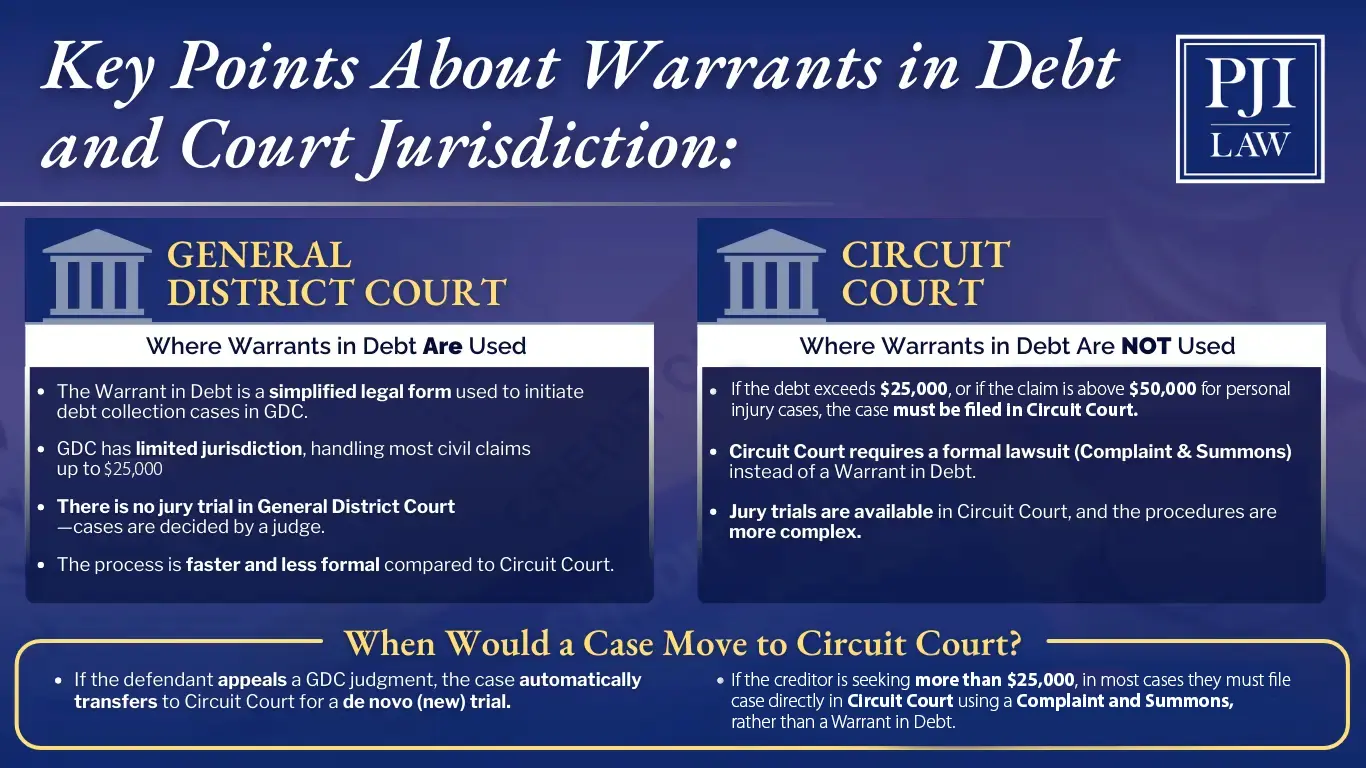
    1. File in the Correct Court – A Warrant in Debt is typically filed in General District Court for claims up to $25,000, with some exceptions such as a $50,000 limit for personal injury cases. For larger claims, the case is generally handled in Circuit Court.
    2. Complete the Warrant in Debt Form – This document must include the amount owed, any additional fees or interest, and a brief explanation of the claim.
    3. File the Form with the Court Clerk – The clerk will process the form and assign a return date, which serves as the initial hearing.
    4. Serve the Debtor Properly – The debtor must receive legal notice of the claim through a sheriff or private process server. If the debtor voluntarily accepts service, it may be sent by certified mail.
    5. Attend the Return Date – If the debtor does not appear, the court may grant a default judgment in favor of the creditor.

    Before filing a Warrant in Debt, it’s important to understand where your case belongs. The infographic below outlines key differences between the General District Court and the Circuit Court.
    Receiving a Warrant in Debt as a Debtor

    Discovering this document in your mailbox or posted at your home can be unsettling. You might question what it means for your daily life and finances and whether you have any defenses. It is important to respond and attend the hearing because ignoring a Warrant in Debt does not make it go away.

    Consequences of Ignoring a Warrant in Debt

    What Is a Warrant in Debt in Virginia?

    Failing to respond to a Warrant in Debt can result in serious financial consequences, including:

    • Default Judgment – The court automatically rules in favor of the plaintiff.
    • Wage Garnishment – Up to 25% of your disposable income may be withheld to repay the debt, subject to federal and Virginia wage garnishment laws (Virginia Code § 34-29). However, Virginia law protects lower-income individuals by limiting garnishments to only the amount exceeding 30 times the federal minimum wage per week. This means that if your weekly earnings are low, less than 25% may be garnished, or nothing at all.
    • Bank Account Levy – The creditor may freeze and withdraw money from your bank account.
    • Liens on Property – If you own real estate, the creditor may place a lien against your home.
    • Docketing a Judgment – A judgment obtained in General District Court does not automatically become a lien on a debtor’s real estate. To create a lien, the creditor must file an abstract of judgment in the Circuit Court of the county or city where the debtor resides or owns real estate to attach the judgment to real estate and potentially impact future sales or refinancing.

    Under Virginia Code § 8.01-466, creditors have legal rights to enforce judgments.

    How to Defend Yourself Against a Warrant in Debt

    If you believe the claim against you is incorrect or unfair, you have several legal defenses:

    1. The Debt Is Not Yours

    Mistakes happen, and sometimes debts are wrongly assigned or misidentified. If you were mistakenly named in the lawsuit, you can dispute it.

    2. The Amount Is Incorrect

    Even if you owe money, the amount may be inflated with unauthorized fees, penalties, or interest. Request an itemized statement.

    3. The Debt Is Too Old (Statute of Limitations)

    Virginia has a statute of limitations that restricts how long a creditor can sue for a debt:

    • Written contracts (e.g., credit cards, loans): 5 years
    • Oral agreements: 3 years
    • Promissory notes: 6 years

    If the debt is older than the statute allows, you can request dismissal.

    4. The Plaintiff Lacks Proof

    The creditor must prove you owe the debt. If they don’t have documentation, you can challenge their claim.

    5. Bankruptcy Protection

    If you’ve filed for bankruptcy, the debt may be discharged. A creditor cannot sue for discharged debts.

    What Is a Warrant in Debt in Virginia?

    Court Proceedings and Possible Outcomes
    What Is a Warrant in Debt in Virginia?

    What Happens at the Return Date?

    The return date is the first court hearing, typically set within 60 days of filing. You are not required to present a full defense at this hearing, but you must show up if you want to contest the claim.

    Options at the Return Date

    • Dispute the Claim – If you believe you don’t owe the debt or the amount is incorrect, you can argue your case.
    • Request a Trial – If you need more time to gather evidence, you can request a trial date.
    • Settle with the Plaintiff – You may negotiate a repayment plan or settlement outside of court.
    • Do Nothing – If you don’t show up, the court will likely issue a default judgment against you, allowing the creditor to collect the debt through wage garnishment, bank levies, or liens on property.

    Trial Phase

    If the debtor contests the debt, the judge might set another court date for a more in-depth hearing. At that time, each side can submit evidence and call witnesses to testify under oath. As a creditor, you would typically show proof of the transaction or contract and records indicating nonpayment. As a debtor, you might highlight any errors in the creditor’s documentation or present proof that payments were made or that the account is not yours.

    The judge then weighs the facts and decides whether money is owed and, if so, how much. This decision is called the judgment. Depending on the complexity of the case, the judge may issue the ruling immediately or take a short period to consider all the information.

    Possible Court Outcomes

    • Default Judgment: If the debtor fails to attend the hearing or does not respond, the creditor generally obtains a judgment automatically.
    • Judgment for the Creditor: If the judge rules in favor of the creditor, the debtor is responsible for the amount plus interest and possibly court costs or fees.
    • Judgment for the Debtor: If the debtor successfully proves that no money is owed or that the claim is invalid, the court may dismiss the case.
    • Settlement or Payment Agreement: Both sides can reach a settlement, either before the return date or during the proceedings, which might include a payment plan or a reduced lump-sum payment.

    Judgments, Appeals, and Enforcement

    What Is a Warrant in Debt in Virginia?
    Once a judgment is entered, it signals the court’s final decision regarding the debt. For creditors and debtors alike, this judgment triggers the next phase: collection for creditors, and payment or defense strategies for debtors.

    Post-Judgment Steps for Creditors

    • Docketing the Judgment: You might record the judgment on the public record in the appropriate Virginia county or city. This step can place a lien on any real estate the debtor owns in that jurisdiction.
    • Garnishment: You can request a garnishment against the debtor’s wages or bank account. Wage garnishment is subject to federal and Virginia state law limits, which cap how much of a debtor’s paycheck can be withheld. See § 8.01-511 of the Code of Virginia for rules on issuing a garnishment.
    • Levy and Seizure: In rare cases, a creditor can seek a court order to seize certain personal property to satisfy the judgment. The property must not be exempt under Virginia law, and procedures must be followed with precision.

    Options for Debtors After a Judgment

    • Payment Arrangements: Once the court rules in favor of the creditor, you might negotiate a schedule to repay the debt. Communicating with the creditor is often a way to avoid garnishments or liens.
    • Appeal to Circuit Court: In Virginia, you have a right to appeal a General District Court judgment to the Circuit Court within a limited time (usually 10 days from the judgment date). An appeal involves paying appeal costs and possibly posting a bond. 
    • Claim of Exemptions: If the creditor tries to garnish your wages or bank account, you may have exemptions you can claim, such as those for certain retirement benefits. These exemptions are spelled out in Virginia law, and you can assert them during the garnishment process.

    What Is a Warrant in Debt in Virginia?
    A Warrant in Debt in Virginia is a legal tool used to resolve disputes over unpaid debts. Whether you are seeking to collect or defend against a claim, knowing the process can impact the outcome. For creditors, proper documentation and following court procedures are critical to winning a case.

    For debtors, responding on time, attending court, and presenting a valid defense can affect the outcome. Consulting a civil litigation attorney can provide case-specific guidance.

    Facing a Warrant in Debt? Or Need to File One?

    Whether you’re a creditor seeking repayment or a debtor responding to a lawsuit, a Warrant in Debt can have significant financial and legal consequences. Having the right legal guidance can make all the difference in protecting your rights and interests.

    At PJI Law, we assist creditors in filing claims, securing judgments, and enforcing debt collection through proper legal channels. We also represent debtors who need to challenge improper claims, negotiate settlements, or assert legal defenses against collection actions.

    Our team provides clear guidance and strong representation at every stage, from filing paperwork to appearing in court.

    Your online search for a “debt collection attorney” or “collection attorney near me” who understands Virginia’s debt collection laws brought you here. PJI Law is ready to advocate for you. Call (703) 865-6100 or complete our confidential online form to schedule your consultation today.

    At PJI Law, you’ll receive white glove service and personalized attention!

    Copyright © 2025. PJI Law, PLC. All rights reserved.

    The information in this blog post (“post”) is provided for general informational purposes only and may not reflect the current law in your jurisdiction. No information in this post should be construed as legal advice from the individual author or the law firm, nor is it intended to be a substitute for legal counsel on any subject matter. No reader of this post should act or refrain from acting based on any information included in or accessible through this post without seeking the appropriate legal or other professional advice on the particular facts and circumstances at issue from a lawyer licensed in the recipient’s state, country, or other appropriate licensing jurisdiction.

    PJI Law, PLC
    3900 Jermantown Rd, 2nd Floor
    Fairfax, Virginia 22030
    (703) 865-6100
    https://pjibe.webteam.ai/

  • How to Avoid Pitfalls When Making a Personal Loan to a Friend in Virginia

    How to Avoid Pitfalls When Making a Personal Loan to a Friend in Virginia

    The phone rings, and you see it’s one of your closest friends calling. After a few minutes of catching up, they gently bring up an unexpected financial situation. “I wouldn’t ask if it weren’t important,” they say, “but I was wondering if you might be able to help me out with a loan. I’ll make repaying you my priority.”

    You pause, feeling the weight of the decision. You know your friend wouldn’t ask if it weren’t serious, and as much as you want to help, lending money to friends can feel risky. You don’t want to jeopardize your friendship, but you also need to ensure your finances are protected.

    Lending money to friends feels straightforward in the moment, but it often involves more than expected. A clear, structured loan agreement can safeguard your finances and friendship alike. In this blog, we’ll cover the key steps to take when making a personal loan to a friend in Virginia, what your options are if your friend stops paying, and when you might need the help of a collection attorney. From crafting a simple agreement to understanding interest limits, you’ll learn how to lend responsibly while safeguarding your finances and peace of mind.

    Virginia’s Contract and Interest Rate Laws for Loans

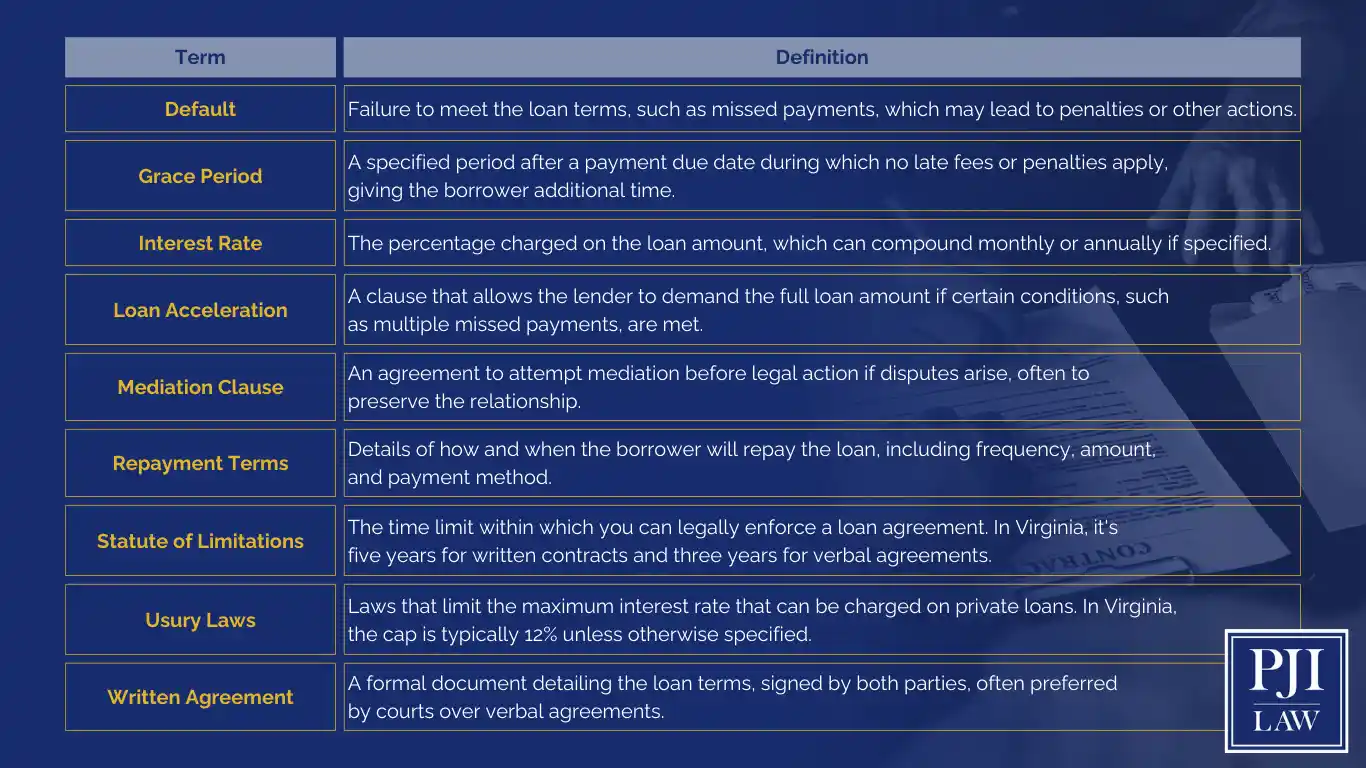
    Before you reach for your wallet, it’s essential to understand that in Virginia, personal loans between friends are legally binding contracts. The state’s statute of limitations for written contracts is five years, while verbal agreements have a three-year limit. To enforce your loan agreement, you need to act within these timeframes before the statute of limitations expires. You can view the full statute here.

    Additionally, Virginia’s usury laws cap interest rates at 12% annually for most private loans, unless a different rate is set in writing. If your loan amount exceeds a threshold (usually $5,000), a higher rate may apply—you can confirm this threshold and other specifics of Virginia’s usury laws here. Written contracts aren’t just for big business deals—they provide clarity for both sides in personal loans as well, making it easier to resolve any misunderstandings that may arise. While charging interest to a friend might feel uncomfortable, establishing clear terms helps both parties treat the loan seriously.

    need-help-with-a-loan-agreement-for-making-a-loan-to-a-friend

    Consider Alternative Options

    Before committing to a personal loan, explore alternative borrowing options that might be easier on your friendship and your finances:

    • Local Credit Unions: Credit unions often offer personal loans at lower rates than traditional banks. Many credit unions in Virginia provide flexible loan terms that can be more affordable and structured than a private loan.
    • Peer-to-Peer Lending Platforms: Platforms like LendingClub or Prosper facilitate loans between individuals but provide structure, interest rates, and payment schedules. This can keep the loan more formal without involving friends or family directly.
    • Non-Profit Credit Counseling Services in Virginia: Many non-profit organizations offer financial counseling and small loan options, especially for individuals in financial hardship. Services like these can be a safer alternative than relying on friends or family for funds.
    • Emergency Assistance Programs: Some community organizations in Virginia provide emergency funds or loans for specific needs, like medical bills or utilities, at low or no interest. This can be a helpful resource, especially if the loan is for a temporary hardship.
    • Payment Plans with Creditors: If the funds are needed for an existing debt, see if the creditor offers a payment plan or reduced payment options. Many creditors offer flexibility on repayment terms, which can remove the need for a personal loan entirely.

    Know When to Say No

    know-when-to-say-no

    Sometimes, the best way to protect your finances and your friendship is to decline a loan request. Consider saying no if any of these apply:

    • Financial Limitations: If you can’t afford to lose the money or would be financially strained by lending it, it’s likely best to decline.
    • History of Financial Issues: If the friend has a pattern of financial instability or unpaid debts, the risk may outweigh the benefit.
    • Feeling Pressured or Rushed: If you feel uncomfortable or pressured into the loan, take a step back. Financial decisions should never be rushed.
    • Unwise Loan Purpose: If the loan is for something unnecessary or seems risky (e.g., gambling or a risky investment), it may be best to say no.
    • Potential Impact on Your Own Stability: If lending would affect your financial security, prioritize protecting your own stability.

    Document Everything in Writing

    document-everything-in-writing

    If you decide to go ahead with the loan, you might think a handshake or verbal promise is enough between friends, but Virginia courts strongly favor written agreements. Having a written contract not only clarifies expectations but also protects both parties if issues arise. Here’s what to include for legal enforceability:

    • Exact Loan Amount: Specify the precise amount of money being borrowed. This should match any cash, check, or digital transfer provided.
    • Interest Rate (if applicable): If charging interest, include the rate and whether it compounds monthly or annually. If interest isn’t being charged, note that the loan is interest-free.
    • Parties’ Full Legal Names and Addresses: Record both parties’ full names and current addresses as they appear on identification.
    • Date of Agreement: Include the date the agreement is signed, as this helps establish the timeline if legal action is needed.
    • Signatures and Notary (if possible): Both parties should sign. For extra formality, consider notarizing the document to strengthen its enforceability in court.


    do-you-need-a-collection-attorney-after-making-a-loan-to-a-friend

    Consider using a loan agreement template tailored to Virginia law, but review it carefully and consult a legal professional if needed to ensure all necessary elements are included.
    PJI-Law-SuperBlog-Images-5

    Establish Clear Repayment Terms

    Vague repayment plans often lead to misunderstandings that can strain even the strongest friendships. Outline each repayment term in detail to avoid complications:

    • Total Loan Amount: Specify the amount your friend will repay, including any interest. This ensures both parties are clear on the final repayment amount.
    • Payment Frequency and Due Dates: Decide how often payments will be made (e.g., weekly or monthly) and specify due dates. A consistent schedule helps both parties avoid missed payments.
    • Payment Amount and Method: Define the amount for each payment and the payment method (e.g., bank transfer, check, or cash). Consistency will help keep the loan organized.
    • Grace Periods and Consequences for Missed Payments: Decide whether to offer a grace period and outline any penalties or actions for missed payments. Specify if late fees apply or if multiple missed payments allow additional actions like loan acceleration.
    • Acceptance of Partial Payments: State if partial payments are acceptable, and if so, how they’ll be applied to the principal and interest. This keeps everyone clear on loan progress.

    By outlining these terms thoroughly, you create a structured repayment plan that supports a smoother repayment process and protects both parties.

    Safeguard Your Tax Position

    The IRS pays attention to personal loans, even between friends. Loans without clear terms or interest rates may appear as gifts to the IRS, triggering gift taxes or other tax obligations. To avoid tax complications and keep your financial records clean:

    • Document this as a loan, not a gift.
    • Charge at least the minimum interest rate required by the IRS (the applicable federal rate for your loan term, which you can find here.
    • Keep detailed records of all payments received.
    • Report interest income on your tax returns.
    • Understand that forgiving the loan has tax implications, and consult an accountant if necessary.

    Plan for Worst-Case Scenarios

    plan-for-worst-case-scenarios
    Nobody likes to think about things going wrong, but anticipating potential issues can save both your finances and your friendship if problems arise. Including these provisions in your loan agreement helps prevent misunderstandings and sets expectations:

    • Early Repayment Options: Specify whether early repayment is allowed and if there are any incentives for paying off the loan sooner. For example, you could decide to waive a portion of interest if the loan is repaid early. This provides flexibility for your friend if their financial situation improves.
    • Defining Default and Its Consequences: Outline exactly what constitutes a default. This could include missed payments, partial payments, or a specified number of late payments. Clearly define the consequences, such as late fees, interest increases, or other penalties, so there is no ambiguity if payments become inconsistent.
    • Relocation Terms: Decide what happens if either you or your friend moves out of Virginia during the loan period. Moving can complicate legal recourse, especially if it becomes necessary to pursue repayment. You may want to specify that the terms of the loan remain governed by Virginia law, even if one of you relocates.
    • Mediation Before Legal Action: To avoid escalating tensions, include a clause that requires mediation before pursuing legal action if a serious dispute arises. Mediation can be a less costly, less adversarial way to resolve issues and can help preserve your relationship while seeking a fair solution.
    • Loan Acceleration Terms: State if and when the loan will be “accelerated” due to missed payments. Loan acceleration means that if a certain number of payments are missed, the entire balance becomes due immediately. This gives you a clear path for handling cases of serious non-payment.
    • Provision for Potential Modifications: Include a clause allowing for possible modifications to the loan terms if unforeseen financial hardships arise. This clause can specify that any adjustments to the payment schedule or amounts must be agreed upon in writing by both parties, adding a layer of flexibility without undermining the agreement.

    By planning for these scenarios, you’re protecting both parties and minimizing potential disruptions. Setting these terms upfront helps ensure a smoother process if challenges occur, providing peace of mind and structure for both you and your friend.

    Keep Communications Professional

    Once the loan is made, it’s important to treat the arrangement professionally to avoid misunderstandings or strains on your relationship. While maintaining formality in personal loans can feel awkward at first, it reduces misunderstandings and keeps everyone on the same page. Taking these steps can help maintain clear communication and accountability:

    • Separate Loan-Related Communication: Keep loan-related discussions separate from your usual interactions. Use email or written notes instead of casual texts, which helps set a more professional tone and keeps a clear record.
    • Document Every Payment: Record each payment as it’s made and keep a log of payment dates, amounts, and methods (e.g., cash, check, bank transfer). This documentation can be valuable if you ever need to reference specific payment details.
    • Provide Regular Loan Statements: Create monthly or quarterly loan statements summarizing payments made, the remaining balance, and any upcoming due dates. This way, both of you are always aware of the loan’s status.
    • Send Professional Payment Reminders: If a payment is due soon, send a polite reminder that is professional and friendly. This can be as simple as an email or text message that keeps the tone respectful and business-like.
    • Maintain a Loan Tracking Spreadsheet: Track the loan balance, payments received, and due dates in a spreadsheet. This keeps everything organized and makes it easy to see the loan’s progress.

    Protect Your Friendship

    Money can strain even the best relationships, so take steps to keep your friendship intact and minimize the emotional impact of the loan:

    • Keep Loan Discussions Private: Avoid bringing up the loan at social events or in group settings. Discuss it one-on-one, away from mutual friends, so it doesn’t become a public or uncomfortable topic.
    • Maintain Clear Boundaries: Refrain from casually discussing the loan when spending time together socially. Let your social time stay focused on enjoying each other’s company.
    • Respect Privacy: Avoid sharing details of the loan with mutual friends or family. This keeps the arrangement private and minimizes any external pressure on the borrower.
    • Continue Friendship Activities: As much as possible, maintain your usual friendship routines. This helps keep the loan from becoming a defining aspect of your relationship.
    • Address Issues Calmly and Privately: If problems arise, approach them privately and respectfully. A calm, constructive conversation can help resolve issues without damaging the relationship.

    When to Seek Legal Assistance

    when-to-seek-legal-assistance

    If significant problems arise with the loan, consider consulting a Virginia collections attorney who handles contract disputes or small claims cases to guide you through your options:

    • Multiple Missed Payments: If your friend has missed several payments and stopped communicating, a legal consultation may help you decide on next steps.
    • Disputes Over Loan Existence: If your friend denies the loan’s existence or refuses to acknowledge the terms, legal support can help you enforce your agreement.
    • Approaching the Statute of Limitations: If you’re nearing Virginia’s statute of limitations (five years for written agreements, three years for verbal), consult an attorney to ensure your rights remain protected.
    • Relocation or Bankruptcy: If your friend moves out of Virginia or files for bankruptcy, your legal options may change. Legal advice can clarify how these circumstances impact the loan.
    • Exhausted Informal Resolution Attempts: If all other attempts at resolving the matter have failed, pursuing the issue in Virginia’s small claims court may be a cost-effective option. The court handles cases up to $5,000, which may be suitable for many personal loans.

    Remember, making a personal loan to a friend in Virginia requires careful consideration and planning. Helping a friend in tough times is admirable, but by protecting yourself legally and financially, you’re ensuring both your friendship and finances are preserved.

    Get Back What You’re Owed: Recover Your Loan to a Friend with PJI Law’s Trusted Support

    When you extended a personal loan to a trusted friend, you took every step to cover your bases. But now, with the loan in default, you’re left in a difficult position of needing to recover what you’re owed. At PJI Law, we understand that deciding to take collection action against a friend isn’t easy and that personal loan disputes can feel both financially stressful and emotionally complicated.

    With our white-glove service and personalized approach, PJI Law’s trusted collection attorneys are here to help. We’ll carefully review your loan agreement, assess your options, and work toward a resolution that brings you the results you need. Throughout the process, you’ll receive focused, attentive support, ensuring you feel informed and confident every step of the way.

    Reaching out for help is a big step, and we’re ready to provide the guidance you need. If you’ve been searching online for a “debt collection attorney near me,” call us instead at (703) 865-6100 or complete our confidential online form to schedule a confidential consultation with PJI Law. Let us handle the complexities so you can move forward with peace of mind.

    At PJI Law, you’ll receive white glove service and personalized attention!

    Copyright © 2024. PJI Law, PLC. All rights reserved.

    The information in this blog post (“post”) is provided for general informational purposes only and may not reflect the current law in your jurisdiction. No information in this post should be construed as legal advice from the individual author or the law firm, nor is it intended to be a substitute for legal counsel on any subject matter. No reader of this post should act or refrain from acting based on any information included in or accessible through this post without seeking the appropriate legal or other professional advice on the particular facts and circumstances at issue from a lawyer licensed in the recipient’s state, country, or other appropriate licensing jurisdiction.

    PJI Law, PLC
    3900 Jermantown Rd, 2nd Floor
    Fairfax, Virginia 22030
    (703) 865-6100
    https://pjibe.webteam.ai/

  • What Happens After a Judgment is Entered Against You in Virginia? Experienced Debt Collector Lawyers Answer

    What Happens After a Judgment is Entered Against You in Virginia? Experienced Debt Collector Lawyers Answer

    In today’s economic climate where the cost of living continues to outpace income growth, and many Virginians find themselves turning to credit cards to cover basic needs, the shadow of debt looms large. Job losses and reduced hours have made it increasingly difficult for individuals to keep up with their debt repayments, leading to a significant legal consequence: the entry of a judgment against them in Virginia. 

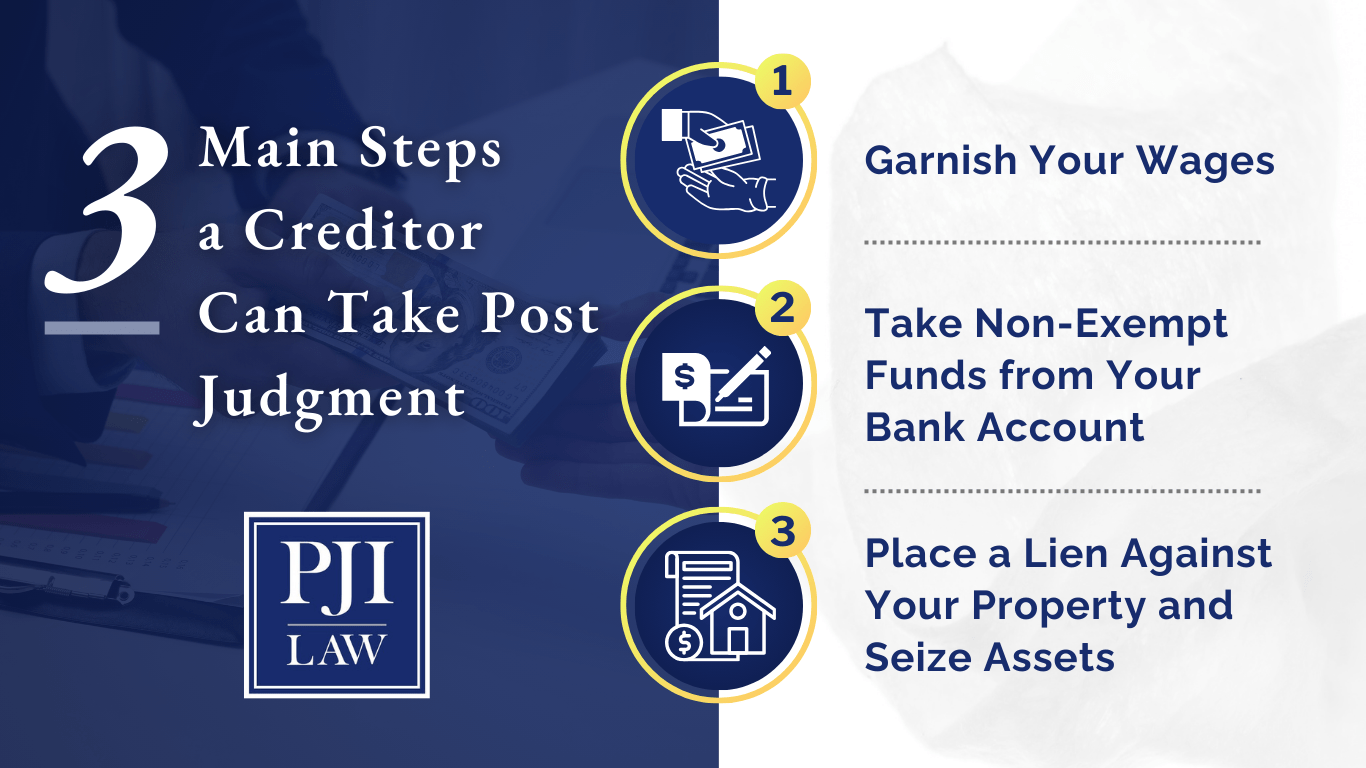
    Being the subject of a court judgment for debt in Virginia is a critical event with far-reaching implications. It officially signifies that you owe a debt and grants creditors the legal channels to pursue aggressive collection actions. These can include garnishing your wages, seizing funds from your bank accounts, and placing liens on your property. Such actions not only strain your current financial situation but also affect your ability to secure credit in the future.

    It’s essential to grasp the full impact of a court judgment and the legal processes that follow. Virginia’s laws offer creditors several methods to enforce debt collection, significantly impacting your financial health. In this blog, a debt relief attorney from PJI Law explains what happens after a judgment is entered against you, detailing the legal mechanisms at creditors’ disposal and suggesting strategies to navigate these challenges. But first, let’s go over what a judgment in Virginia means.

    Understanding Judgments in Virginia

    When a court in Virginia enters a judgment against you, it legally confirms that you owe a debt to another party. Here’s what you need to know:

    • Legal Status: A judgment is a court’s decision that results in a legal obligation for you to pay the debt.
    • Duration: Once a judgment has been entered, creditors are granted a 10-year period to pursue collection efforts. This period can be renewed twice, extending the potential collection timeline to a maximum of 30 years. Some creditors may initiate collection immediately following the judgment, whereas others might choose to wait until the appeal period concludes. Regardless of the timing, creditors have a variety of tools available for collecting the debt, such as garnishing wages or placing liens on property.
    • Interest: Post-judgment interest may accrue on the outstanding amount at the rate stated in the judgment until it is paid.
    • Statute of Limitations: In Virginia, creditors are given a three-year window to initiate legal action for debts arising from verbal agreements. This period extends to five years if the debt involves a written contract. Once the statute of limitations expires, creditors lose the legal right to sue for the debt. However, any payment made by the debtor can inadvertently reset this timeframe, effectively renewing the creditor’s ability to take legal action. Given the complexity of these rules, seek advice from debt collector lawyers to understand your options and the potential implications of your actions.

     potential implications of your actions

    Post-Judgment Proceedings

    Post-Judgment Proceedings

    After a judgment is entered against you in Virginia, certain post-judgment proceedings may commence, wherein creditors attempt to collect the debt you owe. Understanding these procedures can help you navigate the situation more effectively.

    Common Creditor Actions

    • Wage Garnishment: A portion of your wages can be withheld directly from your paycheck and sent to the creditor. However, Virginia law protects a portion of your income, and creditors cannot garnish more than 25% of your disposable earnings (after state and federal income taxes are withheld). 
    • Bank Levy: The creditor may obtain a court order to freeze funds in your bank accounts. 
    • Property Lien: A lien could be placed on your real estate or other property. This means the creditor has a claim to the proceeds if you sell the property. Be aware that some exemptions apply to liens, protecting portions of your home equity and other assets. 
    • Writ of Execution: Allows the sheriff to seize and sell non-exempt personal property like vehicles or investments to satisfy the judgment. Certain assets are exempt from execution, including essential personal belongings and a portion of your home equity. 
    • Debtor’s Interrogatories: You may be required to attend a court hearing and answer questions under oath about your finances. You have the right to legal representation during this process, and the scope of information you must disclose is limited by law.

    Protecting Yourself

    debt relief attorney

    • Virginia law provides exemptions that shield portions of your income and property from creditors. Familiarize yourself with these exemptions to understand what you can keep. 
    • Open communication with the creditor is crucial. You may be able to negotiate a payment plan or other arrangements such as entering into a settlement agreement to avoid further action.  
    • Seeking legal advice is highly recommended. A debt relief attorney can guide you through your options, represent you in court if necessary, and ensure your rights are protected.

    Wage Garnishment

    When a judgment is entered against you in Virginia for a debt, creditors can use a process called wage garnishment to collect the amount owed. This means a portion of your earnings will be withheld from your paycheck and sent directly to the creditor until your debt is paid off. 

    How Wage Garnishment Works

    • Notification: Before garnishment starts, you and your employer will be served a Garnishment Summons outlining the details, including the amount to be withheld. Your employer cannot fire you solely because of wage garnishment. 
    • Calculation: The amount garnished is based on your “disposable income,” which is your earnings after mandatory deductions like state and federal income taxes:
      • Maximum Limit: No more than 25% of your weekly disposable earnings can be garnished.
      • Alternative Calculation: Or, the amount by which your disposable earnings exceed 40 times the federal minimum hourly wage, whichever is less.

    Bank Account Levy

    debt relief attorney

    In addition to garnishing your wages, a creditor is entitled to initiate a garnishment action against your bank account. This involves submitting either a Writ of Execution or a Garnishment Suggestion Form, as dictated by the court’s procedures. 

    The creditor must then serve the summons to both you and the bank. This document outlines the garnishment procedure and instructs the bank on the withholding of the designated funds. Additionally, the summons specifies a return date for a court hearing, allowing you an opportunity to challenge the garnishment, particularly if the funds in question are legally exempt from such actions.

    In response to the summons, the bank temporarily restricts access to your account, maintaining this status until the designated return date. This pause provides you with a window to submit documentation asserting the exemption of certain funds from garnishment.

    Some of the exemptions include the following:

    • Social Security Benefits
    • Supplemental Security Income
    • Temporary Assistance for Needy Families
    • Unemployment Compensation
    • Veterans’ benefits

    Failure to present such a claim means the garnishment may proceed, potentially lasting 30, 60, 90, or 120 days, based on the court’s determination.

     based on the court's determination.

    Property Liens and Seizure

    debt relief attorney

    If a judgment is entered against you in Virginia, creditors may use various legal tools to collect the debt, including placing liens on your property or seizing your assets. Understanding how liens work and your rights regarding potential seizure is crucial for protecting your interests.

    • Exemptions: Virginia law protects portions of your property from liens and seizure, like your primary residence up to a certain equity value. 
    • Lien Enforcement: Creditors can enforce liens through various means, including foreclosure for real estate or public auctions for personal property. 

    Seeking legal advice is crucial to understand the specific enforcement process and your options.

    Facing Seizure

    As mentioned earlier, if your personal property is at risk of seizure, the creditor may obtain a Writ of Execution, allowing them to:

    • Inventory: Officials will create a list of your seizable assets.
    • Sale: Seized items are sold at public auction to satisfy the debt.

    Protecting Yourself

    Facing property liens and potential seizure can be overwhelming. Remember:

    • Seek Legal Advice: Consulting with debt collector lawyers is crucial to understanding your rights, exploring options like negotiating with creditors, and potentially challenging the lien or seizure process.
    • Act Promptly: Time is of the essence. Responding to legal notices promptly and taking proactive steps can make a significant difference in protecting your assets.

    significant difference in protecting your assets

    Appealing a Judgment

    If you have a judgment entered against you in Virginia and believe the decision was incorrect, you may have the option to appeal. It’s important to act quickly, as there are strict time limits.

    • Filing the Notice of Appeal: You have 10 days to notify the court of your intent to appeal and 30 days to complete all formal requirements (filing, fees, bond) to initiate the appeal process. If you miss this deadline, you may lose your right to appeal. 
    • Preparation of the Record: Your appeal will be based on the record of what happened in the trial court. Ensure all relevant documents, transcripts, and evidence are included.

    Briefs Submission

    • Appellant Brief: You, as the appellant, must submit a brief that outlines your arguments and why the judgment should be reversed.
    • Appellee Brief: The appellee will respond with their brief defending the trial court’s decision.
    • Oral Arguments: In some cases, you may have the opportunity to present oral arguments before the appellate court. 
    • Decision: The Court of Appeals of Virginia will either affirm the lower court’s decision, reverse it, or remand it for further proceedings.

    Be aware that appeals focus on legal errors and are not a re-trial of the facts. Consult with an attorney skilled in appellate law to assess the merits of an appeal and navigate the complex legal process.

    Setting Aside or Vacating a Judgment

    If you have a judgment entered against you in Virginia and believe it was issued due to errors, valid defenses, or other legal grounds, you might have options to set it aside or vacate it. However, navigating this process effectively requires careful consideration and, ideally, legal guidance.

    Seeking Legal Help

    Consulting with Virginia debt collector lawyers experienced in civil litigation is highly recommended. They can:

    • Assess your situation and advise on the most appropriate course of action.
    • Help you navigate the complexities of court procedures and deadlines.
    • Craft compelling legal arguments and represent you effectively in court.

    Setting aside a judgment doesn’t necessarily end the matter. The original claim might proceed even if the judgment is vacated. Consulting with an attorney can help you understand the full implications and potential outcomes.

    Bankruptcy

    Bankruptcy

    If the judgment cannot be challenged or the amount of debt is too large to manage, filing for bankruptcy could be a practical option. This could mean either selling off assets to cover the debt (under Chapter 7 bankruptcy) or setting up a plan to pay back the debt over time (under Chapter 13 bankruptcy), which might eliminate some debts and restructure others.

    While bankruptcy can offer a lifeline, it also carries significant repercussions for your credit and financial standing. A detailed discussion with a debt relief attorney will outline the process and whether it’s a fitting option for you.

    Long-Term Impacts on Credit and Borrowing

    After a judgment is entered against you in Virginia, your credit report is significantly affected. This can have long-term implications on your ability to borrow money and the terms of credit available to you. Here’s what you should be aware of:

    • Credit Score Decrease: Your credit score will likely drop considerably. Judgments are public records, and the credit bureaus will include them in your credit report.
    • Credit Reporting Period: A judgment can remain on your credit report for up to seven years from the date it was filed, potentially lowering your ability to secure loans or favorable interest rates.
    • Difficulty Getting Approved: When you apply for credit, creditors may view you as a high-risk borrower, making it more difficult to get approved for new credit accounts or loans.
    • Higher Interest Rates: If lenders do approve you for credit, you might be subjected to higher interest rates due to the increased risk of default they perceive, leading to more expensive borrowing costs.
    • Securing Housing: Landlords might also check your credit report. A judgment can make it more challenging to rent an apartment or house.
    • Employment Concerns: Some employers perform credit checks before hiring. A poor credit report could impact your job prospects in fields that regard financial responsibility as critical.

    To mitigate these long-term effects, consider working with a debt relief attorney to explore your options, such as satisfying the judgment, setting up payment plans, or challenging the judgment if grounds exist. Acting proactively can help to repair your credit over time.

    Facing the Fallout After a Judgment in Virginia? PJI Law Can Help

    debt relief attorney

    The path forward after having a judgment entered against you in Virginia can seem overwhelming, filled with legal hurdles and financial stress. However, you don’t have to face it alone. PJI Law is your local resource for tailored legal assistance, providing the support you need to tackle the challenges of a debt judgment head-on.

    At PJI Law, we pride ourselves on delivering compassionate, comprehensive legal services designed to safeguard your financial future and uphold your rights. Whether you’re appealing a judgment, seeking clarification on your legal standing, or exploring avenues for debt relief such as entering into a settlement agreement, our attorneys are dedicated to achieving the best outcome for you.

    Don’t let the burden of a debt judgment disrupt your life. If you’ve been searching online for “judgment attorneys near me,” reach out to PJI Law today instead. Contact us for personalized attention at (703) 865-6100 or fill out our online form to schedule your consultation in Fairfax, Virginia. Discover how we can help you move beyond this obstacle towards financial recovery and peace of mind.

    Copyright © 2024. PJI Law, PLC. All rights reserved.

    The information in this blog post (“post”) is provided for general informational purposes only and may not reflect the current law in your jurisdiction. No information in this post should be construed as legal advice from the individual author or the law firm, nor is it intended to be a substitute for legal counsel on any subject matter. No reader of this post should act or refrain from acting based on any information included in or accessible through this post without seeking the appropriate legal or other professional advice on the particular facts and circumstances at issue from a lawyer licensed in the recipient’s state, country, or other appropriate licensing jurisdiction.

    PJI Law, PLC
    3900 Jermantown Rd, 2nd Floor
    Fairfax, Virginia 22030
    (703) 865-6100
    https://pjibe.webteam.ai/

  • Debt Collection Process in Virginia: How to Legally Get Borrowed Money Back

    Debt Collection Process in Virginia: How to Legally Get Borrowed Money Back

    If a borrower fails to repay the money owed to you, it can put your financial security at risk. You might also feel helpless and frustrated, especially if they ignore your attempts to collect on the debt. Though you want to be repaid as soon as possible, you’re unsure how or where to turn. Fortunately, Virginia has laws regarding the debt collection process to protect businesses and individuals from the frustration of being unable to collect on the debt owed to them.

    At PJI Law, PLC, our collections attorney team is here to help you collect an unpaid debt. In this blog post, we’ll summarize the debt collection process and the steps we can take to get your borrowed money back legally. If you have specific questions about the process, contact us at (703) 865-6100 to receive personalized service and attention.

    Debt Collection Process

    When you meet with one of our collections litigation lawyers to discuss your case, you might be surprised to learn that the first step we will take on your behalf is not filing a lawsuit. There are other steps we can take first to allow your debtor to repay their past-due debts. However, we are fully prepared to file a lawsuit against the debtor if they refuse to cooperate.

    Debtor Letter

    Our firm can send the debtor a letter containing details about the debt and proposing a repayment timeline. This demand letter complies with all applicable state and federal debt collection laws. If the debtor agrees, we will negotiate with them regarding repayment.

    File a Lawsuit

    If the debtor ignores the demand letter or is unwilling to cooperate, we will seek your permission to file a lawsuit against the debtor.

    Post-Judgment Enforcement

    Once we obtain a judgment on your behalf, the judgment debtor will have 10 days to file a notice of appeal. If they do not appeal the judgment, we can take advantage of the following post-judgment enforcement actions if the judgment debtor does not voluntarily pay the judgment at this point.

    Debtor Interrogatories

    To locate the judgment debtor’s assets, we can file Debtor Interrogatories to summon the judgment debtor to appear before the Court to answer questions regarding their assets or compel them to turn over money or other property to satisfy the debt. If the judgment debtor refuses to appear or answer questions, they may be held in contempt of court.

    Bank and Wage Garnishments

    Bank and wage garnishments are often the most effective collection tools against a judgment debtor who has ignored all efforts at a voluntary resolution of a judgment. To start the process of garnishing the judgment debtor’s bank account and wages, our collections litigation attorneys will prepare a Suggestion for Summons in Garnishment form and file it with the Clerk of Court. Next, the Clerk will serve the judgment debtor’s bank and employer with a Garnishment Summons.

    In Virginia, all unprotected funds in the judgment debtor’s bank account can be seized, and the account frozen to take any future deposits made during the garnishment period.

    Wages can be garnished for the lesser of 25% of the judgment debtor’s disposable earnings or the amount by which their disposable earnings exceed 40 times the federal minimum hourly wage. Garnishments may be refiled every 180 days until the debt is paid in full. If you decide to go this route, we can discuss the garnishment process in greater detail.

    Property Liens

    In Virginia, a judgment lien can only be attached to real estate, not personal property. Real estate includes the debtor’s house, condo, land, or similar kind of property interest. To attach the lien, our attorneys record the judgment on the county recorder’s lien docket in any Virginia county where the debtor owns the property now or may own property in the future.

    Property Levy

    Once 21 days after the entry of judgment has passed, you can request that the Court issue a writ of fieri facias. The writ will be forwarded to the sheriff authorizing them to go to the judgment debtor’s residence and levy (inventory) property owned by the judgment debtor, which can be later sold at public auction to recover the debt.

    The writ of fieri facias is good for 90 days from the date of issuance, meaning the sheriff has 90 days to execute the process. The levy can also have the excellent effect of prompting settlement negotiations or a payment plan with the judgment debtor.

    How Long is the Judgment Period?

    The judgment you obtained is good for 10 years from the date of judgment. However, you can extend the collection period for another 10 years twice, meaning you have up to 30 years to collect the money for the judgment from the judgment debtor.

    The Goal of the Debt Collection Process

    Through this debt collection process, our goal is to facilitate repayment in the easiest way possible by giving the judgment debtor many opportunities along the way to repay their debt. However, we will not hesitate to take any steps necessary so you can legally get your money back.

    Contact Northern Virginia Collection Attorneys to Legally Get Your Money Back

    When someone fails to repay the money borrowed from you or otherwise owed to you, it can be a frustrating and stressful time. Fortunately, as collections litigation lawyers, there are many steps we can take on your behalf to recover money owed to you.

    At PJI Law, PLC, each client receives our complete dedication, personal attention, and courteous, white-glove service. Call our office at (703) 865-6100 or complete our online form to schedule your consultation to learn how our Fairfax, Virginia, collections legal team can help you get the debt collection process started to get your money back.

    Copyright © 2023. PJI Law, PLC. All rights reserved.

    The information in this blog post (“post”) is provided for general informational purposes only and may not reflect the current law in your jurisdiction. No information in this post should be construed as legal advice from the individual author or the law firm, nor is it intended to be a substitute for legal counsel on any subject matter. No reader of this post should act or refrain from acting based on any information included in or accessible through this post without seeking the appropriate legal or other professional advice on the particular facts and circumstances at issue from a lawyer licensed in the recipient’s state, country, or other appropriate licensing jurisdiction.

    PJI Law, PLC
    3900 Jermantown Rd, 2nd Floor
    Fairfax, Virginia 22030
    (703) 865-6100
    https://pjibe.webteam.ai/