Tag: Civil Litigation

  • Should You Hire a Virginia Civil Dispute Lawyer Before a Dispute Turns Into a Lawsuit?

    Should You Hire a Virginia Civil Dispute Lawyer Before a Dispute Turns Into a Lawsuit?

    A disagreement rarely starts as a lawsuit. It usually begins with a contract that fell apart, a business relationship that broke down, a landlord-tenant conflict that escalated, or one party believing the other failed to honor an agreement. What starts as a dispute can quickly turn into a civil lawsuit if no one steps in early.

    If you’re facing a serious legal dispute in the Northern Virginia area, you may be wondering whether you need a civil dispute lawyer now or whether you should wait until someone files in court. The answer can shape the resolution of your legal matter before a complaint is ever filed.

    In many civil matters, early involvement by a civil litigation attorney changes the direction of the case entirely. It can protect your interests, reduce risk, and position you advantageously before the litigation process becomes time-consuming and expensive.

    At a Glance

    • A civil dispute involves legal conflicts between private parties, not criminal charges brought by the government.
    • A dispute becomes a civil lawsuit once a complaint is filed in court and formal litigation begins.
    • Early involvement of a civil litigation attorney can help resolve legal disputes before trial.
    • Many civil matters in Fairfax County involve breach of contract, business disputes, landlord-tenant issues, and fraud claims.
    • Waiting to hire a lawyer can increase costs, limit negotiation leverage, and expose you to stricter court deadlines.
    • Virginia law sets clear rules and deadlines for how civil cases proceed.
    • Strategic early counsel may lead to settlement, mediation, or arbitration without a prolonged trial.
    • An experienced legal team can protect your interests and position you for a favorable resolution.

    What Is a Civil Dispute Under Virginia Law?

    Under Virginia law, a civil dispute arises when one party seeks relief from another party for harm, financial loss, or failure to meet obligations. These are civil matters, not criminal matters.

    In a criminal matter, the government prosecutes a defendant and may seek fines or criminal penalties. In contrast, civil litigation involves private parties resolving legal disputes in civil court. One party may seek compensation, enforcement of an agreement, or other remedies allowed by law.

    Civil cases can involve:

    • Breach of contract
    • Business disputes
    • Fraud or misrepresentation
    • Landlord-tenant disputes
    • Property disagreements
    • Insurance coverage claims

    Virginia Code Title 8.01 governs much of the procedure for civil action in the Commonwealth. It sets deadlines, defines substantive and procedural law, and outlines how civil lawsuits proceed through the court system.

    Many civil cases begin informally. A party finds that the other side has failed to perform under a contract. A business partner believes there has been a breach. A landlord-tenant relationship deteriorates. If not addressed in a timely manner, these disputes can escalate into formal litigation.

    Searching for a civil dispute lawyer in Fairfax, Virginia

    Civil Matters That Often Require Early Legal Strategy

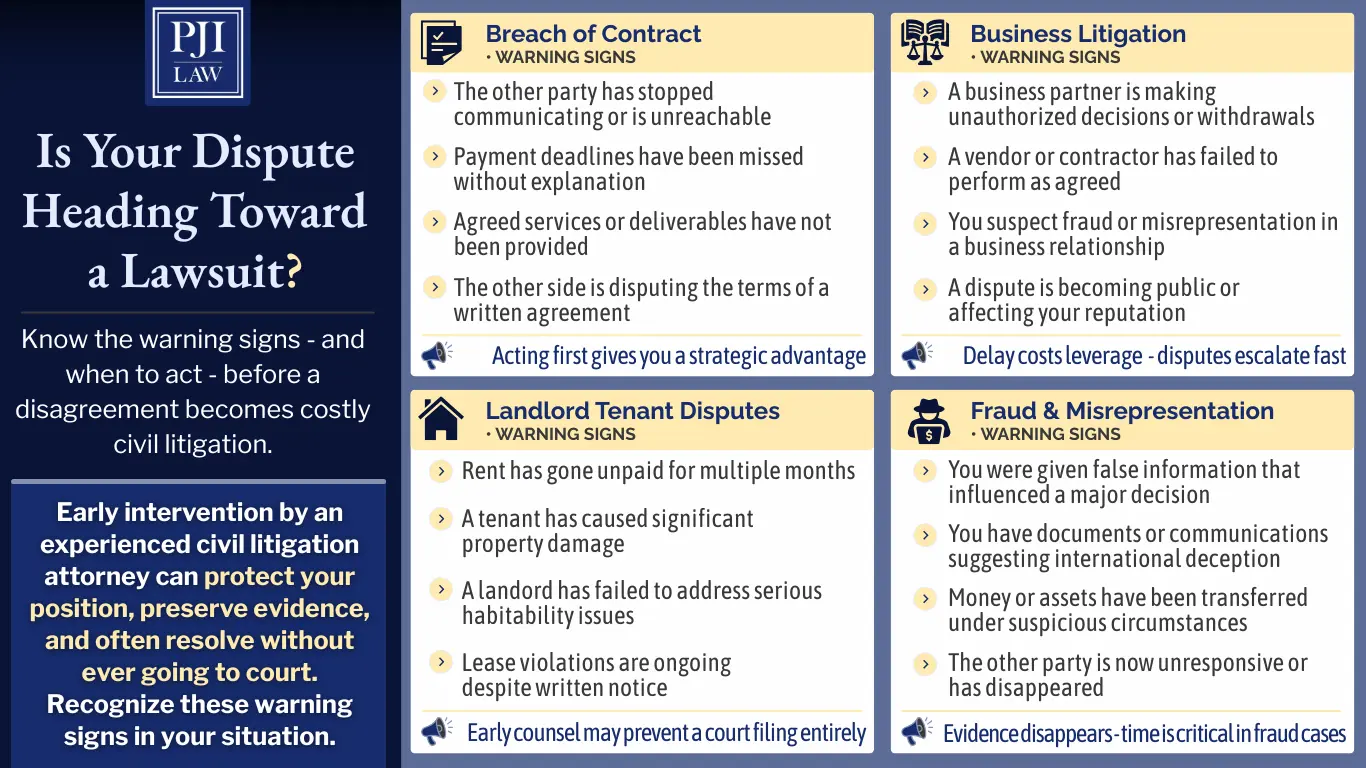
    Civil litigation in Fairfax County covers a wide range of legal disputes. Knowing the warning signs for your specific situation can help you determine when it’s time to consult an attorney before matters escalate.

    Breach of Contract

    If the other party has stopped communicating, missed payment deadlines, failed to deliver agreed services, or is disputing the terms of a written agreement, these are early signals that a breach of contract claim may be developing. Acting before the other side retains counsel can preserve leverage and create room for strategic negotiation.

    Business Litigation

    If a business partner is making unauthorized decisions, a vendor has failed to perform, or you suspect fraud or misrepresentation within a business relationship, waiting to consult an attorney can cost you leverage and increase exposure. Business disputes can escalate and become public quickly.

    Landlord-Tenant Disputes

    If rent has gone unpaid for multiple months, a tenant has caused significant property damage, or a landlord has failed to address serious habitability issues, the dispute may be approaching the point where court intervention becomes likely. Early counsel can help resolve landlord-tenant disputes before a formal filing.

    Fraud and Misrepresentation

    If you suspect you were deliberately misled during a business transaction, contract negotiation, or property sale, and you have communications or documents that suggest intentional deception, time is critical. Evidence can disappear, and statutes of limitations apply. Consulting an attorney early is essential.
    Is Your Dispute Heading Toward a Lawsuit


    When Does a Dispute Become a Lawsuit in Virginia?

    A dispute becomes a lawsuit when a plaintiff files a complaint in court. At that point, the defendant must be formally served, and the litigation process begins.

    In Fairfax County, civil cases may be filed in:

    Once filed, the court sets deadlines. Hearings may be scheduled. Discovery begins. The matter moves toward trial unless resolved.

    The difference between a dispute and a lawsuit is procedural but significant. Before filing, the parties still have flexibility. After filing, the rules of court strictly control the process.

    Early involvement by attorneys for civil matters can influence whether the matter proceeds to trial or is resolved through settlement, mediation, or arbitration.

    Why Waiting Can Be Risky

    Many people assume they should wait until the other side files a lawsuit. In reality, delay can increase exposure. Civil litigation can become time-consuming and expensive once filed. Risks of waiting include:

    • Loss of leverage in negotiation
    • Missed deadlines under the Virginia statute of limitations
    • Informal communications that harm your position
    • Destruction or loss of evidence
    • Escalation that makes settlement more difficult
    • Increased legal fees once trial preparation begins

    If opposing counsel becomes involved before you consult an attorney, you may already be reacting rather than planning.

    An experienced civil litigation attorney can step in early to protect your interests, evaluate claims, and determine whether the dispute can be resolved without court intervention.

    Do you need a lawyer for a civil dispute that might lead to a lawsuit in Fairfax, Virginia

    What a Civil Litigation Attorney Does Before a Lawsuit Is Filed

    Hiring a civil litigation attorney before filing a civil lawsuit is about strategy. An attorney evaluates:

    • The strength of your legal claims
    • Defenses available if you must defend
    • Damages and potential compensation
    • Contract language and breach issues
    • Risk under substantive and procedural law
    • The cost-benefit of filing in court

    Your legal team may draft a formal demand letter, structure negotiations, or recommend mediation or arbitration. Many civil litigation lawyers resolve disputes without trial when the facts and law support a strong position.

    Early counsel can also help you:

    • Preserve documents and communications
    • Avoid statements that could later harm your case
    • Frame issues in a way that positions you for a favorable resolution
    • Prepare for possible hearings if litigation becomes necessary

    Skilled attorneys with extensive experience understand how civil litigation unfolds in Fairfax County courts. That knowledge allows them to advocate effectively while also pursuing practical solutions.

    Can a Dispute Be Resolved Without Going to Court?

    Yes. Many civil matters are resolved without trial.

    Settlement discussions, mediation, and arbitration often occur before a lawsuit is filed or during litigation. A structured negotiation process can often produce a preferred resolution without the expense of extended court proceedings.

    A civil litigation attorney evaluates whether:

    • Settlement is feasible
    • Mediation is appropriate
    • Arbitration is required under the contract
    • Filing a civil lawsuit strengthens leverage

    The goal is not always trial. The goal is to achieve the most favorable outcome under the circumstances for clients while minimizing unnecessary cost and disruption.

    Early Counsel vs. Waiting Until a Lawsuit Is Filed

    Consider the difference:

    Hiring Early

    • Strategic case evaluation
    • Preservation of evidence
    • Negotiation leverage
    • Controlled communication
    • Potential early resolution

    Waiting

    • Reactive defense
    • Court deadlines imposed
    • Increased litigation expenses
    • Greater trial risk
    • Limited flexibility

    Civil litigation can become significantly more complex once a complaint is filed. In many civil cases, early involvement contributes to disputes being resolved in a timely manner.

    What to Expect When You Hire a Civil Litigation Attorney in Fairfax County

    When you retain a civil litigation attorney in Fairfax County, your legal team will:

    • Review facts and documentation
    • Assess applicable Virginia law
    • Identify claims or defenses
    • Develop a litigation strategy
    • Represent you in negotiations
    • Prepare for hearings or trial if necessary

    Civil litigation may involve state or federal court, depending on jurisdiction. Your attorneys will evaluate venue, procedural requirements, and risks. Their role is to represent you, defend against claims where necessary, and advocate for a favorable resolution through negotiation or trial.

    Experienced lawyers understand that litigation is as much about positioning and risk management as it is about courtroom appearances. It’s about protecting business interests, minimizing exposure, and pursuing success through careful planning.

    What to Expect If Your Civil Dispute Proceeds to Trial in Virginia

    While many civil disputes are resolved through negotiation, mediation, or settlement, some do proceed to trial. Understanding what that process involves underscores why early legal strategy matters.

    In Virginia, civil trials are held in either the General District Court or the Circuit Court, depending on the amount in controversy and the complexity of the dispute. In Fairfax County and throughout Northern Virginia, civil litigation is governed by the Virginia Supreme Court Rules and local court procedures. Once a case is filed, deadlines become firm, discovery obligations expand, and the structure of the court controls the pace of the matter.

    If a dispute advances to trial, the process generally includes:

    • Pre-trial preparation, including discovery, depositions, and motion practice
    • Presentation of evidence, where each side introduces documents, witness testimony, and legal arguments
    • Closing arguments, followed by a decision from the judge or jury

    Civil trials are methodical and evidence-driven. They are not the dramatic courtroom scenes often portrayed on television. However, they are formal, procedural, and demanding.

    The advantage of hiring a civil litigation attorney early is not simply preparation for trial. Strategic early involvement increases the likelihood that a dispute can be resolved before court becomes necessary. And if a trial cannot be avoided, it allows you to enter the courtroom prepared, protected, and in a strong position.

    Searching online for a “civil dispute lawyer near me”

    Frequently Asked Questions

    Q: Do I need a civil dispute lawyer before filing a lawsuit in Virginia?

    A: In many civil matters, yes. Early counsel allows you to evaluate claims, protect evidence, and determine whether filing is necessary.

    Q: What is the difference between civil litigation and a criminal matter?

    A: Civil litigation involves private disputes between parties seeking compensation or relief. A criminal matter involves the government pursuing criminal penalties or fines.

    Q: How long does a civil litigation case take in Fairfax County?

    A: The timeline depends on complexity, court schedules, and whether the case proceeds to trial. Many civil cases are resolved before trial.

    Q: Can landlord-tenant disputes be resolved without court?

    A: Yes. Some landlord-tenant disputes are resolved through negotiation before formal civil action.

    Q: What happens if the other party refuses settlement?

    A: If settlement fails, filing a lawsuit may become necessary. Your attorneys will prepare for hearings and trial while continuing to evaluate resolution opportunities.

    Strategic Civil Litigation Guidance Before a Dispute Becomes a Lawsuit

    Legal disputes rarely begin in a courtroom. They begin with uncertainty, strained business relationships, unanswered demands, or a disagreement that grows more complicated by the day. Acting early can change the direction of a dispute long before it turns into a civil lawsuit.

    At PJI Law, PLC, our legal team works with individuals and business owners across Fairfax and the Northern Virginia area who want to address civil matters strategically and in a timely manner. Whether you’re facing a breach of contract, a business dispute, landlord-tenant concerns, fraud allegations, or another civil litigation issue, our attorneys evaluate your position carefully and develop a plan designed to protect your interests and pursue your preferred resolution.

    Clients searching online for a “civil law lawyer near me” often want practical guidance before the situation escalates. Others looking for experienced “civil lawyers in Virginia” need representation in negotiations, mediation, arbitration, or court when litigation becomes necessary. Our firm provides both thoughtful early intervention and skilled courtroom advocacy when required.

    With extensive experience in civil litigation throughout Fairfax County, our attorneys understand how local courts operate and how opposing counsel approaches pre-suit negotiations. We work closely with our clients, explain risks clearly, and represent them with professionalism and preparation at each stage of the process.

    If you’re facing a serious dispute and want to evaluate your options before it becomes a lawsuit, call (703) 865-6100 or contact us online to schedule a confidential consultation today. Early legal strategy can materially influence the direction and outcome of your civil matter.

    At PJI Law, you’ll receive white-glove service and personal attention from a team that treats you like family.

    Copyright © 2026. PJI Law, PLC. All rights reserved.

    The information in this blog post (“post”) is provided for general informational purposes only and may not reflect the current law in your jurisdiction. No information in this post should be construed as legal advice from the individual author or the law firm, nor is it intended to be a substitute for legal counsel on any subject matter. No reader of this post should act or refrain from acting based on any information included in or accessible through this post without seeking the appropriate legal or other professional advice on the particular facts and circumstances at issue from a lawyer licensed in the recipient’s state, country, or other appropriate licensing jurisdiction.

    PJI Law, PLC
    3900 Jermantown Road, 2nd Floor
    Fairfax, VA 22030
    (703) 865-6100
    https://pjibe.webteam.ai/
     

  • Common Contract Disputes Virginia Businesses Face and How to Avoid Them

    Common Contract Disputes Virginia Businesses Face and How to Avoid Them

    In Virginia, contracts are central to how businesses operate. They keep projects on track, safeguard your interests, and establish the responsibilities of everyone involved.

    When a party stops meeting obligations or changes how they communicate, the interruption can be felt immediately. Contract disputes affect your time, your money, and the business relationships you rely on. Many Virginia businesses only recognize problems in a contract once performance issues appear or communication stalls. At that point, the dispute may already be forming, and you now have to decide how to move forward without additional strain on your operations.

    This blog outlines the contract disputes Virginia companies face, the warning signs to watch for, and the steps you can take to protect your business before conflict escalates.

    At a Glance

    Key points Virginia business owners should know:

    • Early warning signs, including missed deadlines, communication gaps, and invoice disputes, often appear long before a formal breach occurs.
    • Common disputes in Virginia involve payment terms, performance issues, NDAs, contract formation, and unclear obligations.
    • Risky contract terms, such as ambiguous payment clauses, undefined confidentiality provisions, liquidated damages, and automatic renewals, frequently trigger conflict.
    • Preventive steps such as clear drafting, written records, well-defined expectations, and organized documentation reduce the chance of future disputes.
    • A Virginia contract dispute lawyer can review agreements, assess whether a breach occurred, and guide you on a strong path forward.

    Need an attorney for contract disputes in Fairfax, Virginia

    Early Warning Signs a Contract Dispute May Be Developing

    Contract disputes in Virginia rarely appear without warning. In many businesses, small problems begin to surface long before one party alleges a breach of contract or initiates litigation. When you recognize these early indicators, you gain more control over the desired outcome, protect your interests, and reduce the chance that a minor issue escalates into a significant business conflict.

    1. Changes in Communication or Responsiveness

    When the other party stops returning calls or delays responses, the pattern may signal uncertainty about contractual obligations. If project milestones go unconfirmed, the issue can grow into a broader dispute.

    2. Requests to Change Terms Mid-Project

    Repeated attempts to adjust pricing, extend timelines, or reduce responsibilities may indicate deeper concerns about the provisions in a contract. These requests often appear in many businesses before formal disputes develop, and they can become key evidence later if one party breached the contract.

    3. Missed Deadlines and Performance Delays

    Early delays often become the root cause of larger contract disputes. Even when a party promises to catch up, missed deadlines affect payment, delivery, and the process the parties expected when signing the contract. This pattern frequently leads Virginia businesses to seek remedies to protect their position.

    4. Disagreements Over Invoices or Payment Terms

    When payment schedules change, invoices remain unresolved, or the other party disputes charges without explanation, a disagreement may be forming. These conflicts commonly appear in breach of contract matters where the party fails to meet payment terms or challenges financial responsibilities. If not addressed early, these issues often grow into disputes over payment, performance, and the obligations outlined in the agreement.

    5. Conflicting Interpretations of Key Contract Terms

    A warning sign appears when the other party begins interpreting the contract differently than before. If two parties read the same agreement in conflicting ways, the inconsistency may signal that a future dispute is developing.

    6. Irregular or Declining Work Quality

    Changes in work quality or performance consistency can signal that a contract dispute is developing. Businesses encounter this issue when a party delivers work that does not match the agreement. If the problem continues, the matter may progress into formal claims that one party breached its obligations under a contract.

    Recognizing these early signs helps you determine when to request documentation, clarify responsibilities, or review contracts with a lawyer for a business contract who understands how disputes develop. Taking these proactive steps may prevent future disputes and reduce the likelihood that the disagreement escalates to litigation.

    If you’re seeing any of these patterns, this is the right time to review the agreement, not after the dispute escalates.

    Common Contract Disputes Virginia Businesses Face

    Common Contract Disputes Virginia Businesses Face

    Virginia businesses encounter similar challenges regardless of industry. Below are the dispute categories that most often lead to legal action.

    1. Breach of Contract

    A breach of contract occurs when one party fails to uphold obligations outlined in an enforceable agreement. The breach may be material or minor, but both can create legal issues if the other party suffered damages.

    To prove a breach under Virginia law, you must generally show:

    • A valid contract existed between the parties.
    • A specific obligation was breached by the defendant.
    • You suffered damages or financial loss as a direct outcome of that breach.
    • You performed your own duties under the agreement.

    Virginia law requires a review of the contract terms first, followed by performance records, communications between the parties, and payment history. When liability is disputed, attention shifts to the provisions that define duties, deadlines, and conditions for performance.

    2. Payment-Related Breach of Contract

    Payment-related contract disputes are also common in Virginia. These disputes involve missed invoices, partial payments, payment withheld due to quality concerns, or payment delayed beyond agreed deadlines. One party may argue they suffered financial loss because the other side failed to deliver, while the accused party insists the contract allowed them to dispute the invoice.

    If you need to pursue damages, the contract’s payment terms, invoicing procedures, and dispute-resolution sections play a central role.

    3. Disputes Involving Non-Disclosure Agreements

    Non-disclosure agreements (NDAs) present problems when one party believes confidential information was shared without permission. If you signed a legally binding agreement that protects trade secrets, customer lists, pricing strategies, or internal processes, a breach could undermine your competitive position.

    To prove a party breached an NDA, you must show:

    • A legally binding contract existed.
    • Confidential information was disclosed.
    • The disclosure violated specific contract terms.

    Many NDAs include liquidated damages provisions for quick financial compensation. Virginia law permits liquidated damages clauses when the amount represents a reasonable estimation of harm and is not considered a penalty.

    4. Disputes Over Contract Formation

    A contract dispute may arise when one party claims the agreement was never legally enforceable. This could happen when:

    • The parties involved did not sign the final version.
    • One party lacked the authority to bind the company.
    • Key contract terms were never agreed upon.
    • The contract violates Virginia law.

    The review focuses on whether a legally binding agreement existed when the parties intended to finalize it. This review may include emails, signatures, payment records, and conduct that shows both parties acted as though a contract existed.

    5. Performance-Related Disputes

    A dispute may form when one party delivers substandard work, uses improper materials, or falls behind schedule. These issues appear frequently in construction, vendor contracts, technology services, and consulting arrangements.

    When performance disputes escalate, parties may pursue damages or seek an interpretation or clarification of ambiguous or incomplete contract clauses.

    Searching online for a “contract disputes attorney near me”

    Contract Terms That Lead to Major Conflicts

    Certain provisions appear repeatedly in Virginia-based contract litigation.

    Ambiguous Payment Terms

    Without clear payment steps, parties disagree on what triggers payment. Contracts often omit:

    • Invoice delivery instructions
    • Accepted payment methods
    • Deadlines for payment
    • Procedures for disputing an invoice

    These omissions cause confusion and may lead to financial compensation claims.

    Liquidated Damages Provisions

    A liquidated damages clause creates a predetermined amount owed if a party breaches a specific term. These provisions are enforceable when the amount is reasonable and reflects anticipated harm, while overly punitive amounts may be rejected.

    Dispute Resolution Sections

    Some contracts include mediation or arbitration as alternative dispute resolution tools. These methods may reduce litigation costs and give you more control over the resolution process. However, if these sections lack detail, parties may disagree on how and when to start the process.

    Non-Disclosure and Confidentiality Clauses

    NDAs must define confidential information clearly. Without this definition, parties may dispute whether a disclosure breached the contract. Laws governing confidentiality continue to evolve in Virginia, which makes precise drafting even more important.

    Automatic Renewal Provisions

    Renewal clauses cause issues when a contract renews without notice. Companies may argue they did not agree to the renewal, while the other party insists the contract language required cancellation in writing.

    If your current contracts include these terms, consider having them reviewed to prevent avoidable disagreements later.

    How to Avoid Contract Disputes in Virginia

    How to Avoid Contract Disputes in Virginia

    The most effective way to prevent a contract dispute is to focus on the structure of the agreement before work begins. When expectations are documented clearly and supported with strong records, disagreements are less likely to escalate into litigation.

    1. Ask for Clear, Detailed Contract Terms

    A well-drafted agreement describes:

    • The services provided
    • Deadlines for performance
    • The invoicing and payment process
    • The approval process
    • How to handle disagreements
    • Responsibilities of all parties

    Avoid vague phrases such as “reasonable time” or “best efforts,” and request language that spells out deliverables and timelines with precision. When terms are specific, both sides begin the relationship with the same expectations.

    2. Review Contracts Thoroughly Before Signing

    Review contracts with lawyers for contract disputes experienced in Virginia contract law. An attorney can identify ambiguous terms, flag risk areas, and suggest revisions that protect your interests.

    Virginia law requires mutual agreement on all material terms, so the document should reflect what both parties intended when negotiating the agreement.

    3. Document All Agreements in Writing

    Oral promises create legal issues. Written agreements provide relevant information that may be relied on later if a dispute arises. If changes occur during a project, request that those revisions be documented in a written amendment rather than relying on verbal updates or informal emails.

    4. Maintain Organized Records Throughout the Contract Lifecycle

    Strong documentation supports your position if a dispute forms. Keep copies of signed agreements, change orders, invoices, payment records, and all communications with the other party.

    Detailed records also help demonstrate that you did not waive your rights by continuing performance after a potential breach.

    5. Use Non-Disclosure Agreements When Needed

    If your business depends on confidential information, NDAs protect your interests. Clearly define what counts as confidential information, the duration of protection, and the obligations of the parties involved.

    6. Establish a Process for Communication

    Many disputes begin with miscommunication. Regular updates, written notices, and documented approvals create a record that supports your position if the other party later disputes what was agreed upon.

    7. Include a Dispute-Resolution Section

    Alternative dispute resolution, such as mediation or arbitration, may resolve disagreements without resorting to litigation. These methods can move faster than litigation and may protect ongoing business relationships.

    Virginia law also expects parties to take reasonable steps to limit financial loss when a dispute appears to be developing, which makes early communication and documentation even more important.

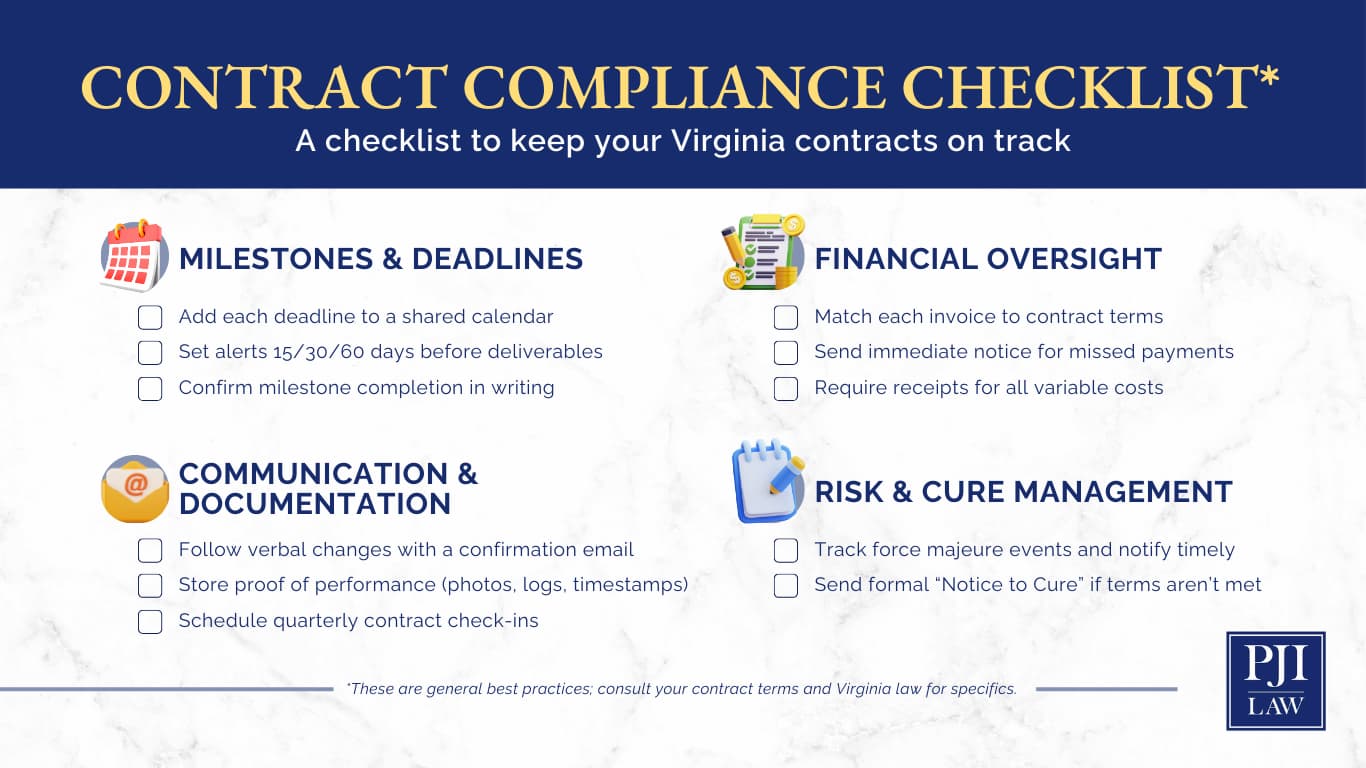
    CONTRACT COMPLIANCE CHECKLIST

    When to Consider Legal Action in a Contract Dispute

    Not all disagreements require court intervention. However, you may consider legal action when:

    • The party breached a significant obligation.
    • You suffered damages and can document the loss.
    • Attempts to resolve the dispute informally were unsuccessful.
    • The dispute threatens important business relationships.
    • The other party refuses to negotiate.

    A contract lawyer can determine what legal options apply to your situation and whether litigation or alternative dispute resolution offers the strongest path toward resolution.

    How Most Virginia Contract Disputes Are Resolved

    Most contract disputes in Virginia are resolved without going to court. Negotiation, mediation, arbitration, or informal settlement discussions often resolve the issue first.

    Businesses often choose these approaches because they are faster, less expensive, and more private than traditional litigation. Many agreements in Virginia also include dispute-resolution requirements, which means the parties must attempt mediation or arbitration before filing a lawsuit.

    Even when a lawsuit is filed, it often resolves long before trial. Settlements occur after informal discussions, during discovery, or once the parties understand the strengths and weaknesses of the claims. In some situations, a dispute may close through withdrawal or default if one party stops participating.

    Trials generally occur only when the parties cannot agree on the facts, the contract terms, or the value of the claimed financial loss. These situations are the exception rather than the rule.

    How PJI Law, PLC Supports Virginia Businesses

    PJI Law, PLC works with clients across Fairfax and Northern Virginia who want to protect their business interests and reduce the risk of disputes. Our team reviews contracts, drafts agreements, and represents businesses in breach of contract litigation. Whether you’re preparing to sign a new contract or facing questions about a dispute that already surfaced, our attorneys provide guidance grounded in Virginia law and focused on efficient resolution.

    If a disagreement is affecting your business operations, talking with a lawyer early can protect your options and reduce the risk of further loss.

    Searching for an attorney for contract disputes in Fairfax, VA

    Frequently Asked Questions

    Q: What counts as a breach of contract in Virginia?

    A: A breach of contract occurs when a party does not fulfill a specific obligation outlined in the agreement. This could involve payment, performance, quality of work, or misuse of confidential information.

    Q: Do I need a written contract to bring a claim?

    A: No. Virginia recognizes both written and oral contracts. Written agreements offer clearer evidence and carry a five-year statute of limitations under Va. Code § 8.01-246(2). Oral or unwritten agreements carry a three-year limitation period under Va. Code § 8.01-246(4).

    Q: What damages can a business recover in a contract dispute?

    A: Businesses may recover financial compensation for measurable loss. In limited situations, specific performance (requiring the breaching party to fulfill the contract) or declaratory relief (clarifying rights and obligations) may also be available. Documentation is critical to proving economic harm.

    Q: What if the other party claims the contract was never valid?

    A: A party may claim the agreement lacked authority, contained unclear or missing terms, or violated Virginia law. Enforceability is determined by examining evidence such as emails, conduct, signatures, payment history, and how the parties behaved to assess whether a valid, binding agreement existed.

    Q: Can NDAs and confidentiality clauses be enforced in Virginia?

    A: Yes. NDAs can be enforced when they clearly identify the confidential information and protect a legitimate business interest. Provisions may be rejected if they act like penalties or restrict more than what is reasonably necessary.

    Q: How can I reduce the risk of future disputes?

    A: Clear drafting, documentation, organized communication, and well-defined dispute-resolution terms all strengthen your agreements. Many businesses benefit from attorney review before signing.

    Q: When should I contact a lawyer for a contract dispute?

    A: If the issue involves missed payments, performance delays, questions about validity, or a disagreement that threatens business operations, it’s time to consult a Virginia contract dispute lawyer.

    Protect Your Business With Guidance from PJI Law, PLC

    Contracts influence the way your business operates. When a contract dispute interrupts key projects or strains important business relationships, timely legal guidance can make the difference between a brief disruption and a long-term setback. Business owners turn to our firm when they need civil suit lawyers in Virginia who understand how to resolve contract disputes through negotiation, alternative dispute resolution, or litigation when necessary.

    At PJI Law, PLC, we work closely with Virginia business owners who need strong, well-structured agreements that reflect their goals and reduce risk across the contract’s lifecycle. If you’d like to review contracts, discuss a dispute, or strengthen future agreements, call us at (703) 865-6100 or contact us online to schedule a complimentary and confidential consultation. 

    Our team supports clients across Fairfax and Northern Virginia, offering services that protect your interests and respect the time and effort you put into your business.

    At PJI Law, you’ll receive white-glove service and personal attention from a team that treats you like family.

    Copyright © 2026. PJI Law, PLC. All rights reserved.

    The information in this blog post (“post”) is provided for general informational purposes only and may not reflect the current law in your jurisdiction. No information in this post should be construed as legal advice from the individual author or the law firm, nor is it intended to be a substitute for legal counsel on any subject matter. No reader of this post should act or refrain from acting based on any information included in or accessible through this post without seeking the appropriate legal or other professional advice on the particular facts and circumstances at issue from a lawyer licensed in the recipient’s state, country, or other appropriate licensing jurisdiction.

    PJI Law, PLC
    3900 Jermantown Rd, 2nd Floor
    Fairfax, VA 22030
    (703) 865-6100
    https://pjibe.webteam.ai/

  • How to Avoid Pitfalls When Making a Personal Loan to a Friend in Virginia

    How to Avoid Pitfalls When Making a Personal Loan to a Friend in Virginia

    The phone rings, and you see it’s one of your closest friends calling. After a few minutes of catching up, they gently bring up an unexpected financial situation. “I wouldn’t ask if it weren’t important,” they say, “but I was wondering if you might be able to help me out with a loan. I’ll make repaying you my priority.”

    You pause, feeling the weight of the decision. You know your friend wouldn’t ask if it weren’t serious, and as much as you want to help, lending money to friends can feel risky. You don’t want to jeopardize your friendship, but you also need to ensure your finances are protected.

    Lending money to friends feels straightforward in the moment, but it often involves more than expected. A clear, structured loan agreement can safeguard your finances and friendship alike. In this blog, we’ll cover the key steps to take when making a personal loan to a friend in Virginia, what your options are if your friend stops paying, and when you might need the help of a collection attorney. From crafting a simple agreement to understanding interest limits, you’ll learn how to lend responsibly while safeguarding your finances and peace of mind.

    Virginia’s Contract and Interest Rate Laws for Loans

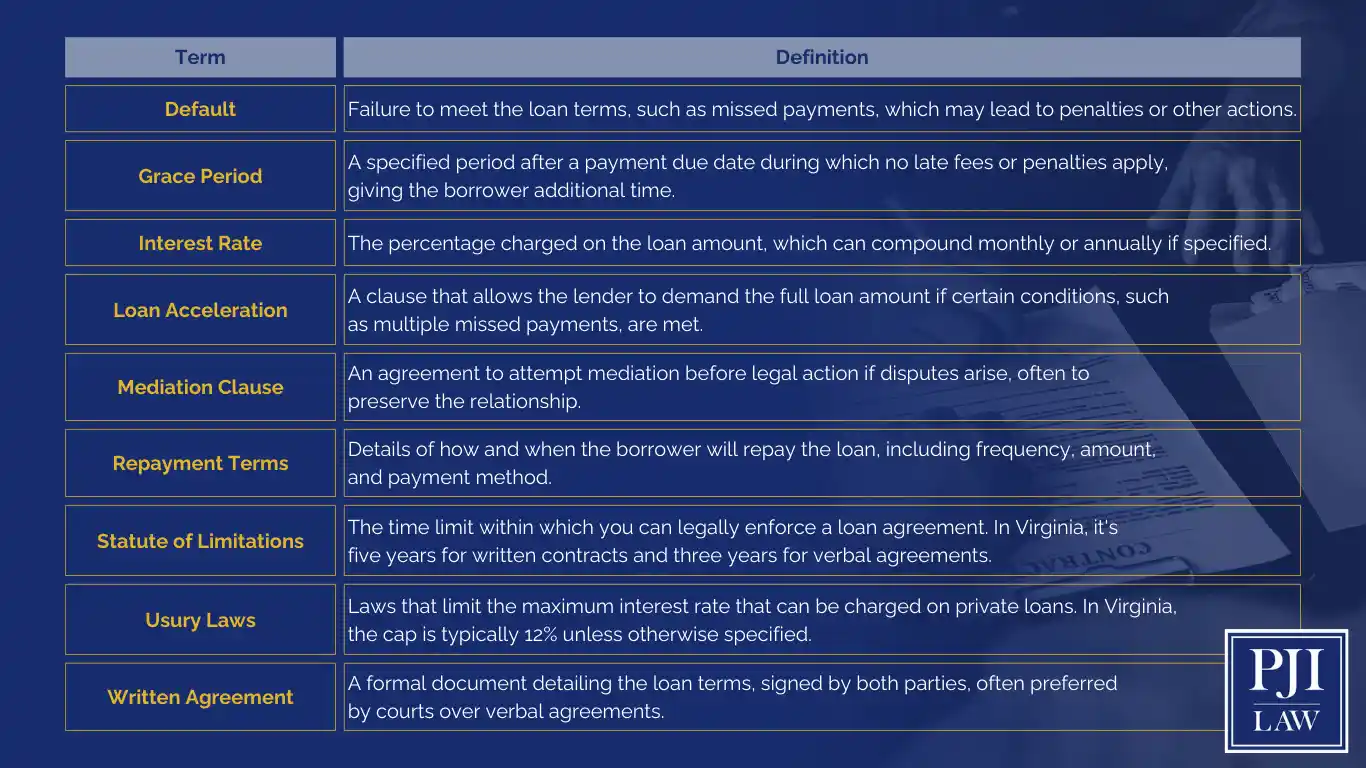
    Before you reach for your wallet, it’s essential to understand that in Virginia, personal loans between friends are legally binding contracts. The state’s statute of limitations for written contracts is five years, while verbal agreements have a three-year limit. To enforce your loan agreement, you need to act within these timeframes before the statute of limitations expires. You can view the full statute here.

    Additionally, Virginia’s usury laws cap interest rates at 12% annually for most private loans, unless a different rate is set in writing. If your loan amount exceeds a threshold (usually $5,000), a higher rate may apply—you can confirm this threshold and other specifics of Virginia’s usury laws here. Written contracts aren’t just for big business deals—they provide clarity for both sides in personal loans as well, making it easier to resolve any misunderstandings that may arise. While charging interest to a friend might feel uncomfortable, establishing clear terms helps both parties treat the loan seriously.

    need-help-with-a-loan-agreement-for-making-a-loan-to-a-friend

    Consider Alternative Options

    Before committing to a personal loan, explore alternative borrowing options that might be easier on your friendship and your finances:

    • Local Credit Unions: Credit unions often offer personal loans at lower rates than traditional banks. Many credit unions in Virginia provide flexible loan terms that can be more affordable and structured than a private loan.
    • Peer-to-Peer Lending Platforms: Platforms like LendingClub or Prosper facilitate loans between individuals but provide structure, interest rates, and payment schedules. This can keep the loan more formal without involving friends or family directly.
    • Non-Profit Credit Counseling Services in Virginia: Many non-profit organizations offer financial counseling and small loan options, especially for individuals in financial hardship. Services like these can be a safer alternative than relying on friends or family for funds.
    • Emergency Assistance Programs: Some community organizations in Virginia provide emergency funds or loans for specific needs, like medical bills or utilities, at low or no interest. This can be a helpful resource, especially if the loan is for a temporary hardship.
    • Payment Plans with Creditors: If the funds are needed for an existing debt, see if the creditor offers a payment plan or reduced payment options. Many creditors offer flexibility on repayment terms, which can remove the need for a personal loan entirely.

    Know When to Say No

    know-when-to-say-no

    Sometimes, the best way to protect your finances and your friendship is to decline a loan request. Consider saying no if any of these apply:

    • Financial Limitations: If you can’t afford to lose the money or would be financially strained by lending it, it’s likely best to decline.
    • History of Financial Issues: If the friend has a pattern of financial instability or unpaid debts, the risk may outweigh the benefit.
    • Feeling Pressured or Rushed: If you feel uncomfortable or pressured into the loan, take a step back. Financial decisions should never be rushed.
    • Unwise Loan Purpose: If the loan is for something unnecessary or seems risky (e.g., gambling or a risky investment), it may be best to say no.
    • Potential Impact on Your Own Stability: If lending would affect your financial security, prioritize protecting your own stability.

    Document Everything in Writing

    document-everything-in-writing

    If you decide to go ahead with the loan, you might think a handshake or verbal promise is enough between friends, but Virginia courts strongly favor written agreements. Having a written contract not only clarifies expectations but also protects both parties if issues arise. Here’s what to include for legal enforceability:

    • Exact Loan Amount: Specify the precise amount of money being borrowed. This should match any cash, check, or digital transfer provided.
    • Interest Rate (if applicable): If charging interest, include the rate and whether it compounds monthly or annually. If interest isn’t being charged, note that the loan is interest-free.
    • Parties’ Full Legal Names and Addresses: Record both parties’ full names and current addresses as they appear on identification.
    • Date of Agreement: Include the date the agreement is signed, as this helps establish the timeline if legal action is needed.
    • Signatures and Notary (if possible): Both parties should sign. For extra formality, consider notarizing the document to strengthen its enforceability in court.


    do-you-need-a-collection-attorney-after-making-a-loan-to-a-friend

    Consider using a loan agreement template tailored to Virginia law, but review it carefully and consult a legal professional if needed to ensure all necessary elements are included.
    PJI-Law-SuperBlog-Images-5

    Establish Clear Repayment Terms

    Vague repayment plans often lead to misunderstandings that can strain even the strongest friendships. Outline each repayment term in detail to avoid complications:

    • Total Loan Amount: Specify the amount your friend will repay, including any interest. This ensures both parties are clear on the final repayment amount.
    • Payment Frequency and Due Dates: Decide how often payments will be made (e.g., weekly or monthly) and specify due dates. A consistent schedule helps both parties avoid missed payments.
    • Payment Amount and Method: Define the amount for each payment and the payment method (e.g., bank transfer, check, or cash). Consistency will help keep the loan organized.
    • Grace Periods and Consequences for Missed Payments: Decide whether to offer a grace period and outline any penalties or actions for missed payments. Specify if late fees apply or if multiple missed payments allow additional actions like loan acceleration.
    • Acceptance of Partial Payments: State if partial payments are acceptable, and if so, how they’ll be applied to the principal and interest. This keeps everyone clear on loan progress.

    By outlining these terms thoroughly, you create a structured repayment plan that supports a smoother repayment process and protects both parties.

    Safeguard Your Tax Position

    The IRS pays attention to personal loans, even between friends. Loans without clear terms or interest rates may appear as gifts to the IRS, triggering gift taxes or other tax obligations. To avoid tax complications and keep your financial records clean:

    • Document this as a loan, not a gift.
    • Charge at least the minimum interest rate required by the IRS (the applicable federal rate for your loan term, which you can find here.
    • Keep detailed records of all payments received.
    • Report interest income on your tax returns.
    • Understand that forgiving the loan has tax implications, and consult an accountant if necessary.

    Plan for Worst-Case Scenarios

    plan-for-worst-case-scenarios
    Nobody likes to think about things going wrong, but anticipating potential issues can save both your finances and your friendship if problems arise. Including these provisions in your loan agreement helps prevent misunderstandings and sets expectations:

    • Early Repayment Options: Specify whether early repayment is allowed and if there are any incentives for paying off the loan sooner. For example, you could decide to waive a portion of interest if the loan is repaid early. This provides flexibility for your friend if their financial situation improves.
    • Defining Default and Its Consequences: Outline exactly what constitutes a default. This could include missed payments, partial payments, or a specified number of late payments. Clearly define the consequences, such as late fees, interest increases, or other penalties, so there is no ambiguity if payments become inconsistent.
    • Relocation Terms: Decide what happens if either you or your friend moves out of Virginia during the loan period. Moving can complicate legal recourse, especially if it becomes necessary to pursue repayment. You may want to specify that the terms of the loan remain governed by Virginia law, even if one of you relocates.
    • Mediation Before Legal Action: To avoid escalating tensions, include a clause that requires mediation before pursuing legal action if a serious dispute arises. Mediation can be a less costly, less adversarial way to resolve issues and can help preserve your relationship while seeking a fair solution.
    • Loan Acceleration Terms: State if and when the loan will be “accelerated” due to missed payments. Loan acceleration means that if a certain number of payments are missed, the entire balance becomes due immediately. This gives you a clear path for handling cases of serious non-payment.
    • Provision for Potential Modifications: Include a clause allowing for possible modifications to the loan terms if unforeseen financial hardships arise. This clause can specify that any adjustments to the payment schedule or amounts must be agreed upon in writing by both parties, adding a layer of flexibility without undermining the agreement.

    By planning for these scenarios, you’re protecting both parties and minimizing potential disruptions. Setting these terms upfront helps ensure a smoother process if challenges occur, providing peace of mind and structure for both you and your friend.

    Keep Communications Professional

    Once the loan is made, it’s important to treat the arrangement professionally to avoid misunderstandings or strains on your relationship. While maintaining formality in personal loans can feel awkward at first, it reduces misunderstandings and keeps everyone on the same page. Taking these steps can help maintain clear communication and accountability:

    • Separate Loan-Related Communication: Keep loan-related discussions separate from your usual interactions. Use email or written notes instead of casual texts, which helps set a more professional tone and keeps a clear record.
    • Document Every Payment: Record each payment as it’s made and keep a log of payment dates, amounts, and methods (e.g., cash, check, bank transfer). This documentation can be valuable if you ever need to reference specific payment details.
    • Provide Regular Loan Statements: Create monthly or quarterly loan statements summarizing payments made, the remaining balance, and any upcoming due dates. This way, both of you are always aware of the loan’s status.
    • Send Professional Payment Reminders: If a payment is due soon, send a polite reminder that is professional and friendly. This can be as simple as an email or text message that keeps the tone respectful and business-like.
    • Maintain a Loan Tracking Spreadsheet: Track the loan balance, payments received, and due dates in a spreadsheet. This keeps everything organized and makes it easy to see the loan’s progress.

    Protect Your Friendship

    Money can strain even the best relationships, so take steps to keep your friendship intact and minimize the emotional impact of the loan:

    • Keep Loan Discussions Private: Avoid bringing up the loan at social events or in group settings. Discuss it one-on-one, away from mutual friends, so it doesn’t become a public or uncomfortable topic.
    • Maintain Clear Boundaries: Refrain from casually discussing the loan when spending time together socially. Let your social time stay focused on enjoying each other’s company.
    • Respect Privacy: Avoid sharing details of the loan with mutual friends or family. This keeps the arrangement private and minimizes any external pressure on the borrower.
    • Continue Friendship Activities: As much as possible, maintain your usual friendship routines. This helps keep the loan from becoming a defining aspect of your relationship.
    • Address Issues Calmly and Privately: If problems arise, approach them privately and respectfully. A calm, constructive conversation can help resolve issues without damaging the relationship.

    When to Seek Legal Assistance

    when-to-seek-legal-assistance

    If significant problems arise with the loan, consider consulting a Virginia collections attorney who handles contract disputes or small claims cases to guide you through your options:

    • Multiple Missed Payments: If your friend has missed several payments and stopped communicating, a legal consultation may help you decide on next steps.
    • Disputes Over Loan Existence: If your friend denies the loan’s existence or refuses to acknowledge the terms, legal support can help you enforce your agreement.
    • Approaching the Statute of Limitations: If you’re nearing Virginia’s statute of limitations (five years for written agreements, three years for verbal), consult an attorney to ensure your rights remain protected.
    • Relocation or Bankruptcy: If your friend moves out of Virginia or files for bankruptcy, your legal options may change. Legal advice can clarify how these circumstances impact the loan.
    • Exhausted Informal Resolution Attempts: If all other attempts at resolving the matter have failed, pursuing the issue in Virginia’s small claims court may be a cost-effective option. The court handles cases up to $5,000, which may be suitable for many personal loans.

    Remember, making a personal loan to a friend in Virginia requires careful consideration and planning. Helping a friend in tough times is admirable, but by protecting yourself legally and financially, you’re ensuring both your friendship and finances are preserved.

    Get Back What You’re Owed: Recover Your Loan to a Friend with PJI Law’s Trusted Support

    When you extended a personal loan to a trusted friend, you took every step to cover your bases. But now, with the loan in default, you’re left in a difficult position of needing to recover what you’re owed. At PJI Law, we understand that deciding to take collection action against a friend isn’t easy and that personal loan disputes can feel both financially stressful and emotionally complicated.

    With our white-glove service and personalized approach, PJI Law’s trusted collection attorneys are here to help. We’ll carefully review your loan agreement, assess your options, and work toward a resolution that brings you the results you need. Throughout the process, you’ll receive focused, attentive support, ensuring you feel informed and confident every step of the way.

    Reaching out for help is a big step, and we’re ready to provide the guidance you need. If you’ve been searching online for a “debt collection attorney near me,” call us instead at (703) 865-6100 or complete our confidential online form to schedule a confidential consultation with PJI Law. Let us handle the complexities so you can move forward with peace of mind.

    At PJI Law, you’ll receive white glove service and personalized attention!

    Copyright © 2024. PJI Law, PLC. All rights reserved.

    The information in this blog post (“post”) is provided for general informational purposes only and may not reflect the current law in your jurisdiction. No information in this post should be construed as legal advice from the individual author or the law firm, nor is it intended to be a substitute for legal counsel on any subject matter. No reader of this post should act or refrain from acting based on any information included in or accessible through this post without seeking the appropriate legal or other professional advice on the particular facts and circumstances at issue from a lawyer licensed in the recipient’s state, country, or other appropriate licensing jurisdiction.

    PJI Law, PLC
    3900 Jermantown Rd, 2nd Floor
    Fairfax, Virginia 22030
    (703) 865-6100
    https://pjibe.webteam.ai/

  • What Are Your Rights as a Virginia Landlord During COVID-19?

    What Are Your Rights as a Virginia Landlord During COVID-19?

    Being a landlord requires familiarity with relevant local and state housing rules. However, the impact of COVID-19 has further complicated the rules and processes surrounding owning and renting a property because many tenants have enhanced rights, and courts are either backed up or possibly unwilling to hold tenants to their typical requirements.

    Tenants who have had their income impacted by the pandemic might attempt to postpone eviction cases for 60 days. They must simply provide the court with proof that they are not receiving wages or payments associated with the state of emergency declared by the governor.

    Under the Governor’s Declared State of Emergency, What Must a Landlord Do If a Tenant Is Late on One or More Rent Payments?

    Landlords rely on tenants to pay their rent on time. Per Governor Ralph Northam’s declared state of emergency, landlords must take some specific actions if a tenant is late on one or more rent payments:

    • Provide written notice to your tenant of the amount due and what they owe.
    • Give your tenant 14 days to pay the amount due and owed, make another payment arrangement, or enter into a payment plan.
    • Include details about providing a signed statement certifying additional expenses or income loss due to a declared state of emergency.
    • Explain the tenant’s ability to enter into a repayment plan for back due rent in the written notice.
    • The payments must be equal over the shorter of these two periods; the end of the lease term or the shorter of 6 months.
    • The landlord cannot include late fees in the repayment plan.

    If a renter makes payments on time, as a landlord, you can proceed with an eviction filing hearing for other lease violations, as long as you do not use them as a proxy for the tenant not paying rent.

    What Is Covered by the CARES Act Rental Payment Protections?

    The CARES Act, which President Trump signed into law in March 2020, provided 120 days of eviction relief for those tenants living in federally backed housing. The eviction moratorium began on March 27, 2020, and ended on July 24, 2020, meaning that landlords could not serve renters an eviction notice until July 25th, 2020.

    Due to additional funds given to the Department of Housing and Urban Development for housing vouchers, housing for the elderly, rent assistance, and public housing support, your tenants could contact HUD rental assistance.

    The CARES Act extended eviction protections until January 31, 2021, providing an additional $25 billion in rent assistance support to those who had lost income due to the pandemic.

    The CDC’s Unprecedented Role in Extending Eviction Moratoriums

    On September 4, 2020, the Centers for Disease Control and Prevention (CDC) imposed a nationwide temporary federal moratorium on residential evictions for nonpayment of rent. The order’s stated purpose is to prevent the further spread of COVID-19, specifically by preventing homelessness and overcrowded housing conditions resulting from eviction.

    The action, which followed an Executive Order directing the CDC to consider such a measure, is unprecedented, both in terms of the federal reach into the traditional state and local governance of landlord-tenant law and its use of a public health authority for this purpose. The national eviction moratorium took effect less than two weeks after the CARES Act eviction protections expired on January 31, 2021. The CDC’s most recent order extends the residential eviction ban until July 31, 2021.

    When can a Virginia Landlord Proceed with an Evictions Filing?

    Despite giving a grace period and as much support as possible to tenants, a Virginia landlord might still need to move forward with an eviction. Since most of these orders expired on March 31st, 2021, if you have attempted to work with your tenants and have been unable to resolve the situation, be prepared to file and go to court with the support of an experienced attorney.

    A civil lawyer can assist you with navigating this complex process. Our team at PJI Law, PLC, knows these complicated issues and can support and prepare you for what to expect. A tenant might still bring up impacts of COVID-19 in court during eviction hearings, so an experienced attorney can advise you of the different requirements and what to expect.

    I’ve Filed an Evictions Lawsuit for Non-Payment of Rent in Virginia. What’s Next?

    After you have already filed an eviction case, it’s in your best interest to retain an attorney. Once a Virginia landlord has filed a Summons for Unlawful Detainer In the appropriate General District Court court and paid filing fees, the summons must be served on the tenant by a professional process server or a sheriff.

    Then an eviction hearing must be scheduled within a few weeks after the summons is filed with the court. If the judge rules in favor of the landlord, they will issue a writ of eviction, and the eviction process will proceed. A judge could issue the writ of eviction as soon as ten days after entering the judgment in favor of the landlord.

    If the writ of eviction is not requested within 180 days, however, the landlord will have to start the eviction process all over again. A sheriff typically delivers the writ to the tenant within 15 to 30 days of receiving the writ of eviction. The tenant then has 72 hours to vacate the property before the sheriff can return to evict them.

    Contact PJI Law, PLC

    Our civil lawyer team at PJI Law, PLC, has extensive experience supporting landlords who find themselves in these predicaments of having to navigate through COVID-19 and protect their investments and expectations. Our firm provides efficient, top-quality legal services in estate planning, probate, business law, and civil litigation. We focus on each client’s unique story while we offer personalized service and attention. Our professionalism, experience, and dedication manifest in our excellent reputation and stellar client reviews.

    Schedule a consultation with PJI Law, PLC, today at (703) 865-6100 to learn more about how we can help you proceed with an eviction case.

    Copyright © 2021. PJI Law, PLC. All rights reserved.

    The information in this blog post (“post”) is provided for general informational purposes only, and may not reflect the current law in your jurisdiction. No information contained in this post should be construed as legal advice from the individual author or the law firm, nor is it intended to be a substitute for legal counsel on any subject matter. No reader of this post should act or refrain from acting on the basis of any information included in, or accessible through, this post without seeking the appropriate legal or other professional advice on the particular facts and circumstances at issue from a lawyer licensed in the recipient’s state, country or other appropriate licensing jurisdiction.

    PJI Law, PLC
    3900 Jermantown Rd, 2nd Floor
    Fairfax, Virginia 22030
    (703) 865-6100
    https://pjibe.webteam.ai/

  • What Can Virginia Landlords Do About Tenants Who Are Behind on Rent in the Age of COVID-19?

    What Can Virginia Landlords Do About Tenants Who Are Behind on Rent in the Age of COVID-19?

    Whereas commercial landlords can often utilize “self-help” and evict a non-paying tenant by changing the locks or, in some instances, shutting off utilities, landlords with residential tenants must use the court system by filing a Summons for Unlawful Detainer in order to evict a tenant.

    Beginning March 16, 2020, all judicial evictions were frozen due to the judicial state of emergency declared by the Supreme Court of Virginia. Since then, there have been all kinds of changes that can be immensely confusing for those who, unlike landlord-tenant attorneys, don’t have it as part of their job descriptions to keep tabs on legislative and judicial updates.

    A freeze on evictions would inconvenience and frustrate landlords during ordinary times, but a freeze on evictions during a period when many tenants are suffering financially and missing rent payments can cripple a landlord still facing monthly mortgage bills. Certainly both landlords and tenants are facing and dealing with unique hardships during the pandemic. If possible, both parties should explore and consider every possible way to resolve difficulties and avoid evictions. However, a resolution is not always possible; so what remedies do landlords during the eviction freeze?

    If negotiations fail, the best thing a landlord can do is to have their unlawful detainer proceeding filed with the court now and scheduled on the soonest date permitted by the court. General District Courts have been accepting unlawful detainer filings since March 16th, and these matters have been piling up in the clerk’s office. For example, in one standard-sized General District Court in Virginia, nearly 200 unlawful detainer lawsuits were filed in the seven weeks following March 16th.

    Many of the landlords with pending matters have had their initial return dates continued by the court, or have had to select new dates, due to extensions of the judicial emergency. A law firm familiar with the peculiarities of your local court would be well positioned to strategize with you about how to improve chances of getting to the “front of the line”.

    PJI law has represented landlords in Fairfax County, Loudoun County, Prince William County, Arlington County, the City of Alexandria and other Northern Virginia jurisdictions in matters ranging from unpaid rent, to evictions, to property damage, to fraudulent representation. If you need advice on the best course of action or need assistance in getting your matter through court efficiently in light of the long queue that has built up, please schedule a consultation either in person, on the phone, or by video to discuss your matter. You can reach us at (703) 865-6100 or at landlords@pjilaw.com.