
Running a business in Virginia comes with its fair share of legal complexities — and one of the most critical yet often overlooked areas is determining who has the authorization to sign on behalf of the company. Whether you’re inking a major contract, opening a new bank account, or finalizing an important transaction, understanding the ins and outs of signing authorization is essential to protecting your organization and avoiding costly missteps.
In this comprehensive guide, we’ll walk you through the ins and outs of signing authority in the state of Virginia. You’ll learn about the different roles and titles that typically carry this power, how to properly document and delegate signing privileges, and strategies for maintaining tight control over who can legally bind your company. By the end, you’ll have the knowledge and tools you need to ensure your organization is always operating within the bounds of the law when it comes to authorizing signatures.
Understanding Corporate Organizational Structure
When it comes to determining who has the authorization to sign on behalf of a Virginia-based company, the first step is understanding the organization’s core structure and hierarchy:
Limited Liability Company (LLC)
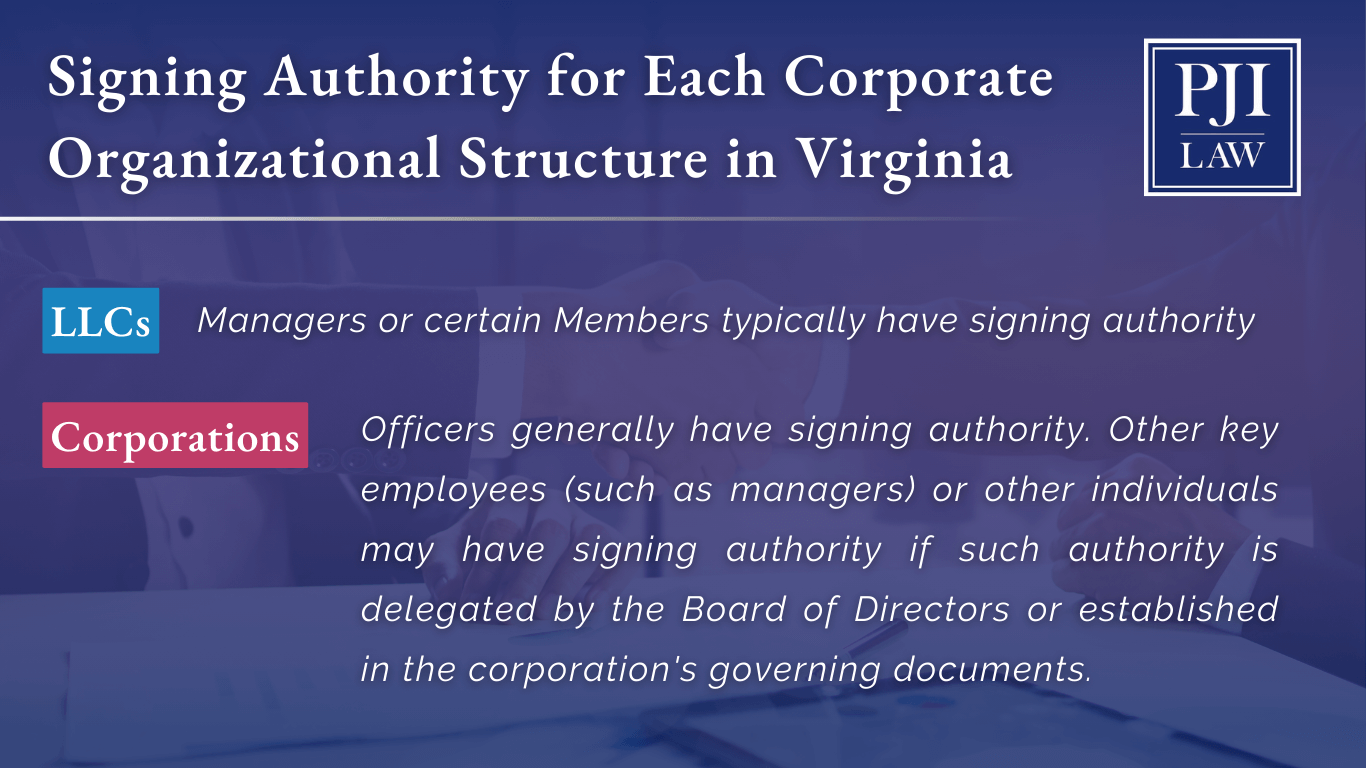
In a Virginia LLC, the default signing authority typically lies with the manager or managing members. This means the individual(s) designated as the LLC’s managers or managing members will hold the broadest power to enter into agreements and legally bind the company. However, the operating agreement may also grant signing privileges to non-managing members or even specific employees, so it’s important to review your LLC’s documentation closely.
Corporations
For Virginia corporations, the Board of Directors usually holds the primary signing authority. The President, CEO, CFO and other C-suite executives derive their signing power from the Board’s delegation. Lower-level employees may also be granted more limited authority, but this should be clearly documented in the articles of incorporation or bylaws.
Regardless of your business entity type, developing a thorough understanding of your corporate organizational structure is crucial. A business attorney in Virginia can provide invaluable guidance in navigating these complexities.

Incorporating Signing Authority into a Company’s Organizational Documents
While the managing members of an LLC and the Board of Directors of a corporation typically hold the broadest signing privileges, Virginia businesses may also choose to delegate more limited authority to members and employees (LLC) or the highest-ranking officers and directors (corporation). A Virginia business attorney can properly document and align this process with state regulations.
Department heads, regional managers, and other mid-level roles may be granted the ability to sign off on routine transactions or contracts within their specific areas of responsibility. Administrative staff may also be empowered to affix their signatures for particular purposes, such as processing invoices or opening bank accounts.
Businesses should have clear policies and procedures outlining the specific parameters, documentation requirements, and oversight mechanisms. Regularly reviewing and updating these guidelines can help mitigate risks and ensure compliance.
Operating Agreements for LLCs and Company Bylaws for Corporations
For Virginia businesses, clearly documenting signing authority protocols is crucial, regardless of the business structure. LLCs rely on operating agreements, while corporations rely on bylaws. Operating agreements and bylaws serve as the foundational legal documents for LLCs and corporations respectively, governing an organization’s internal operations and decision-making processes.
When it comes to signing authority, operating agreements and bylaws should outline the specific roles and positions that hold the power to legally bind the company. This effort typically includes defining the signing privileges of managing members, members, and employees for LLCs, and officers like the President, CEO, CFO, other C-suite executives, and the Board of Directors for corporations.
Operating agreements and bylaws may also address the delegation of more limited signing authority to managers, department heads, and other employees. Establishing these parameters in the governing documents helps ensure consistency, accountability, and compliance with state regulations. Additionally, the operating agreements and bylaws should detail the procedures for updating or amending the company’s authorized signatories to allow a business to adapt to changes in leadership, organizational structure, or operational needs over time.
Working closely with a Virginia business attorney is crucial when incorporating signing authority protocols into a company’s operating agreements or bylaws. An attorney can provide guidance in establishing legally sound language aligned with the business’s unique requirements.
Documenting Signing Authority: Resolutions and Powers of Attorney
In addition to incorporating signing authority protocols into the operating agreements and company bylaws, Virginia businesses should also maintain clear documentation through formal resolutions and powers of attorney. These supplementary legal instruments help solidify and communicate the specific individuals empowered to sign on the organization’s behalf.
Corporate resolutions are official actions taken by a company’s Board of Directors or other governing body to authorize certain individuals to sign contracts, open bank accounts, or execute other binding agreements. These resolutions should precisely identify the authorized signatories, outline the scope of their authority, and be properly recorded in the company’s records.
For LLC managing members, powers of attorney (POA) offer a legal means of delegating signing powers by granting a designated individual the legal right to act on the company’s behalf. Through a POA, managing members of a LLC can empower members or employees to sign specific documents, manage financial transactions, or make other decisions that obligate the organization. For these reasons, powers of attorney require careful drafting and record-keeping.
If you’re wondering, “What type of Virginia POA do I need?”, we invite you to read our detailed blog on the topic.
When making decisions about your organization’s signing authority, whether a LLC or a corporation, working closely with a business attorney in Virginia can make a world of difference. They can employ language and procedures that fully comply with state laws, protect the company’s interests, and withstand potential legal challenges down the line.
Restrictions on Signing Authority Based on Transaction Type
While certain high-ranking officers and directors may hold broad signing privileges, businesses often place specific restrictions on their authority based on the type or size of the transaction. These limitations help maintain appropriate oversight and controls over the company’s critical financial and legal affairs.
For example, a business may grant the CEO the ability to sign off on routine vendor contracts up to a certain dollar value, while requiring Board approval for any agreements exceeding that threshold. Similarly, the CFO may have signing authority for standard accounting and payroll functions, but not for major capital expenditures or debt financing.
Documenting these transaction-based restrictions is crucial, whether through corporate bylaws, board resolutions, or other formal policies. Clearly outlining the specific signing parameters for different business activities allows the company to enforce appropriate controls and accountability.
Maintaining a Centralized Record of Authorized Signatories
Beyond simply documenting signing authority protocols, an experienced Virginia business attorney would also recommend you establish a centralized system for tracking and managing the individuals who are empowered to legally bind the company. This creates a single, authoritative source of truth that can be consistently referenced and updated as needed.
One effective approach is to maintain a master list of all authorized signatories, including their names, titles, the specific scope of their signing privileges, and the supporting documentation (e.g. board resolutions, powers of attorney) that grants them this authority. This record should be securely stored and accessible to relevant personnel, such as the executive team, legal counsel, and accounting/finance departments. Also, anytime there is a shift in leadership, a new hire in a position with signing authority, or a modification to the company’s policies, the master record must be promptly adjusted to reflect the current state of affairs.
Distributing the authorized signatory list to key external partners, such as banks, vendors, and other counterparties, can also help maintain transparency and ensure all parties are aware of who has the power to legally obligate the business. This minimizes the risk of unauthorized signatures or other potential issues.
Implementing robust controls and procedures around the management of authorized signatories demonstrates a company’s commitment to compliance and responsible governance. It’s a simple yet critical step that can pay major dividends in protecting the organization’s interests down the line.

Reviewing and Updating Signing Authority as the Company Evolves
As a company grows and evolves, it’s crucial to regularly review and update its signing authority protocols. What may have been an appropriate structure for a fledgling startup can quickly become insufficient as the business expands and takes on more complexity.
Virginia companies should proactively reassess their authorized signatories on a recurring basis — whether annually, semi-annually, or whenever major milestones or transitions occur. This ensures the individuals empowered to legally bind the organization remain aligned with the current leadership, operational structure, and risk profile.
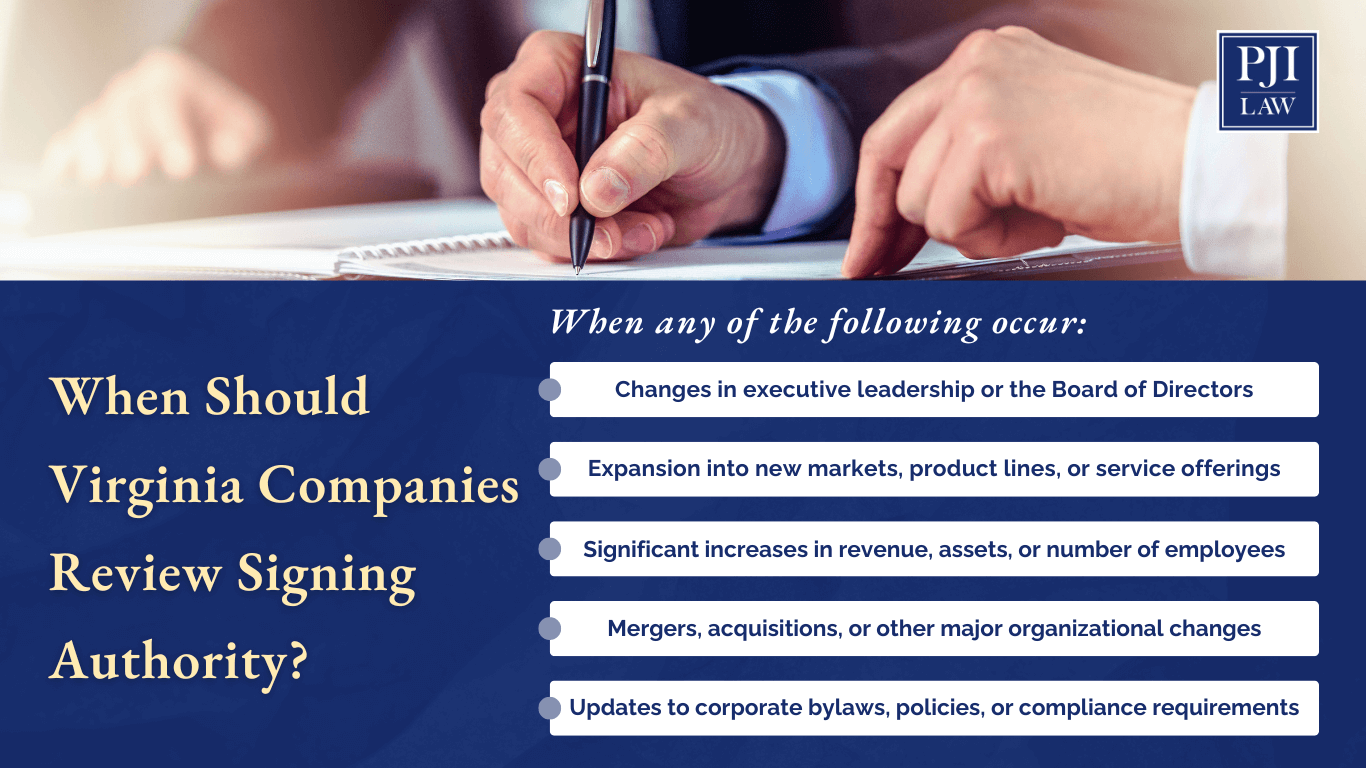
Some of the key triggers that should prompt a review of signing authority include:
- Changes in executive leadership or the Board of Directors
- Expansion into new markets, product lines, or service offerings
- Significant increases in revenue, assets, or number of employees
- Mergers, acquisitions, or other major organizational changes
- Updates to corporate bylaws, policies, or compliance requirements
Working closely with a Virginia business attorney can help guide this review and update process by providing an objective, third-party perspective. They can identify potential gaps or vulnerabilities in the existing signing authority framework and recommend revisions to bolster oversight, reduce liability, and keep the company operating efficiently.
Outdated or overly rigid systems of authorized signatories can create unnecessary friction, expose the business to risk, and even lead to costly legal disputes. Prioritizing the ongoing management of this critical function is an investment that pays dividends in the long run.
Ensuring Compliance with Virginia State Laws on Signing Authority
Have you been searching for a “business lawyer near me?”
At PJI Law, our experienced Virginia business attorney is here to provide the essential support and guidance you need. Our team is deeply versed in the nuances of business law, and the documentation required to properly delegate signing privileges. We can work closely with you to review and update your company bylaws or operating agreements, establish robust policies and procedures for managing signing authority, help identify appropriate signing restrictions based on transaction types, and much more.
With PJI Law on your side, you move with confidence, knowing that your Virginia business is operating with the proper controls and oversight. Call us at (703) 865-6100 or complete our online form to schedule your consultation.
Copyright © 2024. PJI Law, PLC. All rights reserved.
The information in this blog post (“post”) is provided for general informational purposes only and may not reflect the current law in your jurisdiction. No information in this post should be construed as legal advice from the individual author or the law firm, nor is it intended to be a substitute for legal counsel on any subject matter. No reader of this post should act or refrain from acting based on any information included in or accessible through this post without seeking the appropriate legal or other professional advice on the particular facts and circumstances at issue from a lawyer licensed in the recipient’s state, country, or other appropriate licensing jurisdiction.
PJI Law, PLC
3900 Jermantown Rd, 2nd Floor
Fairfax, Virginia 22030
(703) 865-6100
https://pjibe.webteam.ai/